Ancient false friends exploited trust, gifts, alliances, kinship, and loyalty, turning friendship itself into one of politics’ sharpest weapons.

By Matthew A. McIntosh
Public Historian
Brewminate
Introduction: Friendship as a Weapon in Ancient Politics
The ancient world did not lack enemies, but it often feared the false friend more. Open hostility could be met with walls, armies, treaties, guards, and suspicion. Friendship, by contrast, opened doors. It created access to councils, banquets, cities, marriages, correspondence, hostages, military camps, royal chambers, and the intimate spaces where power became vulnerable. Greek philia, Roman amicitia, guest-friendship, alliance, clientage, kinship diplomacy, and sworn loyalty all carried moral force, but they were never merely sentimental bonds. They were political instruments. A friend might be a beloved companion, but also a useful ally, a patron, a dependent, a diplomatic partner, a protected client, or a temporary convenience. Ancient politics operated through these personal and institutional relationships, and that made friendship one of the most dangerous languages of power.
False friendship worked because ancient societies placed enormous value on trust, obligation, hospitality, gratitude, oath, and public loyalty. To betray a declared enemy was strategy; to betray a friend was a moral drama. This is why ancient narratives return so often to the gift that conceals violence, the courtier who hides revenge, the ally who asks for protection and becomes a master, the senator who approaches as a colleague and strikes as a conspirator, or the favored companion who turns proximity into usurpation. These stories were not only tales of personal treachery. They exposed a structural danger in political life. The very practices that held communities and empires together also made deception possible. Friendship created expectation, and expectation created opportunity.
Here I use “false friendship” not as a loose synonym for any broken alliance, but as a specific political pattern: the use of apparent loyalty, cooperation, kinship, hospitality, alliance, or affection to gain advantage over a rival, patron, ruler, city, or people. That distinction matters. Ancient politics was full of shifting interests, and not every reversal should be reduced to betrayal. States changed sides; kings recalculated; aristocrats followed advantage; allies disagreed over obligations. The cases examined here are sharper because friendship itself becomes the mechanism of danger. The Trojan Horse enters Troy as a sacred-looking gift. Harpagus serves Astyages while preserving the memory of revenge. Greek alliances turn on fear and expediency. Roman amicitia masks domination. Caesar’s assassins exploit civic proximity and personal trust. In each case, friendship is not merely betrayed after the fact. It is used as the road by which betrayal becomes possible.
The sources themselves require caution. Some examples, such as the Trojan Horse, belong to legend and literary memory rather than recoverable history. Others come through historians and biographers who shaped betrayal into moral instruction, political warning, or dramatic narrative. Herodotus, Thucydides, Plutarch, Appian, Suetonius, Cassius Dio, Josephus, and later Byzantine writers did not simply record deception; they interpreted it. Their accounts reveal what ancient and later authors thought friendship ought to mean, how loyalty could fail, and why betrayal was so unsettling to political imagination. Read carefully, these stories show that ancient false friendship was not an exception to politics. It was one of politics’ recurring possibilities. In a world where power depended on personal access, the friend who could be trusted enough to enter was sometimes more dangerous than the enemy waiting outside the gate.
Legendary Deception: The Trojan Horse and the Gift That Destroyed a City

The Trojan Horse is the most famous false friend in the ancient imagination, though it belongs to the world of legend rather than secure historical reconstruction. The story survives through a long epic and literary tradition, with its most influential surviving form in Book 2 of Virgil’s Aeneid, where Aeneas recounts the final night of Troy. Its power lies in the way it turns the symbols of friendship, piety, victory, and hospitality into instruments of annihilation. The Greeks do not destroy Troy by open assault in this version. They appear to withdraw, leave behind a monumental wooden horse, and allow the Trojans to believe that the war has ended. The enemy’s absence becomes the first deception. The gift becomes the second. The city’s own act of reception becomes the final step in its destruction. The genius of the story is that it makes Troy’s fall depend not only on Greek cunning, but on Trojan interpretation. The Trojans must see the Horse as meaningful, sacred, and safe before it can become lethal. The weapon succeeds because it is first accepted as something other than a weapon.
The Horse works because it is not merely a military trick. It is a social and religious deception. The Trojans do not bring a siege engine into their city knowingly; they receive what appears to be an offering connected to the gods and to the end of conflict. This matters because ancient gift-giving was never morally neutral. Gifts could signal honor, obligation, supplication, alliance, gratitude, or submission. The Greeks manipulate that symbolic world by making the Horse appear meaningful in terms the Trojans can understand. It seems to mark Greek defeat, divine appeasement, and Trojan triumph at once. The deception depends on more than hidden soldiers. It depends on the corruption of interpretation. Troy falls because its people are persuaded to read danger as blessing.
Sinon’s role makes the betrayal even more revealing. In Virgil’s account, the Horse does not enter Troy by wood and wheels alone; it enters through speech. Sinon presents himself as a victim of the Greeks, a man abandoned by his own people, and someone whose suffering proves his credibility. His false story gives the Trojans a reason to trust both him and the object he explains. He weaponizes pity, religious fear, and the desire to believe that the long war is finally over. This is false friendship in one of its purest forms: the enemy becomes believable by appearing injured by the enemy. Sinon’s apparent weakness gives him access that open strength could not achieve. Laocoön warns against Greek gifts, but warning is defeated by narrative, spectacle, and omen. The Trojans are not merely foolish; they are caught between competing signs, one of suspicion and one of apparent divine confirmation. The famous deception joins material concealment to rhetorical seduction. The hidden warriors inside the Horse matter, but the more dangerous invasion begins before they emerge. It begins when Trojan judgment is captured.
As a model of false friendship, the Trojan Horse condenses several ancient fears into one image. The enemy does not need to batter down the gate if he can persuade the city to open it. The dangerous gift does not appear dangerous because it arrives clothed in ritual meaning. The false refugee gains influence because he seems powerless. The victorious city becomes vulnerable precisely at the moment it believes itself safe. This pattern would echo through later political and military stories because it identified a recurring weakness in human communities: trust is necessary, but trust can be staged. Hospitality, compassion, religious reverence, and the desire for closure can all become paths of entry for violence. The story also exposes the danger of wanting too badly for conflict to be over. After years of war, the Trojans are emotionally prepared to believe in Greek departure, divine favor, and restored security. Deception succeeds because it gives them the ending they long to accept. The Horse is terrifying because Troy participates in its own defeat without understanding what it has welcomed.
The story’s legendary status does not make it historically useless. On the contrary, its survival reveals how strongly Greek and Roman audiences associated deception with the fragile boundary between enemy and guest. The Trojan Horse became an enduring cultural shorthand for treachery disguised as reconciliation, a gift that cancels the distinction between offering and attack. It also established a pattern that will follow through more historically grounded examples: false friendship succeeds when political or military enemies exploit the moral habits that make trust possible. Whether in mythic Troy, royal courts, Greek alliances, or Roman politics, the most dangerous enemy is not always the one outside the walls. Sometimes he is the one whose story sounds plausible enough to be invited in.
Harpagus and Astyages: Revenge Disguised as Loyalty in Herodotus
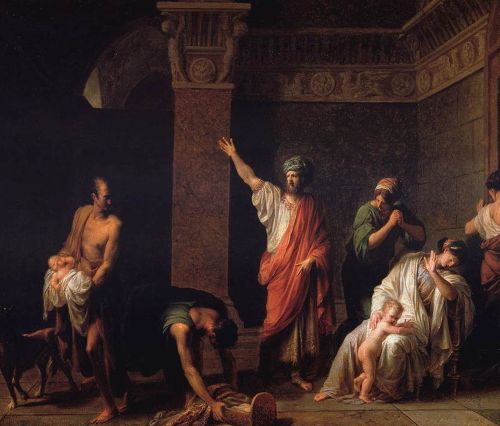
In Herodotus’s account of the fall of the Median kingdom, Harpagus offers one of the ancient world’s sharpest portraits of revenge concealed beneath obedience. The story begins not with open rebellion, but with a ruler’s fear. Astyages, king of the Medes, dreams that his daughter Mandane’s child will overthrow him. When Cyrus is born, Astyages orders Harpagus, a trusted noble, to arrange the infant’s death. Harpagus passes the task to a herdsman rather than carrying it out himself, and Cyrus survives. When Astyages discovers the deception years later, he punishes Harpagus with theatrical cruelty, serving him the flesh of his own son at a banquet and then revealing what he has eaten. The scene is deliberately horrifying. It turns royal dining, hospitality, and court intimacy into an arena of domination. Astyages does not merely punish disobedience; he forces Harpagus to perform submission while absorbing an injury that can never be forgotten.
What makes Harpagus important for the history of false friendship is not a single act of sudden betrayal, but the long discipline of concealed hatred. After the banquet, he does not rise in immediate fury. He does not denounce Astyages, attack the king, or flee the court. Instead, he appears to accept the punishment and continues outwardly within the Median political order. His loyalty becomes theatrical. He remains close enough to power to wait, observe, communicate, and eventually act. This is a different pattern from the Trojan Horse, where deception enters a city in one dramatic stroke. Harpagus represents the patient false friend: the man who remains useful, obedient, and apparently contained while privately transforming loyalty into strategy. Astyages believes he has broken him, but he has only taught him the value of delay.
Herodotus frames this story as a study in tyranny’s blindness. Astyages can compel outward submission, but he cannot command inward loyalty. His power allows him to humiliate Harpagus, yet that very cruelty destroys the trust on which royal security depends. The king mistakes fear for fidelity. He assumes that because Harpagus continues to serve, he has been mastered. But coerced obedience is not friendship, and humiliation creates a political memory longer than fear. Harpagus eventually turns to Cyrus, urging him to rise against Astyages and helping engineer the Median nobles’ defection. His betrayal is not random treachery; it is revenge disguised as service, made possible by the king’s failure to understand that court relationships are sustained by more than command. Astyages’ household and court become dangerous not because enemies are absent, but because injury has been forced to wear the mask of loyalty. The deeper irony is that Astyages’ attempt to secure his throne produces the conditions of his overthrow. By treating a trusted noble as an object of terror rather than as a participant in rule, he converts proximity into danger. Harpagus does not need to invent a grievance or fabricate a reason for disloyalty; Astyages supplies both. In Herodotus’s moral universe, tyranny is self-defeating because it cannot distinguish between submission and allegiance, between silence and forgiveness, between a bowed head and a loyal heart.
The episode also reveals how ancient narratives linked false friendship to the instability of courts. In royal households, proximity was power. The trusted noble, adviser, general, cupbearer, or companion often knew the ruler’s habits, fears, enemies, and weaknesses better than any external foe could. That access made court loyalty invaluable, but also perilous. Harpagus can damage Astyages precisely because he is not an outsider storming the palace. He is an insider who understands the resentments of the elite and the possibilities of succession. By communicating with Cyrus and encouraging revolt, he turns private grievance into dynastic transformation. The betrayal moves from personal revenge to regime change. A ruler’s cruelty toward one servant becomes the opening through which an empire falls and another rises. This is the political logic that makes the false friend so dangerous in monarchic settings: he already belongs to the circle of trust. He does not need to cross a battlefield, bribe a gatekeeper, or announce hostility. He can use the ruler’s own networks, rituals, and assumptions against him. Harpagus’ revenge is effective because it is not merely emotional; it becomes organizational. He knows which nobles may be dissatisfied, which channels of communication can be used, and which symbolic alternative Cyrus can represent. The court that Astyages imagines as an extension of his authority becomes, under pressure, the infrastructure of his ruin.
For Herodotus, the story of Harpagus and Astyages is more than a dramatic origin tale for Cyrus the Great. It is a meditation on the limits of power when authority is severed from trust. Astyages’ violence produces the very enemy he fears, while Harpagus’ apparent submission hides a political patience more dangerous than open revolt. The false friend here is not merely deceitful. He is created by the ruler who believes terror can replace loyalty. In that sense, Harpagus belongs to a recurring ancient pattern: betrayal often grows in the intimate spaces where domination has mistaken silence for consent. The enemy at the gate may be visible, but the wounded ally at the banquet table may already be planning the future.
Greek Diplomacy and the Fragility of Alliance: When Temporary Friends Became Strategic Threats
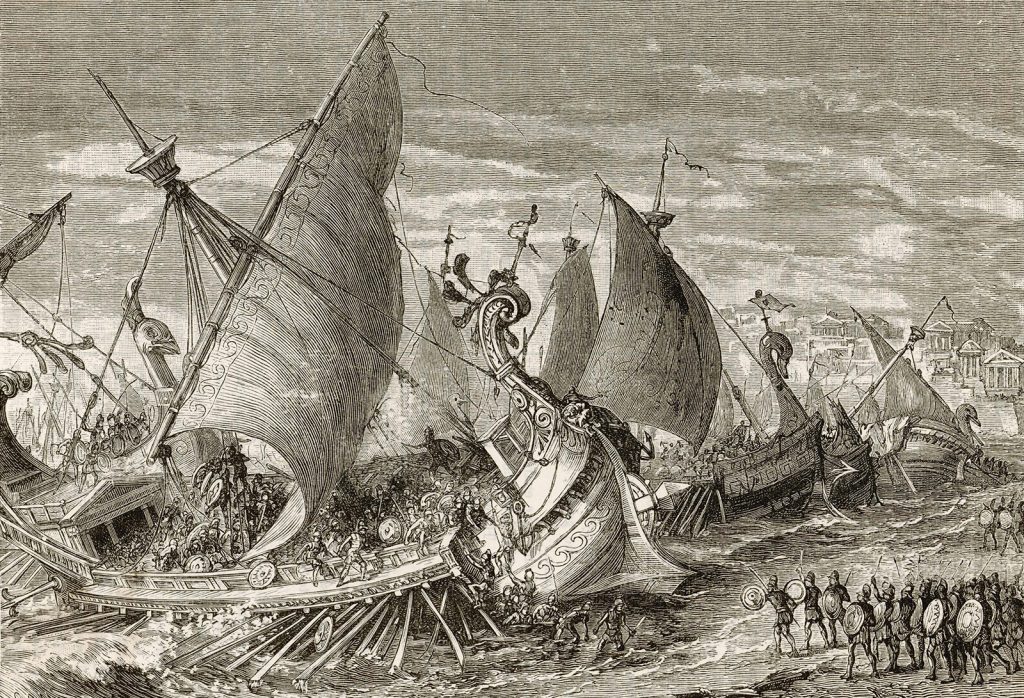
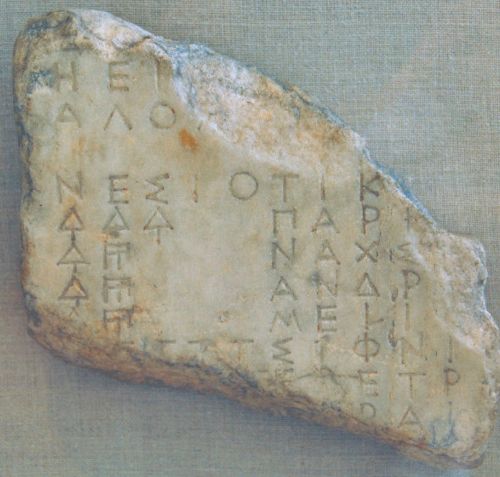
Greek diplomacy made friendship public, formal, and useful, but it rarely made it simple. Alliances among poleis were often expressed through oaths, treaties, shared enemies, religious language, guest-friendship, and appeals to justice, yet these bonds existed inside a fiercely competitive world of honor, fear, autonomy, and advantage. A city could call another its ally while watching it with suspicion. A weaker polis might seek protection from a stronger one and discover that protection carried the seeds of dependence. A powerful city might present intervention as assistance while using the crisis to expand influence. Greek interstate friendship operated in a space between morality and necessity. It claimed the language of loyalty, but it was constantly tested by changing calculations of security.
Thucydides’ account of the Peloponnesian War is the clearest ancient analysis of this instability. He repeatedly shows alliances forming not because states loved one another, but because fear, interest, and circumstance made cooperation temporarily useful. Corcyra’s appeal to Athens before the war is a good example. Corcyra had long avoided entangling alliances, but conflict with Corinth pushed it toward Athens. Its envoys did not appeal only to justice; they argued that alliance with Corcyra would strengthen Athens strategically and weaken Corinth. Athens’ eventual decision was cautious and self-interested, designed to avoid immediate full-scale war while still gaining naval advantage. Friendship here was not sentimental trust. It was a calculated relationship in which each party tried to use the other without becoming trapped by the arrangement. Corcyra needed Athenian protection, Athens wanted Corcyra’s fleet and a check on Corinth, and both sides dressed strategic necessity in diplomatic language. The relationship was “friendly” in the formal sense but unstable in substance, because its value depended on utility rather than durable affection. Thucydides’ brilliance lies in showing how quickly alliance could become a trap: to refuse Corcyra risked losing advantage, but to accept it risked escalation. Friendship could preserve security only by creating new danger.
The career of Alcibiades reveals the danger of the political actor whose loyalties were brilliant, mobile, and profoundly suspect. Born into the Athenian elite and connected to powerful networks, Alcibiades could speak the language of civic service while repeatedly turning political survival into a form of strategic self-reinvention. He promoted the Sicilian expedition, fled Athens after accusations of sacrilege, advised Sparta against his own city, later sought influence through Persian connections, and eventually returned to Athenian service. Ancient writers made him a symbol of charisma without stability, intelligence without restraint, and aristocratic ambition without reliable loyalty. He was not simply a traitor in a flat moral sense. He was more dangerous than that: a man whose personal relationships, diplomatic knowledge, and political gifts allowed him to become useful to whichever power could advance his position at a given moment. Alcibiades understood that information itself was a form of power. As an Athenian insider, he knew the city’s ambitions, habits, weaknesses, factions, and military thinking. When he transferred that knowledge to Sparta, his friendship with enemies became strategically valuable precisely because he had once belonged to Athens. His case shows how betrayal through friendship could operate not by disguising hostility from the beginning, but by converting former intimacy into usable intelligence.
Alcibiades also shows why false friendship was so difficult to separate from ordinary political flexibility in the Greek world. Exile, factional conflict, democratic suspicion, oligarchic intrigue, and military crisis repeatedly pushed elites across boundaries that modern readers might expect to be firm. A polis could banish a man and later recall him. A general could become an adviser to an enemy and then reappear as a potential savior. Personal ambition and civic identity did not always align neatly, especially when political factions claimed to represent the true interest of the city against their domestic rivals. In that setting, friendship could become a weapon not only between states, but within them. The dangerous friend was often the insider who knew the city’s habits, fears, weaknesses, and strategic possibilities well enough to sell that knowledge elsewhere.
The Melian Dialogue presents the harsher end of this diplomatic world by stripping away the comforting language of friendship almost entirely. Melos, a small island with Spartan connections, tried to remain neutral in the conflict between Athens and Sparta. Athens refused to accept neutrality as harmless, insisting that imperial credibility required submission. The exchange, as Thucydides presents it, is not a simple case of false friendship, since Athens does not pretend affection for Melos. Its importance lies in what it reveals about the limits of moral language when power feels insecure. The Athenians suggest that justice matters only among equals in power, while the strong do what they can and the weak suffer what they must. This brutal logic clarifies the darker context in which Greek alliances operated. If open domination was always possible, then professions of friendship, protection, and alliance had to be read with suspicion. They might be sincere, but they might also be the polite mask worn before coercion. Melos’ attempted neutrality also shows that not choosing sides could itself be treated as hostility by a power anxious about reputation. Athens did not merely want safety; it wanted visible submission, because an independent Melos might encourage others to imagine that imperial pressure could be resisted. The episode exposes the imperial underside of Greek diplomatic friendship: the friend was valuable when useful, but the neutral could become intolerable because neutrality denied the stronger power’s claim to command.
Greek diplomacy teaches that false friendship did not always require theatrical betrayal. Sometimes it took the quieter form of unstable alliance, useful protection, opportunistic partnership, or public loyalty hollowed out by private calculation. The enemy of one’s enemy could become a friend, but only while the shared danger remained useful. A city seeking aid could become dependent on the ally that rescued it. A charismatic statesman could convert friendship into mobility across hostile camps. A great power could speak of alliance while pursuing domination. The fragility of Greek interstate friendship lay in the fact that poleis needed trust but feared dependency, invoked justice but calculated advantage, and made promises in a world where survival could quickly make old promises inconvenient. In that sense, Greek diplomacy turned friendship into a necessary risk: the bond that might save a city today could become the channel of danger tomorrow.
Philip II and Alexander III: Dynastic Friendship, Court Suspicion, and the Politics of Succession

The Macedonian court of Philip II and Alexander III offers a different form of false friendship from the Trojan Horse, Harpagus, or Greek interstate alliance. Here the danger came not from an enemy entering from outside, but from the intimate world of kinship, royal favor, bodyguards, companions, marriages, and succession claims. Macedonian monarchy depended on personal loyalty, military charisma, aristocratic support, and proximity to the king. Those closest to power were also those best positioned to threaten it. Friendship in this setting did not mean private affection alone. It meant access to the ruler, inclusion in elite circles, expectation of reward, participation in military command, and recognition within a volatile hierarchy where royal favor could elevate a man quickly and destroy him just as fast.
Philip II had built Macedon into the dominant power in Greece through military reform, diplomacy, marriage alliance, patronage, and calculated intimidation. His kingship relied on an inner circle of nobles, officers, companions, and family members whose loyalty had to be managed constantly. Marriage was one of his political instruments, but it also multiplied rivalries within the royal house. Each marriage could bind a faction, neutralize a rival, reward a noble family, or signal a diplomatic turn, but each could also produce new claimants, jealousies, and competing expectations. Alexander’s position as heir was powerful, but not unassailable, especially after Philip’s marriage to Cleopatra Eurydice, a Macedonian noblewoman whose family connections threatened to strengthen a rival succession line. The famous quarrel at the wedding feast, preserved in later sources, dramatizes this danger even if its details are shaped by hostile memory: public celebration could become a stage for dynastic insult, masculine pride, and succession anxiety. Friendship and kinship were inseparable from suspicion. The court was full of men and women who might dine together, campaign together, flatter one another, and still calculate who would survive the next shift in royal favor. The language of loyalty remained necessary, but it was never innocent. It was the grammar through which ambition learned to speak politely.
The assassination of Philip II in 336 BCE exposed the lethal instability beneath this system. Ancient sources identify Pausanias, one of Philip’s bodyguards, as the assassin, though they differ in emphasis and suspicion. The act itself was shocking because it occurred within the royal world of trust. A bodyguard was not a distant enemy. He was a man whose office depended on proximity, access, and confidence. His presence near the king was supposed to signify protection, not danger; that is exactly why the betrayal carried such force. Later speculation about whether others encouraged or benefited from the murder reveals how difficult it was to separate personal grievance from dynastic politics. Alexander and Olympias have often stood near these suspicions in ancient and modern discussion, but the evidence does not permit a simple declaration of guilt. What can be said with greater confidence is that Philip’s death created an immediate crisis in which every relationship around the throne had to be reinterpreted. The loyal companion, the rival claimant, the grieving widow, the ambitious noble, and the useful general all became politically dangerous categories. The assassination turned friendship into evidence, proximity into suspicion, and survival into proof of political skill. Once the king was dead, the question was not only who had killed him, but who could move quickly enough to prevent the murder from becoming a civil war.
Alexander’s first task was not conquest abroad, but survival at home. He moved quickly to secure recognition from the Macedonian army and elite, then neutralized potential rivals. Ancient sources describe the deaths or elimination of figures who could have complicated his succession, including Amyntas IV and members of the faction connected to Cleopatra Eurydice. Olympias’ role in the destruction of Cleopatra Eurydice and her child is reported with hostility in later narratives and must be treated carefully, but the broader pattern is clear: succession in Macedon did not operate by calm legal procedure. It depended on speed, military acclamation, aristocratic calculation, and the removal of plausible alternatives. The language of family could not restrain the logic of power. Brothers, cousins, stepmothers, infants, generals, and guardians all existed within a field where blood relation might provide legitimacy, but also danger. The friend today could become the rallying point of tomorrow’s opposition.
This is where dynastic politics intersects most closely with the larger theme. False friendship in the Macedonian court did not always require theatrical deception. It operated through the ambiguity of loyalty itself. A noble might honor the king while cultivating another claimant. A bodyguard might stand near the ruler while carrying grievance. A marriage might be celebrated as alliance while producing rival heirs. A general might proclaim loyalty while waiting to see who would prevail. Alexander’s later career would continue to show how dangerous intimacy could be, from the execution of Philotas and Parmenion to the killing of Cleitus, though those episodes belong to a later phase of imperial kingship. Already at the moment of succession, the pattern was visible. Macedonian power was personal, and personal power made trust both indispensable and perilous. To be close to the king was to be trusted, watched, rewarded, feared, and sometimes marked for death. The court did not simply surround power; it produced the conditions under which power was contested. Its friendships were armed relationships, its banquets political performances, its marriages strategic wagers, and its silences potential conspiracies. This is why dynastic friendship could never be separated from dynastic suspicion. The same man who clasped hands in loyalty might be measuring the distance to the throne.
The transition from Philip to Alexander shows that ancient political betrayal was not confined to enemies, spies, or formal allies. It could emerge inside the family, the guard, the banquet, the marriage alliance, and the circle of companions. Macedonian monarchy turned friendship into a structure of access, and access into a potential weapon. Alexander’s rise was not simply the inheritance of a throne from father to son. It was a rapid, violent sorting of loyalties after an assassination that made every relationship suspect. The lesson is not that Alexander or Olympias should be reduced to caricatures of treachery. It is that dynastic systems built on personal loyalty produced conditions in which friendship itself became unstable. In a court where power passed through bodies, bloodlines, favors, and armed men, the false friend was not an exception to politics. He was one of its permanent possibilities.
Rome’s “Friends” and Clients: Alliance as the Language of Domination
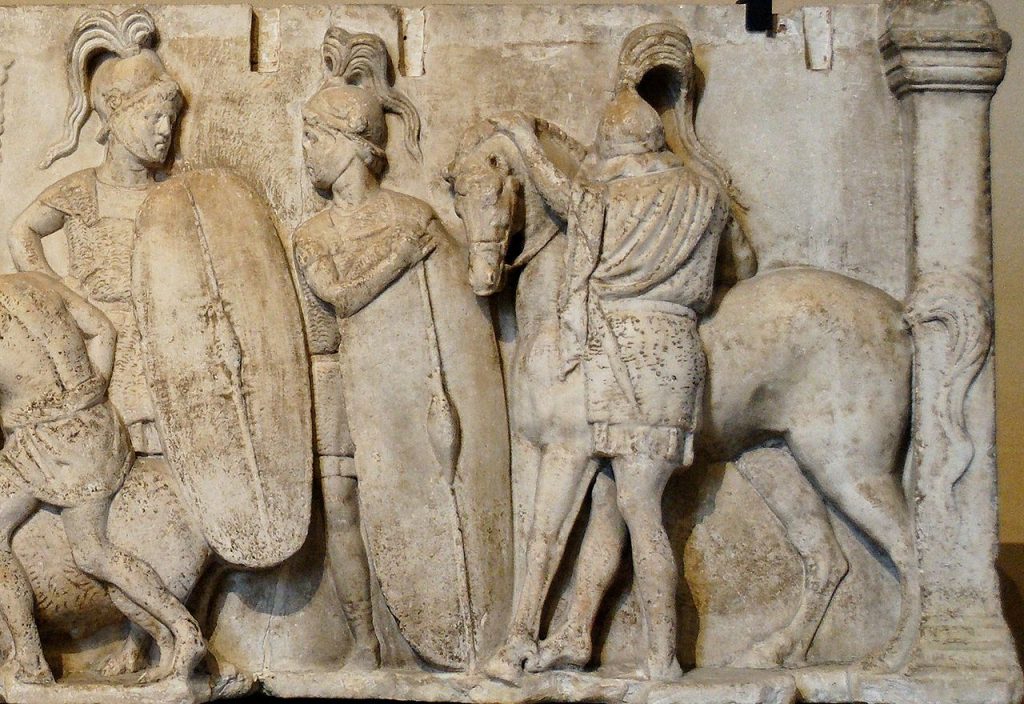
Rome made friendship into an instrument of empire. The language of amicitia, alliance, protection, and clientship allowed Roman power to expand while often presenting itself as lawful, reciprocal, and defensive. Communities could be called “friends and allies of the Roman people,” but that phrase did not necessarily mean equality. It could describe a relationship of mutual obligation, but it could also mask dependency, vulnerability, and coercion. Rome’s genius was not simply military conquest. It was the ability to turn diplomatic language into a ladder of domination, one step at a time. A people might first request help, accept arbitration, receive Roman protection, host Roman troops, surrender hostages, pay indemnities, or depend on Roman favor, only to discover that friendship had become a structure of subordination.
This Roman model did not always begin as open deceit. That is precisely what made it so effective. Roman intervention could appear reasonable, even necessary, within the moral language of alliance. A threatened community appealed to Rome; Rome defended an ally; a treaty confirmed obligations; a defeated enemy accepted terms; a client ruler received recognition; a local dispute required arbitration. Each act could be justified in isolation. Yet the cumulative effect was the growth of Roman authority. The asymmetry lay in who defined the meaning of friendship. Rome could present itself as protector while deciding when protection required intervention. It could call another people an ally while expecting obedience. It could claim to defend order while making itself the final judge of order. Friendship became dangerous because it did not always look like conquest at the beginning. It could feel like rescue until the rescued party found itself unable to refuse the rescuer.
The Roman Republic’s expansion in the Mediterranean had already shown how flexible this language could be. In the Greek East, Rome often operated through declarations of freedom, alliance, and protection while steadily increasing its ability to dictate political outcomes. The famous claim to have liberated the Greeks from Macedonian domination after the Second Macedonian War carried enormous rhetorical force, but freedom under Roman protection proved unstable. Cities and leagues were encouraged to see Rome as guarantor, patron, and arbiter, yet Roman arbitration could become command. A community that appealed to Rome against a local rival might gain short-term advantage, but it also invited a distant power to define legitimate politics in its region. The Senate could recognize, reward, rebuke, partition, restore, or punish in the name of settlement and order. That was the genius of Roman hegemony: it often made local actors participate in their own subordination by encouraging them to seek Roman approval against one another. The language of friendship allowed Rome to appear less like a conqueror and more like a moral supervisor of interstate order. This was not false friendship in the crude sense of a single treacherous act. It was more durable and more dangerous: a diplomatic framework in which weaker communities were drawn into Roman dependency through the very language that promised security.
Julius Caesar’s Gallic War offers one of the clearest examples of Roman friendship turning into domination through narrative. Caesar presents his early actions in Gaul as defensive, necessary, and connected to Rome’s obligations toward allies, especially the Aedui, who had long-standing ties to Rome. The Helvetian migration, Germanic pressure under Ariovistus, and appeals from Gallic groups gave Caesar opportunities to frame intervention as protection rather than aggression. Yet each intervention enlarged Roman military presence, deepened Caesar’s authority, and transformed local politics. The rhetoric of helping friends became a justification for permanent armed involvement. Caesar did not simply march into Gaul announcing conquest as the first principle. He narrated conquest as the logical outcome of defending allies, securing Roman interests, answering requests, and suppressing threats. That narrative mattered because it turned expansion into obligation. It also allowed Caesar to present himself as a disciplined servant of Roman security rather than as an ambitious commander using frontier crisis for personal glory. The text repeatedly converts local complexity into Roman necessity: migrations become dangers, appeals become duties, rivals become threats, and resistance becomes rebellion. Through that narrative structure, Caesar’s readers are encouraged to see domination as the reluctant consequence of responsible friendship.
For Rome’s Gallic “friends,” the danger was that alliance with Rome could weaken local autonomy even when it solved immediate problems. A tribe threatened by a rival might benefit from Roman aid, but Roman aid brought Roman expectations. The Aedui, Remi, and other groups could use Roman friendship to gain advantage over enemies, yet they also entered a political world in which Caesar controlled the terms of reward, punishment, status, and survival. The friend of Rome might be honored, protected, or elevated, but only so long as that friendship served Roman strategy. Once Gallic communities resisted Roman command, Caesar could recast them from allies or dependents into rebels. This was a crucial imperial maneuver: Rome’s own expansion created the conditions for resistance, and resistance then justified harsher domination. Friendship, in this structure, was not the opposite of conquest. It was one of conquest’s preferred languages.
Roman amicitia belongs fully within the history of ancient false friendship, but at the level of empire rather than personal betrayal alone. The Trojan Horse destroyed a city by disguising violence as a gift. Harpagus hid revenge beneath obedience. Greek alliances exposed how temporary friendship could become strategic danger. Rome made the pattern institutional. Its “friends” were often drawn into a system where moral language concealed unequal power, and where protection could become supervision, supervision could become intervention, and intervention could become rule. This does not mean that every Roman alliance began as cynical fraud or that local communities lacked agency. Many elites actively sought Roman friendship because it could bring prestige, protection, wealth, and advantage over rivals. That agency did not make the relationship equal. It often made Roman domination more efficient, because Rome could govern through local ambitions as much as against them. The falsehood lay not always in deliberate lying at every moment, but in the gap between the language of friendship and the realities of domination. Rome’s allies discovered that the friend who came to help might stay to command.
Brutus, Cassius, and Julius Caesar: Friendship, Liberty, and the Knife Beneath the Toga
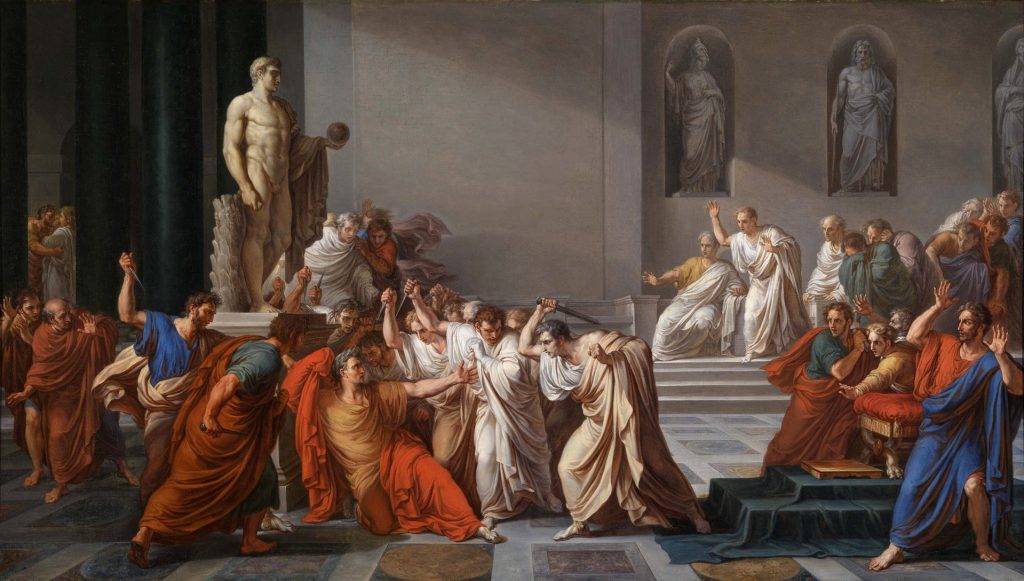
The assassination of Julius Caesar on the Ides of March in 44 BCE remains one of antiquity’s most powerful examples of betrayal through proximity. Caesar was not killed by foreign enemies, battlefield rivals, or declared opponents standing across a line of combat. He was murdered in Rome, in a senatorial setting, by men who approached him as colleagues, aristocrats, former beneficiaries, and political intimates. The event drew its force from the collapse of expected boundaries. The toga, symbol of Roman civic identity, concealed knives. The Senate, theoretically the heart of republican deliberation, became the site of collective violence. Men who had shared political life with Caesar, and in some cases had accepted his clemency or favor, transformed civic access into assassination. If the Trojan Horse was a gift that opened a city, the conspirators were living Trojan Horses: admitted through the ordinary rituals of Roman public life, carrying death beneath the appearance of institutional familiarity.
Marcus Junius Brutus was central to the moral drama because his name, ancestry, and relationship to Caesar made the assassination more than a political killing. Ancient accounts emphasize the symbolic burden of Brutus’ descent from Lucius Junius Brutus, the legendary founder of the Roman Republic who expelled the kings. Whether or not Brutus fully inhabited that ancestral role in the way later tradition imagined, the association mattered deeply. He could be cast as the man called by history to resist monarchy. Caesar had spared Brutus after Pompey’s defeat and elevated him within the postwar political order. That relationship did not make Brutus merely Caesar’s “best friend” in the sentimental modern sense, but it did bind him to Caesar through clemency, office, political restoration, and public trust. Brutus’ position was morally entangled. If he remained loyal to Caesar, he could be accused of betraying the ancestral liberty his name evoked. If he turned against Caesar, he violated the obligations of gratitude and personal dependence created by pardon and favor. His participation in the conspiracy gave the murder its sharpest edge. It was not only Caesar’s body that was pierced, but the Roman language of gratitude, obligation, and aristocratic honor. Brutus made the assassination appear, at least to its defenders, less like private revenge and more like an act of republican sacrifice. That symbolism was precisely why his betrayal mattered so much. A lesser man might have killed Caesar, but Brutus could make the killing look like history passing judgment.
Gaius Cassius Longinus brought a different kind of energy to the conspiracy. Ancient writers often portray him as more restless, resentful, and politically practical than Brutus, though such portraits are shaped by moral and rhetorical traditions. Cassius had fought against Caesar in the civil war, received pardon, and continued within Roman political life after defeat. His hostility to Caesar’s supremacy seems to have been more direct and less burdened by the philosophical hesitation attached to Brutus in later narratives. Yet Cassius, too, belonged to the world he helped destroy. He was not an outsider stabbing at Rome from beyond its borders. He was a senator and aristocrat acting inside the elite networks of a republic already shattered by civil war. His role shows that false friendship in Roman politics could grow from defeated opposition reincorporated into the victor’s system. Caesar’s clemency brought enemies back into public life, but pardon did not guarantee loyalty. It sometimes restored men close enough to strike. Cassius understood this political terrain with a sharper practical instinct than Brutus, and ancient tradition often presents him as the conspirator who recognized that Caesar’s power could not be resisted by speeches alone. He also understood that Brutus’ participation was essential, not merely numerically but symbolically. Without Brutus, the plot might look like resentment from disappointed aristocrats. With Brutus, it could claim the mantle of ancestral liberty. Cassius’ importance lies partly in his ability to turn personal grievance, political fear, and republican theater into a coalition capable of action.
The conspirators understood that assassination required more than hatred. It required choreography. They needed the right location, the right day, the right collective movement, and the right appearance of normal senatorial business. The Senate meeting at the Theatre of Pompey offered a setting heavy with irony, since Caesar was killed beneath the shadow of the rival he had defeated. The conspirators approached him not as armed rebels, but as petitioners and colleagues. Ancient accounts describe one conspirator drawing near under the pretext of a request, others gathering around, and the attack unfolding only when Caesar was physically surrounded. Whether every detail in later narratives can be accepted literally is less important than the structure of the scene. Trust, ritual, and institutional access made the murder possible. Caesar could guard against armies, but not easily against senators performing senatorial behavior until the instant performance became violence.
The moral complexity of the assassination lies in the conspirators’ own self-understanding. They did not present themselves simply as murderers or personal enemies. They claimed to be liberators defending the Republic against monarchy, tyranny, and the concentration of power in one man. That claim cannot be dismissed as mere hypocrisy, even if it also cannot be accepted uncritically. Caesar’s accumulation of honors, dictatorship, control over offices, and symbolic elevation had badly strained republican norms. Many senators feared that the Republic had become a shell around personal rule. Yet the method chosen by Brutus, Cassius, and their allies exposed the contradiction in their cause. They killed in the name of liberty, but they did so through conspiracy. They defended republican publicity through secret planning. They claimed to restore civic order by turning a civic assembly into a murder scene. Their betrayal sits at the center of a Roman political tragedy: when institutions no longer seemed capable of restraining power, elite friendship and senatorial access became weapons of last resort.
The assassination failed as a restoration of republican government, but it endured as a defining image of false friendship because it joined intimacy, ideology, and violence so completely. Caesar’s death did not heal the Republic. It accelerated the conflicts that led to renewed civil war and the rise of Augustus. In retrospect, the knives beneath the togas revealed not republican renewal but institutional collapse. Roman political friendship had become too entangled with ambition, clemency, resentment, gratitude, and fear to sustain trust. Brutus and Cassius were not foreign enemies. They were men formed by the same aristocratic culture as Caesar himself, and that is what made their betrayal historically potent. The open enemy could be met on campaign. The false friend could wait in the Senate, speak the language of honor, invoke liberty, and step close enough to kill.
Antony, Cleopatra, and Octavian: Alliance, Kinship, Propaganda, and the Collapse of Trust

After Caesar’s assassination, Roman politics became a world in which friendship, loyalty, and betrayal were almost impossible to separate. The conspirators had claimed to restore liberty, but the result was not republican renewal. It was another round of civil war, vengeance, and armed negotiation among men who presented themselves as Caesar’s heirs, avengers, and necessary guardians of order. Mark Antony, Octavian, and Lepidus formed the Second Triumvirate in 43 BCE, not as a friendship of trust, but as a legalized arrangement of mutual danger. Each needed the others; each also had reason to fear them. The triumvirs divided power, punished enemies, redistributed provinces, and used proscriptions to eliminate opponents and seize wealth. Alliance here was not the opposite of violence. It was the structure through which violence was organized. The language of cooperation gave extraordinary coercion a legal form, allowing personal rivalry to operate inside an official settlement. This made the triumvirate one of the late Republic’s clearest examples of friendship as temporary architecture: a political house built because all parties needed shelter, even though each knew the others might eventually set it on fire. What looked like partnership was already haunted by the expectation of betrayal.
The Second Triumvirate was a formalized friendship built on suspicion from the beginning. Antony possessed military prestige, political experience, and proximity to Caesar’s old networks. Octavian possessed Caesar’s name, adoption, and a growing ability to turn that inheritance into legitimacy. Lepidus, though initially important, increasingly became the weaker partner. Their cooperation depended on shared enemies, especially the assassins of Caesar, but once those enemies were defeated, the alliance’s internal contradictions sharpened. In this world, loyalty was provisional because power itself was provisional. A colleague could become a rival as soon as the balance of forces shifted. The triumviral relationship shows one of the most common patterns of false friendship in civil conflict: men clasp hands not because they trust one another, but because they are not yet ready to fight.
Kinship was supposed to stabilize what ambition threatened to destroy. Antony’s marriage to Octavia, Octavian’s sister, in 40 BCE was a political settlement as much as a personal union. It joined households, softened public conflict, and gave Roman society a visible sign that the two strongest men in the state could be reconciled. Octavia herself became a figure of mediation, loyalty, and Roman domestic virtue. Yet the marriage also made betrayal more rhetorically powerful when the alliance collapsed. If Antony could be portrayed as neglecting Octavia for Cleopatra, then political rivalry could be recast as family injury, moral failure, and Roman dishonor. The failed marriage did not merely mark private estrangement. It gave Octavian a language with which to transform political competition into a story about loyalty violated from within.
Cleopatra VII sharpened this propaganda war because she allowed Octavian to define Antony’s betrayal as more than personal ambition. Antony’s relationship with the Egyptian queen could be represented as a surrender of Roman discipline to eastern luxury, monarchy, sexuality, and foreign domination. This was not a neutral description of reality. It was a political construction designed to separate Antony from Roman legitimacy while avoiding, as much as possible, the appearance of another civil war between Romans. Octavian’s propaganda made Cleopatra the center of the threat and Antony the Roman who had allowed himself to be captured by it. The Donations of Alexandria in 34 BCE intensified this narrative, since Antony’s public distribution of eastern territories to Cleopatra and her children could be presented as evidence that he was sacrificing Roman interests to a foreign dynasty. Whether Antony understood those acts as eastern statecraft, dynastic arrangement, or imperial display, Octavian could interpret them for Roman audiences as treachery.
The collapse of trust between Antony and Octavian shows how false friendship could be manufactured through narrative as well as action. Each side had reasons to accuse the other of bad faith. Antony could see Octavian as an ambitious young rival exploiting Caesar’s name, hoarding power in Italy, and undermining an agreed partnership. Octavian could present Antony as a faithless colleague, failed husband, and compromised Roman. The struggle was not only military; it was interpretive. Who had betrayed whom? Who had abandoned the Republic, the family, the gods, Caesar’s legacy, or Rome itself? In the late Republic, legitimacy depended on controlling that story. Betrayal was not merely something done in secret. It was something publicly named, staged, circulated, and attached to the enemy. The false friend was dangerous not only because he broke trust, but because he could claim that the other side had broken it first.
By the time Octavian defeated Antony and Cleopatra at Actium in 31 BCE, the language of friendship had been consumed by the logic of supremacy. The triumviral alliance, the marriage bond, the shared Caesarian inheritance, and the diplomatic settlements had all failed to contain rivalry. Octavian’s victory allowed him to write the political meaning of that failure. Antony became the Roman who had lost himself to Cleopatra; Cleopatra became the foreign queen whose alliance had threatened Rome; Octavian became the restorer of order after betrayal and corruption. The reality was more complex, but the propaganda was powerful because it turned civil war into moral rescue. Antony had not simply lost a war in this version of events; he had betrayed Roman self-command, Roman masculinity, Roman family order, and Roman political destiny. Cleopatra was made to carry the burden of foreign seduction and monarchic danger, allowing Octavian to frame his victory as defense rather than ambition. This interpretive victory was as important as the naval one. It transformed the destruction of a Roman rival into the salvation of Rome itself. Antony, Cleopatra, and Octavian reveal a late Republican world in which friendship was never secure from ambition, kinship could become a weapon, and betrayal was fought not only with armies, but with stories sharp enough to prepare the way for empire.
Herod the Great and the Roman World: Friendship as Survival under Empire

Herod the Great shows another side of ancient false friendship: not the friend who betrays from secret malice, but the client ruler who survives by treating friendship as political insurance. Herod’s world was defined by Roman power, dynastic rivalry, local opposition, and the constant danger that a patron’s fall could become a client’s ruin. To be “friend of the Romans” was not to enjoy equal companionship. It was to live inside an imperial hierarchy where loyalty had to be visible, useful, and adaptable. Herod’s genius lay in understanding that Roman friendship was personal as well as structural. A king in Judaea did not merely need Rome in the abstract. He needed the right Roman at the right moment, and when the right Roman changed, survival required a new performance of loyalty.
Herod’s career before Actium was closely tied to Mark Antony, whose support helped secure and maintain his kingship. That relationship gave Herod legitimacy, military backing, and a place within the eastern politics of the late Republic. Antony’s patronage mattered because Herod’s authority was contested both locally and dynastically. He was not simply ruling from an uncontested throne; he had to overcome rivals, negotiate Jewish aristocratic hostility, manage the legacy of the Hasmoneans, and present himself to Rome as the most reliable agent of order in a volatile region. Roman backing transformed his claim from precarious ambition into enforceable kingship. Yet Antony’s defeat by Octavian created a classic client-king crisis. A ruler whose authority had depended on one Roman patron now had to convince the victorious rival that he was still useful rather than expendable. Josephus presents Herod as meeting Octavian with striking directness, acknowledging his loyalty to Antony while arguing that the same quality made him valuable to a new master. Whether the scene preserves Herod’s exact words or Josephus’ later literary shaping, the political logic is clear. Herod transformed apparent liability into proof of character. He had been loyal to Antony; therefore, he could be loyal to Octavian. In that maneuver, friendship became transferable without being described as faithlessness. Herod did not deny the old bond. He reinterpreted it as evidence that he understood loyalty itself.
This was friendship as survival, and it complicates simple moral categories of betrayal. Herod did not merely abandon Antony because it was convenient, though convenience was certainly part of the matter. Antony was defeated, Cleopatra was dead, and the Roman world had reorganized itself around Octavian. Herod’s choice was not between pure loyalty and treachery, but between adaptation and extinction. In the world of Roman client kingship, fidelity to a fallen patron could become political suicide. Herod’s pivot to Octavian demonstrates how asymmetrical friendship worked under empire: the weaker friend had to remain loyal enough to be trusted, but flexible enough not to be destroyed by another man’s defeat. Roman friendship rewarded constancy only when constancy served Roman power.
Herod’s domestic and regional politics show the same pattern on a more intimate scale. His alliances, marriages, executions, building projects, and court decisions were all shaped by the need to secure his throne under Roman oversight while managing local legitimacy in Judaea. Marriage into the Hasmonean line through Mariamne offered dynastic prestige, but it also tied Herod to a family that could threaten his authority. The marriage could present Herod as connected to an older and revered royal house, yet that same connection gave Hasmonean relatives symbolic power that might be turned against him. His suspicion of rivals, including members of his own household, made his court a place where kinship and danger constantly overlapped. Like the Macedonian court under Philip and Alexander, Herod’s palace was not separate from politics. It was politics concentrated. Friendship, marriage, family, and patronage became unstable because every relationship could become a claim, a faction, or an accusation. Herod’s dependence on Rome intensified this instability because local rivalries could be appealed beyond Judaea to the imperial patron. A family dispute, succession anxiety, or aristocratic grievance might become dangerous if it reached Roman ears in the right form. Under Roman supremacy, even royal intimacy was haunted by imperial calculation. The court friend, the royal spouse, the favored son, and the useful adviser all stood within a world where private affection could never be separated from public survival.
Herod belongs in this history not because he represents the same kind of betrayal as Brutus, Harpagus, or Sinon, but because his career reveals how friendship changed under empire. Rome’s “friends” survived by serving Roman interests, anticipating Roman expectations, and recalibrating loyalty when Roman politics shifted. Herod was neither simply a puppet nor simply an independent monarch. He was a skilled and ruthless client king who understood that friendship with Rome was a performance of usefulness backed by force. The falsehood lay in the language of friendship itself, which disguised the inequality beneath the relationship. Herod could be called Rome’s friend, but the friendship endured only so long as Rome found him valuable. In that world, the open enemy was dangerous, but the imperial friend was unavoidable.
Late Antique and Byzantine Court Betrayal: Basil I and Michael III as an Afterlife of Ancient Patterns

Basil I and Michael III belong outside the strict chronological limits of the ancient world, but their story preserves an older pattern of court betrayal with remarkable clarity. In the 9th-century Byzantine Empire, as in earlier monarchic and imperial systems, power still moved through proximity, favor, household intimacy, military usefulness, and access to the ruler’s person. Basil rose from obscure origins to become one of Emperor Michael III’s most favored companions, then co-emperor, and sole ruler after Michael’s assassination in 867 CE. The episode is best read as an afterlife of ancient political habits rather than as a purely ancient case. It shows how the trusted favorite, familiar from royal courts across antiquity, could become more dangerous than an open enemy because he already stood inside the circle of confidence.
Michael III’s court was a world in which personal favor could remake status with startling speed. Basil’s ascent depended on physical charisma, usefulness, courtly adaptability, and the emperor’s patronage. He entered imperial service, gained influence, married advantageously within the court’s arrangements, and eventually displaced other powerful figures around Michael. This kind of rise was always unstable. A favorite’s authority depended less on office alone than on the emperor’s continuing affection and trust. That made him both elevated and vulnerable. The same intimacy that gave Basil opportunity also placed him within a competitive environment of suspicion, rivalry, and factional maneuver. Byzantine court politics, like Macedonian and Roman politics before it, turned friendship into a structure of access. The man closest to the ruler could serve him, shield him, manipulate him, or replace him.
The killing of Michael III reveals the old danger of intimacy in its starkest form. Basil had not approached the emperor as a foreign invader or rebel commander at the gates of Constantinople. He had risen as a beneficiary of imperial favor and had been brought into the highest rank of partnership as co-emperor. That made the betrayal politically and symbolically potent. The man who owed his greatness to Michael became the man under whom Michael died. As with earlier court betrayals, the historical record is shaped by later political needs. The Macedonian dynasty that Basil founded had every reason to blacken Michael’s reputation and present Basil’s seizure of power as necessary, stabilizing, or divinely favored. Michael was often remembered through hostile portrayals emphasizing disorder, drunkenness, impiety, or misrule. Such accounts must be handled cautiously. Yet even allowing for hostile source traditions, the structural pattern remains clear: Basil’s route to power ran through friendship, patronage, and imperial intimacy before it ended in lethal replacement.
This Byzantine episode also clarifies why court betrayal could so easily be moralized after the fact. Usurpation needed narrative. A ruler who killed or displaced a benefactor could not openly celebrate ingratitude, so later memory often recast the victim as unworthy and the usurper as the restorer of order. That strategy was already familiar in ancient political writing. Harpagus’ revenge against Astyages could be framed through tyranny’s cruelty. Brutus and Cassius could claim liberty against Caesar. Octavian could portray Antony as corrupted and Rome as rescued. Basil’s rise fits this same logic of justification. Betrayal becomes easier to defend when the betrayed ruler can be represented as dangerous, decadent, incompetent, or illegitimate. The false friend does not merely seize power; he must explain why the seizure was not treachery but necessity.
Basil and Michael serve as a useful epilogue to ancient patterns of false friendship. Their story shows that the danger did not vanish with the classical world. Courts remained places where favor created vulnerability, where companionship could become ambition, and where access to the ruler’s body could become access to the throne. The details are Byzantine, but the political grammar is older: intimacy creates opportunity, gratitude can coexist with calculation, and the language of loyalty can hide the preparation for violence. If the Trojan Horse dramatized the enemy welcomed into the city, Basil’s rise dramatized the favored companion welcomed into imperial power itself. In both cases, the fatal opening came through trust.
Patterns of False Friendship: Gifts, Access, Intelligence, Legitimacy, and Timing
The following video from “ASMR Historian” covers the life of Alcibiades:
Across these examples, false friendship worked because ancient politics depended on trust as much as force. Armies could conquer, but friendship opened doors that armies could not always breach. A gift could enter a city. A courtier could remain near a king. An ally could request protection and become dependent. A senator could approach under the forms of civic business. A client ruler could survive by transferring loyalty from one patron to another. A favorite could rise through intimacy before turning proximity into power. These cases differ in setting, source type, and historical reliability, but they share a common structure: friendship created access, and access created danger. The false friend was dangerous because he did not need to defeat suspicion from outside. He worked through the rituals that suspended suspicion in the first place.
The first pattern is the false gift. The Trojan Horse gives the clearest literary form to this danger, but the logic extends far beyond Troy. Gifts in ancient societies were rarely simple objects. They carried claims of honor, submission, gratitude, alliance, religious devotion, and reciprocal obligation. That made them politically powerful and politically risky. A gift could flatter the receiver while placing him under symbolic pressure to accept it. Refusal might appear impious, cowardly, insulting, or diplomatically foolish. Acceptance could create obligation, dependency, or vulnerability. The danger of the false gift lay in the fact that it exploited a social habit normally associated with order. Gifts were supposed to bind people, households, cities, and rulers into recognizable relationships. They could mark the end of hostility, the beginning of alliance, the recognition of status, or the honoring of a god. The Greeks’ wooden horse functions so well as a legendary image because it weaponizes that moral world. The object is not merely smuggled into Troy; it is interpreted into Troy. Its danger depends on its apparent meaning. False friendship often worked in exactly that space between appearance and interpretation, where a sign of peace could conceal an instrument of violence.
The second pattern is access through intimacy. Harpagus, Brutus, Cassius, Basil, and the courtiers around Philip II and Alexander III all reveal the same structural problem: the people closest to power were often the people best positioned to betray it. Rulers needed companions, advisers, guards, relatives, generals, secretaries, clients, and household servants. They could not govern alone. Yet every trusted relationship created a route through the defenses that protected the ruler from declared enemies. The bodyguard stood near the body. The senator stood near the dictator. The court favorite stood near the emperor. The family member stood near the succession. In monarchic and aristocratic systems, power was personal, and personal power required proximity. That is why court betrayal appears so often in ancient and post-ancient political writing. It exposed the fatal paradox of rule: the king or leader had to trust someone, but trust itself became a vulnerability.
The third pattern is intelligence. The false friend often knew what the enemy did not. Alcibiades understood Athenian ambition and strategy because he had belonged to Athens. Harpagus understood Median elite resentment because he operated within Astyages’ court. Roman allies and clients understood local rivalries well enough to use Roman power against their neighbors, while Rome learned how to govern through those same rivalries. Brutus and Cassius knew the rhythms of senatorial life, the expectations of public approach, and the symbolic value of killing Caesar in a civic setting. Friendship produced information: habits, weaknesses, factions, ambitions, fears, routes of access, and moments of inattention. The friendly spy did not always need to steal documents or overhear secrets in the modern sense. Often, he simply benefited from belonging. He knew where power gathered, who resented whom, which ritual could be exploited, and when confidence had replaced caution.
The fourth pattern is legitimacy. False friendship rarely succeeds by force alone; it needs a story that makes the act intelligible afterward. Sinon must explain the Horse. Harpagus’ betrayal becomes revenge against tyranny. Caesar’s assassins claim liberty. Octavian frames Antony’s fall as rescue from corruption and foreign domination. Basil’s later tradition presents Michael III as unworthy of rule. Rome describes intervention as defense of allies, protection of order, or fulfillment of obligation. These stories matter because betrayal creates a moral wound. The betrayer must answer the charge of ingratitude, treachery, or dishonor by presenting the action as necessary, just, pious, patriotic, or restorative. False friendship belongs not only to the moment of deception, but to the later struggle over memory. The act must be narrated into legitimacy. Without that narrative, the false friend remains merely a traitor; with it, he may become liberator, avenger, protector, founder, or restorer.
The fifth pattern is timing. False friendship depends on waiting for the moment when trust is most useful and suspicion is weakest. The Trojans are vulnerable when they believe the war has ended. Harpagus waits until Cyrus can become an alternative to Astyages. Greek alliances shift when common danger changes. Caesar’s assassins wait for a public setting where approach will look ordinary. Herod changes patrons after Actium, when the Roman world has unmistakably reorganized itself around Octavian. Basil acts after he has moved from favorite to co-emperor, when proximity has become institutional power. In each case, betrayal is not simply a matter of intention. It is a matter of timing intention correctly. The false friend must know when to remain patient, when to appear loyal, when to speak, when to strike, and when to explain. He must also understand the emotional state of the victim or community: exhaustion after war, confidence after victory, complacency after pardon, dependence after alliance, relief after settlement, or uncertainty after regime change. Timing turns psychology into opportunity. The betrayal succeeds because it meets the moment when people most want to believe in safety, continuity, gratitude, or necessity. Bad timing exposes betrayal as foolishness. Good timing makes betrayal look like destiny.
These patterns show why ancient false friendship was more than personal hypocrisy. It was a political technology. Gifts manipulated obligation. Access bypassed defenses. Intelligence converted intimacy into advantage. Legitimacy transformed treachery into public meaning. Timing turned hidden intention into effective action. The ancient world feared the false friend because he exploited the very bonds that made society possible: hospitality, alliance, kinship, gratitude, clemency, patronage, and trust. These bonds were not decorative additions to politics. They were the working machinery of diplomacy, monarchy, aristocratic competition, imperial rule, and household power. That made their corruption especially dangerous. A society can defend itself against an enemy it recognizes as hostile, but it struggles to defend itself against the person or object already admitted under the sign of friendship. Open enemies threatened from beyond the boundary. False friends threatened the boundary itself. They revealed that the same relationships that held cities, courts, republics, and empires together could also become the roads by which they were undone.
Conclusion: Why the False Friend Was More Dangerous Than the Open Enemy
The ancient false friend was dangerous because he attacked through trust rather than against it. Open enemies announced the need for defense. They could be watched from walls, met in battle, checked by treaties, or resisted through suspicion. False friends worked differently. They appeared as guests, allies, companions, clients, kin, protectors, petitioners, patrons, or colleagues. They entered through the same doors that made political life possible: hospitality, alliance, clemency, patronage, marriage, court service, and civic ritual. Their danger lay not only in deception itself, but in the way deception made ordinary signs of safety unreliable. The gift might be a weapon. The loyal courtier might be preserving revenge. The ally might become master. The senator might carry a knife. The imperial friend might protect only until protection became command.
This is why ancient writers returned so often to betrayal as a moral and political crisis. Betrayal violated more than strategy. It wounded the shared assumptions that allowed communities and rulers to function. If a city could not trust a gift, a king could not trust a noble, a patron could not trust a client, a ruler could not trust a bodyguard, and a statesman could not trust a colleague, then power became surrounded by uncertainty. Yet ancient politics could not simply abandon trust. Courts needed advisers. Armies needed allies. Republics needed civic access. Empires needed clients. Diplomacy needed oaths, envoys, hospitality, and exchange. The false friend was terrifying because he exposed a permanent contradiction: political order required relationships that could always be exploited by those willing to perform loyalty while preparing violence.
The examples traced here show that false friendship took many forms, from legendary deception to institutional domination. The Trojan Horse dramatized the gift that turned welcome into destruction. Harpagus revealed how tyranny could manufacture treachery by mistaking obedience for loyalty. Greek diplomacy exposed the instability of alliances made through fear and interest. Macedonian succession politics showed how kinship and court intimacy could become lethal. Roman amicitia transformed alliance into a language of empire. Brutus and Cassius turned senatorial access into assassination. Octavian’s struggle with Antony and Cleopatra showed how betrayal could be manufactured through propaganda as well as action. Herod’s career revealed client friendship as survival under unequal power, while Basil and Michael demonstrated the long afterlife of ancient court patterns in Byzantine politics. Across all these cases, friendship was not the opposite of danger. It was often the path by which danger arrived.
The open enemy threatened the boundary from outside; the false friend dissolved it from within. That is why the title’s irony matters. In the ancient world, enemies were necessary, expected, and often legible. Friends were more complicated. They could rescue, protect, enrich, legitimate, and sustain, but they could also watch, wait, learn, narrate, and strike. Ancient societies knew that power depended on trust, and they also knew trust could be staged. The false friend endured as one of antiquity’s most unsettling figures because he revealed that betrayal was not an accident at the margins of politics. It was a possibility built into the very relationships that made politics work. Who needed enemies, indeed, when friendship itself could open the gate?
Bibliography
Affiliate disclosure: Amazon links on this site are paid links. As an Amazon Associate I earn from qualifying purchases.
- Alonso, Victor. War, Peace and International Law in Ancient Greece. Leiden: Brill, 2012.
- Anderson, Michael J. The Fall of Troy in Early Greek Poetry and Art. Oxford: Clarendon Press, 1997.
- Apollodorus. The Library of Greek Mythology. Translated by Robin Hard. Oxford: Oxford University Press, 1997.
- Appian. The Civil Wars. Translated by John Carter. London: Penguin Classics, 1996.
- Aristotle. Nicomachean Ethics. Translated by Terence Irwin. Indianapolis: Hackett, 1999.
- Arrian. Anabasis of Alexander. Translated by P. A. Brunt. Cambridge, MA: Harvard University Press, 1976.
- Bosworth, A. B. Conquest and Empire: The Reign of Alexander the Great. Cambridge: Cambridge University Press, 1988.
- Briant, Pierre. From Cyrus to Alexander: A History of the Persian Empire. Winona Lake: Eisenbrauns, 1996.
- Burgess, Jonathan S. The Tradition of the Trojan War in Homer and the Epic Cycle. Baltimore: Johns Hopkins University Press, 2001.
- Carney, Elizabeth Donnelly. Olympias: Mother of Alexander the Great. London: Routledge, 2006.
- Cassius Dio. Roman History. Vol. 4, Books 41–45. Translated by Earnest Cary. Cambridge, MA: Harvard University Press, 1914–1927.
- —-. Roman History. Vol. 5, Books 46–50. Translated by Earnest Cary. Cambridge, MA: Harvard University Press, 1917.
- Cicero. Laelius De Amicita (On Friendship). Translated by P. G. Walsh. Warminster: Aris & Phillips, 1990.
- —-. De Officiis (On Duties). Translated by M. T. Griffin and E. M. Atkins. Cambridge: Cambridge University Press, 1991.
- —-. Philippics 1–6. Edited and translated by D. R. Shackleton Bailey. Cambridge, MA: Harvard University Press, 2009.
- Dewald, Carolyn, and John Marincola, eds. The Cambridge Companion to Herodotus. Cambridge: Cambridge University Press, 2006.
- Diodorus Siculus. Library of History. Vol. 8, Books 16.66–17. Translated by C. Bradford Welles. Cambridge, MA: Harvard University Press, 1963.
- Flavius Josephus. Antiquities of the Jews. Translated by William Whiston.
- —-. The Jewish War. Translated by G. A. Williamson. Revised by E. Mary Smallwood. London: Penguin, 1981.
- Goldsworthy, Adrian. Antony and Cleopatra. New Haven: Yale University Press, 2010.
- —-. Caesar: Life of a Colossus. New Haven: Yale University Press, 2006.
- Green, Peter. Alexander of Macedon, 356–323 BCE: A Historical Biography. Berkeley: University of California Press, 1991.
- Gruen, Erich S. The Hellenistic World and the Coming of Rome. 2 vols. Berkeley: University of California Press, 1984.
- —-. The Last Generation of the Roman Republic. Berkeley: University of California Press, 1974.
- Gurval, Robert Alan. Actium and Augustus: The Politics and Emotions of Civil War. Ann Arbor: University of Michigan Press, 1995.
- Heckel, Waldemar. Who’s Who in the Age of Alexander the Great: Prosopography of Alexander’s Empire. Malden, MA: Blackwell, 2005.
- Herodotus. Histories. Translated by Robin Waterfield. Oxford: Oxford University Press, 1998.
- Herrin, Judith. Byzantium: The Surprising Life of a Medieval Empire. Princeton: Princeton University Press, 2007.
- Hölkeskamp, Karl-Joachim. Reconstructing the Roman Republic: An Ancient Political Culture and Modern Research. Translated by Henry Heitmann-Gordon. Princeton: Princeton University Press, 2010.
- Homer. The Odyssey. Translated by Samuel Butler. The Internet Classics Archive.
- Hornblower, Simon. The Greek World 479–323 BC. 4th ed. London: Routledge, 2011.
- Jenkins, Romilly. Byzantium: The Imperial Centuries, CE 610–1071. Toronto: University of Toronto Press, 1966.
- Julius Caesar. Commentarii de Bello Civili (Commentaries on the Civil Wars). Translated by Jane F. Gardner. London: Penguin, 1967.
- —-. Commentarii de Bello Gallico (Commentaries on the Gallic War). Translated by Carolyn Hammond. Oxford: Oxford University Press, 1996.
- Justin. Epitome of the Philippic History of Pompeius Trogus. Translated by J. C. Yardley. Atlanta: Scholars Press, 1994.
- Kagan, Donald. The Peloponnesian War. New York: Viking, 2003.
- Konstan, David. Friendship in the Classical World. Cambridge: Cambridge University Press, 1997.
- Kuhrt, Amélie. The Persian Empire: A Corpus of Sources from the Achaemenid Period. London: Routledge, 2007.
- Lintott, Andrew. Imperium Romanum: Politics and Administration. London: Routledge, 1993.
- Llewellyn-Jones, Lloyd. Persians: The Age of the Great Kings. New York: Basic Books, 2022.
- Low, Polly. Interstate Relations in Classical Greece: Morality and Power. Cambridge: Cambridge University Press, 2007.
- Millar, Fergus. The Roman Near East, 31 BCE–337 CE. Cambridge, MA: Harvard University Press, 1993.
- Mitchell, Lynette G. Greeks Bearing Gifts: The Public Use of Private Relationships in the Greek World, 435–323 BCE. Cambridge: Cambridge University Press, 1997.
- Morstein-Marx, Robert. Julius Caesar and the Roman People. Cambridge: Cambridge University Press, 2021.
- Nicolet, Claude. The World of the Citizen in Republican Rome. Translated by P. S. Falla. Berkeley: University of California Press, 1980.
- Plutarch. Alexander. In Plutarch’s Lives. Translated by Robin Waterfield. Oxford: Oxford University Press, 1998.
- —-. Antony. In Fall of the Roman Republic. Translated by Rex Warner. Revised by Robin Seager. London: Penguin, 2005.
- —-. Fall of the Roman Republic. Translated by Rex Warner. Revised by Robin Seager. London: Penguin, 2005.
- Richardson, Peter. Herod: King of the Jews and Friend of the Romans. Columbia: University of South Carolina Press, 1996.
- Rocca, Samuel. Herod’s Judaea: A Mediterranean State in the Classical World. Tübingen: Mohr Siebeck, 2008.
- Rollinger, Christian. Amicitia Sanctissime Colenda: Freundschaft und soziale Netzwerke in der Späten Republik. Heidelberg: Verlag Antike, 2014.
- Shepard, Jonathan, ed. The Cambridge History of the Byzantine Empire, c. 500–1492. Cambridge: Cambridge University Press, 2008.
- Sherwin-White, A. N. Roman Foreign Policy in the East, 168 B.C. to A.D. 1. Norman: University of Oklahoma Press, 1984.
- Skylitzes, John. A Synopsis of Byzantine History, 811–1057. Translated by John Wortley. Cambridge: Cambridge University Press, 2010.
- Southern, Pat. Antony and Cleopatra: The Doomed Love Affair That United Ancient Rome and Egypt. Stroud: Amberley, 2009.
- Suetonius. The Twelve Caesars. Translated by Robert Graves. London: Penguin Classics, 2007.
- Syme, Ronald. The Roman Revolution. Oxford: Oxford University Press, 1939.
- Tempest, Kathryn. Brutus: The Noble Conspirator. New Haven: Yale University Press, 2017.
- Theophanes Continuatus. Theophanes Continuatus. Translated by Michael Featherstone and Juan Signes-Codoñer. Boston: De Gruyter, 2015.
- Thucydides. History of the Peloponnesian War. Translated by Rex Warner. Revised by M.I. Finley. London: Penguin Classics, 1972.
- Tougher, Shaun. The Reign of Leo VI (886–912): Politics and People. Leiden: Brill, 1997.
- Treadgold, Warren. A History of the Byzantine State and Society. Stanford: Stanford University Press, 1997.
- Virgil. The Aeneid. Translated by Robert Fagles. New York: Viking, 2006.
- Waters, Matt. Ancient Persia: A Concise History of the Achaemenid Empire, 550–330 BCE. Cambridge: Cambridge University Press, 2014.
- West, M. L., ed. and trans. Greek Epic Fragments: From the Seventh to the Fifth Centuries BCE. Cambridge, MA: Harvard University Press, 2003.
- Woolf, Greg. Becoming Roman: The Origins of Provincial Civilization in Gaul. Cambridge: Cambridge University Press, 1998.
- Zanker, Paul. The Power of Images in the Age of Augustus. Ann Arbor: University of Michigan Press, 1988.
Originally published by Brewminate, 05.12.2026, under the terms of a Creative Commons Attribution-NonCommercial-NoDerivatives 4.0 International license.
About the Author