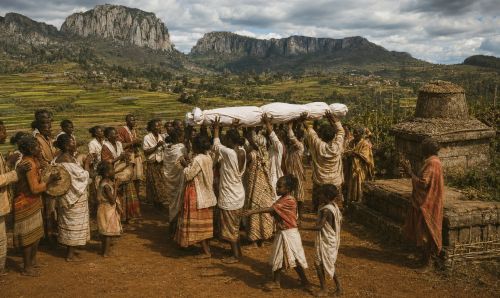
Famadihana, Madagascar’s “turning of the bones,” is more than a funerary ritual. It is a powerful act of ancestral return, family reunion, social repair, and historical memory.

By Matthew A. McIntosh
Public Historian
Brewminate
Introduction: The Ancestors Who Return
In the dry season of Madagascar’s central highlands, when roads are more passable and scattered kin can gather, a family tomb may be opened not in silence alone, but in expectation. Relatives arrive from nearby villages, distant towns, and sometimes from far beyond the ancestral land. Musicians play, speeches are made, food is prepared, and the names of the dead are spoken again among the living. The ceremony known as famadihana, often translated as “the turning of the bones,” centers on the exhumation, rewrapping, and return of ancestral remains to the family tomb. To outside observers, the scene can appear startling: the dead lifted from the tomb, wrapped in new silk shrouds, carried, celebrated, and addressed as continuing members of the family. Yet to reduce the rite to spectacle is to miss its central purpose. Famadihana is not a macabre interruption of ordinary life. It is one of the ways ordinary life is repaired, renewed, and anchored in the presence of the dead.
The ritual rests on a Malagasy understanding of death as transition rather than abrupt disappearance. The dead do not simply cease to matter when breath leaves the body. They pass gradually from the unstable condition of recent death toward the more settled authority of ancestry, and the living have obligations in that passage. A corpse first buried is not necessarily a person fully placed. Bones, tombs, cloth, speech, kinship, and memory all participate in the making of an ancestor. Famadihana belongs to a wider family of secondary burial practices, in which the first funeral does not complete the work of death. The later handling of the remains marks another stage in social and spiritual transformation: the dead are gathered, cared for, named, rewrapped, and restored to the tomb as members of a lineage whose power extends beyond mortality.
But Famadihana is also historical. It should not be treated as a timeless survival from an untouched past, nor as a ritual that can be explained by one origin story alone. Its deepest roots may lie in older Malagasy and Austronesian-inflected traditions of secondary burial, but the recognizable highland forms of the rite developed through particular political, social, and material histories. The rise of the Merina kingdom, the building of permanent stone tombs, military expansion, the movement of bodies over long distances, colonial disruption, Christian missions, wage labor, migration, and modern public-health intervention all shaped how families handled their dead. The practice became meaningful in a world where people were often separated from ancestral land by war, service, poverty, or work. To return bones to the tomb was not merely to move remains. It was to restore belonging.
Famadihana is best understood as a ritual of return: the return of the dead to the tomb, the return of kin to the ancestral place, the return of memory to embodied form, and the return of social order after the disruption of death. Its history is not one of simple continuity or simple decline. Rather, it is a history of adaptation. Across centuries, Malagasy families have used the care of ancestral remains to negotiate descent, status, affection, obligation, grief, and authority. The dead who return in the ritual are not passive relics of the past. They are participants in the making of family, land, and history itself.
Madagascar before Famadihana: Migration, Island Worlds, and Austronesian Memory
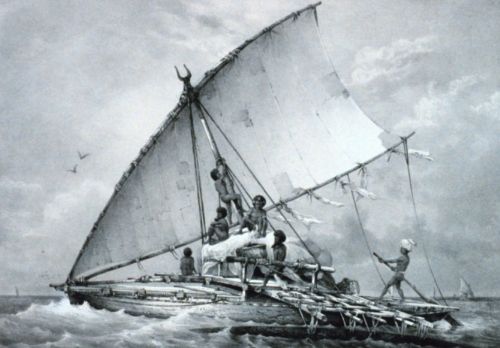
Long before Famadihana took the form now associated with the central highlands, Madagascar was already a place where distance, memory, and belonging had to be negotiated across water. The island’s history begins not with isolation, but with movement. Madagascar lies off the southeastern coast of Africa, yet the Malagasy language belongs to the Austronesian family, linking the island to the wider world of Southeast Asia and the Indian Ocean. Its people, cultures, crops, and ritual vocabularies emerged from crossings: from Africa, from Island Southeast Asia, from the Comoros, from the Swahili coast, and from the long commercial routes that carried sailors, captives, traders, plants, words, and religious ideas across the ocean. To understand it historically, one must begin with Madagascar as an island made by circulation. The dead would later be returned to tombs, but the living who created those tomb-centered societies descended from people whose own histories were marked by migration.
The Austronesian dimension of Malagasy history is important, though it must be handled carefully. Linguistic evidence has long connected Malagasy to the languages of Island Southeast Asia, particularly to the Barito group of southern Borneo, while genetic and archaeological research has shown that Malagasy ancestry is not singular but mixed, with both Southeast Asian and African contributions. This does not mean that a complete ritual system was simply transported from Borneo to Madagascar intact. Migrations do not preserve culture like insects in amber. They unsettle, combine, and transform it. Still, the Austronesian element matters because many Austronesian-speaking societies historically practiced forms of secondary burial, ancestor veneration, and ritual concern with the proper transformation of the dead. These parallels do not prove that Famadihana existed from the moment of settlement, but they help explain why later Malagasy mortuary practices could develop within a cultural world where bones, burial, kinship, and ancestral presence were already deeply meaningful.
The settlement of Madagascar was probably not a single event but a long process, and that long process matters because it created the mixed cultural landscape from which later highland mortuary practices emerged. Archaeological traces, crop histories, linguistic reconstruction, and oral traditions all point toward layered arrivals and regional variation rather than one founding migration. Early communities brought or adopted foodways that connected them to several worlds at once: rice, taro, banana, coconut, and other crops with Asian histories; cattle and pastoral practices linked to Africa; and coastal exchange systems tied to Islamic and Swahili commercial networks. These material foundations shaped social life in ways that later mattered for death. Rice agriculture encouraged particular forms of land use, irrigation, seasonal labor, and attachment to cultivated territory. Cattle became wealth, sacrifice, bridewealth, political currency, and a visible measure of household status. Cloth, including later ritual textiles, became part of the language of dignity, exchange, protection, and social recognition. Ancestors were not abstract spirits detached from material life. They were connected to fields, herds, houses, heirlooms, tombs, and remembered places. Before the practice can be understood as a funerary rite, Madagascar must be understood as a society in which bodies, land, food, cattle, cloth, and kinship were already being woven together into durable forms of social memory.
The central highlands, where Famadihana would later become most strongly associated with Merina and Betsileo practice, were not merely an inland refuge from coastal history. They were part of a broader island network. Highland communities developed their own political and ritual institutions, but they did so within a Madagascar shaped by trade, warfare, migration, and regional difference. The later importance of ancestral villages and tombs in highland society should not be projected backward as if it had always existed in the same form. Yet the social problem that tombs would answer was already present: how to bind dispersed people to a common place, how to turn ancestry into authority, and how to make a lineage endure beyond the lives of individual members. In societies where settlement, movement, and alliance were all historically important, the tomb could become more than a grave. It could become a declaration that the family had a center.
Early European observers, writing from the seventeenth century onward, recorded Malagasy funerary practices unevenly and often through the distorting assumptions of outsiders. Their accounts cannot be taken as transparent windows into Malagasy belief. They frequently misunderstood what they saw, imposed Christian categories on non-Christian rituals, and tended to exoticize practices involving the dead. They were also often coastal, missionary, commercial, or colonial observers whose access to inland ritual life was partial and whose descriptions reflected the politics of encounter as much as the practices themselves. Even so, such sources are useful when read critically because they show that Malagasy mortuary life already attracted attention as a domain of ceremony, status, and ancestral obligation. They also remind us that “Malagasy religion” was never a single thing. Coastal and highland communities differed; political rank mattered; enslaved, commoner, and noble dead were not necessarily treated alike; and ritual meaning could shift from one region to another. Some customs emphasized tomb placement, others the public honor given to the corpse, others the relationship between rulers, ancestors, and land. What later writers would call Famadihana has to be separated from the broader category of Malagasy funerary concern. The later history emerged from this plural world, not from one uniform national custom.
For that reason, the best way to begin the history is not by declaring it ancient in any simple sense, but by identifying the older conditions that made it possible. Madagascar’s Austronesian inheritance, African entanglements, Indian Ocean connections, and highland systems of descent all contributed to a world in which the dead remained socially present. Secondary burial, in this broad setting, was not merely disposal of remains after decomposition. It was a way of completing relationships. It joined the biological fact of death to the social work of ancestry. Famadihana would later give this work a distinctive historical form: the opening of the tomb, the rewrapping of the dead, the reunion of the living, and the renewal of kinship around ancestral remains. But before the bones could be “turned,” Madagascar itself had already been shaped by centuries of turning outward and inward, across the sea and back toward the ancestral place.
Death as Transition: Secondary Burial and the In-Between Dead
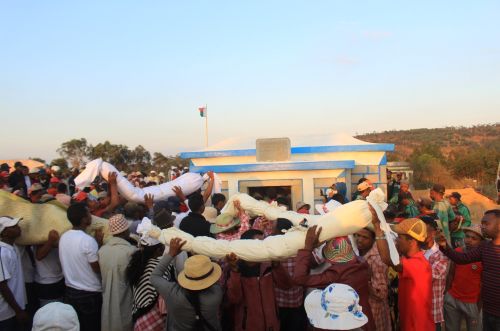
To understand the ritual, it is necessary to begin with a simple but profound distinction: death is not always imagined as a single event. In many societies, including those of Madagascar’s central highlands, death unfolds as a process. A person may stop breathing, be mourned, and be buried, yet still not be fully settled among the ancestors. The first burial addresses the immediate crisis of death: the danger of the corpse, the sorrow of the household, the rupture caused by bodily decay, and the need to remove the dead from the ordinary space of the living. But secondary burial addresses a different problem. It asks what the dead have become, where they properly belong, and how the living must act so that the deceased may be transformed from a recently dead person into an ancestor capable of remaining in ordered relation with the family.
Robert Hertz’s classic theory of secondary burial matters here because it treats funerary rites not merely as disposal practices, but as social dramas of transformation. In his account, the period between first and second burial corresponds to an intermediate condition: the corpse is decomposing, the soul or social identity of the dead is not yet fully resolved, and the mourners themselves remain in a state of ritual and emotional suspension. The dead are neither fully present nor fully gone. They are in between. This interval matters because it gives ritual time to do what biology alone cannot do. Decomposition alters the body, but ceremony alters status. The first burial removes the corpse from daily life, while the second burial reintroduces the dead in a changed form, no longer as a dangerous or sorrowful presence but as one who can be gathered into the moral order of ancestry. Hertz’s argument also helps explain why secondary burial often carries such emotional and social force: it is not a repetition of the funeral, but a second threshold. The living are also transformed by it. Their mourning is reorganized, their obligations are publicly displayed, and their relationship with the deceased is shifted from immediate grief to enduring duty. The second burial marks a kind of completion. It does not undo death, but it reorganizes death into a stable social form. The person who died is no longer simply a corpse or a painful absence. The dead are placed, named, gathered, and incorporated into the wider community of ancestors.
In highland Malagasy practice, this broad logic helps explain why the tomb is not merely the end of the story. The tomb is a house of the dead, but it is also a social institution through which kinship is made visible. A body temporarily buried elsewhere, or a recently dead person not yet properly incorporated into the family tomb, represents a relationship still unfinished. The dead must be brought into the correct ancestral company. Their remains must be handled with care, wrapped with dignity, and placed among those to whom they belong. This is why secondary burial cannot be reduced to a technical matter of moving bones after decomposition. It is a moral and kinship act. It establishes that the deceased has not been abandoned to anonymity, distance, or disorder, but has been received into the durable body of the lineage.
The “in-between” condition of the dead also shapes the obligations of the living. If the dead remain socially active before their final incorporation among the ancestors, then the living cannot simply grieve and move on. They must continue to speak, remember, gather, prepare, spend, and perform. Famadihana gives visible form to that obligation. When families open the tomb and rewrap ancestral remains, they are not merely commemorating the past; they are renewing a relationship that still has consequences in the present. The ancestors may be asked for blessing, protection, fertility, health, success, or reconciliation. The living demonstrate that they have not neglected their duties. Care for the dead becomes evidence of moral seriousness. To honor the ancestors is to show that one understands one’s place within a chain of descent extending backward and forward beyond the individual life.
This transitional view of death also helps explain why Famadihana can be joyful without being irreverent. From the outside, music, dancing, feasting, and laughter around ancestral remains may seem to violate the solemnity expected of funerals. But it is not the first shock of death. It belongs to a later stage, when grief has been transformed into relationship and when the dead can be approached as ancestors rather than only as lost loved ones. The ceremony joins mourning to reunion. It acknowledges decay, but it also insists that decay is not the same as disappearance. The body changes; the relationship continues. Secondary burial turns death from a rupture into a passage, and the ceremony becomes one of the great Malagasy rituals for managing that passage: from corpse to ancestor, from sorrow to obligation, from separation to restored belonging.
Tombs, Descent, and the Geography of Belonging in the Central Highlands
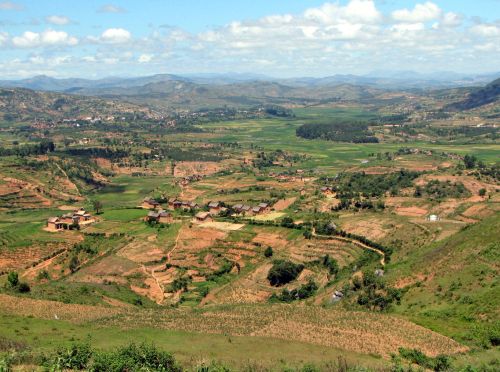
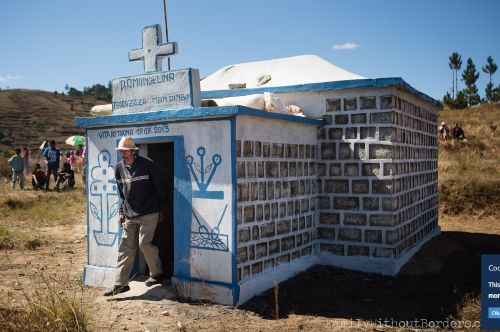
In the central highlands of Madagascar, the tomb is not simply a place where the dead are stored. It is one of the most powerful institutions through which families imagine themselves as continuous across time. Houses may be rebuilt, fields may change hands, children may leave for towns, and living relatives may scatter across the island or beyond it, but the ancestral tomb remains a fixed point of return. It gathers the dead physically and the living morally. To belong to a family is not only to share blood, name, memory, or obligation; it is also to know where one’s dead are placed. The tomb becomes a geography of kinship, a visible claim that descent is rooted somewhere and that the family has a center deeper than the movements of individual lives. It gives ancestry a location. It turns memory into something that can be visited, repaired, guarded, and ritually reopened. In a world where the living may be pulled away by marriage, labor, political service, urban migration, or hardship, the tomb answers instability with a claim of permanence: whatever distance may do to the household, the ancestors remain gathered, and the family remains answerable to them.
This is why highland tombs have to be understood as more than funerary architecture. They are social monuments. Built of stone, earth, masonry, or other durable materials depending on period, wealth, and region, they make permanence visible. They declare that a descent group is not merely a collection of living relatives but an enduring body composed of both the dead and the living. The tomb’s physical durability matters because it contrasts with the fragility of human life. Bodies decay; generations pass; disputes break out; households divide. Yet the tomb asserts continuity against all of this. It tells the living that they are temporary occupants of a much longer family history, one that began before them and will continue after them if they fulfill their obligations.
The importance of the tomb also reflects the central highland relationship between ancestry and land. In Merina and related highland settings, the ancestral village and the family tomb often functioned together as anchors of identity. One might live elsewhere for work, marriage, trade, military service, education, or poverty, but the ancestral place retained a special moral authority. It was the place where one’s forebears had lived, where their remains were gathered, and where family continuity could be publicly displayed. This did not mean that everyone experienced belonging equally. Rank, gender, legitimacy, enslavement, marriage, and inheritance all affected who could claim a tomb and on what terms. But precisely because tombs mattered so much, questions of burial could become questions of social identity. To be denied proper placement was not a minor ritual inconvenience. It could mean exclusion from the very lineage through which one’s memory and status were secured.
The ritual must be situated within this tomb-centered world. The ritual opens the tomb not to violate it, but to renew its power. When the dead are brought out, rewrapped, addressed, and returned, the family is also reassembled around the structure that defines its continuity. The tomb becomes a stage on which descent is performed. Relatives who may rarely see one another are drawn back to the ancestral place. Younger generations are shown where they come from. Old quarrels may be softened, though not always resolved. Obligations are made visible through labor, money, food, speech, cloth, and attendance. The dead are not merely remembered in private feeling; they are restored to public family order. The tomb gives Famadihana its spatial logic. The ceremony turns bones, but it also turns people back toward the ancestral center.
The geography of belonging created by tombs was important in a society where movement was common. The central highlands were never static. Political consolidation, military campaigns, forced labor, slavery, trade, marriage, and later colonial and wage-labor systems all separated people from ancestral land. Such separation made the tomb more, not less, important. The farther people moved, the more powerful the ancestral tomb could become as an imagined point of return. A person might live in Antananarivo, serve in distant campaigns, work on another family’s land, migrate to a coastal town, or die far from home, but the desire to be gathered eventually with one’s people could remain strong. Secondary burial answered this social anxiety. It made it possible to correct distance after death. If life scattered the family, the tomb could gather it again. This was not only a sentimental longing for home, but a practical and moral solution to displacement. A death away from ancestral land could leave the deceased socially unfinished, suspended between the place of death and the place of belonging. Tomb-centered burial restored order by relocating the dead within the proper company of kin. It also reassured the living that separation in life did not have to become separation forever. The family might be divided by circumstance, but the tomb preserved the possibility of reunion.
Yet the tomb did not only express affection and continuity. It also organized power. Ancestral tombs could reproduce hierarchy within the family and within society. Those who controlled tomb decisions often controlled claims about descent, legitimacy, inheritance, and memory. Which ancestors were honored, which branches of the family took responsibility, who paid, who spoke, who hosted, and who had the right to be buried there were all matters of consequence. The tomb could unite, but it could also exclude. It could preserve memory, but it could also simplify or absorb individual lives into a collective ancestral identity. Named persons might gradually become less distinct as their remains were rewrapped and gathered with others. The tomb made kinship durable, but it also disciplined memory into forms the group could recognize and manage.
This helps explain why it is so difficult to separate from place. It is not only a rite for the dead body; it is a rite for the family’s location in history. The tomb, the ancestral village, the gathered kin, the rewrapped remains, and the shared meal all say the same thing in different registers: these people belong together because their dead belong together. The central highland tomb turns descent into architecture and memory into geography. It is a house for the ancestors, but it is also a map for the living. To return to it is to enter a story older than oneself, and to open it during Famadihana is to acknowledge that family is made not only by birth and affection, but by repeated acts of return.
Merina State Formation and the Political Life of Ancestors
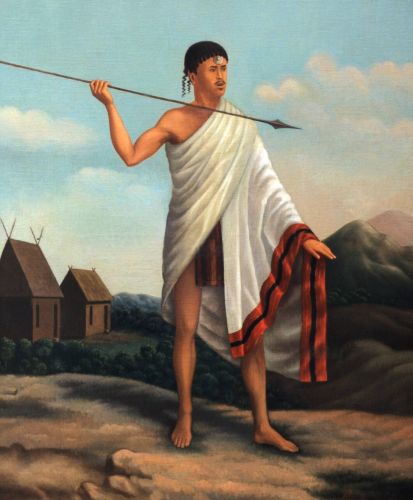
The central highland tomb did not develop in a political vacuum. By the late eighteenth and early nineteenth centuries, the kingdom of Imerina was becoming one of the most powerful states in Madagascar, and its rise gave ancestry a new public significance. Earlier highland communities had already connected descent, land, and tombs, but Merina state formation intensified those connections by placing genealogy at the heart of political order. Rulers did not govern only as military leaders or administrators. They claimed authority through descent, sacred power, ritual precedence, and the capacity to bind people to land. The ancestors were not confined to the private world of family memory. They were part of the language through which sovereignty itself was imagined. To rule was to stand in relation to the dead, to inherit power from them, and to organize the living under the moral weight of ancestral precedent.
The reign of Andrianampoinimerina in the late eighteenth and early nineteenth centuries marked a crucial moment in this process. His consolidation of Imerina brought together competing highland polities and helped establish a stronger royal center around Antananarivo. This political project depended on warfare, alliance, marriage, redistribution, and ritual authority, but it also depended on memory. A kingdom required more than territory. It required stories of origin, legitimate descent, sacred places, and institutions that could make hierarchy appear older and deeper than immediate force. Royal ancestors and royal tombs helped accomplish that work. They made the monarchy appear rooted in a past that living subjects were expected to recognize. The king’s authority was not presented as a merely personal achievement, nor even only as the result of conquest. It was embedded in a lineage of sacred kingship, ancestral sanction, and ritual geography. Tombs, royal hills, named ancestors, and remembered precedents helped transform political rule into inherited order. In that sense, the dead were not ornamental figures in Merina political culture. They gave the kingdom a language of legitimacy. The monarchy could command armies and exact labor, but its deeper authority rested partly on the claim that present power fulfilled ancestral destiny. The dead became participants in statecraft: not because they issued commands in any ordinary sense, but because their remembered presence gave political claims a sacred and genealogical depth.
Under Radama I, Merina power expanded beyond the central highlands into wider parts of Madagascar. This expansion changed the relationship between death, service, and belonging. Military campaigns, administrative service, corvée labor, trade, and new forms of mobility placed highland people in distant regions, sometimes far from their ancestral tombs. The state could mobilize bodies across the island, but families still imagined proper belonging through descent and burial. A person who died away from home created a problem that was at once emotional, ritual, and political. The kingdom’s expansion made distance a recurring feature of life, and distance sharpened the importance of return. In this setting, the movement of remains back toward ancestral tombs cannot be understood simply as piety. It also reflected the pressures of a state that stretched people beyond local worlds while kinship continued to pull them back toward ancestral places.
The political life of ancestors also structured social hierarchy within Merina society. Nobles, commoners, dependents, and enslaved people did not stand in identical relation to tombs, descent, or memorial authority. Burial could affirm rank, and exclusion from certain ancestral spaces could expose the limits of belonging. Genealogy was not merely a record of kinship; it was a social weapon, a claim to precedence, land, honor, and legitimacy. Tombs materialized those claims. They showed who could be gathered with whom, whose dead commanded recognition, and whose ancestry could be publicly displayed. This does not mean that every family tomb functioned like a royal monument, but the same underlying logic linked household and kingdom: the dead gave order to the living. Ancestors made hierarchy durable because they located present status in a past that could not easily be challenged without challenging the moral structure of the community itself.
Famadihana belongs within this broader history of ancestor-centered power. The ritual would later become most visible as a family ceremony of reunion, rewrapping, and return, but its meaning was shaped by a society in which ancestors organized land, rank, authority, and memory. The dead were not simply loved; they were powerful. They blessed, legitimized, constrained, and judged. In the Merina world, to handle ancestral remains was never only a domestic act. It touched the deepest questions of belonging: who counted as kin, where a family was rooted, what obligations the living owed, and how the past continued to govern the present. The opening of a tomb, the movement of bones, the rewrapping of remains, and the public gathering of kin all took place within a social order where ancestry carried consequence. Such acts could affirm a family’s continuity, but they could also expose tensions over descent, rank, inheritance, and exclusion. State formation did not create ancestor reverence from nothing, but it gave ancestral memory a sharper political edge. It made the tomb a household institution with public consequences and made the family dead part of the larger history of power in Madagascar. Famadihana was never only a ritual of remembrance. It was also a ritual through which the living repeatedly situated themselves within a hierarchy of land, descent, obligation, and ancestral authority.
The Nineteenth-Century Transformation: War, Soldiers’ Bones, and Tomb-to-Tomb Transfers
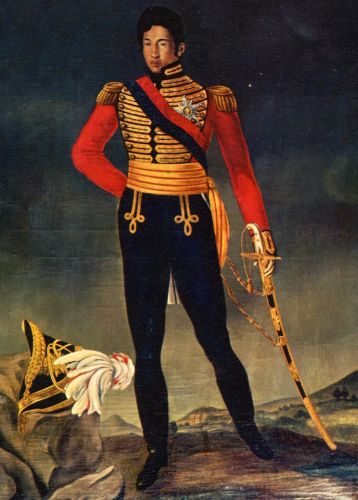
The nineteenth century did not invent Malagasy concern for the dead, nor did it create the highland conviction that proper burial anchored a person within descent and land. What it did was intensify the conditions under which death away from home became common, troubling, and ritually urgent. As Merina power expanded from the central highlands across much of Madagascar, more people were pulled into circuits of movement that exceeded the older scale of village and lineage life. Soldiers marched far from ancestral tombs. Laborers were sent to distant worksites. Administrators, traders, captives, and dependents moved through expanding political and economic networks. These movements created a recurring problem: what happened when a person died in the wrong place? A corpse buried near the place of death might satisfy immediate necessity, but it did not necessarily satisfy kinship. The dead still had to be returned, if not as a whole body, then as bones, to the ancestral world where they could properly belong.
This is why the movement of soldiers’ remains became so important in the history of Famadihana. Merina expansion under Radama I and his successors depended heavily on military service, and warfare scattered highland men across the island. Some died on campaign, far from the tombs that defined their place in family history. Their deaths were not only military losses; they created ritual dislocations. A soldier buried in a distant temporary grave remained separated from the descent group whose tomb should have received him. The return of bones became a way to repair the damage created by state expansion. It translated imperial movement back into ancestral order. The kingdom could send men outward, but families sought to bring them back inward, converting death in the field into burial among kin.
Pier Larson’s work is relevant because it complicates the common assumption that Famadihana is simply an ancient custom periodically repeated in unchanged form. He argues that highland secondary burial underwent significant transformations in the nineteenth century, particularly through practices of disinterring bodies, transporting remains and transferring them into newly built or more appropriate tombs. The rite was not merely the continuation of an old idea of double burial. It was reshaped by new historical pressures: state militarization, long-distance death, the expansion of stone sepulchres, and changing patterns of family display. The “turning” of the dead belongs to a wider history of relocation. Bodies and bones were not only being moved from earth to tomb; they were being moved from provisional status to ancestral permanence, from the disruptions of the state back into the moral geography of kinship.
Tomb-to-tomb transfer also mattered. As families gained wealth, consolidated status, or built more durable family tombs, remains could be moved from older, humbler, temporary, or inappropriate resting places into new ancestral sepulchres. This was not a trivial act of architectural improvement. It redefined the family’s past. To gather earlier dead into a new tomb was to create a more coherent lineage body, one that could be seen, visited, named, and honored in a single place. The tomb became a historical project as much as a funerary one. It did not merely preserve memory; it reorganized memory. By transferring remains, families could assert continuity, repair omissions, elevate status, and bring scattered ancestors into a shared architectural statement of descent. Such transfers could also fold different generations into a newly visible genealogy, making the tomb itself a kind of archive in stone. A family that had recently prospered, returned to ancestral land, or achieved higher local standing could use reburial to bring its dead into alignment with its new social position. Conversely, the movement of bones could expose older tensions: which ancestors deserved inclusion, which branch of the family had the authority to arrange the transfer, and whether the new tomb represented genuine unity or the ambitions of one lineage segment. The act of relocation did more than move remains from one place to another. It revised the family’s map of belonging. It gathered the past into a new center and allowed the living to tell a more ordered story about who they were, where they came from, and how their dead should be remembered.
Such practices also changed the meaning of the bones themselves. In the first burial, the corpse still bore the immediacy of death: grief, danger, decay, and bodily individuality. In later exhumation, the bones could be approached differently. They were no longer simply the remains of a recently dead person but the material core of an emerging or established ancestor. This did not erase emotion. The return of remains could be moving, intimate, and painful. But it placed emotion inside a larger ritual grammar. Bones were portable in a way corpses were not. They could be gathered, wrapped, carried, and installed. They allowed families to correct distance after decomposition had done its work. The physical reduction of the body made possible a social enlargement: the dead could now be joined more fully to the collective ancestry of the tomb.
The nineteenth-century transformation of Famadihana also reveals the tension between household ritual and state power. The Merina state depended on mobilizing people away from local attachments, but highland kinship continued to imagine ultimate belonging through the ancestral tomb. This tension did not necessarily produce open contradiction. Military service, royal command, and family obligation could coexist. Yet the return of soldiers’ bones shows how families ritually answered the state’s claim on bodies. A man might serve the kingdom in life, but in death he still belonged to his ancestors. The act of recovering and reburying remains carried a quiet political significance. It acknowledged the reach of the kingdom while insisting that the final location of the person was not the battlefield, the road, the garrison, or the colonial register, but the tomb of descent.
By the later nineteenth century, war, forced movement, economic change, and colonial pressure would deepen these anxieties, but the key transformation was already underway. Famadihana had become a ritual capable of answering a historical problem produced by mobility. It could gather those who had died elsewhere, consolidate those who had been buried separately, and renew the tomb as the family’s permanent center. The rite’s power lay in its ability to turn displacement into return. Soldiers’ bones, transferred ancestors, new tombs, and public ceremonies all expressed the same historical logic: the dead could be moved through crisis and distance, but they were not meant to remain lost. They had to be brought back into the company of kin, where the family could remake both its memory and itself.
Christian Missions, Conversion, and the Ancestors under Debate
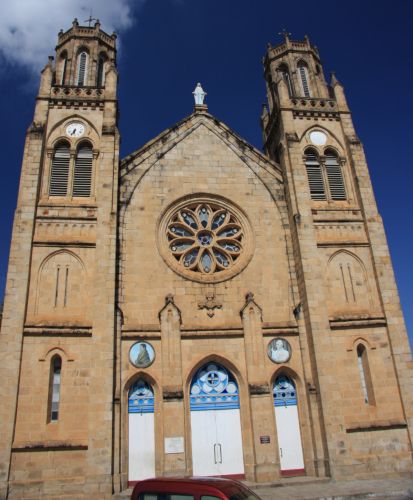
The nineteenth-century transformation of Famadihana unfolded alongside another major force in highland history: the arrival and expansion of Christian missions. Missionary influence did not enter Madagascar as a purely religious matter, separate from politics, literacy, diplomacy, and state formation. Under Radama I, Protestant missionaries from the London Missionary Society were permitted to work in the Merina kingdom, where they helped introduce schools, printing, Bible translation, and new forms of written knowledge. Christianity became entangled with royal policy, elite education, diplomatic contact, and the kingdom’s effort to engage European power without surrendering sovereignty. Missionaries taught reading and writing, helped create a written Malagasy religious vocabulary, and contributed to new habits of record keeping, schooling, and public instruction. These changes mattered because they offered new ways of defining truth, authority, and moral obligation. A sermon, a printed Bible, a school lesson, or a translated doctrine could challenge inherited ritual knowledge that had previously circulated through elders, family memory, oral performance, and tomb-centered obligation. This meant that Christian teaching reached the highlands not simply as a private faith, but as part of a larger reorganization of authority, language, and public life. From the beginning, Christian conversion raised questions about more than doctrine. It challenged how Malagasy people would understand the relation between the living, the dead, the ancestors, the king, the family, and God.
For missionaries, ancestral ritual presented a deep interpretive problem. Protestant and Catholic observers often viewed Malagasy reverence for the dead through Christian categories of idolatry, superstition, or false worship. Practices that Malagasy families understood as duty, respect, kinship, and care could be condemned as improper veneration or as a refusal to recognize the exclusive authority of the Christian God. Famadihana, with its opening of tombs, handling of remains, speeches to ancestors, requests for blessing, and public celebration, seemed difficult to reconcile with missionary expectations about death and burial. In many Christian traditions, the grave marked final bodily rest until resurrection; disturbing remains could appear irreverent, and addressing ancestors could seem dangerously close to prayer. The conflict was not simply over whether the dead should be honored. It was over what kind of power the dead possessed, what obligations the living owed them, and whether ancestral authority could coexist with Christian salvation.
Yet the encounter between Christianity and ancestral practice was never as simple as missionary condemnation meeting Malagasy resistance. Conversion itself was uneven, strategic, sincere, political, familial, and generational. Some Malagasy converts rejected ancestral rites as incompatible with Christian faith. Others accepted Christian worship while continuing to regard tombs and ancestors as central to family life. Still others reinterpreted practices such as Famadihana as cultural acts rather than religious worship, distinguishing respect for forebears from adoration of the dead. This distinction mattered. If the ceremony could be understood as honoring parents, preserving family unity, and remembering lineage, then it might be defended as compatible with Christian identity. If ancestors were approached as supernatural beings who granted blessings apart from God, then church authorities could condemn the rite as theologically unacceptable. The debate turned on the meaning of action: the same rewrapping, feasting, and speaking might be read by one person as kinship and by another as idolatry.
The political history of conversion sharpened these tensions. Under Ranavalona I, Christianity was suppressed and Malagasy Christians suffered persecution, making Christian identity itself a matter of danger and resistance. Later, under Ranavalona II, royal conversion to Protestant Christianity in 1869 gave Christianity new official prestige and reshaped the religious landscape of the kingdom. But royal and elite conversion did not erase older systems of ancestor reverence. Instead, it created a more complicated public world in which Christian institutions, royal authority, ancestral claims, and family obligations overlapped. Churches could condemn ancestral practices, but families still had tombs. Missionaries could preach resurrection, but people still had dead relatives whose remains had to be placed properly. The state might sponsor Christian forms of legitimacy, yet social life remained saturated with descent, land, and the moral authority of the ancestors. Conversion also produced uneven religious geographies within families themselves. One branch might embrace church discipline, another might continue older rites, and another might move between the two depending on circumstance. The same person could attend church, respect biblical teaching, contribute to a Famadihana, and feel no easy contradiction until a missionary, pastor, elder, or relative insisted that a choice had to be made. Christianity did not simply replace ancestral authority; it forced ancestral authority into new public negotiations. The question was no longer only what the ancestors required, but how those requirements could be defended, modified, or rejected in a kingdom increasingly shaped by Christian institutions and written doctrine. Conversion changed the terms of debate, but it did not remove the dead from Malagasy social imagination.
Famadihana became one of the places where Malagasy Christians negotiated the boundaries of faith and family. The ritual asked practical questions that abstract doctrine could not always settle. Should a Christian attend a family Famadihana if refusal would insult relatives and dishonor ancestors? Could one contribute money for cloth and food without endorsing ancestor veneration? Could prayers be directed to God while the dead were rewrapped? Could the ceremony be stripped of its older religious meanings and preserved as an act of remembrance? These questions were not minor. They touched the deepest obligations of Malagasy life. To refuse Famadihana might appear to assert Christian purity, but it might also be seen as abandoning one’s kin. To participate might preserve family unity, but it could trouble a convert’s conscience or invite church discipline. The rite exposed the strain between two moral communities: the church gathered around Christian doctrine and the family gathered around the tomb.
The debate also reveals how misleading it is to imagine “tradition” and “Christianity” as fixed opposites. Malagasy Christianity itself developed in conversation with Malagasy ideas of kinship, authority, and sacred power. Biblical language about fathers, inheritance, resurrection, burial, blessing, and the communion of the faithful could be interpreted through local concerns about ancestors and descent. Christian teaching offered new ways to criticize older hierarchies, ritual expenses, and fear of ancestral punishment. Some Christians found in the gospel a release from obligations they regarded as burdensome or spiritually dangerous. Others found ways to Christianize ancestral respect, arguing that honoring the dead did not require worshiping them. Famadihana survived in this contested space because it was not one thing to all participants. It could be condemned as paganism, defended as culture, softened into memorial practice, or continued as a powerful act of ancestral communion.
The arrival of Christian missions did not simply cause the decline of Famadihana, though it did contribute to rejection of the rite in some communities and families. More importantly, it forced the ritual into argument. Ancestors who had once been embedded in local moral life now had to be explained in relation to scripture, church authority, resurrection theology, and Christian identity. This changed the practice even where it continued. Families became more conscious of how the ritual appeared to outsiders and to Christian relatives. Some ceremonies were modified, postponed, privatized, or reinterpreted. Others continued precisely because families insisted that Christianity should not sever the living from their dead. In that sense, missions and conversion did not merely oppose Famadihana. They helped produce one of its modern meanings: a ritual in which Malagasy people debated whether ancestry was a rival to Christian faith, a cultural inheritance beneath it, or one of the enduring forms through which family, memory, and belonging still had to be honored.
Colonial Crisis, Franco-Hova War, and the Politics of Ancestral Security
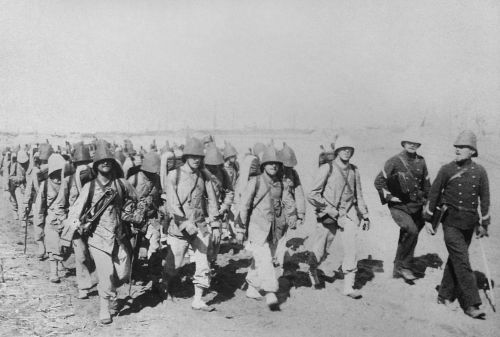
The late nineteenth century placed the Merina kingdom, and with it the highland world of tombs and ancestors, under extraordinary strain. French pressure on Madagascar had grown through decades of commercial ambition, missionary rivalry, diplomatic dispute, and imperial competition, but the crisis became openly military in the 1880s. The Franco-Merina War of 1883–1885 did not simply threaten a ruling dynasty. It unsettled the political and ritual geography through which many highland families understood security. If the ancestral tomb represented permanence, colonial war represented intrusion, uncertainty, and displacement. Foreign power entered not only ports and treaties, but also the moral imagination of the highlands, where land, sovereignty, descent, and the dead were closely bound together. Ancestral security became inseparable from political security. To ask who controlled Madagascar was also, in a deeper sense, to ask whether families could continue to guard the places where their dead belonged.
The first Franco-Hova conflict ended without immediate annexation, but it exposed the vulnerability of the kingdom. The 1885 settlement gave France a stronger official position in Madagascar’s external affairs, while the Merina court attempted to preserve as much independence as possible. This ambiguous arrangement created a period of tension rather than peace. Malagasy sovereignty was neither fully destroyed nor fully secure. For highland families, such uncertainty had social and ritual consequences. War disrupted roads, trade, labor, taxation, and local authority. It also intensified fear that people might die far from their ancestral places, that tombs might be neglected, or that the obligations binding living and dead might become harder to fulfill. Famadihana, in this climate, was not a retreat into private tradition. It was one of the ways families continued to assert that their deepest obligations did not depend on colonial recognition.
The second French military campaign in 1894–1895 and the annexation of Madagascar in 1896 deepened this rupture. The Merina monarchy was first subordinated and then effectively dismantled, while French colonial administration began reorganizing law, labor, taxation, landholding, and political authority. The exile of Queen Ranavalona III in 1897 symbolized more than the fall of a court. It marked the collapse of a highland political order in which royal authority, Christian monarchy, ancestral legitimacy, and state ritual had been uneasily joined. Under colonial rule, the ancestors remained, but the political world that had helped structure their public meaning was transformed. Families now had to maintain ancestral obligations under a government that often viewed Malagasy ritual life through administrative, missionary, racial, or sanitary categories rather than through Malagasy ideas of kinship and duty. This shift mattered because colonial rule did not merely replace one government with another. It altered who could define legitimate authority, what counted as acceptable public practice, and how local customs were described in official language. A tomb that Malagasy families understood as a house of descent might be seen by administrators as a local custom to be tolerated, regulated, taxed, or disciplined. A ceremony of ancestral return might be reduced in colonial eyes to disorder, superstition, or spectacle. The result was a new asymmetry of interpretation: Malagasy families continued to act within a moral world of ancestors and obligations, while colonial officials increasingly claimed the power to classify that world from outside it.
The Menalamba uprising of the late 1890s revealed how deeply colonial conquest could be experienced as a moral and ancestral crisis. The revolt, centered in parts of Imerina and beyond, was not simply a nationalist rebellion in the modern sense, nor merely a conservative reaction against foreign rule. It drew on anger over conquest, forced labor, missionary influence, taxation, local grievances, and the humiliation of the old order. Its very name, often translated as “red shawls,” evoked a symbolic world in which political resistance, ritual power, and claims to moral restoration were intertwined. The ancestors could become signs of a threatened order. Colonial occupation was not only a matter of soldiers and administrators; it could be understood as an attack on the relationships that made land sacred, tombs meaningful, and descent authoritative. The politics of resistance and the politics of burial were not identical, but they arose from the same historical wound: the fear that Malagasy people were losing control over the places, practices, and memories that made them who they were.
Famadihana’s relevance in this period lies in its ability to answer crisis without needing to become overt rebellion. A family ceremony of rewrapping and return could reaffirm belonging at the very moment when colonial rule unsettled public sovereignty. Opening the tomb gathered people around an authority older than the French administration and more intimate than the fallen monarchy. The ceremony declared that the dead still had claims, that kin still had duties, and that ancestral land remained morally charged even when political control had changed hands. This did not make every Famadihana anti-colonial in a direct or programmatic sense. Families performed the rite for many reasons: affection, obligation, status, reconciliation, fear, memory, and continuity. Yet under colonial conditions, those reasons acquired sharper meaning. To care for the ancestors was also to preserve a Malagasy order of value that colonial power could regulate, misunderstand, or condemn, but could not easily replace. The rite allowed families to stage continuity in a world where continuity had become politically fragile. It made the tomb a counterweight to colonial instability, not because it offered a formal program of resistance, but because it located authority in a lineage older than the colonial state. The dead did not overthrow administrators, but they gave the living another source of legitimacy, another measure of obligation, and another way to imagine belonging beyond the categories of empire. In that sense, The ritual could be politically meaningful without being politically explicit. Its power lay in the quiet insistence that the family’s deepest history remained anchored in ancestral soil.
The colonial state also brought new pressures to bear on ritual practice. Administrators were often concerned with order, labor discipline, taxation, public health, and the management of local authority. Missionaries continued to debate ancestral customs, sometimes condemning them as incompatible with Christianity. Economic disruption and new forms of wage labor made expensive ceremonies harder for some families to sustain, while migration made return to ancestral tombs both more difficult and more emotionally charged. Famadihana became one of the places where colonial modernity was felt in practical terms. Could distant relatives afford to travel? Could a family purchase the necessary cloth and food? Would Christian kin participate? Would officials or pastors object? Would younger people still feel bound by the ancestral tomb? The ritual survived not by standing outside history, but by absorbing these pressures into its own logic of return.
Colonial crisis modified Famadihana without reducing it to a colonial invention. The rite had older roots and nineteenth-century transformations already underway, especially through soldiers’ bones, tomb transfers, and the consolidation of family sepulchres. But the Franco-Merina wars and the French conquest gave ancestral security a new urgency. When sovereignty was shaken, the tomb remained one of the few places where families could still enact continuity on their own terms. When colonial administration reordered public life, Famadihana reordered kinship around the dead. When war and migration scattered bodies, the ritual gathered them again. Its historical significance lies precisely here: in a period when Madagascar’s political order was being violently turned, Malagasy families continued to turn the bones of their ancestors, not as a quaint survival, but as a profound act of placement, memory, and moral repair.
The Ritual in Its Stabilized Form: Dry Season, Lambamena, Kabary, Music, and Feasting

By the time Famadihana appears in its more recognizable modern form, it is no longer only a matter of moving bones from one resting place to another. It has become a full ceremonial event, shaped by season, kinship, speech, cloth, music, food, and public display. The dry season is important because it allows travel, gathering, and tomb opening under conditions more favorable than the rains. Families who may live far from one another can return to the ancestral place, and the practical demands of the ceremony can be met more easily. This seasonality matters because the ceremony is not a private act performed by a few close relatives in isolation. It requires witnesses, participants, contributors, musicians, speakers, cooks, elders, children, affines, neighbors, and guests. The dead are returned to visibility at the same moment the family itself becomes visible.
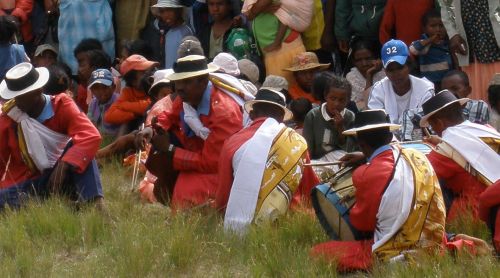
Preparation begins long before the tomb is opened. A Famadihana requires consultation among relatives, agreement over which ancestors are to be honored, discussion of costs, purchase or preparation of new shrouds, arrangements for food and drink, and the summoning of kin. These practical details are part of the ritual, not merely background to it. To organize the ceremony is to reveal the structure of the family: who has authority, who contributes money, who speaks for the group, who travels from afar, who refuses, who reconciles, and who remains absent. The ancestors may be the formal focus, but the living are also being measured. A family that cares properly for its dead demonstrates unity, respectability, and moral seriousness. Failure to do so can suggest neglect, poverty, division, or weakening attachment to the ancestral tomb. At the center of the ceremony is the lambamena, the red or precious funerary shroud used to wrap the ancestral remains. Cloth in Madagascar has long carried meanings that exceed utility. It covers, protects, dignifies, and marks status; in mortuary ritual, it becomes a medium through which care for the dead is made visible. To wrap an ancestor in fresh cloth is to renew the relationship between the living and the dead. The old wrappings, associated with time, decay, and previous ceremonies, give way to new material signs of honor. The ancestors are not treated as refuse from the past, but as persons whose continuing dignity requires expenditure and attention. The cloth mediates between bodily decay and social permanence. It acknowledges that the physical remains have changed while insisting that kinship has not.
The opening of the tomb is one of the ceremony’s most charged moments. The tomb, normally closed as the house of the ancestors, is temporarily made accessible. The dead are brought out from the hidden interior into the public space of family and community. This movement is not understood as desecration, because the opening is ritually framed and socially authorized. The ancestors are not exposed to mockery; they are presented for renewed care. Their remains may be identified, handled, rearranged, rewrapped, and sometimes carried in procession. The act can be intimate and collective at once. Relatives touch what remains of those who came before them, while the gathered group confirms that these remains belong to a shared descent history. The tomb opens, but so does the family archive. Speech gives order to this moment. Kabary, the Malagasy art of formal oratory, is central to many public occasions, and in the context of Famadihana it helps transform emotion into social meaning. Speakers may address the living, invoke the ancestors, explain the purpose of the gathering, honor the dead, acknowledge obligations, and remind participants of the family’s history. Such speech does not simply decorate the ritual. It interprets it. It tells those present what they are doing and why it matters. It can smooth tensions, affirm hierarchy, praise generosity, and place individual grief inside the wider moral language of descent. Through formal words, the ceremony becomes legible as more than exhumation. It becomes a public act of remembrance, duty, and belonging.
Music and dancing are equally important, and they are often the elements that most surprise outside observers. To those accustomed to quiet funerary solemnity, celebration around ancestral remains may seem contradictory. But Famadihana belongs to a later stage of the relationship with the dead, not to the first shock of bereavement. The ancestors are mourned, but they are also welcomed. Music creates movement where death had created stillness. Dancing with or near the wrapped remains dramatizes reunion. The dead are brought briefly into the social energy of the family, not as corpses newly lost, but as ancestors whose presence calls forth memory, joy, obligation, and continuity. The celebration does not deny mortality. It insists that death has been ritually transformed into ancestral relationship.
Feasting extends the ritual into the body of the community. Food and drink gather people, reward attendance, display hospitality, and convert family obligation into shared experience. The feast can be generous, expensive, and socially competitive. It may involve livestock, rice, alcohol, and large quantities of prepared food, depending on the family’s resources and regional practice. Feeding guests honors both the living and the dead. It shows that the family is capable of sustaining relationships beyond the narrow household, and it turns remembrance into communal participation. Yet the feast also exposes the economic pressures of Famadihana. Honor requires expenditure. A ceremony meant to unite the family can generate anxiety over debt, unequal contributions, or the burden placed on poorer relatives. Celebration and strain are not opposites here; they often coexist.
The final return of the ancestors to the tomb completes the cycle. The remains, now newly wrapped and publicly honored, are placed back among the dead to whom they belong. The tomb closes again, but the relationship has been renewed. For the living, the ceremony leaves behind more than memory. It may settle disputes, create new obligations, mark generational succession, strengthen attachment to ancestral land, and remind younger relatives that they belong to a family older than themselves. Famadihana in its stabilized form is not a single act but a sequence: preparation, gathering, opening, handling, wrapping, speaking, dancing, feasting, and returning. Each element turns the dead back toward the living and the living back toward the dead. The bones are turned, but so are the bonds of kinship, which must be renewed again and again if the family is to remain whole.
Blessing, Constraint, and the Ambiguous Power of the Ancestors
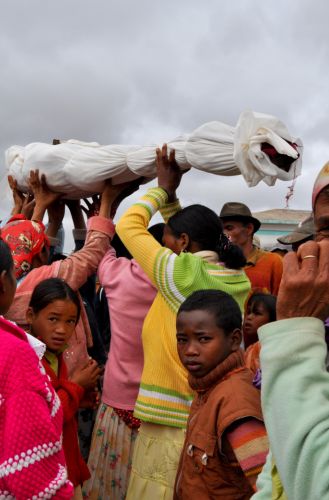
The ancestors honored in the ritual are not passive memories. They are not simply the dead as the living wish to remember them, softened into nostalgia and safely contained in the past. In highland Malagasy thought, ancestors may bless, protect, guide, and strengthen their descendants, but their power is not only comforting. It can also be demanding, disciplinary, and dangerous when neglected. The dead retain a claim on the living because kinship does not end with burial. Indeed, death may intensify authority rather than dissolve it. An elder who in life could command respect may, after death and proper incorporation into the tomb, become part of a larger ancestral order whose expectations weigh on descendants. Famadihana is not merely affectionate commemoration. It is a negotiation with power.
This ambiguity helps explain why the ritual combines joy with seriousness. Families celebrate because the ancestors are present again, because kin have gathered, because obligations are being fulfilled, and because the dead are being honored with cloth, speech, music, and food. But celebration does not mean the ancestors are harmless. The same dead who bless the family may also be feared if they are neglected, forgotten, improperly buried, or offended by disorder among descendants. Misfortune, illness, infertility, conflict, poverty, or repeated bad luck may be interpreted, in some contexts, as signs that ancestral obligations have not been met. The point is not that every hardship is mechanically blamed on angry ancestors, but that ancestral power provides a moral language through which suffering and disorder can be understood. If the family is troubled, one possible question is whether the dead have been properly cared for.
David Graeber’s interpretation of Famadihana is useful because it resists the temptation to portray the ritual as only warm, communal, and reconciliatory. In his reading, the ancestors are bound up with forms of authority that can be coercive as well as protective. Their power is felt not only in blessing but in constraint. The living are drawn together by the ancestors, but they are also pressed into duties they may not have freely chosen. They must contribute money, attend ceremonies, obey elders, respect tomb rules, and accept a lineage identity that may override personal preference. Famadihana may mend relationships, but it can also reveal the force by which families compel participation. A relative who refuses to contribute may be judged selfish; one who avoids the ceremony may be seen as rejecting kin; one who challenges tomb authority may threaten more than etiquette. The ancestors unite the family partly because they make family obligation difficult to escape. This does not mean that the ritual is simply oppressive, or that participants experience obligation only as burden. Many people may feel genuine affection, pride, reverence, and comfort in fulfilling ancestral duties. But Graeber’s point helps keep the analysis honest: kinship is rarely sustained by sentiment alone. It is also sustained by pressure, expectation, memory, shame, fear, and the authority of those who came before. Famadihana gathers the living not only because they want to gather, but because the dead make gathering necessary.
This is one reason the handling of bones is so powerful. Bones are intimate, material, and resistant to abstraction. They are not merely symbols of ancestry; they are the actual remains through which ancestry is encountered. When wrapped, carried, displayed, and returned, they bring the authority of the dead into the hands of the living. Yet this contact is never neutral. To touch ancestral remains is to enter a relationship of care, debt, and submission. The living may speak to the ancestors, but the ancestors also speak through the expectations surrounding them. Their presence can silence quarrels, but it can also intensify them by making disagreement appear morally dangerous. A dispute over money, burial rights, or family rank is no longer only a dispute among the living when it occurs in the shadow of the tomb. The dead become witnesses and, in a sense, judges.
The power of the ancestors also operates through memory and forgetting. Famadihana seems at first to preserve the dead by naming and rewrapping them, but the ritual can also absorb individual persons into a more collective ancestral body. As generations pass, the distinct biographies of particular men and women may fade while their remains remain gathered in the tomb. This does not make the ritual less meaningful. On the contrary, it shows how ancestry works. The dead are remembered not always as separate personalities, but as a lineage presence. Their power comes partly from this consolidation. Individual lives become ancestral force; personal histories become family authority. The tomb gathers difference into continuity, and Famadihana periodically renews that transformation. A grandmother, soldier, farmer, spouse, child, or elder may once have been remembered through a dense web of stories, habits, quarrels, achievements, and griefs. Over generations, those details may thin, but the ancestor’s place in the tomb remains. The person becomes less a biography than a source of belonging. This kind of forgetting is not simple neglect. It can be a ritual process by which individual mortality is transformed into collective endurance. What is lost in biographical detail may be gained in collective weight.
The ancestors of Famadihana should neither be romanticized as gentle family spirits nor reduced to objects of fear. Their power is ambiguous because kinship itself is ambiguous. Families nurture, but they also demand. They protect, but they also discipline. They preserve memory, but they also impose belonging. Famadihana stages this complexity with unusual clarity. The living dance with the dead, but they also carry the burden of the dead. They ask for blessing, but they submit to obligation. They renew affection, but they also reaffirm hierarchy. The ritual’s endurance rests partly on this double force: it offers reunion and continuity, while also reminding descendants that they are not self-made individuals free from the claims of those who came before. To belong to the ancestors is to be blessed by them, but also to be bound.
Family Reunion, Social Repair, and the Passing of Memory
Famadihana is often described as a ceremony for the dead, but it is just as powerfully a ceremony for the living. The opening of the tomb calls ancestors back into view, yet it also calls relatives back into relationship with one another. Family members who have been separated by work, marriage, migration, quarrels, poverty, or ordinary neglect return to the ancestral place and stand together before the dead. This gathering is not incidental. The ancestors provide the reason, the obligation, and the authority for reunion. A wedding may join families, a funeral may assemble mourners, but Famadihana brings together descendants across generations under the sign of shared origin. It tells the living that they belong together because their dead belong together. Even relatives who may not know one another well are drawn into a visible kinship order through the tomb. They may arrive as urban workers, distant cousins, married-out daughters, sons-in-law, grandchildren, or returning migrants, but the ritual places them within a shared descent story. The ancestral tomb becomes the point where scattered lives are gathered into one family narrative, and where social distance is answered by the physical act of return.
The reunion is practical before it is sentimental. A ceremony requires planning, contributions, travel, cooking, ritual speech, division of tasks, and decisions about which ancestors will be honored. These preparations force relatives to communicate, negotiate, and recognize one another’s claims. A family divided by distance may have to cooperate again; relatives who have avoided one another may have to sit, eat, speak, and work together; younger people who know little about distant kin may be introduced to cousins, elders, and affines whose connection to them is explained through the tomb. The dead become the organizing center around which the living family is reassembled. In that sense, Famadihana is not merely a reunion because people happen to gather. It is a ritual mechanism for making gathering necessary.
This is why Famadihana can become an occasion of social repair. The ceremony does not magically erase conflict, and it should not be romanticized as a guaranteed reconciliation. Families may arrive with unresolved disputes over land, inheritance, money, marriage, status, religious participation, or the costs of the ceremony itself. Yet the presence of the ancestors changes the terms of disagreement. Quarrels that might continue endlessly in ordinary life are placed under a larger moral authority. To continue a feud in the shadow of the tomb can appear shameful, dangerous, or disrespectful. Elders and speakers may use the occasion to urge harmony, remind descendants of shared origins, and frame reconciliation as a duty owed not only to one another but to the ancestors who made the family possible. Even when conflict remains, it has been publicly measured against the ideal of ancestral unity.
Memory passes in this setting not as abstract instruction, but through performance. Children and younger adults see the tomb opened, hear names repeated, watch elders identify remains or recount relationships, and learn where the family is rooted. They absorb genealogy through place, speech, cloth, gesture, and food. The family past is not presented as a written chart alone, but as an embodied scene: these are the ancestors, this is the tomb, these are the relatives who came, these are the obligations that continue. In societies where migration and modern schooling may weaken everyday contact with ancestral villages, such moments become important. Famadihana gives younger generations a sensory education in descent. It teaches them that family history is not only something known, but something done.
The ritual does not preserve memory in a perfectly transparent way. It selects, compresses, and reorganizes the past. Some ancestors may be named vividly, while others are remembered only collectively. Some branches of the family may dominate the speech; others may be quieter or marginal. The ceremony may preserve stories of origin and belonging while softening stories of conflict, enslavement, exclusion, illegitimacy, or inequality. Graeber’s insight that Famadihana can involve forgetting as well as remembering is useful here. As remains are rewrapped and gathered again into the tomb, individual lives may gradually merge into a more collective ancestral presence. This is not necessarily a failure of memory. It is one of the ways lineage memory works. The dead become less a set of biographies and more a shared source of authority, blessing, and identity. The process can be tender, but it can also be politically consequential. What the family chooses to remember publicly becomes part of its accepted history, while what is left unnamed may recede into silence. Famadihana does not simply transmit the past; it edits the past through ritual form. It gives descendants a usable ancestry, one powerful enough to bind them together even when the full complexity of individual lives has faded.
The family reunion created by Famadihana is neither simple nostalgia nor mere celebration. It is a social act with real work to do. It gathers scattered kin, teaches descent, displays obligation, pressures relatives toward cooperation, and renews the moral bond between living and dead. It can heal, but it can also expose unresolved tensions. It can preserve memory, but it can also reshape memory into forms the family can bear. Its power lies in this mixture. Famadihana makes ancestry visible at the moment when family unity must be performed again. The tomb is opened, the ancestors are rewrapped, and the living are reminded that kinship is not only inherited once at birth. It must be returned to, spoken, paid for, argued over, reconciled, and renewed.
Silk, Prestige, and Strain: The Economy of Honoring the Dead
Famadihana is a ritual of memory, kinship, and ancestral return, but it is also an economic event. The ceremony requires resources: cloth for rewrapping the dead, food and drink for guests, musicians, transport, labor, and the time of relatives who may have to leave work or travel from distant places. These costs are not incidental to the ritual’s meaning. They are one of the ways honor becomes visible. To care for the dead properly is to spend, prepare, host, and provide. The ancestors are not honored only through words or inward feeling, but through material acts that others can see and remember. Famadihana turns devotion into public expenditure. The family’s love, obligation, and respect are measured partly through what it is willing and able to give.
The lambamena stands at the center of this economy of honor. A new shroud does more than cover remains. It renews the ancestor’s dignity and displays the family’s continuing care. Cloth has long been one of the most important material forms of value in Madagascar, associated with protection, status, exchange, and ceremonial recognition. In Famadihana, the shroud becomes a visible bridge between bodily decay and social permanence. The ancestor’s body may have decomposed, but the relationship is not allowed to decay with it. Fresh cloth declares renewal. It says that the dead have not been forgotten, that descendants remain capable of honoring them, and that the tomb is still sustained by living hands. Because the shroud is both intimate and public, it carries a double force: it touches the ancestor directly while also communicating the family’s reputation to all who witness the rite.
Prestige enters the ceremony through generosity. A family that hosts well demonstrates not only affection for the dead but competence among the living. Food must be abundant enough to satisfy guests; musicians must be paid; travelers must be accommodated; speeches must be properly made; the event must appear worthy of the ancestors being honored. This public dimension can strengthen family pride and community standing. It can also create competition, especially where ceremonies are compared with those of neighbors, rivals, or wealthier kin. A modest Famadihana may still be sincere, but social judgment is rarely absent from public ritual. The dead are honored, but the living are evaluated. A feast that seems inadequate, a shroud thought too poor, or a poorly organized gathering can become evidence of family weakness, neglect, or shame. Because the ceremony is witnessed by relatives, affines, neighbors, and sometimes people with only indirect ties to the family, it becomes a public test of household capacity. Generosity says that the family has not merely survived but can still act with dignity before the community. It also allows descendants to convert economic resources into moral authority: those who contribute substantially may gain influence in family decisions, while those who fail to contribute may lose standing. Prestige does not hover around the ceremony as decoration. It is built into the ritual economy itself. The honor given to the ancestors returns as honor for the living, and the reputation of the living reflects back upon the dead.
The cost of Famadihana creates pressure as well as pride. Relatives may be expected to contribute according to their means, but “means” can be interpreted differently by different people. A migrant worker, an urban professional, or a relative thought to have prospered elsewhere may be asked to shoulder more of the burden. Poorer relatives may contribute labor, food, or smaller sums, but still feel the weight of expectation. Disputes can arise over who pays, who decides, who benefits from the prestige, and whose ancestors are being honored. The ceremony that reunites the family can also reveal economic inequality within it. Famadihana’s beauty lies partly in collective obligation, but collective obligation can become coercive when honor requires more than some descendants can comfortably afford.
This strain is important in modern contexts shaped by wage labor, migration, schooling costs, church affiliation, urban life, and cash scarcity. The ritual depends on a moral economy older than many of the financial pressures families now face, but it must be performed within those pressures. A family may delay Famadihana because money is short, scale back the feast, reduce the number of ancestors honored, or negotiate participation among relatives who live far away. Some critics, including Christian opponents and economically burdened descendants, may argue that the expense is excessive or misdirected. Yet for many families, the cost is precisely what proves seriousness. Cheap remembrance may seem inadequate to the dead. The difficulty of the ceremony can become part of its meaning: honoring the ancestors requires sacrifice because kinship itself requires sacrifice.
The economy of Famadihana complicates any purely spiritual reading of the rite. Ancestors are honored through cloth, food, music, labor, and money because social bonds are material as well as emotional. The ceremony redistributes resources, displays status, strengthens reputations, and sometimes deepens debt. It can unite kin through shared contribution, but it can also sharpen resentment when burdens fall unevenly. It can preserve dignity for the dead while exposing vulnerability among the living. This does not make the ritual less sacred. Rather, it shows that sacred obligations are lived through ordinary economies. The dead return wrapped in silk, but behind the silk lie negotiations, savings, sacrifices, rivalries, and acts of generosity. Famadihana endures because families continue to find meaning in that costly exchange: wealth becomes honor, honor becomes memory, and memory becomes a renewed bond between the living and the dead.
Public Health, Plague, and the Modern State

Modern debates over Famadihana have often turned on public health, especially in relation to plague. Madagascar is one of the places where plague remains endemic, and outbreaks have periodically drawn national and international concern. This has placed ancestral ritual under a new kind of scrutiny. Earlier missionary critics had framed Famadihana as a spiritual or theological problem; colonial administrators had often framed Malagasy customs as matters of order, labor, or “civilization.” Modern public-health officials, by contrast, have had to ask whether the handling of remains, the opening of tombs, travel for ceremonies, and large gatherings might create risks during disease outbreaks. The question is serious, but it is also easily distorted. If handled crudely, it can turn a complex ritual of kinship and memory into a caricature of dangerous custom.
The disease most often associated with these concerns is plague, caused by Yersinia pestis. Bubonic plague is usually transmitted through fleas associated with infected rodents, while pneumonic plague can spread between people through respiratory droplets and is dangerous when not treated quickly. Madagascar’s 2017 outbreak drew particular attention because of its unusually large pneumonic component and its spread in urban areas, including Antananarivo and Toamasina. The World Health Organization reported that the 2017 outbreak involved both pneumonic and bubonic forms, with pneumonic plague accounting for most clinically classified cases during the height of the outbreak. This context matters because public anxiety around Famadihana is not simply invented from nowhere. Handling bodies, gathering large numbers of people, and moving between communities can become public-health concerns when an infectious disease is present.
Yet the relationship between Famadihana and plague must be described with care. The risk does not come from all ancestors, all tombs, or all forms of rewrapping. It is most relevant when a person has died from plague, when remains are handled too soon, or when a ceremony creates conditions for exposure among relatives and guests. Public-health researchers have noted that symptoms have been reported during exhumations, and Madagascar’s Ministry of Public Health has recommended a seven-year interval before exhuming the body of someone who died of plague, to reduce the possibility of transmission. This recommendation shows the modern state trying to regulate ritual time. Famadihana has its own temporal logic, shaped by decomposition, family readiness, dry-season travel, and ancestral obligation. Public health introduces another clock: the time required to reduce biological risk.
The challenge for the modern state is that public health cannot succeed by treating Famadihana as ignorance. Families do not open tombs because they misunderstand death; they do so because the dead remain part of kinship, land, and moral obligation. A command simply forbidding exhumation may protect health in the short term, but it can also deepen mistrust if people believe officials are insulting the dead or interfering with ancestral duties. Social-science guidance on plague response in Madagascar has emphasized that burial and exhumation practices must be understood within wider conditions of poverty, healthcare access, trust, rumor, and structural inequality, not isolated as irrational behavior. A family may resist public-health instructions not because it rejects medicine as such, but because officials have failed to recognize what is at stake: the proper placement of the dead and the moral standing of the living. This is true when public-health orders arrive from distant institutions, in technical language, or through officials who have little relationship with the affected community. In those circumstances, regulation can feel less like protection than intrusion. Families may ask why the state appears only to forbid, police, or shame, rather than to help them care safely for both the living and the dead. Effective intervention requires more than epidemiological correctness. It requires social trust, local mediation, respectful explanation, and recognition that ritual delay can carry emotional and moral costs. If officials ask families to postpone or modify ancestral obligations, they must also help make that postponement meaningful rather than humiliating.
This tension is part of a much larger global problem in epidemic response. States often claim emergency authority over bodies: they regulate burial, restrict gatherings, impose quarantine, require testing, or mandate rapid disposal of remains. Families, meanwhile, experience such measures through grief, religion, memory, and dignity. The dead body is never merely biological. It is also a parent, child, spouse, elder, ancestor, citizen, patient, and member of a community. In Madagascar, this tension becomes particularly charged because the corpse may not be understood as finished with social life after the first burial. If the state says a body must remain untouched, but the family believes the dead must eventually be gathered into the tomb, then public health and ancestral obligation meet at the most sensitive possible point: the boundary between care for the living and care for the dead.
The most effective public-health response is not a simple opposition between science and tradition. It is negotiation. Officials, doctors, anthropologists, local leaders, pastors, elders, and families all have roles to play in translating risk into terms that communities can accept. A culturally grounded response might distinguish between plague and non-plague deaths, explain why certain delays are necessary, provide safe alternatives, involve trusted local authorities, and avoid humiliating families in moments of mourning. It might also recognize that protecting descendants from disease can itself be framed as an ancestral obligation. The dead do not need to be dishonored in order for the living to be protected. The question is how to create enough trust that temporary limits on ritual action are understood as care rather than contempt.
Public-health controversy has become one of the modern forces reshaping Famadihana. Like Christian missions, colonial administration, migration, and economic strain, plague intervention has pushed the ritual into argument. It has forced families to consider when ancestral duties should be delayed, how health risk should be balanced against ritual obligation, and who has the authority to decide when a tomb may be opened. But these debates do not make Famadihana a relic incompatible with modernity. They show the opposite: the ritual remains important enough that the modern state must reckon with it. Famadihana persists in a world of epidemiology, antibiotics, ministries, international health agencies, and emergency regulations because the dead still matter socially. The challenge is not whether Madagascar must choose between ancestors and public health, but whether public health can protect the living while taking seriously the bonds that continue to join them to the dead.
Decline, Adaptation, and the Future of Famadihana
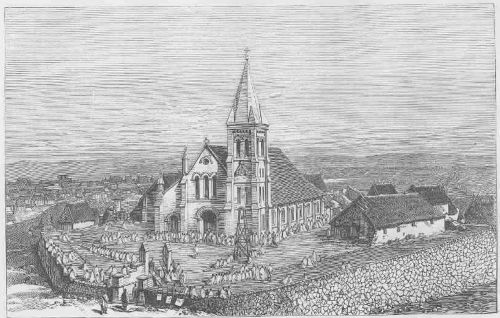
Famadihana is often described today in terms of decline, but decline is too simple a word for what has happened. The ritual has certainly weakened in some communities, been rejected by some Christian families, delayed by economic hardship, complicated by public-health restrictions, and reshaped by migration and urban life. Yet it has not disappeared. Its modern history is better understood as uneven adaptation. Some families continue to perform Famadihana with major expense and public celebration. Others reduce the scale, extend the interval between ceremonies, reinterpret the rite as cultural remembrance rather than religious veneration, or participate selectively out of respect for elders. The result is not a clean passage from “tradition” to “modernity,” but a field of negotiation in which families continually decide what they owe the dead, what they can afford, what they believe, and how much ancestral obligation still binds them.
Christian opposition remains one of the most important forces behind rejection or modification of Famadihana. For some Malagasy Christians, especially those influenced by churches that strongly condemn ancestral veneration, the ritual appears incompatible with Christian faith. The opening of tombs, the handling of remains, the addressing of ancestors, and the expectation of blessing can be understood as religiously dangerous rather than culturally honorable. Yet even here, practice varies. Some Christians refuse to participate entirely; others attend but do not perform certain gestures; still others distinguish between worshiping ancestors and honoring family memory. This variation matters because it shows that conversion does not produce one uniform response. Famadihana survives partly because it can be reclassified: as religion, as culture, as family duty, as heritage, as memory, as social obligation, or as a practice that some descendants endure for the sake of kinship even when they no longer believe in all of its older meanings. It also survives because religious identity is lived within families, not only within churches. A pastor or denomination may define the rite in doctrinal terms, but a family must decide what refusal would mean at the tomb, in front of elders, and before relatives who interpret participation as love and respect. For many people, the question is not simply “Is this Christian?” but “What will my absence say about who I am, whose child I am, and whether I still belong?” That tension allows Famadihana to persist in modified forms even where Christian critique is strong.
Economic strain is equally decisive. The costs of cloth, food, music, travel, and hospitality can be heavy, especially for families already facing school fees, medical expenses, unstable work, urban rent, or rural poverty. A ritual that once displayed honor through generosity may become a source of debt or resentment when public expectation outruns household means. This does not necessarily lead families to abandon Famadihana altogether. More often, it produces adjustment. Ceremonies may be postponed, simplified, combined with other family events, funded by relatives living in towns or abroad, or limited to fewer ancestors. Such changes can create debate within families. Elders may fear that scaling down the rite signals neglect of the dead, while younger or poorer relatives may argue that true respect cannot require financial ruin. The future of Famadihana will likely be shaped as much by household economics as by theology or state regulation.
Migration has also changed the ritual’s social meaning. As more Malagasy people live away from ancestral villages, in cities or overseas, the tomb can become both more distant and more emotionally powerful. The practical difficulty of returning may weaken participation, but distance can also make the ancestral place more symbolically important. A person who lives far from the highlands may feel the pull of Famadihana precisely because ordinary life no longer keeps them close to family land. The ritual becomes a periodic return not only to the dead, but to an identity that migration threatens to thin. Younger generations raised in urban, Christian, global, or digital environments may encounter the ceremony through mixed feelings: pride, curiosity, embarrassment, skepticism, affection, or obligation. They may understand it less as an unquestioned duty and more as a heritage practice whose meaning must be chosen rather than simply inherited. Migration also redistributes responsibility. Relatives who earn wages in cities or abroad may be expected to contribute money even when they cannot attend, while those who remain near the ancestral village may carry the burden of local preparation, negotiation, and ritual labor. This can create new tensions between financial contribution and physical presence. A distant relative may pay but feel disconnected; a local relative may host but feel under-supported. Famadihana becomes a way of measuring whether kinship can survive dispersal. The tomb remains in place, but the family has become mobile, and the ritual must continually translate between rooted ancestry and scattered modern lives.
Tourism and media have added another layer of complication. Famadihana has often been represented outside Madagascar through sensational images of “dancing with corpses,” a phrase that attracts attention but risks reducing the ritual to exotic spectacle. Such portrayals can distort the ceremony’s deeper logic of kinship, obligation, and ancestral return. They can also influence how Malagasy families themselves talk about the rite, particularly when outsiders arrive with cameras, journalists, or expectations of strangeness. Public visibility may bring pride in Malagasy heritage, but it can also produce discomfort when sacred or intimate family acts are turned into consumable images. The future of Famadihana will depend partly on who gets to interpret it. If it is framed only as macabre curiosity, its meaning is flattened. If it is understood as a historically layered form of family reunion and ancestral care, its dignity becomes clearer even to those who do not share its assumptions.
The most likely future of Famadihana is neither total disappearance nor unchanged survival. It will continue unevenly, strongest where tomb-centered kinship, ancestral obligation, and family resources still support it; weaker where church opposition, poverty, public-health concerns, or migration make participation difficult. But the ritual’s history suggests that adaptation is not a sign of failure. Famadihana has always changed: through Austronesian and Malagasy mortuary inheritances, Merina state formation, soldiers’ bones, tomb transfers, colonial crisis, Christian debate, economic strain, and modern health regulation. Its endurance lies in its capacity to turn change itself into ritual return. Families may alter the ceremony, argue over it, postpone it, reinterpret it, or refuse it, but the questions it raises remain powerful: where do the dead belong, what do the living owe them, and how can a family remain connected across death, distance, and time?
Are We Turning a Fluid Regional Practice into a Single Tradition?
The following video from Guy Shachar covers a Famadihana ceremony:
The strongest challenge here is that “Famadihana” may make a diverse set of practices appear more unified, ancient, and stable than they really were. The term is often used as if it names one coherent Malagasy tradition, but the historical evidence points instead to variation: regional variation, class variation, chronological change, and differences between family practice, missionary description, anthropological interpretation, and popular representation. What outsiders call “the turning of the bones” may include several related but distinct acts: transferring remains from a temporary grave to a family tomb, moving ancestors from one tomb to another, periodically rewrapping established ancestors, repatriating the bones of those who died far from home, or gathering kin around a tomb to renew descent. These acts overlap, but they are not identical. If we treat them as one timeless institution, we risk smoothing away precisely the historical complexity that makes Famadihana significant.
This challenge is important because Famadihana is often presented as a national Malagasy custom, when its most famous forms are strongly associated with the central highlands and especially with Merina and Betsileo settings. Madagascar is not culturally uniform. Its regions differ in history, ecology, political organization, religious practice, burial forms, and relationships to tombs and ancestors. Coastal communities, highland communities, royal lineages, commoners, enslaved descendants, Christians, rural families, urban migrants, and diaspora Malagasy have not all approached death in the same way. Even within the central highlands, families may disagree over timing, expense, theological meaning, ritual obligations, and the proper handling of remains. A ceremony performed in one district cannot simply stand for the whole island. To speak of Famadihana too broadly is to risk turning a regional and historically contingent practice into an emblem of “Malagasy culture” in the abstract. It can also encourage outsiders to imagine Madagascar through one dramatic image, as though a single ritual scene could summarize the island’s many histories of death, kinship, religion, and power. Such simplification is not harmless. It can reproduce the old ethnographic habit of making one striking custom stand in for an entire people, while overlooking the families who do not practice Famadihana, the Christians who reject it, the communities whose mortuary traditions differ, and the individuals who participate with ambivalence rather than certainty. The question is not only whether Famadihana is old or meaningful, but whether our language has made it too neat.
There is also a danger of romanticizing continuity. Because Famadihana involves ancestors, tombs, bones, and family memory, it can easily be imagined as something that has survived unchanged from the deep past. The Austronesian connections are real and important, and secondary burial has deep comparative roots, but those facts do not prove that the modern highland ceremony is an intact survival from early settlement. Larson’s work is useful here because it emphasizes transformation rather than simple continuity. The nineteenth century mattered: Merina expansion, soldiers dying far from home, tomb construction, tomb-to-tomb transfers, Christian missions, and colonial crisis all helped reshape the practices that later observers recognized as Famadihana. The ritual’s history is not a straight line from ancient migration to modern ceremony. It is a layered history in which old ideas of death and ancestry were repeatedly reorganized under new conditions. This matters because “survival” can be a misleading word. It makes change sound like dilution, when change may be the very mechanism by which the rite remained meaningful. A family that transferred bones into a newly built tomb, a Christian household that reinterpreted the ceremony as remembrance rather than worship, or a modern family that delayed Famadihana because of plague restrictions was not simply preserving or abandoning the past. Each was renegotiating the relationship between the dead and the living under new historical pressures. Continuity existed, but it existed through adaptation.
This criticism does not overturn my argument, but it does discipline it. Famadihana should not be treated as a single, unchanging national essence. It should be understood as a family of related practices through which Malagasy communities, especially in the highlands, have dealt with the problem of placing the dead and renewing kinship. The ritual’s power lies not in perfect uniformity but in its capacity to connect several recurring concerns: the unfinished status of the dead, the importance of the tomb, the authority of ancestors, the return of scattered kin, the display of honor through expenditure, and the repair of distance after migration, war, or social change. In other words, Famadihana is not one thing because it has never changed. It is recognizable because different historical forms keep returning to the same core problem: how to make death serve belonging rather than separation.
The counterpoint strengthens the final interpretation. Famadihana matters precisely because it is fluid. Its history shows how a ritual can endure without remaining fixed, how families can preserve ancestral obligation while adapting to state formation, Christianity, colonialism, public health, migration, and poverty. The practice should not be frozen into an exotic image of people dancing with corpses, nor dissolved into so many variations that it loses coherence altogether. It is better understood as a changing ritual language of return. Sometimes that return means bringing soldiers’ bones home. Sometimes it means transferring remains into a new tomb. Sometimes it means rewrapping ancestors already gathered in the family sepulchre. Sometimes it means reassembling a divided family around a past it still needs. The tradition is not a relic outside history. It is one of the ways history itself has been turned, wrapped, and returned to the living.
Conclusion: Turning the Bones, Turning History
Famadihana endures because it gives form to one of the most difficult human problems: how to keep the dead within the life of the family without denying that death has changed them. The ritual does not pretend that the body remains whole, that grief disappears, or that ancestry is effortless. It begins from the reality of decay and separation, then answers that reality through return. Bones are lifted from the tomb, wrapped again, carried among descendants, addressed through speech, joined to music and feasting, and placed once more among the ancestors. In that movement, death becomes more than loss. It becomes a passage through which the family reorders itself, renews its obligations, and makes visible the bonds that join living people to those who came before them.
Its history also shows that Famadihana is not a frozen survival from an untouched past. The rite carries traces of older secondary-burial logics and Austronesian-inflected mortuary worlds, but its recognizable highland forms were shaped by Malagasy history itself: Merina state formation, tomb construction, military expansion, soldiers dying far from home, tomb-to-tomb transfers, Christian missions, colonial conquest, economic strain, plague intervention, migration, and modern reinterpretation. Each period changed the meanings attached to the tomb and the ancestors. Yet change did not necessarily weaken the ritual. Often, it made the ritual more necessary. When people were scattered by war, labor, poverty, or urban life, Famadihana offered a way to gather them. When sovereignty collapsed or churches challenged ancestral authority, the tomb remained a place where families could argue, adapt, and continue.
The ritual’s deepest power lies in this combination of tenderness and constraint. Famadihana is a family reunion, but not merely a pleasant one. It is a celebration, but not merely a festive one. It teaches memory, but also edits memory. It honors ancestors, but also binds descendants to duties they may find costly, difficult, or theologically troubling. Its beauty is inseparable from its burden. The living dance with the dead, but they also pay for the dead, carry the dead, answer to the dead, and arrange themselves around the authority of the dead. That ambiguity is not a contradiction. It is the point. Famadihana reveals kinship as Malagasy families have had to live it: affectionate, hierarchical, material, sacred, contested, and renewed through repeated acts of return.
To turn the bones is also to turn history. The ancestors are not simply relics inside a tomb, and the living are not simply modern people looking backward. Both are caught in a continuing exchange. The dead give descendants origin, blessing, pressure, and belonging; the living give the dead cloth, speech, food, memory, and place. Across the centuries, Famadihana has allowed Malagasy families to transform distance into reunion, decay into dignity, and rupture into continuity. Its future may be uneven, debated, and altered by new conditions, but the question at its center will remain powerful wherever the tomb still calls descendants home: how can the living honor the dead without being trapped by the past, and how can the past remain present without ceasing to change?
Bibliography
Affiliate disclosure: Amazon links on this site are paid links. As an Amazon Associate I earn from qualifying purchases.
- Adelaar, K. Alexander. “The Indonesian Migrations to Madagascar: Making Sense of the Multidisciplinary Evidence.” In Austronesian Diaspora and the Ethnogeneses of People in Indonesian Archipelago, edited by Truman Simanjuntak, Ingrid H. E. Pojoh, and Mohammad Hisyam, 205–232. Jakarta: LIPI Press, 2006.
- Beaujard, Philippe. The Worlds of the Indian Ocean: A Global History. Vol. 1, From the Fourth Millennium BCE to the Sixth Century CE. Cambridge: Cambridge University Press, 2019.
- Blench, Roger. “The Austronesians in Madagascar and on the East African Coast: Surveying the Linguistic Evidence for Domestic and Translocated Animals.” Paper presented at the Tenth International Conference on Austronesian Linguistics, Puerto Princesa, Philippines, January 2006.
- Bloch, Maurice. From Blessing to Violence: History and Ideology in the Circumcision Ritual of the Merina of Madagascar. Cambridge: Cambridge University Press, 1986.
- —-. “Death, Women and Power.” In Death and the Regeneration of Life, edited by Maurice Bloch and Jonathan Parry, 211–230. Cambridge: Cambridge University Press, 1982.
- —-. Placing the Dead: Tombs, Ancestral Villages, and Kinship Organization in Madagascar. London: Seminar Press, 1971.
- Bloch, Maurice, and Jonathan Parry, eds. Death and the Regeneration of Life. Cambridge: Cambridge University Press, 1982.
- Callet, François. Tantaran’ny Andriana eto Madagasikara. Antananarivo: Imprimerie Catholique, 1908.
- Campbell, Gwyn. “Crisis of Faith and Colonial Conquest: The Impact of Famine and Disease in Late Nineteenth-Century Madagascar.” Cahiers d’Études Africaines 32:127 (1992), 409–453.
- —-. An Economic History of Imperial Madagascar, 1750–1895: The Rise and Fall of an Island Empire. Cambridge: Cambridge University Press, 2005.
- Cole, Jennifer. Forget Colonialism? Sacrifice and the Art of Memory in Madagascar. Berkeley: University of California Press, 2001.
- Crowther, Alison, et al. “Ancient Crops Provide First Archaeological Signature of the Westward Austronesian Expansion.” Proceedings of the National Academy of Sciences 113:24 (2016), 6635–6640.
- Dahl, Otto Christian. Migration from Kalimantan to Madagascar. Oslo: Norwegian University Press, 1997.
- Dewar, Robert E., and Alison F. Richard. “Madagascar: A History of Arrivals, What Happened, and Will Happen Next.” Annual Review of Anthropology 41 (2012), 495–517.
- Ellis, Stephen. The Rising of the Red Shawls: A Revolt in Madagascar, 1895–1899. Cambridge: Cambridge University Press, 1985.
- Ellis, William. History of Madagascar. 2 vols. London: Fisher, Son, & Co., 1838.
- —-. Three Visits to Madagascar during the Years 1853–1854–1856. London: John Murray, 1859.
- Engelke, Matthew. “The Anthropology of Death Revisited.” Annual Review of Anthropology 48 (2019), 29-44.
- Flacourt, Étienne de. Histoire de la grande isle Madagascar. Paris: Gervais Clouzier, 1661.
- Freeman, Joseph J., and David Johns. A Narrative of the Persecution of the Christians in Madagascar. London: John Snow, 1840.
- Gennep, Arnold van. The Rites of Passage. Translated by Monika B. Vizedom and Gabrielle L. Caffee. Chicago: University of Chicago Press, 1960.
- Graeber, David. “Dancing with Corpses Reconsidered: An Interpretation of Famadihana (in Arivonimamo, Madagascar).” American Ethnologist 22:2 (1995), 258–278.
- Green, Rebecca L. “Lamba Hoany: Proverb Cloths from Madagascar.” African Arts 36:2 (2003), 30–46.
- Heitzinger, Kristen, et.al. “Using Evidence to Inform Response to the 2017 Plague Outbreak in Madagascar.” Epidemiology and Infection 147 (2019), e3.
- Hertz, Robert. Death and the Right Hand, translated by Rodney Needham and Claudia Needham. Glencoe, IL: Free Press, 1960.
- Hurles, Matthew E., Bryan C. Sykes, Mark A. Jobling, and Peter Forster. “The Dual Origin of the Malagasy in Island Southeast Asia and East Africa: Evidence from Maternal and Paternal Lineages.” American Journal of Human Genetics 76:5 (2005), 894–901.
- Jackson, Michael. “The Identity of the Dead: Aspects of Mortuary Ritual in a West African Society (L’identité des morts: aspects des rites mortuaires dans une société d’Afrique occidentale).” Cahiers d’Études Africaines 17:66/67 (1977), 271-297.
- Jullien, Sophie, et.al. “Plague Transmission from Corpses and Carcasses.” Emerging Infectious Diseases 27:8 (2021), 2033–2041.
- Keller, Eve. “The Banana Plant and the Moon: Conservation and the Malagasy Ethos of Life in Masoala, Madagascar.” American Ethnologist 35:4 (2008), 650-664.
- Küchler, Susanne, and Daniel Miller, eds. Clothing as Material Culture. Oxford: Berg, 2005.
- Larson, Pier M. “Austronesian Mortuary Ritual in History: Transformations of Secondary Burial (Famadihana) in Highland Madagascar.” Ethnohistory 48:1-2 (2001), 123–155.
- —-. History and Memory in the Age of Enslavement: Becoming Merina in Highland Madagascar, 1770–1822. Portsmouth, NH: Heinemann, 2000.
- Leonardi, Cherry. “Laying the First Course of Stones: Building the London Missionary Society Church in Madagascar, 1862-1895.” The International Journal of African Historical Studies 36:3 (2003), 607-633.
- McGeorge, Susan. “Imerina Famadihana as a Secondary Burial.” Archipel 7 (1974): 21–39.
- Parra-Rojas, Carolina, et al. “The 2017 Plague Outbreak in Madagascar: Data Descriptions and Epidemic Modelling.” Epidemics 25 (2018), 20–25.
- Pearson, Mike Parker. The Archaeology of Death and Burial. College Station: Texas A&M University Press, 1999.
- Pearson, Mike Parker, and Denis Regnier. “Collective and Single Burial in Madagascar.” In Gathered in Death: Archaeological and Ethnological Perspectives on Collective Burial and Social Organisation, edited by Aurore Schmitt, Sylviane Déderix, and Isabelle Crevecoeur, 41–62. Louvain-la-Neuve: Presses universitaires de Louvain, 2018.
- Rabemanantsoa, Maurice. Le Famadihana et la résurrection des morts: Étude malgacho-biblique d’un rite en relation avec la foi en la résurrection. Antananarivo: Ambozontany, 2021.
- Radimilahy, Chantal. Mahilaka: An Archaeological Investigation of an Early Town in Northwestern Madagascar. Uppsala: Department of Archaeology and Ancient History, Uppsala University, 1998.
- Randrianja, Solofo, and Stephen Ellis. Madagascar: A Short History. Chicago: University of Chicago Press, 2009.
- Razafindrakoto, Georges. “The Old Testament and the Malagasy Famadihana Ritual.” Old Testament Essays 19:2 (2006), 456–470.
- Ripoll, Santiago, Eva Niederberger, and Leslie Jones. Key Considerations: Behavioural, Social and Community Dynamics Related to Plague Outbreaks in Madagascar. Brighton: Social Science in Humanitarian Action Platform, 2022.
- Ruud, Jørgen. Taboo: A Study of Malagasy Customs and Beliefs. Oslo: Oslo University Press, 1970.
- Sibree, James. The Great African Island: Chapters on Madagascar. London: Trübner & Co., 1880.
- Suwalowska, Hanna, Caitlin Amara, M. Nurul Islam, and Karl Blanchet. “Ethical and Sociocultural Challenges in Managing Dead Bodies during Epidemics and Natural Disasters.” BMJ Global Health 6:11 (2021), e006345.
- Thompson, Virginia, and Richard Adloff. The Malagasy Republic: Madagascar Today. Stanford, CA: Stanford University Press, 1965.
- Vérin, Pierre. The History of Civilisation in North Madagascar. Translated by David Smith. Rotterdam: A. A. Balkema, 1986.
- World Health Organization. “Plague – Madagascar.” Disease Outbreak News, November 15, 2017.
Originally published by Brewminate, 06.17.2026, under the terms of a Creative Commons Attribution-NonCommercial-NoDerivatives 4.0 International license.
About the Author