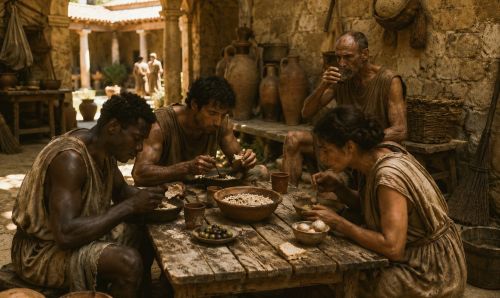
Roman slaves ate grain, beans, oil, olives, weak wine, and scraps, but every meal was shaped by labor, hierarchy, and ownership.

By Matthew A. McIntosh
Public Historian
Brewminate
Introduction: Eating under Ownership
To ask how slaves ate in ancient Rome is to ask more than a question about ingredients. It is to enter one of the most ordinary and revealing spaces of Roman slavery: the daily management of the enslaved body. Roman slaves did not eat as autonomous members of a household, marketplace, or civic community. They ate under ownership. Their food was measured, assigned, withheld, supplemented, scavenged, cooked in constrained circumstances, or received as the remainder of someone else’s abundance. A bowl of porridge, a ration of barley, a handful of beans, a cup of sour wine, or scraps from a banquet table could all belong to the same slave society, but they did not mean the same thing. Food in Roman slavery was not merely sustenance. It was labor policy made edible.
The basic pattern was usually cheap, durable, and high in calories: cereals, legumes, oil, olives, vinegar, salt, seasonal produce, and low-quality wine. Yet there was no single “slave diet” that can be applied evenly across Rome’s long history or vast geography. An enslaved field hand on an Italian estate, a chained worker in a mine, a cook in an aristocratic kitchen, an imperial slave in an urban office, and a child born into a villa household occupied different food worlds. Some lived close to hunger; some received calculated rations meant to preserve their working capacity; some gained access to leftovers, kitchen waste, garden produce, or even foods better than those available to poor free people. The crucial distinction was not always between good food and bad food, but between food chosen and food controlled.
The sources make this history difficult to recover. Enslaved people rarely speak directly in the surviving record, and Roman authors who mention slave food usually do so from the perspective of owners, managers, moralists, satirists, physicians, or legal authorities. Agricultural writers such as Cato, Varro, and Columella provide unusually concrete information about rations, wine, oil, and estate discipline, but they tell us what elite landowners recommended, not necessarily what every enslaved person actually consumed. Archaeology, particularly at Pompeii and Herculaneum, adds another layer by preserving kitchens, storage vessels, carbonized food, servant spaces, bakeries, and traces of beans, fruit, bread, and other foods. Still, even archaeology captures fragments rather than a complete menu. The task is not to reconstruct one universal meal, but to read food as evidence of hierarchy, labor, household organization, and survival.
Eating under Roman slavery was shaped by a recurring logic: slaves were fed according to their perceived usefulness, location, work, status, and proximity to wealth. Roman food culture was expansive, varied, and deeply Mediterranean, but enslaved people encountered it through systems of dependence. Grain and legumes kept bodies moving. Oil and salt made monotony bearable. Lora, sour wine, and leftovers marked social rank in liquid and edible form. Domestic slaves might handle luxury without sharing in its freedom; mine workers might be fed at the edge of bodily collapse; villa slaves might receive enough nourishment to protect an owner’s investment. Across this spectrum, the enslaved meal reveals a central fact of Roman slavery: domination was not only enacted through sale, punishment, or labor, but through the daily power to decide what another person would eat.
Before Rome’s Empire: Grain, Porridge, and the Older Italian Food World

Long before Rome ruled the Mediterranean, Roman eating belonged to an older Italian world of fields, hearths, storage jars, and boiled grain. The food culture that later shaped the rations of slaves did not begin as a specifically “slave” cuisine. It emerged from the practical conditions of central Italian agriculture: cereal cultivation, seasonal scarcity, household production, and the need for foods that could be stored, measured, and stretched. Early Roman identity, as later Romans imagined it, was tied less to imported delicacies than to agricultural austerity. The idealized old Roman was a farmer-citizen, hardened by labor, satisfied with plain food, and morally superior to the luxury of later ages. That nostalgia was never a neutral historical record, but it preserved an important truth: the foundation of Roman diet lay in grain.
The most important early staple was not necessarily bread as later urban Romans knew it, but puls, a thick porridge or gruel made from grain. Puls could be prepared from emmer wheat, barley, millet, or other cereals, depending on availability, price, region, and household status. It could be eaten plain, salted, enriched with legumes, loosened into a thin gruel, thickened into something closer to a paste, flavored with oil, or accompanied by vegetables and small condiments. This flexibility made it one of the most useful foods in a world where harvests, storage, and labor rhythms mattered more than culinary variety. In literary memory, puls became almost a symbol of archaic Roman simplicity. Pliny the Elder later claimed that the Romans lived for a long time on porridge before bread became central to their diet, a statement that should not be read too literally but does point to the deep antiquity of boiled grain in Roman food culture. Porridge was useful because it was adaptable and forgiving. It required less infrastructure than raised bread, could be made in household pots, and could turn coarse, cracked, or mixed grains into a filling meal. It also blurred the line between poverty, practicality, and moral ideal: what elite writers could praise as ancestral toughness could, in the daily life of laborers and dependents, simply be the cheapest way to keep hunger at bay.
This older porridge culture matters for the history of slavery because enslaved diets often represented the lowest-cost, most repetitive, and most controlled version of ordinary staple eating. Slaves were not usually fed strange foods outside Roman norms. They were fed the basic foods of the Roman poor, but under conditions of dependence and coercion. Grain could be measured by the month, issued in bulk, and converted into labor power. Barley, millet, and emmer could be boiled into puls or baked into rough cakes. Legumes such as fava beans, lentils, chickpeas, and peas added substance and protein. The diet was humble, but not automatically irrational. For owners, it was economical; for laborers, it was heavy, repetitive, and sustaining enough to keep them working.
The distinction between bread and porridge also reveals changing structures of Roman society. Bread, became increasingly prominent as milling, baking, urban markets, and public grain networks expanded. In a city like Rome, bread eventually became not only a staple but a civic symbol, tied to markets, bakeries, grain supply, and the politics of feeding the urban population. But in older and more rural contexts, porridge remained a practical staple. It did not require a professional baker, a large oven, carefully prepared leaven, or dependable access to commercial milling. It could be prepared near the place of labor, in estate kitchens, slave quarters, temporary work sites, or simple household spaces. For enslaved agricultural workers, this mattered enormously. A food system built on raw grain and simple cooking allowed owners to shift some of the burden of preparation onto the enslaved themselves. The slave received grain not as a finished meal, but as a ration that still had to be ground, boiled, baked, or otherwise transformed through additional labor. In that sense, even the meal began before eating: in the grinding of grain, the gathering of fuel, the tending of fire, and the conversion of measured allowance into something edible.
Grain was only the base. The older Italian food world was also a world of pulses, vegetables, fruit, oil, salt, and wine. Small gardens produced cabbage, onions, leeks, garlic, herbs, and greens. Orchards and local landscapes supplied figs, apples, pears, nuts, and olives. Legumes were important because they could be dried and stored, making them valuable in lean seasons and useful for feeding laboring bodies. Fava beans carried a complicated cultural history in the ancient Mediterranean, appearing in ordinary diets, ritual contexts, and elite disdain. For the enslaved and poor, their importance was practical. They filled the pot. They stretched grain. They helped make monotonous meals more nourishing.
This does not mean that early or humble Roman food should be romanticized. Roman moralists loved to contrast the sturdy porridge of the ancestors with the corrupt luxuries of their own day, but real subsistence was hard, seasonal, and vulnerable. Harvest failures, war, debt, disease, and unequal access to land shaped what people ate. For enslaved people, these pressures were intensified by the absence of legal freedom. A poor free farmer might endure scarcity, but he did not usually eat from a ration imposed by an owner. An enslaved worker’s bowl of puls belonged to two histories at once: the long history of Mediterranean staple agriculture and the more violent history of human beings treated as managed property.
By the time Rome’s expansion began to flood Italy with enslaved captives and reorganize agricultural production on larger estates, the basic edible grammar was already in place. Cereals supplied calories; legumes supplied bulk and protein; oil, salt, vinegar, and cheap wine made the diet more tolerable; seasonal produce added variety when available. These foods could belong to many social worlds at once. They could appear in the hut of a poor farmer, the kitchen of a modest household, the ration list of an estate manager, or the quarters of enslaved laborers. What changed with the growth of slavery was not the invention of an entirely new cuisine, but the tightening of control over an old one. Foods that had once signified rural endurance, household thrift, or ancestral simplicity could be absorbed into a harsher regime of measurement and command. The same grain that sustained a citizen-farmer could be weighed out to an enslaved field hand. The same porridge praised as a marker of old Roman virtue could become a monotonous instrument of coerced survival. The same beans that nourished the poor could be transformed into the cheapest possible supplement for laboring bodies. Puls, barley cakes, beans, and cheap wine could evoke Roman rustic virtue in elite memory, but in the hands of slaveholders they became instruments of accounting, discipline, and extraction.
The Republican Villa and the Rationed Body

As Rome expanded through Italy and then beyond it, slavery became increasingly tied to the agricultural estate. The Republican villa was not merely a country house or a rustic retreat; it was a workplace, storage center, disciplinary space, and accounting machine. Land, vines, olive trees, animals, tools, buildings, and human beings were all placed within the owner’s calculation of profit. In this setting, food became one of the most direct ways enslaved bodies were converted into labor. The question was not what a slave might want to eat, or what a household might share in common, but what amount of grain, oil, wine, and supplementary food would keep workers alive, obedient, and productive at the lowest sustainable cost. The villa turned older Italian staples into rationed instruments of estate management. A field hand’s meal was not simply a meal; it was part of a broader system that linked acreage, season, crop, supervision, and bodily endurance. The estate owner had to calculate how many workers were needed for harvest, pruning, pressing, digging, hauling, and guarding, and those workers had to be fed in ways that fit the calendar of labor. The more Roman agriculture became organized around surplus, market sale, and elite accumulation, the more the slave ration became one of the hidden foundations of rural profit.
Cato’s De Agricultura is the starkest early witness to this logic. Written in the second century BCE, it presents the estate from the perspective of the landowner who wants efficiency, discipline, and return on investment. Slaves appear alongside oxen, presses, jars, tools, and fields, not as members of a moral community but as necessary parts of production. Cato’s interest in feeding them is real, but it is managerial rather than humane. He gives instructions for grain allowances, wine distributions, oil, olives, clothing, and work routines because the estate depends on regulating consumption. Food is counted because labor is counted. A slave’s ration belongs to the same world as the pruning of vines, the sale of surplus, the repair of equipment, and the supervision of overseers.
The most important ration was grain. Cato recommends monthly allowances that vary according to season and labor demand, with heavier rations for periods of intense work and smaller ones when labor requirements decline. This seasonal adjustment is crucial. It shows that Roman slave feeding was not simply neglectful starvation, though it could be brutally inadequate in many contexts. On a well-managed estate, the owner had an incentive to preserve the working capacity of valuable laborers. But preservation was not generosity. It was an economic calculation. Grain was measured out because the enslaved worker’s body had to be maintained like any other productive asset. The body was fed enough to continue working, but the ration itself reminded the worker that even basic sustenance came through the owner’s authority. The monthly grain allowance also shifted labor onto the enslaved person beyond the formal workday, because raw grain still had to become food. It might need to be ground, soaked, boiled, baked, shared, guarded from theft, or stretched with whatever legumes, greens, oil, vinegar, or scraps were available. In that sense, rationing did not end with distribution. It shaped the daily organization of time, hunger, and domestic labor within the slave quarters themselves. The owner could imagine the ration as a simple entry in an estate account, but for the enslaved worker it became the practical boundary of bodily survival.
Wine, oil, olives, and other supplements followed the same logic of controlled provision. Enslaved workers did not normally drink the fine wine that displayed elite refinement and hospitality. They received inferior wine, sour wine, or weaker products associated with the lower end of estate consumption. Oil could be issued in measured quantities, and olives might supplement the grain ration when other foods were scarce or when the estate produced them in abundance. These were not minor details. Fat, salt, acidity, and flavor made a grain-heavy diet more tolerable and more useful to laboring bodies. They also made the hierarchy of the estate visible. The master’s table, the overseer’s access, the field hand’s ration, and the kitchen’s leftovers formed a descending order of consumption. Everyone might depend on the same estate economy, but they did not eat from it equally.
The Republican villa reveals a central feature of Roman slavery: feeding was both maintenance and domination. The ration kept the enslaved person alive, but it also marked the condition of being owned. It transformed grain into command, oil into calculation, wine into hierarchy, and the meal into a daily reminder of dependence. This does not mean that every estate followed Cato’s recommendations exactly, or that every enslaved agricultural worker received the same diet. Practice surely varied by region, crop, owner, overseer, market access, harvest conditions, and the bargaining power or vulnerability of particular slaves. Yet Cato’s estate manual exposes the governing principle with unusual clarity. In the Republican villa, food was not separate from slavery’s violence. It was one of the quiet forms that violence took.
Puls, Bread, and Barley Cakes: How Slave Food Was Prepared
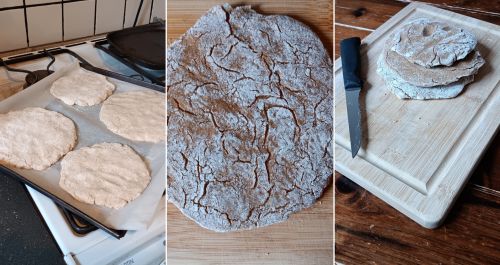
The rationed grain of the Roman villa did not become food by itself. Before it could fill the stomach, it had to be cleaned, ground, mixed, boiled, baked, or otherwise made edible, and that preparation was part of the lived burden of enslavement. Ancient agricultural writers could list grain allowances as if they were simple units of estate management, but the enslaved people who received those rations still had to transform them into meals. This distinction matters. A slave was not necessarily handed a loaf of bread or a cooked bowl of porridge at the end of the day. In many rural settings, the ration began as raw or minimally processed grain, and the labor of preparation fell on the enslaved community itself. Food extended the workday. The body that had been used in the field, vineyard, olive grove, stable, or press room still had to work to make its own sustenance.
The oldest and most practical preparation was puls, the thick grain porridge associated with early Roman food culture. Puls could be made from emmer, barley, millet, or other available grains, and it required only water, a pot, fire, and time. It could be thin and gruel-like or dense enough to hold its shape, depending on the grain, the amount of water, and the length of cooking. It could be eaten plain, but more often it would have been improved, when possible, with salt, oil, legumes, greens, vinegar, or cheap condiments. These additions mattered because porridge was not simply a neutral staple. It was a base that could be made tolerable or intolerable according to what accompanied it. A little oil added fat and smoothness; beans or lentils added substance; greens and onions added sharpness; vinegar and salt gave life to otherwise dull grain. For enslaved laborers, puls had several advantages from the owner’s point of view. It was cheap, filling, and adaptable to grains of lesser quality. It did not require the same infrastructure as commercial bread baking, and it could be prepared in quantity. It also allowed an estate to absorb variation in supply: cracked grain, mixed cereals, inferior barley, or leftovers from storage could still become a hot meal. From the eater’s point of view, those same advantages could also mean monotony. A food that was efficient for the estate could become repetitive in the mouth and heavy in the body, particularly when consumed day after day as the foundation of survival. Puls carried the memory of old Roman simplicity, but for enslaved workers it was less a nostalgic emblem than a practical boundary: what one ate when another person controlled the grain, the fire, and the time.
Bread occupied a more complicated place in slave diet. By the late Republic and imperial period, bread was central to Roman urban food culture, but not all bread was equal and not all slaves had the same access to it. Wheat bread carried higher status than coarser loaves made from barley, mixed grains, or bran-heavy flour. In cities, slaves attached to wealthy households, bakeries, taverns, or public institutions might encounter bread frequently, sometimes as leftovers, work food, or household provision. On rural estates, bread required more organization: grinding, kneading, fuel, ovens, and sometimes specialized labor. Where these resources existed, estate slaves could certainly eat bread. Where they did not, porridge and coarse cakes remained more practical. The issue was not a simple transition from puls to bread, but a hierarchy of preparation, infrastructure, and access.
Grinding was one of the hidden labors behind both porridge and bread. Grain had to be cracked or milled before it could be cooked efficiently, and in many ancient households this was exhausting work. Hand mills, mortars, saddle querns, and later rotary mills turned grain into meal or flour through repetitive bodily effort. Enslaved people were deeply involved in this work, whether for their own meals or for the food of others. In small settings, grinding might be a nightly or morning task attached to the preparation of the next meal. In larger households and estates, it could be more organized and more grueling, folded into the routines of kitchens, storerooms, and work crews. In urban bakeries and mills, the labor could become notably brutal, with slaves and animals powering heavy milling equipment. Literary sources often remembered mills as places of degradation, punishment, and bodily exhaustion, and the association was not accidental. Milling reduced grain to flour, but it also reduced human strength into repetitive motion. The irony is sharp: enslaved workers often labored within the very food system that fed them poorly. They ground grain for households, markets, or masters, while their own meals might remain coarse, rationed, and plain. They helped create the soft bread of urban consumers while eating darker, rougher, or less finished versions of the same cereal economy. The preparation of food was not only domestic labor but a form of production embedded in the larger Roman economy. Before the slave ate grain, another enslaved body may already have carried it, stored it, turned the mill, swept the flour, tended the oven, or cleaned the ash.
Barley cakes and other coarse flatbreads occupied the space between porridge and formal bread. They could be made from barley meal or mixed grain, shaped quickly, and baked on hot stones, in ashes, under embers, or on simple hearth surfaces. Such cakes were portable, durable, and suitable for laborers who needed food that could be carried to fields, road works, pastures, or temporary work sites. Barley itself had a lower status than wheat in much of Roman food culture and was often associated with animals, soldiers under punishment, rural laborers, or poorer diets. Yet it was also useful: hardy, available, and capable of sustaining hard work. For enslaved people, barley cakes may have represented both practicality and social inferiority. They filled the stomach, but they also marked distance from the softer, whiter, more desirable breads of the elite table.
The preparation of slave food reveals how deeply the Roman meal was shaped by labor before it was shaped by taste. Puls, bread, and barley cakes were not just different foods; they were different arrangements of time, tools, fuel, skill, and control. A bowl of puls could be made with minimal infrastructure but offered little variety. A loaf of bread might signal greater access to ovens, mills, or household organization, but it could still be coarse and rationed. A barley cake could travel with the worker, but it also carried the stigma of lower-status grain. In each case, enslaved people ate within limits imposed by owners, overseers, estate resources, and labor demands. The meal was prepared from grain, but it was also prepared by power.
Legumes, Gardens, and the Protein Question

A grain-heavy diet was not necessarily a protein-empty diet. Modern readers often approach ancient poverty through the assumption that meat was the decisive marker of nourishment, but Roman food habits complicate that expectation. Most enslaved people probably ate little meat, and many may have tasted it only rarely, irregularly, or in scraps. Yet protein could come from other sources. Beans, lentils, chickpeas, peas, and related pulses formed one of the most important supports of ordinary Mediterranean nutrition. They were cheaper than meat, easier to store, adaptable to soups and porridges, and capable of stretching a cereal ration into something more substantial. For enslaved laborers, legumes were not a luxury. They were one of the basic ways a monotonous grain diet became more sustaining.
Fava beans deserve particular attention because they occupied such a prominent place in the ancient Mediterranean food world. They were familiar, filling, and durable, and they could be dried for storage or cooked into thick dishes with grain, oil, salt, vinegar, greens, or herbs. Like barley or coarse porridge, fava beans could carry social stigma. Elite writers sometimes treated beans as humble, rustic, or bodily crude, but that disdain says more about social hierarchy than about nutritional value. For the poor and enslaved, beans were useful precisely because they were ordinary. They could be boiled into a soft mash, added to puls, served with oil or vinegar, or combined with other available foods to make a ration more filling. They also worked well within the practical rhythms of estate life. Dried beans could be stored through lean seasons, distributed from estate supplies, cooked in large quantities, and used to thicken meals when grain alone was not enough. Their value lay in their plainness: they did not require elite kitchens, expensive sauces, or delicate handling. A pot of beans could feed laborers cheaply while adding substance to the cereal base on which owners already depended. That made legumes attractive within an economy that sought to preserve working strength without granting abundance. The fava bean was not merely a food but a quiet piece of Roman labor management, humble in appearance but central to the daily maintenance of bodies expected to work.
Gardens added another layer of possibility, though not always security. Roman estates and households often cultivated vegetables, herbs, and fruit trees, and these foods could supplement the cereal-legume base. Cabbage, onions, leeks, garlic, greens, cucumbers, gourds, herbs, figs, apples, pears, nuts, and olives all belonged to the broader world of Roman small-scale food production. Some enslaved workers may have received garden produce as part of estate provisioning; others may have gathered, grown, bartered, or informally accessed it depending on local custom and supervision. Even small additions mattered. An onion, a handful of greens, a few olives, or a piece of fruit could change the taste and nutritional quality of a meal otherwise dominated by grain. But the garden should not be romanticized as a space of autonomy. For the enslaved, access to produce remained conditional. What grew on the estate belonged at the last to the owner.
The protein question leads back to the larger problem of control. A slave diet based on grain and legumes could sustain hard labor, at least in the narrow physiological sense. It might provide calories, some protein, fiber, minerals, and enough bulk to make work possible. But adequate survival is not the same as well-being. Repetition, poor preparation, limited fat, seasonal shortages, spoiled stores, unequal distribution, and the exhaustion of labor could all undermine the apparent nutritional logic of the ration. A bowl of beans and grain may have been healthier than a modern reader first imagines, but it was still a coerced meal. Its adequacy was judged by the owner’s need for continued productivity, not by the enslaved person’s comfort, preference, or dignity.
This is why legumes and garden foods are central to understanding Roman slave eating. They complicate the image of constant starvation without softening the reality of exploitation. Many enslaved people were probably not kept alive on grain alone, and some may have eaten diets that were nutritionally more varied than a simple ration list suggests. Archaeological evidence from sites such as Pompeii has helped sharpen this point by showing that servants and enslaved workers attached to wealthy households or villas might have access to beans, fruits, olives, and other foods beyond the bare cereal ration. But those findings should complicate the picture, not sentimentalize it. Nutritional variety could coexist with coercion. A slave who ate fruit was still owned; a slave who received beans and oil was still being provisioned for someone else’s purpose. Variation was distributed through hierarchy. A favored domestic slave might receive leftovers and fresh produce; a villa worker might receive beans, olives, and seasonal fruit; a mine laborer might receive far less. The question is not whether Roman slaves ever ate nourishing food. Many did. The question is what it meant to be nourished as property. In that sense, the bean pot and the garden patch reveal the same hard truth as the grain ration: Roman slavery fed people in order to use them.
Oil, Olives, Salt, Vinegar, Garum, and the Making of Cheap Food Edible
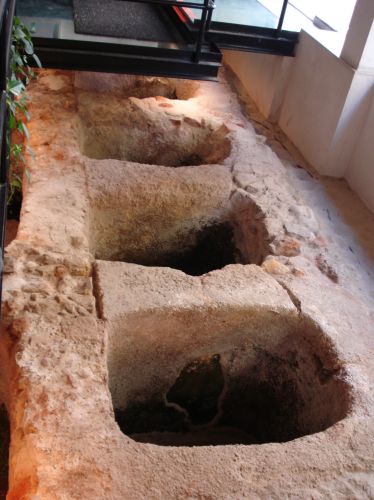
A diet built on grain and legumes could sustain life, but it needed help to become bearable. Roman slave food was not only a matter of calories; it was also a matter of taste, texture, preservation, and bodily usefulness. Puls without salt, beans without oil, barley cakes without anything sharp or fatty, and greens without seasoning would have been difficult to eat repeatedly with any satisfaction. The cheapest flavorings mattered enormously. Oil, olives, salt, vinegar, herbs, and low-grade fermented fish products could transform a dull ration into something more edible. They did not erase the coercion behind the meal, but they made the meal workable. Condiments and small supplements were not decorative extras. They were part of the basic mechanics of feeding laboring bodies cheaply.
Olive oil was important because it added fat to a diet otherwise dominated by cereals and pulses. Fat made food more satisfying, helped carry flavor, and increased the energy value of simple meals. But oil was also valuable, measurable, and marketable, which meant that enslaved workers were unlikely to receive it casually or abundantly. Agricultural writers such as Cato treated oil as something to be distributed in controlled quantities, much like grain and wine. A little oil could soften porridge, dress beans, improve greens, or make coarse bread easier to swallow. Olives themselves could serve a similar function. They were salty, durable, and easy to pair with grain. On an estate that produced olives or oil, enslaved workers may have had more regular access to them, but that access remained governed by ownership. Oil came from the same agricultural world the slaves helped maintain, yet its distribution reminded them that production did not mean possession.
Salt was even more basic. It preserved food, sharpened flavor, supported physical labor, and belonged to the everyday infrastructure of ancient eating. In a hot Mediterranean climate, for people engaged in heavy agricultural work, salt was not simply a seasoning but a bodily necessity. It made bland grain and legumes palatable, helped preserve fish, olives, vegetables, and other foods, and could turn otherwise meager provisions into something sharper and more satisfying. Salt also connected the enslaved meal to wider Roman networks of production and exchange. It came from salt pans, coastal works, mines, trade routes, markets, and state interests, making it one of the quiet infrastructures beneath ordinary eating. Its importance is easy to miss because it appears so ordinary. Yet for enslaved people living on repetitive rations, salt may have been one of the most important differences between food as mere fuel and food as something that could actually be eaten day after day. It sharpened porridge, made beans less dull, helped preserve small fish or olives, and gave bodily support to people sweating through harvest, digging, hauling, grinding, pressing, and carrying. Like grain, salt also reveals Roman food as a system of small controls. The owner did not need to deny all flavor to dominate the enslaved; domination could also take the form of deciding how much flavor was allowed.
Vinegar belonged to the same world of inexpensive usefulness. It was sharp, cheap, and versatile, and it could enliven grain dishes, vegetables, legumes, and watered drinks. In Roman military and labor contexts, vinegar mixed with water was associated with posca, a sour drink of soldiers, workers, and lower-status consumers. For slaves, vinegar may have had several uses at once: flavoring, preservation, refreshment, and a way to make poor water or weak drink more tolerable. It also fit the logic of byproducts that runs throughout slave provisioning. Just as lora came from the remains of wine production, vinegar could emerge from wine that had turned sour or from liquids no longer suitable for elite consumption. What was inferior at the master’s table could become useful in the slave’s bowl or cup. Roman hierarchy did not merely separate luxury from deprivation; it created descending channels through which leftovers, residues, and degraded products moved downward.
Garum and related fish sauces require careful handling because they existed across a wide range of quality and price. The finest fermented fish sauces could be expensive, traded, branded, and prized by elites. But not every fish sauce was a luxury condiment. Cheaper fish sauces, brines, and salted fish products circulated widely in the Roman world and could add intense flavor to otherwise plain food. A small amount could season porridge, beans, greens, or bread, supplying saltiness and savor where meat was absent. This mattered in diets where animal flesh was rare, because fermented fish products could provide the impression of richness without requiring a substantial portion of meat or fish. They could make a pot of legumes seem deeper, a barley cake less dry, or boiled greens less punishingly plain. Enslaved workers were unlikely to receive the best garum, just as they were unlikely to receive the best wine or oil. But lower-grade fish sauces and salty preserved fish products may have entered their diets when geography, price, household practice, or leftovers allowed. Coastal regions, urban households, military supply lines, taverns, markets, and wealthy kitchens all offered different levels of access. A domestic slave cleaning up after a refined meal might encounter fish sauce as residue or leftover; a rural worker far from commercial supply might rarely taste it at all. Here again, the important point is hierarchy rather than simple presence or absence. Roman slaves did not live outside the empire’s food culture; they often encountered its cheaper, rougher, and more residual forms.
These small additions reveal the subtle economy of Roman slave feeding. A ration did not need to be generous to be strategically edible. A little oil could add strength, a few olives could add salt and fat, vinegar could brighten a dull meal, and cheap fish sauce could simulate richness without providing meat. Such flavorings helped owners maintain labor without transforming the slave’s diet into abundance. They also complicate any simple picture of slave food as nothing but dry grain and water. Enslaved people often lived within a food world of improvisation: stretching, seasoning, softening, souring, salting, and making do. Yet the very need for these additions underscores the poverty of the base diet. Condiments made cheap food edible, but they did not make eating free. In the enslaved meal, flavor itself was rationed.
Lora and Slave Wine: Drinking the Afterlife of the Grape

Wine was one of the great markers of Roman civilization, but not all wine carried the same social meaning. At elite tables, wine could signal refinement, hospitality, status, region, age, and taste. It could be mixed, cooled, scented, discussed, collected, and displayed. For enslaved workers, wine usually entered life at the bottom of that hierarchy. They did not normally drink the carefully stored vintage poured for guests or the better household supply reserved for masters and favored dependents. Instead, they received poorer wine, sour wine, diluted wine, or the weak after-product known as lora. In slave provisioning, the grape did not disappear after elite consumption. It continued downward, transformed from luxury into ration.
Lora was made from the remains of winemaking. After the grapes had been pressed for proper wine, the skins, seeds, stems, and pulp still retained some flavor, sugar, and color. Water could be added to this residue and pressed again, producing a thin, weak beverage that carried the memory of wine without its strength or quality. It was not simply “bad wine” in the ordinary sense, but a secondary product of the wine economy, created from what remained after the valuable liquid had already been extracted. This made it well-suited to the logic of slave feeding. It cost little, wasted nothing, and gave laborers something more palatable than plain water. Like bran, sour wine, inferior oil, kitchen scraps, or low-grade fish sauce, lora belonged to the economy of leftovers and residues that structured much of enslaved consumption.
Cato’s agricultural instructions make this hierarchy unusually visible. His estate manual does not imagine enslaved workers as diners sharing in the wine culture of the Roman elite. It treats wine as a provision to be measured and graded according to season, quality, and usefulness. Workers might receive after-wine, sour wine, or inferior wine at particular times of the year, with better supplies reserved elsewhere in the estate economy. That does not mean wine was irrelevant to slaves. On the contrary, its regular appearance in rationing advice shows that owners considered it important. It provided calories, hydration, and morale; it may also have been thought useful for laborers performing hard work in heat or poor conditions. But its distribution reveals precisely the point: even a drink associated with Roman sociability became, in enslaved hands, a managed allowance.
The social meaning of lora depended on contrast. Roman elites often treated wine as a civilized pleasure, bound up with conversation, leisure, literary culture, and the rituals of dining. It belonged to the world of the convivium, where status could be displayed through the quality of the vintage, the order of service, the mixing bowl, the cups, the guests, and the conversation that surrounded drinking. Enslaved workers encountered the same agricultural product in a stripped-down form, after the pleasure and profit had been removed. The master’s wine came first; the slave’s drink came after. This descending order was not incidental. Wine production itself depended heavily on labor: pruning vines, tying shoots, harvesting grapes, carrying baskets, treading, pressing, cleaning vessels, storing amphorae, and maintaining equipment. Enslaved workers could spend the year helping produce wine that they would never drink in its finest form. Lora condensed the contradiction of the villa economy. The slave labored at the source of abundance but consumed its remainder. The vineyard’s hierarchy moved from the field into the cup, turning the act of drinking into a reminder that production and enjoyment were not distributed equally.
The drink also shows how Roman slave diets were shaped by byproducts rather than simply by scarcity. Slaveholders were not always feeding workers from separate food systems; they were often channeling the lower grades of the same production systems downward. The vineyard produced fine wine, ordinary wine, sour wine, vinegar, and lora. The olive grove produced oil of different qualities, olives, pulp, and residues. Grain processing produced flour, coarse meal, bran, and sweepings. Animal slaughter produced prime cuts, offal, fat, bones, and scraps. The enslaved diet often lived among these secondary streams. What was too poor for the master could still be useful for the slave. What was not marketable at a high price could still maintain labor. Lora is one of the clearest examples because it was literally the afterlife of a prestige product.
This does not mean lora was always despised by everyone who drank it, or that enslaved people experienced it only as humiliation. Weak wine and sour drinks could be refreshing when water quality was uncertain or work was physically exhausting. In some contexts, a thin wine-like drink may have been preferable to stale water and useful during hot weather or heavy labor. It may also have broken the monotony of water and grain, offering a small sensory variation in an otherwise repetitive diet. Its alcohol content, if any remained, was likely low, but even that faint association with wine may have mattered socially and psychologically. A cup of lora might warm the body, sharpen a meal, wash down coarse bread, or mark a pause in labor. Enslaved people were not passive digestive machines; they had tastes, memories, preferences, habits, and ways of making the best of what was available. Still, the point is not that every cup of lora was a scene of misery. The point is that the terms of access were unequal. Enslaved workers did not choose lora as one option within a wide world of consumption. They received it because the estate’s hierarchy had already assigned the better wine elsewhere.
Lora belongs near the center of any history of Roman slave food because it makes hierarchy drinkable. It was cheap, practical, and efficient, but it was also symbolic. It showed how the Roman economy could extract value from the grape twice: first for market, household, or elite enjoyment, and then again for the maintenance of labor. The enslaved person’s cup carried the residue of someone else’s abundance. Like puls, barley cakes, beans, olives, vinegar, and low-grade condiments, lora reminds us that slave food was not merely poor food. It was food and drink organized by ownership. To drink lora was to consume the leftover life of the vineyard, transformed by Roman slavery into sustenance without equality.
Household Slaves and the Banquet’s Shadow

If the villa shows slave food as rationed labor maintenance, the elite Roman household reveals another form of inequality: proximity without equality. Domestic slaves lived near abundance. They cooked, carried, poured, carved, cleaned, stored, washed, swept, and disposed of the foods that marked elite status. They saw fine bread, fish, meat, fruit, sauces, wine, sweets, imported delicacies, and elaborate courses move through the house. Yet proximity to luxury did not make them participants in it as free diners. The banquet created a sharply ordered world in which some reclined and consumed while others stood, served, watched, and waited. For household slaves, food was everywhere, but it was not theirs in the same way.
The Roman banquet, or convivium, was one of the clearest stages on which this hierarchy appeared. Elite dining was not only about eating; it was about rank, performance, conversation, display, and control over people and things. Slaves arranged the dining room, prepared dishes, mixed wine, brought water, carried lamps, removed plates, cleaned spills, and responded to commands. Their bodies were part of the dining apparatus. A well-trained cupbearer, cook, server, carver, doorkeeper, or attendant could enhance the prestige of the master just as surely as silverware, costly wine, painted walls, imported fish, or exotic fruit. The smoother the service appeared, the more completely enslaved labor disappeared into the illusion of cultivated leisure. But the slave’s presence at the banquet was asymmetrical. He or she was necessary to the meal’s success while being excluded from the social equality that the meal performed among invited guests. The slave moved through the feast as labor, not company. Even when a domestic slave stood physically close to the couch, the cup, or the serving dish, that closeness only sharpened the distance between service and participation. The banquet depended on enslaved presence, but it also depended on keeping that presence socially subordinate.
Yet domestic service could still alter what enslaved people ate. Household slaves in wealthy homes may have had access to foods unavailable to many field workers: leftover bread, broken pastries, meat scraps, fish bones with flesh remaining, cooked vegetables, sauces, fruit, watered wine, rejected dishes, and kitchen surplus. Cooks and kitchen workers occupied a complicated position. They handled the richest foods in the house and may have been able to taste, divert, salvage, or receive portions that never reached lower-status slaves. Servers might eat after the guests, while cleaners and kitchen assistants might survive on what remained after both master and higher-ranking household staff had taken their share. The result was not equality but a hierarchy of scraps. Even leftovers could be stratified.
This access could make some domestic slaves better fed than rural laborers, mine workers, or even poor free people. A slave in an aristocratic kitchen might encounter meat more often than a free day laborer who had to purchase everything from the market. A favored attendant might receive gifts of food or wine. A skilled cook, educated secretary, nurse, hairdresser, steward, or personal servant might be fed in ways that protected their value and preserved household appearance. The Roman household was not a flat institution; slaves within it occupied ranks shaped by skill, trust, intimacy, age, gender, origin, and the master’s favor. Food helped mark those internal distinctions. To be close to the master’s table could mean better access, but it could also mean closer surveillance, greater vulnerability, and more direct exposure to elite power. A slave who handled luxury might be punished for a dropped cup, a poorly mixed wine, a badly timed course, or a gesture read as insolence. A cook who prepared expensive food might enjoy more opportunities to eat well, but also carried responsibility for pleasing the palate of the household. A personal attendant might receive better leftovers, but only because the master’s favor had temporarily made that slave useful, visible, or pleasing. Better food did not dissolve domination. It could become one of domination’s rewards, distributed unevenly to encourage loyalty, obedience, skill, and competition within the enslaved household itself.
Literary sources often reveal this world through satire, exaggeration, and moral complaint. Petronius’ Satyricon, Juvenal’s satires, and Martial’s epigrams are not documentary accounts of ordinary slave meals, but they are valuable for showing how Romans imagined dining as a theater of inequality. They depict hosts who humiliate dependents, guests who measure status through food, and households where service and consumption are inseparable from domination. These texts must be used carefully because they reflect elite literary conventions, not neutral observation. Still, their jokes and cruelties make sense only in a society where food distribution was socially charged. Who received what bread, what wine, what portion, what leftovers, and what place in the dining room mattered because Roman meals were structured by status from beginning to end.
The household banquet complicates the idea of slave diet as simple deprivation. Some domestic slaves ate better than many other enslaved people. Some may have eaten varied, flavorful, even rich food at times. But this improvement came through dependence, not freedom. Their access to abundance was derivative, conditional, and often humiliating. They ate in the banquet’s shadow: after the guests, below the master, beside the kitchen, from the remains of display. The domestic slave’s diet shows that exploitation could include both hunger and surplus. In Rome, being near luxury did not mean escaping slavery. It meant that even abundance could be organized as a form of ownership.
Public Slaves, Workshops, Bakeries, and Urban Food Economies
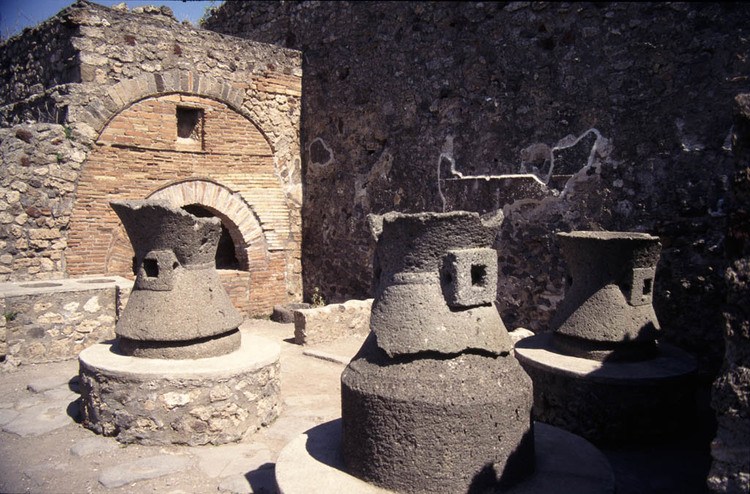
Roman slavery was not confined to villas and private dining rooms. Cities depended on enslaved labor in offices, workshops, warehouses, mills, bakeries, baths, temples, streets, shops, and public institutions. These urban slaves occupied a different food world from the agricultural laborer who received a ration on an estate or the domestic attendant who lived in the shadow of a banquet. The city offered more routes to food, but also more forms of dependency. Bread could be bought from bakeries, meals could be acquired from cookshops, leftovers could circulate through households and taverns, and slaves with limited funds might supplement what they were given. Yet the same city also contained brutal workplaces where food production itself became a site of punishment and exhaustion. Urban life widened the possibilities of eating without removing the condition of ownership.
Public slaves formed one important category within this wider urban landscape. Owned by the Roman state, municipalities, temples, or civic bodies rather than by a single private master, they performed tasks that could include clerical work, maintenance, religious service, execution of public duties, recordkeeping, and assistance to magistrates. Some public slaves may have lived in circumstances less physically brutal than field hands or miners, most importantly if they possessed specialized skills or worked in administrative settings. Their food likely depended on the institution that controlled them, the wages or allowances attached to their tasks, and any unofficial income they could gather. But public ownership did not mean freedom. A public slave might be more visible in civic life than a rural worker, and in some cases might handle money, documents, or tools of public authority, yet his or her subsistence still passed through systems of command. The city could offer mobility and contact, but not autonomy.
Workshops created another set of conditions. Artisans, metalworkers, textile workers, potters, fullers, leather workers, carpenters, and other laborers might be enslaved, free, or freed, often working side by side in mixed environments. This matters because food in the urban economy was not distributed only through household rations. Some enslaved workers may have received meals from employers; others may have been given money or allowances; still others may have depended on the household to which they belonged while spending their days in a shop. Where slaves possessed a peculium, a limited fund or property-like allowance managed under the owner’s authority, they might be able to buy small foods in the market: bread, olives, fruit, cheap cooked dishes, sausage scraps, beans, or watered wine. Such purchases did not make them free consumers in the full sense, but they could allow modest variation within constraint.
Bakeries and mills deserve special attention because they expose the darker side of urban food production. Bread was central to Roman city life, but the work that produced it could be punishing. Grain had to be transported, stored, milled, sifted, mixed, kneaded, shaped, baked, sold, and delivered. In large bakeries, milling could involve heavy rotary mills turned by animals or enslaved workers. Literary references to mill labor often associate it with degradation, darkness, dust, exhaustion, and punishment. To be sent to the mill could mean being consigned to one of the most humiliating and physically destructive forms of labor. The mill was a place where the body disappeared into mechanism: shoulders, arms, backs, and legs converted into circular motion, hour after hour, so that grain could become flour for someone else’s table. Dust filled the lungs, heat came from ovens and enclosed workspaces, and the rhythm of labor was determined by demand rather than appetite. The irony was severe: enslaved workers could spend their lives producing bread for the city while eating coarse rations themselves. Rome’s urban food supply rested not only on grain imports and commercial organization, but on the bodies that turned grain into flour and flour into bread.
The bakery also complicates the relationship between food access and labor. A slave in a bakery might be physically near bread all day, but proximity did not guarantee nourishment. The owner controlled what could be eaten, sold, discarded, or stolen. Some workers may have consumed broken loaves, burnt edges, coarse batches, stale bread, or flour-based meals as part of workplace provisioning. Others may have been tightly supervised to prevent loss. The smell of baking bread, like the sight of banquet dishes in an elite home, could sharpen the inequality between making food and possessing it. A bakery slave’s diet might have been more bread-centered than that of a rural field hand, but it was still structured by labor discipline. The loaf was both product and ration, commodity and meal.
Urban food markets, cookshops, and taverns added further variation. Rome and other large cities contained vendors selling prepared foods to people who lacked kitchens, time, fuel, or household stability. Cheap hot food, bread, pulses, stews, sausages, fish products, fruit, wine, and snacks circulated through streets and neighborhoods. Enslaved people sent on errands, working outside the house, or allowed limited movement could encounter this marketplace directly. A household slave might be sent to purchase food; a workshop slave might buy something with spare coins; a public slave might eat near a workplace; a porter or messenger might consume food on the move. These possibilities are important because they show that urban slaves were not always confined to a single ration bowl. The city created moments of improvisation: a crust bought from a vendor, a cup of cheap wine in a tavern, a handful of olives from a stall, a warm dish eaten between errands, or a little food acquired through tips, favors, petty exchange, or theft. Such moments may have mattered enormously to enslaved people because they offered variety and small choices within a life otherwise governed by command. But the market did not erase hierarchy. It created small openings inside a larger condition of dependence.
The urban economy also blurred the line between slaves, freedpeople, and the free poor. In a crowded city, people of different legal statuses might eat similar cheap foods: bread, beans, lentils, olives, onions, fish sauce, watered wine, and cooked dishes from stalls. A poor free person might live precariously, while a skilled slave in a wealthy household or public office might have steadier access to food. This overlap can mislead modern interpretation if diet is treated as a simple mirror of legal status. The difference was not always visible in the ingredients themselves. It lay in the structure behind them. The free poor might struggle to buy bread; the slave might receive bread or money from an owner, employer, or institution. Both could eat humbly, but only one ate under another person’s legal power.
Urban slaves lived within a more fluid food environment than many rural workers, but not necessarily a kinder one. The city offered leftovers, markets, cookshops, workplace meals, stolen tastes, purchased snacks, institutional allowances, and contact with a wide range of foods. It also contained mills, bakeries, warehouses, and workshops where bodies were consumed by the labor of feeding others. The variety of urban eating should not be mistaken for independence. It shows instead how Roman slavery adapted to the city’s complexity. In the countryside, the ration often appeared as estate accounting; in the household, it appeared as leftovers and proximity; in the city, it appeared through markets, workshops, public service, and food production itself. Urban slave food was less uniform than the villa ration, but it remained governed by the same central fact: the enslaved person’s access to food depended on someone else’s power. A city might multiply the paths by which food reached the enslaved, but it also multiplied the ways enslaved people could be used: as mill hands, porters, clerks, cooks, vendors’ assistants, bath workers, warehouse laborers, and messengers moving through the crowded machinery of urban life. Their diets reflected this complexity. Some ate better than rural field hands; some endured worse conditions than many domestic slaves; many lived between ration, market, leftover, and workplace provision. The city did not abolish the rationed body. It scattered it across streets, shops, ovens, counters, storerooms, and stalls.
The Worst Diets: Mines, Chains, Quarries, and Punitive Labor

At the harshest edge of Roman slavery, food ceased to be maintenance in any generous sense and became the bare minimum required to extract labor from bodies already marked as expendable. Mine workers, quarry laborers, chained field hands, and those condemned to punitive labor lived far from the relatively flexible food worlds of household service or urban markets. Their meals were not shaped by proximity to banquets, access to cookshops, or the possibility of leftovers from a wealthy kitchen. They were shaped by confinement, surveillance, exhaustion, and the brutal economics of replaceability. If the villa ration reveals how slaveholders calculated the maintenance of productive bodies, mines and quarries reveal what happened when the calculation tilted toward rapid consumption rather than long-term preservation.
Ancient descriptions of mining labor are among the darkest evidence for coerced work in the Greco-Roman world. Diodorus Siculus, writing about mines in the Hellenistic and Roman Mediterranean, depicts laborers driven underground in conditions of extreme misery, with little rest, little care, and no meaningful hope of release. Such accounts are rhetorically charged, but they are not merely literary nightmares. Mining was dangerous, hot, dark, cramped, dusty, and physically destructive. Workers broke rock, carried loads, drained water, hauled ore, breathed foul air, and endured injury, disease, and collapse. The body was consumed from several directions at once: by muscular strain, by darkness, by lack of sleep, by punishment, by thirst, and by the constant threat of accident. Food was unlikely to be varied or generous. It needed only to keep laborers moving until they could no longer be used. Grain, coarse bread, gruel, legumes, salt, and perhaps cheap wine or sour drink may have formed the base, but even these could be distributed at levels far below what sustained health. A ration that might have been barely adequate for ordinary labor could become devastating underground, where exertion, heat, fear, and injury raised the body’s needs while the institution lowered its care. The mine pushed the Roman logic of slave provisioning toward its cruelest conclusion: enough food to continue extraction, not enough food to restore the person being extracted from.
Quarry labor followed a similar logic, though often under open sky rather than underground darkness. Stone extraction required cutting, lifting, dragging, shaping, and transporting enormous weights. It demanded strength but also destroyed the body through repetitive strain, accident, heat, and exposure. Enslaved or condemned workers in these places may have received rations closer to those of military labor gangs than domestic households: simple, portable, cheap, and easily supervised. Bread or coarse grain preparations could be issued because they were measurable and durable. Beans or other legumes might supplement the diet when available. Salt and weak drink could support labor under heat. But meat, fresh produce, and flavorful additions were probably limited, irregular, or absent for many. The food had to serve the work, and the work was relentless.
Chained agricultural laborers occupied another severe category. Not all Roman field slaves were chained, but the use of chain gangs and slave prisons on larger estates appears in Roman agricultural and moral writing as part of the landscape of rural discipline. The ergastulum, the workhouse or confinement space associated with dangerous, punished, or tightly controlled slaves, stands as a reminder that the countryside could be carceral as well as productive. Food would have been administered with discipline in mind. The ration was not simply a household provision; it was part of a system that restricted movement, punished resistance, and maximized output. A chained worker might receive grain, bread, beans, oil, or wine according to estate routine, but the social meaning of the meal was sharpened by confinement. To eat in chains was to experience even basic nourishment as an extension of punishment.
Punitive labor also complicates the idea that Roman slave food was always governed by rational investment. Owners had reason to preserve expensive slaves, skilled workers, domestic attendants, stewards, cooks, secretaries, or trained artisans. But some laborers were treated as nearly disposable: war captives, condemned criminals, rebellious slaves, mine workers, or those assigned to dangerous extraction. In these cases, the owner or state might not expect long-term productivity. Food could become meaner, less varied, and less concerned with health. Starvation-level feeding was not the universal Roman slave diet, but it belonged to the construct as one of its possibilities. The same society that could feed a valued urban slave well enough to preserve skill could also grind down a mine worker with rations that merely postponed death. This unevenness is central to understanding Roman slavery. It was not a contradiction within the system but one of its operating principles. The more replaceable the enslaved person seemed, the less incentive there was to nourish them beyond immediate utility. The more remote the workplace, the easier it became for suffering to disappear from elite view. The ration followed the market valuation of the body, not the humanity of the person.
The worst diets also reveal how distance from the household changed the enslaved person’s relationship to food. A domestic slave might negotiate scraps, receive favors, or benefit from the rhythms of kitchen abundance. A workshop slave might purchase something from a stall if movement and money allowed. Even an estate slave might supplement rations with garden produce, olives, or seasonal foods. But mine and quarry laborers were often cut off from these small openings. Their food came through the institution that confined them. This made monotony more extreme and dependence more absolute. Hunger, thirst, bad water, spoiled grain, insufficient fat, and lack of fresh produce could combine with overwork to produce chronic weakness. There was little room for improvisation: no market stall at the edge of the tunnel, no banquet leftovers, no kitchen hierarchy to navigate, no garden patch to supplement a ration. Even if some workers formed solidarities, shared food, or found small ways to endure, the structure itself narrowed possibility. Diet was not merely poor; it was part of the machinery of bodily destruction. The enslaved person did not simply eat less. He or she ate within a world designed to use up strength faster than food could restore it.
The mines, quarries, chain gangs, and punitive labor camps mark the lower boundary of Roman slave eating. They remind us that “slave diet” cannot be reconstructed only from villa manuals, household leftovers, or archaeological traces of better-provisioned servants. Roman slavery contained gradients of nourishment, and those gradients followed the perceived value of the enslaved body. Some slaves were fed to preserve skill, appearance, or household prestige. Others were fed to finish a harvest, turn a mill, pull stone, or survive one more shift underground. At the bottom, food became almost indistinguishable from coercion itself: not a meal in any social sense, but a ration of endurance imposed on bodies that Roman power was prepared to spend.
Pompeii, Herculaneum, and Archaeology: Food Remains from Enslaved Lives
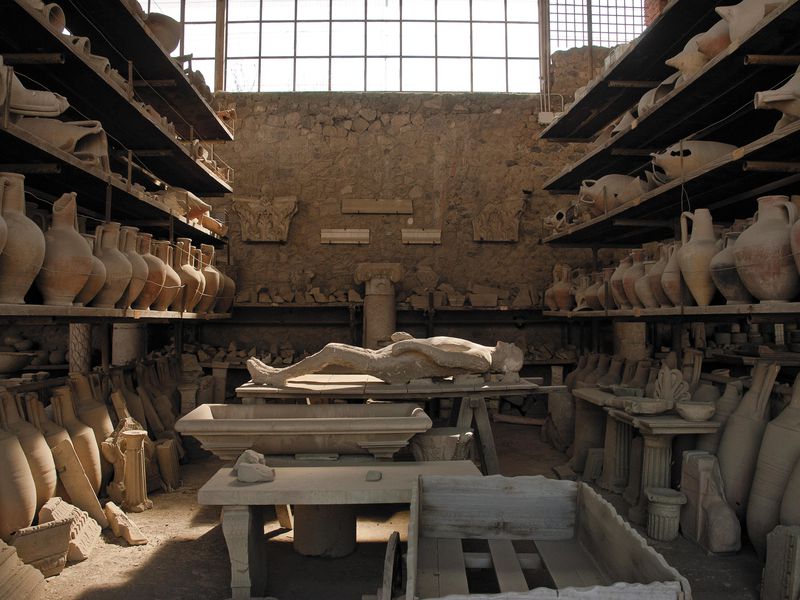
The literary record of Roman slave food is dominated by the voices of owners, managers, satirists, and moralists, but archaeology forces the discussion back toward material life. Pompeii and Herculaneum are important because the eruption of Vesuvius in 79 CE preserved kitchens, storerooms, bakeries, taverns, vessels, carbonized foods, gardens, and domestic spaces with unusual vividness. These sites do not give us the whole Roman world, and they cannot be treated as a perfect image of slavery everywhere. They were prosperous Campanian towns, shaped by local agriculture, trade, elite display, and volcanic catastrophe. Yet they offer something the texts often deny: traces of food close to the places where people actually cooked, stored, served, and ate.
The value of Pompeii and Herculaneum lies partly in their ordinariness. Archaeologists do not find “slave meals” neatly labeled as such. Instead, they find remains that must be interpreted through architecture, household organization, tool placement, storage jars, cooking installations, room size, access routes, and social context. A small back room, a kitchen corner, a service corridor, a stable area, or a crowded sleeping space may reveal more about enslaved life than a grand dining room does. The challenge is that enslaved people often occupied the very spaces designed to make them hard to see: marginal rooms, work areas, passageways, storage zones, sleeping corners, and multipurpose service spaces. Their lives were woven into the functioning of houses and villas rather than memorialized as independent households. Food remains in these settings help shift attention from elite consumption to the people who made elite consumption possible. Carbonized grains, beans, fruits, nuts, olives, bread, bones, amphorae, and cooking vessels show the dense material world in which enslaved and lower-status people lived. They also remind us that Roman slave food was not a theoretical ration only; it was handled, stored, spilled, burned, cooked, and left behind. A pot, a jar, a basket, or a burned loaf can sometimes tell us what a prescriptive agricultural manual cannot: that the daily life of eating was improvised inside the physical arrangements of labor and hierarchy.
Recent finds at the villa of Civita Giuliana, north of Pompeii, are useful here because they connect servant or slave quarters with actual food remains. Reports from the Pompeii Archaeological Park and later coverage describe amphorae containing fava beans and a basket or container of fruit, including pears, apples, or sorbs, associated with the villa’s slave or servant areas. These finds complicate the image of enslaved people living only on dry grain and water. They suggest that at least some enslaved workers attached to wealthy villas could receive or access legumes and fruit, foods that added protein, fiber, flavor, and variety to a cereal-based diet. But the interpretation must remain careful. Beans and fruit do not prove comfort, freedom, or humane treatment. They show provisioning within hierarchy. A better-fed slave was still a slave, and a nutritious ration could still be part of a system designed to preserve labor value.
Pompeii’s broader food archaeology reinforces this complexity. The city and its surrounding villas preserve evidence for cereals, legumes, olives, figs, grapes, nuts, fruits, fish products, and cooked foods sold or consumed in urban spaces. Thermopolia, often loosely described as snack bars or cookshops, show that prepared food circulated through the city outside formal elite dining rooms. A well-publicized thermopolium excavation revealed residues including duck bone, cooked pig, a mixture apparently involving sheep, fish, and land snails, and crushed fava beans, underscoring how archaeological analysis can revise older assumptions about what Roman food shops served. For enslaved people, this urban food economy mattered because some of them worked in, supplied, cleaned, or patronized such places under restricted conditions. Pompeii shows not only household food but a wider street-level food networks in which slaves, freedpeople, workers, travelers, and the poor may have crossed paths.
Herculaneum adds another kind of evidence because scientific analysis of human remains has been used to reconstruct diet at the population level. Such studies do not give us menus in the ordinary sense, nor can they always tell us exactly who was enslaved, free, wealthy, poor, local, or migrant. But they can reveal patterns of food consumption embedded in bone chemistry, showing differences that written sources rarely notice. One major study reported differences in diet between men and women at Herculaneum, with men showing greater consumption of cereals and seafood and women showing more evidence of eggs, dairy, and meat. This does not map directly onto slave status, and it should not be forced into a simple claim about enslaved diets. Its importance is methodological. It shows how isotopic and bioarchaeological evidence can reveal food patterns invisible in literary texts. Diet varied by gender, status, labor, access, household role, and perhaps mobility. A person’s food history could be shaped by where they worked, whether they served inside a house or labored outside it, whether they had access to kitchens or markets, and whether their household assigned them leftovers, rations, purchased foods, or specialized provisions. For enslaved people, these methods open a path toward reconstructing bodily experience without relying entirely on elite authors.
The strongest lesson from Pompeii and Herculaneum is not that Roman slaves “ate well” or “ate badly” in one uniform way. It is that slave eating existed within layered food environments. A villa servant might receive fava beans and fruit; a kitchen worker might handle meat and sauces; a stable hand might eat coarse bread and olives; a bakery worker might live near bread while enduring exhausting labor; a household attendant might eat leftovers from a meal he or she was never invited to share. Archaeology makes this variation visible. It also makes the inequality sharper. The same site can preserve banquet rooms, kitchens, servant spaces, storage jars, and labor areas, showing how close abundance and dependency could be. In a single villa, elite dining rooms and cramped service quarters might sit within the same architectural complex, connected by corridors, thresholds, and routines of command. In a town like Pompeii, the same streets could contain bakeries, cookshops, market stalls, elite houses, workshops, and slave quarters, all participating in a shared food economy without sharing its benefits equally. Archaeology resists both exaggeration and simplification. It does not allow us to say that all enslaved people starved, but neither does it allow us to mistake material variety for justice. In Pompeii, food was not simply distributed by hunger. It was distributed by architecture, rank, work, ownership, and access.
For this reason, archaeology both confirms and corrects the written sources. Cato’s ration lists reveal the managerial logic of feeding enslaved labor. Satire and banquet literature reveal the social theater of unequal consumption. Pompeii and Herculaneum add the material residue: beans in amphorae, fruit in storage, bread in ovens, food in cookshops, bones in containers, vessels in kitchens, and cramped rooms behind elegant spaces. These remains do not speak in full sentences, but they resist abstraction. They show that enslaved people lived amid real foods, not merely categories of “grain” or “ration.” They also remind us that nourishment could coexist with domination. The archaeological record does not soften Roman slavery; it makes its daily operation more concrete. Enslaved people ate beans, fruit, bread, porridge, oil, olives, and leftovers not outside the Roman food system, but inside it, at the points where labor, household order, and ownership met.
Food, Discipline, and Reward

Food in Roman slavery was never only a neutral provision. It was one of the daily mechanisms by which owners, overseers, and household managers organized obedience. The same ration that sustained the body could also discipline it. Grain, oil, wine, olives, beans, leftovers, and occasional treats were distributed through relationships of power, not through equal membership in a household. To feed an enslaved person was to decide how much strength that person should have, when they should receive it, what quality of food they deserved, and whether their conduct, labor, illness, age, or usefulness justified more or less. Food belonged to the ordinary grammar of domination. It did not need to appear spectacularly violent to enforce slavery. Its power lay in repetition.
Agricultural writers reveal this logic most clearly because they describe food as part of estate management. Cato’s rationing advice, for example, does not treat enslaved workers as people with appetites, pleasures, or culinary preferences. It treats them as laboring units whose consumption must be measured against work requirements. Seasonal adjustment of grain allowances, the distribution of inferior wine, and the controlled issue of oil and olives all belong to a practical system in which food was calibrated to productivity. This kind of feeding was not random cruelty, though cruelty could easily inhabit it. It was disciplined calculation. The owner did not merely ask, “What will keep them alive?” but “What will keep them useful at acceptable cost?” That question turned the slave meal into an extension of estate accounting.
Food could also punish. A reduction in rations, the withholding of wine, the denial of oil, or the assignment of especially coarse food could communicate displeasure without requiring formal legal process. In carceral settings such as the ergastulum, or among chained workers and punished laborers, the ration itself could become part of the penalty. Roman sources do not give us a complete schedule of punitive feeding, but the broader logic is clear enough: people whose movement, labor, and bodies were controlled could also have their food controlled. Hunger was an efficient instrument because it was intimate and unavoidable. It worked inside the body. A beating might leave visible marks; a reduced ration weakened more slowly, turning discipline into fatigue, irritability, dependence, and compliance. Punitive feeding also had the advantage of appearing ordinary from the outside. A slave given less grain, worse wine, fewer olives, or no access to kitchen scraps might not be undergoing a dramatic public punishment, but the body would register the penalty all the same. Hunger could be stretched across days, folded into labor routines, and disguised as economy, scarcity, or the overseer’s judgment. It also reinforced the enslaved person’s awareness that survival itself was conditional. The next meal could be smaller because of resistance, suspected laziness, illness interpreted as uselessness, a failed task, a broken tool, or simply an owner’s anger. In that sense, food discipline worked not only through actual deprivation but through anticipation. The possibility of hunger made obedience bodily before any punishment was imposed.
But food was not only a weapon of deprivation. It could also reward. A favored household slave might receive better leftovers, a cup of better wine, access to fresh bread, fruit, meat scraps, oil, or a place closer to the kitchen’s surplus. Skilled slaves such as cooks, stewards, secretaries, tutors, nurses, or personal attendants might be fed better because their work required trust, appearance, training, or intimacy. Even on estates, overseers or higher-ranking slaves may have had better access to provisions than ordinary field hands. Such rewards did not soften the structure of slavery; they helped maintain it. Unequal distribution encouraged competition, dependence, and loyalty. It reminded the enslaved that better food came not as a right but as favor. The master’s generosity, when it appeared, reinforced the master’s authority.
This hierarchy of food also operated within the enslaved community itself. Roman households and estates were rarely made up of undifferentiated masses of slaves. They contained ranks: vilici and overseers, cooks and kitchen assistants, personal attendants and stable hands, tutors and porters, wet nurses and field workers, skilled artisans and punished laborers. Food helped make these distinctions visible. The person who handled the storeroom might have opportunities unavailable to the person locked in a workhouse. The cook might taste sauces never served to a field hand. The trusted attendant might eat from leftovers before lower-status slaves received anything. These internal inequalities could produce resentment, negotiation, alliance, theft, and small acts of strategy. Enslaved people were not passive recipients of rationing; they lived within it, maneuvered around it, and sometimes used the small spaces it left open.
The central point is that Roman slave food was governed by power even when it was nutritionally adequate or occasionally generous. A slave might be hungry, but a slave might also be fed well enough to work, trained well enough to serve, or favored enough to eat richly at times. None of those possibilities removed the condition of ownership. Food became one of the ways Roman slavery translated domination into everyday life: punishment through hunger, reward through leftovers, discipline through measurement, hierarchy through quality, and dependence through the simple fact that the next meal came from someone else’s decision. The slave ration was not merely a response to hunger. It was a political act inside the household, estate, workshop, and city.
Gender, Age, Children, and the Household Food Order
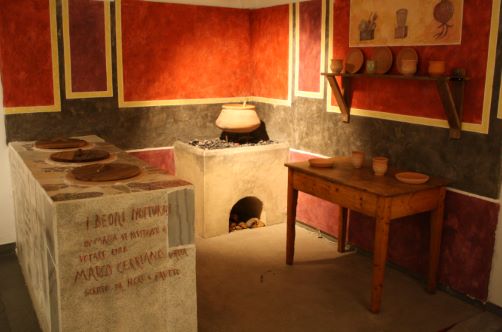
Slave food in Rome was shaped not only by work and location, but also by gender, age, bodily condition, and household role. The enslaved population was not made up only of adult male field hands, even though agricultural manuals often make that figure seem central. Roman households and estates contained women, men, children, infants, elderly people, wet nurses, cooks, textile workers, cleaners, attendants, porters, tutors, stewards, stable hands, and laborers at many levels of physical strength and social visibility. Their diets could differ sharply. A young child born into slavery, an elderly slave no longer able to work, a pregnant woman, a wet nurse, a kitchen assistant, and a male vine-worker did not occupy the same nutritional world. The household food order was also a bodily order, sorting people according to usefulness, vulnerability, intimacy, and expected labor.
Enslaved women’s access to food depended heavily on where they worked. Women assigned to kitchens, storage areas, textile rooms, nurseries, bathing spaces, or personal service might live closer to household food supplies than women performing agricultural labor. That proximity could provide opportunities: tasting, receiving leftovers, handling vegetables, preparing porridge, controlling small scraps, or participating in the informal circulation of food among servants. A woman working near the kitchen might know when bread was stale but still edible, which fruit was bruised, which beans could be stretched into another meal, and which scraps could be passed quietly to a child, partner, friend, or fellow slave. But proximity could also mean stricter supervision. A kitchen slave who handled desirable foods might be watched closely for theft or waste. A personal attendant might receive better provisions because she reflected the status of the household, but that same closeness to the master or mistress could expose her to surveillance, sexual vulnerability, emotional demands, and sudden punishment. Access to food was rarely separable from exposure to power. For enslaved women, the path toward better food could run through the most dangerous parts of the household: intimacy, service, visibility, and dependence.
Women who labored in the fields or on estates likely experienced food more like male agricultural workers, though with additional burdens that male-centered sources often obscure. They could be expected to weed, harvest, carry, process, spin, prepare food, tend children, and perform household labor after field labor ended. Their nutritional needs might increase during pregnancy, lactation, illness, or recovery from childbirth, but Roman slaveholders did not necessarily respond to those needs from compassion. If owners improved the food of pregnant women or nursing mothers, it was often because reproductive capacity and infant survival had economic value. The enslaved woman’s body could be treated as both laboring body and reproductive asset. Food in this setting sustained not only work but the future reproduction of the slave household itself.
Wet nurses occupy one of the most revealing positions in this food order. In Roman elite households, enslaved or dependent women could nurse freeborn children, sometimes becoming emotionally important figures within the household while remaining socially subordinate. Their diet mattered because the infant’s health was believed to depend on the quality of the nurse’s milk, and ancient medical writers paid close attention to nursing bodies, temperament, regimen, and food. A wet nurse might receive better or more regulated food than other enslaved women, not because she possessed greater freedom, but because her body had become nutritionally linked to a valued child. Her meals could be watched, corrected, and interpreted through the needs of someone else’s baby. Foods thought to strengthen milk, avoid illness, steady the body, or preserve the nurse’s usefulness could become part of a disciplined regimen. This made the wet nurse’s position both privileged and deeply constrained. She might be better fed than a field worker or kitchen drudge, but the improvement came through a sharper form of bodily management. Her eating was monitored for someone else’s future. Here the politics of slave food became intimate: the enslaved woman’s diet was managed through the body of the child she fed.
Children born into slavery are harder to see in the evidence, but they were central to the household food order. They had to be fed before they could become useful, and that made their survival a question of household calculation. Some slave children may have grown up near kitchens, nurseries, workshops, or sleeping quarters, eating softened grain, porridge, bread soaked in liquid, legumes, fruit, milk when available, and leftovers suited to small children. Others may have survived on whatever the enslaved community could stretch from adult rations. Their diets were probably shaped by the status of their mothers, the wealth of the household, the owner’s interest in raising slave children, and the availability of women able to nurse or care for them. Childhood did not remove slavery’s hierarchy. It merely placed dependence inside dependence: the child depended on an enslaved mother or caregiver, while both depended on the owner’s provisioning.
Age also mattered at the other end of life. Elderly slaves, disabled slaves, and those no longer able to perform heavy labor occupied an uncertain place in the economy of feeding. Agricultural writers could be chillingly practical about unproductive bodies, and Roman slaveholders had incentives to reduce the cost of those who no longer produced value. Some older slaves may have remained useful as caretakers, guards, cooks, supervisors of children, textile workers, or household attendants; others may have been neglected, sold, abandoned, or given reduced provisions. Food exposed the cruelty of utility. As long as an enslaved person’s body could be made useful, nourishment could be justified as maintenance. When usefulness declined, the ration could shrink with it. Old age under slavery was not simply biological decline, but a dangerous change in economic meaning.
Inside the household, these distinctions created a complex food hierarchy. The master’s table stood at the top, but below it were many layers: elite guests, free dependents, freedpersons, favored slaves, skilled domestic staff, kitchen workers, ordinary household slaves, field workers, punished slaves, children, the sick, and the elderly. Food moved downward through this hierarchy in different forms: formal rations, kitchen scraps, leftovers, special allowances, medicinal foods, festival meals, stolen bites, and rewards. It also moved sideways through informal networks among enslaved people themselves, as food was shared, hidden, bartered, protected, or quietly redirected toward those most in need. Gender and age shaped where a person stood in that movement. A young male laborer might receive more grain because he was expected to work hard; a wet nurse might receive regulated food because she fed an infant; an elderly woman might survive on leftovers because she no longer counted as productive; a child might eat what its mother could obtain. These arrangements could produce small solidarities as well as sharp inequalities. A kitchen worker might become important within the enslaved community because she had access to scraps; an overseer might control food in ways that made him feared; a child might depend on the hidden generosity of adults who had little enough themselves. The household food order was not fixed, but it was never neutral. It taught everyone where they stood.
To study gender, age, and children in Roman slave eating is to see the limits of any single “slave diet.” The enslaved were fed according to work, but also according to bodies: strong bodies, reproductive bodies, nursing bodies, growing bodies, aging bodies, punished bodies, trusted bodies, and inconvenient bodies. Some received more because they were valuable; some received less because they were expendable; some gained access through kitchens, nurseries, or intimacy; others were pushed to the margins of household provisioning. This does not fragment the larger argument. It sharpens it. Roman slavery did not simply ration food to slaves as a mass. It sorted nourishment through the household’s judgments about usefulness, dependence, and control.
Slave Food and Free Poverty: Was the Difference Always Obvious?

The difference between enslaved and free people in Rome was legally immense, but it was not always obvious from the contents of a bowl. Many poor free Romans also lived on grain, bread, porridge, legumes, olives, onions, cheap wine, fish sauce, seasonal fruit, and whatever cooked foods they could afford from markets or street vendors. Meat was often irregular, quality varied, and hunger was not limited to the enslaved. In crowded cities, on marginal farms, and among day laborers, free poverty could produce diets that looked very similar to slave rations. A poor free worker and an enslaved laborer might both eat coarse bread, beans, and watered wine. Their food could overlap even when their social condition did not.
This overlap matters because it prevents us from treating diet as a simple map of legal status. Some slaves, especially those in wealthy households, public service, skilled occupations, or trusted domestic roles, may have eaten better than many poor free people. A cook in an aristocratic kitchen might handle meat, sauces, fish, fruit, and wine more often than a free casual laborer could afford them. A favored attendant might receive leftovers from a banquet, while a poor citizen bought only bread and olives. A slave attached to a prosperous villa might receive beans, fruit, oil, and wine as part of a controlled provisioning system, while a free tenant farmer faced uncertainty after a bad harvest or a failed market day. The Roman world did not always distribute food according to legal dignity. It often distributed it according to wealth, household access, labor value, market position, and proximity to abundance.
Yet this comparison can easily mislead if it becomes too focused on calories or ingredients. The fundamental difference was not simply what was eaten, but how food was obtained. The poor free person might suffer hunger, debt, insecurity, and dependence on patrons, wages, markets, or public distributions, but his or her food was not normally issued as the ration of owned property. The enslaved person’s meal came through the authority of a master, overseer, household manager, institution, or workplace. Even when the food was sufficient, even when it included fruit, oil, or meat scraps, it remained embedded in coercion. A free laborer might buy cheap bread with uncertain wages, receive help from a patron, wait for a distribution, or go hungry after work failed. These were harsh forms of dependence, but they did not usually give another person the legal right to command the laborer’s body, sell him, punish him, separate him from family, or reduce his ration as discipline. The enslaved person’s food, by contrast, was tied to a larger condition in which the body itself had been absorbed into another person’s household, estate, or institution. The difference was not always visible in the meal itself. It was visible in the power behind the meal. The free poor could be miserable and hungry, but they were not legally edible units of another person’s estate account. The slave’s bowl was filled from someone else’s right of command.
This is why the question “did some slaves eat better than free people?” must be answered carefully. Yes, in some cases they probably did. But the answer does not weaken the argument that slave food was a form of domination. It strengthens it by showing that deprivation alone is not the defining feature of enslaved eating. Roman slavery could feed people adequately, even generously at times, when doing so served household prestige, labor efficiency, reproductive value, or skilled service. A well-fed slave was not a contradiction. A well-fed slave was often a better investment. Food could preserve a cook’s skill, a nurse’s milk, a secretary’s usefulness, a steward’s reliability, or a field hand’s strength. The apparent improvement in diet still took place inside ownership, and ownership gave every meal a different meaning.
The comparison with free poverty sharpens the central interpretation. Roman slave food was not always the worst food in Roman society, and enslaved people were not always the hungriest people in the Roman world. But they ate under conditions that transformed nourishment into dependency. Free poverty exposed people to market failure, patronage, low wages, and scarcity; slavery exposed people to command over the body itself. The ingredients might overlap, but the relationship behind them differed. A loaf of coarse bread, a bowl of beans, or a cup of cheap wine could sit in the hands of a free poor laborer or an enslaved worker and look nearly identical. But one was purchased, begged, earned, or received within precarious freedom; the other was allotted within ownership. The visible meal could be the same. The social meaning was not.
Late Republic to Empire: Scale, Supply, and the Mediterranean Food Machine
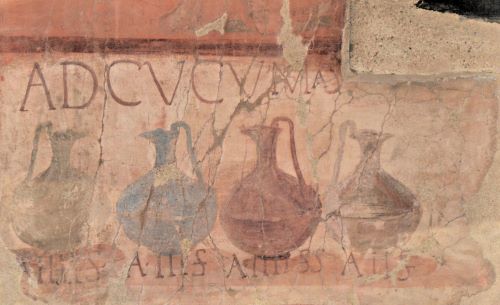
By the late Republic, Rome’s food world had grown far beyond the older Italian household economy of porridge, gardens, and local grain. Conquest expanded the scale of everything: landholding, enslavement, taxation, trade, urban population, military supply, and elite consumption. The result was not merely a larger version of the old Roman diet, but a Mediterranean food machine in which grain, oil, wine, fish products, animals, slaves, ships, amphorae, markets, and state power moved together. Enslaved people stood at nearly every point in that system. They cultivated fields, harvested grapes and olives, tended animals, worked presses, carried loads, turned mills, baked bread, cleaned kitchens, served banquets, labored in warehouses, and consumed the lower grades of the foods they helped produce. Roman slave food cannot be understood apart from this imperial scale.
The growth of large estates in Italy and the provinces transformed the relationship between food production and slave labor. War captives, purchased slaves, and locally enslaved workers could be concentrated on villas, plantations, mines, workshops, and urban households. In some regions, enslaved labor helped produce commercial crops for wider markets: wine, olive oil, grain, and other agricultural goods. These foods were not produced only for immediate household use. They moved through storage facilities, ports, contracts, merchant networks, and elite investment strategies. A slave on a wine estate might receive lora while helping produce wine for sale or display. A worker on an olive estate might receive a measured amount of oil while laboring in the groves that generated far more valuable oil for the market. A grain worker might harvest, thresh, carry, and store cereals that would later feed cities, armies, or other estates, while receiving a ration calculated from the same crop economy. This was one of the defining ironies of Roman agricultural slavery: enslaved people were not merely excluded from abundance; they were used to create it. Their own meals often came back to them in reduced, measured, or inferior form. The enslaved diet was connected to the same structure that created Roman abundance, but usually from the bottom end of the chain.
Rome itself intensified these connections. As the city grew into a metropolis, it required enormous and regular supplies of grain, oil, wine, and other foods. The urban food supply drew on Sicily, Sardinia, North Africa, Egypt, Spain, Gaul, and other parts of the Mediterranean. Grain ships, warehouses, bakeries, markets, and distributions became part of the infrastructure of imperial survival. Enslaved labor did not simply feed the countryside; it helped feed the city. Slaves worked in transport, storage, milling, baking, retail, domestic service, and cleanup. They also ate within the city’s food economy, sometimes from rations, sometimes from leftovers, sometimes from markets, sometimes from institutional allowances. The empire’s food machine fed enslaved people unevenly while depending on them heavily.
This scale also changed the meaning of ordinary slave foods. Grain was no longer only the produce of a nearby field; it could be an imperial commodity moved across seas. Oil might come from local groves or from great provincial production zones. Wine could be household-made, regionally traded, or imported. Garum and salted fish products moved through commercial circuits that tied coastal production to inland consumption. Amphorae, stamps, shipwrecks, warehouses, and refuse heaps all testify to a food economy larger than any single household. Even the humblest foods could carry the imprint of distance: a slave’s oil might reflect estate production in one region, a fish sauce might come through networks of coastal processing and trade, and grain might be connected to taxation, rent, purchase, or imperial supply. Yet the slave’s meal often reduced this vastness to a simple ration: a measure of grain, a cup of weak wine, a little oil, a few olives, some beans, a coarse loaf. The world behind the meal could be enormous, but the meal itself remained constrained. Empire made variety possible, but hierarchy decided who received it. The Mediterranean could be wide, but the enslaved bowl remained narrow.
Imperial scale did not create uniformity. Slaves in North Africa, Italy, Egypt, Spain, Gaul, Greece, and the eastern provinces did not all eat the same foods in the same proportions. Local crops, climate, trade access, household wealth, labor type, and cultural habits shaped diet. A slave in an olive-producing region might have more regular contact with oil and olives; one near coastal fish-processing zones might encounter salted fish products more often; one in a grain-producing estate might live on cereals with fewer supplements; one in an urban household might eat a more mixed diet of leftovers and market foods. Environmental conditions mattered as much as legal status. A dry region, a fertile valley, a port city, a military frontier, and an inland estate all created different possibilities for provisioning. Even within the same province, a skilled household slave, a seasonal agricultural worker, a quarry laborer, and a child in a villa household could experience very different diets. The Roman Empire was not a single kitchen. It was a network of regional food systems held together by power, trade, taxation, and labor. Slavery operated through that diversity rather than replacing it.
The imperial economy also sharpened the contrast between production and consumption. Rome’s elites could imagine themselves as masters of a world of abundance: Spanish fish sauce, Campanian wine, African oil, Egyptian grain, eastern spices, Italian fruits, and carefully staged banquets. Enslaved people helped make that abundance possible but were rarely invited into it except as workers, servers, or recipients of leftovers and byproducts. This was one of the central contradictions of Roman food culture. The same construct that expanded culinary possibilities also deepened inequalities of access. Slaves were not outside Roman civilization’s food achievements; they were embedded in them. They planted, harvested, pressed, carried, cooked, served, and cleaned up after the very abundance that marked their exclusion.
From the late Republic into the Empire, Roman slave food became part of a much larger story of Mediterranean integration. The ration of grain on a villa, the lora in a laborer’s cup, the beans in a servant’s storage jar, the stale bread in a bakery, the oil measured out to workers, and the leftovers from an urban banquet were all connected to networks of conquest, commerce, and command. Rome’s food machine did not merely feed people. It sorted them. It transformed geography into hierarchy, crops into profit, labor into calories, and empire into daily meals. For enslaved people, the Mediterranean abundance of Rome was experienced not as equal participation but as controlled access. The empire widened the table, but it did not give everyone a seat.
Are We Over-Systematizing the Roman Slave Diet?
The following video from “Quicklearn: AI Makes You Smarter” covers the Roman slave diet:
“The Roman slave diet” may be too orderly a phrase for evidence that is scattered, uneven, and often indirect. Rome’s world lasted for centuries, stretched across the Mediterranean, and contained radically different forms of enslavement. An enslaved vineyard worker in Republican Italy, a domestic servant in Pompeii, a mine laborer in Spain, an imperial slave in Rome, a child in a villa household, and a woman nursing an elite infant did not share a single food regime. The sources themselves make the problem worse. Agricultural manuals describe ideals of management, not daily reality. Satire exaggerates. Archaeology preserves accidents. Legal texts abstract lived experience into categories. Even bioarchaeological evidence can reveal diet without always identifying legal status. To speak too confidently of “how Roman slaves ate” risks turning a varied and fragmentary history into an artificial system.
Cato is a particularly important danger. His rationing advice is invaluable because it gives concrete information about grain, wine, oil, olives, and estate management, but it is also prescriptive, elite, Italian, and managerial. It tells us what one Roman landowner thought an estate should do, not what every estate actually did. Owners could be more generous, more negligent, more brutal, more flexible, or more improvisational than Cato’s model suggests. Local harvests, market prices, climate, crop specialization, labor shortages, slave resistance, overseer behavior, household culture, and emergency conditions all shaped what enslaved people actually received. A ration list may look precise on the page, but the lived meal could be altered by theft, spoilage, kindness, punishment, scarcity, bargaining, leftovers, or informal sharing among slaves themselves. Even the act of issuing grain did not guarantee a fixed meal, because rations still had to pass through grinding, cooking, fuel availability, storage conditions, and the social life of the slave quarters. One enslaved group might stretch grain with beans and greens; another might lose part of its allowance to an overseer’s corruption; another might benefit from a good harvest or suffer from mold, pests, or shortage. The danger is not that Cato is useless; the danger is that his clarity can seduce us into mistaking estate theory for the whole Roman world. His text should be treated as a window into the logic of elite management, not as a census of enslaved experience.
Pompeii and Herculaneum present a different but related problem. Their preservation is extraordinary, but that very extraordinariness can distort interpretation. Campanian towns buried by Vesuvius were not average Roman communities frozen for our convenience. They were particular places with particular economies, architectures, households, and patterns of wealth. The presence of beans, fruits, bread, cookshops, gardens, and service spaces can illuminate enslaved food access, but it cannot prove that all Roman slaves ate similarly. A villa servant’s fava beans do not tell us what a quarry worker ate. A thermopolium’s food remains do not tell us what a chained estate laborer could buy. Isotopic evidence from Herculaneum reveals population-level dietary patterns, but it does not always separate enslaved from free, rich from poor, or domestic from industrial labor. The interpretation of rooms and remains can also be uncertain: a cramped space may have housed slaves, servants, workers, animals, stores, or some combination of these; a jar of beans might represent a ration, a household supply, a commercial product, or temporary storage. Archaeology is powerful precisely because it gives material detail, but material detail does not always explain social status by itself. It requires inference, and inference must remain disciplined. Archaeology should complicate the written sources, not replace one simplification with another.
This challenge modifies my central argument in an important way. The conclusion should not be that Roman slaves ate one standard diet of grain, beans, lora, oil, and leftovers. Some did, some did not, and many probably moved between different food experiences over a lifetime. Enslaved people were sold, transferred, punished, promoted, urbanized, ruralized, trained, displaced, born into households, or sent into harsher work. Their food changed with these movements. The better interpretation is that Roman slavery produced a spectrum of coerced provisioning. At one end were the starved, chained, punished, and expendable. At another were skilled, favored, domestic, or publicly owned slaves whose food could be steadier or richer than that of many free poor people. Between them stood the majority of enslaved lives we can only partially reconstruct: fed enough to work, sometimes supplemented, sometimes deprived, always dependent.
This counterpoint ultimately strengthens rather than weakens the main interpretation. The most revealing fact is not uniformity but control. Roman slave food varied by region, labor, household, gender, age, skill, and status, but that variation itself followed structures of ownership. Food could be rationed, improved, withheld, degraded, supplemented, stolen, shared, or received as favor. It could preserve a valuable cook, sustain a wet nurse, punish a chained laborer, maintain a field hand, or use up a mine worker. The construct was not one menu; it was a hierarchy of access. To avoid over-systematizing the Roman slave diet, we should speak not of a single enslaved cuisine but of food under command. The Roman slave meal was diverse in content, but unified by dependence: whatever filled the bowl, someone else had the recognized power to decide whether it would be filled at all.
Conclusion: The Taste of Unfreedom
The food of enslaved people in ancient Rome was rarely exotic. It was usually made from the basic materials of the Mediterranean poor: grain, porridge, coarse bread, barley cakes, beans, lentils, chickpeas, olives, oil, salt, vinegar, weak wine, fruit, greens, scraps, and occasional meat or fish. These foods could sustain life, and in some circumstances they could even form a nutritionally adequate diet. But the central fact was not simply what appeared in the bowl. It was who controlled the bowl. To eat as a slave was to eat under another person’s authority, whether that meant a measured grain ration on a villa, leftovers from a banquet, lora after the pressing of grapes, beans stored in servant quarters, or a coarse meal issued in a mine or workhouse.
I have argued that Roman slave food should be understood not as one uniform diet, but as a hierarchy of coerced provisioning. The enslaved did not all eat alike. Domestic slaves in wealthy households might encounter leftovers, fruit, wine, and meat scraps. Villa workers might receive grain, legumes, olives, oil, and weak wine calculated around agricultural labor. Urban slaves might move between household rations, market foods, bakery work, workshop meals, and small purchases. Wet nurses, children, elderly slaves, punished laborers, cooks, public slaves, and mine workers all occupied different nutritional positions. Yet the variation itself followed the logic of ownership. Food was distributed according to usefulness, proximity, trust, discipline, bodily condition, and economic value.
The Roman slave meal reveals the ordinary intimacy of domination. Slavery was not only visible in chains, markets, beatings, or legal status. It was visible in the daily ration, the withheld cup of wine, the inferior oil, the leftover crust, the pot of beans, the sour drink, and the difference between the food one produced and the food one was allowed to consume. A slave might be starved, adequately fed, or even favored with better food, but none of those conditions erased dependency. Nourishment could preserve labor, reward obedience, protect investment, sustain reproduction, or mark household rank. Even generosity, when it appeared, remained trapped inside power. A better meal could still be a managed meal.
To study how Roman slaves ate is to see Roman society from below and from within. The empire’s grand food systems depended on enslaved labor while distributing abundance unequally. This included its grain ships, vineyards, olive groves, bakeries, markets, kitchens, banquets, and warehouses. Enslaved people lived inside that food world, but rarely on their own terms. They planted, harvested, ground, baked, cooked, poured, served, cleaned, carried, and stored the foods that sustained Roman civilization. Their own meals carried the taste of that contradiction. In a bowl of puls, a cup of lora, a handful of beans, or a scrap from the master’s table, Roman slavery made itself ordinary, bodily, and inescapably present.
Bibliography
Affiliate disclosure: Amazon links on this site are paid links. As an Amazon Associate I earn from qualifying purchases.
- Allison, Penelope M. Pompeian Households: An Analysis of the Material Culture. Los Angeles: Cotsen Institute of Archaeology, University of California, Los Angeles, 2004.
- Apuleius. The Golden Ass: Being the Metamorphoses of Lucius Apuleius. Translated by P. G. Walsh. Oxford: Oxford University Press, 1994.
- Berry, Joanne. The Complete Pompeii. London: Thames & Hudson, 2007.
- Bradley, Keith R. Discovering the Roman Family: Studies in Roman Social History. Oxford: Oxford University Press, 1991.
- —-. Slavery and Society at Rome. Cambridge: Cambridge University Press, 1994.
- Brown, Madeline. “Grain, Pulses and Olives: An Attempt toward a Quantitative Approach to Diet in Ancient Rome.” Journal of the Washington Academy of Sciences 97:1 (2011), 1-24.
- Cato the Elder. On Agriculture. In Cato and Varro: On Agriculture, translated by W. D. Hooper and Harrison Boyd Ash. Cambridge, MA: Harvard University Press, 1934.
- Columella, Lucius Junius Moderatus. On Agriculture. Translated by E. S. Forster and Edward H. Heffner. 3 vols. Cambridge, MA: Harvard University Press, 1941–1955.
- Curtis, Robert I. Ancient Food Technology. Leiden: Brill, 2001.
- —-. Garum and Salsamenta: Production and Commerce in Materia Medica. Leiden: Brill, 1991.
- D’Arms, John H. “The Roman Convivium and the Idea of Equality.” In Sympotica: A Symposium on the Symposion, edited by Oswyn Murray, 308–320. Oxford: Clarendon Press, 1990.
- Dalby, Andrew. Food in the Ancient World from A to Z. London: Routledge, 2003.
- Diodorus Siculus. Library of History. Translated by C. H. Oldfather. Cambridge, MA: Harvard University Press (Loeb Classical Library), 1957.
- Dixon, Suzanne. The Roman Family. Baltimore: Johns Hopkins University Press, 1992.
- Donahue, John F. “Toward a Typology of Roman Public Feasting.” The American Journal of Philology 124:3 (2003), 423-441.
- Dunbabin, Katherine M. D. The Roman Banquet: Images of Conviviality. Cambridge: Cambridge University Press, 2003.
- Easton, Jeffrey. “Mostly Work and Some Play: Assessing the Associative Behaviors of the Roman Municipal familia publica.” Historia: Zeitschrift für Alte Geschichte 70:2 (2021), 242-266.
- Erdkamp, Paul. The Grain Market in the Roman Empire: A Social, Political and Economic Study. Cambridge: Cambridge University Press, 2005.
- Evans, J. K. “Wheat Production and Its Social Consequences in the Roman World.” The Classical Quarterly 31:2 (1981), 428-442.
- Fitzgerald, William. Slavery and the Roman Literary Imagination. Cambridge: Cambridge University Press, 2000.
- Flohr, Miko. The World of the Fullo: Work, Economy, and Society in Roman Italy. Oxford: Oxford University Press, 2013.
- Garnsey, Peter. Famine and Food Supply in the Graeco-Roman World: Responses to Risk and Crisis. Cambridge: Cambridge University Press, 1988.
- —-. Food and Society in Classical Antiquity. Cambridge: Cambridge University Press, 1999.
- Grant, Mark. Roman Cookery: Ancient Recipes for Modern Kitchens. London: Serif, 1999.
- Harper, Kyle. Slavery in the Late Roman World, AD 275–425. Cambridge: Cambridge University Press, 2011.
- Holleran, Claire. Shopping in Ancient Rome: The Retail Trade in the Late Republic and the Principate. Oxford: Oxford University Press, 2012.
- Hopkins, Keith. Conquerors and Slaves. Cambridge: Cambridge University Press, 1978.
- Jashemski, Wilhelmina F., Frederick G. Meyer, and Massumino Ricciardi, eds. The Natural History of Pompeii. Cambridge: Cambridge University Press, 2002.
- Joshel, Sandra R. “Nurturing the Master’s Child: Slavery and the Roman Child-Nurse.” Signs 12:1 (1986), 3-22.
- —-. Slavery in the Roman World. Cambridge: Cambridge University Press, 2010.
- Junkelmann, Marcus. Panis Militaris: Die Ernährung des römischen Soldaten. Mainz: Philipp von Zabern, 1997.
- Juvenal. The Satires. Translated by Niall Rudd. Oxford: Oxford University Press, 1991.
- Kehoe, Dennis P. Investment, Profit, and Tenancy: The Jurists and the Roman Agrarian Economy. Ann Arbor: University of Michigan Press, 1997.
- Laes, Christian. “Child Slaves at Work in Roman Antiquity.” Ancient Society 38 (2008), 235-283.
- López, Pedro and Barja de Quiroga. “Freedmen Social Mobility in Roman Italy.” Historia: Zeitschrift für Alte Geschichte 44:3 (1995), 326-348.
- Martial, Epigrams. E. Capps, T. E. Page, and W. H. D. Rouse, eds. London: William Heinemann, 1919.
- Mattingly, David J. Imperialism, Power, and Identity: Experiencing the Roman Empire. Princeton, NJ: Princeton University Press, 2011.
- Meyer, Frederick G. “Carbonized Food Plants of Pompeii, Herculaneum, and the Villa at Torre Annunziata.” Economic Botany 34:4 (1980), 401–437.
- Patterson, Orlando. Slavery and Social Death: A Comparative Study. Cambridge, MA: Harvard University Press, 1982.
- Petronius. Satyricon. Translated by Gareth Schmeling. Loeb Classical Library. Cambridge, MA: Harvard University Press, 2020.
- Pliny the Elder. Natural History. Translated by H. Rackham et al. Cambridge, MA: Harvard University Press, 1938–1962.
- Pompeii Archaeological Park. The Excavations of Civita Giuliana.
- Purcell, Nicholas. “The Way We Used to Eat: Diet, Community, and History at Rome.” American Journal of Philology 124:3 (2003), 329–358.
- Rawson, Beryl. Children and Childhood in Roman Italy. Oxford: Oxford University Press, 2006.
- Roller, Matthew B. Dining Posture in Ancient Rome: Bodies, Values, and Status. Princeton, NJ: Princeton University Press, 2006.
- Scheidel, Walter, and Steven J. Friesen. “The Size of the Economy and the Distribution of Income in the Roman Empire.” Journal of Roman Studies 99 (2009), 61–91.
- Seneca. Epistulae Morales ad Lucilium. Richard M. Gummere, trans. London: William Heinemann, 1917.
- Soranus. Gynecology. Translated by Owsei Temkin. Baltimore: Johns Hopkins University Press, 1956.
- Tchernia, André. The Romans and Trade. Translated by Helen Slater. Oxford: Oxford University Press, 2016.
- Temin, Peter. The Roman Market Economy. Princeton: Princeton University Press, 2012.
- Thompson, F. H. The Archaeology of Greek and Roman Slavery. London: Duckworth, 2003.
- Treggiari, Susan. Roman Marriage: Iusti Coniuges from the Time of Cicero to the Time of Ulpian. Oxford: Oxford University Press, 1991.
- Ulpian. The Digest of Justinian. Edited by Theodor Mommsen and Paul Krueger. Translated by Alan Watson. Philadelphia: University of Pennsylvania Press, 1985.
- Varro, Marcus Terentius. On Agriculture. Translated by W. D. Hooper and Harrison Boyd Ash. Loeb Classical Library. Cambridge, MA: Harvard University Press, 1934.
- Verboven, Koenraad. “The Associative Order: Status and Ethos among Roman Businessmen in the Late Republic and Early Empire.” Athenaeum 95:2 (2007), 861–893.
- Vössing, Konrad. Mensa Regia: Das Bankett beim hellenistischen König und beim römischen Kaiser. Munich: K. G. Saur, 2004.
- Wallace-Hadrill, Andrew. Herculaneum: Past and Future. London: Frances Lincoln, 2011.
- Westermann, William Linn. “Slave Maintenance and Slave Revolts.” Classical Philology 40:1 (1945), 1-10.
- White, K. D. Roman Farming. Ithaca, NY: Cornell University Press, 1970.
- Wilkins, John, and Shaun Hill. Food in the Ancient World. Malden, MA: Blackwell, 2006.
- Woolf, Greg. Rome: An Empire’s Story. Oxford: Oxford University Press, 2012.
Originally published by Brewminate, 06.12.2025, under the terms of a Creative Commons Attribution-NonCommercial-NoDerivatives 4.0 International license.
About the Author