In 738, Quiriguá’s ruler captured and decapitated Copán’s celebrated king, 18 Rabbit. His death ended one political order and gave both cities a new history to carve in stone.

By Matthew A. McIntosh
Public Historian
Brewminate
Introduction: 113 Days from Triumph to Death
On January 10, 738 CE, Waxaklajuun Ubaah K’awiil dedicated the final form of Copán’s great ballcourt. Framed by sculpted macaws and furnished with inscribed benches, the court represented one of the culminating achievements of a reign already distinguished by extraordinary artistic patronage. Its completion proclaimed that the king still commanded the labor, materials, ritual knowledge, and skilled artisans required to reshape the ceremonial center. Nothing in the surviving dedicatory inscription anticipates an approaching catastrophe. Yet only 113 days later, Waxaklajuun Ubaah K’awiil was dead, ritually decapitated at Quiriguá under the authority of K’ak’ Tiliw Chan Yopaat, a ruler whose accession he had previously supervised. The abrupt passage from ceremonial achievement to captive death makes the spring of 738 one of the most dramatic reversals preserved in Classic Maya history.
Waxaklajuun Ubaah K’awiil had ruled since 695 as the thirteenth king of a dynasty founded nearly three centuries earlier by K’inich Yax K’uk’ Mo’. The familiar name “18 Rabbit” survives from an earlier stage in the decipherment of Maya writing; his name is now understood more accurately as referring to the eighteen images or manifestations of K’awiil, a deity closely associated with royal authority, lightning, and generative power. During more than four decades on the throne, he commissioned a sequence of stelae whose deeply undercut figures appear almost to emerge from the stone. Elaborate headdresses, supernatural beings, ceremonial implements, and layers of symbolic costume transformed each royal portrait into a vision of the king inhabiting several sacred identities at once. These monuments were not passive decorations or flattering likenesses. They materialized the ruler’s capacity to communicate with ancestors, renew the ordered universe, and embody the community during public rites. By distributing his stelae across Copán’s ceremonial landscape and associating them with temples, plazas, and calendrical observances, Waxaklajuun Ubaah K’awiil made his own represented body a permanent feature of the city. His capture consequently threatened more than a line of succession: it exposed the vulnerability of a political system that had invested exceptional meaning in one royal person.
The inscriptions do not explain precisely how the ruler of a substantially smaller kingdom accomplished this feat. Quiriguá’s monuments repeatedly commemorate the decapitation on May 3, 738, while Copán’s later Hieroglyphic Stairway states more guardedly that its king died “with his flint, with his shield.” Neither version supplies a conventional account of armies meeting in battle, and archaeology has revealed no corresponding destruction of either capital. Suggestions that Waxaklajuun Ubaah K’awiil was ambushed while campaigning, intercepted while seeking captives, or defeated with direct military assistance from Calakmul remain reconstructions assembled from incomplete evidence. The distinction between what the inscriptions record and what modern scholars infer will remain essential throughout this history.
Copán did not disappear when its king died. K’ak’ Joplaj Chan K’awiil succeeded him on June 11, only thirty-nine days after the execution, demonstrating that Quiriguá had killed an overlord without extinguishing his dynasty. Copán retained a large population, considerable productive capacity, and political institutions capable of sustaining royal government, although the interruption in major freestanding royal monuments reveals that continuity did not mean confidence. Quiriguá, meanwhile, converted the sacrifice into the central legitimating event of its independence and eventually filled an enlarged Great Plaza with monuments proclaiming K’ak’ Tiliw’s sacred power. Copán later answered by incorporating the dead king into a restored dynastic history, presenting him as a warrior ancestor rather than an abject captive. The execution of 738 should therefore be understood as a rupture in the regional political order rather than the instantaneous collapse of one city and effortless elevation of another. Its deepest consequence was the struggle that followed, as both kingdoms claimed the authority to decide what the death of Waxaklajuun Ubaah K’awiil meant.
Two Cities Joined by an Unequal Dynasty
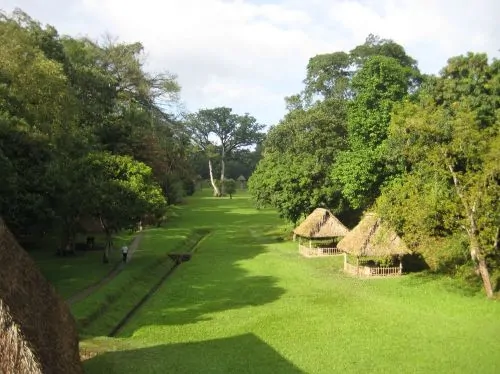
Copán and Quiriguá were separated by approximately fifty kilometers, but the terrain between them placed the two centers in distinct geographical worlds. Copán occupied a fertile upland valley in what is now western Honduras, where its rulers developed a densely settled capital surrounded by agricultural communities and subordinate centers. Quiriguá stood to the north on the broad floodplain of the Motagua River in present-day Guatemala, close to a major corridor connecting the Maya highlands, Caribbean coast, and southeastern lowlands. Their difference in scale was substantial: Copán eventually supported a population many times larger than that of Quiriguá and possessed a far more extensive royal acropolis. They were not simply neighboring cities that happened to compete for the same territory. For more than three centuries, they belonged to a shared political history in which Quiriguá retained its own ruling house while acknowledging the supremacy of Copán’s dynasty.
The surviving accounts of their relationship begin with events in 426 and 427 CE, although the monuments recording them were erected centuries afterward. Copán’s Altar Q presents K’inich Yax K’uk’ Mo’ as the founder of a sequence of sixteen rulers, each shown seated upon the glyph representing his name. Its inscription states that the founder received royal authority at an unidentified place in September 426 and arrived at Copán approximately five months later. Quiriguá’s Zoomorph P, dedicated in 795, reaches back to the same foundational moment but inserts another figure into the narrative. This ruler, conventionally nicknamed Tok Casper because the full reading of his name remains uncertain, received authority under the supervision of K’inich Yax K’uk’ Mo’ and became the founder of Quiriguá’s royal line. The two retrospective histories therefore represented Copán and Quiriguá as products of a coordinated political expansion rather than entirely independent dynastic creations. Because Altar Q and Zoomorph P were commissioned by later kings with their own claims to legitimize, their version of the fifth century cannot be treated as an unedited contemporary record. Even so, the agreement between the texts and excavated evidence makes the central relationship difficult to dismiss: Quiriguá’s dynasty possessed its own antiquity, but that antiquity was remembered as beginning beneath Copán’s authority.
Archaeology gives physical substance to this paired foundation without resolving every question raised by the inscriptions. The Hunal Tomb beneath Copán’s Acropolis probably contained K’inich Yax K’uk’ Mo’, an elderly man who had suffered several injuries and whose isotopic profile indicates that he grew up outside the Copán Valley. At Quiriguá, a stone-lined crypt dating to approximately 450 held another adult male beneath the earliest eastern shrine of the acropolis, a placement consistent with the burial and continuing veneration of a dynastic founder. Both men possessed notched teeth inlaid with jade, and both burials became the focus of superimposed buildings renewed by later generations. These parallels support the memory of connected foundations, although they do not prove that the two rulers were relatives or that every detail preserved on the later monuments was historically exact.
Quiriguá’s location helps explain why Copán’s founder would have wanted a loyal dynasty established there. The Motagua River was one of the most important avenues of movement across the southeastern Maya region, carrying people and commodities between inland production zones and the Caribbean. Archaeological reconstruction indicates that an ancient channel once passed close to the western side of Quiriguá’s ceremonial center, while a silted feature near the site core has been interpreted as a river landing. Occupation of this position gave Quiriguá access to networks through which cacao, obsidian, jade, ceramics, and other valued materials circulated. It is tempting to describe the city as a customs station through which Copán extracted a fixed share of all trade, but the surviving evidence cannot demonstrate such an organized monopoly. Quiriguá also occupied an extensive agricultural floodplain whose productivity supported its own population and royal projects. Its economic importance came from the combination of fertile land and riverine access rather than from trade alone. Copán’s supremacy probably allowed its court to benefit from labor, tribute, diplomatic influence, or preferential movement through this corridor, but the quantities and mechanisms remain unknown. Quiriguá was consequently an important partner in Copán’s regional power even while it remained politically subordinate to it.
That subordination did not prevent Quiriguá from developing a durable local identity. Its damaged Early Classic monuments preserve only fragments of the earliest succession, but they confirm that local rulers continued after the founder and commissioned their own ceremonial works. Altar L, dedicated in 652 by K’awiil Yopaat, names Copán’s twelfth ruler, K’ak’ Uti’ Witz’ K’awiil, in a context consistent with acknowledged overlordship. Conversely, numerous pottery vessels manufactured in the Quiriguá region were placed in the mid-sixth-century tomb associated with Copán’s eighth king, suggesting exchange sufficiently meaningful to become part of a royal funeral. By approximately 650, Quiriguá had rebuilt its acropolis after a catastrophic flood and added a ballcourt, new ceremonial buildings, and a renewed shrine over the probable founder’s burial. The relationship therefore combined domination with sustained material exchange and a shared language of dynastic commemoration.
Modern terms such as “vassal,” “satellite,” and “dependency” describe parts of this arrangement without capturing it completely. Copán did not administer Quiriguá as a bureaucratic province, nor is there evidence that officials dispatched from Copán governed every aspect of life along the Motagua. Supremacy was expressed through supervised accessions, unequal titles, ceremonial appearances, and public acknowledgment of the Copán king’s superior standing. Such authority was real, but it depended upon relationships that had to be performed and renewed by successive rulers. Under K’ak’ Uti’ Witz’ K’awiil, whose reign from 628 to 695 marked an apogee in Copán’s regional power, Quiriguá still commemorated its own kings while accepting their inferior position. When Waxaklajuun Ubaah K’awiil supervised the accession of K’ak’ Tiliw Chan Yopaat in 724 or 725, he reenacted a hierarchy traced back to the two dynastic founders. Yet a subordinate king with ancestral legitimacy, control of local labor, and command of a strategically placed community was not an official whom Copán could necessarily replace at will. The same arrangement that extended Copán’s influence therefore preserved the institutional means by which Quiriguá could eventually reject it.
Waxaklajuun Ubaah K’awiil and the Making of a Divine Ruler
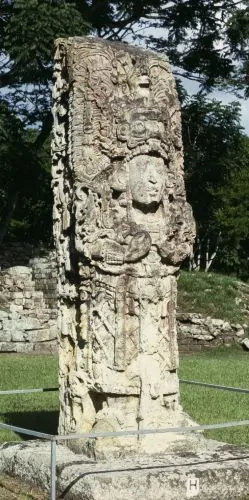
When Waxaklajuun Ubaah K’awiil acceded to Copán’s throne in 695 CE, he became the thirteenth ruler of a dynasty already nearly three centuries old. He inherited institutions, sacred places, and ancestral histories that gave the kingship its authority, but inheritance did not make that authority self-sustaining. Every ruler had to reactivate the dynasty through ceremonies that joined his living body to deceased kings, patron gods, and the ordered movements of time. Waxaklajuun Ubaah K’awiil’s name, conventionally translated as “Eighteen Images of K’awiil” or “Eighteen Faces of K’awiil,” associated him with a supernatural being closely connected to lightning, fertility, dynastic continuity, and royal power. The older nickname “18 Rabbit” preserves an early misunderstanding of the name glyph and obscures the religious claim embedded within it. Across a reign lasting more than four decades, the king’s court transformed that claim into a sustained visual argument: Copán’s ruler was the human center through whom ancestral legitimacy and supernatural potency entered the political world.
Classic Maya inscriptions designated such a ruler as a k’uhul ajaw, commonly translated as “holy lord” or “divine king.” The English expression can be misleading if it suggests that Maya kings were permanently identical to gods or worshiped in precisely the same manner as timeless supernatural beings. Stephen Houston and David Stuart have shown that Classic Maya kingship instead rested upon a more flexible relationship among human identity, sacred substance, ancestral presence, and ritual manifestation. A holy lord remained mortal: he was born, underwent accession, shed blood, suffered military defeat, and eventually died. During carefully staged ceremonies, he could wear the regalia of a deity, reenact a primordial event, communicate with ancestors, or make a supernatural persona visible through his own body. Costumes and masks did more than conceal the man beneath them; they expanded his person by incorporating beings, substances, and histories upon which his authority depended. Royal divinity was therefore neither a purely theological abstraction nor an immutable personal attribute. It was an accomplishment repeatedly produced through titulature, ritual knowledge, bodily discipline, precious materials, controlled access, and public recognition.
Stela J, erected near Copán’s eastern approach early in the reign, reveals how deliberately this authority was constructed. Unlike the later monuments for which Waxaklajuun Ubaah K’awiil became famous, it does not present a towering portrait of the king. Its unusually interlaced inscription has long been understood as evoking a woven mat, one of Mesoamerica’s most enduring signs of government and legitimate office. By marking an entrance into the royal center with dynastic writing rather than a monumental body, Stela J announced that visitors were entering a place ordered by kingship before the subsequent stelae made that kingship overwhelmingly personal.
The later sequence (conventionally comprising Stelae C, F, 4, H, A, B, and D) placed the ruler’s body at the center of Copán’s ceremonial landscape. Erected principally for major calendrical endings between 711 and 736, these monuments were not simply commemorative portraits set up at irregular moments of royal vanity. Their deep undercutting, swelling volumes, and elaborate surface carving caused the king to project outward from the stone, while the dense regalia surrounding him dissolved the boundary between human figure and supernatural assemblage. Headdresses carried divine faces and ancestral references; ceremonial bars and serpentine forms generated small beings; ornaments transformed breath, blood, maize, and lightning into visible attributes of rule. On Stela H, Waxaklajuun Ubaah K’awiil appears in a persona most often associated with the Maize God, his netted garment and vegetal imagery linking royal performance to agricultural regeneration and creation. On Stela D, the final stela of the sequence, an aged supernatural identity gives the ruler’s body a radically different temporal character, as though the king could encompass both youthful renewal and primordial antiquity. These images are better understood as extensions of royal personhood than as illustrations of an actor merely pretending to be someone else. Within Classic Maya conceptions of representation, a carved image could preserve a name, presence, and capacity for action beyond the duration of the original ceremony. Elizabeth Newsome consequently interprets the serial stelae as a coordinated program joining period endings, cosmic renewal, sacred trees, and the king’s ritual transformations. Some elements of that reconstruction remain open to debate, particularly where surviving imagery is made to support a single continuous mythology, but the broader pattern is unmistakable: the sequence made temporal order appear dependent upon the ruler’s repeated embodiment of sacred identities.
Stela A extended this carefully fashioned authority beyond Copán itself. Dedicated in 731, its inscription brought together emblematic references associated with Copán, Tikal, Palenque, and the Snake dynasty centered at Calakmul. Earlier scholarship sometimes treated the passage as a list of the four capitals that governed the Maya world, but Simon Martin’s reassessment cautions against converting an ideological arrangement into a formal league or an exact map of geopolitical supremacy. The fourfold grouping drew upon a cosmological language of completeness in which political space could be imagined through ordered quarters and central points. By placing Copán within that elevated company, the monument presented Waxaklajuun Ubaah K’awiil’s kingdom not as a remote southeastern court but as one of the places through which universal political order could be articulated.
The making of this divine ruler was never the work of the ruler alone. Sculptors, scribes, priests, architects, courtiers, quarry workers, porters, and tributary communities converted royal claims into stone, ceremony, and collective memory. Their labor does not diminish Waxaklajuun Ubaah K’awiil’s importance, but it warns against treating every iconographic decision as the expression of an individual artistic mind. His public person was a courtly production, fashioned through specialized knowledge and validated by audiences whose presence completed the performance. That production proved extraordinarily successful: by the 730s, Copán’s ceremonial center represented kingship through one of the most complex surviving bodies of royal sculpture in the ancient Americas. Yet its success created a corresponding vulnerability, because the political order had been concentrated so visibly in the named and costumed body of one man. Capturing that body could therefore signify more than defeating an army, while destroying it could be presented as the reversal of an entire sacred order. Before that vulnerability was exposed at Quiriguá, Waxaklajuun Ubaah K’awiil’s court carried the same royal theology outward into temples, plazas, stairways, and the Great Ballcourt, making the kingdom itself an architectural extension of its divine ruler.
A Kingdom Made Visible
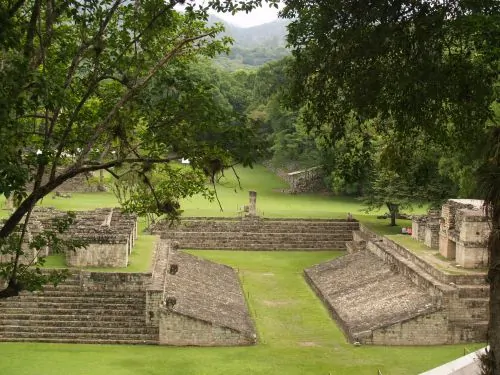
Waxaklajuun Ubaah K’awiil’s sacred authority acquired much of its force because it occupied space. Copán’s monuments did not merely describe a political order already secured through other means; they helped create that order by directing movement, distinguishing public from restricted places, and presenting royal history as a permanent feature of the landscape. The open Great Plaza displayed the king before large audiences, whereas the elevated courts and chambers of the Acropolis placed other ceremonies behind architectural thresholds. Between them stood structures associated with dynastic commemoration and the ballgame, connecting public spectacle to more restricted forms of ritual knowledge. These settings transformed the ruler’s ceremonies into an experience of the kingdom itself. To approach Copán’s center was to enter a world in which carved stone, built elevation, and ceremonial movement continually returned attention to the dynasty.
The Great Plaza provided the broadest stage for this political vision. Waxaklajuun Ubaah K’awiil’s portrait stelae were distributed through a space already marked by earlier buildings and monuments, allowing his court to appropriate dynastic history without erasing it. Each new stela commemorated a major calendrical ending, but its meaning extended beyond the date recorded in its inscription. The standing image presented the king as an axis joining different levels of the cosmos, while an associated altar offered a lower surface upon which offerings, incense, blood, or other ritual materials could be placed. Their contrasting forms joined the enduring royal body to acts that had to be renewed. Deep carving encouraged shadows to move across the ruler’s regalia as daylight changed, making the image appear less like a flat record than a presence activated by its surroundings. Because the carving continued around multiple faces of the monuments, complete apprehension required movement rather than a single fixed viewpoint. Processions and spectators would therefore have encountered Waxaklajuun Ubaah K’awiil repeatedly as they crossed or circled the plaza, although the precise routes followed during particular ceremonies cannot now be reconstructed. The Great Plaza was public in comparison with the Acropolis, but public visibility did not imply unrestricted participation: access, proximity, and ritual roles almost certainly remained socially graded.
The king also used architecture to bind his reign to that of his immediate predecessor. Around 710, he commissioned an early version of the Hieroglyphic Stairway on Structure 10L-26, associated with the burial monument of K’ahk’ Uti’ Witz’ K’awiil. The enormous stairway visible today was substantially enlarged and rededicated by Copán’s fifteenth ruler in 755, so it should not be attributed in its entirety to Waxaklajuun Ubaah K’awiil. His original intervention was nevertheless significant: it converted the burial of a former king into an ascending dynastic text and presented the new ruler as both heir to the dead and custodian of Copán’s historical memory.
Temple 22, dedicated in 715 after Waxaklajuun Ubaah K’awiil had completed approximately twenty years in office, carried this architectural rhetoric much further. Standing on the northern side of the Acropolis’s East Court, the temple was approached through a setting more controlled than the Great Plaza and elevated above those permitted to remain below. Its surviving hieroglyphic step speaks in the first person of the ruler’s completion of his k’atun, binding the building to the measured duration of his reign. Sculpted masks identified the structure as a witz, or sacred mountain, while the great supernatural form surrounding its entrance transformed the doorway into the opening of a cave. Repeated maize beings and other images of fertility extended across the façade, integrating mountain, vegetation, rulership, and ordered time. Crossing the threshold therefore enacted a passage into a concentrated model of the living universe rather than an entrance into an ordinary chamber. Restricted ceremonies conducted within may have included bloodletting, offerings, and communication with divine or ancestral beings, although the specific sequence of rites is not preserved. Jennifer von Schwerin’s reconstruction argues that the temple represented more than a generic mountain of creation: its imagery assembled a fertile and regulated cosmos around a historically specific Copán king. Architecture made a political proposition appear natural by presenting Waxaklajuun Ubaah K’awiil’s reign as part of the structure of the world.
Temple 22 also demonstrates how cautiously Copán’s architectural achievement must be reconstructed. Much of its exterior collapsed, leaving thousands of carved fragments whose original positions have been recovered through archaeological analysis, comparison, and informed experimentation rather than through an intact façade. Other buildings attributed to the reign, including Structures 10L-20 and 10L-21, were badly damaged or lost as the Copán River eroded the eastern side of the Acropolis. The surviving monuments consequently offer only a partial measure of the king’s building program. They also conceal the human expenditure behind royal imagery: quarrying stone, shaping blocks, producing lime plaster, transporting materials, and maintaining laborers required organized access to substantial resources. The inscriptions assign achievement to the king, but the physical kingdom was made visible through the obligations and expertise of a much larger population.
The Great Ballcourt brought public architecture, dynastic memory, and ritual competition together on an exceptional scale. Ballcourt A had developed through several earlier phases, some associated with the dynasty’s founder, before Waxaklajuun Ubaah K’awiil remodeled one version and then replaced it with the final court known as A-III. Its position between the Great Plaza and the Acropolis made it a spatial hinge connecting the city’s principal monumental zones. Parallel buildings enclosed a long playing alley with sloping benches, creating an arena in which participants could be watched from elevated positions and in which movement, impact, sound, and ceremony became inseparable. Macaw imagery dominated the court: prominent stone heads marked its sides, while reconstructions of the upper architectural sculpture identify sixteen mosaic birds distributed across the flanking buildings. Some carried signs associated with darkness, encouraging interpretations of the macaw as a solar being descending into an underworld setting. Yet the court should not be reduced to a single allegory of light defeating darkness or treated as a direct illustration of the much later Popol Vuh. Classic Maya ballgames could express several related ideas, including royal competition, warfare, sacrifice, fertility, ancestral commemoration, and negotiation between courts. At Copán, references to the founder and a great macaw deity gave those meanings a specifically dynastic form. Waxaklajuun Ubaah K’awiil was not simply providing a facility for play; he was claiming ownership of an arena in which dangerous competition could be contained, performed, and resolved beneath royal authority. Using the calendrical correlation followed here, the completed court was dedicated on January 10, 738, only 113 days before his execution. The later suggestion that he was captured while seeking prisoners for another dedicatory ceremony is dramatically appealing, but no surviving inscription establishes that motive.
The ballcourt’s completion marked the culmination of a program that had unfolded across nearly the whole of Waxaklajuun Ubaah K’awiil’s reign. Stelae made his changing ritual personae visible at successive calendrical endings, temples embedded his authority in sacred geography, and the ballcourt represented him as master of controlled conflict. This architectural crescendo should not be mistaken for proof that Copán’s political position was unchallenged, since monumental confidence can coexist with external danger and internal dependence. It does show that the court possessed the resources and specialized knowledge required to state its claims with extraordinary force. That very concentration of authority in the ruler’s images and buildings magnified the consequences when his body fell into enemy hands. Quiriguá’s victory would soon demonstrate that monumental language could be seized as well as inherited, allowing a former subordinate to answer Copán’s kingdom of stone with an even more audacious sculptural landscape of its own.
The Vassal Who Began to Act Like a King
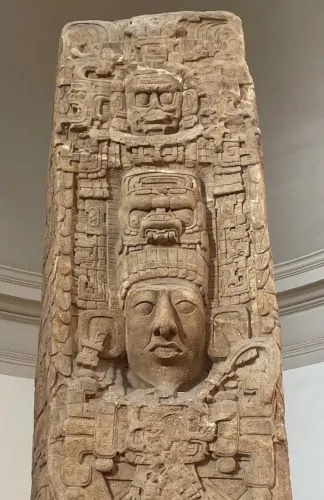
Calling K’ak’ Tiliw Chan Yopaat a vassal captures the inequality between Quiriguá and Copán, but it should not import an entire European feudal system into Classic Maya politics. Subordination was expressed through such acts as supervised accessions, restricted titles, and acknowledgment of an external ruler, while the precise movement of tribute and labor remains less directly documented. Quiriguá was also more than an insignificant provincial settlement. Situated beside the lower Motagua River, it occupied a fertile floodplain along a corridor connecting the Guatemalan highlands with the Caribbean coast. Jadeite, obsidian, agricultural products, and other goods could move through this corridor, and excavations have identified what appears to have been a river-landing facility near the site center. Quiriguá’s population and architecture remained modest compared with Copán’s, yet its location gave the city a strategic importance far greater than its size suggests. Copán’s domination therefore secured influence over a valuable river route while placing Quiriguá’s rulers in the politically uncomfortable position of governing an important place without possessing fully independent kingship.
K’ak’ Tiliw Chan Yopaat entered this unequal order at the turn of 724–725, when Waxaklajuun Ubaah K’awiil oversaw his accession. The event is known principally through later Quiriguá inscriptions, especially Stela E, which records K’ak’ Tiliw receiving the K’awiil scepter under the supervision of the Copán ruler. For Waxaklajuun Ubaah K’awiil, participation in the ceremony publicly reaffirmed Copán’s authority to legitimate the lord occupying Quiriguá’s throne. For the new ruler, the accession provided sacred credentials that could not easily be withdrawn once conferred. He possessed a recognized royal office, a local court, and the authority to perform calendrical ceremonies for his own community. Nothing in the surviving record proves that he intended rebellion from the beginning, but Copán had helped create the legitimate ruler who would eventually challenge its right to command him.
K’ak’ Tiliw’s first decade in power was not marked by an open military break. A later inscription credits him with planting a stone for the major period ending of 731, showing that he had begun to occupy the ceremonial calendar in his own name. The scale remained far below the stela program then transforming Copán’s Great Plaza, but the political principle was similar: a ruler made his authority durable by fixing his ritual acts in stone. Quiriguá was learning Copán’s monumental language even as its court began using that language to define a separate center of power.
The decisive surviving evidence from this early phase is Altar M, dedicated on September 15, 734, alongside the closely related Altar N. Altar M took the form of a great supernatural head and probably materialized a named sacred location upon which royal ceremonies could be performed. Its imagery drew upon Copán’s recent sculpture, and its inscription calculated time from the dedication of Copán’s Stela B in 731, making the relationship between the monuments unusually explicit. This was not simple copying because Quiriguá’s sculptors converted the borrowed imagery into a three-dimensional zoomorphic form that had no exact Copán counterpart. The text appears to describe an act performed under K’ak’ Tiliw’s supervision, placing him in the superior ritual position that Copán’s king had occupied at his own accession. Its titulary associates him with Quiriguá, while also preserving the difficult expression “Black Copán lord” and an elevated southern kalomte’ title. Altar M is consequently often presented as Quiriguá’s declaration of independence and the first unequivocal occasion on which K’ak’ Tiliw called himself a k’uhul ajaw, or holy lord. That interpretation is plausible but less secure than it is sometimes made to appear, because the crucial prefix is eroded and can be reconstructed either as k’uhul or as a less consequential phonetic sign. The monument therefore cannot prove that independence was formally proclaimed on a single day in 734. What it does demonstrate is a ruler appropriating Copán’s imagery, supervising the actions of others, and building a sacred landscape centered upon his own authority.
By 736, this gradual assertion had acquired an international dimension. K’ak’ Tiliw marked the period ending by erecting a stela, and the much later text of Stela I associates the occasion with Wamaw K’awiil, ruler of the distant Snake dynasty at Calakmul. The passage is strong evidence for high-level contact, although it does not by itself establish the terms of an alliance or prove that Calakmul had already promised military assistance. Copán may have regarded K’ak’ Tiliw’s ceremonies as tolerable expressions of local lordship, failed to recognize their cumulative significance, or lacked an easy means of restraining him; the inscriptions do not reveal which explanation is correct. What later appears as a sudden rebellion was more likely a process in which ritual autonomy preceded military action. K’ak’ Tiliw first established himself as a legitimate ruler, then claimed the right to supervise ceremonies and converse with powers beyond Copán’s regional order. By early 738, the subordinate installed by Waxaklajuun Ubaah K’awiil had not yet defeated his overlord, but he had already begun behaving as though Quiriguá’s sovereignty required no permission from Copán.
Calakmul in the Background
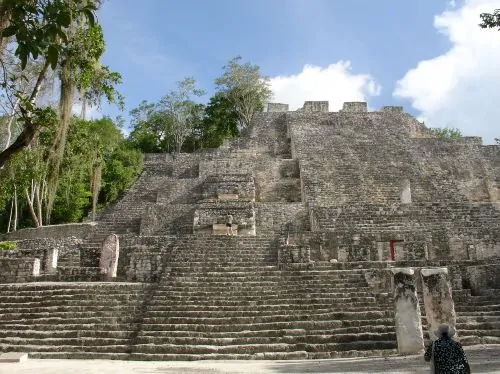
Calakmul enters the history of Copán and Quiriguá through an inscription created long after the decisive events. Quiriguá’s Stela I, erected around 800, looks back to the period ending of July 26, 736, when K’ak’ Tiliw Chan Yopaat planted a stela. The passage then names Wamaw K’awiil as the holy lord of Chiik Nahb, an important place-name associated with Calakmul. This establishes contact between Quiriguá’s ruler and a member of the powerful Snake dynasty only two years before Waxaklajuun Ubaah K’awiil’s death. The damaged relationship expression between their names is less explicit than modern summaries often suggest. It may indicate Wamaw’s participation in or authority over the ceremony, but it does not state that the two kings signed an alliance, planned an attack, or exchanged troops. Calakmul’s involvement must therefore be reconstructed from political context rather than read directly from an unambiguous confession in stone.
The broader history of the Snake dynasty makes such involvement entirely credible. During the seventh century, its rulers had assembled an extensive hierarchy of allied and subordinate courts through supervised accessions, diplomatic marriages, ritual sponsorship, and selective military assistance. This was not a territorially continuous empire administered from Calakmul, but a dispersed political network whose strength depended upon relationships between rulers. Tikal’s victory over Calakmul in 695 damaged that network and restored Tikal’s prestige, yet it did not make the Snake dynasty politically irrelevant. Wamaw K’awiil was still able to appear far beyond Calakmul itself and to claim exalted royal titles. A ballgame panel of uncertain original provenance depicts him with a ruler associated with Hix Witz, indicating that he remained engaged in the diplomatic practices through which the Snake kings had cultivated distant clients. His appearance at Quiriguá consequently fits an established mode of Calakmul statecraft. What had changed was not the dynasty’s ambition but its ability to translate an extensive network into uncontested supremacy.
Calakmul also possessed intelligible reasons to encourage Quiriguá’s separation from Copán. Influence over Quiriguá could open access to the Motagua corridor while denying Copán some of the revenues and strategic leverage derived from it. Weakening Waxaklajuun Ubaah K’awiil would also diminish an important southeastern kingdom with old connections to the political tradition centered upon Tikal. Those connections do not prove that Copán was acting as Tikal’s operational ally in 738, so the conflict should not automatically be converted into a southern front of a neatly organized Tikal–Calakmul war.
The case for direct Calakmul intervention begins with the disparity between the two southeastern kingdoms. Quiriguá’s population was a fraction of Copán’s, and its ceremonial center remained far smaller, making a solitary victory over its overlord appear difficult to explain. Matthew Looper, Robert Sharer, and Loa Traxler have therefore suggested that Wamaw K’awiil may have offered military support or at least the promise of retaliation if Copán attempted to restore its control. Copán’s subsequent failure to reconquer Quiriguá can be read as evidence that this threat remained effective. Yet the 738 event does not resemble a conventional invasion in the archaeological record. Neither capital shows a corresponding destruction horizon, no inscription identifies a Calakmul army, and Quiriguá’s later narratives assign responsibility to K’ak’ Tiliw rather than to Wamaw. If Waxaklajuun Ubaah K’awiil was isolated, deceived, or ambushed while away from the main body of Copán’s forces, Quiriguá would not have needed to defeat the larger kingdom in a prolonged war. Copán’s failure to retaliate may likewise reflect the loss of its ruler and the disruption of succession rather than fear of distant Calakmul. A passage on Copán’s later Hieroglyphic Stairway adds a further complication by invoking Yax Ha’al Chaak, a deity strongly associated with the Snake dynasty, in its account of Waxaklajuun Ubaah K’awiil’s death and the fate of his warriors at Turtle Hill. The reference may preserve an acknowledgment of Calakmul’s presence behind the conflict, but religious agency within a retrospective and damaged text cannot be translated straightforwardly into a troop deployment. Direct intervention remains possible without being demonstrable.
A diplomatic alliance offers a less dramatic but more persuasive interpretation. In Classic Maya politics, public association with a prestigious foreign king could alter the balance of power even when no army crossed the intervening distance. Wamaw K’awiil’s participation in a Quiriguá period-ending ceremony could recognize K’ak’ Tiliw as an autonomous royal actor, signal protection to other courts, and provide access to information unavailable within Copán’s sphere. Calakmul had repeatedly constructed influence through rituals of hierarchy and alliance rather than through permanent occupation. Quiriguá, distant enough to escape close Snake supervision, could accept external backing without simply exchanging one nearby overlord for another. Calakmul in turn could weaken a regional competitor at limited cost while demonstrating that its international reach had survived earlier defeats.
Coincidence remains possible because the crucial record is retrospective and its damaged wording does not reveal what Wamaw K’awiil actually did in 736. Kings participated in distant ceremonies for many reasons, not every diplomatic encounter produced a war, and later Quiriguá scribes had reasons to magnify the distinguished connections of their dynasty. Even so, the short interval between the Calakmul association and the attack on Copán makes complete irrelevance difficult to accept. The most defensible conclusion is that Quiriguá secured some form of Snake-dynasty recognition or strategic support, while the stronger claim that Calakmul planned the operation and supplied the decisive soldiers remains unproved. This interpretation preserves K’ak’ Tiliw’s agency instead of reducing him to a proxy executing Wamaw’s design. Calakmul stood behind the rebellion as a source of diplomatic leverage and possible protection, but Quiriguá’s court chose how to use that relationship. The resulting combination of local ambition and external opportunity made an act previously unthinkable suddenly achievable: the seizure of the king who had once possessed the authority to place K’ak’ Tiliw on his throne.
Six Days in 738: What the Inscriptions Say and What They Do Not
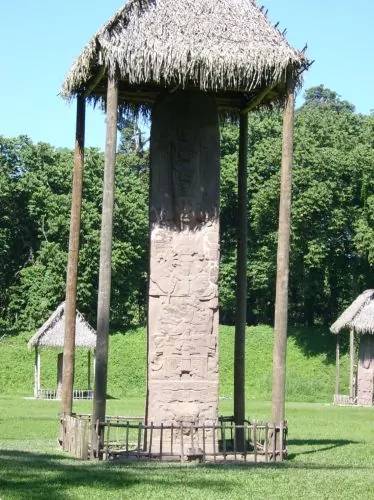
The epigraphic history of Waxaklajuun Ubaah K’awiil’s fall is anchored by two dates separated by only six days. On 9.15.6.14.0, correlated here with April 27, 738 CE, a retrospective inscription at Quiriguá describes hostile ritual actions directed against sacred beings associated with Copán’s king. On 9.15.6.14.6, May 3, later Quiriguá monuments record his decapitation under the authority of K’ak’ Tiliw Chan Yopaat. The interval is exact within the Maya Long Count, even though published Gregorian correlations occasionally differ by several days. Yet this chronological precision can create the illusion of a continuous narrative that the inscriptions do not supply. None of the surviving texts was a neutral chronicle composed to preserve every stage of the confrontation. Reading them historically therefore requires separating what their verbs state from what later interpreters have reasonably, but sometimes too confidently, inferred.
The evidence for April 27 comes from Quiriguá’s Stela I, dedicated around 800 CE, more than sixty years after the events it commemorates. Its retrospective passage records two difficult actions: the first probably involved the striking, piercing, or seizure of something made of wood, while the second concerned the drilling or kindling of fire. The passage associates these actions with Chante Ajaw and K’uy Nik? Ajaw, identified as gods belonging to Waxaklajuun Ubaah K’awiil. Because these divinities also appear in Copán’s inscriptions and sculpture, Matthew Looper interprets the passage as an account of violence against Copán’s ancestral or patronal gods. The objects may have been portable wooden effigies, sacred standards, or components of a palanquin carried with the royal party, although their precise form remains uncertain. If that reconstruction is correct, their seizure and burning amounted to more than the destruction of military equipment: it attacked the supernatural beings that accompanied and authorized Copán’s ruler. What Stela I does not do is attach an unequivocal capture verb directly to Waxaklajuun Ubaah K’awiil on April 27. The frequently repeated assertion that the king himself was captured on that date joins the desecration of his gods to the independently recorded execution six days later. This is a strong and economical inference, but it remains an inference rather than a literal translation. Even Stela I stops before describing the decapitation, leaving later monuments to supply the fatal endpoint.
The six intervening days are almost entirely empty of recoverable testimony. No surviving inscription explains where Waxaklajuun Ubaah K’awiil was held, how he was transported, whether negotiations or demands were attempted, which companions survived, or what ceremonies preceded his death. Archaeology cannot fill this interval, because neither Copán nor Quiriguá possesses a securely dated, citywide destruction horizon corresponding to the episode. A localized interception or ambush (perhaps during a military expedition, and perhaps even one connected with captive-taking after the dedication of Copán’s Great Ballcourt) is plausible, but the evidence cannot convert that possibility into a detailed narrative.
The May 3 endpoint rests on firmer epigraphic ground because Quiriguá’s later rulers repeatedly made the killing part of their monumental history. Stela S, erected in 746, may once have provided early postwar testimony, but its severely eroded text cannot sustain a secure reconstruction. The first well-preserved explicit account appears on Stela J, dedicated in 756, eighteen years after the event, where the decisive expression is usually read as ch’ak-baah, “the chopping of the head.” The monument’s northern inscription recalls K’ak’ Tiliw Chan Yopaat’s accession in 724 under Waxaklajuun Ubaah K’awiil’s auspices. Its southern text then records the Copán ruler’s decapitation and associates the reversal with K’ak’ Tiliw’s renewed reception of K’awiil, the embodiment of royal authority. Placed together, the two passages transform a former overseer into a sacrificial victim and the former dependent into a ruler who can claim authority on his own terms. Stela F, erected in 761, similarly presents the beheading as an event carried out under K’ak’ Tiliw’s authority or supervision. That construction assigns him political responsibility without establishing that he personally wielded the weapon. Stela F also locates the event at a place called Ihk’ Way Nal, commonly rendered “Black Hole” or interpreted as part of a “Black Hole–Black Lake” supernatural landscape. Looper associates this place with Quiriguá’s Great Plaza, whose architecture and imagery could evoke an entrance into the watery underworld, but the equation remains an interpretation rather than an unambiguous geographical statement. Stela E repeated the decapitation in 771, and Zoomorph G recalled it again in 785 while memorializing K’ak’ Tiliw after his death. Through repetition, Quiriguá converted a six-day political crisis into the foundational achievement of a reign, although none of these monuments provides a contemporaneous eyewitness account of what physically occurred.
Copán’s retrospective account used a markedly different vocabulary. K’ak’ Yipyaj Chan K’awiil, the fifteenth ruler in the dynasty, dedicated the final version of the Hieroglyphic Stairway of Structure 10L-26 in 755, one year before Quiriguá raised Stela J. Among its long sequence of dynastic events, the stairway acknowledges Waxaklajuun Ubaah K’awiil’s death but does not name K’ak’ Tiliw Chan Yopaat, Quiriguá, captivity, or decapitation. Instead, the text employs a death expression concerning the expiration of the king’s breath and follows it with the martial formula tutok’ tupakal, “with his flint, with his shield.” That pairing dignified his death through the conventional language of warfare, permitting Copán to remember him as a warrior-king rather than as the mutilated captive of a former subordinate. Because many stairway blocks were displaced and some passages remain damaged, the larger textual sequence cannot be reconstructed with complete confidence. Even so, the contrast with Quiriguá’s explicit head-chopping formula is too pronounced to dismiss as accidental. Copán’s omission does not mean that knowledge of the execution disappeared; it shows that the dynasty chose not to monumentalize the victor’s preferred version of its humiliation.
The inscriptions establish a narrow but consequential historical minimum. On April 27, hostile actions were performed against wooden objects or sacred images identified with Waxaklajuun Ubaah K’awiil’s gods. Six days later, the Copán ruler was decapitated in an event undertaken under K’ak’ Tiliw Chan Yopaat’s authority and subsequently associated with the place called Ihk’ Way Nal. What cannot be securely recovered is the exact moment of the king’s capture, the size and composition of the opposing forces, the place of the initial encounter, the route of his confinement, the presence of foreign troops, the identity of the executioner, or the sequence of rituals conducted before his death. These silences are not incidental gaps in an otherwise modern form of historical reporting, because Classic Maya royal inscriptions were selective arguments about legitimacy, hierarchy, and sacred time. Quiriguá chose the brutal specificity of decapitation because the reversal of lord and subordinate authenticated its ruler’s sovereignty. Copán chose the language of expired breath, flint, and shield because dynastic recovery required continuity with an honored ancestor rather than submission to Quiriguá’s political script. The six days of 738 are therefore both precisely dated and almost irretrievably obscure: the texts preserve the transformation of power while withholding most of the human process through which it occurred.
The Axe and the King: Decapitation as Political and Sacred Theater
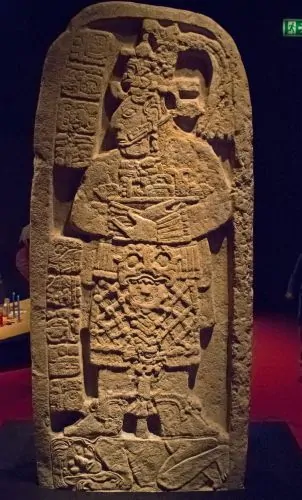
Decapitation transformed Quiriguá’s victory from a military success into a controlled statement about sovereignty. Calling the execution “theater” does not imply playacting or insincerity; it identifies an event whose setting, bodily actions, witnesses, and subsequent commemoration made political meaning visible. Read together, the April 27 assault upon Copán’s royal gods and the May 3 killing indicate a deliberate conclusion to the crisis rather than an accidental death during combat. Quiriguá’s later monuments named that death with the expression ch’ak-baah, conventionally translated as “the chopping of the head.” The logogram once called the “Axe/Comb” sign has been deciphered as ch’ak, meaning to chop or cut, while baah designates the head. The inscriptions do not identify the precise weapon, its material, the number of blows, or the individual who wielded it. What they make explicit is that the killing occurred under K’ak’ Tiliw Chan Yopaat’s authority, converting physical violence into an attributable royal act.
The victim’s rank gave the performance its extraordinary force. Waxaklajuun Ubaah K’awiil was a k’uhul ajaw, a sacred lord whose body had been repeatedly presented at Copán as the meeting point of dynasty, ancestry, divine impersonation, and political command. Classic Maya kingship resided not only in an abstract office but also in a named and elaborately adorned person who performed rituals, carried regalia, shed blood, and appeared before the community as the living image of legitimate order. Captivity made that body available as evidence that Copán’s sacred ruler could be stripped of control and subjected to another king’s command. The noun baah carried meanings that included head, self, person, and image, although those meanings should not be collapsed into a single indigenous theory of identity. Its semantic range nevertheless gave the chopping of the head a resonance extending beyond anatomical death: the public self through which a ruler had represented his kingdom was violently divided. At Quiriguá the reversal was particularly pointed because Waxaklajuun had supervised K’ak’ Tiliw’s accession in 724. Stela J set that installation against the later decapitation and K’ak’ Tiliw’s renewed reception of K’awiil, representing a ruler who no longer derived his authority from Copán’s approval. Captive monuments and the murals of Bonampak demonstrate a wider visual language in which elite prisoners could be bound, deprived of regalia, exposed on stairways, and identified through inscriptions attached to their bodies. Quiriguá provides no surviving portrait of Waxaklajuun as a captive, so his clothing, restraints, injuries, and treatment before death cannot be reconstructed from those comparisons.
The probable setting intensified the execution’s meaning. Stela F places the decapitation at Ihk’ Way Nal, the “Black Hole” or “Black Hole–Black Lake” place that Matthew Looper associates with Quiriguá’s Great Plaza and its imagery of an opening into the watery underworld. The architectural and iconographic evidence makes that identification plausible, but the inscription is not a map proving the exact position of the victim and executioner. If the association is correct, the plaza supplied both a cosmological threshold and a highly visible civic space, while later monuments extended the original performance to audiences who had never witnessed the death.
Sacred meaning did not merely decorate an otherwise secular execution. Classic Maya texts and images placed decapitation within narratives concerning supernatural defeat, agricultural regeneration, underworld passage, and the creation of political order. A Late Classic passage on Yaxchilán’s Hieroglyphic Stairway 2 recounts three primordial head-choppings, including that of the Maize God, at a place also called Ihk’ Way Nal. The recurrence of this place-name in Quiriguá’s account is striking, although it does not prove that the 738 execution followed a standardized mythological script. The colonial-era K’iche’ Popol Vuh likewise preserves stories in which One Hunahpu’s severed head becomes generative and in which his son Hunahpu is decapitated during the underworld ballgame before being restored. Because that text was written many centuries after Waxaklajuun’s death and emerged from a different Maya region, it cannot be treated as a direct explanation of the ceremony at Quiriguá. It nevertheless demonstrates the durability of associations among severed heads, captive death, fertility, ballplay, and the defeat of underworld powers. The ballgame supplies a tempting comparison because Classic Maya courts could evoke entrances to the underworld and because some ballgame imagery joined political competition with sacrifice. Waxaklajuun had dedicated Copán’s final Great Ballcourt only 113 days before his death, creating the possibility of an ironic reversal in which the patron of royal ballgame ritual became the victim of an enemy’s sacred performance. Yet no Quiriguá inscription says that he played a final game, was killed on a ballcourt, or impersonated a particular supernatural victim. The most defensible interpretation is therefore structural rather than literal: Quiriguá placed the execution of a real captive within a sacred vocabulary that made violent reversal intelligible as the restoration of proper order. Regenerative symbolism did not diminish the brutality or imply that Quiriguá intended to honor the dead king; it allowed the destruction of Copán’s ruler to signify the political renewal of Quiriguá.
For all the event’s textual visibility, the treatment of Waxaklajuun’s remains is unknown. Bioarchaeological evidence from other Maya sites demonstrates practices of decapitation, dismemberment, skeletal modification, and the retention or display of body parts taken from enemies. Christophe Helmke has also emphasized that the Classic Maya word baak could designate both a captive and bone, reflecting an association between prisoners and bodies available for transformation into trophies. Such evidence establishes a range of possible practices, but it cannot be projected automatically onto Quiriguá. No securely identified skull, skeleton, or burial belonging to Waxaklajuun has been recovered there. It is therefore impossible to determine whether his head was displayed temporarily, curated as a trophy, deposited as an offering, or eventually reunited with the body. The location of his corpse, the possibility of cremation, and any return of remains to Copán are equally undocumented. What survives securely is the advertised act of head-chopping, not the subsequent biography of the severed head.
The execution was political theater because sacred efficacy and political hierarchy reinforced one another rather than occupying separate spheres. Within Quiriguá, the ceremony demonstrated that K’ak’ Tiliw could command warriors, control a royal captive, and perform a sacrifice capable of reorganizing relations with the supernatural world. News carried beyond the city would have announced that Copán could no longer guarantee the inviolability of its ruler or enforce the hierarchy established at K’ak’ Tiliw’s accession. Killing the man who had installed him condensed fourteen years of changing relations into one comprehensible reversal: the former subordinate now determined whether the former overlord lived. The ceremony alone did not create Quiriguá’s independence, which still depended upon defensible territory, access to resources, diplomatic relationships, and the ability to retain local support. It instead gave those material changes an authoritative beginning that could be dated, named, and repeatedly carved in stone. Stelae J, F, and E and the memorial text of Zoomorph G kept Waxaklajuun perpetually at the moment of defeat while placing K’ak’ Tiliw on the enduring side of the axe. Copán’s later preference for the honorable language of flint and shield reveals a competing effort to rescue the dead ruler from Quiriguá’s staging of his identity. The lasting power of the execution consequently lay not only in the severing of a king’s head but in Quiriguá’s success at making that severance the charter event of a new political order.
Copán after the Execution
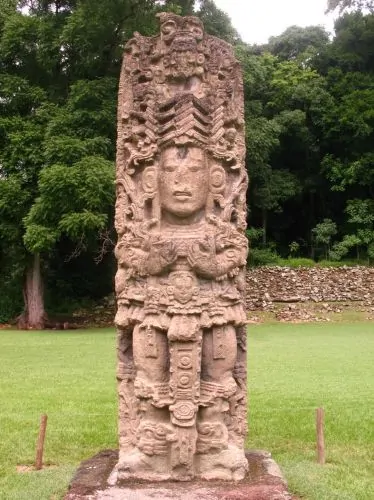
The execution of Waxaklajuun Ubaah K’awiil did not leave Copán without a ruler for long. Only thirty-nine days after his death, K’ak’ Joplaj Chan K’awiil acceded as the dynasty’s fourteenth king. Such speed demonstrates that the mechanisms of royal succession survived the catastrophe and that no rival lineage immediately displaced the dynasty established by K’inich Yax K’uk’ Mo’. It does not demonstrate that the transition was peaceful or that Copán retained its former regional authority. The new ruler inherited a court deprived of its dominant patron, a damaged relationship with Quiriguá, and a political landscape in which the ritual invulnerability claimed by Copán’s kings had been publicly disproved. Dynastic continuity therefore concealed a profound rupture in the conditions under which kingship had previously operated.
K’ak’ Joplaj Chan K’awiil ruled from 738 until 749, yet no surviving program of freestanding royal monuments compares with those commissioned by his predecessor. The contrast is striking because Waxaklajuun Ubaah K’awiil had repeatedly filled Copán’s ceremonial center with dated embodiments of himself. A later dynastic text characterized the intervening period through the absence of altars, pyramids, and formally constituted places, turning architectural inactivity into a historical condition worthy of commemoration. Nevertheless, the archaeology does not reveal a complete cessation of building. Structure 10L-22A, probably dedicated around 746, is commonly interpreted as a popol nah, or council house, whose sculptural program represented a series of seated local lords associated with particular places. Instead of concentrating attention exclusively upon an enthroned divine king, the building made a broader political community visible through the imagery of council, rank, and the woven mat that symbolized authority. It would be excessive to treat this arrangement as evidence for constitutional government or the voluntary surrender of royal power. Its form nevertheless suggests that K’ak’ Joplaj Chan K’awiil governed through more conspicuous negotiation with subordinate lords and established corporate groups than the self-magnifying monuments of his predecessor had acknowledged. The changed architecture may register an attempt to stabilize the kingdom by displaying consultation precisely when the monarchy’s capacity to command could no longer be assumed.
“Monumental silence” must therefore be defined narrowly. Copán was not abandoned after 738, its population did not disappear, and its residents did not cease all construction or ritual activity. What diminished was the production of major public monuments that projected the reigning king as the unquestioned center of political and cosmic order. The available evidence cannot determine whether this restraint resulted principally from lost tribute, disrupted exchange, pressure from Quiriguá, factional competition, ritual shock, or a deliberate reluctance to advertise royal claims that the court was temporarily unable to enforce.
When K’ak’ Yipyaj Chan K’awiil became Copán’s fifteenth ruler in 749, he also delayed the resumption of grand royal commemoration. His decisive intervention came in 755, when he expanded and rededicated the Hieroglyphic Stairway of Structure 10L-26. That monument cannot simply be interpreted as a new response invented after the disaster of 738, because Waxaklajuun Ubaah K’awiil had sponsored an earlier version around 710. The earlier inscription already presented an extended account of Copán’s dynastic past, culminating in the commemoration of the twelfth ruler and the ancestral shrine associated with him. K’ak’ Yipyaj Chan K’awiil enlarged this existing historical project, incorporated additional passages, and joined the troubled present to a lineage extending back to the dynasty’s founder. In its completed state, the staircase contained more than sixty risers and approximately 2,200 glyphs, making it one of the most ambitious historical inscriptions produced anywhere in the Classic Maya world. The collapse and incorrect replacement of many carved blocks have left much of its text irrecoverably disordered, but its broad commemorative purpose remains apparent. It transformed ascent toward the temple into movement through a sequence of royal predecessors, battles, deaths, rituals, and accessions. Authority was no longer expressed primarily through the solitary magnificence of the living king; it was accumulated through the visible depth of the dynasty. By incorporating Waxaklajuun Ubaah K’awiil into that longer history, K’ak’ Yipyaj Chan K’awiil could acknowledge the dead ruler without allowing the manner of his death to define Copán’s account of him.
The recovery was accompanied by a markedly martial visual language. Seated royal figures on the staircase appeared in costumes recalling Teotihuacan warriors, while the temple above employed foreign-looking weapons, shields, war-serpent imagery, and other symbols that connected Copán’s dynasty to an ancient and prestigious military past. An inscription referred to Waxaklajuun Ubaah K’awiil’s death through the expiration of his breath and the formula “with his flint, with his shield,” commemorating him as a warrior while omitting the politically humiliating details of capture and execution. This was neither a denial of death nor a candid narrative of defeat; it was a controlled reframing that returned the slain king to the dynasty as an honorable martial ancestor. Stela M, erected at the staircase’s base in 756, restored the freestanding royal portrait to Copán’s ceremonial center after nearly eighteen years without a comparable display. Stela N followed in 761 with another densely elaborated combination of royal image, sacred costume, and retrospective history. These monuments revived the aesthetic virtuosity associated with Waxaklajuun Ubaah K’awiil, but they placed that virtuosity within a more defensive rhetoric of ancestry, warfare, and dynastic endurance.
The same concern became even clearer under Yax Pasaj Chan Yopaat, who acceded in 763 as Copán’s sixteenth dynastic ruler. His Altar Q, dedicated in 776, represented all sixteen kings seated upon their name glyphs, four on each side of a single stone. On its principal face, K’inich Yax K’uk’ Mo’ confronted Yax Pasaj across the boundary between ancestral time and the living present. The founder appeared to hand the insignia of office directly to his distant successor, compressing approximately three and a half centuries of uncertain history into an unbroken act of transmission. The image asserted continuity, but its insistence upon displaying every ruler also reveals how urgently continuity required demonstration. Yax Pasaj’s legitimacy rested not merely upon his own sacred nature but upon his position as the endpoint of an ordered succession whose founder remained ritually active. Late eighth-century architecture and sculpture increasingly foregrounded titled nobles, council members, and other elite constituencies whose identities had previously been subordinated to the sovereign’s image. Such developments should not be attributed exclusively to the execution of 738, because elite competition, demographic pressure, economic strain, and political decentralization had deeper and more complicated histories. The execution nevertheless exposed the monarchy’s dependence upon those constituencies and probably accelerated the need to represent their participation in the maintenance of the kingdom.
Copán after 738 was therefore neither a collapsed city nor a restored version of the kingdom that had existed before the execution. Its dynasty survived, but the approximately eighteen-year interruption in major freestanding royal commemoration marks a real contraction in the court’s capacity or willingness to monumentalize sovereign power. When large-scale royal sculpture returned, it relied more heavily upon ancestral succession, martial memory, foreign antiquity, and the participation of ranked elites. This was a change of emphasis rather than the invention of an entirely new political language: Waxaklajuun Ubaah K’awiil had already cultivated dynastic history, and later rulers never abandoned the theology of divine kingship. Yet the living monarch increasingly appeared within structures of legitimacy that extended beyond his individual body. The king stood among predecessors, inherited authority from a founder, and ruled amid political groups whose cooperation had become difficult to conceal. Copán’s silence consequently records more than mourning for a dead patron; it marks the interval during which the dynasty learned to speak after the public destruction of its strongest claim, that its divinely sanctioned ruler could command the regional order he represented.
Quiriguá Writes Victory in Stone
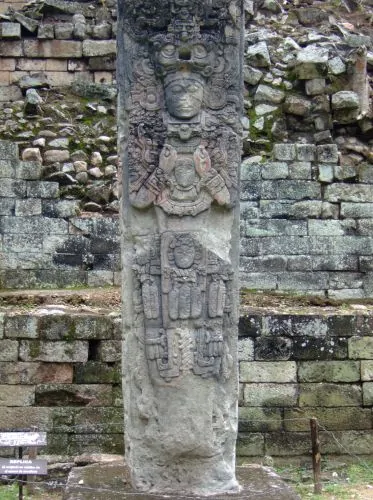
Quiriguá did not mark the events of 738 by immediately covering its plaza with monuments to conquest. The surviving sequence becomes conspicuous only eight years later, suggesting that K’ak’ Tiliw Chan Yopaat required time to convert military success into stable political authority, accumulated resources, and a coherent commemorative program. That delay matters because the monuments were not spontaneous celebrations raised in the emotional aftermath of battle. They were components of a sustained campaign to redefine Quiriguá’s history around the defeat of its former overlord. While Copán’s rulers withdrew from large-scale freestanding commemoration, Quiriguá increasingly filled its Great Plaza with images of a king who had demonstrated that Copán’s supremacy could be overturned. Victory became durable not because the capture was remembered privately, but because K’ak’ Tiliw made it the foundation of a new public landscape.
The sequence began with Stela S in 746 and continued through Stela H in 751, Stela J in 756, Stela F in 761, Stela D in 766, and Stela E in 771, followed by further commissions during the remaining years of K’ak’ Tiliw’s reign. These monuments transformed the five-year periods of the Maya calendar into recurring demonstrations of political survival. Each dedication renewed the king’s presence in the plaza while connecting his reign to cosmic cycles extending far beyond the immediate conflict with Copán. Repeated portraits showed K’ak’ Tiliw standing frontally beneath enormous headdresses, surrounded by regalia and inscriptions that made his body the axis of historical and sacred time. The escalating physical scale was itself an assertion of power. Stela E consisted of a sandstone monolith approximately 10.6 meters long and weighing perhaps sixty-five metric tons, although a substantial portion of its base was buried to keep it upright. Quarrying, transporting, carving, and erecting such a stone demanded specialized knowledge and the coordinated labor of a population extending beyond the royal household. Its dimensions proclaimed that Quiriguá could now command people and materials on a scale appropriate to an autonomous kingdom. Across more than three decades, the serial monuments converted one king’s exceptional victory into the normal rhythm of Quiriguá’s ceremonial life.
The inscriptions repeatedly returned to the capture of Waxaklajuun Ubaah K’awiil and the subsequent “axing” that ended his life six days later. Rather than providing a detailed account of the battle, they isolated the decisive actions, named the captive, and placed the events within the victorious king’s chronology. Their omissions concealed the size of the forces involved, the circumstances of the capture, and whatever external support Quiriguá may have received. Through repetition, the compressed account became a charter of sovereignty: K’ak’ Tiliw was the king who had seized and destroyed the ruler whose dynasty had once authorized his own accession.
Quiriguá’s sculptors worked within an artistic and epigraphic tradition long shared with Copán, making the post-738 program an appropriation of regional authority rather than a rejection of everything associated with the former overlord. Earlier Quiriguá monuments had already exhibited strong Copán connections, and craftsmen at the two centers may have participated in overlapping networks of training, patronage, and exchange. After the victory, Quiriguá developed those inherited conventions in increasingly distinctive directions. Its sculptors exploited local sandstone to create elongated royal bodies, deeply layered regalia, elaborate headdresses, and unusually animated hieroglyphs. The full-figure signs of Stela D transformed written dates and titles into miniature assemblies of gods, ancestors, captives, and supernatural beings, making the inscription itself a field of sculptural performance. With Zoomorph B in 780, the conventional upright stela gave way to a massive animate form in which royal, ancestral, and cosmic identities appeared to emerge from the carved stone. Such commissions expressed more than aesthetic ambition: they demonstrated the court’s ability to maintain artisans, provision laborers, and occupy ceremonial space with objects designed to outlast their makers. Scholars have often connected this new capacity to Quiriguá’s position near the Motagua River and its possible control over routes carrying jade and other valuable materials between the Maya highlands, Caribbean coast, and interior lowlands. That explanation remains plausible, but the evidence does not establish that Quiriguá acquired a trade monopoly or simply diverted revenues previously flowing to Copán. What the monuments establish with greater certainty is that K’ak’ Tiliw could mobilize resources on a level unimaginable for a merely dependent lord.
Quiriguá therefore did more than announce that it had escaped Copán’s control. It appropriated the imagery, calendrical learning, and monumental practices through which Copán had long represented regional kingship, then used them to proclaim the former subordinate’s equality and eventual superiority. The murdered king repeatedly entered Quiriguá’s inscriptions not as the radiant patron seen on Copán’s stelae, but as the named captive whose fall confirmed K’ak’ Tiliw’s legitimacy. Copán’s silence and Quiriguá’s sculptural expansion cannot be treated as a simple transfer of artists, wealth, or political strength, since neither archaeology nor epigraphy documents such a direct exchange. Nevertheless, their opposing monumental trajectories gave visible form to the reversal produced in 738. Because K’ak’ Tiliw continued to rule until 785, he had nearly half a century in which to commemorate, reinterpret, and ritualize his victory. The capture of Waxaklajuun Ubaah K’awiil had been a single political event; Quiriguá’s monuments turned it into the organizing memory of a kingdom.
Two Cities Rewrite the Same Death
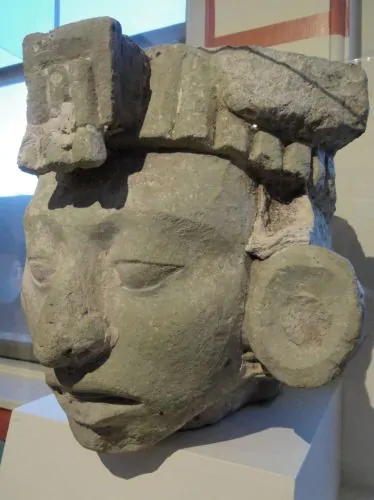
The death of Waxaklajuun Ubaah K’awiil entered the monumental records of Copán and Quiriguá as two different political events. At Quiriguá, it became the culminating act of a victorious rebellion and the proof that K’ak’ Tiliw Chan Yopaat possessed independent royal power. At Copán, it became the death of a legitimate ancestor whose place in the dynasty remained intact despite the circumstances of his defeat. Neither version was a disinterested report intended to preserve everything that had occurred. Each court selected particular names, actions, images, and silences according to what its rulers needed the past to demonstrate. The resulting contrast reveals how Classic Maya inscriptions recorded history by assigning events a politically useful meaning.
Quiriguá’s account was the more explicit because its king benefited from identifying both the defeated ruler and the violence inflicted upon him. The inscriptions named Waxaklajuun Ubaah K’awiil unmistakably as Copán’s king, associated his capture with K’ak’ Tiliw, and recorded the subsequent axe event six days later. Preserving the captive’s elevated identity magnified the achievement: an unnamed enemy would have provided a far less impressive measure of the victor’s power. The phrasing also reorganized the relationship between the two courts. Copán’s ruler, once the authority under whom K’ak’ Tiliw had acceded, became the object acted upon by the former subordinate. Later monuments returned to this inversion long after the immediate danger had passed, showing that the capture remained central to Quiriguá’s official understanding of its independence. Because these texts stood within a plaza used for calendrical ceremonies, their claims were renewed whenever the court assembled before them. They taught successive audiences to interpret Quiriguá’s elevated status as the consequence of a particular king’s decisive action. Yet the inscriptions said almost nothing about the forces involved, the circumstances that allowed the capture, or the possible assistance of Calakmul and other allies. What appears at first to be a remarkably candid account of royal violence was therefore also a compressed narrative that attributed a complicated political reversal to the agency of one ruler.
Copán chose an almost opposite form of compression. On the expanded Hieroglyphic Stairway, Waxaklajuun Ubaah K’awiil’s death was expressed through the expiration of his breath and a formula associating him with flint and shield, preserving the date and martial dignity of the event without recounting his humiliation. K’ak’ Tiliw, Quiriguá, captivity, and decapitation disappeared from Copán’s surviving version. Through omission and euphemism, the captured king ceased to be Quiriguá’s trophy and reentered Copán’s history as a fallen warrior and legitimate dynastic ancestor.
The physical settings of the two accounts strengthened their opposing interpretations. At Quiriguá, upright stelae repeatedly presented K’ak’ Tiliw as the living center of cosmic and historical order. Each new dedication returned the victorious king to the plaza, where the memory of 738 supported later claims to autonomy, longevity, and sacred authority. At Copán, the relevant text formed part of a staircase whose more than sixty risers carried the viewer through centuries of dynastic history. Because Waxaklajuun Ubaah K’awiil had commissioned the earlier phase of that monument before his defeat, the Stairway was not originally conceived as a response to Quiriguá’s rebellion. K’ak’ Yipyaj Chan K’awiil nevertheless expanded it in 755 so that the damaged present could be incorporated into a history reaching back to K’inich Yax K’uk’ Mo’. The visitor did not encounter the thirteenth ruler’s death as the endpoint of Copán’s story but passed through it while ascending toward a shrine devoted to royal ancestry. Altar Q carried this strategy further in 776 by placing Waxaklajuun among all sixteen Copán rulers and depicting the founder transferring authority directly to the reigning Yax Pasaj Chan Yopaat. Quiriguá isolated the death as the event that transformed the regional order, whereas Copán submerged it within a succession that supposedly remained unbroken.
Neither version should be reduced to a simple opposition between historical truth and propaganda. Quiriguá preserved the essential facts of capture and execution, but it concealed the contingencies that might have qualified K’ak’ Tiliw’s personal achievement. Copán supplied a precise dynastic setting for the ruler’s death while refusing to identify the enemy responsible for it. The texts were also retrospective rather than immediate battlefield reports, since the principal surviving commemorations were carved years or decades after 738. Reading the two traditions together makes the broad sequence considerably more secure than either account would make it alone. Copán’s refusal to contest the death date, combined with its conspicuous avoidance of the capture, indicates how politically damaging Quiriguá’s version was, although that silence cannot independently verify every implication of the victorious account. The contradiction between the records is therefore not an obstacle to reconstruction but evidence of the different political burdens the event imposed upon the two courts.
Together, the monuments created rival memories that extended the struggle beyond the bodies of the two kings. K’ak’ Tiliw needed the death to remain exceptional because his authority rested upon having overturned a hierarchy that had once subordinated Quiriguá to Copán. Copán’s later rulers needed the same death to appear containable because their legitimacy depended upon the assertion that one king’s defeat had not broken the dynasty. The rival accounts consequently organized historical time in different ways. For Quiriguá, 738 opened a new age in which the former dependent could speak and build as a sovereign kingdom. For Copán, it was a painful interruption absorbed into a lineage that continued to derive authority from its founder. The same man became a conquered overlord in one city and an honored predecessor in the other. His political afterlife demonstrates that royal death acquired its fullest meaning not at the moment of execution, but through the monuments that taught later generations how the execution was to be remembered.
Did One King’s Death Really Reverse Two Cities’ Fortunes?
The following video from Penn Museum covers the battle between Copán and Quiriguá:
The strongest challenge to interpreting 738 as a reversal of fortunes is that it risks turning a complicated regional history into a drama controlled by two exceptional rulers. Copán did not collapse when Waxaklajuun Ubaah K’awiil died, nor did Quiriguá suddenly become one of the largest or most powerful Maya cities. Both communities were shaped by demographic pressures, agricultural resources, exchange networks, elite competition, and relationships extending far beyond their royal courts. Monumental inscriptions exaggerate individual agency because they were created to represent kings as the authors of collective achievements. If “fortune” is measured through population, economic welfare, territorial control, or long-term institutional stability, the archaeological evidence does not support a simple exchange in which everything Copán lost passed directly to Quiriguá.
Copán’s continued vitality presents the clearest objection to any theory of immediate decline. K’ak’ Joplaj Chan K’awiil acceded only thirty-nine days after the execution, demonstrating that the dynasty retained sufficient cohesion to install a successor. His reign left little monumental self-advertisement, but Structure 10L-22A indicates that the court continued sponsoring architecture and organizing relationships with local lords. Settlement evidence likewise reveals dense occupation, household construction, craft production, and elite activity well after 738. Copán may actually have reached its greatest population during the decades following Waxaklajuun Ubaah K’awiil’s death, although estimates and chronological boundaries remain contested. K’ak’ Yipyaj Chan K’awiil resumed major royal patronage with the expanded Hieroglyphic Stairway in 755 and Stela M in 756. Yax Pasaj Chan Yopaat subsequently commissioned Altar Q, Temple 11, and other ambitious works that continued to present Copán as the seat of a sacred dynasty. These were not the actions of a court that had lost every source of wealth or authority. The later difficulties visible in decentralization, environmental strain, nutritional stress, and the eventual abandonment of royal institutions developed across several generations. Copán’s monumental interruption should therefore be treated as evidence of disruption within royal representation, not as proof that the execution initiated an uninterrupted march toward collapse.
Quiriguá’s sculptural expansion is equally difficult to translate into comprehensive prosperity. K’ak’ Tiliw Chan Yopaat had ruled since 724, while the city’s location near the Motagua River offered economic opportunities that did not originate with the capture. His exceptionally long reign gave the court decades in which to quarry stone, accumulate labor, and develop a distinctive monumental tradition. Quiriguá’s relatively modest settlement and its own decline after the early ninth century show that gigantic monuments did not necessarily indicate demographic strength or durable regional supremacy.
This counterargument weakens if it treats the execution as merely incidental because it was not the sole cause of either city’s trajectory. The chronological contrast remains unusually sharp: Copán’s sequence of royal stelae ceased after its king’s death, while Quiriguá’s monumental program accelerated during the years that followed. Quiriguá’s inscriptions themselves repeatedly identified the capture and execution as the defining achievement of K’ak’ Tiliw’s reign. Copán’s later decision to record the death while omitting the captor demonstrates that the event remained too damaging to narrate openly. In a political system organized through personal relationships among rulers, the removal of a king could alter obligations, tribute arrangements, military alliances, and the perceived capacity of a dynasty to protect its dependents. Waxaklajuun Ubaah K’awiil was not merely an officeholder whose replacement restored every previous relationship; he was a patron whose body embodied Copán’s claims to sacred and regional authority. His capture provided Quiriguá with an opportunity to repudiate subordination, while his execution prevented Copán from negotiating his restoration or representing the episode as a temporary setback. Existing economic ambitions and political resentments may have made rebellion possible, but the public destruction of the overlord made its consequences difficult to reverse. The death mattered as the event through which longer-term pressures became a new political reality.
The interpretation must therefore distinguish between the reversal of a hierarchical relationship and the complete reversal of two urban societies. Quiriguá did not inherit Copán’s population, artistic personnel, commercial revenues, or wider political network in any demonstrable wholesale transfer. Copán remained the larger center and continued to sustain an active court for decades, while Quiriguá’s new prominence proved comparatively brief. Yet within the field of royal prestige, monumental authority, and regional independence, the positions of the two cities changed unmistakably after 738. Quiriguá could henceforth present itself as the kingdom whose ruler had defeated Copán, while Copán could no longer treat its former dependent as a subordinate community. Structural conditions determined why the rebellion became possible and shaped how far its consequences extended. One king’s death neither doomed Copán nor guaranteed Quiriguá’s future, but it converted those conditions into a visible rupture that both dynasties spent the remainder of the eighth century interpreting.
Conclusion: The Death That Both Kingdoms Claimed
Waxaklajuun Ubaah K’awiil’s fall exposed the vulnerability concealed within the magnificence of divine kingship. He had spent more than four decades making Copán’s sacred authority visible through stelae, temples, sculpture, and the Great Ballcourt. His capture demonstrated that even the most elaborately sanctified ruler remained dependent upon military power, political loyalty, and relationships that monumental imagery could idealize but never guarantee. The execution did not destroy Copán or terminate its dynasty. It did end the regional order in which Quiriguá’s subordination had reinforced Copán’s supremacy. The distinction between dynastic survival and political rupture is essential to understanding why both kingdoms remembered the death so differently.
Quiriguá claimed the death first in the most immediate sense: its ruler seized Waxaklajuun, held him for six days, and subjected him to an axe event staged as public political and sacred theater. K’ak’ Tiliw Chan Yopaat then claimed the event repeatedly through inscriptions that identified the captive and transformed his execution into the charter of Quiriguá’s independence. The enormous stelae that followed did not merely celebrate a successful rebellion; they presented Quiriguá as a kingdom capable of commanding labor, sacred knowledge, and monumental artistry on a sovereign scale. Copán could not reverse the execution, but its later rulers could prevent Quiriguá from possessing its meaning completely. The expanded Hieroglyphic Stairway recorded Waxaklajuun’s death while suppressing the identities of his captor and the victorious city. Stela M restored royal monumentality, while Altar Q eventually seated the defeated ruler among an uninterrupted succession extending from the founder to the living king. Quiriguá made Waxaklajuun the captive whose destruction validated a new political order; Copán reclaimed him as the ancestor whose death could not invalidate the old dynasty. Both versions preserved genuine elements of the past, but each selected the elements that sustained its own future.
Archaeology prevents the execution from becoming a magical explanation for everything that followed. Copán remained populous and productive, resumed major royal construction, and survived as a dynastic capital for generations, while Quiriguá’s monumental expansion also depended upon geography, resources, labor, and ambitions that predated 738. The death neither transferred all regional wealth to Quiriguá nor set Copán upon an inevitable path toward collapse. Its importance lay in converting existing tensions into an irreversible change in the relationship between the two courts.
The larger significance of 738 therefore lies in the intersection of violence, representation, and historical memory. Classic Maya kingship operated through the repeated public assertion that the ruler’s body stood at the center of sacred and political order. K’ak’ Tiliw shattered that assertion by displaying his former overlord as a captive who could be killed, then monumentalized the act until rebellion appeared to have been the fulfillment of his reign. Copán’s successors answered by shifting emphasis from the invulnerability of one living king toward the endurance of ancestors, founders, and the dynasty as a collective institution. Artistic authority did not pass mechanically from Copán to Quiriguá, but the opposed patterns of silence and production made the altered balance of prestige visible across the region. Both kingdoms claimed Waxaklajuun’s death because neither could allow the rival interpretation to stand uncontested. The axe ended the life of Copán’s greatest artistic patron; the monuments of two cities ensured that the struggle over what his death meant would continue long after both kingdoms had ceased to rule.
Bibliography
Affiliate disclosure: Amazon links on this site are paid links. As an Amazon Associate I earn from qualifying purchases.
- Abrams, Elliott M. How the Maya Built Their World: Energetics and Ancient Architecture. Austin: University of Texas Press, 1994.
- Andrews, E. Wyllys V, and William L. Fash, eds. Copán: The History of an Ancient Maya Kingdom. Santa Fe: School of American Research Press, 2005.
- Ashmore, Wendy. “Contingent Acts of Remembrance: Royal Ancestors of Classic Maya Copan and Quirigua.” Ancient Mesoamerica 26:2 (2015), 213–231.
- —-. Quiriguá Reports, Volume IV: Settlement Archaeology at Quirigua, Guatemala. Quirigua Reports 4. Philadelphia: University of Pennsylvania Museum of Archaeology and Anthropology, 2007.
- Baudez, Claude-François. Maya Sculpture of Copán: The Iconography. Norman: University of Oklahoma Press, 1988.
- Bell, Ellen E., Marcello A. Canuto, and Robert J. Sharer, eds. Understanding Early Classic Copan. Philadelphia: University of Pennsylvania Museum of Archaeology and Anthropology, 2004.
- Berryman, Carrie Anne. “Captive Sacrifice and Trophy Taking among the Ancient Maya: An Evaluation of the Bioarchaeological Evidence and Its Sociopolitical Implications.” In The Taking and Displaying of Human Body Parts as Trophies by Amerindians, edited by Richard J. Chacon and David H. Dye, 377–99. New York: Springer, 2007.
- Burdick, Catherine E. “Held Captive by Script: Interpreting ‘Tagged’ Prisoners in Late Classic Maya Sculpture.” Ancient Mesoamerica 27:1 (2016), 31–48.
- Cheek, Charles D. “Maya Community Buildings: Two Late Classic Popol Nahs at Copan, Honduras.” Ancient Mesoamerica 14:1 (2003), 131–138.
- Copán, Honduras. Altar Q. 776 CE.
- —-. Ballcourt III Bench Inscription, Structures 10L-9, 10L-22, 10L-26, and 10L-10. 738 CE.
- —-. Hieroglyphic Stairway, Structure 10L-26. Eighth century CE.
- —-. Stelae C, F, J, 4, H, A, B, D, M, and N. 711–761 CE.
- Earley, Caitlin C. “Warfare, Sacrifice, and the Captive Body in Late Classic Maya Sculpture.” Ancient Mesoamerica 34:1 (2023), 249–265.
- Fash, Barbara W. The Copán Sculpture Museum: Ancient Maya Artistry in Stucco and Stone. Cambridge, MA: Peabody Museum Press and David Rockefeller Center for Latin American Studies, Harvard University, 2011.
- —-., et.al. “Investigations of a Classic Maya Council House at Copan, Honduras.” Journal of Field Archaeology 19, no. 4 (1992): 419–42.
- —-. “Late Classic Architectural Sculpture Themes in Copán.” Ancient Mesoamerica 3:1 (1992), 89–104.
- Fash, William L. “Religion and Human Agency in Ancient Maya History: Tales from the Hieroglyphic Stairway.” Cambridge Archaeological Journal 12:1 (2002), 5–19.
- —-. Scribes, Warriors, and Kings: The City of Copán and the Ancient Maya. Revised ed. London: Thames & Hudson, 2001.
- Fash, William L., and David S. Stuart. “Dynastic History and Cultural Evolution at Copán, Honduras.” In Classic Maya Political History: Hieroglyphic and Archaeological Evidence, edited by T. Patrick Culbert, 147–179. Cambridge: Cambridge University Press, 1991.
- Fash, William L., E. Wyllys Andrews, and T. Kam Manahan. “Political Decentralization, Dynastic Collapse, and the Early Postclassic in the Urban Center of Copan, Honduras.” In The Terminal Classic in the Maya Lowlands: Collapse, Transition, and Transformation, edited by Arthur A. Demarest, Prudence M. Rice, and Don S. Rice, 260–287. Boulder: University Press of Colorado, 2004.
- Gordon, George Byron. The Hieroglyphic Stairway, Ruins of Copan: Report on Explorations by the Museum. Memoirs of the Peabody Museum of American Archaeology and Ethnology, Harvard University 1, no. 6. Cambridge, MA: Peabody Museum, 1902.
- Helmke, Christophe. “Tactics, Trophies, and Titles: A Comparative Perspective on Ancient Maya Raiding.” Ancient Mesoamerica 31:1 (2020), 29–46.
- Houston, Stephen D., and David Stuart. “The Ancient Maya Self: Personhood and Portraiture in the Classic Period.” RES: Anthropology and Aesthetics 33 (1998), 73–101.
- —-. “Of Gods, Glyphs, and Kings: Divinity and Rulership among the Classic Maya.” Antiquity 70:268 (1996), 289–312.
- Houston, Stephen, David Stuart, and Karl Taube. The Memory of Bones: Body, Being, and Experience among the Classic Maya. Austin: University of Texas Press, 2006.
- Looper, Matthew G. Lightning Warrior: Maya Art and Kingship at Quirigua. Austin: University of Texas Press, 2003.
- —-. “New Perspectives on the Late Classic Political History of Quiriguá, Guatemala.” Ancient Mesoamerica 10:2 (1999), 263–280.
- Manahan, T. Kam. “The Way Things Fall Apart: Social Organization and the Classic Maya Collapse of Copan.” Ancient Mesoamerica 15:1 (2004), 107–125.
- Martin, Simon. Ancient Maya Politics: A Political Anthropology of the Classic Period 150–900 CE. Cambridge: Cambridge University Press, 2020.
- Martin, Simon, and Nikolai Grube. Chronicle of the Maya Kings and Queens: Deciphering the Dynasties of the Ancient Maya. 2nd ed. London: Thames & Hudson, 2008.
- Maudslay, Alfred Percival. Biologia Centrali-Americana; or, Contributions to the Knowledge of the Fauna and Flora of Mexico and Central America: Archaeology. London: R. H. Porter and Dulau & Co., 1889–1902.
- Miller, Mary, and Claudia Brittenham. The Spectacle of the Late Maya Court: Reflections on the Murals of Bonampak. Austin: University of Texas Press, 2013.
- Newsome, Elizabeth A. Trees of Paradise and Pillars of the World: The Serial Stela Cycle of “18-Rabbit-God K,” King of Copan. Austin: University of Texas Press, 2001.
- Orejel, Jorge L. “The ‘Axe/Comb’ Glyph as ch’ak.” Research Reports on Ancient Maya Writing 31 (1990). 1–8.
- Price, T. Douglas, et.al. “Kings and Commoners at Copan: Isotopic Evidence for Origins and Movement in the Classic Maya Period.” Journal of Anthropological Archaeology 29:1 (2010), 15–32.
- Proskouriakoff, Tatiana. A Study of Classic Maya Sculpture. Carnegie Institution of Washington Publication 558. Washington, DC: Carnegie Institution of Washington, 1950.
- Quiriguá, Guatemala. Altar L, Altar M, Monument 26, Stelae H, J, L, F, D, E, I, S, and Zoomorph P.
- Scarborough, Vernon L., and David R. Wilcox, eds. The Mesoamerican Ballgame. Tucson: University of Arizona Press, 1991.
- Schele, Linda. “Human Sacrifice among the Classic Maya.” In Ritual Human Sacrifice in Mesoamerica, edited by Elizabeth H. Boone, 7–48. Washington, DC: Dumbarton Oaks Research Library and Collection, 1984.
- Sharer, Robert J., and Loa P. Traxler. “Copan and Quirigua: Shifting Destinies in the Southeastern Maya Lowlands.” Contributions in New World Archaeology 4 (2012), 141–158.
- Stuart, David. “The Beginnings of the Copan Dynasty: A Review of the Hieroglyphic and Historical Evidence.” In Understanding Early Classic Copan, edited by Ellen E. Bell, Marcello A. Canuto, and Robert J. Sharer, 215–247. Philadelphia: University of Pennsylvania Museum of Archaeology and Anthropology, 2004.
- —-. “A Foreign Past: The Writing and Representation of History on a Royal Ancestral Shrine at Copan.” In Copán: The History of an Ancient Maya Kingdom, edited by E. Wyllys Andrews and William L. Fash, 373–394. Santa Fe, NM: School of American Research Press, 2005.
- —-. “Hieroglyphs and Archaeology at Copan.” Ancient Mesoamerica 3:1 (1992), 169–184.
- Tokovinine, Alexandre. “Divine Patrons of the Maya Ballgame.” Mesoweb, 2002.
- Torres, Hilda Landrove. “Reflexivity and Self-Referentiality in Image: An Analysis of Yaxchilan Panel VII Hieroglyphic Stairway.” Revista de Antropologia 63:1 (2020), 105-121.
- Tunesi, Raphael. “A New Monument Mentioning Wamaaw K’awiil of Calakmul.” The PARI Journal 8:2 (2007), 13–19.
- Viel, René. “The Pectorals of Altar Q and Structure 11: An Interpretation of the Political Organization at Copan, Honduras.” Latin American Antiquity 10:4 (1999), 377–399.
- von Schwerin, Jennifer. “The Sacred Mountain in Social Context: Symbolism and History in Maya Architecture—Temple 22 at Copan, Honduras.” Ancient Mesoamerica 22:2 (2011), 271–300.
- Webster, David L., AnnCorinne Freter, and Nancy Gonlin. Copán: The Rise and Fall of an Ancient Maya Kingdom. Fort Worth, TX: Harcourt College Publishers, 2000.
Originally published by Brewminate, 09.02.2026, under the terms of a Creative Commons Attribution-NonCommercial-NoDerivatives 4.0 International license.
About the Author