BASF’s fertilizer disaster at Oppau in 1921 reveals how production changes could undermine safety assurances, and why scientific uncertainty complicated judgments of responsibility.

By Matthew A. McIntosh
Public Historian
Brewminate
Introduction: When a Fertilizer Became a Catastrophe
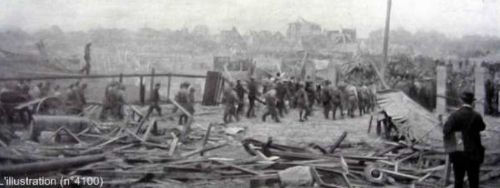
At 7:32 on the morning of September 21, 1921, two enormous explosions struck BASF’s nitrogen works at Oppau, near Ludwigshafen on the Rhine. More than five hundred people died, approximately two thousand were injured, and destruction extended from the industrial premises into the surrounding residential community. The explosion originated in a building containing ammonium sulfate nitrate, a fertilizer manufactured to supply agriculture with usable nitrogen. Hardened accumulations of the product were being loosened with explosive charges, an operation that had become an accepted part of handling stored fertilizer. A procedure intended to make commercially valuable material manageable had instead exposed workers and their neighbors to a disaster whose explanation would occupy investigators for years.
BASF’s standing made the failure particularly consequential. Its development of industrial ammonia synthesis demonstrated an extraordinary capacity to translate scientific knowledge into large-scale production, opening an important route to nitrogen fertilizers. Confidence in the company’s expertise consequently rested on achievements that were substantial and verifiable. The handling of ammonium sulfate nitrate also had an experimental justification. Tests appeared to show that combining ammonium nitrate with sufficient ammonium sulfate suppressed the explosive behavior associated with the nitrate component. Successful operations reinforced that conclusion and helped turn explosive loosening into an established practice. In an explanation reported by Nature after the disaster, BASF’s directors invoked laboratory findings and earlier operating experience to defend the fertilizer’s presumed safety. They also emphasized that the explosion had occurred in stored fertilizer and sought to protect the reputation of high-pressure ammonia synthesis from being implicated in it. Their response exposed the question confronting investigators: how could a material considered safe on the strength of scientific testing and practical experience behave so differently under the conditions prevailing at Oppau?
Subsequent inquiry made the fertilizer’s production history central to that question. A newly introduced spray-drying process altered physical characteristics relevant to explosive behavior, even where the product’s nominal chemical proportions remained acceptable. Later technical reassessments have strengthened the connection between those changes and the catastrophe, while leaving uncertainty about the precise contribution of individual factors. The historical problem involves determining how far surviving evidence supports causal reconstruction, especially when the explosion consumed the material whose condition investigators most needed to establish.
The difficulty of reconstructing the mechanism also affects how historians might assign responsibility. Accusations of negligence require attention to what decision-makers could reasonably have known, including the limitations of the tests on which they relied. Corporate assurances deserve equally close scrutiny, because a conclusion established for one material under particular experimental conditions could acquire a much broader authority in industrial practice. Changes intended to improve production raised a further question about whether the earlier evidence still justified the operations being performed. Public authorities faced their own difficulty. Evaluating specialized judgments demanded technical knowledge, yet agreement among knowledgeable people could preserve assumptions that needed examination. Meanwhile, those living beside the works bore consequences far beyond the boundaries of the decisions they could influence. The investigations must consequently be understood as efforts to establish physical causes whose findings also carried implications for compensation and accountability. Oppau’s importance lies in the relationship between an accomplished scientific industry and the obligations accompanying its power to expose others to risk. Its history shows why expertise must include an obligation to reconsider the evidence supporting an assurance of safety when the conditions of production change.
Nitrogen from the Air: The Agricultural Promise of Industrial Chemistry
Agricultural production depends on a distinction that the abundance of nitrogen in the atmosphere can obscure. An element may be plentiful while remaining unavailable to the organisms that need it. Nitrogen constitutes approximately four-fifths of ordinary air, but cereal crops cannot directly use its molecular form to build the compounds required for growth. They obtain much of their nitrogen through roots as nitrate or ammonium, incorporating it into proteins and other essential cellular substances. Cultivation continually changes the balance between these available forms and the nitrogen retained in soil organic matter. Harvesting removes nutrients from the field, while biological transformations and losses determine how much remains for the next crop. Nineteenth-century agricultural chemistry made these relationships increasingly measurable, although agreement about nitrogen nutrition emerged through experiment and controversy. At Rothamsted, the long-running trials begun by John Bennet Lawes and Joseph Henry Gilbert in 1843 demonstrated the importance of nitrogen additions, including ammonium sulfate, to wheat yields. Such findings supplied an empirical foundation for treating fertility as something that could be supplemented through manufactured products.
Farmers had maintained productive soils long before those experiments explained parts of the underlying chemistry. Manure returned nutrients to cultivated ground, and rotations incorporating legumes could add nitrogen through the activity of microorganisms associated with their roots. These practices demanded suitable land and labor, and their benefits depended on how farms organized crops and livestock. Recycling also had a limit. Returning material already produced within an agricultural system could reduce losses, but it could not indefinitely compensate for everything carried away in food or other products.
During the nineteenth century, commercial fertilizers enlarged the geographical reach of that effort to replenish cultivated soils. Peruvian guano and the sodium nitrate deposits of the South American Pacific region became important sources of nutrients for importing countries. Their availability connected agricultural output to distant extraction and ocean transport, making the fertility of European fields partly dependent on resources concentrated elsewhere. Concern about the durability of those supplies acquired a prominent scientific spokesman in William Crookes, whose 1898 presidential address to the British Association framed the future wheat supply as a problem demanding chemical intervention. In the revised argument published as The Wheat Problem the following year, Crookes projected a serious shortage if population continued to increase without corresponding advances in production. His emphasis on wheat consumers reflected the priorities of societies whose diets and commercial expectations centered on that grain; it did not provide a comprehensive account of hunger throughout the world. Critics challenged the assumptions underlying his calculations, including the prospective expansion of cultivation, so his timetable cannot be treated as an established prediction. Nevertheless, the controversy helped give atmospheric nitrogen fixation a compelling public purpose. A sufficiently economical process might supplement agricultural production without relying on the discovery of another conveniently situated mineral deposit.
Industrial fixation was already taking several forms before BASF established its ammonia works. The Norwegian electric-arc process developed by Kristian Birkeland and Samuel Eyde used electrical energy to bring nitrogen and oxygen into combination, ultimately providing compounds that could be sold as fertilizer. Its heavy electricity requirements favored locations with abundant inexpensive hydroelectric power. Another route reacted nitrogen with calcium carbide to produce calcium cyanamide, creating a commercially significant fertilizer industry with its own requirements for energy and raw materials. These alternatives mattered because ammonia synthesis entered an existing field of competing technologies, rather than appearing as the sole response to agricultural demand. Their different operating costs also showed that an atmospheric feedstock did not remove the economic importance of location. Usable nitrogen still had to be produced through a particular industrial system.
Fritz Haber approached the direct synthesis of ammonia through the relationship between chemical equilibrium and the speed of reaction. Nitrogen and hydrogen could combine to form ammonia, but finding conditions that produced a useful quantity presented difficulties beyond demonstrating that the reaction was possible. Increased pressure favored ammonia formation, while raising the temperature accelerated reactions but reduced the proportion of ammonia favored at equilibrium. A practical process required a workable compromise, aided by a catalyst that increased the rate without changing the equilibrium itself. Haber and his collaborator Robert Le Rossignol developed an apparatus in which ammonia could be removed and unreacted gases circulated through the system again. Their successful demonstration to BASF in 1909 established the feasibility of a continuing synthesis operation. Circulation was particularly consequential because it meant that the usefulness of the process did not depend on converting all the incoming gas in a single passage. In his Nobel lecture of 1920, Haber presented the achievement as a conjunction of experimental work and physical chemistry, locating it within a longer sequence of investigations. The reaction had become a promising basis for manufacture, but the apparatus that demonstrated it left major industrial problems unresolved.
Carl Bosch directed the transformation of that laboratory system into a production process capable of operating on an entirely different scale. Compressing a small quantity of carefully prepared gas for an experiment differed substantially from supplying and circulating industrial volumes continuously. Hydrogen had to be obtained at an acceptable cost, and impurities had to be removed because they could damage the performance of the catalyst. The early catalytic materials Haber had found effective could not simply become the foundation of an expanding industry, prompting BASF to conduct extensive searches for a practical alternative. Alwin Mittasch and his colleagues developed effective iron-based catalysts, making systematic examination of materials part of the manufacturing achievement. Equally demanding problems arose in the construction of pressure equipment. Hot hydrogen could attack carbon-containing steel and undermine vessels that initially appeared mechanically adequate. Engineers developed arrangements that separated a chemically suitable inner lining from the outer structure responsible for bearing pressure. Bosch’s subsequent Nobel lecture emphasized such obstacles and the sustained development work necessary to overcome them, offering a participant’s account whose retrospective celebration must be read with attention to its purpose. These changes show why industrial ammonia synthesis cannot be explained simply as a laboratory apparatus enlarged until it supplied a market. A successful factory required coordination among materials research and the engineering of a continuous process, supported by investment large enough to sustain repeated trials and redesign. BASF’s contribution included building that organization around a reaction whose commercial future was initially uncertain.
When commercial ammonia production began at Oppau in 1913, the achievement offered agriculture a new source of nitrogen rather than an immediate solution to every constraint on food supply. Ammonia provided a starting material that could be converted into saleable fertilizers, including ammonium sulfate, but farmers still needed products they could purchase and apply under local conditions. The value of additional nitrogen depended on the crop and on other limits to growth, such as moisture or deficiencies of different nutrients. Access to fertilizer also depended on prices and the ability to recover its cost through agricultural returns. Subsequent generations would become much more dependent on synthetic nitrogen than the agricultural world surrounding Oppau’s opening had been, and that later dependence should not be projected backward onto the first years of manufacture. The immediate significance was the addition of a source whose output could expand through industrial capacity, giving producers greater scope to supplement biological recycling and imported nitrates. That possibility also established a durable connection between farming and chemical manufacture: food production could increasingly depend on the continued operation of installations located far from the fields they supplied. Oppau stood at an early stage of this development, just before war dramatically enlarged the demands placed on Germany’s nitrogen industry.
Oppau through War and Uneasy Peace
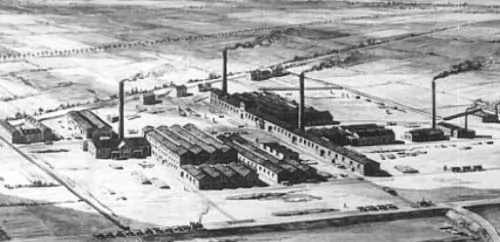
Mobilization in August 1914 changed the demands placed on Oppau within a year of its opening. Germany’s reliance on imported Chilean sodium nitrate became a strategic vulnerability as British naval power restricted access to overseas supplies. Modern ammunition required nitrogen compounds on a scale that made the availability of suitable raw materials a military concern. Synthetic ammonia offered a domestic starting point, provided that manufacturers could convert it into the substances needed by the armaments industry. Through catalytic oxidation and subsequent processing, ammonia could furnish nitric acid, which was indispensable to the manufacture of several important explosives. Agricultural and military consumers consequently drew on connected production facilities, although the products supplied to each differed. The capacity to redirect nitrogen toward ammunition gave the new works a significance extending well beyond the fertilizer market for which it had originally been constructed.
Government guarantees helped finance the enlargement of BASF’s nitrogen operations. Bosch’s undertaking to supply synthetic nitrogen for munitions in 1914, remembered as the “saltpeter promise,” committed BASF to an accelerated program of development and construction. Financial assistance and assurances of purchases reduced the commercial uncertainty associated with enlarging facilities whose peacetime markets were still developing. Establishing ammonia oxidation at industrial scale became an urgent task, and Oppau began producing nitric acid in 1915. Further extensions increased the works’ output, while a second major installation at Leuna, near Merseburg, began ammonia production in April 1917. Its inland location offered greater protection from enemy aircraft than the Rhine site, illustrating how military considerations influenced the geography of chemical manufacture. Germany’s wartime nitrogen supply also included calcium cyanamide and other sources, which received their own investments and official support. Anthony S. Travis’s reconstruction of this industry places BASF’s expansion within that wider mobilization of chemical resources. Such a perspective qualifies the familiar account in which the achievements of Haber and Bosch alone explain Germany’s ability to continue fighting; their process became crucial within a supply system assembled from several technologies. By the armistice, the company possessed substantial nitrogen-producing assets developed through exceptional demand, together with an interest in preserving their value after military orders declined.
The cessation of hostilities brought no immediate stability to factory operations. Coal shortages forced Oppau to stop production in November 1918, and the works resumed only gradually from June 1919. Labor conflict added further interruptions, including a closure lasting approximately three weeks in the autumn of 1920. These disruptions made the transition to civilian manufacture dependent on fuel deliveries and industrial relations as well as on the availability of an agricultural market. Germany was already experiencing inflation, but the conditions of 1919–1921 must be distinguished from the much more severe monetary collapse of 1923.
French occupation gave this economic transition an additional political dimension. Situated on the left bank of the Rhine, Oppau operated in a region where the victorious powers could scrutinize German industrial capacity directly. Allied technical visitors examined the works, and American military officers obtained information and catalyst samples that subsequently contributed to research in the United States. Inspection served purposes that extended from investigating wartime production to acquiring knowledge useful for competing nitrogen industries. For BASF, revealing the details of its process threatened a commercial advantage built through years of expensive development. Some Allied commentators, meanwhile, regarded the survival of Germany’s chemical capacity as a continuing danger even if its immediate output served civilian markets. The British chemist Victor Lefebure advanced this position in his 1921 book, The Riddle of the Rhine, arguing that nitrogen installations retained a capacity to support rearmament that conventional definitions of military equipment failed to capture. His account is valuable evidence of contemporary anxiety, but its advocacy of stronger chemical disarmament also shaped its presentation of German industry. Bosch pursued a negotiated settlement, and an agreement with the French government in November 1919 granted access to BASF’s ammonia technology while helping preserve production at Oppau and Leuna. France’s interest encompassed usable fertilizer as well as industrial knowledge. The Versailles treaty required Germany to deliver 30,000 tons of ammonium sulfate annually to France during the first three years after the treaty entered into force. The treatment of nitrogen manufacture in the peace settlement involved bargaining over an industry that supplied essential civilian goods while retaining military applications.
Commercial reconstruction also proceeded through arrangements inside Germany. A nitrogen syndicate established in 1919 coordinated producers under government influence, reflecting official concern with fertilizer supplies and the future of installations financed during the war. Domestic agriculture offered a substantial outlet, while shortages of foreign exchange increased the attraction of replacing imported nitrate with German production. BASF’s product range changed as the company sought civilian uses for its expanded nitrogen business. A directors’ statement summarized in Nature after the explosion described a sequence from ammonium sulfate before the war to ammonium nitrate during it, followed in the postwar period by mixtures containing potassium chloride and then by ammonium sulfate nitrate. During the conversion to peace, BASF combined the search for civilian customers with the introduction of new fertilizer formulations.
Outside the factory, industrial growth was transforming the municipality whose name the works bore. Oppau’s population roughly doubled between 1905 and 1921, from about 3,500 inhabitants to approximately 7,000, as the expansion of BASF drew households into the surrounding area. The resulting community depended heavily on industrial employment, making the future of the nitrogen works a matter of immediate concern to people who had no share in its ownership. Wages from the company and its contractors sustained families, while local development increasingly followed the demands created by a large neighboring employer. Threats to production could consequently bring workers and management into a shared defense of the enterprise, especially when occupation authorities appeared capable of dismantling industrial facilities. Such common interests coexisted with disputes over working conditions, as the postwar labor conflicts demonstrate. This setting helps explain the urgency of maintaining an economically viable fertilizer business, but a causal account of the disaster still requires evidence connecting the surrounding pressures to particular decisions within the works. By September 1921, Oppau’s recovery rested partly on a fertilizer different from the ammonium sulfate sold when the installation opened, bringing the composition and manufacture of that newer product into the center of the historical inquiry.
What Was Ammonium Sulfate Nitrate?

The fertilizer marketed at Oppau as ammonium sulfate nitrate contained two ammonium salts whose proportions were specified by weight. Ammonium nitrate, NH₄NO₃, combined ammonium and nitrate ions; ammonium sulfate, (NH₄)₂SO₄, combined ammonium and sulfate ions. BASF’s nominal formulation assigned half the salt content to each component, giving the 50:50 mixture commonly called “Oppau salt.” That designation described a manufacturing specification rather than a guarantee that every particle possessed an identical composition. Both constituents supplied nitrogen, while the sulfate component also supplied sulfur, so the addition had an agricultural function alongside its importance for handling and safety. The percentage of ammonium nitrate in the product must be distinguished from the percentage of nitrogen. The former measured one complete salt, including its oxygen and hydrogen, whereas the latter measured an element present in both constituents. Keeping those quantities separate is essential when interpreting contemporary analyses of the fertilizer.
Crystallization introduced another distinction into this apparently straightforward recipe. Two salts can remain as separate crystals within a mechanical mixture, or their ions can form a double salt with a distinct crystalline arrangement and definite chemical proportions. A double salt is consequently a particular solid phase, and identifying it requires information beyond the overall amounts of its starting constituents. A shared crystal lattice gives a double salt a structural identity that a loose blend lacks. Upon dissolution, that lattice breaks apart into ions in solution, so the double-salt formula describes the solid rather than a molecule persisting unchanged in water. For the ammonium nitrate–ammonium sulfate system, important forms include the double salts conventionally written as 2NH₄NO₃·(NH₄)₂SO₄ and 3NH₄NO₃·(NH₄)₂SO₄. The first formula describes two formula units of ammonium nitrate for each unit of ammonium sulfate; it does not describe a two-to-one ratio by weight. Because those units have different masses, the pure 2:1 double salt contains approximately 54.8 percent ammonium nitrate and 45.2 percent ammonium sulfate. Oppau’s equal-weight formulation cannot simply be equated with that compound alone. A product containing the double salt together with additional ammonium sulfate could still satisfy the commercial specification. The constituent salts had been brought into contact through an aqueous manufacturing process, but the proportions of double salts and separate crystals in the finished Oppau material were not fully controlled. Modern crystallographic studies have established the structures of the two double salts, while experiments on small mixed particles have demonstrated that crystallization can produce a phase that subsequently changes into another. Those later findings clarify the possible behavior of this chemical system without establishing the precise crystalline contents of the fertilizer destroyed in 1921.
Ammonium nitrate’s energetic properties arose from its own chemistry. Its nitrate ions provided an oxidizing component, while the ammonium ions could participate in reactions that released energy and generated gases. Explosive decomposition could occur without the addition of a separate combustible substance, although initiating and sustaining it depended heavily on the material’s condition and surroundings. Ammonium sulfate reduced the nitrate fraction and modified the mixture’s reaction behavior, but its ammonium content meant that describing it as entirely inert under every conceivable condition would be chemically misleading. Detonation, in which rapid reaction accompanies a propagating shock wave, required a different explanation from ordinary dissolution or gradual decomposition.
At the scale of a warehouse, identifying the chemical phases still left substantial questions about the material’s physical organization. A given mass could consist of relatively coarse grains or much finer particles, arrangements that exposed different amounts of surface and created different contacts between constituents. The density of the crystalline substance also needed to be distinguished from bulk density, which included the spaces within and between particles. Two accumulations with similar average chemical analyses could occupy different volumes and possess different internal structures. Residual water added another variable because it affected heat absorption and the processes by which salts dissolved and recrystallized. Investigations after Oppau demonstrated that particle size, density, and water content influenced the response of these materials to explosive shock, making the weight ratio only one part of their characterization. Distribution mattered on more than one scale. Separate grains might differ in composition, and particular deposits within a building might differ from the average composition of a larger stock. An analysis made from a combined sample could establish the proportions in that sample while leaving local variations unresolved. This limitation did not prove that nitrate-rich deposits existed at the explosion’s origin; it defined what an acceptable average analysis could demonstrate.
Moisture absorption gave these distinctions an immediate practical consequence. Ammonium nitrate is hygroscopic, meaning that it takes up water from humid air, and under sufficiently moist conditions it can dissolve in the water it absorbs. Subsequent changes in moisture can cause dissolved material to crystallize again at the contacts between particles, creating solid bridges that bind previously loose grains. Pressure within a stored mass can further affect those contacts, while changes in crystalline phases provide additional routes through which a fertilizer’s texture evolves. These are general mechanisms documented by research on ammonium nitrate materials; the relative contribution of each at Oppau remains a historical question. Adding ammonium sulfate was intended partly to improve the product’s behavior during storage, yet the Oppau formulation retained a pronounced tendency to cake. A hardened accumulation’s resistance to a shovel measured the cohesion of its particles, without establishing their internal porosity or their response to a sudden shock. Caking consequently made preparation for shipment a recurring task, even after the chemical manufacture of the fertilizer was complete.
Caked Fertilizer and the Authority of Repeated Success
Seasonal purchasing made the warehouse a critical part of Oppau’s commercial operation. Fertilizer could accumulate during continued manufacture and then require rapid dispatch when farmers bought for their crops. The hardened stock obstructed that movement because ordinary digging and shoveling could make little progress against some deposits. Storage involved an additional problem of extracting a marketable product from an increasingly resistant mass. At Oppau, the transport contractor Kratz handled removal, placing this task within the daily coordination between the manufacturer and an outside firm. The seasonal mismatch made speed of clearance a persistent concern, giving the choice of a workable loosening method consequences for the factory’s ability to deliver its output. The commercial attraction of an efficient technique helps explain why its safety became a consequential technical judgment.
BASF approached the obstruction with a technique already familiar in industrial engineering: localized blasting. Its intended purpose was to fracture the caked fertilizer, after which workers could remove the loosened material through ordinary handling. An article entitled “Die Sprengtechnik im Dienste der Industrie” appeared in the company’s works magazine in November 1920, evidence that industrial blasting was discussed openly within the firm before the catastrophe. Such a publication locates the practice within the company’s acknowledged technical repertoire and helps explain its organizational standing. The works used Perastralit, a commercial explosive, for this loosening. The safety judgment depended on distinguishing the energy released by the charge from any explosive reaction that might propagate through the surrounding stock. Blasting required assurance both that the charge could be handled competently and that the material exposed to its shock would respond as expected. These judgments drew on different kinds of expertise, although workers encountered them together in a single task. Each uneventful shot then supplied further grounds for treating their combination as a dependable industrial method.
Laboratory investigations had begun before ammonium sulfate nitrate became the focus of the testing program. Experiments in 1918 concerned fertilizers containing ammonium nitrate and potassium salts, while work between mid-December 1919 and January 1920 examined ammonium sulfate nitrate itself. Carl Müller was among the three BASF scientists involved in this work. They tested mechanical mixtures as well as double salts, using the Trauzl lead-block method to assess the expansion produced by an initiated sample under prescribed conditions. The nominal 50:50 formulation gave a small response in this procedure, whereas samples with substantially larger nitrate fractions behaved more energetically. This difference supplied a positive experimental reason for treating the chosen formulation as suitable for explosive loosening. It also made composition a practicable object of supervision, since routine chemical analyses could check whether production conformed to the accepted recipe. The scientific authority behind the method rested on observed differences between tested materials, with a criterion that production staff could monitor. Interpreting a lead-block measurement as a warehouse safety judgment nevertheless required an additional inference about how a prepared specimen represented deposited stock. According to Tor Erik Kristensen’s later reconstruction, these preaccident studies included no large-scale explosion trial of ammonium sulfate nitrate. That left practical experience with stored material important in extending the laboratory judgment into industrial use.
Permission to undertake the work supplied a further kind of reassurance. Hermann Humpe, who directed the blasting on September 21, had received training beginning in December 1920 and obtained a district license. BASF’s application on his behalf was approved by the Frankenthal authorities on December 15, 1920; the company received its own authorization on January 27, 1921. These permissions establish that explosive loosening operated within an official framework and that the chief blaster had recognized qualifications. They addressed competence to carry out blasting and should not be read as independent scientific certification of every fertilizer deposit encountered during the following year.
The much-cited total of successful blasts demands equally careful handling. BASF’s management estimated that 20,000 to 30,000 shots had been made without an accident, a figure carried into the subsequent investigative record. Those operations extended across different fertilizers and changing material conditions, so the total cannot serve as the count for a single unchanged ammonium sulfate nitrate preparation. A narrower chronology is more informative. In May and June 1921, approximately 100 to 120 Perastralit shots were used without incident to remove stock produced during the first period of spray drying in silo 110. Blasting of material deposited during a second spraying period began on September 20, the day before the disaster. Successful clearance had occurred after spray drying was introduced, but the experience belonged to an earlier phase of its use. Separating these episodes preserves the significance of that experience while identifying the deposits to which it actually applied. The large aggregate figure and the smaller, more precisely located series answer different historical questions. One establishes the extent of the factory’s reliance on blasting, while the other helps assess its experience with a particular production history. Neither figure alone establishes that the material encountered in September would respond like every stock previously cleared.
Repeated success acquired authority through the interaction of these forms of evidence. An uneventful removal answered an immediate practical question about the stock being worked, and laboratory testing gave that result an explanation grounded in the fertilizer’s formulation. In turn, warehouse experience supported the applicability of the experimental judgment beyond the test apparatus. That exchange could sustain a reasonable working confidence while leaving the scope of the evidence insufficiently defined. A sequence of completed operations demonstrated what had happened under conditions actually encountered; extending the conclusion required deciding which conditions made those operations comparable.
The historical problem concerns the continuity assumed between successive deposits, including changes whose significance could escape a chemical analysis. The available record does not establish the private attitudes of everyone involved, making a general diagnosis of complacency less secure than a reconstruction of what their assurances covered. Following the alteration of the drying process reveals how an established fertilizer came to be manufactured under conditions that challenged the relevance of its accumulated safety record.
A Changed Process under an Established Product Name
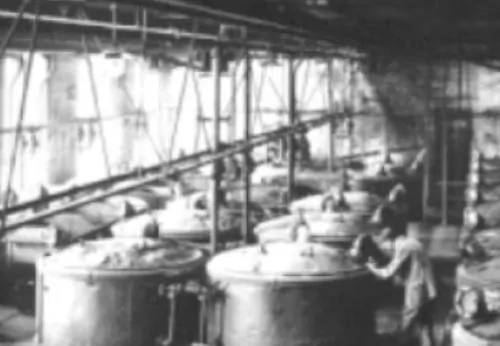
The innovation adopted during the winter of 1920–1921 concerned the stage at which a hot fertilizer mixture became a solid product. Concentrated ammonium nitrate solution and solid ammonium sulfate were combined into a viscous slurry, which then required cooling and drying. Under the older arrangement, the material passed through covered channels containing mixing screws, with air assisting the cooling process; solidification produced small lumps that conveyors carried into storage. The replacement method used compressed air to disperse the slurry through a nozzle, producing a much finer powder. Lower residual moisture was an intended improvement, and the resulting material could be spread more readily in agricultural use. The commercial purpose of the alteration was intelligible in terms of the fertilizer’s performance for its purchasers. BASF continued to manufacture under the established ammonium sulfate nitrate designation and the nominal equal-weight specification. The drying equipment nonetheless participated in determining what kind of solid that specification yielded. Evaluating the change as an improvement in product quality consequently left a further question about its effects on the product’s behavior during industrial handling.
Location and arrangement changed as the spraying system developed. Initially, atomization took place in ventilated chambers in building 111, where conveyors collected the powder and transferred it to silo 112. On April 27, 1921, spraying began directly inside silo 110, supplied through a pipeline from the mixing equipment. The Bavarian commission’s account, reconstructed in Kristensen’s technical reassessment, distinguishes successive arrangements within that building. During the initial period, the nozzle discharged toward different locations, producing heaps that overlapped irregularly as the direction of spraying changed. Partial clearance left substantial quantities of this earlier material inside the warehouse. By the end of May, the nozzle occupied a fixed position and directed its discharge toward openings in the floor connected to a conveyor below. Much of the fertilizer passed through these openings and traveled onward toward silo 112. The spray extended beyond the openings, so an elongated accumulation formed around them, acquiring a horseshoe shape and the working name “bunker.” This arrangement continued until September 19. Silo 110 functioned simultaneously as a place where fertilizer acquired its finished physical form and as a building retaining earlier stocks. The product moving out on the conveyor and the material accumulating inside followed different paths through the same installation, an important distinction when reconstructing which portion was subsequently exposed to blasting.
Airborne powder added another deposit to this changing interior. Witness accounts described dust dense enough to restrict visibility to a few meters, with finer material settling on structural beams and over fertilizer already in storage. The exceptionally dry summer of 1921 formed part of the environmental setting in which this accumulation developed. Loose deposits reportedly reached approximately 35–45 centimeters in thickness and remained in the building. Older hardened stocks persisted beneath some of this powder, so the room contained visibly different forms of material alongside one another. These observations establish a history of deposition; determining the chemical composition and explosive significance of the finer fraction requires additional evidence.
A brief production trial in early September makes the contemporary recognition of danger more concrete. Between September 2 and 4, ammonium nitrate was sprayed separately, with ammonium sulfate added farther along the conveying system. The resulting fertilizer went into silo 112, a destination that distinguishes this trial’s output from the principal stocks retained in silo 110. Postaccident testimony stated that ammonium nitrate deposited on the walls during the trial was regarded as hazardous and scraped away. That account records an expressed concern about an identifiable substance and a reported precaution taken against it. Because the evidence comes through later testimony, it cannot establish that removal was complete or rule out every contribution from the trial. Its interpretive significance lies in the distinction employees reportedly made between the exposed nitrate and the accepted mixed fertilizer. Recognizing the former as dangerous could coexist with continued confidence in the latter, especially when the mixture satisfied the composition on which earlier testing had concentrated. The episode suggests why the factory’s criteria for recognizing danger need to be reconstructed alongside its equipment. It also directs the inquiry toward how a change in preparation was assessed when the output retained a familiar chemical identity.
Connecting these production alterations to a precise initiating mechanism requires a further step. Ulrich Hörcher’s review gives particular importance to the possibility that spraying produced a fine fraction enriched in ammonium nitrate, while Kristensen places greater weight on the sensitivity associated with the porous fertilizer and treats the extent of nitrate enrichment more cautiously. Their accounts make the manufacturing changes central but differ over what must be inferred about the material that actually exploded. The destruction of that material limits how decisively its preaccident characteristics can be reconstructed from surviving samples and testimony. Process history nevertheless establishes something firmer than a speculative explanation built solely from the catastrophe’s scale. The stock awaiting removal had been produced and deposited through successive alterations to the installation. Continued use of the same fertilizer name accompanied changes in its formation and its distribution inside the warehouse. By September 21, the task of clearing silo 110 brought operators into contact with the accumulated results of those alterations.
September 21: The Explosion and Its Human Geography
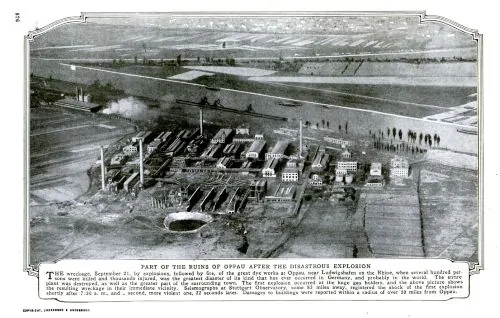
Preparations for removing fertilizer from silo 110 were underway before seven o’clock on Wednesday, September 21. Witnesses saw Humpe getting ready for another round of blasting, continuing the clearance that had begun the previous day. The surviving evidence places the catastrophe within that work, although it does not recover every detail of the final operation. At 7:32:14 a.m., the first major explosion occurred and a more powerful second explosion followed four seconds later. Seismographic recordings subsequently established the interval more securely than recollections alone could have done. Accounts from people at the works or approaching it described a muffled report followed by an immense eruption of flame and a cloud that obscured the surroundings. Descriptions convey the abrupt loss of visibility and orientation experienced by survivors. The measured sequence establishes two distinct events, while the question of precisely how they were connected belongs to the technical investigation.
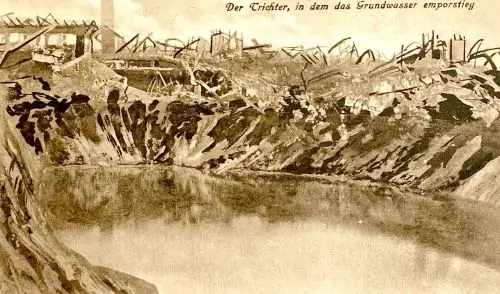
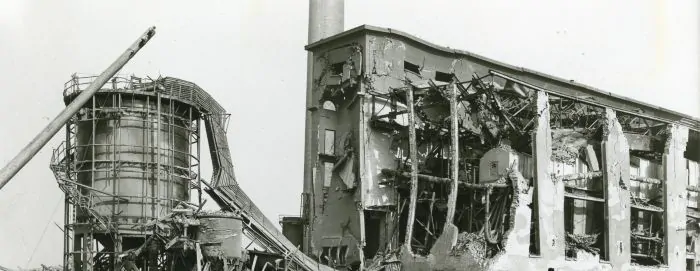
The fertilizer inventory and the quantity that exploded require separate figures. Approximately 4,500 metric tons were stored in silo 110, but later estimates attributed the destructive reactions to several hundred tons, roughly a tenth of the total. These estimates depended on reconstruction after the event and should retain that qualification. Even this partial involvement destroyed the warehouse and formed a crater extending more than a hundred meters across and nearly twenty meters deep. Groundwater soon entered the depression. The heaviest destruction at the plant lay in its southwestern part, while buildings elsewhere suffered varying degrees of damage. For anyone working close to the source, the violence of the event bore little relation to the limited disruption expected from a loosening shot.
Destruction extended outward into a landscape of neighboring settlements and industrial premises. Oppau sustained the heaviest residential damage. Later surveys recorded approximately 1,036 buildings completely destroyed, with hundreds more severely damaged. Edigheim also suffered extensive losses, while farther away the effects included damaged roofs and displaced window frames. Across the Rhine, Mannheim experienced injuries and widespread breakage, including damage to the large, glazed surfaces of shops and commercial buildings. Broken windows were reported well beyond the immediate industrial district, reaching places such as Heidelberg and Darmstadt. Distance shaped the severity of these effects without producing a simple boundary between affected and unaffected communities. A correspondent sent from Darmstadt described increasingly visible damage along the journey toward the works, giving contemporary readers an account of the disaster spread across a familiar regional route. Such reports require care because initial descriptions sometimes exaggerated how completely individual places had been destroyed. Yet their observations of damaged buildings and displaced residents are consistent with the later record of extensive losses. Residential proximity also changed the character of the emergency. People could survive the explosions and still lose the rooms and possessions needed to resume ordinary life, making the condition of homes a central part of the catastrophe’s human extent.
Employees of outside firms accounted for a large share of the deaths within the works. One official reckoning, discussed by Christian Haller, placed the combined total of dead and missing at 559, including 99 people whose bodies could not be recovered or identified. Among the identified fatalities, 140 were BASF employees, 298 worked for outside firms, and 22 died outside the company premises. The large number employed by other enterprises shows how broadly the plant’s daily operation drew people into its physical danger. Their employment relationships differed, but their exposure could converge at the same location. Assessing the relative exposure of different groups requires locating their jobs and establishing how many people from each employer were present that morning. These figures establish that the company’s direct payroll gives an inadequate account of the population affected within the works. Approximately 1,977 people were recorded as injured, while the precise totals vary among subsequent accounts. Haller also notes that the victims came from roughly fifty communities. The deaths consequently affected households distributed across the region, including families whose dwellings stood beyond the zone of severe structural damage. Recording a person as missing introduced a further difficulty for relatives, since the inability to identify or recover a body prevented the immediate certainty available in other deaths.
The hour of the explosions influenced this pattern of exposure. The larger daytime workforce, due to begin at about eight o’clock, had not yet fully taken up its stations, although substantial numbers were already at the works and others were arriving. The evidence supports that difference in attendance; calculating an exact alternative death toll for a later explosion would go beyond it. Survivors among the workforce undertook the first rescue efforts inside the damaged plant. Ernst Westhoven, the head of BASF’s medical department, organized assistance and the transport of injured people in company trains to the separate Ludwigshafen works, where the clinic and temporary treatment stations received them. The surviving facilities there became part of the response to destruction at Oppau. BASF’s later account records that the works fire brigade had only one ambulance available, an indication of the disparity between ordinary emergency provision and the demands suddenly placed upon it. The railway connection acquired immediate importance as a means of moving casualties toward treatment.
Help soon involved services beyond the company. Doctors and organized rescue personnel arrived from surrounding towns, while classrooms provided additional space for treating injured people. French occupation forces assisted with medical support and control of access to the damaged area. Contemporary reporting described vehicles carrying casualties away while other traffic brought rescuers toward Oppau, with crowds of pedestrians adding to congestion. The emergency depended on maintaining routes through an area simultaneously receiving help and generating a large demand for evacuation. Cooperation between German local services and French personnel gave the response an institutional reach suited to a disaster crossing municipal boundaries.
Outside the treatment stations, families faced the immediate problem of finding relatives and securing somewhere to spend the night. The Darmstadt correspondent reported people retrieving bedding from damaged houses and carrying belongings away on handcarts, observations that describe survival in small acts of household recovery. Loss of shelter could occur alongside bereavement, multiplying the demands upon the same family. Public mourning followed on September 25 at Ludwigshafen’s main cemetery, where President Friedrich Ebert and representatives of the French occupation administration joined the memorial gathering. Other affected communities also held commemorations. These ceremonies recognized a public loss extending across workplaces and places of residence. During the first day, fear of another explosion had already influenced whether people remained near their homes or approached the works, and newspapers reported company assurances intended to quiet that fear. Statements about continuing danger entered the emergency as practical guidance while the cause of the catastrophe remained unresolved. The demand for an explanation developed amid rescue and displacement, giving the claims that followed consequences beyond the technical debate.
Explaining Disaster before the Evidence Was Settled
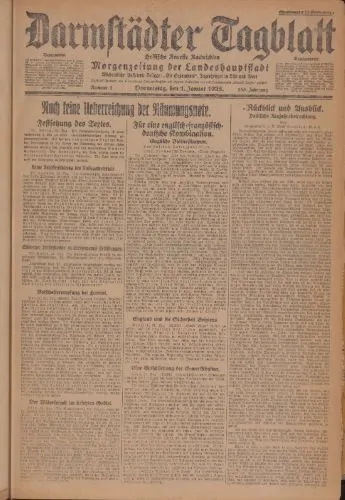
Newspapers provided explanations from reports arriving at different stages of the emergency. The September 22 issue of the Darmstädter Tagblatt preserved this uncertainty within a single edition as one dispatch located the explosions in “Laboratorium 53” and asserted that none of approximately eight hundred workers there had survived while a subsequent company statement identified a fertilizer silo as the source. The first account was substantially wrong, but its appearance alongside the correction shows how incompatible versions could circulate together. Identifying the destroyed installation was already a causal choice, since a laboratory accident suggested a different kind of activity from an explosion in stored fertilizer. The paper also printed the directors’ assertion that earlier investigations had disclosed no explosive properties in the product, immediately placing experimental authority beside an acknowledged lack of explanation. For historians, the sequence of these statements matters as much as their individual content. Information that later became securely established entered public discussion through a succession of provisional claims.
Wartime associations furnished another set of explanations, in the international technical press. Haller records that Le Moniteur scientifique de Quesneville advanced the allegation that German wartime explosives had been concealed under the appearance of fertilizer and had subsequently exploded. Such an account could make the disaster seem intelligible through an already familiar suspicion of German chemical industry. It nevertheless required evidence of concealed explosive stocks rather than merely the established history of nitrogen chemistry’s military uses. Claims about secret activity also met resistance within foreign publications. L’Industrie Chimique considered suggestions involving a new explosive or an unfamiliar gas while questioning whether clandestine manufacture was plausible at a works exposed to occupation authorities’ inspection. The debate cannot be reduced to a uniform foreign accusation answered by German technical knowledge. Different writers assigned different evidentiary weight to the same political setting. The recent war supplied reasons to ask about military materials, but it could also encourage an unsupported transfer from knowledge of the industry’s past to claims about the contents of a particular warehouse.
BASF’s public response worked to delimit the event and preserve the credibility of its industrial knowledge. The directors’ October 4 statement, summarized in Nature later that month, identified ammonium sulfate nitrate as the stored product and categorically separated the accident from high-pressure ammonia synthesis. Locating the source in fertilizer storage addressed a genuine confusion about which part of the works had failed. The statement also invoked experimental results and an established history of explosive loosening to defend the material’s previously accepted safety. Publication in a scientific periodical gave those company claims a channel through which they could reach an international readership, although their origin remained the directors’ own account. An earlier intervention at the September 25 memorial went further. Bosch attributed the catastrophe to unfamiliar and still unexplained natural conditions and denied malpractice or negligent omission. His statement joined an assertion about the state of scientific understanding to a judgment about responsibility. Those propositions required different forms of support. An unresolved reaction mechanism did not, by itself, establish that every relevant decision had been adequately examined. The earlier tests remained part of the evidence to be explained, including why their results had supported a procedure that now failed. Assessing the response requires separating its defensible identification of the accident’s location from its broader claim that the mystery already excluded culpable failure. The published assurances were evidence about how BASF represented its conduct while its conduct was still under investigation.
Material explanations were present early enough to complicate any portrayal of the contemporary debate as wholly inattentive to physical conditions. In an October 14 contribution to the Vossische Zeitung, Kurt Arndt suggested that the exceptionally dry summer might have altered the fertilizer’s moisture content. Emil Hene proposed gradual decomposition of the mixed product as a possible route to the explosion. These were hypotheses, with different implications for what investigators should seek in production records or surviving material. Arndt’s suggestion shows that moisture was available as a line of inquiry in 1921; identifying its actual contribution still required experimental comparison. An early proposal can deserve attention without receiving retrospective credit for a complete explanation.
Disagreement also concerned the behavior of the initiating explosive. Gustav Rosendahl’s September 29 contribution to the Chemiker-Zeitung attributed the disaster to the deliberate use of larger cartridges or a different explosive, directing suspicion toward the execution of the loosening operation. A response published in January 1922 challenged the assumption behind that explanation, arguing that a more powerful explosive might disperse the resistant material in ways less conducive to a larger reaction. The competing judgments concerned how energy from the charge interacted with the surrounding fertilizer, an issue that could not be resolved simply by describing one charge as stronger than another. They also placed responsibility in different locations within the proposed sequence of events. A fault in the blasting operation would call for a different investigation from an unexpected response in material prepared according to an accepted procedure. Haller’s survey identifies more than fifty technical contributions across seventeen specialist journals, indicating how widely such questions were discussed as the inquiries developed. That volume measures the extent of professional engagement, while leaving the independence and quality of the contributions to be assessed individually. Multiplying commentary could expose assumptions to criticism; it could also repeat an assertion without adding another observation of the stock or the final operation. A published technical disagreement consequently defined questions for investigation more readily than it supplied a settled finding.
Sorting these claims required standards suited to the kind of proposition being advanced. An account locating the source in an installation could be checked against the pattern of destruction and recovered operational evidence. Explaining the fertilizer’s reaction required a closer relationship between proposed material conditions and demonstrated behavior. Judgments about reasonable precautions additionally depended on reconstructing what information had been available when decisions were made. These distinctions allow the early debate to be read without granting equal standing to every allegation or treating the company’s expertise as sufficient to settle the matter. A useful hypothesis specified evidence that might confirm, qualify, or overturn it; a confident assertion could circulate without meeting that requirement. Public explanations also had consequences before their scientific merits were decided, because identifying an abnormal material or an improper operation influenced where blame and demands for prevention were directed. The official inquiries had to work within this crowded field of assertions. Their contribution depended on constructing a record against which explanations could be compared, including those offered by the organization with the fullest knowledge of the works.
From Ruins to Evidence: How the Investigations Worked
The investigation acquired several institutional centers almost immediately. Bavaria’s Landtag resolved to establish a commission on the afternoon of September 21, and the Reichstag authorized a parliamentary inquiry one week later. The Bavarian body included technical specialists and representatives of industrial labor, while the Reichstag committee drew its members from different political parties and commissioned scientific advisers. Their proceedings were largely separate, although joint public meetings provided occasions for exchanging information. The distribution of work also followed practical distinctions within the problem. Examining manufacture required access to the works, whereas experimental research could proceed in university and government laboratories. Alexander Gutbier, at the Technische Hochschule Stuttgart, undertook physical and chemical investigations; Hermann Kast, directing explosives research at the Chemisch-Technische Reichsanstalt in Berlin, became a central figure in the testing program. BASF supplied documents and technical assistance. Public authorities exercised investigative powers while depending in part on the affected enterprise’s knowledge of its own installations. Understanding that arrangement requires attention to how company information was examined and challenged.
Excavation recovered an unusually valuable resource beneath the wreckage: the factory’s operating and analysis books. These records allowed investigators to calculate quantities of ammonium nitrate and ammonium sulfate processed into fertilizer and to examine the analytical results recorded during manufacture. Their value came partly from having been created before anyone knew which details a disaster inquiry would require. Entries made for production control could establish a sequence of operations without relying entirely on recollections offered after the explosion. Drawings and descriptions of the equipment supplied a different perspective, showing how material moved between manufacturing and storage areas. Witness questioning was necessary to connect those arrangements with actual working practice, including alterations to spraying and the clearance of accumulated stock. Reading these sources together made it possible to reconstruct an installation whose most important interior features had disappeared. That reconstruction involved interpretation. A drawing described an arrangement, while testimony helped establish when and how it had been used. The surviving books likewise recorded what the factory habitually measured, leaving investigators to determine whether those measurements answered the questions now being asked. The documentary inquiry consequently extended beyond checking whether the arithmetic was correct. It sought a history of the material’s preparation and handling that could guide the selection of experiments.
Specimen collection introduced another set of distinctions into the inquiry. Researchers examined fertilizer scattered from silo 110 and material recovered from the damaged silo 112, keeping their places of origin relevant to the interpretation of results. Kast’s account indicates that some specimens reached the Reichsanstalt through the investigating magistrate, while representatives of the institute collected others at the site. Judicial and scientific collection contributed to the same analytical program through different routes. Material associated with the blasting operation was also examined, allowing the initiating explosive to be investigated alongside the fertilizer. Such collection could support comparisons between substances that had been present at the works, but it could not retrieve the portion consumed in the reaction. Identifying a sample’s provenance was consequently part of establishing what question its analysis could reasonably answer.
Laboratory work translated the developing reconstruction into more specific inquiries about material behavior. The German investigators studied commercial Oppau fertilizer and prepared mixtures whose composition could be varied deliberately. Their explosive tests employed different forms of enclosure and quantities of material, extending from laboratory measurements to substantially larger trials. Altering moisture or particle size offered ways to investigate properties that an analysis of total nitrogen could not describe. Changes to the strength of initiation and the degree of confinement examined the circumstances under which a reaction might develop. These procedures required a further judgment about comparability. Producing an explosion under an experimental arrangement demonstrated a possibility, while connecting that possibility to Oppau depended on evidence about the stock and its surroundings. Standards of experimental adequacy were debated within the investigation itself. Ernst Richard Escales, an explosives chemist serving as an expert for the Frankenthal court, reported sixteen trials using fertilizer from the factory and explosive obtained from stocks seized by the Ludwigshafen police. Military personnel supplied technical assistance for that work. The Bavarian commission subsequently rejected the evidentiary force of his results because the necessary comparative explosions had not been performed. As Haller’s account makes clear, participation by a recognized specialist did not ensure acceptance of every experimental conclusion. The objection concerned what the trials enabled others to distinguish, making criticism of experimental design part of the inquiry’s production of evidence.
British participation enlarged the research effort beyond the German proceedings. The Chemistry Research Board of the Department of Scientific and Industrial Research obtained material from Germany for examination at the Government Laboratory and the Royal Arsenal at Woolwich. Robert Robertson and his collaborators investigated chemical and physical properties, while Godfrey Rotter reported on experiments addressing the fertilizer’s capacity for explosion. These assignments brought complementary forms of expertise into a study whose conclusions depended on connecting the identification of a substance with its observed behavior. Publication in the Transactions of the Faraday Society in 1924 made the reports available for assessment within an international scientific forum.
Bringing the findings together required sustained consultation. Kast records that the experts met in Darmstadt on August 1, 1922, subsequently visited Oppau to inspect BASF’s plaster model of the explosion crater, and met again in Leipzig on September 17. The model gave participants a common representation of the excavation against which to discuss the destruction, supplementing the factory plans used in reconstructing the site. Its manufacture by BASF also illustrates how corporate assistance entered the inquiry in concrete, examinable forms. Parliamentary questions helped organize the advisers’ deliberations, directing separate investigations toward judgments that could be presented in a collective report. The eventual publications appeared at different times and served different purposes. Commission findings entered the German explosives journal in 1924, while Kast’s extended account followed in installments during 1925–1926. For the historian, those dates distinguish the development of an argument from its later, fuller presentation. Reading the reports as successive documents preserves the opportunities for revision that an undifferentiated appeal to an “official explanation” would conceal. The investigations left a record through which later scholarship could revisit particular experiments and recover qualifications attached to their interpretation. The resulting archive makes disagreements traceable to particular specimens, experimental arrangements, and assumptions about what the measurements established.
Competing Explanations: What Made the Material Explosive?
An unfamiliar contaminant offered one explanation for the fertilizer’s unexpected reaction. Investigators considered whether substances such as ammonium nitrite or an acid impurity had introduced an exceptional source of instability. Chemical examinations of the recovered fertilizer did not substantiate those proposals. The product nevertheless contained ordinary manufacturing residues, including small quantities of chloride and iron oxides, whose possible influence on decomposition required a different assessment from the search for a concealed explosive ingredient. Finding a constituent capable of affecting ammonium nitrate under some conditions would still leave its contribution at Oppau to be demonstrated. The analytical results substantially weakened explanations built around an unusual contaminant, directing attention toward the fertilizer’s existing components and their behavior.
Excess ammonium nitrate remained a more substantial possibility, but the location and origin of any excess mattered. An error in the proportions supplied during manufacture would imply a different history from a concentration developing within particular deposits afterward. The surviving factory analyses gave little support to a general failure to maintain the intended mixture. Post-accident sampling produced a less uniform picture. Five of forty-two specimens from silo 112 contained more than 60 percent ammonium nitrate, although two of those five came from the same location. Those findings established that nitrate-rich material could be encountered in the neighboring store, without identifying the composition at the origin of the explosion in silo 110. Investigators also considered whether nitrate crusts dislodged during the cleaning of manufacturing equipment had traveled into silo 112, providing an explanation specific to that building. Samples scattered from silo 110 and examined in Germany and Britain generally agreed with the commercial specification. The evidence consequently resisted an accusation that the whole stock had been manufactured incorrectly. It left a narrower question about whether the process had produced a hazardous concentration in a fraction whose chemical composition was never securely established.
Segregation during atomization supplied a mechanism for such a localized concentration. The material entering the nozzle included sulfate particles suspended in a concentrated solution, so its components did not necessarily crystallize and travel through the building together. The Bavarian commission considered whether larger, sulfate-rich particles fell nearer the discharge while finer, nitrate-rich material remained airborne and settled farther away. There was supporting evidence from another part of the works. Dust collected above the spraying chambers in building 111 contained ammonium nitrate concentrations reaching approximately 75 percent. Experimental spraying likewise indicated that partial separation was possible. The Reichstag investigators disputed how readily that finding could be transferred to silo 110, emphasizing differences in ventilation and temperature between the installations. Those differences were consequential because evaporation and crystallization depended on the conditions surrounding the droplets. Evidence that one spraying chamber produced enriched dust could support an inquiry into another chamber without proving identical separation there. Hörcher’s later reconstruction gives this mechanism a major role, proposing that a sensitive nitrate-rich fraction reacted first and then supplied a stronger initiating impulse to surrounding fertilizer. Kristensen accepts enrichment as plausible while questioning whether it was necessary to explain the disaster. Their accounts collectively assign different weight to the chemical alteration required for the proposed sequence. Segregation remains a serious explanation whose local occurrence and magnitude are less certain than the existence of the spraying process itself.
Grain structure raised a related question about how sulfate moderated the reaction. Experiments on mechanically combined salts showed that their relative particle sizes could alter explosive behavior even when their overall proportions remained constant. Phokion Papa Naoúm and Rudolf Aufschläger distinguished the energy available from a reacting mixture from the speed at which its components exchanged heat. Ammonium sulfate could absorb heat during its initial decomposition and thereby impede the development of a reaction in neighboring nitrate, while its ammonium content also had potential fuel value in an oxidizing mixture. The strength of that moderating effect depended partly on how the components were distributed and brought into contact. Such results complicated the assumption that a specified quantity of sulfate supplied an equally effective restraint in every physical arrangement. Reduced moisture provided another influence, since water absorbed heat and affected the formation and subsequent alteration of the solid material. These findings established several routes by which preparation could change sensitivity, although experiments on separately mixed grains could not simply be treated as replicas of the fertilizer manufactured from slurry at Oppau.
The importance of porosity becomes clearer through a distinction between possessing chemical energy and responding to a shock. A loose deposit contains small spaces within or between its particles, and rapid compression can concentrate energy around those spaces. Later research identified mechanisms through which collapsing cavities and compressed gas could produce intensely heated microscopic regions, conventionally called hot spots. A reaction could begin at these sites even though the average temperature of the surrounding material remained much lower. Whether that initial reaction grew into detonation depended on further conditions governing its development and propagation. Work associated with Frank Philip Bowden and Abraham David Yoffe during the 1940s, synthesized in their 1952 study of explosion initiation, supplied a framework for understanding such localized heating. Applying it to Oppau is a retrospective interpretation, rather than evidence that BASF’s specialists already possessed that explanation. The German investigators nevertheless obtained an important empirical result: reducing the density of certain nitrate-sulfate mixtures made explosive decomposition easier to produce. Their interpretation placed emphasis on loose material being stirred or dispersed by the pressure wave, leaving the microscopic significance of its voids largely unexplained. Kristensen’s reassessment treats porosity as central to the changed fertilizer’s susceptibility. That argument allows material retaining approximately the specified chemical proportions to become more responsive to initiation because its physical structure has altered. It also requires care in transferring results from experimental mixtures to the particular deposits inside silo 110.
The four-second gap between the major explosions created a further constraint on any proposed mechanism. Some reconstructions allowed the earlier event to change the circumstances of the later one. Kast regarded successive blasting charges as the most plausible explanation, suggesting that material around a second charge might shield it from immediate initiation by the first explosion. The surviving charge could then fire after the surrounding fertilizer had been disturbed, producing a much greater effect. That proposal drew on experience with delayed secondary explosions in ammunition accidents, rather than a direct observation of the final charges at Oppau. Hörcher’s account concentrates on the transfer of initiation from a sensitive fraction to a larger quantity whose physical properties had also changed. These proposals address different parts of the possible escalation, and their compatibility depends on how the charge sequence is related to the response of the fertilizer. Establishing two distinct explosive events did not by itself select between every proposed route of escalation. A satisfactory reconstruction had to connect the interval with a credible mechanism and with the uneven participation of the stored material in the catastrophe.
The explanations that survived scrutiny carried different evidentiary strengths. An extraordinary contaminant lacked the analytical support its proponents needed, while a general error in the manufactured mixture fitted the recovered evidence poorly. Local nitrate enrichment had a plausible production mechanism and suggestive findings elsewhere in the works, but its extent in the destroyed deposits remained inferential. Changes in physical sensitivity received firmer experimental support, although the precise contribution of each property at Oppau could not be isolated. These explanations could also operate together. An enriched fraction might have been unusually porous, and its response could have initiated material with a different composition. The strongest interpretation connects the accident to the material produced by the altered drying arrangements while preserving uncertainty about the exact sequence of reactions. The extent of that uncertainty depends on whether the experiments reproduced the relevant properties and surroundings of the fertilizer that actually participated in the explosion.
Why Experiments Did Not Produce a Single Answer
Postaccident experiments repeatedly showed that the Oppau fertilizer supplied for testing was difficult to detonate. German and British researchers obtained little response from impact and friction tests, while heating caused decomposition without consistently developing into a self-sustaining explosive reaction. Trials with substantial initiating charges also frequently failed to establish propagation through the fertilizer. These findings gave additional support to portions of BASF’s earlier laboratory work, even after the warehouse disaster had exposed the inadequacy of the resulting safety judgment. The apparent inconsistency required investigators to specify which properties their tests had examined. Repeating a negative result could establish that a particular specimen resisted a particular stimulus, while leaving unresolved the behavior of material prepared or arranged differently.
Even the identification of a positive result required interpretation. The initiating explosive supplied its own pressure pulse, so damaged apparatus could not establish how much the fertilizer had contributed. Gas formation near the charge also differed from a reaction continuing through the surrounding material. Rotter placed particular weight on propagation, finding little evidence that the tested salt appreciably augmented the initiating explosion. Researchers could agree about a test’s visible effects while disagreeing about whether those effects demonstrated explosive behavior in the fertilizer.
Sample preparation introduced a more consequential uncertainty because a precaution intended to strengthen a test could change the material’s responsiveness in the opposite direction. The British researchers received fertilizer in a consolidated condition and conducted much of their work on relatively dense charges. Rotter described one experiment in which strong initiation was applied to highly compressed salt, the arrangement being judged favorable to propagation. From that perspective, a failure under such apparently demanding circumstances seemed quite persuasive. The German results on less densely packed mixtures indicated that this reasoning could miss the significance of the powder’s physical state. Increasing density did not invariably make a test more severe, and reducing it could make a mixture more receptive to initiation. Kristensen identifies this divergence as a central weakness in the British interpretation, although the investigators’ access to hardened specimens helps explain their experimental choices. The importance lies in the way an assumption about the worst conditions organized the work. A laboratory procedure could be carefully executed yet examine a comparatively resistant form of the product. Its outcome would then answer the question built into the preparation rather than every question raised by the disaster.
Size and geometry imposed additional limits on comparison. In a narrow charge, lateral expansion can reduce pressure at the reaction front until sustained detonation becomes impossible. A broader mass can maintain propagation under conditions in which a small specimen fails. Later detonation physics describes a minimum charge dimension below which steady propagation ceases, often expressed as a critical diameter. British trials extended to approximately one hundred kilograms, greatly exceeding the quantities used in lead-block measurements, yet their scale alone did not establish that they reproduced the mechanical surroundings of a deposit inside the silo. Strong metal confinement restricted expansion and could sustain a reaction that an unconfined specimen would not support. Scaling a test required attention to the dimensions and arrangement of the material as well as its mass. The warehouse’s overall dimensions cannot by themselves reveal the threshold applicable to the particular fertilizer that reacted there.
Artificially prepared mixtures offered investigators a way to isolate individual variables. Separately combining nitrate and sulfate allowed their proportions or grain sizes to be varied in ways useful for isolating a factor. The resulting specimen nevertheless had a different preparation history from a product crystallized through contact with solution. A finding about one could illuminate the other only after the relevant resemblance had been established. Standardization also favored a uniform test charge, whereas the factory had accumulated deposits formed during different stages of operation. The experiments could reveal a mechanism’s feasibility without reproducing the spatial relationships that allowed it to matter in the warehouse.
Calculations brought their own assumptions into the evaluation of results. The Reichstag specialists supplemented testing with estimates of the heat released by proposed decomposition reactions, selecting plausible final products and calculating the energy balance. Such an approach could indicate how changing the nitrate-sulfate ratio affected the energy potentially available. It depended on correctly representing the conditions under which the products formed. Kristensen’s later reassessment distinguishes conversion at ordinary, constant pressure from the much higher pressures associated with detonation. His modeling allows a different distribution of products, notably sulfuric acid in a condensed phase, which alters the predicted thermal behavior of the mixtures. Different final products retain different amounts of chemical energy, changing how much becomes available during the reaction. A calculation could be internally consistent while offering an incomplete representation of the event its authors sought to explain. This limitation was consequential when calculated energy trends were used to interpret an experimental boundary between mixtures that reacted and those that resisted initiation. Thermochemical estimates contributed evidence, but their relationship to the observations required scrutiny alongside the measurements themselves.
Publication further shaped what other specialists understood the investigations to have established. The British authors reported that the German conclusions agreed closely with their own, although the respective programs had assigned different significance to dense and loose material. Agreement in a concluding statement could conceal an unresolved difference in experimental interpretation. Kristensen also identifies a difference of emphasis between the German disclosures of 1924 and Kast’s more extensive account published in 1925–1926. The later presentation made the altered physical condition more prominent. An American notice in Industrial & Engineering Chemistry responded to the earlier reports by stressing that the circumstances responsible for the catastrophe had not been duplicated experimentally. Its assessment registered a continuing demand for reconstruction despite the substantial testing already completed. The circulation of summaries could spread a common sense of uncertainty without transmitting every useful correlation found in the underlying work. Specialists outside the immediate inquiries encountered a published selection of findings whose arrangement affected which problems appeared settled and which remained open.
The inquiries established a set of conditional findings rather than one comprehensive reconstruction. They identified resistant specimens and demonstrated that other preparations responded differently, establishing relationships that subsequent research could interpret more adequately. They also narrowed several proposed causes without reproducing the complete accident. The difficulty was determining how those findings could be combined into a historically credible account of one destroyed accumulation. A negative experiment deserved weight within the conditions it tested, just as a successful explosive trial needed evidence connecting its arrangement with the factory. Neither result automatically settled the conduct of people who had acted before the decisive research existed. Moving from experimental findings to judgments about those decisions would require a further examination of what the organization had known and how it had evaluated changes in production.
Responsibility after the Explosion
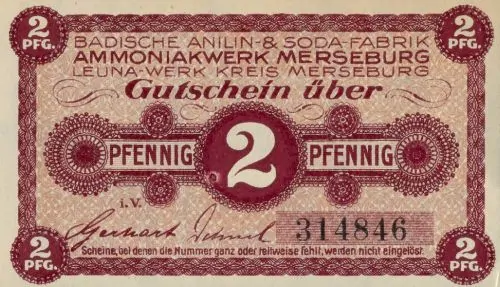
On April 10, 1923, the regional court at Frankenthal discontinued the criminal proceedings against BASF’s operating management. The testimony and expert opinions had supplied no basis for establishing culpable negligence. In the reasoning reproduced by Christian Haller, the court accepted that the scientific knowledge available before the accident had given management grounds for believing the blasting operations safe. This conclusion concerned the justification for decisions made before September 21, rather than the behavior documented through later technical research. The distinction mattered because the explosion’s occurrence could establish that an assurance had failed without proving that an identifiable person had breached a recognizable precaution. Discontinuing the proceedings was a consequential judgment about the evidence available for criminal attribution. It did not determine how the losses should be distributed or how far the company’s obligations to the affected population extended.
Authority within the works had been divided among people whose decisions addressed different parts of the operation. Laboratory assessments supported blasting, while production personnel altered the manufacture and handling of the fertilizer. The historical question is how information about those changes passed between the two functions and who could require a renewed safety assessment. Administrative permission offered another form of authorization, but its existence could not establish that every later product retained the properties of previously tested material. Examining these relationships locates decisions within the organization without assigning equal fault to everyone involved.
Well before the criminal proceedings ended, negotiations over financial assistance had made responsibility a practical dispute over terms and amounts. By December 1921, BASF was prepared to offer 200 million marks through the Hilfswerk Oppau, the organization administering relief and reconstruction. The proposed arrangement preserved the company’s denial of blame and of a legal obligation to make good the losses. Those receiving payments were also to relinquish further claims against BASF. The Bavarian commissioner responsible for the relief organization, Karl Stützel, considered the proposed sum inadequate, estimating requirements at approximately 321 million marks and warning about further currency depreciation. His objection concerned the lasting adequacy of the proposed fund, as well as the amount immediately available. No comprehensive agreement resulted from these negotiations, although assistance continued through company payments and the relief fund. The offer consequently needs to be understood as a proposed settlement, with conditions attached, rather than as an uncomplicated measure of generosity or an admission of liability. A waiver would have converted an immediate payment into an end to a recipient’s ability to seek additional compensation. For households facing urgent expenses, that exchange involved a different calculation from the company’s concern to limit an uncertain future exposure. The relief negotiations show that disagreement about responsibility persisted even where the necessity of providing money was acknowledged. Company assistance also expressed an understanding of the relationship between industrial leadership and its dependents. Katja Patzel-Mattern interprets BASF’s communication after Oppau through a patriarchal conception of corporate governance, in which management claimed authority while presenting itself as a source of protection. Within that conception, a firm could recognize suffering and organize substantial help while describing its contribution as voluntary. The language of care established an obligation that differed from a claimant’s enforceable entitlement to compensation. Patzel-Mattern’s analysis helps explain how such conduct could sustain public acceptance when it corresponded to prevailing expectations of an employer’s social role. It also directs attention to the unequal positions within that relationship as the party dispensing assistance retained considerable influence over its terms. The historical significance of relief lies partly in this combination of material support with the preservation of managerial authority.
The means of supporting survivors proved vulnerable to events far beyond the damaged works. Donations administered by the Hilfswerk helped meet personal and property losses, supplemented by payments from BASF and resources available through other institutions, including insurers. These contributions spread the financial burden across a wider community than the company alone. As the mark depreciated, nominal allocations provided an increasingly unstable foundation for continuing assistance. Payments to widows and orphans from donated funds were discontinued, and by the end of 1924 the exhausted Hilfswerk had dissolved. A commitment recorded in marks consequently cannot be treated as a fixed quantity of support delivered across several years. The weakening of relief did not retrospectively establish negligence in the factory, but it did shape the consequences of leaving recovery dependent on funds whose value and replenishment could not be assured. Evaluating responsibility after Oppau requires following what recipients could actually obtain, as well as what contributors initially promised.
Haller places the handling of responsibility within the close relationship that wartime expansion and postwar necessity had created between BASF and the German state. Agricultural demand and the importance of nitrogen production gave both institutions reasons to favor industrial recovery and social stability. He argues that an explanation stressing the inability of science to determine the accident’s causes was compatible with those shared interests. That interpretation identifies a political advantage in uncertainty, although the existence of an advantage cannot by itself demonstrate that investigators suppressed a settled explanation. The substantial disagreements among specialists remain evidence that the technical difficulties were real. The criminal case’s closure could not answer every historical question about the organization’s evaluation of production changes or the fairness of its financial response. Responsibility had become an issue of how institutions exercised their authority under incomplete knowledge and how they treated people who bore the resulting losses. Public authorities still had to decide which practices could continue, even after the attempt to establish criminal fault had ended.
Prevention without a Complete Explanation
Restrictions on blasting began before the investigations had reached their published conclusions. On December 16, 1921, the Prussian minister for trade and industry, Wilhelm Siering, prohibited the loosening of fertilizer salts by explosive charges. His jurisdiction did not include the Bavarian Palatinate, where Oppau stood, but the decision shows that the accident could prompt action elsewhere without a complete reconstruction of its mechanism. The intervention addressed a deliberate industrial operation that authorities could remove from ordinary practice. Disagreement about which portion of the fertilizer had reacted did not prevent them from recognizing explosive initiation as an avoidable exposure. Mechanical methods offered a different way to recover hardened material, although they could require more labor and alter the economics of storage. The resulting restriction established a prospective condition of operation while the technical inquiries continued.
A memorandum prepared in April 1923 by the Reich Labor Ministry’s central supervisory office for explosives and munitions factories pursued a more detailed approach to manufacture and storage. Its provisions included restrictions on spraying ammonium sulfate nitrate in spaces used as warehouses or intermediate stores, reserving that process for production rooms. Dust generated during spraying, with other powdery manufacturing residues, was to be returned promptly to production instead of accumulated in storage. The document also prescribed mechanical loosening for stored ammonium nitrate and fertilizers containing more than 50 percent ammonium nitrate by weight, warning that powerful initiation could make such materials explode. Intermediate stores were to contain no more than one thousand metric tons at a time. These instructions treated the arrangement of the works as part of the safety problem, extending oversight to production spaces and the placement of stocks. Keeping a warehouse distinct from a production room would prevent the same enclosure from serving as both a place where freshly manufactured material settled and a place where large stocks awaited removal. Returning dust to manufacture interrupted the gradual formation of deposits whose properties might differ from those of the saleable product. Quantity limits placed an additional constraint on storage without specifying the precise fraction capable of reacting. These provisions addressed several plausible contributions to the catastrophe without requiring officials to establish their exact sequence.
Important qualifications nevertheless remained within the guidance itself. As Kristensen emphasizes, the 1923 memorandum continued to characterize fertilizer containing equal weights of nitrate and sulfate as nonexplosive. That designation preserved a boundary based on composition even as other provisions addressed conditions created during manufacture and storage. The statements suggest that authorities sought to prevent departures from an accepted material category while retaining confidence in the category’s ordinary safety. This was a narrower interpretation than the later argument that a suitably porous product could become responsive without a substantial change in its overall proportions. The distinction affected what a satisfactory inspection might be expected to establish. Confirmation of the prescribed composition could support one assurance, while the absence of dust accumulations or prohibited operations addressed hazards that composition alone could not describe. The memorandum records an uneven adjustment in understanding, with operational precautions extending beyond the apparent simplicity of its classification.
BASF’s response combined a substantial interruption in one fertilizer’s manufacture with a rapid restoration of ammonia production. The Oppau ammonia works resumed operation in December 1921 and had recovered their reported full capacity by February 1922. Production of ammonium sulfate nitrate ceased and BASF’s historical chronology places its resumption under a modified process in 1940. These different timetables distinguish the continued value of synthetic nitrogen from the acceptability of a particular product and method of handling it. Industrial recovery could proceed while a manufacturing practice associated with the catastrophe remained suspended.
Later process-safety scholarship makes the connection between these measures and continuing reassessment more explicit. Hörcher identifies the examination of a proposed process change, including its effects on the hazardous properties of the material, as a central lesson of Oppau. His formulation belongs to a subsequent professional framework, but the early restrictions already made particular features of production visible as subjects for oversight. Inspectors could examine whether spraying occurred in a storage building or whether manufacturing dust was being allowed to collect, using criteria that could be communicated beyond the original investigators. Professional dissemination also mattered. Chemiker-Zeitung established an additional section on accident prevention. Such developments gave specialist findings practical consequences even when their causal interpretation remained contested. Their effectiveness would still depend on implementation and on whether later alterations introduced conditions the instructions had not anticipated. The record of a prohibition or memorandum establishes what authorities prescribed; it does not by itself measure compliance across the fertilizer industry. Prevention after Oppau involved decisions about acceptable operations that could be justified with less certainty than a complete account of the explosion required. Establishing that those decisions were possible after September 1921 leaves a separate historical question about which precautions could reasonably have been expected before it.
Does Scientific Uncertainty Understate BASF’s Responsibility?
The following video from “The Raven’s Eye” discusses the Oppau explosion in 1921:
The strongest objection to emphasizing uncertainty is that it can turn an account of limited knowledge into an overly generous judgment of industrial supervision. A company need not possess a complete theory of detonation before examining whether altered manufacture has undermined an earlier safety assessment. Disputes about the final reaction consequently leave room for criticism of the decisions that exposed the fertilizer to explosive charges. The challenge concerns the adequacy of inquiry before continuing that operation, even when the resulting accident remains incompletely understood.
Such criticism was voiced close to the events. In 1926, Max Wolff, a former factory director writing as M. Lupus, attacked the treatment of the disaster and argued that competent operation, supported by sufficient technical knowledge, could have prevented it. His critique, discussed by Haller and Kristensen, emphasized the neglect of physical considerations within an approach dominated by chemical assumptions. The Magdeburg newspaper Volksstimme publicized his argument that the accident should not be explained away as an unfortunate combination of circumstances. The objection came from within the period’s technical debate, although it drew upon findings produced after the explosion. Haller supplies a further reason to examine how official authority supported the defense of industrial practice. He identifies a November 1926 letter from a regional factory inspector that adopted almost verbatim the language of an October letter from IG Farben’s patent department. By then BASF formed part of that chemical combine. This documentary connection gives specific substance to concerns about the independence of official responses to criticism. It establishes close communication and the borrowing of an industrial argument; its significance for the original investigations requires separate evidence. Nevertheless, the possibility of institutional self-protection belongs within the interpretation of why uncertainty became so prominent in the public account.
The strongest technical form of the objection concerns evidence that was accessible before the explosion but became inaccessible afterward. Investigators could not recover the fertilizer that had reacted, whereas factory personnel had previously possessed opportunities to examine material as it accumulated. The altered dryness and powdery deposits were observable features of production even when their contribution to explosive sensitivity was unrecognized. A critic can argue that an unusual accumulation warranted closer attention without requiring its observers to predict the eventual reaction in detail. Kristensen notes that no separate determination of the nitrate-sulfate proportions in the loose material lining the silo appears to have been made. The later shortage of evidence should not be projected backward as though the relevant objects had always been beyond examination. This asymmetry shifts the issue from the investigator’s inability to reconstruct a destroyed deposit to the producer’s opportunity to assess it while it existed. The case for renewed scrutiny is strongest where a visible alteration challenged the resemblance between the material in use and the material on which reassurance depended.
A fair evaluation must also preserve the scientific distinctions upon which contemporary judgments rested. The explosion at Kriewald in July 1921 involved explosives used to loosen hardened ammonium nitrate, but Kristensen reports that BASF apparently learned of that accident only after Oppau. It cannot be securely treated as a warning that the company consciously disregarded. Kriewald involved undiluted nitrate, whose potential danger BASF’s experiments had already recognized; the question at Oppau concerned whether sulfate had adequately suppressed that danger. The distinction between the products was the basis of the company’s testing and was not inherently unreasonable. Subsequent difficulties encountered by researchers outside BASF show that establishing the sensitivity of the mixed fertilizer required more than simply acknowledging nitrate’s explosive capabilities. A further round of inquiry would not necessarily have identified the conditions under which the altered material could react. Similarly, Wolff’s criticism benefited from an investigative record unavailable to those making the original decisions. His intervention challenges any claim that the accident was universally accepted as inexplicable, but it does not establish which particular experiment a responsible specialist in early 1921 would have considered decisive.
This consequently changes the weight given to uncertainty in the final interpretation. Unresolved details of the explosion limit the precision with which responsibility can be assigned to particular actions, yet they do not make the adequacy of BASF’s precautions impossible to assess. The company’s control over production and access to the material created opportunities for inquiry that outsiders possessed only imperfectly. Its expertise made the continued reliance on earlier assurances a decision requiring justification, especially when the conditions of manufacture had visibly changed. The most persuasive criticism concerns the sufficiency of those reasons, rather than an unsupported attribution of foreknowledge. Understanding why specialists remained confident can explain their conduct while leaving that conduct open to a demanding historical judgment. Scientific uncertainty should qualify the attribution of responsibility without becoming the principal reason for setting it aside.
Conclusion: Expertise and the Obligation to Reconsider
Oppau exposes a difficulty within the exercise of technical expertise. Competence in producing a useful material does not ensure that every judgment about its behavior is equally secure. BASF’s achievement in nitrogen chemistry had practical foundations, and its fertilizer operations incorporated testing and accumulated experience. The failure occurred when confidence derived from those activities accompanied a production change whose implications had not been adequately established. A material could satisfy familiar commercial specifications while acquiring physical characteristics important to its response to explosives. The demand for dependable fertilizer encouraged attention to product quality and ease of handling, while the relevance of altered physical structure to initiation remained harder to interpret. These were interconnected features of the enterprise, so accomplishment in one area could reinforce confidence in another without furnishing comparable evidence for it. The issue extends beyond the discovery that a fertilizer could explode to the relationship between what specialists had demonstrated and what their decisions presumed.
The investigations made that relationship more visible, even as they left parts of the accident unresolved. Their disagreements exposed difficulties in deciding whether specimens and experimental conditions represented the material that had occupied the warehouse. Knowledge developed unevenly, and conclusions became firmer as researchers identified assumptions their procedures had failed to examine. The surviving evidence supports a reasoned account of the failure while leaving the relative contributions of proposed mechanisms open. This distinction allows a historical explanation to remain substantive without presenting conjectural details as established events.
Accountability must be considered alongside this uneven development of knowledge. The company’s ability to inspect its own production gave it opportunities unavailable to investigators confronting destroyed material, and that difference matters when assessing the adequacy of its precautions. Later discoveries cannot automatically be treated as facts that specialists should already have recognized before the accident. A demanding historical judgment can evaluate the treatment of visible alterations while allowing that their eventual consequences were not fully understood. Damage outside the factory further establishes why a firm’s safety judgment could never concern its own interests alone. Public oversight faced a related problem, since officials needed industrial knowledge while also having to judge the claims made on its authority. Outside investigators needed access sufficient to examine the company’s standards of proof and the application of those standards as practiced. Their involvement could broaden scrutiny, but their own dependence on prevailing technical assumptions limited what external review could accomplish. Restrictions adopted after Oppau show that authorities could act on identifiable practices without first resolving every disputed feature of the explosion. Such action required judgments about the acceptability of an operation, and those judgments differed from the evidence needed to attribute criminal fault. A credible interpretation must preserve the possibility of justified criticism without converting the catastrophe’s outcome into proof of every allegation made afterward.
The agricultural importance of industrial nitrogen survived Oppau, while the disaster changed the conditions under which particular methods could be defended. Its history supports a conception of expertise that includes examining when earlier findings cease to justify present confidence. That examination requires access to the relevant evidence and the authority to change practice when the grounds for an assurance weaken. The people exposed to an industrial process should not have to await a definitive explanation of catastrophe before identifiable sources of danger are addressed. The obligation to reconsider follows from the authority to alter production and to expose others to its consequences.
Bibliography
Affiliate disclosure: Amazon links on this site are paid links. As an Amazon Associate I earn from qualifying purchases.
- Arndt, Kurt. “Ammonsalpeter und Hochschulreform. Ein Nachwort zum Oppauer Unglück.” Vossische Zeitung, no. 484, October 14, 1921.
- BASF. “100th Anniversary of the Oppau Explosion.” 2021.
- Bayerisches Staatskommissariat für das Hilfswerk Oppau, ed. Denkschrift über die Tätigkeit des Hilfswerks Oppau. Neustadt an der Hardt: Pfälzische Verlagsanstalt Carl Liesenberg, 1925.
- Bayerische Untersuchungskommission. “Untersuchungsbericht der bayerischen Untersuchungskommission zur Aufklärung des Explosionsunglückes in Oppau.” Zeitschrift für das gesamte Schieß- und Sprengstoffwesen 19 (1924), 71–75, 90–95.
- Bosch, Carl. “The Development of the Chemical High Pressure Method during the Establishment of the New Ammonia Industry.” Nobel lecture, May 21, 1932.
- Bowden, Frank Philip, and Abraham David Yoffe. Initiation and Growth of Explosion in Liquids and Solids. Cambridge: Cambridge University Press, 1952.
- Crookes, William. The Wheat Problem: Based on Remarks Made in the Presidential Address to the British Association at Bristol in 1898, Revised, with an Answer to Various Critics. London: John Murray, 1899.
- Field, John E. “Hot Spot Ignition Mechanisms for Explosives.” Accounts of Chemical Research 25:11 (1992), 489–496.
- Franz, A. W. “Die Sprengtechnik im Dienste der Industrie.” Werkzeitung der Badischen Anilin- & Soda-Fabrik Ludwigshafen 8:11 (November 1920), 121–126.
- Galloway, James N., et.al. “A Chronology of Human Understanding of the Nitrogen Cycle.” Philosophical Transactions of the Royal Society B: Biological Sciences 368:1621 (2013), 20130120.
- Giffen, R. “The Wheat Problem.” Nature 61 (December 21, 1899), 169–171.
- Haber, Fritz. “The Synthesis of Ammonia from Its Elements.” Nobel lecture, June 2, 1920.
- Haller, Christian. “Das Explosionsunglück in der BASF vom 21. September 1921: Katastrophenwahrnehmung und -verarbeitung in Presse, Politik und Fachwelt.” Zeitschrift für die Geschichte des Oberrheins 161 (2013), 325–375.
- Hene, Emil. “Zum Unglück in Oppau.” Chemiker-Zeitung 45:120 (October 6, 1921), 965.
- Hörcher, Ulrich. “Oppau 1921: Old Facts Revisited.” Chemical Engineering Transactions 48 (2016), 745–750.
- Johnson, Jeffrey Allan. “The Power of Synthesis (1900–1925).” In German Industry and Global Enterprise: BASF: The History of a Company, edited by Werner Abelshauser, 115–205. Cambridge: Cambridge University Press, 2003.
- Kast, Hermann. “Der Abschluß der Untersuchung des Oppauer Unglücks.” Chemiker-Zeitung 48 (1924), 133–135, 158–160.
- —-. “Die Explosion in Oppau am 21. September 1921 und die Tätigkeit der Chemisch-Technischen Reichsanstalt.” Supplement to Zeitschrift für das gesamte Schieß- und Sprengstoffwesen 20:11–12 (1925), 1–8; 21, and 1–9 (1926), 9–43.
- Komunjer, L., and C. Affolter. “Absorption–Evaporation Kinetics of Water Vapour on Highly Hygroscopic Powder: Case of Ammonium Nitrate.” Powder Technology 157: 1–3 (2005), 67–71.
- Kristensen, Tor Erik. A Factual Clarification and Chemical-Technical Reassessment of the 1921 Oppau Explosion Disaster: The Unforeseen Explosivity of Porous Ammonium Sulfate Nitrate Fertilizer. FFI-Rapport 16/01508. Kjeller: Norwegian Defence Research Establishment, 2016.
- Landgericht Frankenthal, II. Strafkammer. Beschluss zur Einstellung der Voruntersuchungssache, April 10, 1923. Copy. Landesarchiv Speyer, N 13, Nr. 228, Gewerbeaufsichtsamt Speyer. Excerpts reproduced in Haller, “Das Explosionsunglück,” 369.
- Lefebure, Victor. The Riddle of the Rhine: Chemical Strategy in Peace and War. London: Collins, 1921.
- Ling, Tsz Yan, and Chak K. Chan. “Formation and Transformation of Metastable Double Salts from the Crystallization of Mixed Ammonium Nitrate and Ammonium Sulfate Particles.” Environmental Science & Technology 41:23 (2007), 8077–8083.
- Lupus, M. [Max Wolff]. “Oppau. Eine sprengtechnische Betrachtung der Riesendetonation des Ammonsulfatsalpeterlagers am 21. September 1921.” Zentralblatt für Gewerbehygiene und Unfallverhütung, n.s., 3, nos. 8–9 (1926), 237–243.
- Mallmann, Paul J. “The Oppau Disaster: Facts and Conjectures as to Its Cause.” Scientific American 126:3 (1922), 198.
- “Merkblatt über die Herstellung von Ammonsalpeter und Ammonsulfatsalpeter, sowie über die Lagerung von ammonsalpeterhaltigen Düngemitteln.” Zeitschrift für das gesamte Schieß- und Sprengstoffwesen 18 (1923), 82–83.
- Montejo-Bernardo, J. M., S. García-Granda, and A. Fernández-González. “Structures of Relevant Ammonium Salts in Fertilizers.” Acta Crystallographica Section B: Structural Science 66:3 (2010), 358–365.
- Moye, A. “Zur Prüfung auf Explosionssicherheit.” Chemiker-Zeitung 46:14 (January 19, 1922), 117.
- Naoúm, Phokion, and Rudolf Aufschläger. “Ueber Explosionsfähigkeit und Explosionsbedingungen von Ammonsalpeter und Gemischen desselben mit anderen Salzen.” Zeitschrift für das gesamte Schieß- und Sprengstoffwesen 19 (1924), 35–38.
- “The Oppau Explosion.” Nature 108 (October 27, 1921), 278–279.
- “Oppau vor der Aufklärung.” Volksstimme (Magdeburg), October 10, 1926, first supplement.
- Patzel-Mattern, Katja. “Von der Unmöglichkeit nicht zu kommunizieren: Unternehmerische Kommunikation nach industriellen Unfällen, BASF 1921 und Hoffmann-La Roche 1976.” Jahrbuch für Wirtschaftsgeschichte 57:2 (2016), 423–453.
- Robertson, Robert, et.al. “Investigation on the Chemical and Physical Properties of Oppau Ammonium Sulphate-Nitrate at the Government Laboratory.” Transactions of the Faraday Society 20 (1924), 46–55.
- Rosendahl, Gustav. “Die Explosion in Oppau.” Chemiker-Zeitung 45:114 (September 29, 1921), 937.
- Rotter, Godfrey. “Report on Experiments to Determine Whether Ammonium Sulphate-Nitrate as Prepared at Oppau Possesses Explosive Properties.” Transactions of the Faraday Society 20 (1924), 61–65.
- Sanner, Lisa. “Als wäre das Ende der Welt da”: Die Explosionskatastrophen in der BASF 1921 und 1948. Ludwigshafen am Rhein: Stadtverwaltung Ludwigshafen am Rhein, 2015.
- Short, M., S. J. Voelkel, and C. Chiquete. “Steady Detonation Propagation in Thin Channels with Strong Confinement.” Journal of Fluid Mechanics 889 (2020), A3.
- Smil, Vaclav. Enriching the Earth: Fritz Haber, Carl Bosch, and the Transformation of World Food Production. Cambridge, MA: MIT Press, 2001.
- Travis, Anthony S. “First Steps: Synthetic Ammonia in the United States.” Substantia 5, no. 2 (2021): 55–77.
- —-. Nitrogen Capture: The Growth of an International Industry (1900–1940). Cham: Springer, 2018.
- —-. The Synthetic Nitrogen Industry in World War I: Its Emergence and Expansion. Cham: Springer, 2015.
- Treaty of Peace between the Allied and Associated Powers and Germany, Signed at Versailles, June 28th, 1919. Treaty Series no. 4. Cmd. 153. London: His Majesty’s Stationery Office, 1919.
- “Zusammenfassendes Gutachten der Sachverständigen des 34. Reichstagsausschusses zur Erforschung der Ursachen des Oppauer Unglücks.” Zeitschrift für das gesamte Schieß- und Sprengstoffwesen 19:2 (February 1924), 29–31.
Originally published by Brewminate, 10.07.2026, under the terms of a Creative Commons Attribution-NonCommercial-NoDerivatives 4.0 International license.
About the Author