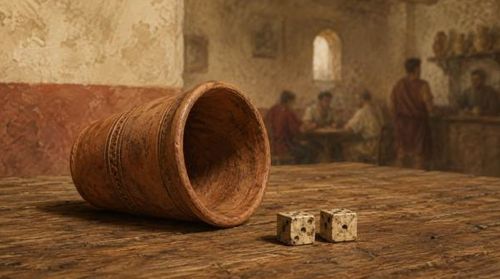
A Roman dice cup was an object with a noisy social life. It did not decide the result, but it shaped the moment. The rattle created suspense. The hidden dice gave everyone a second to look up. The fall turned private chance into something a room could see, hear, remember, and argue about.
Cubic dice are useful historical evidence because their markings, wear, size, and findspots connect ordinary objects to ordinary behavior. Alex de Voogt’s open-access study of cubic dice as archaeological material notes that dice can carry culturally specific information, not just mathematical possibility. In Rome, that evidence belongs to taverns and thresholds.
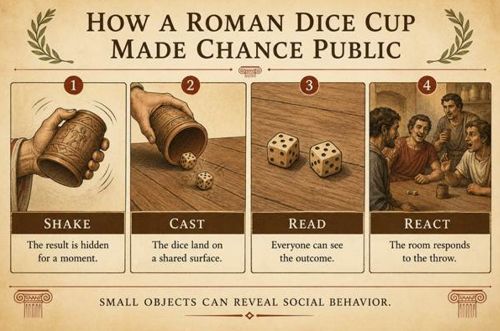
The purpose of a dice cup was very simple: gather the dice, conceal them for a breath, and then release them. That small sequence made the throw legible. People could tell when a turn began, when the cast was complete, and when the result was ready to be read.
Of course, dice cups are such useful items that they aren’t unique to Ancient Rome; we still use them in many games today. Even digital games, which don’t usually incorporate an actual cup, simulate the dice rolling across the table.
This isn’t actually necessary because they’re determining randomness through an RNG – but if you look at most virtual renderings of dice games today, you’ll see the software still simulates dice movement and, perhaps more importantly, still incorporates that crucial pause to let the drama set in and the players mentally prepare for the result. You can imagine Ancient Romans leaning over the table, waiting for the dice to settle, and enjoying the anticipation.
Indeed, the dice’s presence in these games is so important that modern versions usually go so far as to simulate the sound too. If you play craps at Bovada, you’ll hear the rattle as they strike the table. The old cup and the current table are not identical, but both make chance visible enough for a group to follow, and both allow a little pause while anticipation builds.
Taverns Turned Rolls into Social Scenes
Roman taverns were not quiet rooms built for solitary concentration. They were places of drink, food, travel, work breaks, noise, and quick exchange. A dice cup in that setting had more than a practical purpose. It gave a casual game ceremony. The hand shook, the cup tipped, the dice landed, and attention tightened.
The Dice-Players fresco from Pompeii makes that world feel close. Two men lean over the table, their words written into the image, while the scene holds the instant when play becomes dispute. Roman leisure was not always about polite recreation. It could be warm, loud, competitive, and theatrical. Anyone studying how history expands knowledge can learn from details like this because they show behavior, rather than only naming an institution.
The cup also created a fairness ritual. By hiding the dice before release, it separated the hand from the final arrangement. By exposing the dice after the cast, it invited witnesses. That did not guarantee peace. A disputed result could still produce insult, suspicion, laughter, or a shove. Yet the ritual gave the room a shared sequence to judge.
What The Cup Reveals
A dice cup helps historians move from object to action. On its own, it may look minor beside aqueducts, amphitheaters, roads, and inscriptions. In use, however, it shows how Romans handled uncertainty in public spaces.
Its value also comes from scale. Grand monuments often tell us what elites wanted to display. Dice cups pull attention toward ordinary habits. They suggest people with spare minutes, companions, arguments, and rituals of play. A tavern game could hold more human texture than a formal monument because it caught people in motion, less guarded and more immediate.
This is where material culture does its quiet work. A simple object can preserve traces of touch and setting. Wear marks hint at repetition. Findspots suggest where objects moved. Images show posture and atmosphere. None of these clues tell the whole story alone. Together, they make a social scene more credible.
Why Small Play Objects Matter
Dice cups teach through compression. They bring together chance, rule, gesture, sound, and witness in one hand-held object. That is why they still feel readable after centuries. The player did not need abstract theory to feel suspense before the dice fell. The viewer did not need a written manual to understand that the result mattered.
They also complicate the divide between work and leisure. In Roman urban life, public spaces often carried several uses at once. A tavern could be a place to drink, meet travelers, exchange news, pass the time, and watch a quarrel begin over a small cast of dice. Play did not sit outside of social life. It revealed social life by reducing it to a tight scene of attention. The dice cup survives as a reminder that history is often clearest when handled at a human scale. A cup, a table, a roll, a reaction: each part helps us see ancient people as participants in shared moments, not figures trapped behind dates. Modern history teaching reaches the same conclusion when it treats cultural objects as active ways to understand the past, a point reinforced by open research on history and heritage teaching.
About the Author