When Rumi died in Konya in 1273, Muslims, Christians, and Jews reportedly joined his funeral. His followers transformed that contested memory into the celebration of Shab-e Arus.

By Matthew A. McIntosh
Public Historian
Brewminate
Introduction: A Death Remembered as a Wedding
On December 17, 1273, Jalal al-Din Muhammad Rumi died in Konya following an illness that had drawn disciples, relatives, and fellow religious teachers to his bedside. His death removed from the city not only a celebrated Persian poet but also a jurist, preacher, Sufi master, and leader whose influence reached well beyond his immediate circle. According to the tradition preserved by his followers, the funeral procession became an extraordinary public event in which Muslims were joined by Christians and Jews, each community mourning Rumi through the language of its own sacred inheritance. The crowd was reportedly so immense that the bier moved only with difficulty through the streets and did not reach the burial place until evening. Few scenes from Rumi’s life have done more to sustain his later reputation as a spiritual figure who crossed religious boundaries. Yet the very power of the story requires historical caution, because its fullest surviving description was recorded decades after the mourners had dispersed.
The account most responsible for the funeral’s enduring form appears in Shams al-Din Ahmad Aflaki’s Manaqeb al-arefin, a Mevlevi hagiography begun in 1318 at the request of Rumi’s grandson Ulu Arif Chelebi. Aflaki described inhabitants of every station pouring into the streets, tearing their garments, uncovering their heads, and crying as though the resurrection had begun. Christian and Jewish mourners allegedly carried their scriptures while reciting from the Psalms, Torah, and Gospels, refusing demands that they withdraw from what was formally a Muslim funeral. Their spokesmen explained that they had recognized in Rumi the spiritual character of Moses, Jesus, and the prophets, giving them a claim upon his memory that Muslim officials could not extinguish. This is a vivid narrative, but it is not a contemporary civic record or an independent eyewitness report. It was composed within a community whose authority rested increasingly upon the sanctity of Rumi and the privileged position of his descendants. Aflaki’s purpose was not simply to report what happened; it was to demonstrate the almost universal recognition commanded by the Mevlevi master. That devotional purpose does not prove that the procession was invented, but it prevents its most dramatic details from being treated as uncontested fact.
The remembrance of Rumi’s death also underwent a second transformation, one that shifted attention from the suffering of those left behind to the spiritual destination of the person who had died. Rumi’s poetry repeatedly describes death as return, release, and passage into greater life, drawing upon Quranic teaching while giving it the emotional language of the lover approaching the Beloved. Later Mevlevi tradition named the anniversary Shab-e Arus, the “Wedding Night,” because bodily death represented the completion of that longed-for encounter. Union in this context did not mean that the human being became identical with God; it expressed final nearness to the divine presence after the limitations of earthly existence had fallen away. The anniversary consequently became an occasion for solemn remembrance and spiritual joy rather than an attempt to deny the grief recorded in accounts of the funeral.
Rumi’s death belongs simultaneously to the history of an event and to the history of its remembrance. A religiously diverse crowd in thirteenth-century Konya may indeed have mourned a teacher whose relationships extended across communal lines, but the funeral known today was shaped by those who needed to explain what his life had meant after he could no longer speak for himself. His burial beside his father provided that memory with a physical center, while the community organized by Husam al-Din and Sultan Walad gave it institutional continuity. The mausoleum, Mevlevi succession, and recurring commemoration gradually transformed bereavement into a durable religious culture without preserving every stage unchanged. Even the modern ceremonies held on December 17 carry the effects of Ottoman development, republican suppression, cultural revival, and international fascination with Rumi. The historical importance of the funeral does not finally depend upon proving every speech or scriptural recitation attributed to its mourners. It lies in the determination of Rumi’s followers to remember his death as a moment when the boundaries surrounding a Muslim saint appeared unable to contain the breadth of his appeal.
Konya in 1273: A Plural City under Mongol Shadow
When Rumi died in 1273, Konya remained the symbolic center of the Seljuk Sultanate of Rum, but the political order that had made it prosperous was steadily disintegrating. The decisive rupture had come at Köse Dag in 1243, when a Mongol army defeated the forces of Sultan Kaykhusraw II and reduced the Seljuk state to tributary dependence. Subsequent sultans retained their titles, courts, and ceremonial authority, yet their survival depended upon Mongol approval and the ambitions of powerful ministers who competed to govern in their names. By Rumi’s final years, the child sultan Kaykhusraw III occupied the throne while Muin al-Din Sulayman Parvana exercised much of the practical power under the distant sovereignty of the Ilkhanid ruler Abaqa. Konya was still a capital, but it was the capital of a realm whose rulers could no longer control their succession, military obligations, or fiscal burdens without reference to authorities farther east. The political uncertainty surrounding the city forms an essential background to Rumi’s career, because his spiritual community matured while Seljuk sovereignty became increasingly fragile.
Mongol domination did not reduce Konya to a ruined or permanently occupied provincial town. Tribute demands and military interventions imposed severe pressures, but inclusion within a Mongol-controlled political world also intensified movement between Anatolia, Iran, the Caucasus, and Central Asia. Administrators, scholars, merchants, craftspeople, and displaced families continued to arrive from regions disrupted by conquest. Their presence helped sustain Konya as a Persianate center of learning and patronage even as the political structure supporting that culture weakened.
The city’s population cannot be reconstructed with the precision available for a modern census, and the surviving sources describe communities unevenly. Konya nevertheless belonged to an Anatolia in which centuries of Byzantine Christian settlement had not disappeared with the arrival of Turkish Muslim rule. Greek-speaking Christians remained numerous in the surrounding region, while Armenians and other eastern Christians participated in the wider commercial and political life of the sultanate. A Jewish community also existed in Konya, with Aflaki referring to a Jewish quarter as an identifiable part of the city. Alongside these communities lived Turkish-speaking soldiers, pastoral migrants, artisans, and townspeople, as well as Persian-speaking administrators and religious intellectuals whose language dominated much of the court and its literary culture. Arabic retained its authority in Quranic learning, theology, and jurisprudence without necessarily serving as the ordinary language of the street. Konya’s pluralism was consequently religious, linguistic, and social, although the boundaries among those categories were less orderly than later descriptions often imply.
The Seljuk ruling house itself embodied some of this complexity. Sultans formed marriages and political alliances with Christian dynasties, while Greek, Georgian, and Armenian women entered elite households without every connection producing an immediate or complete abandonment of earlier identities. Christian officials, physicians, artisans, and military retainers could serve Muslim patrons, just as Muslim merchants and travelers moved through territories governed by Christian rulers. Such relationships did not eliminate communal divisions, but they made daily cooperation unavoidable. The court’s political language might invoke Islamic sovereignty even while its survival depended upon people and alliances that crossed confessional lines.
Religious coexistence under Seljuk rule was not equality in the modern sense. Christians and Jews possessed protected but subordinate legal standing, and their security depended upon political circumstances, local custom, and the willingness of rulers to enforce obligations consistently. Churches, monasteries, mosques, madrasas, Sufi meeting places, and neighborhood institutions sustained distinct communities even as marketplaces and patronage networks brought their members together. Conversion further complicated the city’s religious geography, because movement into Islam could occur through marriage, political advantage, social pressure, personal conviction, or attachment to a charismatic teacher. Hagiographic narratives frequently transformed these complicated processes into stories in which a Christian or Jew instantly recognized the spiritual superiority of a Muslim saint. Yet polemical preaching and competition for followers show that familiarity did not necessarily produce theological acceptance. Konya permitted close contact across religious lines, but that contact could generate rivalry as readily as mutual respect.
Rumi’s public life unfolded within this unstable and interconnected city. His Muslim identity placed him inside its dominant religious institutions, while his reputation as a teacher and spiritual master exposed him to patrons, petitioners, neighbors, and admirers who did not all belong to the same community. The claim that Christians and Jews joined his funeral is socially credible even if the details supplied by Aflaki cannot be independently confirmed. A diverse procession would not prove that medieval Konya had overcome religious division; it would reveal that those divisions did not prevent a prominent figure from acquiring significance beyond them. The city under Mongol shadow supplied both the human setting in which such mourning was possible and the uncertainty in which the memory of a unifying saint became particularly valuable.
A Muslim Master with More Than a Muslim Audience
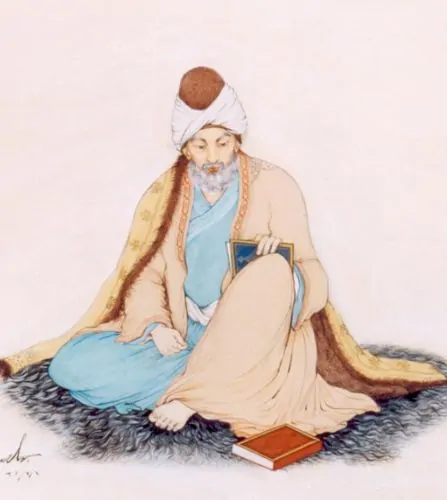
Rumi entered later memory principally as a poet of divine love, but in thirteenth-century Konya he was also known as a Muslim scholar whose authority rested upon formal religious education. Before his encounter with Shams of Tabriz, he had studied Quranic interpretation, hadith, jurisprudence, Arabic, and the established disciplines expected of a learned preacher. Following the death of his father, Baha al-Din Walad, Rumi assumed responsibility for the madrasa and teaching community associated with his family. His surviving sermons and discourses reveal a speaker who could address legal obligations, scriptural narratives, theological controversies, and the ethical problems of ordinary life. The Masnavi cites the Quran and traditions concerning the Prophet Muhammad with a frequency unusual even among major Persian mystical poems. Rumi’s later reputation for crossing religious boundaries must begin with the recognition that he did so as a Muslim teacher, not by abandoning the tradition that had formed him.
The familiar story in which Shams suddenly transformed a conventional jurist into an ecstatic mystic exaggerates the division between Rumi’s earlier and later lives. Rumi had already received sustained Sufi instruction from Burhan al-Din Muhaqqiq Tirmidhi, and his father had combined religious scholarship with an intensely devotional understanding of spiritual knowledge. Shams disrupted Rumi’s public routines and redirected his attention toward the consuming demands of companionship, love, and inward realization, but he did not introduce him to Islam or mysticism. The lyric poetry associated with Shams emerged from this intensification rather than from a rejection of Rumi’s previous identity. Rumi continued to pray, fast, teach, interpret scripture, and inhabit the social world of Muslim learning after becoming known for music and ecstatic movement. His disciples called him Mawlana, “our master,” a title that acknowledged religious authority as much as poetic genius. The Masnavi, dictated with the encouragement of Husam al-Din Chelebi, became a vehicle through which scriptural teaching and mystical interpretation could continue in Rumi’s physical absence. His spiritual authority expanded because he joined learning to charismatic experience, not because one displaced the other.
The community surrounding Rumi was nevertheless much broader than a classroom of jurists. Artisans such as Salah al-Din Zarkub stood beside educated disciples, while high-ranking patrons sought Rumi’s counsel and helped sustain the institutions connected with him. His correspondence shows him interceding with officials, recommending petitioners, and participating in networks through which religious influence could affect employment, taxation, protection, and access to power. Women from elite households also appear as patrons and participants in the social world preserved by the Mevlevi tradition.
Accounts of Rumi’s relationships with Christians and Jews come largely from followers who wished to demonstrate the extraordinary reach of his sanctity. Aflaki portrays priests, monks, and other non-Muslims visiting Rumi, listening to his teaching, witnessing miracles, or acknowledging his spiritual rank. Some stories end in conversion, while others leave the non-Muslim participant admiring Rumi without explicitly entering Islam. These narratives cannot always be accepted as literal records of particular conversations, because they employ recognizable hagiographic patterns in which outsiders confirm the saint’s authority. Yet their repeated appearance suggests that contact with non-Muslims was neither unimaginable nor embarrassing to the community that preserved Rumi’s memory. His poetry likewise draws upon Moses, Jesus, Mary, Abraham, and other figures shared with Jewish and Christian tradition, although it normally presents them through Quranic narration and Muslim interpretation. Even the celebrated story of Moses and the shepherd, with its rebuke of rigid judgment, does not dissolve religious truth into relativism; it asserts the superiority of sincere love and divinely awakened understanding over confidence in external correctness.
Rumi could command more than a Muslim audience without becoming a teacher detached from Islam. Non-Muslims might approach him as a respected scholar, powerful holy man, neighbor, patronal intermediary, or interpreter of spiritual experience, and those roles did not require agreement with every element of his theology. His language of longing offered points of recognition across communal boundaries, while his institutional position made him visible to people whose lives intersected with Muslim authority in Konya. The later Mevlevi tradition enlarged these encounters because they helped portray Rumi as a saint whose significance could be recognized even by those outside his confession. When Christians and Jews were said to have entered his funeral procession, they were not intruding suddenly into a purely Muslim life; they were appearing at the culmination of a public career already remembered as reaching beyond its formal religious constituency.
The Education of Loss: Shams and the Presence of Absence
Loss entered Rumi’s adult life long before his followers gathered around his own deathbed. His father, Baha al-Din Walad, died in 1231, leaving Rumi to inherit a teaching position and communal responsibilities that he was still preparing to assume. Burhan al-Din Muhaqqiq Tirmidhi subsequently became his spiritual instructor, connecting the son more fully to the devotional path associated with the father. When Burhan al-Din died around 1240 or 1241, Rumi again faced the disappearance of a guiding presence and the necessity of continuing without it. These deaths did not immediately produce the poetic language for which he later became famous, but they established a recurring relationship between bereavement and succession. Each loss required Rumi to preserve what had been received while discovering a form of authority that could not depend upon the teacher’s physical survival.
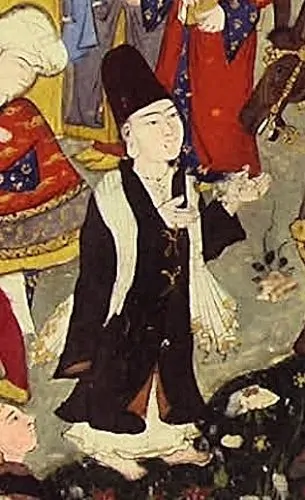
The arrival of Shams of Tabriz in Konya in 1244 brought that problem into Rumi’s life with far greater emotional force. Shams was neither a conventional courtly mentor nor a deferential disciple, and the intensity of their companionship unsettled members of Rumi’s household and teaching circle. Later accounts describe prolonged periods of private conversation during which Rumi withdrew from familiar obligations, provoking resentment among followers who believed that the wandering stranger had taken their master from them. Shams left Konya at least once, apparently for Damascus, before returning after appeals from Rumi and the intervention of Sultan Walad. His final disappearance in the late 1240s produced traditions ranging from voluntary departure to murder, with later suspicion falling upon people close to Rumi, but the surviving evidence does not establish his fate. What can be traced more securely is Rumi’s refusal to allow physical absence to terminate the relationship. The lyric poems gathered under the title Divan of Shams of Tabriz invoke the missing companion until distinctions among poet, beloved, and poetic voice become deliberately unstable. Shams ceased to be only the absent man whom Rumi desired to recover and became a name through which Rumi articulated the divine love awakened by their encounter.
Tradition remembers Rumi searching for Shams in Damascus before recognizing that the companion he sought externally had become inseparable from his own transformed consciousness. That recognition should not be mistaken for simple emotional closure, because the poetry continues to express bewilderment, yearning, jealousy, abandonment, and moments of overwhelming joy. Absence remains active within the verse rather than being resolved by a single mystical revelation. The surviving poems consequently provide stronger evidence for the creative and spiritual consequences of separation than the hagiographic stories provide for the precise circumstances of Shams’s disappearance.
Rumi’s relationship with loss did not end when Shams became an inward presence. Salah al-Din Zarkub, the goldsmith whom Rumi recognized as a spiritual companion after Shams, died in 1258 following a long illness. Rumi mourned him openly, yet the community continued through the leadership and companionship of Husam al-Din Chelebi, whose encouragement led to the composition of the Masnavi. These successive relationships have sometimes been described as though one companion simply replaced another, but such language understates the distinct place each man occupied in Rumi’s spiritual life. Shams embodied a disruptive encounter that overturned settled identity, while Salah al-Din represented a quieter companionship rooted within the social world of Konya. Husam al-Din became the attentive listener whose presence allowed Rumi’s oral teaching to assume the monumental form of the Masnavi. Companionship survived through altered relationships, literary creation, and the continuing work of a community rather than through the denial that particular people had been lost.
To call these experiences an education in loss is not to claim that bereavement mechanically produced Rumi’s mystical theology. His understanding of death remained grounded in the Quran, prophetic tradition, earlier Persian Sufism, and disciplined religious practice. Personal separation nevertheless gave unusual emotional depth to his conviction that absence could conceal another form of presence. The beloved might disappear from sight without becoming spiritually inert, and longing could become a mode of knowledge rather than merely a wound awaiting relief. This pattern later enabled Rumi’s followers to understand their own master’s death through a language already made powerful by his poetry. When they remembered his departure as union, they extended an interpretation of loss that Rumi had spent much of his mature life learning to inhabit.
The Language of Union
Rumi’s understanding of death begins within the Quranic account of creation, earthly life, resurrection, and return to God. Human beings come from God and return to him, but return does not mean that the individual simply dissolves into an impersonal universe. The grave marks a passage into another mode of existence in which divine judgment, mercy, and the consequences of human action remain real. Rumi could treat death joyfully because he believed that earthly perception concealed more than it revealed, not because he considered life or moral responsibility unimportant. His poetry repeatedly presents the visible world as a temporary form through which the soul must travel while learning to recognize its origin. The language of union rests upon an Islamic understanding of return even when Rumi expresses it through the intimate vocabulary of longing for a beloved.
Biological death was only one meaning of death within Rumi’s mystical teaching. The Sufi path demanded that the seeker undergo a voluntary death of pride, possessiveness, self-sufficiency, and the impulses conventionally gathered under the term nafs. This was not a command to destroy the personality or despise the body, but an effort to end the ego’s claim to exist independently of God. Sufis described that process through fana, the annihilation of self-centered consciousness, followed by baqa, enduring through God rather than through the unstable desires of the isolated self. A person who had experienced this inward death could remain active in the world while no longer treating social rank, wealth, reputation, or bodily survival as ultimate possessions. Rumi’s stories repeatedly contrast such surrender with the anxious calculations of people who attempt to protect themselves from every form of loss. To die before bodily death was to become capable of meeting mortality without allowing fear to define the meaning of existence.
One of Rumi’s best-known passages describes existence ascending through mineral, plant, animal, and human forms before moving toward conditions that the ordinary intellect cannot comprehend. The passage should not be read as a scientific theory of evolution or as a straightforward doctrine of reincarnation. Its purpose is to challenge the assumption that every transition called death must involve diminishment. Previous forms disappear, yet each disappearance opens capacities that could not have existed within the earlier condition.
The metaphor of marriage gave this passage from limitation to fulfillment its most emotionally concentrated expression. In Persian Sufi poetry, the soul could appear as a lover separated from the divine Beloved, with earthly existence experienced as distance and spiritual realization as arrival. A wedding brought separation to an end without requiring the poet to define that intimacy through the technical language of theology. Rumi’s imagery of union could consequently approach statements that sound daring when removed from their poetic setting, but it did not ordinarily assert that the human essence became identical with God. The lover remained dependent upon the Beloved even at the moment when the experience of distance disappeared. Marriage also carried meanings that death alone could not convey: anticipation, preparation, unveiling, intimacy, and entrance into a new household. The later Mevlevi expression Shab-e Arus, the “Wedding Night,” condensed these associations into a name for Rumi’s death anniversary. It transformed the day of his departure into the consummation of a longing that his followers believed had governed his spiritual life.
This language did not require mourners to pretend that separation caused no pain. Rumi’s poetry had emerged partly from experiences in which a beloved companion disappeared, and the intensity of longing remained valuable precisely because absence was emotionally real. Poems associated with death sometimes reverse conventional funeral expectations by imagining music near the grave or warning observers not to interpret burial as extinction. Such reversals do not mock grief; they dispute the mourner’s assumption that the grave contains the whole meaning of what has occurred. Death can appear terrible from the perspective of those who remain while seeming radically different to the person imagined as approaching divine presence.
The distinction between grief and spiritual interpretation would become crucial after Rumi died. His followers could weep, tear their clothing, struggle to reach his bier, and still believe that the master himself had entered the union described in his teaching. Their suffering belonged to continued earthly separation, whereas the language of the wedding assigned a different meaning to his destination. This double vision prevented joy from becoming indifference and prevented grief from serving as proof that Rumi’s promises had failed. It also gave the Mevlevi community a theological means of surviving the loss of the person around whom it had formed. The funeral remembered by Aflaki displays the anguish of absence, while Shab-e Arus preserves the conviction that absence did not have the final word.
The Last Illness: What Can Be Known of December 1273
The secure outline of Rumi’s death is brief. He became ill in Konya late in 1273 and died there on December 17, corresponding to 5 Jumada II 672 in the Islamic calendar. He was approximately sixty-six years old and had spent more than four decades in Anatolia. His family, disciples, and associates were present in the city, although no contemporary document records the progress of the illness day by day. Mevlevi tradition places his death near sunset, a detail that later acquired symbolic importance as the beginning of the Wedding Night. He was subsequently buried beside his father, Baha al-Din Walad, at the site that became the center of Mevlevi devotional life.
Everything beyond that core depends upon sources written after Rumi’s death. Sultan Walad, Rumi’s son, provides the closest surviving literary perspective upon the early community, but his concern was the transmission of spiritual authority rather than a clinical account of his father’s final days. The Risala attributed to Sipehsalar stands nearer to Rumi’s circle and may preserve information from people who knew him, although the work’s date, authorship, and later completion remain difficult to establish precisely. Aflaki offers the fullest sequence of illness, visitors, sayings, funeral arrangements, and public mourning, but he began gathering his material several decades after the event. His narrative draws upon earlier writings and communal testimony while shaping them into a demonstration of Rumi’s sainthood. Later authors frequently condensed these sources without preserving their differences, producing a smooth story in which every reported poem and prediction appears equally certain. A critical reconstruction must instead distinguish proximity from detail, because the most elaborate account is not the one closest to 1273. The surviving tradition tells historians a great deal about how Rumi’s death was remembered, but much less about the physical nature of the illness that killed him.
Several poems have been presented as Rumi’s final composition or as words spoken from his deathbed. Their themes are appropriate to the setting: the speaker dismisses bodily weakness, welcomes departure, and warns companions not to mistake an altered face for spiritual defeat. Yet the Divan of Shams was not arranged as a chronological diary, and the transmission of individual lyrics rarely permits a secure date of composition. A poem may illuminate how Rumi understood mortality without proving that he composed or recited it during his last illness.
Aflaki surrounds the sick master with prominent visitors who come to express concern, request guidance, or pray for his recovery. Among them appears Sadr al-Din al-Qunawi, the influential disciple of Ibn Arabi and one of Konya’s foremost intellectual figures, whom the Mevlevi tradition also associates with Rumi’s funeral prayer. Rumi’s reported responses display calm acceptance and imply that efforts to postpone death misunderstand the journey he is about to complete. Physicians likewise appear unable to reverse the illness, reinforcing the contrast between ordinary medicine and the saint’s superior knowledge of his approaching end. Stories of earthquakes, prophetic sayings, unusual light, and other portents subsequently heightened the cosmic significance of the moment. Such details belong to a widespread hagiographic language in which nature recognizes the death of a holy person, and closely related motifs appear elsewhere in Mevlevi accounts. They may preserve memories of actual disturbances or bedside conversations, but they cannot be verified independently and should not be allowed to obscure the historical limits of the evidence.
What emerges most clearly is not a medically identifiable cause of death but a carefully formed portrait of spiritual readiness. The sources deny Rumi the confusion or terror that might diminish his authority, presenting him as someone whose final conduct confirmed what his poetry had long taught. That portrait may contain genuine memories preserved by relatives and disciples, yet it also reflects the needs of a community confronting the disappearance of its center. Rumi’s last illness became the first stage in the interpretation of his death, before the procession, mausoleum, or annual commemoration had given that interpretation public form. What can be known of December 1273 is inseparable from what the Mevlevis believed had to be remembered: their master did not merely succumb to illness but consciously approached the return for which his spiritual life had prepared him.
The Funeral That Filled Konya
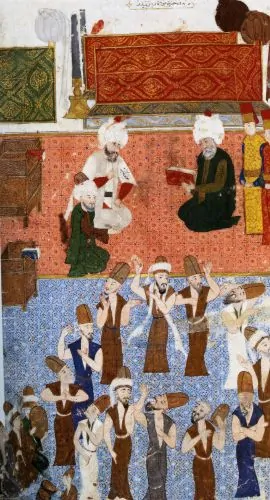
Rumi’s death on December 17, 1273, converted a private household crisis into a public event that appears to have engulfed Konya. The basic fact of a large funeral is inherently plausible: he had preached in the city’s mosques, taught Islamic law, guided disciples, cultivated relationships with political elites, and become known well beyond the circle that received his intimate spiritual instruction. His standing joined several kinds of authority that did not always belong to the same person. When his body was carried from his home toward burial, Konya was mourning a jurist, preacher, Sufi master, poet, family patriarch, and civic notable at once.
The most famous description of the funeral comes from Shams al-Din Ahmad Aflaki’s Manaqeb al-arefin, composed several decades after Rumi’s death within the community that had formed around his descendants. Aflaki depicts streets overwhelmed by mourners and a procession so congested that the bier advanced only with difficulty. Men and women, children and elders, the powerful and the poor all appear in his account, while cries of grief transform the city into a single theater of bereavement. The narrative emphasizes bodily disorder: garments are torn, lamenters press toward the coffin, and the disciplined movement expected of a funeral procession repeatedly gives way before the crowd. Such details cannot automatically be accepted as eyewitness reportage, but neither should they be dismissed merely because they belong to hagiography. They convey an early Mevlevi conviction that Rumi’s death had exposed the extraordinary breadth of his social presence.
A public funeral in medieval Konya was also a claim about the place of the deceased within the moral order of the city. Attendance could express devotion, respect, political loyalty, social obligation, curiosity, or the desire to be near a person regarded as holy. Aflaki’s crowd should not consequently be imagined as a homogeneous congregation united by one interpretation of Rumi. Its very scale suggests overlapping constituencies whose relationships with him differed sharply. The procession became meaningful because those constituencies temporarily occupied the same streets and directed their attention toward the same body.
Aflaki intensifies this image of convergence by naming Muslims, Christians, and Jews among the mourners. He also describes Greeks, Turks, Arabs, and members of different social ranks, creating an almost encyclopedic portrait of Konya gathered around the bier. According to his narrative, Christian and Jewish participants read or chanted from their scriptures and compared Rumi’s teachings with the truths they associated with Moses, Jesus, and earlier prophets. Some Muslims attempted to drive the non-Muslims away, arguing that they had no proper place at the funeral of a Muslim scholar. The resulting dispute is as important as the participation itself, because it prevents the scene from becoming a frictionless celebration of medieval pluralism. Aflaki represents religious boundaries as real and actively defended, even while portraying Rumi’s sanctity as powerful enough to attract people across them. Jamal J. Elias has treated the episode not as evidence that communal identities had disappeared, but as a story in which those identities remained visible while being reorganized around recognition of a Muslim saint.
The rites themselves remained Islamic. Rumi was washed, shrouded, prayed over, and buried as a Muslim, while Sadr al-Din al-Qunawi is traditionally associated with the funeral prayer, although reports concerning his role must be handled cautiously. Nothing in the multicommunal narrative indicates that the funeral became a blended liturgy or that Rumi’s followers suspended the confessional identity he had maintained throughout his life. The presence of Christians and Jews, if the tradition preserves a historical memory, broadened the community of mourners without changing the religious form of burial. This distinction matters because later retellings sometimes turn shared mourning into a claim that Rumi stood outside Islam altogether.
The funeral account is strongest when read on two historical levels. It may preserve a genuine recollection of an unusually large procession attended by members of several communities, especially since Rumi’s public career and the social composition of Konya make such attendance credible. Yet its elaborate speeches, scriptural recitations, dramatic confrontations, and comprehensive catalog of peoples belong to a narrative recorded long after the event. Aflaki was describing the past for a Mevlevi audience that already regarded Rumi’s life as a sequence of signs revealing sanctity. His funeral accordingly becomes the final public confirmation of a charisma that kings, scholars, artisans, women, children, Muslims, Christians, and Jews had supposedly recognized during his lifetime. The packed streets of Konya were both a remembered historical scene and an argument: Rumi’s body belonged to the Muslim community, but the meaning of his holiness could not be contained by the boundaries of a single mourning public.
Sacred Recognition: Who Had the Right to Mourn?
The most revealing moment in Aflaki’s funeral narrative is not simply the appearance of Christians and Jews, but the attempt to exclude them. Some Muslim participants reportedly objected that non-Muslims had no rightful place in the burial procession of a celebrated Muslim scholar. Their protest transformed mourning into a dispute over religious possession: did Rumi belong exclusively to the community whose law he taught and whose scripture shaped his poetry, or could those outside that community claim a meaningful relationship with him? Aflaki’s answer preserves Rumi’s Islamic identity while granting the non-Muslim mourners a striking form of spiritual recognition. The funeral becomes a contest over who could interpret the significance of the dead.
That contest must be located within the unequal religious order of thirteenth-century Anatolia. Christians and Jews lived under Muslim rule as protected but subordinate communities, and their rights were framed by Islamic law rather than by any modern principle of religious equality. Their churches, neighborhoods, commercial networks, and communal institutions nevertheless remained important features of urban life. Konya’s population had been shaped by Byzantine inheritance, Turkish settlement, migration, conquest, commerce, and the dislocations caused by the Mongol advance. Daily interaction across confessional lines was unavoidable even when religious identities remained legally and socially consequential. Muslims might trade with Christian artisans, employ non-Muslim physicians, negotiate with local Greek-speaking populations, or encounter Jews through commerce and administration without treating theological differences as unimportant. The city could be both interconnected and hierarchical, a combination that makes the reported conflict at Rumi’s funeral more historically intelligible than an image of effortless tolerance would.
Aflaki allows the Christians and Jews to defend their presence in explicitly religious terms. They do not claim that differences among religions are meaningless, nor do they present Rumi as detached from Islam. Instead, they reportedly declare that they recognized through him the spiritual qualities associated with the prophets and teachings of their own traditions. Their right to mourn rests on recognition rather than membership.
This distinction is central to the construction of Rumi’s sanctity. In Aflaki’s account, Christian mourners compare him with Jesus and the saints, while Jewish participants connect what they encountered in him with Moses and the prophetic inheritance of Israel. Sacred truth is represented as refracted through distinct scriptural communities, yet made perceptible in the character of one Muslim holy man. Rumi becomes intelligible to non-Muslims because they recognize familiar signs of divine wisdom in an unfamiliar confessional location. Their testimony does not make him less Muslim; within the logic of the narrative, it confirms the universality of the truth manifested through an exemplary Muslim. The episode differs sharply from modern portrayals of Rumi as a spiritual teacher whose appeal depended on escaping religion. Aflaki’s Rumi crosses boundaries by radiating sanctity from within Islam, not by occupying a neutral space beyond it. Christian and Jewish recognition enlarges his spiritual authority while leaving the theological hierarchy of the hagiography intact. The narrative is inclusive in the breadth of its witnesses but remains Islamic in the meaning it assigns to their witness.
The Muslim effort to remove the non-Muslims performs an equally important function. It voices the objection that Aflaki’s readers might themselves have raised, giving narrative form to anxiety about improper intimacy between religious communities. By allowing Christians and Jews to answer, Aflaki converts potential scandal into testimony on Rumi’s behalf. Those who appear to threaten the integrity of a Muslim funeral become witnesses to the exceptional power of Muslim holiness. The dispute consequently strengthens the hagiographic argument precisely because recognition is shown overcoming resistance.
Yet the speeches attributed to the mourners cannot be treated as transcripts of an exchange in December 1273. Aflaki wrote decades later, when Rumi’s descendants and disciples had an institutional interest in depicting their master as a saint whose authority had been acknowledged throughout Anatolian society. The carefully constructed responses of the Christian and Jewish participants fit a recurrent hagiographic pattern in which outsiders perceive holiness that less discerning insiders initially fail to understand. But the episode did not have to be invented from nothing to serve that literary purpose. Rumi’s public prominence, Konya’s mixed population, and the practical relationships connecting its communities make some non-Muslim attendance at a major civic funeral entirely plausible. What cannot be securely recovered is the number of those mourners, what they recited, or whether the confrontation occurred in the form Aflaki describes.
The strongest historical conclusion lies between credulity and dismissal. The multifaith funeral may preserve a communal memory that Rumi attracted mourners beyond the Muslim population, but its surviving form is an early Mevlevi interpretation of what that attendance meant. Christians and Jews were granted the right to mourn because their grief demonstrated the reach of Rumi’s sanctity. Their presence did not dissolve religious boundaries; it made those boundaries visible at the moment they were crossed.
From Grave to Green Dome: Building Rumi’s Presence
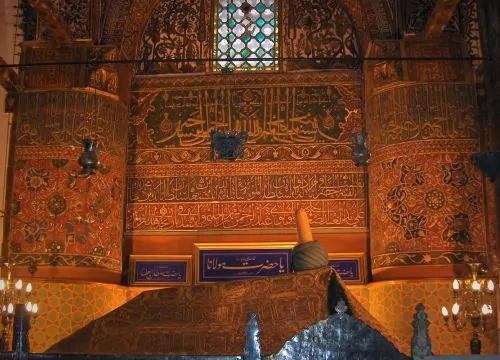
Rumi was buried beside his father, Baha al-Din Walad, in a garden outside the Seljuk palace walls of Konya. Baha al-Din had died in 1231, and his grave had already given the site an association with learning, piety, and the family’s spiritual authority. Rumi’s burial there joined two generations within a single sacred landscape. The grave did more than preserve the location of his remains; it fixed an otherwise mobile network of disciples around a permanent center. Death gave Rumi’s community an address.
The first mausoleum was constructed soon afterward under the patronage of Gürcü Hatun, the Georgian-born Seljuk princess who had been one of Rumi’s prominent devotees. Aflaki also associates the project with the official Alam al-Din Qaysar, while Badr al-Din of Tabriz is traditionally identified as its architect. The participation of such patrons reveals how quickly household mourning became monumental commemoration. Building above the grave required wealth, access to skilled labor, and cooperation from people connected to the political order of Mongol-dominated Anatolia. The resulting structure announced that Rumi was not merely a teacher remembered by surviving students but a saintly presence worthy of enduring architectural honor. It also gave patrons a visible means of associating themselves with his reputation. Although the details and costs reported by later sources should be treated cautiously, the construction of a substantial tomb soon after 1273 is well established.
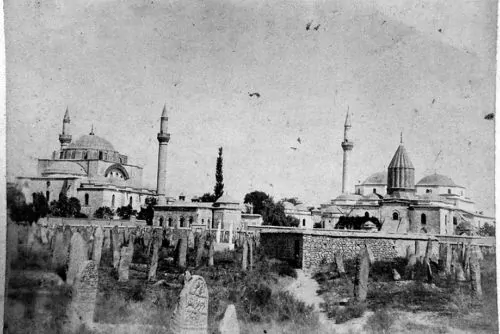
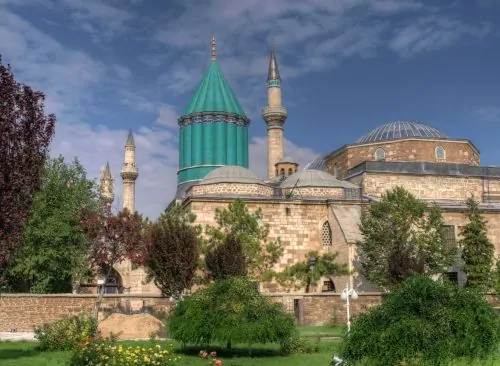
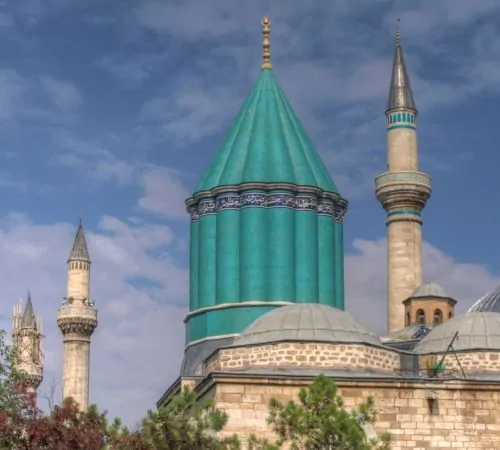
The earliest monument should not be confused with the complete complex visible in Konya today. Rumi’s shrine accumulated its familiar appearance through additions, repairs, rebuilding, and changing political patronage over several centuries. The celebrated fluted tower commonly called the Green Dome, or Kubbe-i Hadra, dates in its present basic form to the Karamanid period rather than directly to Rumi’s funeral. Its construction in 1396–1397 under Ala al-Din Ali Bey demonstrates that monumentalizing Rumi remained politically valuable more than a century after his death.
Architecture altered the relationship between the living master and those who came after him. While alive, Rumi’s presence depended upon encounters in homes, mosques, madrasas, streets, and gatherings organized around teaching or companionship. The tomb concentrated that dispersed charisma in one place that could be entered, revisited, maintained, and described to others. Visitors could pray for Rumi, recite scripture, offer gifts, seek blessing, or place themselves within the spiritual memory of his community. The building also shaped movement by directing bodies toward the grave and giving devotional attention a physical orientation. The mausoleum did not merely cover remains; it taught visitors how to approach the dead. Its height and decoration made sanctity visible within the cityscape, while the interior transformed proximity into an experience of reverence. Such practices belonged to the broader development of saintly shrines across medieval Anatolia, where tombs became centers of patronage and communal identity. Rumi’s resting place participated in that culture even as the fame of his poetry eventually gave it an exceptional reach.
The complex continued to expand as the Mevlevi community acquired institutional form. A space centered on two family graves gradually incorporated facilities needed by a resident and visiting religious community, including areas for prayer, musical ceremony, instruction, lodging, cooking, and charitable distribution. Ottoman rulers and officials repaired or enlarged the buildings, using patronage of the shrine to display piety and affirm their relationship with an influential Sufi lineage. Each intervention modified the physical setting while reinforcing the claim that Rumi’s presence endured there. The shrine became at once a mausoleum, a Mevlevi center, and a monument shaped by successive regimes.
The Green Dome represents an achieved historical image rather than an unchanged survival from 1273. Its architectural layers record the work through which Rumi’s descendants, disciples, patrons, and later rulers converted a grave into a durable institution. That process did not eliminate grief but reorganized it spatially, making return to the dead possible through pilgrimage and ritual proximity. The body that had disappeared from Konya’s streets remained accessible through a site maintained in his name. Monumental architecture gave permanence to the Mevlevi assertion that physical death had not ended Rumi’s capacity to gather people. Before the anniversary of his death could become a widely recognized “Wedding Night,” the tomb had already transformed absence into presence.
After the Master: Succession and the Making of the Mevlevi Community
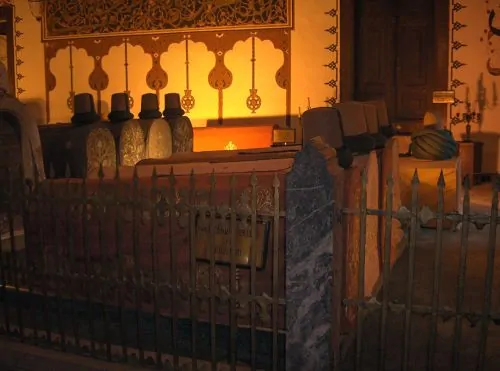
Rumi’s death created a problem that poetic assurances of union could not solve by themselves. His disciples still required guidance, disputes needed mediation, gatherings needed leadership, and the household depended upon an orderly transfer of authority. Yet there was no fully organized “Mevlevi order” waiting to continue under established regulations. What existed in 1273 was a community held together by personal loyalty, family connections, teaching relationships, and shared devotion to Rumi. The Mevleviye emerged from the effort to make those bonds survive their center.
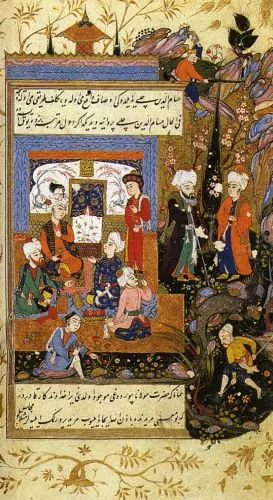
The first succession passed not to Rumi’s son Sultan Walad but to Husam al-Din Chalabi, the disciple whose companionship had been crucial to the composition of the Masnavi. Sultan Walad portrays himself as accepting Husam al-Din’s precedence and encouraging others to do the same. This deference preserved continuity with Rumi’s final years, when Husam al-Din had served as trusted companion, organizer, and spiritual interlocutor. His leadership until his death in 1284 gave the bereaved community time to stabilize without immediately transforming spiritual authority into hereditary family property.
Sultan Walad nevertheless became decisive in turning remembrance into institution. After Husam al-Din’s death, he assumed leadership and remained at the head of the community until 1312. His authority rested partly on descent, but biological relationship alone did not guarantee recognition among people accustomed to a master who had valued spiritual companionship above ordinary rank. Sultan Walad presented himself as both Rumi’s son and the faithful transmitter of his path. Through teaching, writing, patronage, and the cultivation of disciples, he connected the authority of the family with the charisma of the deceased master. His narrative works preserved accounts of Rumi, Baha al-Din Walad, Burhan al-Din Muhaqqiq, Shams-i Tabrizi, and Husam al-Din within a continuous sacred genealogy. That genealogy helped make succession appear as preservation rather than replacement.
The community taking shape around Sultan Walad should not yet be imagined as identical to the Ottoman Mevlevi order of later centuries. Its ceremonies, ranks, training practices, and institutional relationships developed gradually. Devotion to Rumi’s memory supplied a common center, while the tomb at Konya offered a physical focus for visitors and resident disciples. Music, recitation, and forms of turning associated with Rumi’s gatherings were retained and increasingly ordered, but the precisely regulated sema known from later Mevlevi practice was the result of historical development. Institutional continuity depended upon adaptation as much as fidelity.
Succession became more explicitly dynastic after Sultan Walad. His son Ulu Arif Chalabi assumed leadership in 1312 and traveled widely, cultivating relationships with rulers, urban elites, scholars, and devotees across Anatolia and neighboring regions. These journeys expanded the community beyond Konya without diminishing the symbolic centrality of Rumi’s tomb. Local circles could now understand themselves as participants in a wider network connected through allegiance to Rumi’s descendants. Ulu Arif also became the patron of the hagiographic project eventually completed by Shams al-Din Ahmad Aflaki. The resulting Manaqeb al-arefin supplied the expanding community with a treasury of exemplary stories, miracles, confrontations, conversions, and remembered conversations. It taught readers how to interpret the founding generation and established recognizable models of Mevlevi identity. The production of sacred biography was part of institutional construction, not merely an antiquarian effort to record the past. By organizing memory, the early Mevlevis organized themselves.
The title “Chalabi,” later commonly rendered “Chelebi,” came to designate leaders drawn from Rumi’s lineage. Hereditary succession gave the community continuity, prestige, and a recognized connection to its revered center. It could also produce rivalry, because spiritual competence and genealogical seniority did not necessarily coincide. Even so, the family’s custody of the tomb made descent materially significant as well as symbolically powerful.
Political patronage further shaped the community’s survival. Mevlevi leaders developed relationships with Seljuk successor states, the Karamanids, and eventually the Ottomans, while patrons endowed buildings and supported ritual life. Such alliances gave the order resources and protection, but they also placed it within struggles over urban influence and dynastic legitimacy. The Mevleviye was never simply a spontaneous fellowship of readers transported by Rumi’s poetry. It became a network of lodges, offices, endowments, ceremonial practices, and inherited authorities whose development extended well beyond the lifetime of the man at its center. Rumi supplied the name and foundational charisma, but his successors built the social structure capable of carrying them through time. The community that mourned him in 1273 gradually became the institution that taught later generations how his death should be understood.
From Urs to Shab-e Arus: Turning Death into an Anniversary
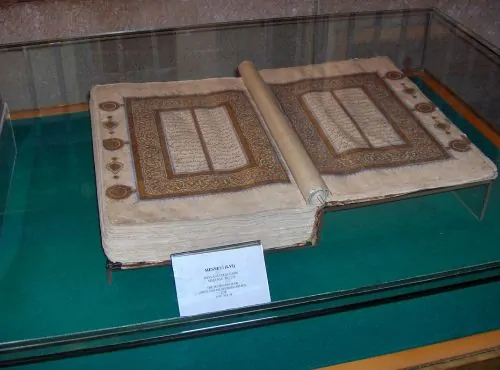
A grave fixed Rumi’s memory in space, but an anniversary fixed it in time. Returning to the date of his death allowed followers who had not witnessed the funeral to enter a recurring cycle of remembrance. The commemoration transformed a singular loss into an event that could be prepared for, repeated, and inherited. Each observance joined a new generation to the community that had mourned in 1273. Bereavement thereby became part of the Mevlevi calendar.
The broader Sufi tradition provided a language for this transformation. The Arabic term urs, meaning a wedding or nuptial celebration, came to designate the death anniversary of a saint because death was understood as passage into fuller proximity to God. In Persian, Shab-e Arus means “Wedding Night,” while “Night of Union” expresses the theological interpretation attached to the phrase rather than its literal translation. The metaphor gave ritual form to ideas already prominent in Rumi’s poetry: earthly separation is provisional, the soul belongs to God, and death reveals what bodily perception conceals. Yet the metaphor should not be reduced to cheerful denial. Rumi’s poetry repeatedly acknowledges grief, longing, bewilderment, and the painful education of separation. Calling his death a wedding did not erase bereavement; it placed bereavement within a spiritual account of return. The anniversary could hold lamentation and celebration together without requiring either to cancel the other.
Precisely when Rumi’s death anniversary acquired the stable designation Shab-e Arus cannot be established from the evidence surrounding 1273. Early Mevlevi sources preserve his understanding of death as reunion and record the growth of devotion around his tomb, but they do not document the complete later ceremony in its familiar form. The annual observance developed as the community itself developed. Treating the modern commemoration as an unchanged ritual created immediately after the funeral would compress centuries of Mevlevi history into a founding legend.
Remembrance at Konya gradually drew together visits to the tomb, Quranic recitation, prayer, poetry, music, charitable hospitality, and sema. These practices allowed participants to encounter Rumi through several forms of attention rather than through doctrine alone. The tomb made him physically locatable, his poetry supplied a continuing voice, and the ritual gathering reproduced the companionship upon which his teaching had depended. Sema gave bodily expression to the movement from multiplicity toward unity, although its meanings and choreography became increasingly regulated under later Mevlevi institutions. Communal meals and acts of generosity extended remembrance beyond the ceremonial space by translating devotion into hospitality. Repetition also standardized memory: elements that may once have varied locally could become expected features of the anniversary. The order converted an interpretation of Rumi’s death into a durable social practice.
Calendar history adds another layer to that process. Rumi died on 5 Jumada II 672 in the Islamic calendar, corresponding to December 17, 1273, but an anniversary observed strictly by the lunar calendar would move through the solar year. The now-familiar concentration on December 17 reflects later calendrical and public commemorative practices rather than a timeless feature of the observance. What remained consistent was not every ceremonial detail or even the civil date, but the interpretive claim that Rumi’s death completed a movement toward the divine beloved. Shab-e Arus gave that claim a memorable name and made it available for collective reenactment. Through anniversary, the Mevlevi community taught that the proper response to Rumi’s absence was not to cease mourning, but to turn mourning toward union.
From Dervish Rite to Global Commemoration
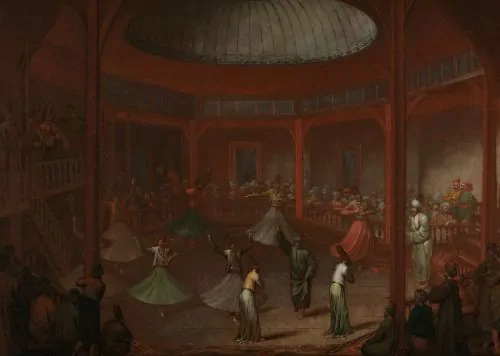
By the late Ottoman period, the Mevleviye had developed far beyond the circle that gathered around Rumi’s immediate successors. Lodges operated in major cities across the empire, training initiates while serving as centers of poetry, music, calligraphy, education, and sociability. The sema was performed within a disciplined religious setting whose movements, garments, music, and offices carried meanings learned through initiation. Members of the Ottoman governing and artistic elites often patronized or joined Mevlevi circles, giving the order cultural influence disproportionate to its numbers. Rumi’s death anniversary belonged to this institutional world before it became an international public event.
The establishment of the Turkish Republic sharply altered that world. Law No. 677, enacted in 1925, closed Sufi lodges and tomb establishments while abolishing recognized dervish offices and titles. Mevlevi institutions lost their legal standing, and the complex at Konya was subsequently converted into a museum. The order’s practices did not disappear, but they survived through families, private gatherings, musical transmission, and networks no longer permitted to operate openly as religious institutions. This rupture changed the public meaning of the sema. A rite formerly embedded in Sufi discipline could be presented instead as folklore, national culture, artistic heritage, or commemoration of a great poet. Such categories made public performance possible while narrowing the explicitly religious claims that the new secular state was willing to recognize.
Public commemorations in Konya began to reemerge during the twentieth century, with official observances developing from the late 1930s and expanding more visibly during the 1950s. Performances of the sema returned under cultural supervision rather than through restoration of the abolished lodge system. The anniversary increasingly centered on the fixed date of December 17 and attracted visitors who were neither Mevlevi initiates nor Muslim devotees. Rumi’s Wedding Night was becoming a civic spectacle as well as a sacred remembrance.
The international expansion of the commemoration accelerated through tourism, migration, recording technologies, translations, and state cultural diplomacy. Audiences encountered Rumi in concert halls, museums, festivals, bookstores, spiritual retreats, and digital media far removed from Konya’s thirteenth-century religious world. UNESCO’s recognition of the Mevlevi sema ceremony as intangible cultural heritage reinforced its status as something belonging not only to a particular Sufi lineage but to humanity’s shared cultural inheritance. The eight-hundredth anniversary of Rumi’s birth in 2007 further enlarged his global visibility. Turkish cultural institutions presented the ceremony internationally, while performers adapted its scale and staging to theaters designed for spectators rather than initiated participants. Popular English versions of Rumi’s poetry helped create a vast new audience, although many adaptations minimized Quranic references and removed the poems from their Islamic intellectual setting. For some observers, the turning dervish consequently became a generalized emblem of tolerance or mystical self-discovery. For others, the ceremony remained inseparable from Islamic remembrance, devotional music, and the discipline of the Mevlevi path. Global commemoration did not produce one universal Rumi; it generated several competing versions of him.
The modern Shab-e Arus is neither an unchanged medieval survival nor simply an invented tourist performance. It preserves the Mevlevi interpretation of Rumi’s death as union, but it does so through institutions, calendars, political restrictions, and global media that accumulated long after 1273. Its expanded audience fulfills the early hagiographic image of a master mourned beyond the boundaries of his immediate community, even as that expansion can detach him from the tradition that made the commemoration possible. The ceremony’s visibility has secured Rumi an extraordinary afterlife while making ownership of his meaning more contested. What began as the remembrance of a Muslim teacher’s death now moves between devotional rite, national heritage, public spectacle, and global spiritual symbol.
Was the Multifaith Funeral a Mevlevi Charter Myth?
The following video from “Let’s Talk Religion” is an historical overview of Rumi:
The strongest challenge to the famous funeral narrative begins with the lateness and purpose of its principal source. Shams al-Din Ahmad Aflaki began writing the Manaqeb al-arefin in 1318, roughly forty-five years after Rumi’s death, at the request of Rumi’s grandson and institutional successor, Ulu Arif Chalabi. His work belongs to the genre of saintly hagiography rather than detached civic chronicle. It was designed to preserve exemplary memories, authenticate spiritual authority, and explain why the Mevlevi lineage deserved allegiance. A narrative in which every community of Konya recognized Rumi’s sanctity served those purposes remarkably well.
The evidentiary difficulty becomes sharper when Aflaki’s elaborate account is compared with earlier or less expansive sources. Sultan Walad, writing much closer to the founding generation, presented the history of Rumi’s teachers and successors but did not leave the same detailed tableau of Christian and Jewish mourners defending their place in the procession. Faridun ibn Ahmad Sipehsalar also contributed to the early biographical tradition, although the dating and transmission of his work present their own problems. Neither provides independent confirmation for all the speeches, scriptural recitations, confrontations, and social categories assembled by Aflaki. Silence cannot prove that non-Muslims were absent, especially when authors selected details according to different literary purposes. It does prevent Aflaki’s version from being treated as corroborated eyewitness evidence. The richest details appear in the source with the greatest chronological distance and the clearest institutional investment. Historians must consider whether the multifaith funeral was less a report of one afternoon than a retrospective declaration of what Rumi had come to mean.
Under this interpretation, the story functioned as a Mevlevi charter myth. “Myth” here does not mean a fabrication universally known to be false, but an authoritative narrative that legitimates a community’s identity and arrangements. By making Christians and Jews witnesses to Rumi’s holiness, the story presented Mevlevi authority as recognized beyond the order and beyond Islam. By making skeptical Muslims object, it also permitted the hagiography to answer charges that such breadth compromised Rumi’s religious integrity.
Several features of the narrative support this reading. Outsiders recognize sanctity with unusual clarity, while less perceptive insiders attempt to police boundaries they do not fully understand. Christian and Jewish mourners are given speeches that align their scriptures with Rumi’s spiritual status, turning religious difference into testimony for the saint. The comprehensive gathering of ethnic, confessional, social, and gender categories makes the funeral resemble a symbolic portrait of the inhabited world. Rumi’s body stands at the center, and the Mevlevi tradition becomes the custodian of a holiness that all discerning people supposedly acknowledged. Such scenes are characteristic of hagiography, where social reality is arranged to disclose sacred meaning. The account also supported the later order’s relationships with diverse patrons and audiences by projecting its broad appeal back to the foundational moment of Rumi’s death. Read in this way, the funeral confirmed not only Rumi’s sanctity but the legitimacy of the community speaking in his name.
Yet identifying the story’s charter function does not require rejecting every historical claim it contains. Rumi was a major public figure in a religiously mixed city, and attendance by some Christians and Jews remains plausible even if their reported speeches cannot be verified. The most defensible interpretation separates a possible historical core from its hagiographic architecture: a large funeral with a socially varied crowd may have been remembered, while later Mevlevis expanded that memory into a universal recognition scene. This counterpoint narrows what can be asserted about December 1273 but deepens what the narrative reveals about the fourteenth century. The funeral matters not because Aflaki transparently recorded everyone who mourned, but because his community chose multifaith mourning as the defining image of Rumi’s passage from local master to enduring saint.
Conclusion: When Mourning Became Union
Rumi’s death on December 17, 1273, occurred in a Konya shaped by political insecurity, religious diversity, and the cultural movement of peoples across Anatolia. He died as a Muslim scholar and Sufi teacher whose authority had grown through preaching, jurisprudence, poetry, and personal companionship. His audience extended beyond a narrow circle of initiates, although the precise breadth of that audience cannot be reconstructed from later devotion alone. The funeral represented the sudden conversion of living relationships into public memory. From that moment, Rumi’s followers faced the problem of how to preserve a presence that death had removed.
They answered by giving absence several durable forms. The grave beside Baha al-Din Walad established a sacred center, while the mausoleum and later Green Dome made Rumi’s continuing importance visible in Konya’s landscape. Husam al-Din Chalabi, Sultan Walad, Ulu Arif Chalabi, and subsequent leaders carried personal allegiance into institutional succession. Hagiographers organized memories of the master into narratives that defined his sanctity and validated the community formed around his descendants. Ritual gatherings allowed poetry, music, prayer, and bodily movement to reactivate relationships with the dead. The anniversary of his passing placed these practices within a recurring calendar. What began as bereavement became a structure capable of gathering people who had never encountered Rumi in life. The Mevlevi community did not merely preserve his legacy; it created the forms through which later generations could experience that legacy as present.
The multifaith funeral remains the most compelling and uncertain image in that process. Some Christian and Jewish attendance is historically credible, but the speeches and confrontations recorded by Aflaki cannot be independently established as events of 1273. His account offers firmer evidence for early Mevlevi memory than for the exact composition of the procession. Its historical value lies partly in that distinction, because it shows that Rumi’s followers wanted universal recognition to stand at the threshold of his posthumous life.
Shab-e Arus completed the reinterpretation by naming death a wedding rather than a final separation. The phrase drew upon Rumi’s Islamic understanding of return to God while allowing sorrow to become a discipline of longing. Across centuries of political patronage, institutional suppression, cultural revival, and international celebration, the commemoration acquired meanings its first mourners could not have anticipated. Yet its central act remained remarkably consistent: the community returned to the moment of loss and refused to treat it as disappearance. Rumi’s funeral passed into history, but the forms constructed around it made his death perpetually repeatable as reunion. Mourning became union because generations of followers built a tomb, an order, and an anniversary in which absence could continue to gather the living.
Bibliography
Affiliate disclosure: Amazon links on this site are paid links. As an Amazon Associate I earn from qualifying purchases.
- Aflaki, Shams al-Din Ahmad. The Feats of the Knowers of God: Manaqeb al-arefin. Translated by John O’Kane. Leiden: Brill, 2002.
- Blessing, Patricia. Rebuilding Anatolia after the Mongol Conquest: Islamic Architecture in the Lands of Rum, 1240–1330. Farnham, UK: Ashgate, 2014.
- Cahen, Claude. The Formation of Turkey: The Seljukid Sultanate of Rum, Eleventh to Fourteenth Century. Translated and edited by P. M. Holt. Harlow, UK: Longman, 2001.
- Chittick, William C. The Sufi Path of Love: The Spiritual Teachings of Rumi. Albany: State University of New York Press, 1983.
- Elias, Jamal J. After Rumi: The Mevlevis and Their World. Cambridge, MA: Harvard University Press, 2025.
- —-. “Sufism and Islamic Identity in Jalaluddin Rumi’s Anatolia.” In Light upon Light: Essays in Islamic Thought and History in Honor of Gerhard Bowering, edited by Jamal J. Elias and Bilal Orfali, 291–315. Leiden: Brill, 2019.
- de Groot, Rokus. “Rumi and the Abyss of Longing.” Mawlana Rumi Review 2 (2011), 61-93.
- Este ‘lami, Muhammad. “Understanding Rumi’s ‘Mathnawi’.” Mawlana Rumi Review 3 (2012), 7-19.
- Friedlander, Shems. The Whirling Dervishes: Being an Account of the Sufi Order Known as the Mevlevis and Its Founder the Poet and Mystic Mevlana Jalalu’ddin Rumi. Albany: State University of New York Press, 1975.
- Karamustafa, Ahmet T. Sufism: The Formative Period. Edinburgh: Edinburgh University Press, 2007.
- Keshavarz, Fatemeh. Reading Mystical Lyric: The Case of Jalal al-Din Rumi. Columbia: University of South Carolina Press, 1998.
- Lewis, Franklin D. Rumi: Past and Present, East and West: The Life, Teachings and Poetry of Jalal al-Din Rumi. Rev. ed. Oxford: Oneworld, 2008.
- Masroori, Cyrus. “An Islamic Language of Toleration: Rumi’s Criticism of Religious Persecution.” Political Research Quarterly 63:2 (2010), 243-256.
- Mojaddedi, Jawid. Beyond Dogma: Rumi’s Teachings on Friendship with God and Early Sufi Theories. Oxford: Oxford University Press, 2012.
- Peacock, A. C. S. Islam, Literature and Society in Mongol Anatolia. Cambridge: Cambridge University Press, 2019.
- Peacock, A. C. S., and Sara Nur Yildiz, eds. The Seljuks of Anatolia: Court and Society in the Medieval Middle East. London: I.B. Tauris, 2013.
- Qamber, Akhtar. “Rumi: Mystic Extraordinary.” India International Centre Quarterly 15:3 (1988), 103-116.
- Raudvere, Catharina, and Leif Stenberg, eds. Sufism Today: Heritage and Tradition in the Global Community. London: I.B. Tauris, 2008.
- Renard, John. All the King’s Falcons: Rumi on Prophets and Revelation. Albany: State University of New York Press, 1994.
- Rumi, Jalal al-Din. The Masnavi: Book One. Translated by Jawid Mojaddedi. Oxford: Oxford University Press, 2004.
- —-. Mystical Poems of Rumi. Translated by A. J. Arberry. Edited by Ehsan Yarshater. Chicago: University of Chicago Press, 2009.
- —-. Signs of the Unseen: The Discourses of Jalaluddin Rumi. Translated by Wheeler M. Thackston Jr. Boston: Shambhala, 1994.
- Schimmel, Annemarie. I Am Wind, You Are Fire: The Life and Work of Rumi. Boston: Shambhala, 1992.
- —-. The Triumphal Sun: A Study of the Works of Jalaloddin Rumi. 2nd ed. Albany: State University of New York Press, 1993.
- Shams-i Tabrizi. Me and Rumi: The Autobiography of Shams-i Tabrizi. Translated by William C. Chittick. Louisville, KY: Fons Vitae, 2004.
- Shukurov, Rustam. The Byzantine Turks, 1204–1461. Leiden: Brill, 2016.
- Trimingham, J. Spencer. The Sufi Orders in Islam. Oxford: Clarendon Press, 1971.
- UNESCO. Mevlevi Sema Ceremony. Representative List of the Intangible Cultural Heritage of Humanity. Paris: UNESCO, 2008.
- Wolper, Ethel Sara. Cities and Saints: Sufism and the Transformation of Urban Space in Medieval Anatolia. University Park: Pennsylvania State University Press, 2003.
Originally published by Brewminate, 09.01.2026, under the terms of a Creative Commons Attribution-NonCommercial-NoDerivatives 4.0 International license.
About the Author