A Persian victory at Salamis could have kept Xerxes’s army fed by sea, trapped Athens without its fleet, and ended a democracy not yet thirty years old.

By Matthew A. McIntosh
Public Historian
Brewminate
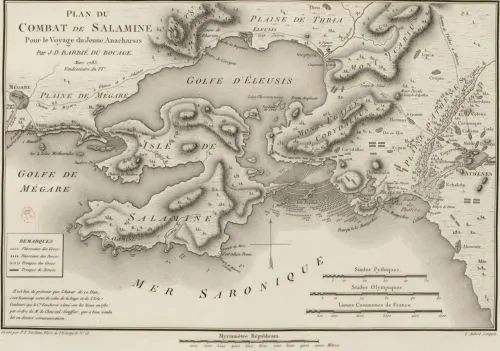
In the last days of September 480 BCE, the Greek fleet lay in the straits of Salamis with nowhere good to go. Athens stood empty behind it, its people ferried across to the island, and some 370 triremes held the narrow water between Salamis and the Attic shore while the Peloponnesian captains argued for falling back to the Isthmus of Corinth. Themistocles settled the argument by fraud. His servant Sicinnus crossed to the Persian camp by night with word that the Greeks meant to slip away before dawn and that his master secretly wished the King success. Xerxes believed him, sealed both ends of the straits, and sent his fleet in, with an Egyptian squadron rowing around the island to close the back channel toward Megara. Numbers, the Persians’ great advantage, became a trap in water too confined to use them. By evening the straits were choked with wreckage, and Xerxes, watching from a throne set on the hillside, had lost the sea. Within weeks he was marching home with most of his army, leaving Mardonius to finish the conquest with a picked force. Plataea ended that attempt the following summer.
It nearly went the other way. Artemisia of Halicarnassus, who commanded five ships in the King’s own fleet, had advised him against fighting in the narrows at all. Her counsel was to keep the fleet in being, move against the Peloponnese, and let hunger and quarrelling dissolve an alliance trapped on a crowded island. Suppose Xerxes listens. The blockade holds the open sea, and the Greek fleet has to come out and fight where Phoenician seamanship and Persian numbers have room to work, or stay and watch its allies desert one by one toward the Isthmus, until the fleet that carried Athens is destroyed in an afternoon or scattered past reassembling.
The first thing a Persian victory changes is supply, and supply was the invasion’s real weakness. Xerxes had brought an army far too large to live off a poor and hostile country, which is why most of it went home in the autumn and why Mardonius wintered with a reduced force in Thessaly, where the locals had submitted and the grazing was good. Command of the sea reverses the problem. Grain ships from Egypt and Phoenicia can put into Greek harbors all winter, the King has no exposed bridge of boats at the Hellespont to fear for, and an army of occupation can be fed at full strength into the spring. Sea power also unbuilds the one defensive work the Greeks trusted, since the wall across the Isthmus guards a road and does nothing about an enemy who can land troops behind it anywhere along the Peloponnesian coast. Sparta‘s hoplites remained the finest heavy infantry in the Greek world, and a Persian commander still had reason to avoid them on ground of their choosing. But Sparta could not garrison every beach, and its allies had to weigh resistance against the terms already accepted by Thessaly and Thebes. Across one winter of blockade and negotiation, the likely outcome is a mainland Greece that submits piecemeal, with a land battle on the scale of Plataea possible but no longer necessary to the result.
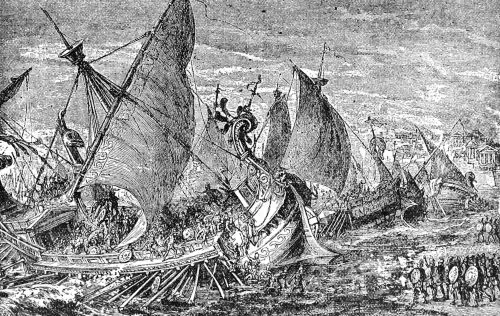
For Athens, the defeat is personal in a way it is for no other city, because the Athenians had put their state on the water. The men of the fleet were the city in arms, and the women, children, and old people crowded on Salamis were its remainder. A destroyed fleet leaves those families to be starved into surrender on the island or taken off it at the King’s pleasure, and Persia’s terms, by its settled practice, would be submission rather than extermination: tribute, and a government the King could trust.
The empire was not doctrinaire about constitutions, and Athens would not be punished for being a democracy as such. Mardonius had replaced tyrants with democracies in the Ionian cities twelve years earlier because that arrangement promised quiet, and Persia generally wanted tribute and obedience from Greek cities rather than uniformity. What it could not permit was a second Athenian fleet, and that prohibition is what ends the experiment. Athenian democracy drew its strength from the thetes, the poor citizens who rowed the triremes and whose indispensability bought them their political weight. Rowers who are dead, enslaved, or scattered cannot fill an assembly, and a disarmed Athens under Persian supervision reverts to the wealthy men who had never liked the arrangement. Some Athenians would refuse the terms altogether, since the Phocaeans had abandoned their city to the Persians a lifetime earlier and sailed west rather than submit, and Athens had colonies and cousins across the Aegean and in Italy to run to. The name and the people survive; the democracy, less than thirty years old, does not. Holding the rest of Greece would test the empire in a different way, because the country is mountainous and poor, its cities chronically at odds, and it sits past a sea crossing and the length of Anatolia from the King’s court. Tribute from Attic farms and Peloponnesian towns would struggle to pay for the garrisons needed to collect it, and royal attention was finite, pulled by Egypt and Babylon, both of which revolted when they judged the King distracted. Ionia had risen in 499 with far less to avenge than a conquered Athens would carry. The plausible shape of Persian Greece is a dependency that loosens with time into the arrangement Persia eventually preferred in real history, when the King’s Peace of 386 BCE let the King dictate Greek affairs by subsidy and threat without occupying a single Greek town. Greek civilization is not extinguished in this timeline. Philosophy had begun in Ionian cities that paid the King his tribute, and Greek culture had already shown it could flourish under Persian sovereignty. What disappears is a specific and unlikely future: no Athenian empire gathered by a victorious fleet, no league treasury on the Acropolis, no Parthenon raised from allied money by a city swollen with confidence. Athens becomes one more talented Greek town under a distant king, and the classical century happens in Ionia and Sicily instead, or nowhere.
What the scenario finally exposes is how little of Salamis was destiny. Half of Greece had already given earth and water before the battle was fought, and Greek cities had lived under the King for two generations without ceasing to be Greek, so freedom in the abstract was not what hung on that afternoon. Two practical things were: whether an invading army could be fed, and whether the poorest citizens of Athens would come home from the straits able to insist that the city could not do without them. In the event, a narrow channel and a lie told in the dark settled both questions at once. Empires are usually undone by distance and supply rather than by courage, and Salamis is the rare case where the supply lines lost in a single day, in full view of the king who owned them.
Originally published by Brewminate, 11.26.2026, under the terms of a Creative Commons Attribution-NonCommercial-NoDerivatives 4.0 International license.
About the Author