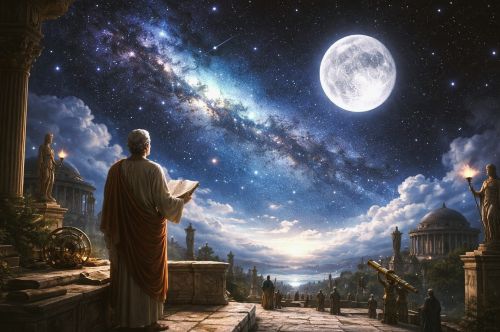
Ancient civilizations wrestled with the possibility of life beyond Earth, offering diverse cosmologies that reveal a persistent human desire to understand our place in a vast universe.

By Matthew A. McIntosh
Public Historian
Brewminate
Introduction: The Ancient Question of Cosmic Company
The question of whether we are alone in the universe feels modern, shaped by telescopes and space exploration. Ancient civilizations were already asking whether life existed beyond Earth, shaped by advances in astronomy, physics, and space exploration. Yet this question has deep roots in antiquity, where philosophers, theologians, and poets grappled with the nature of the cosmos and humanity’s place within it. Long before telescopes revealed distant galaxies, ancient thinkers asked whether the heavens contained other worlds, other beings, and other forms of life. These early inquiries were not driven by empirical science in the modern sense but were grounded in systematic reasoning, observation, and reflection on the structure of reality.
In the Greek world, this question emerged most clearly in the debate between competing philosophical traditions. Atomist thinkers such as Democritus and Epicurus argued that an infinite universe composed of indivisible particles must necessarily produce innumerable worlds, some potentially resembling our own. By contrast, Aristotle and his followers defended a finite, ordered cosmos centered on a unique Earth, rejecting the possibility of multiple worlds as incompatible with their understanding of nature. These positions were not merely speculative but rooted in broader metaphysical commitments about matter, motion, and purpose, demonstrating how deeply cosmological questions were intertwined with philosophical systems.
Beyond the Mediterranean, other civilizations developed their own frameworks for understanding the cosmos and the possibility of life beyond Earth. In South Asia, Buddhist and Hindu traditions articulated expansive cosmologies featuring countless worlds and cycles of creation and destruction, often populated by a wide variety of beings. In China, conceptions of heaven and cosmic order emphasized the relationship between celestial and earthly realms, while in Mesopotamia, narratives of divine beings associated with the sky reflected a worldview in which the heavens were inhabited, though not necessarily in the same sense as the plurality-of-worlds theories of Greek atomism. These diverse perspectives reveal that the question of cosmic plurality was not confined to a single cultural tradition but instead a widespread feature of human thought.
Ancient discussions of life beyond Earth were shaped less by empirical evidence than by underlying philosophical, religious, and cultural frameworks. Whether a thinker envisioned a universe filled with countless inhabited worlds or a singular, ordered cosmos depended on deeper assumptions about the nature of reality itself. Examining these traditions comparatively demonstrates both the diversity of ancient answers and the shared impulse to situate humanity within a larger cosmic context by highlighting the continuity between ancient speculation and modern inquiry, showing that the search for cosmic company is as old as reflective thought.
Greek Foundations: Atomism and the Plurality of Worlds
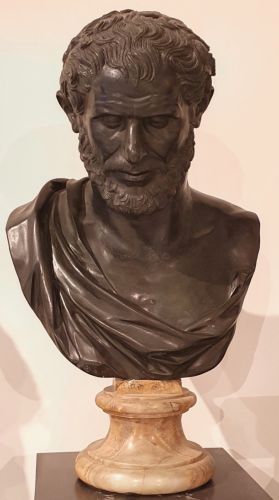
Ancient civilizations did consider the possibility of extraterrestrial life, though their explanations were grounded in philosophy, religion, and cosmology rather than empirical science. The earliest sustained argument for the existence of multiple worlds emerged within the Greek philosophical tradition, particularly among the Atomists. Democritus, building on earlier ideas associated with Leucippus, proposed that reality consisted of indivisible particles moving through an infinite void. There could be no natural limit to the number of configurations that matter might take. If atoms were infinite in number and space was boundless, then it followed logically that worlds themselves must also be innumerable. This was not a speculative flourish but a direct consequence of a materialist ontology that rejected teleology and divine design.
Epicurus developed this line of reasoning into a more explicit cosmological argument. In his Letter to Herodotus, he maintained that the infinite number of atoms, combined with the infinite extent of the void, necessarily produced an infinite number of worlds. These worlds, he argued, could differ widely in structure, composition, and the forms of life they might support. Some might resemble our own, while others would be radically different. Epicurus emphasized that there was no reason to privilege Earth as unique, since the same natural processes operating here would operate elsewhere under similar conditions. This reasoning extended the implications of atomism beyond physics into a broader vision of cosmic plurality. Epicurus was not merely speculating about distant possibilities but constructing a coherent system in which plurality was the expected outcome of natural law. His argument transformed the question of other worlds from a matter of curiosity into a logical necessity grounded in the fundamental properties of matter and motion.
Metrodorus of Lampascus, a prominent follower of Epicurus, articulated this idea in particularly vivid terms. He argued that to assume Earth was the only inhabited world was as unreasonable as believing that a single ear of wheat could grow in a vast field. This analogy conveyed the intuitive force of the Atomist position, translating abstract principles into a concrete image that emphasized abundance rather than scarcity. The comparison underscored a fundamental shift in perspective, in which the universe was no longer seen as a closed and ordered system but as an expansive and generative environment capable of producing countless variations. By invoking a familiar agricultural image, Metrodorus made the abstract implications of atomism accessible and persuasive, reinforcing the idea that multiplicity was not only possible but expected. His formulation also highlights how philosophical arguments were often communicated through analogy, allowing complex ideas to resonate within broader cultural contexts.
The Roman poet and philosopher Lucretius later preserved and elaborated these ideas in De Rerum Natura. Writing in the first century BCE, Lucretius presented a comprehensive account of Epicurean physics and cosmology, arguing that nothing in nature exists as a singular instance when the conditions for its formation are repeated elsewhere. From this premise, he concluded that other worlds must exist, populated by their own forms of life. His work is significant not only for its philosophical content but also for its role in transmitting Atomist ideas to later audiences, ensuring their survival beyond the immediate context of Greek philosophy.
The Atomist conception of innumerable worlds was deeply connected to its rejection of teleology. In contrast to systems that posited a purposeful or divinely ordered universe, Atomism explained the formation of worlds as the result of random motion and combination. This absence of design removed any basis for assuming that Earth held a privileged position. Instead, it became one instance among many, its characteristics determined by chance rather than necessity. This perspective reshaped how humans understood their place in the cosmos, challenging assumptions about centrality and uniqueness. By denying that the universe was organized around a single purpose or endpoint, Atomist thinkers opened the possibility that countless worlds could emerge independently, each shaped by the same underlying processes but producing different outcomes. This shift in perspective represented a radical departure from more traditional views of cosmic order, emphasizing contingency over design and plurality over singularity.
The Atomist tradition represents one of the earliest and most coherent attempts to conceptualize a universe filled with multiple worlds. Its arguments were grounded in a consistent philosophical framework that linked the nature of matter to the structure of the cosmos. While later traditions would challenge these ideas, the Atomist vision of plurality remained a powerful alternative, demonstrating that the possibility of extraterrestrial life was not only imaginable but logically compelling within certain systems of thought. The Greek Atomists laid the intellectual groundwork for later explorations of cosmic diversity.
The Aristotelian Countermodel: A Singular, Ordered Cosmos
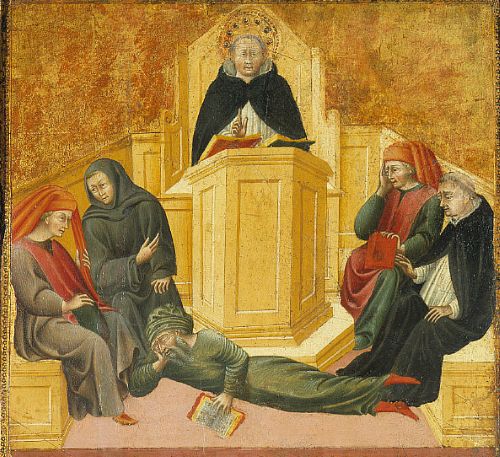
In sharp contrast to the Atomist vision of an infinite universe filled with innumerable worlds, Aristotle developed a cosmological model that emphasized unity, finitude, and order. In his work On the Heavens, Aristotle argued that the cosmos was a single, complete system, structured according to natural principles that left no room for duplication or plurality of worlds. The Earth occupied the center of this universe, surrounded by concentric spheres composed of distinct elements, each moving according to its inherent nature. This model was not merely descriptive but philosophical, grounded in a broader commitment to explaining the natural world through purpose and organization rather than chance.
A central element of Aristotle’s argument against multiple worlds was his conception of natural place. According to his physics, each of the four terrestrial elements (earth, water, air, and fire) had a natural tendency to move toward its proper location within the cosmos. Earth, being the heaviest element, naturally moved toward the center, while fire rose toward the outer regions. From this perspective, the existence of more than one world would be impossible, as all earth-like matter would converge toward a single central point. The notion of multiple Earths existing in separate locations conflicted with this understanding of motion and order, leading Aristotle to reject the plurality-of-worlds theory as incompatible with the fundamental principles of nature.
Aristotle’s cosmology was also deeply teleological, emphasizing purpose and design in the structure of the universe. Every component of the cosmos had a role to play within a unified system, contributing to an overarching order that reflected rational organization. This view reinforced the idea that the universe was complete, with no need for additional worlds to fulfill any purpose. The uniqueness of Earth was not an incidental feature but an integral part of a coherent and purposeful whole, in which each element existed in its proper place and functioned according to its nature.
The influence of the Aristotelian model extended far beyond antiquity, shaping medieval and early modern understandings of the cosmos for centuries. Its integration into later philosophical and theological systems, particularly within Christian and Islamic thought, ensured its dominance as the prevailing cosmological framework. By asserting a singular, ordered universe centered on Earth, Aristotle provided a powerful counterpoint to Atomist plurality, one that framed the question of other worlds not as a matter of possibility but as a violation of the natural order itself. Medieval scholastics, including figures such as Thomas Aquinas, engaged deeply with Aristotelian cosmology, often adapting it to align with theological doctrines while preserving its core assumptions about unity and purpose. Even as new observations and intellectual developments began to challenge aspects of this model, its underlying principles continued to shape debates about the structure of the universe and the possibility of other worlds. Aristotle’s vision of a singular cosmos exerted a lasting influence, framing the terms of discussion for centuries and providing a durable intellectual framework against which alternative ideas were measured.
The Moon as a World: Speculation and Imagination in Classical Thought
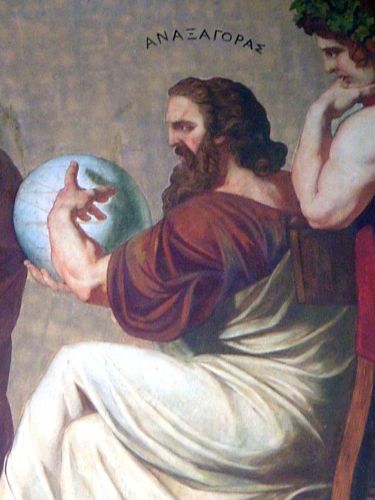
While philosophical debates about the plurality of worlds often remained abstract, the moon provided ancient thinkers with a more immediate and tangible object for speculation. Visible, patterned, and clearly part of the same cosmos as Earth, the moon invited questions about its nature and composition. Was it a divine body, fundamentally different from the Earth, or was it a world in its own right? This question allowed philosophers to move from general cosmological principles to more specific considerations about the possibility of life beyond Earth.
Anaxagoras was among the earliest to propose a naturalistic interpretation of celestial bodies, arguing that the sun was a fiery mass and the moon a solid, earth-like object illuminated by reflected light. This view challenged earlier mythological explanations and opened the possibility that the moon might share characteristics with the Earth. If the moon were composed of similar material, it became conceivable that it might also support forms of life. Although Anaxagoras did not develop a full theory of lunar habitation, his ideas laid the groundwork for later speculation by reframing the moon as a physical entity rather than a purely divine one.
Plutarch, writing in the early Roman imperial period, explored these questions in greater depth in his treatise On the Face Which Appears in the Orb of the Moon. In this work, he considered the possibility that the moon might be inhabited, presenting a range of arguments and counterarguments in a dialogical format. Plutarch did not assert definitively that the moon was populated, but he entertained the idea seriously, suggesting that its environment might differ from Earth in ways that could support different forms of life. His discussion reflects a willingness to engage with speculative possibilities while remaining grounded in philosophical reasoning.
Alongside these philosophical explorations, imaginative literature also played a role in expanding the conceptual boundaries of extraterrestrial life. Lucian of Samosata, in his satirical work True History, described voyages to the moon and encounters with its inhabitants, blending humor with commentary on contemporary intellectual debates. While not intended as a literal account, Lucian’s narrative demonstrates how the idea of life beyond Earth had entered the realm of cultural imagination, becoming a subject not only of philosophical inquiry but also of creative expression. His work reflects a sophisticated awareness of the speculative nature of such discussions, using exaggeration and irony to both engage with and critique prevailing ideas about the cosmos. By presenting fantastical encounters in a recognizable intellectual framework, Lucian blurred the boundaries between serious inquiry and playful invention, illustrating how deeply the concept of extraterrestrial life had permeated the cultural consciousness of the time.
These approaches illustrate how the moon functioned as a focal point for ancient thinking about other worlds. It served as a bridge between abstract cosmology and concrete observation, allowing thinkers to explore the implications of their theories in a more specific context. Whether through philosophical argument or imaginative narrative, the consideration of the moon as a potential world reveals the depth and diversity of ancient engagement with the possibility of life beyond Earth.
Roman Expansion of Cosmic Pluralism
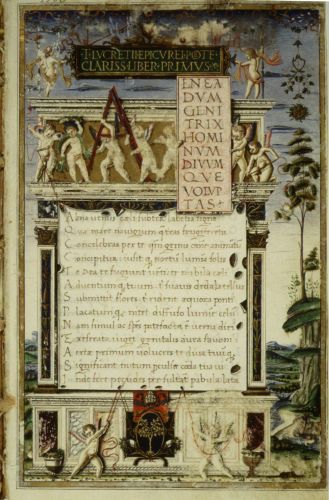
Roman intellectual culture did not originate the idea of multiple worlds, but it played a crucial role in preserving, systematizing, and disseminating Greek cosmological theories. Epicurean philosophy found new expression in the Roman context, where it was adapted to address broader questions about nature, existence, and human understanding. The Roman engagement with these ideas reflects both continuity with Greek thought and a distinctive emphasis on clarity and exposition, especially in literary form.
Lucretius stands at the center of this Roman expansion of cosmic pluralism. In his epic poem De Rerum Natura, he sought to present the principles of Epicurean philosophy in a comprehensive and accessible manner. His treatment of the universe is grounded in the same atomistic framework developed by Democritus and Epicurus, emphasizing the infinite number of atoms moving through an unbounded void. From these premises, Lucretius argued that the formation of multiple worlds was not only possible but inevitable, as the same processes that produced Earth must operate elsewhere under similar conditions.
A key element of Lucretius’s argument is his rejection of uniqueness in nature. He contended that nothing exists as a singular instance when the underlying conditions for its formation are repeated. Just as multiple species of plants and animals exist, so too must multiple worlds arise from the interaction of atoms. This reasoning extends the logic of natural abundance to the scale of the cosmos, showing that Earth is not exceptional but part of a broader pattern. By framing his argument in terms of observable regularities, Lucretius grounded his cosmological claims in a form of reasoning that was both philosophical and empirical. His insistence on the uniformity of natural processes also served to undermine anthropocentric assumptions, suggesting that the conditions that gave rise to life on Earth were not unique but could recur elsewhere. Lucretius transformed a philosophical argument into a broader claim about the nature of reality itself, emphasizing repetition, variation, and the absence of privileged position within the cosmos.
Lucretius also emphasized the diversity of these worlds, suggesting that they could vary widely in their characteristics and inhabitants. Some might resemble Earth closely, while others would differ in fundamental ways, shaped by the specific arrangements of atoms that gave rise to them. This openness to variation aligns with a broader Epicurean commitment to explaining natural phenomena without recourse to divine intervention or predetermined design. The universe, in this view, is a dynamic and generative system, producing a wide range of outcomes through the interplay of matter and motion. By allowing for such diversity, Lucretius expanded the conceptual scope of cosmic plurality, moving beyond the mere existence of other worlds to consider their potential differences. This emphasis on variation underscores the flexibility of the Epicurean framework, which could accommodate both similarity and difference without compromising its underlying principles.
Through his poetic and philosophical synthesis, Lucretius ensured that the concept of cosmic plurality would endure beyond the confines of Greek philosophical schools. His work not only preserved the Atomist vision of innumerable worlds but also presented it in a form that could engage a wider audience. He contributed to the long-term transmission of these ideas, influencing later thinkers and shaping the intellectual landscape in which questions about extraterrestrial life would continue to be explored.
Indian Cosmologies: Infinite Worlds and Cyclical Universes
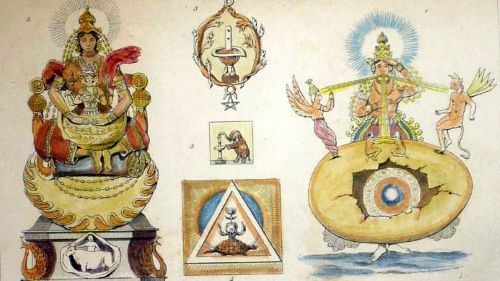
In contrast to the debates of the Greek and Roman worlds, which often revolved around the tension between plurality and singularity, South Asian traditions developed cosmological frameworks in which multiplicity was not controversial but foundational. Both Buddhist and Hindu philosophical systems articulated expansive visions of the universe that included countless worlds, often arranged within vast temporal cycles of creation, destruction, and renewal. These cosmologies did not treat the existence of other worlds as a speculative possibility but as an established feature of reality, embedded within broader metaphysical and religious understandings.
Buddhist cosmology presents one of the most striking examples of this expansive vision. Classical Buddhist texts describe a universe composed of innumerable world-systems, often referred to as “fields” or “realms,” each containing its own configurations of beings and environments. These world-systems are frequently depicted as existing simultaneously, extending infinitely in all directions. The metaphor of the “flower garland,” later elaborated in Mahāyāna traditions, captures this sense of interconnected multiplicity, suggesting a cosmos in which each world reflects and is reflected by others. Within this framework, the existence of life beyond Earth is not only possible but expected, as sentient beings inhabit a wide range of realms across the cosmic landscape.
Hindu cosmological thought similarly embraces multiplicity, though it often emphasizes cyclical processes as the organizing principle of the universe. Texts such as the Rigveda and later Purāṇic literature describe a cosmos that undergoes continuous cycles of creation (sṛṣṭi), preservation (sthiti), and dissolution (pralaya). Within these cycles, the concept of the Brahmāṇḍa, or cosmic egg, encompasses numerous worlds and planes of existence, each populated by different forms of life, including humans, gods, and other celestial beings. This layered structure reflects a hierarchical yet expansive vision of reality, in which Earth is only one among many domains. The multiplicity of realms is not incidental but integral to the functioning of the cosmos, reflecting a worldview in which existence unfolds across different levels of reality, each governed by its own conditions and laws.
A key feature of these cosmologies is the integration of temporal and spatial infinity. The universe is not only vast in extent but also enduring across immense spans of time, with cycles repeating over periods that far exceed human comprehension. This temporal dimension reinforces the idea of multiplicity, as the processes that generate worlds and beings are understood to operate continuously. The existence of numerous worlds is not seen as a singular event but as part of an ongoing and dynamic cosmic process. This view contrasts with more static models of the universe, emphasizing change and recurrence rather than fixed structure. By linking the creation of worlds to recurring cycles, these traditions present a cosmos that is perpetually active, in which the emergence and dissolution of worlds are fundamental aspects of its nature rather than exceptional occurrences.
The presence of diverse beings across these cosmological systems further expands the concept of life beyond Earth. In both Buddhist and Hindu traditions, existence is not limited to human forms but includes a wide array of entities occupying different realms, each with its own conditions and modes of experience. These beings are often understood in spiritual or metaphysical terms, yet their inclusion within a broader cosmological framework highlights a willingness to conceive of life in varied and non-human forms. This openness to diversity reflects a broader philosophical orientation that does not privilege a single type of existence as central or definitive.
Indian cosmological traditions offer a model of the universe in which plurality is both natural and necessary. Their emphasis on infinite worlds, cyclical time, and diverse forms of life stands in contrast to the more restrictive frameworks found in other traditions, while also providing a rich conceptual foundation for thinking about existence beyond Earth. By embedding these ideas within comprehensive metaphysical systems, Buddhist and Hindu thinkers developed a vision of the cosmos that remains among the most expansive in the history of human thought. This vision not only accommodates multiplicity but depends upon it, presenting a universe in which the existence of many worlds is an essential feature rather than a speculative possibility. South Asian cosmologies offer a powerful alternative to models that center on singularity, emphasizing instead a dynamic and pluralistic understanding of existence.
Myth, Symbol, and Interpretation in Indian Material Culture

Beyond textual traditions, Indian cosmological ideas also found expression in material culture, including temple architecture, sculpture, and artistic representation. These visual forms often depict complex cosmological structures and a wide range of beings, reflecting the expansive worldview articulated in philosophical and religious texts. Interpreting these images requires careful attention to their symbolic and cultural context, as they are not straightforward representations of physical reality but are embedded within systems of meaning that blend mythology, theology, and artistic convention.
Sites such as the Kailasha Temple at Ellora offer striking examples of this visual cosmology. Carved directly into rock, the temple complex includes intricate depictions of deities, celestial beings, and mythological scenes that reflect the layered structure of the universe described in Hindu texts. These figures often possess features that differ from ordinary human forms, including exaggerated proportions, multiple limbs, or distinctive facial characteristics. While such imagery can appear unusual to modern viewers, it is best understood as symbolic, representing divine attributes, cosmic functions, or spiritual states rather than literal beings from other worlds. The multiplicity of limbs, for example, is not intended to suggest biological form but to convey power, omnipresence, or the ability to act across multiple domains simultaneously. Similarly, stylized facial features and postures encode meaning within a shared visual language that would have been intelligible to contemporary audiences. Interpreting these forms requires attention not only to their aesthetic qualities but also to the religious and philosophical concepts they embody.
Similarly, archaeological sites such as Dholavira, associated with the Indus Valley Civilization, have generated interpretations that extend beyond conventional historical analysis. Some modern observers have suggested that certain motifs or structural features might indicate knowledge of or contact with non-human entities. Such interpretations often rely on projecting contemporary ideas onto ancient artifacts without sufficient evidence. Scholarly analysis emphasizes the importance of situating these materials within their historical and cultural contexts, recognizing that symbolic representation and abstraction were central to ancient artistic practices. The urban planning of Dholavira, for instance, reflects sophisticated engineering and social organization rather than evidence of external influence, while its inscriptions and material remains remain only partially understood within the limits of current scholarship. To move beyond speculation, historians and archaeologists prioritize contextual evidence, comparative analysis, and methodological rigor, ensuring that interpretation remains grounded in verifiable data rather than imaginative projection.
The challenge of interpretation lies in distinguishing between symbolic cosmology and literal description. Ancient Indian art frequently employs visual language to convey metaphysical concepts, using form and imagery to express ideas about the nature of the universe and the relationships between different realms of existence. These representations are not intended to document physical encounters but to illustrate philosophical and religious principles. As such, they require interpretive frameworks that account for their symbolic nature rather than treating them as direct evidence of extraterrestrial life.
The richness and diversity of these visual traditions reflect a willingness to imagine forms of existence that extend beyond the familiar. The depiction of beings with non-human characteristics, as well as the representation of multiple realms and cosmic structures, suggests an openness to conceptualizing life in varied and expansive ways. This imaginative scope aligns with the broader cosmological frameworks found in Indian philosophical traditions, reinforcing the idea that reality encompasses a wide range of possibilities. Rather than indicating literal encounters with extraterrestrial beings, these representations reveal a conceptual flexibility that allows for the existence of multiple forms of life across different planes of reality. The visual culture of ancient India complements its textual traditions, offering another medium through which expansive cosmological ideas could be explored and communicated.
The material culture of ancient India provides a valuable complement to textual sources, offering additional insight into how cosmological ideas were visualized and communicated. By approaching these artifacts with careful attention to context and symbolism, it becomes possible to appreciate their role in expressing a complex and multifaceted vision of the universe. This approach not only avoids anachronistic interpretations but also highlights the depth of ancient engagement with questions about the nature of existence and the possibility of life beyond Earth.
Chinese Cosmology: Heaven, Order, and Celestial Influence
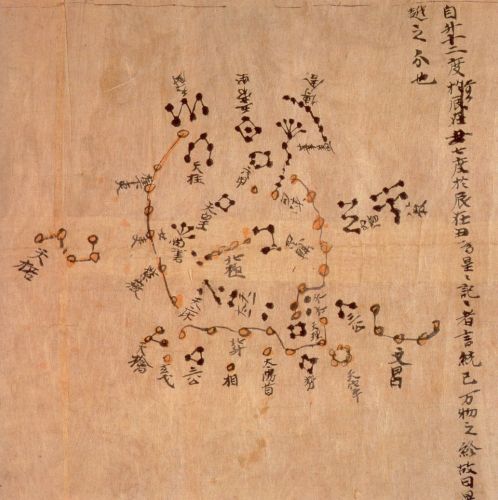
Ancient Chinese cosmology developed along a trajectory distinct from both Greek philosophical speculation and South Asian metaphysical expansiveness. Rather than focusing on the existence of multiple worlds or distant forms of life, Chinese thought emphasized the relationship between heaven (Tian) and earth, framing the cosmos as an interconnected system governed by harmony, balance, and moral order. The heavens were not distant and unknowable realms but active participants in the functioning of the world, influencing natural phenomena and human affairs alike.
Central to this worldview was the concept of Tian, often translated as “Heaven,” which represented both a physical and moral dimension of the cosmos. Heaven was understood as a source of authority and order, setting the pattern for proper conduct and governance on Earth. The emperor, as the “Son of Heaven” (Tianzi), served as the intermediary between these realms, embodying the connection between cosmic and political order. This framework linked celestial phenomena to earthly events, reinforcing the idea that the structure of the universe was mirrored in human society.
Chinese astronomical and cosmological traditions also reflected this emphasis on order and correspondence. Observations of the heavens were closely tied to calendrical systems, agricultural cycles, and state rituals, with celestial movements interpreted as indicators of harmony or disruption within the cosmic system. Rather than seeking to identify other worlds, Chinese scholars focused on understanding the patterns and regularities of the visible heavens, using them to guide practical and political decision-making. This approach highlights a different orientation toward the cosmos, one that prioritized relational understanding over speculative plurality. The careful recording of celestial events, such as eclipses, comets, and planetary motions, was not pursued for abstract curiosity alone but for its perceived implications for governance and social stability. Astronomy became intertwined with statecraft, reinforcing the idea that the cosmos and human society were part of a single, coherent order.
Chinese thought did not entirely exclude the possibility of other forms of existence beyond the human realm. Various traditions, including Daoist and later religious developments, incorporated ideas of immortals, spirits, and celestial beings inhabiting different layers of reality. These beings were not typically conceived as inhabitants of distant planets but as part of a cosmological system that overlapped with the human world. Their presence reflects an understanding of the cosmos as populated and dynamic, though structured differently from the plurality-of-worlds theories found elsewhere. In Daoist traditions, for example, the idea of transcendence involved movement between realms rather than travel across physical space, suggesting a model of existence defined by transformation and access rather than distance. This position highlights the interconnected nature of the cosmos, in which boundaries between realms are permeable and relationships between different forms of existence are central.
The emphasis on harmony and integration shaped how these ideas were expressed and understood. Rather than imagining separate and independent worlds scattered across an infinite universe, Chinese cosmology tended to conceptualize reality as a unified whole, with different levels or dimensions interacting within a single system. This placed less emphasis on physical distance and more on relational connectivity, highlighting the ways in which different aspects of existence were interdependent.
Chinese cosmological traditions offer a distinctive approach to the question of life beyond Earth. While they do not develop explicit theories of multiple inhabited worlds, they present a vision of the cosmos that is rich, populated, and deeply interconnected. By focusing on the relationships between heaven, earth, and human society, these traditions provide an alternative framework for understanding existence beyond the immediate world, one that emphasizes order, influence, and continuity rather than separation and multiplicity.
Mesopotamian Cosmology: Divine Beings and the Sky
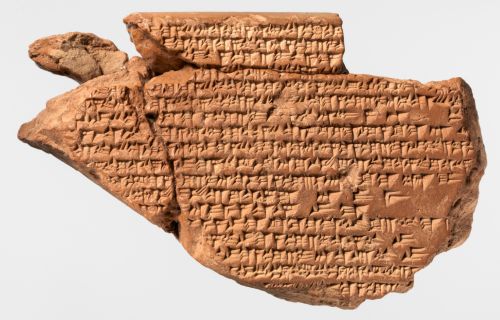
Ancient Mesopotamian cosmology presents yet another distinctive framework for understanding the heavens and the possibility of non-human beings. Unlike Greek philosophical systems that debated the physical structure of the universe or Indian traditions that emphasized multiplicity, Mesopotamian thought was deeply rooted in a theological worldview. The sky was not an abstract space but a divine realm inhabited by powerful beings who governed the forces of nature and human destiny. This view shaped how the cosmos was understood, emphasizing interaction between divine and human spheres rather than speculation about distant worlds.
Central to Mesopotamian belief were the Anunnaki, a group of deities associated with the heavens, the earth, and the underworld. These beings were often described as creators, rulers, and judges, responsible for establishing order and maintaining balance within the cosmos. Their presence in mythological narratives reflects a worldview in which the heavens were populated, but not in the sense of independent, physical worlds inhabited by separate civilizations. Instead, the divine beings of Mesopotamian cosmology occupied a hierarchical and relational position within a structured universe. Their roles were often defined by specific functions, such as governing particular aspects of nature or overseeing human affairs, reinforcing the idea that the cosmos operated according to an organized and purposeful system. This structure was mirrored in social and political hierarchies on Earth, suggesting a deep connection between cosmic order and human society.
Mesopotamian astronomical practices further reinforce this integration of the celestial and the divine. Observations of the stars, planets, and other celestial phenomena were closely tied to systems of divination, in which the movements of heavenly bodies were interpreted as signs of divine intention. Texts such as the Enūma Anu Enlil compile extensive records of celestial events and their perceived meanings, demonstrating the importance of the sky as a medium of communication between gods and humans. This approach presents a cosmology in which the heavens are active and meaningful rather than distant and indifferent.
The interpretation of these traditions in modern contexts has sometimes led to speculative claims about extraterrestrial contact, particularly in relation to the Anunnaki. Interpretations often overlook the symbolic and theological nature of Mesopotamian sources. The beings described in these texts function within a mythological framework that encodes cultural values, social structures, and explanations of natural phenomena. Treating them as literal extraterrestrials imposes a modern framework that is not supported by the historical evidence and risks obscuring the original meanings of the texts. This tendency reflects a broader challenge in interpreting ancient cosmologies, where the temptation to map contemporary ideas onto historical material can lead to significant distortions. A careful, context-sensitive approach is essential, one that recognizes the distinct intellectual and cultural environment in which these ideas were developed.
Understanding Mesopotamian cosmology on its own terms reveals a sophisticated system in which the heavens are integral to the structure of reality. While it does not propose the existence of multiple inhabited worlds in a physical sense, it nonetheless presents a cosmos that is populated, dynamic, and deeply interconnected. By situating celestial beings within a theological framework, Mesopotamian thought offers an alternative approach to the question of life beyond Earth, one that emphasizes divine presence and influence rather than material plurality.
Comparing Traditions: Materialism, Theology, and Cosmological Imagination
When examined together, the cosmological traditions of Greece, Rome, South Asia, China, and Mesopotamia reveal not a single trajectory of thought but a diverse set of intellectual frameworks shaped by distinct philosophical and cultural priorities. Each tradition addressed the question of existence beyond Earth in ways that reflected its underlying assumptions about matter, causation, and the structure of reality. Rather than converging on a unified answer, these traditions demonstrate how deeply cosmological speculation is rooted in broader systems of meaning.
The contrast between materialist and teleological frameworks is particularly instructive. Greek Atomism, later developed and transmitted through Roman Epicureanism, grounded its cosmology in the behavior of matter itself. From the premise of infinite atoms moving through infinite space, it derived the necessity of multiple worlds, each formed through natural processes without divine intervention. The existence of extraterrestrial life followed logically from the principles of the system. By contrast, Aristotelian cosmology, with its emphasis on purpose, hierarchy, and natural order, rejected the plurality of worlds as incompatible with a unified and complete universe.
Religious and metaphysical traditions in South Asia introduced yet another perspective, one in which multiplicity was embedded within a broader vision of cosmic cycles and layered realities. Buddhist and Hindu cosmologies did not rely on materialist reasoning to justify the existence of multiple worlds but instead incorporated them as integral components of a vast and dynamic universe. These frameworks allowed for a wide range of beings and realms, extending the concept of life beyond Earth into domains that were both physical and metaphysical. They expanded the scope of cosmological imagination beyond the constraints of purely physical explanation. The emphasis on cyclical time and recurring creation further reinforced this multiplicity, presenting a universe that continually generates and regenerates worlds across immense spans of time. This not only accommodates plurality but makes it an essential feature of cosmic order, integrating it into a broader metaphysical system that links existence, transformation, and continuity.
Chinese and Mesopotamian traditions, while differing in many respects, share a common emphasis on relational and theological interpretations of the cosmos. In both cases, the heavens were understood as active and meaningful, closely connected to human society and experience. Chinese cosmology emphasized harmony and correspondence between heaven and earth, while Mesopotamian thought focused on divine beings who inhabited and governed the celestial realm. Neither tradition developed a systematic theory of multiple inhabited worlds in the manner of the Atomists, yet both presented a populated and dynamic cosmos shaped by forces that extended beyond the human domain.
These differences underscore the role of cultural and intellectual context in shaping cosmological thought. The question of whether other worlds or beings exist cannot be separated from the frameworks through which it is asked. In materialist systems, the answer emerges from the properties of matter and space, while in theological systems, it is shaped by beliefs about divine agency and cosmic order. In metaphysical systems, it becomes part of a broader vision of reality that encompasses multiple levels of existence. Each approach reflects a distinct way of understanding the relationship between humanity and the cosmos. These frameworks not only guide interpretation but also delimit the range of conceivable answers, shaping both the questions posed and the conclusions reached. The diversity of ancient cosmologies reflects not simply differing opinions but fundamentally different ways of organizing knowledge and understanding existence.
These traditions demonstrate that ancient thought on life beyond Earth was not a peripheral curiosity but a central component of broader philosophical and religious inquiry. The diversity of answers reflects the richness of human attempts to comprehend the universe and humanity’s place within it. By comparing these traditions, it becomes possible to see not only their differences but also their shared engagement with fundamental questions about existence, plurality, and the nature of reality. In this comparative perspective, the ancient search for cosmic company emerges as a deeply human endeavor, shaped by both imagination and intellectual rigor.
Historiography: Interpreting Ancient Thought on Extraterrestrial Life
Modern interpretations of ancient thought on extraterrestrial life reveal as much about contemporary intellectual priorities as they do about the past itself. Historians and philosophers have approached these traditions with differing assumptions, often shaped by developments in modern science, particularly astronomy and astrobiology. The study of ancient cosmologies has oscillated between careful contextual analysis and anachronistic projection, with some interpretations emphasizing continuity with modern scientific ideas and others stressing the fundamental differences between ancient and modern worldviews.
One major historiographical divide concerns the extent to which ancient ideas can be understood as precursors to modern scientific theories about extraterrestrial life. Some scholars have highlighted the remarkable parallels between Atomist theories of innumerable worlds and contemporary models of a vast universe filled with planets. Figures such as Epicurus and Lucretius appear strikingly prescient, anticipating key elements of modern cosmology. Other historians caution against reading these similarities too literally, noting that ancient Atomism lacked the empirical foundation and methodological rigor that characterize modern science. The resemblance, they argue, is conceptual rather than scientific, rooted in philosophical reasoning rather than observational evidence.
A second line of interpretation focuses on the cultural and symbolic dimensions of ancient cosmologies. Scholars working within this framework emphasize that discussions of other worlds or celestial beings were often embedded in broader systems of meaning, including religious belief, moral philosophy, and political ideology. In Mesopotamian and Chinese contexts, for example, the heavens were not sites of speculative exploration but integral components of a cosmological order that structured human experience. Interpreting these traditions as early forms of extraterrestrial speculation risks obscuring their primary functions and meanings within their original contexts. This approach encourages historians to treat ancient texts not as proto-scientific documents but as expressions of cultural logic, shaped by the intellectual and social environments in which they were produced. By doing so, it becomes possible to recover the intended meanings of these cosmologies without imposing modern categories that may distort their significance.
The rise of popular and pseudo-historical interpretations has further complicated the historiography of this topic. Claims about ancient knowledge of extraterrestrial visitors, often centered on misreadings of mythological or artistic evidence, have gained widespread attention in modern media. These interpretations tend to extract elements from ancient texts and material culture while disregarding their historical and cultural contexts, reinterpreting them through the lens of modern fascination with alien life. Professional historians have consistently challenged such claims, emphasizing the importance of rigorous methodology and contextual analysis in the study of ancient sources. This critique is not merely corrective but also methodological, underscoring the need for careful source evaluation, linguistic precision, and awareness of interpretive bias. Without these safeguards, the boundary between historical inquiry and speculative projection becomes blurred, undermining the credibility of scholarship and obscuring the complexities of ancient thought.
In recent scholarship, there has been a growing emphasis on comparative and interdisciplinary approaches that seek to balance these perspectives. By examining ancient cosmologies within their specific cultural contexts while also recognizing broader patterns of human inquiry, historians have developed a more nuanced understanding of how ideas about other worlds and beings functioned in the past. This approach avoids both the pitfalls of anachronism and the tendency to isolate traditions, instead highlighting the diversity of ancient thought and its relevance to enduring questions about the universe and humanity’s place within it.
Conclusion: Ancient Curiosity and the Modern Question
Across the ancient world, the question of whether humanity exists alone in the cosmos emerged not as a marginal curiosity but as a natural extension of broader attempts to understand existence itself. From Greek philosophers contemplating infinite atoms to Indian traditions envisioning countless cycles of creation, and from Chinese cosmological harmony to Mesopotamian divine skies, each culture approached the unknown with intellectual seriousness. The persistence of this question across such varied traditions underscores its universality, revealing a shared human impulse to situate life within a larger cosmic framework.
What is most striking in retrospect is not the agreement among these traditions, but their diversity of reasoning. Some, like the Atomists and later Roman Epicureans, reached toward plurality through logical extrapolation from material principles. Others, including Aristotelian thinkers, rejected multiplicity in favor of a singular and ordered cosmos. Meanwhile, South Asian traditions normalized multiplicity through metaphysical and cyclical frameworks, and Chinese and Mesopotamian systems embedded cosmic life within relational and theological structures. These differences illustrate that the possibility of other worlds was never merely a factual question, but one shaped by deeper assumptions about reality, causation, and meaning.
Modern science has transformed the terrain of this inquiry, replacing philosophical speculation with empirical investigation. The discovery of exoplanets and the growing field of astrobiology have provided new tools to approach the ancient question, shifting it from abstraction to measurable probability. Yet even within this scientific framework, the echoes of ancient thought remain evident. The idea that the universe is vast, generative, and potentially populated resonates with earlier intuitions, even as the methods used to explore it have changed fundamentally.
The continuity between ancient and modern perspectives lies less in their answers than in their shared curiosity. Ancient thinkers, constrained by the limits of observation yet expansive in imagination, laid the conceptual groundwork for questions that science continues to pursue. Their reflections remind us that the search for life beyond Earth is not solely a technical problem but a deeply human endeavor, rooted in the desire to understand our place within a universe that has always seemed larger, more complex, and more mysterious than immediate experience can fully explain.
Bibliography
- Anaxagoras. Fragments. In The Presocratic Philosophers: A Critical History with a Selection of Texts, edited by G. S. Kirk, J. E. Raven, and M. Schofield. Cambridge: Cambridge University Press, 1983.
- Aristotle. On the Heavens. Translated by W. K. C. Guthrie. Cambridge, MA: Harvard University Press, 1939.
- Black, Jeremy, and Anthony Green. Gods, Demons and Symbols of Ancient Mesopotamia: An Illustrated Dictionary. Austin: University of Texas Press, 1992.
- Conman, Joanne. “It’s about Time: Ancient Egyptian Cosmology.” Studien zur Altägyptischen Kultur 31 (2003), 33-71.
- Crowe, Michael J. The Extraterrestrial Life Debate, 1750–1900: The Idea of a Plurality of Worlds from Kant to Lowell. Cambridge: Cambridge University Press, 1986.
- Dalley, Stephanie. Myths from Mesopotamia: Creation, the Flood, Gilgamesh, and Others. Oxford: Oxford University Press, 1989.
- Dehejia, Vidya. Indian Art. London: Phaidon, 1997.
- Democritus. Fragments. In The Presocratic Philosophers: A Critical History with a Selection of Texts, edited by G. S. Kirk, J. E. Raven, and M. Schofield. Cambridge: Cambridge University Press, 1983.
- Dick, Steven J. Life on Other Worlds: The 20th-Century Extraterrestrial Life Debate. Cambridge: Cambridge University Press, 1998.
- Doniger, Wendy. The Hindus: An Alternative History. New York: Penguin Press, 2009.
- Epicurus. Letter to Herodotus. In The Epicurus Reader, translated by Brad Inwood and L. P. Gerson. Indianapolis: Hackett, 1994.
- Eremeeva, A. I. “Ancient Prototypes of the Big Bang and the Hot Universe (to the Prehistory of Some Fundamental Ideas in Cosmology.” Astronomical & Astrophysical Transactions 11:2 (1996), 193-196.
- Flood, Gavin. An Introduction to Hinduism. Cambridge: Cambridge University Press, 1996.
- Furley, David. The Greek Cosmologists, Volume 1: The Formation of the Atomic Theory and Its Earliest Critics. Cambridge: Cambridge University Press, 1987.
- Gethin, Rupert. The Foundations of Buddhism. Oxford: Oxford University Press, 1998.
- Grant, Edward. Planets, Stars, and Orbs: The Medieval Cosmos, 1200–1687. Cambridge: Cambridge University Press, 1994.
- Harvey, Peter. An Introduction to Buddhism: Teachings, History, and Practices. Cambridge: Cambridge University Press, 1990.
- Hunger, Hermann, and David Pingree. Astral Sciences in Mesopotamia. Leiden: Brill, 1999.
- Jamison, Stephanie W. and Joel P. Brereton. Rigveda: A Guide. Oxford: Oxford University Press, 2014.
- Lindberg, David C. The Beginnings of Western Science: The European Scientific Tradition in Philosophical, Religious, and Institutional Context, Prehistory to A.D. 1450. Chicago: University of Chicago Press, 1992.
- Long, A. A., and D. N. Sedley. The Hellenistic Philosophers, Volume 1: Translations of the Principal Sources. Cambridge: Cambridge University Press, 1987.
- Lucian of Samosata. True History. In Selected Satires of Lucian, translated by Lionel Casson. New York: W. W. Norton, 1968.
- Lucretius. On the Nature of Things. Translated by Martin Ferguson Smith. Indianapolis: Hackett, 2001.
- Major, John S., et al. The Huainanzi: A Guide to the Theory and Practice of Government in Early Han China. New York: Columbia University Press, 2010.
- Michell, George. The Hindu Temple: An Introduction to Its Meaning and Forms. Chicago: University of Chicago Press, 1977.
- Needham, Joseph. Science and Civilisation in China, Volume 5: Chemistry and Chemical Technology. Cambridge: Cambridge University Press, 1986.
- Pingree, David. “Astronomy and Astrology in India and Iran.” Isis 54, no. 2 (1963): 229–246.
- Plutarch. Moralia, Volume XII: On the Face Which Appears in the Orb of the Moon. Translated by Harold Cherniss and William C. Helmbold. Cambridge, MA: Harvard University Press, 1957.
- Possehl, Gregory L. The Indus Civilization: A Contemporary Perspective. Walnut Creek, CA: AltaMira Press, 2002.
- Puett, Michael, and Christine Gross-Loh. The Path: What Chinese Philosophers Can Teach Us About the Good Life. New York: Simon & Schuster, 2016.
- Robinson, John. “The Framework of Greek Cosmology.” The Review of Metaphysics 14:4 (1961), 676-684.
- Rochberg, Francesca. The Heavenly Writing: Divination, Horoscopy, and Astronomy in Mesopotamian Culture. Cambridge: Cambridge University Press, 2004.
- Rossi, Franco D. “Reckoning with the Popular Uptake of Alien Archaeology.” Public Archaeology 18:3 (2019), 162-183.
- Sedley, David. Lucretius and the Transformation of Greek Wisdom. Cambridge: Cambridge University Press, 1998.
- Sivin, Nathan. Granting the Seasons: The Chinese Astronomical Reform of 1280, with a Study of Its Many Dimensions and a Translation of Its Records. New York: Springer, 2009.
- Watanabe, John M. “In the World of the Sun: A Cognitive Model of Mayan Cosmology.” Man 18:4 (1983), 710-728.
Originally published by Brewminate, 03.27.2026, under the terms of a Creative Commons Attribution-NonCommercial-NoDerivatives 4.0 International license.
About the Author