Female friendship in the Viking world was forged through household labor, kinship, childbirth, migration, memory, and the daily work of survival.

By Matthew A. McIntosh
Public Historian
Brewminate
Introduction: The Hidden Grammar of Female Friendship
To write about female friendship in the Viking world is to begin with an absence that is not really an absence at all. The surviving record rarely pauses to name friendship between women as a subject worthy of independent attention, yet the society that produced that record could not have functioned without women’s shared labor, trust, advice, memory, and mutual dependence. Male friendship appears more readily in the sources because it was often attached to the visible machinery of public life: oath-taking, lordship, vengeance, legal settlement, travel, raiding, and political alliance. Women’s bonds were more often embedded in the household, the farm, the marriage alliance, the childbirth chamber, the weaving space, the neighboring estate, and the remembered grievance. They were not necessarily less important because they were less formally described. Rather, they belonged to a social world whose most essential forms of cooperation were often treated by male authors as background, ordinary enough to sustain life but not dramatic enough to dominate the archive.
The first difficulty, then, is definitional. “Friendship” cannot simply be lifted from modern emotional language and imposed on Viking Age Scandinavia as though affection, companionship, loyalty, and chosen intimacy meant the same things in every society. Nor should the subject be reduced to sentimentality, as though women’s friendships existed only in moments of comfort, confession, or domestic tenderness. In the Viking Age, friendship was frequently practical before it was lyrical. It was made through repeated acts of reliance: sharing work, exchanging information, assisting with children, managing illness, preserving reputation, helping a young bride adapt to an unfamiliar household, mourning the dead, and sometimes strengthening the social pressure that turned grief into vengeance. Female friendship may have included affection, humor, admiration, and emotional confidence, but it also belonged to a world in which survival depended on whether other women could be trusted when men were absent, kin were distant, and formal law offered limited protection.
The evidence demands caution at every turn. Archaeology reveals textile tools, keys, graves, farmsteads, domestic spaces, imported goods, and patterns of settlement, but it rarely tells us who loved whom, who confided in whom, or who quietly kept another woman alive through winter, childbirth, widowhood, or exile. Law codes expose hierarchy and constraint more clearly than intimacy. Runic inscriptions preserve acts of commemoration, including women’s participation in public memory, but they seldom record the ordinary texture of companionship. Even when women appear as sponsors of memorial stones, household authorities, litigants, widows, or kin representatives, the evidence usually captures their public trace rather than their private attachments. It shows women acting within social worlds dense with obligation, but it does not name the women who helped them endure those obligations. The historian is forced to work between presence and silence, reading not only what survives but also what the form of survival has filtered out. The Icelandic sagas offer richer scenes of women speaking, advising, remembering, provoking, grieving, and confiding, yet they were written down mostly in the thirteenth and fourteenth centuries, after the formal Viking Age, by Christian authors working within literary conventions of honor, feud, kinship, and memory. They are not transparent windows onto the ninth or tenth century, but neither are they useless inventions. They preserve social possibilities, narrative habits, and remembered structures of relation that can be read critically alongside material and legal evidence.
Female friendship in the Viking world was a hidden grammar of social survival. It did not usually take the form of publicly celebrated alliance in the manner of male political friendship, but it shaped the daily and generational life of households, farms, settlements, and kin groups. Women’s friendships were formed through collaborative labor, estate management, marriage, childbirth, fosterage, migration, ritual memory, and the management of conflict. They could be tender, strategic, unequal, coerced, protective, or dangerous, depending on status and circumstance. Free women, enslaved women, widows, wives, daughters, foster mothers, servants, and elite household managers did not share the same power, and no serious account should flatten those differences into a cozy picture of universal sisterhood. Yet across those differences, the Viking world depended on women’s networks more deeply than its surviving texts usually admit. The historian’s task is not to invent what the sources do not say, but to listen for the social logic they took for granted.
Before the Viking Age: Household Worlds, Kinship, and Women’s Social Space

Before the Viking Age became visible to outsiders through raids, ships, trade routes, and the sudden appearance of Scandinavian violence in foreign chronicles, northern European society was already organized around households whose survival depended on women’s labor and social intelligence. The farm was not merely a residence. It was an economic, reproductive, legal, and ritual unit in which kinship, property, status, and daily production were inseparable. Long before Scandinavian men appeared in the Frankish, Anglo-Saxon, or Irish record as raiders and traders, women were helping sustain the domestic systems that made such mobility possible. Their work belonged to an older world of fields, animals, storage buildings, weaving rooms, food preparation, inheritance, and marriage exchange. Female friendship, in this setting, should not be imagined first as leisure or private sentiment, but as a relationship formed inside the practical demands of household life.
The pre-Viking and early Viking household was a crowded social environment. It could include a married couple, children, unmarried kin, elderly relatives, foster children, servants, enslaved people, hired workers, visiting allies, and temporary dependents. Women did not live in isolation from one another. They cooked, preserved food, brewed, tended animals, processed dairy, spun thread, repaired clothing, watched children, managed supplies, participated in ritualized hospitality, and negotiated the countless frictions of shared residence. These tasks were not scattered chores belonging to a minor domestic corner of life. They were the operating system of the household itself, the daily structure through which food remained edible, clothing remained usable, children remained supervised, animals remained productive, and reputation remained intact before neighbors and guests. The household was both a site of intimacy and a site of hierarchy. It brought women into daily contact, but not always as equals. A high-status wife, a widowed mother, a daughter-in-law, a servant, and an enslaved woman could work near one another while standing in sharply different relations to authority, vulnerability, and choice. Their nearness could produce sympathy, instruction, loyalty, and shared endurance, but it could also sharpen resentment, expose dependence, and make coercion feel ordinary. This is why female friendship in this world must be understood as possible, necessary, and morally complex.
Kinship shaped these relationships from the beginning. A woman’s closest female companions might be sisters, mothers, aunts, cousins, daughters, foster kin, or women joined to her through marriage, but kinship did not automatically produce friendship. It created obligation first. Affection, trust, resentment, rivalry, and dependence could all grow inside the same kin structure. In a society where legal identity and social protection were heavily tied to family, women’s relationships with other women helped determine how safely they could move through life. A girl learned household skills from older women before marriage moved her into another kin group. A young wife needed guidance in an unfamiliar household. A mother depended on other women during pregnancy, birth, nursing, illness, and child loss. A widow might rely on female kin or neighbors to preserve her position when male protection weakened or shifted. Friendship was often kinship made livable.
The longhouse itself matters because architecture shaped social life. Its interior gathered labor, sleep, food, animals, tools, memory, and status into a shared environment where privacy was limited and observation constant. Women saw one another’s competence and failures at close range. They knew who could be trusted with food stores, children, gossip, grief, and danger. This nearness could produce companionship, but it could also produce tension. The same space that allowed women to help one another also made conflict difficult to escape. For that reason, female friendship should not be treated as a soft decorative feature of the domestic world. It was part of the emotional discipline required to live inside dense households where economic survival depended on cooperation among people who did not all possess the same power.
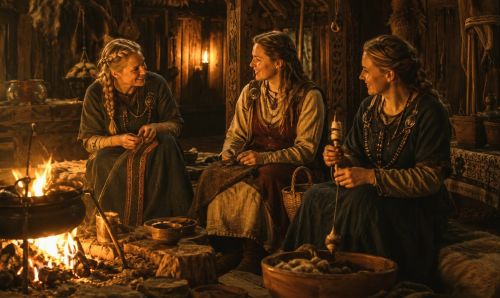
Textile work offers one of the clearest paths into this hidden social world. Wool had to be cleaned, combed, spun, dyed, woven, cut, sewn, repaired, and repurposed. Clothing, bedding, wall hangings, bags, straps, and eventually sails all depended on accumulated skill and long hours of repetitive labor. This work was economic, not ornamental. It required knowledge passed from woman to woman across generations, and it created social time: hours in which hands remained busy while stories, warnings, judgments, jokes, and memories moved through the room. A woman’s skill with fiber could strengthen her standing in the household, but textile production was rarely a solitary achievement. It depended on shared tools, shared instruction, and shared rhythms of labor. If friendship in the Viking world is difficult to see in formal political language, it becomes more visible when one looks at the work that placed women beside one another day after day.
Yet the household was not sealed off from the wider world. Marriage connected farms, redistributed women, moved property, created obligations, and sometimes placed young women far from the female kin among whom they had been raised. Women’s social space had to be rebuilt. A bride entering a new household needed allies among women who could interpret local expectations, household customs, neighborhood tensions, and the temperaments of men whose decisions affected her future. She needed to know which older woman held informal authority, which servant heard everything, which neighbor could be trusted, which grievance still lingered between households, and which gestures of respect mattered more than formal speech. Older women could become guides, rivals, protectors, or enforcers of household discipline. Sisters-in-law might become confidantes or competitors. Female neighbors could offer assistance that birth kin, now distant, could not provide. These relationships could decide whether a new wife gained confidence or remained exposed, whether she learned the household’s rhythms or stumbled into avoidable offense, whether she found companionship or merely endured surveillance. The making of friendship was bound to the making of place. Women did not simply enter households; they had to learn how to survive within them, and other women often determined whether that survival became lonely, dangerous, tolerable, or sustaining.
The period before the Viking Age provides the foundation for everything that follows. When Scandinavian expansion later carried people across seas and into new settlements, it did not create women’s networks from nothing. It stretched, disrupted, and reconfigured older patterns of household cooperation. Female friendship had already been formed through kinship, labor, proximity, instruction, childbirth, food security, and the management of shared space. Its grammar was practical because life was practical. It was emotional because dependence always carries feeling. It was political because households were the basic units through which property, honor, memory, and survival passed from one generation to the next. Before women’s friendships appeared indirectly in sagas, inscriptions, or settlement archaeology, they existed in the ordinary discipline of keeping households alive.
The Viking Age Household: Work, Trust, and the Making of Companionship

By the time Scandinavian expansion became visible across the North Atlantic, the British Isles, the Frankish world, the Baltic, and the river routes eastward, the household remained the basic unit through which Viking Age society organized survival. Ships might carry men into the chronicles of other peoples, but farms, halls, workshops, storehouses, and animal yards sustained the world from which those ships departed. Women’s friendships must be placed inside that household economy, not outside it. The Viking Age did not create a separate female sphere detached from politics and wealth. Rather, it made visible how deeply household production supported reputation, mobility, inheritance, hospitality, and social endurance. Women’s companionship grew from this world of repeated tasks, shared risks, and practical knowledge. Friendship was not merely what women felt after the work was done. It was often made through the work itself.
The household was a place of accumulation. Food had to be grown, harvested, preserved, guarded, distributed, and served according to status and occasion. Animals had to be milked, fed, bred, slaughtered, and protected through seasonal uncertainty. Clothing wore out. Bedding needed repair. Children required constant supervision. Visitors had to be received properly, because hospitality was never only kindness; it was a public statement of household competence and rank. In that environment, trust between women had real consequences. A woman who could be relied upon to remember stores, manage servants, notice illness, calm quarrels, prepare food, or protect household reputation was not merely useful. She became socially necessary. Companionship could emerge from this necessity because repeated dependence has an emotional weight of its own. The woman who knew when another was exhausted, grieving, pregnant, angry, afraid, or under scrutiny was already participating in a form of intimacy that the formal language of public alliance rarely preserved.
Textile production was one of the clearest settings in which this practical companionship took shape. Viking Age cloth was not an incidental household product. It clothed bodies, warmed beds, marked status, provisioned travel, decorated halls, served exchange economies, and, in the case of sailcloth, helped make maritime expansion possible. The work required many stages: preparing wool or other fibers, spinning thread, dyeing, weaving, sewing, mending, and adapting worn textiles for new uses. Each stage demanded knowledge that was learned by watching, correcting, repeating, and remembering, which meant that textile production linked women across age, rank, and generation. The older woman who knew the proper tension of thread, the skilled spinner whose hands could produce even yarn, the girl learning to handle tools without wasting material, and the household manager calculating what must be repaired before winter all belonged to the same economy of skill. Such labor demanded time, patience, discipline, and instruction. It also created a social rhythm in which women could speak while working, teach while correcting, and remember while repeating motions learned from earlier generations. A young woman’s entrance into this work was not just technical training. It was an initiation into the household’s memory, standards, expectations, and judgments. Through textile labor, friendship could form as apprenticeship, shared endurance, mutual recognition, and the quiet trust that grows when women spend hours beside one another turning raw material into the fabric of survival.
This does not mean that every shared task produced affection. The Viking Age household contained hierarchy as well as cooperation. Free wives, daughters, widows, servants, enslaved women, foster daughters, and concubines might work in close physical proximity without having equal power over their own bodies or futures. Enslaved women complicate any easy language of female solidarity. They could participate in the same labor systems that brought women together while also being deprived of choice, family security, sexual autonomy, and legal standing. A high-status woman might depend on the labor of an enslaved woman without recognizing her as a friend. Yet the presence of hierarchy does not make social contact meaningless. It means that companionship, resentment, dependence, protection, coercion, and intimacy could exist in unstable combinations. A serious history of female friendship must leave room for both tenderness and domination, because the household made both possible.
Food work created another layer of female social life. Preserving meat, processing dairy, baking, brewing, storing grain, and preparing meals were not small domestic details. They determined whether a household could survive winter, host guests, feed workers, support dependents, and maintain honor. In a world where scarcity, weather, illness, and travel could destabilize a farm, women’s knowledge of food was a kind of household intelligence. This knowledge was rarely abstract. It lived in timing, memory, smell, touch, and experience. Women learned from other women which stores would last, which animals were weakening, which child was not thriving, which guest required careful treatment, and which household tension might become dangerous. A woman who knew how to stretch supplies without advertising scarcity, how to preserve food before spoilage set in, how to serve guests without humiliating the household, or how to recognize illness before it became obvious held knowledge that was both practical and social. These were not merely culinary skills. They were forms of judgment that protected status, health, hospitality, and peace. Women’s companionship could be built through the ordinary intimacy of preparation and vigilance: working at the same hearth, sharing seasonal anxieties, remembering past shortages, laughing during repetitive labor, or silently recognizing when another woman carried more than her share. These forms of perception created bonds of trust because they were built from attention. To be a good companion was not only to offer comfort. It was to notice what mattered before crisis made it visible.
Women’s friendship also developed through the management of absence. Viking Age mobility meant that men could be away for raiding, trading, legal assemblies, seasonal work, military service, or settlement ventures. Their absence did not suspend household life. It intensified the responsibilities of those who remained. Women had to manage property, labor, animals, children, stores, neighbors, and reputation in conditions that could be uncertain or dangerous. Such management could rarely be done alone. A woman might rely on a sister, mother, daughter, daughter-in-law, servant, neighbor, or trusted widow for advice and assistance. These relationships did not always need formal names because their meaning was proven in action. Who came when a birth went badly? Who helped when livestock strayed or stores ran low? Who could be trusted with news of a husband’s absence, a debt, a pregnancy, a quarrel, or a threat? Friendship became visible in the answer to those questions.
The making of companionship was inseparable from information. Women’s daily movement through household and neighborhood spaces allowed them to gather, interpret, and transmit knowledge. This could include practical knowledge about weather, food, health, animals, tools, clothing, and childcare, but also social knowledge about marriages, rivalries, insults, desires, fears, and reputations. In male-centered sources, such communication can be dismissed as gossip or treated only when it affects feud, marriage, or honor. Yet gossip is often the contemptuous name given to informal intelligence when it circulates outside official power. For women with limited access to assemblies, weapons, and formal legal authority, information was a crucial resource. Female friendship could function as a trusted channel through which women tested rumors, sought counsel, protected one another, warned of danger, or shaped household decisions before men understood the full situation.
The Viking Age household made companionship through repetition. Women became necessary to one another not because they lived in a sentimental refuge from the harder world of law and violence, but because the household itself was one of the places where that harder world was managed. Work created nearness. Nearness created knowledge. Knowledge created trust, tension, dependence, and memory. Some relationships would have been affectionate and sustaining. Others would have been strained by rank, marriage politics, enslavement, jealousy, or obligation. Most probably lived somewhere between those extremes, as human relationships usually do. What matters is that women’s friendships were not marginal to Viking Age society. They were part of the everyday machinery through which households endured, wealth was maintained, children were raised, reputations were protected, and the wider ambitions of the Viking world became possible.
Men Away, Women Together: Estate Management, Absence, and Female Networks

The Viking Age is often narrated through movement: ships crossing the North Sea, traders following river routes eastward, raiders striking monasteries and towns, settlers carrying Scandinavian language and custom into Iceland, Greenland, the British Isles, and beyond. Yet every departure produced another story at home. Farms did not pause because men were abroad. Livestock still needed tending, food still needed storing, children still needed discipline, servants and enslaved people still needed supervision, debts still mattered, and neighbors still watched for weakness. The labor of continuity fell heavily on those who remained, and in many households that meant women whose work was expected precisely because it was indispensable. A voyage might be remembered in saga or chronicle because it ended in treasure, violence, settlement, or death, but the farm that sent the voyager out had to remain productive enough to absorb risk and meaningful enough to draw him back. Male absence sharpened rather than diminished women’s authority within the household. A woman who remained behind was not merely waiting for history to return. She was managing the conditions that allowed raiding, trading, migration, and political ambition to occur in the first place.
Estate management required more than endurance. It demanded judgment. A household mistress had to know the rhythms of animals, fields, food stores, tools, clothing, dependents, and local obligation. She had to decide when to conserve and when to spend, when to welcome and when to guard, when to trust a neighbor and when to treat friendliness as calculation. In many households, especially those of status or wealth, she also had to supervise workers whose loyalty could not be assumed. The keys associated with women in Viking Age material culture are often treated as symbols of domestic authority, and rightly so, but they should not be reduced to decorative tokens of feminine respectability. They suggest control over storage, access, provisioning, and the internal order of the household. Such authority was practical, visible, and socially legible, even when it remained bounded by patriarchal law and kinship expectations.
This authority did not mean solitude. A woman managing a farm during male absence needed other women because the household was never an island. Female networks helped distribute risk. A sister might help with children. A mother or older widow might advise on stores, servants, childbirth, illness, or household discipline. A daughter-in-law might become necessary in ways that softened earlier suspicion. Neighboring women could exchange labor during harvest, share information about weather and livestock, lend assistance during sickness, or warn of tension between families. These relationships were practical before they were sentimental, but practicality did not make them emotionally thin. The woman who arrived to help with a difficult birth, watched children during illness, lent labor at harvest, shared knowledge about dwindling stores, or quietly warned another household of danger was doing more than performing a neighborly courtesy. She was entering the fragile interior of another woman’s life. Such relationships could become friendships not because they were formally declared, but because repeated need tested them. In a world where winter, scarcity, injury, childbirth, and feud could all threaten survival, trust was measured by who appeared when help was needed and who could keep silence when speech was dangerous.
Absence also enlarged the importance of information. When men traveled, women often became guardians of household knowledge: what was owed, who had visited, which kin had behaved honorably, which neighbor had overstepped, which servant seemed unreliable, which child needed watching, which rumor might become a legal or social problem. This kind of knowledge moved most effectively through trusted relationships. A woman might not stand at the public assembly as a male litigant did, but she could shape what men later knew, suspected, feared, or chose to do. Female friendship, in this setting, operated as a channel of interpretation. News did not simply pass from mouth to ear. It was weighed, tested, softened, sharpened, and placed within memory. The woman who heard a rumor and knew whether to dismiss it, hide it, share it, or turn it into warning possessed a form of power that male-authored texts often noticed only after it had already changed events.
The emotional burden of absence should not be overlooked. Men’s departure could bring opportunity, but it could also bring fear. A husband, son, brother, or father might return wealthy, wounded, converted, dishonored, married elsewhere, enslaved, or not at all. Women left behind lived with uncertainty while still performing competence before others. Female friendship helped make that uncertainty bearable. Shared labor could become shared waiting. Women could speak to one another about worries that might be dangerous to reveal publicly: fear of poverty, resentment toward absent men, anger at in-laws, anxiety about pregnancy, suspicion of a neighbor, or dread that a household’s position would collapse. These forms of companionship were not separate from estate management. They were part of it. A woman who could keep another steady under pressure helped preserve not only emotional life, but also the outward discipline on which household honor depended.
Male absence made visible a paradox at the heart of Viking Age gender. Women’s formal power was constrained, but their practical responsibility could be immense. They guarded stores, supervised labor, raised children, managed reputation, interpreted danger, maintained alliances, and preserved the everyday continuity of farms and households. They did so not as isolated figures of heroic domesticity, but within networks of female reliance that stretched through kinship, neighborhood, marriage, service, and shared work. The Viking world celebrated ships, warriors, traders, and explorers, but those forms of movement rested on households that had to remain coherent in their absence. Women’s friendships were part of that coherence. They were the quiet infrastructure through which absence became survivable and return, when it came, still had a home to recognize.
Marriage, Affinity, and the Friendship of Women Joined by Men’s Alliances
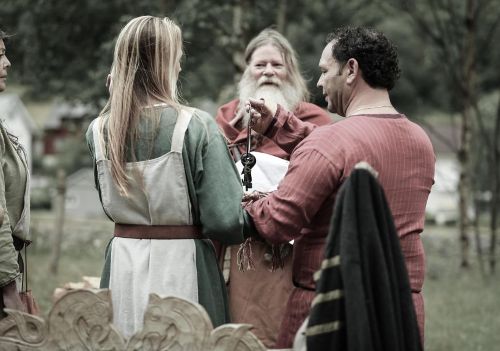
Marriage in the Viking world was never only a private union between two individuals. It joined households, redistributed property, created inheritance expectations, settled or deepened political relationships, and moved women into new social landscapes where their safety and influence depended on more than the formal agreement that had brought them there. A marriage might be negotiated by men, remembered through male genealogies, or interpreted through questions of alliance and honor, but its daily consequences were often borne by women. A bride did not simply acquire a husband. She entered another household’s habits, rivalries, memories, labor systems, and unspoken rules. If friendship emerged, it was rarely a free-floating emotional choice untouched by family strategy. It grew inside affinity, the kinship created by marriage, where obligation came first and affection, distrust, loyalty, or rivalry followed.
For a woman entering a new household, other women could determine whether marriage became survivable or isolating. A mother-in-law might instruct, scrutinize, protect, or dominate her. Sisters-in-law could become companions, rivals, interpreters, or informal judges of her conduct. Older widows and female kin might know the family’s buried grievances, property disputes, and expectations of honor better than any outsider could. Servants and enslaved women might understand the emotional weather of the household more accurately than its formal head. A young wife had to learn not only where things were kept or how work was divided, but whose anger mattered, whose silence was dangerous, whose favor could shield her, and whose memory of an old slight could still shape the present. She also had to learn how to speak, and when not to speak, inside a household whose relationships had begun long before her arrival. A careless word could be remembered. A failure of hospitality could be read as contempt. Too much loyalty to her birth family might be treated as disloyalty to her husband’s kin, while too quick an abandonment of her natal ties could leave her exposed if the marriage soured. Female friendship in this world was practical orientation. It helped a woman read the household into which marriage had placed her. The woman who explained a custom, softened an older relative’s displeasure, shared a warning, or simply made space for the bride’s uncertainty did more than offer kindness. She helped translate a new and dangerous social world into something survivable.
Affinity also created opportunities for deep companionship because women joined by men’s alliances often shared pressures that men did not fully see. Two sisters-in-law might be bound by the same household reputation, the same demands of hospitality, the same vulnerable children, or the same need to manage difficult husbands and fathers. A mother-in-law and daughter-in-law might begin in suspicion but grow into cooperation when illness, absence, childbirth, widowhood, or scarcity made mutual reliance unavoidable. Women’s bonds could also cross household lines through marriages linking neighboring farms or elite families. Feasts, visits, births, funerals, seasonal labor, and legal gatherings created opportunities for women joined by alliance to exchange information and build trust. Such friendships were not outside politics. They were one of the ways politics became livable at the domestic level.
Elite women occupied a particularly important place in this system because marriage could make them carriers of peace between powerful families. Their bodies, fertility, labor, and reputations were drawn into the work of alliance, but they were not merely passive tokens passed between men. A high-status woman could help stabilize a marriage alliance by cultivating bonds with women in her husband’s household, maintaining contact with women in her birth family, and serving as an interpreter between competing expectations. Her friendships could soften suspicion, keep lines of communication open, and prevent small insults from hardening into feud. Yet the same position could also expose her to danger. If relations between families deteriorated, she might be caught between loyalty to her birth kin and obligation to her marital household. Female friendship under such conditions could be a lifeline, but it could also become a field of pressure, surveillance, and divided allegiance.
The sagas preserve this problem in literary form, even though they must be read carefully as later medieval narratives rather than simple Viking Age reportage. They often show women moving through marriage, remarriage, widowhood, and kin obligation in ways that reveal how much emotional and social work affinity required. Women speak to one another in halls, at work, during visits, and around moments of courtship, grievance, and family strategy. These conversations matter because they locate women’s influence not only in spectacular acts of incitement or public defiance, but in the quieter interpretation of household life. A woman might read a marriage more accurately than the men who arranged it. She might recognize resentment before it became open conflict, understand the meaning of a delayed visit, remember an insult others wished to bury, or warn another woman that affection and alliance were not the same thing. These scenes do not always name friendship directly, but they show women testing loyalties, giving counsel, sharing memory, and interpreting the motives of men. When saga women confide in sisters, foster kin, female relatives, or women connected through marriage, the narratives expose a social truth that legal formulas alone cannot capture: marriage created networks among women whose cooperation or hostility could shape the fate of households. The literary record may heighten drama, but the social logic beneath it is plausible and revealing. Affinity made women live with the consequences of male alliance, and women’s friendships helped determine whether those alliances became durable bonds or brittle arrangements waiting for crisis.
Marriage made female friendship both possible and precarious. It placed women in contact with one another, but not always by choice. It offered companionship, instruction, protection, and influence, but also rivalry, hierarchy, suspicion, and coercion. To call these relationships “friendship” requires care, because some were chosen and others were forced by circumstance. Yet that is precisely why they matter. In the Viking world, friendship was not always born from freedom. Sometimes it emerged from the necessity of living inside arrangements made by others. Women joined by men’s alliances could transform obligation into trust, or they could expose the fragility of alliances that men imagined marriage had secured. In either case, the household peace promised by marriage depended not only on husbands, fathers, and brothers, but on the women who had to make kinship work after the bargain was complete.
Childbirth, Childcare, Fosterage, and the Intimacy of Women’s Knowledge
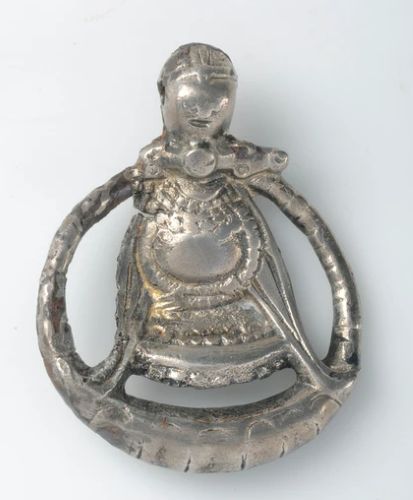
Childbirth and childcare made women’s knowledge intimate in ways that formal sources rarely describe with the fullness they deserve. The Viking Age household was not sustained only by fields, animals, cloth, food stores, and property. It was also sustained by the dangerous, recurring, and emotionally charged work of bringing children into the world and keeping them alive. Pregnancy, birth, nursing, infant illness, childhood injury, and maternal recovery placed women in situations where experience mattered more than public status. A young woman entering pregnancy needed the knowledge of women who had already endured it, witnessed it, or helped others survive it. Friendship could form through fear, bodily vulnerability, instruction, and presence. The woman who knew what to do during a difficult labor, who recognized danger in a mother’s weakness, or who understood the fragile signs of a failing infant held knowledge that could not be replaced by masculine honor, inheritance law, or public assembly speech.
This does not mean that all women shared the same reproductive life or that motherhood should be treated as the essence of womanhood. Some women did not bear children, some lost them, some raised the children of others, and some performed childcare under coercive conditions as servants or enslaved women. Others entered households where their value was measured cruelly by fertility, inheritance, and the production of legitimate heirs. The social importance of childbirth was inseparable from pressure. A wife’s pregnancy could strengthen her position, but repeated child loss or infertility could expose her to suspicion, disappointment, rivalry, or abandonment. A woman who bore sons might gain security in one household, while another who suffered miscarriages or infant deaths might experience the same reproductive world as accusation and grief. Even successful childbirth did not end vulnerability, because survival after birth required nursing, recovery, protection from illness, and the careful reintegration of mother and infant into household labor. Female companionship mattered precisely because these experiences could not be reduced to legal categories. Women needed other women not only for practical assistance, but for interpretation: what pain meant, what bleeding signaled, which remedies might help, when fear should be hidden, when help should be summoned, and how grief could be carried when a child did not survive. Female friendship was not simply emotional comfort surrounding reproduction. It was a shared interpretive knowledge of the body under social pressure.
The childbirth chamber, though only indirectly visible in the surviving evidence, may be imagined as one of the most intensely female social spaces in the Viking household. It gathered women around a body in crisis, and that gathering was both practical and emotional. Older women, female kin, servants, neighbors, or experienced attendants could become essential companions during labor. The intimacy of such a moment was not sentimental decoration. It was made by danger. Birth placed the mother between life and death, the infant between breath and silence, and the household between continuity and loss. In that setting, women’s trust in one another had immediate consequences. A woman might remember who supported her through labor for the rest of her life. She might also remember who failed her, who panicked, who judged, who comforted, who took command, or who later helped her reenter household life after exhaustion, injury, or bereavement. Such memories could deepen friendship far beyond ordinary cooperation.
Childcare extended that intimacy across years. Infants and children required feeding, washing, watching, soothing, discipline, protection, instruction, and integration into household routines. This labor was socially distributed. Mothers mattered, but they did not act alone. Grandmothers, aunts, older sisters, foster mothers, servants, enslaved women, and neighbors could all participate in the daily work of child survival. Women’s friendships could develop through this shared responsibility, especially when childcare intersected with food scarcity, illness, male absence, or seasonal labor. A woman who watched another’s child while she worked, nursed an infant in an emergency, recognized sickness before it became fatal, or comforted a grieving mother performed an act that blurred the boundary between practical help and emotional loyalty. Children created ties among women because they carried the future of households, but also because their vulnerability required constant collaboration. In a world of high risk, to care for another woman’s child was to enter the deepest territory of trust.
Fosterage added another layer to this network of care. In Norse society, fosterage could strengthen alliances, create obligations between households, and extend kinship beyond birth. Men might negotiate such arrangements as part of status, alliance, or patronage, but the daily work of fosterage belonged heavily to the household that received the child, and to the women who fed, clothed, instructed, comforted, and disciplined that child. A foster mother or female caregiver could become emotionally important in ways that legal or genealogical language does not fully capture. The child might represent an alliance between men, but the relationship became real through women’s labor. Fosterage also complicated female friendship because it could join women across households in durable forms of mutual obligation. A mother who entrusted her child to another household had to rely, directly or indirectly, on women she might not fully know. A woman raising another’s child might develop affection, resentment, pride, anxiety, or divided loyalty. Here again, friendship and obligation were not opposites. They grew around one another.
The sagas preserve traces of this world by repeatedly showing how childhood, fosterage, kinship, and household memory shape adult loyalties. Saga narratives often foreground male bonds created through fostering, sworn friendship, or shared upbringing, but beneath those visible relationships lies the labor of women who made childhood possible. Women remember births, marriages, humiliations, inheritances, and kin obligations. They tell stories that children absorb long before those children enter public conflict. They preserve the emotional history of households, including injuries that formal settlement may have closed but memory refused to release. A child might learn who had wronged the family not at an assembly, but from the speech of women around the hearth, loom, bed, or food table. That speech could be tender, cautionary, bitter, protective, or strategic. It could teach a child generosity toward kin, suspicion toward rivals, pride in ancestors, or shame over an unresolved wrong. Female friendship could shape memory itself. Women who trusted one another could exchange versions of the past, reinforce grievances, soften enmity, protect children from dangerous knowledge, or teach them whom to honor and whom to distrust. When women shared childcare, they also shared access to young minds, and that access carried power. Childcare was never merely biological reproduction. It was cultural reproduction.
Childbirth, childcare, and fosterage reveal female friendship as one of the quiet foundations of social continuity. These bonds were made in moments when life was most fragile: a dangerous labor, a hungry winter, a sick child, an absent father, a foster arrangement, a grieving mother, a household trying to preserve its future. They were not always equal, and they were not always gentle. Enslaved women and servants might care for children without receiving the security or recognition given to free mothers. Older women could support younger women, but they could also enforce the expectations that made reproductive life painful. Still, the intimacy of women’s knowledge mattered profoundly. It passed through hands, memory, warning, correction, comfort, and shared vigilance. If male friendship in Viking Age memory often appears in oath, feud, and alliance, female friendship can be found in the work of keeping bodies alive long enough for kinship, memory, and society to continue.
Women in Movement: Settlement, Migration, and Friendship Across the Viking Diaspora
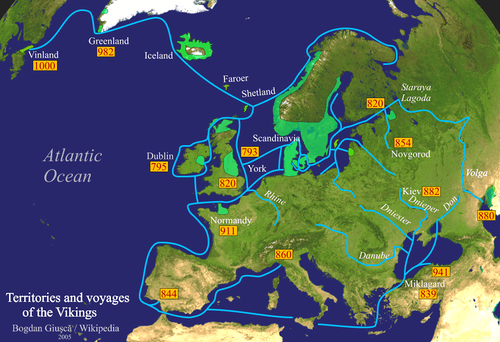
The Viking diaspora widened the world in which Scandinavian women lived, worked, married, remembered, and formed bonds with one another. Movement was not only the story of warriors, traders, ship crews, and ambitious men seeking wealth or land. It also involved women who crossed seas, entered new settlements, joined mixed households, managed farms in unfamiliar environments, and helped reproduce Norse social life far from its older Scandinavian centers. Some women migrated willingly as settlers, wives, daughters, widows, or household managers. Others moved under coercion, including enslaved women taken through raiding, trade, or domestic dependency. In every case, movement changed the conditions of female friendship. It broke some older networks apart, stretched others across distance, and forced women to build new forms of trust in landscapes where survival depended on cooperation.
Settlement placed women inside communities still being made. In Iceland, Greenland, the Faroe Islands, the British Isles, Ireland, Normandy, the Baltic, and the river corridors toward the east, Norse households did not simply transplant themselves unchanged. They adapted to climate, landholding patterns, available labor, local populations, food systems, religious change, and political pressure. Women were central to that adaptation because household life had to be rebuilt from the ground up. The first years of settlement could be especially precarious. Houses had to be established, animals tended, food secured, clothing produced, children protected, and relationships negotiated with neighbors who might be kin, rivals, strangers, or people from different cultural backgrounds. Even familiar tasks took on new urgency in unfamiliar places. A woman who knew how to preserve food in one climate might have to adjust to another. A household accustomed to one network of exchange might have to learn different rhythms of scarcity, storage, and dependence. Female friendship was not ornamental. It was a mechanism for turning settlement from geography into society. Women helped one another interpret new landscapes, build new routines, and decide which customs could be carried intact and which had to bend before the pressures of weather, distance, and unfamiliar neighbors.
Migration also intensified the emotional significance of women’s relationships because movement often meant separation from natal kin. A woman who crossed the sea to marry, settle, or follow a household might lose daily access to the mother, sisters, aunts, cousins, and familiar neighbors who had shaped her earlier life. The women around her in the new settlement mattered in urgent ways. A neighbor could become a substitute sister. A mother-in-law could become either a second mother or a source of fear. A fellow settler could share the memory of loss, homesickness, or dislocation. A servant or enslaved woman might be the only person who fully understood the daily stress inside a household, even if the relationship was unequal. The emotional cost of migration was not always dramatic enough to enter saga memory, but it would have been felt in daily absences: no familiar woman nearby during pregnancy, no childhood companion at the hearth, no trusted aunt to interpret a conflict, no mother to help a daughter endure a frightening birth or a difficult marriage. New female bonds could not simply replace those older attachments, but they could make dislocation survivable. In a diaspora setting, friendship could emerge from the recognition that women were not merely building farms. They were rebuilding the emotional map of kinship itself.
The North Atlantic settlements make this especially clear because survival there required disciplined cooperation. Iceland and Greenland were not empty stages for heroic independence. They were demanding environments in which weather, animal management, stored food, imported goods, and household coordination mattered profoundly. Women’s labor in dairy production, textile work, food preservation, clothing repair, and domestic management helped make these settlements viable. That labor also created social contact. Women visited, exchanged knowledge, borrowed skill, attended births, mourned losses, helped with seasonal tasks, and carried news between farms. Friendship may have been sharpened by isolation. Distance between households could make every trusted relationship more valuable, because assistance could not always be assumed and delay could be dangerous.
In the British Isles and Ireland, Scandinavian women entered more culturally mixed environments. Norse settlement and interaction brought Scandinavian, Gaelic, Anglo-Saxon, Pictish, and other communities into contact through marriage, trade, slavery, conversion, and political accommodation. Female friendship in these settings could cross cultural boundaries, but the terms of such relationships varied widely. Some women may have bonded through shared household labor despite linguistic, religious, or ethnic difference. Others may have been joined through marriage alliances that connected Norse and local elites. Still others were brought into households through captivity or enslavement, where proximity did not mean equality. These mixed settings complicate any simple picture of Viking women preserving a pure Scandinavian social world abroad. Diaspora women lived in contact zones. Their friendships, rivalries, dependencies, and loyalties were shaped by cultural exchange as much as by inherited Norse custom.
Movement also changed the meaning of memory. In a new settlement, women carried knowledge of older places: stories of families left behind, customs from another region, textile techniques, food habits, religious practices, songs, names, and warnings. Such knowledge could become a bond between women who shared an origin, but it could also become a gift offered to women who did not. A woman from Norway in Iceland, a woman of Gaelic background in a Norse household, or a woman taken from one region into another through slavery or marriage might preserve fragments of an earlier life in speech, craft, child naming, ritual, or memory. Female friendship could become one of the means by which such fragments survived. Women did not only transmit culture through formal teaching. They carried it in repeated gestures, recipes, stories, repairs, laments, jokes, and the small corrections by which one woman teaches another how things are done.
The saga tradition remembers migration through genealogy, land-taking, feud, conversion, and household formation, but beneath those themes lies the quieter problem of women adjusting to movement. Women in saga literature are often shown marrying across households, relocating, remembering family claims, and preserving the emotional consequences of earlier displacements. The narratives do not usually pause to analyze female friendship as a subject in itself, but they repeatedly place women in situations where new alliances must become livable. A woman who has moved into a new district must learn whom to trust. A widow must decide which kin network still protects her. A foster mother or female relative may become a bridge between households. A woman with memories of another place may become the keeper of grievances or loyalties that outlast the journey itself. Saga women are often dangerous to ignore precisely because they remember what others try to settle, compress, or forget. Their memories can preserve affection as well as injury, but in either case they reveal that movement did not erase the past. It carried the past into new households, where women’s speech could keep old attachments active and old wrongs morally alive. Migration, in the sagas as in life, made women interpreters of continuity.
The Viking diaspora reveals female friendship as both fragile and creative. It was fragile because migration could sever women from the familiar networks that had once protected them. It could place them in households where language, status, faith, or coercion limited trust. It could expose enslaved women and captives to violent displacement that should never be romanticized as cultural exchange. Yet it was creative because women made new networks under pressure. They turned neighboring farms into support systems, marriage alliances into working relationships, shared labor into companionship, and memory into cultural survival. Across the Viking world, women’s friendships helped convert movement into settlement. The ships may have carried people outward, but women’s bonds helped determine whether those scattered households became communities capable of lasting.
Friendship, Speech, and Confidence in the Sagas
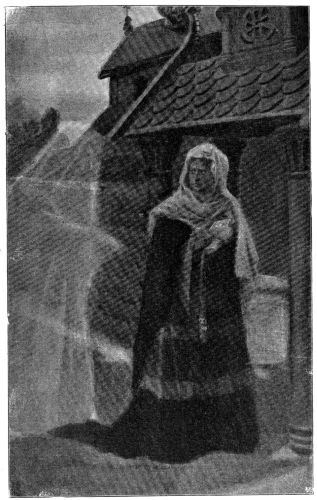
The Icelandic sagas preserve female friendship most clearly when women speak. This is also why they must be handled with caution. The sagas were written down largely in the thirteenth and fourteenth centuries, after the Viking Age, by authors shaped by Christian literacy, Icelandic legal memory, aristocratic genealogy, and literary convention. They do not give the historian direct transcripts of Viking Age women’s conversations. Yet they remain indispensable because they reveal the kinds of relationships, tensions, and speech acts that later medieval Icelanders considered plausible within remembered Norse society. Women in the sagas advise, warn, mourn, provoke, interpret dreams, judge marriages, remember injuries, and read household situations with unsettling precision. Their friendships and confidences often appear not as formal declarations, but as moments of speech exchanged in domestic, kinship, or crisis settings.
The problem is that saga narrative usually notices women’s speech when it matters to men’s public world. A woman’s confidence may be preserved because it touches marriage, inheritance, vengeance, feud, honor, or political reputation. Her everyday companionship with other women is rarely treated as an independent subject. This does not mean such companionship was absent. It means the literary frame selected for drama. A woman sewing with another woman, speaking in a hall, visiting a female relative, or recalling a youthful attachment might enter the story only when the conversation reveals danger, desire, resentment, or obligation. The ordinary conditions that made such speech possible often remain barely described: the repeated visits, the shared work, the knowledge of family temperament, the trust built through years of watching births, marriages, illnesses, and funerals unfold. Saga authors rarely stop to explain how one woman came to know another well enough to speak candidly, because that background familiarity was not the narrative point. Yet the very ease with which such confidences appear suggests an assumed social world beneath the text. Female friendship survives in the sagas as an interrupted record, glimpsed at the point where domestic confidence becomes narratively useful. The historian must resist both extremes: treating saga scenes as simple evidence of Viking Age life, or dismissing them so completely that their social imagination becomes invisible.
Saga women often understand household emotion before men act upon it. They notice disappointed love, concealed anger, unstable marriages, fragile alliances, and insults that others pretend to have settled. This makes female confidence a powerful narrative device. A woman may reveal to another woman what she cannot safely say in public. She may test a judgment, seek sympathy, rehearse a grievance, or ask whether her perception of events is shared. In these scenes, friendship is not merely emotional softness. It is interpretive collaboration. Women help one another read the world. They sort through what a gesture means, what a silence conceals, what a marriage has cost, what a man’s promise is worth, and what danger may follow from wounded pride. The confidence exchanged between women becomes a kind of social intelligence, one that the saga world often treats as dangerous precisely because it is accurate.
The sagas also show how women’s speech could preserve memory. A woman may remember an insult long after men have moved toward settlement, or she may keep alive the emotional meaning of a death that legal compensation has attempted to close. This memory work could bind women together. Shared recollection could become friendship, especially when women recognized the same injury or interpreted the same household history in similar ways. Yet it could also make women frightening figures in saga narrative, because memory resisted the convenience of forgetting. A woman who confides in another may be seeking comfort, but she may also be preserving the moral charge of an event. She may ask not simply, “What happened?” but “What must this mean now?” That question could transform memory into obligation. In a feud society, memory was not passive. It could become pressure. Female friendship, then, might provide a space where grief was named, humiliation was kept alive, and future action became imaginable. The emotional privacy of women’s speech could become one of the hidden stages on which public conflict was prepared, not because women were naturally vengeful, but because they often carried the wounds that formal settlement failed to satisfy.
Saga confidence could be tender. Not every conversation between women exists to sharpen vengeance or expose danger. Women also speak about love, marriage, youth, sorrow, and the ordinary burdens of life inside kinship systems they did not fully control. In Laxdæla saga, the emotional density surrounding Guðrún Ósvífsdóttir’s marriages, memories, and relationships reminds readers that women’s inner lives mattered, even when the narrative ultimately frames them through kinship and feud. Her recollections do not merely decorate the story. They reveal how memory, desire, regret, status, and social expectation could settle inside a woman’s life over many years. In Njáls saga, women’s speech frequently carries the weight of honor, grief, and accusation, but it also reveals how deeply households depended on women’s interpretation of events. Such conversations could hold tenderness and severity together. A woman might comfort another and still tell her the truth. She might sympathize with grief while refusing to let injury be softened into forgetfulness. These texts do not give us a rounded history of female friendship. They give us something more fragmentary and more revealing: scenes in which women know one another well enough to speak beneath the surface of public order. In those moments, friendship becomes the permission to say what the household already feels but cannot yet publicly admit.
Friendship in the sagas is most visible as confidence: the trusted exchange of perception, memory, warning, and grief. Its power lies in the fact that speech between women often occurs before public action, beneath public action, or after public settlement has failed to heal what was broken. Saga authors may not have set out to celebrate female friendship as a social institution, but their narratives repeatedly depend on women’s conversations to expose the emotional truth of households and kin groups. If male friendship in saga literature often appears as alliance, sworn loyalty, or political partnership, female friendship appears as the relationship that allows speech to become bearable and knowledge to become shared. The sagas do not let us hear every woman’s voice. But when they do let women speak to one another, they reveal a world in which trust could travel quietly through words before it altered the fate of families.
Feud, Vengeance, and Women’s Strategic Networks
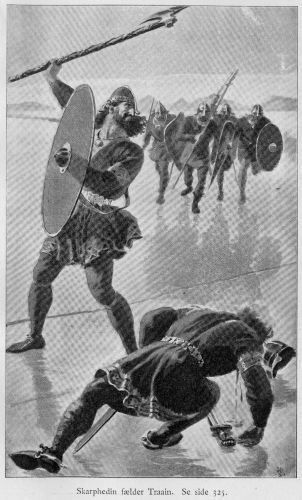
Feud was one of the social worlds in which women’s friendships and trusted networks became most consequential, even when women did not usually wield the same formal legal or martial authority as men. In saga literature and in the social memory it preserves, feud was not simply a sequence of male killings answered by male retaliation. It was a household crisis, a kinship crisis, and a memory crisis. Death, insult, humiliation, compensation, and vengeance moved through families before they moved through weapons. A killing altered more than the number of living men in a lineage. It changed the emotional climate of a household, the expectations placed on survivors, the value of public reputation, and the stories that would be told around hearths, beds, workrooms, and feasting benches. Women stood close to that process because they guarded the emotional meaning of injury. They mourned the dead, measured the adequacy of settlement, judged whether men had acted honorably, and sometimes refused to let a wrong be softened into convenience. Their position was not merely reactive. A woman who remembered the dead, interpreted the terms of compensation, or questioned a man’s willingness to act could shape the moral atmosphere in which feud decisions were made. Female friendship mattered here because grief and anger rarely remained solitary. They were spoken, shared, tested, repeated, and transformed into pressure through trusted relationships.
Women’s strategic networks in feud society were built from the same materials as their everyday friendships: kinship, marriage, neighboring households, shared work, fosterage, hospitality, and confidence. A woman who had married into one family but remained emotionally tied to another could become a carrier of information across kin lines. A sister, widow, foster mother, servant, or trusted neighbor might hear things before men did, or understand the emotional force of an insult before it became publicly actionable. These networks did not operate like formal councils, and they should not be romanticized as secret governments of women. Their power was subtler and more fragile. Women could observe, remember, warn, interpret, and persuade, but they often had to do so through speech directed at men who held the socially recognized capacity for violence, lawsuit, or compensation. Friendship among women could provide the first space in which a grievance found language before it became strategy.
The sagas often present women as inciters of vengeance, but that literary role needs careful handling. It is easy to reduce saga women to goaders who shame reluctant men into violence, yet such a reading flattens the moral world of feud. Women’s speech often arises from real injury: a slain husband, a dishonored brother, a violated kinship bond, an inadequate settlement, or a humiliation that male negotiators are willing to absorb because peace has become convenient. When a woman urges action, she may be demanding violence, but she may also be insisting that memory has ethical force. In a culture where honor, kinship, and public reputation were tightly bound, to forget too quickly could itself become a betrayal. Female friendship could sustain that refusal. Women who shared grief could remind one another that compensation did not always heal loss, and that legal closure did not necessarily mean moral closure.
Hildigunnr’s famous role in Njáls saga captures this dynamic with particular force. Her grief over Höskuldr’s killing is not merely private sorrow. It becomes a ritualized act of memory and accusation, intensified through objects, speech, and the demand that men recognize what has been done. Carol J. Clover’s reading of Hildigunnr’s lament remains important because it shows how women’s lamentation could function as a socially potent form of speech, not simply as emotional overflow. The lamenting woman names the wound, frames the obligations of the living, and exposes the inadequacy of passive grief. That kind of speech would not require a large public platform to matter. It required listeners who understood its force. Female friendship and female confidence could help prepare, echo, and preserve such speech, ensuring that injury did not disappear into the procedural language of settlement before its emotional weight had been felt.
Yet women’s strategic networks did not always push toward vengeance. They could also mediate, delay, warn, soften, or redirect conflict. A woman who understood the temper of two households might counsel caution. A mother might seek to preserve a son from reckless retaliation. A widow might accept settlement because further violence threatened children or property. Female friends could help one another weigh the costs of action, especially when the public language of honor made restraint difficult for men to perform without shame. This mediating role is harder to see because sagas naturally privilege dramatic escalation over quiet prevention. A feud avoided leaves fewer narrative traces than a feud inflamed. Still, the same networks that could keep grievances alive could also help contain them. Women’s friendship was strategic not because it always sought revenge, but because it helped interpret when vengeance, settlement, silence, or delay might best protect a household.
The gendered limits of women’s authority made these networks both powerful and precarious. A woman could speak with moral force, but her words might be dismissed as excessive grief, dangerous provocation, or domestic interference. She could shame a man into action, but she might not control the violence once unleashed. She could preserve memory, but memory could become a burden that trapped younger kin in obligations they did not choose. Female friendship in feud society carried risk. To share grievance was to create solidarity, but also to intensify expectation. To advise vengeance was to demand recognition, but also to expose others to death. To accept settlement was to seek survival, but also to risk being judged weak or disloyal. Women’s networks operated inside these contradictions, where moral clarity and practical danger often pressed against each other.
Feud reveals why female friendship in the Viking world cannot be confined to softness, sympathy, or household comfort. Women’s bonds could sustain tenderness, but they could also sharpen judgment, preserve anger, and turn memory into action. Trusted networks gave women ways to gather information, interpret insult, support grief, pressure kin, and influence the public consequences of private loss. They did not erase patriarchal limits, and they did not give women equal access to law or violence. But they mattered because no feud was fought only by the men who carried weapons. Before vengeance entered the field, it often passed through the hall, the bedchamber, the workroom, the mourning space, and the whispered confidence between women who understood that some wounds, once named, could not easily be put away.
Enslaved Women, Servants, and the Unequal Boundaries of Female Solidarity

Any account of female friendship in the Viking world must confront the fact that women’s proximity to one another did not automatically create solidarity. The household brought women together, but it did so through structures of rank, freedom, dependency, and coercion. A free household mistress, an unmarried daughter, a widowed kinswoman, a servant, an enslaved woman, a concubine, and a foster daughter might all inhabit overlapping domestic spaces, yet they did not inhabit the same social world. They could cook near the same hearth, work the same wool, tend the same children, preserve the same food, and sleep under the same roof while standing in profoundly different relationships to property, sexuality, law, punishment, mobility, and personal choice. Friendship was possible, but it was never innocent of hierarchy. To speak of women’s bonds without naming those inequalities would turn the household into a false refuge and mistake shared labor for shared power.
Enslaved women especially reveal the limits of easy language about female community. Viking Age slavery was not incidental to Scandinavian society. Captives could be taken in raids, traded across regions, inherited, exploited for labor, and absorbed into households where their bodies and futures were controlled by others. Enslaved women might perform the same domestic and textile labor that brought free women into daily companionship, but their presence in that labor system was not voluntary. They could be separated from kin, denied sexual autonomy, assigned intimate work without emotional security, and made responsible for children, food, clothing, animals, or household service without possessing the authority that such labor might give a free woman. A free woman could depend on an enslaved woman’s competence while still benefiting from her subordination. The two might know each other closely, perhaps even affectionately, but knowledge under coercion is not the same as equality.
Servants and lower-status free women occupied a different but still precarious position. They might possess more mobility or legal recognition than enslaved women, yet their survival could depend on pleasing household superiors, maintaining reputation, and navigating sexual, economic, or social vulnerability. A servant who became trusted by a household mistress might gain protection, status, or a kind of domestic intimacy. She might become a confidante because she was present when family members spoke carelessly, when children quarreled, when stores ran low, when illness struck, or when a marriage began to fail. Yet that trust could also be dangerous. The servant who knew too much could be blamed, dismissed, punished, or used as a messenger in conflicts she had little power to control. Her closeness to higher-status women might resemble friendship, but it remained shadowed by dependency.
The sagas often expose these inequalities even when they do not pause to analyze them. Lower-status women, enslaved women, concubines, and servants may appear as messengers, witnesses, sexual partners, fosterers, laborers, instigators, victims, or narrative instruments through whom elite households reveal their tensions. Their speech is more easily dismissed, their bodies more easily used, and their suffering more easily subordinated to the honor of others. Yet their presence matters because they show that the household’s emotional life was not made only by legally recognized wives and daughters. Information passed through women whose rank made them both visible and invisible: visible because they were always present, invisible because literary memory rarely treated their inner lives as worthy of full attention. The historian must read these figures carefully, not to invent friendships the sources do not prove, but to recognize how much female social life depended on women whom the sources often marginalize.
This unequal world also complicates the meaning of care. An enslaved or servant woman might nurse a child, attend a birth, prepare a dead body, comfort a frightened girl, keep a secret, or protect a household during absence. Such acts could create real emotional bonds. A child might love a caregiver whose legal status was inferior. A free woman might rely deeply on a servant whose judgment had been proven over years. Women in subordinate positions might also form friendships with one another, sharing grief, humor, resentment, practical knowledge, and strategies for survival beneath the authority of household superiors. These bonds may have been especially important because women without secure status often had fewer formal protections and greater need for informal support. A servant might warn another about a dangerous man in the household. An enslaved woman might share knowledge about food, illness, work expectations, or the moods of those with power over them. Two lower-status women might create small spaces of recognition inside a system that treated them primarily as labor. Yet even these relationships were shaped by risk, because trust could be punished if it looked like disobedience, conspiracy, theft, sexual impropriety, or divided loyalty. Care performed under constraint cannot be treated as simple affection. The same act could be intimate and coerced, generous and required, emotionally meaningful and structurally unequal. That tension is essential. Female solidarity existed, but it did not float above the social order. It was made inside it, sometimes against it, and sometimes painfully through it.
The unequal boundaries of female solidarity force a more honest understanding of friendship in the Viking world. Women’s relationships were shaped not only by gender but by status, freedom, age, marital position, kinship, wealth, and vulnerability. Shared womanhood did not erase domination. Shared labor did not guarantee trust. Shared suffering did not always produce alliance. Still, within those hard limits, women built relationships that could matter profoundly: alliances of survival among servants, wary cooperation between mistresses and dependents, affection between caregivers and children, practical trust across rank, and quiet forms of mutual recognition that the formal record rarely knew how to preserve. To study female friendship seriously is to keep both truths in view. Women needed one another, but they did not all need one another from the same position of power.
Conversion, Christianity, and New Forms of Female Community

The conversion of Scandinavia did not replace one women’s world with another overnight. It was uneven, regional, negotiated, and deeply entangled with kingship, trade, missionary activity, burial custom, marriage practice, and household authority. For women, Christianization changed the language through which community, memory, sexuality, kinship, and moral responsibility were understood, but it did not erase older patterns of female cooperation. Women still managed households, raised children, prepared food, produced textiles, preserved memory, attended births, mourned the dead, and navigated marriage alliances. What changed was the symbolic and institutional landscape around those acts. Female friendship, once embedded primarily in household, kinship, labor, and local ritual, gradually encountered new Christian frameworks of commemoration, piety, confession, charity, sponsorship, and spiritual kinship.
One of the most visible changes came through death and memory. Viking Age burial traditions had already allowed women to appear as socially meaningful figures through grave goods, placement, dress, and commemoration, but Christianization altered how the dead were remembered and where memory was located. Burial increasingly moved into churchyards. Runic monuments could carry Christian formulas, crosses, prayers, and commemorative language that tied family memory to salvation. Women appear in runic culture as sponsors and commemorated persons, reminding us that they were not merely passive recipients of religious change. They helped shape the public memory of kin. Female friendship is not usually named in such inscriptions, but the commemorative world matters because friendship and kinship both depend on memory. Women who raised stones, preserved names, arranged burial, prayed for the dead, or carried stories of the departed into Christian practice participated in a new moral economy of remembrance.
Christianity also reshaped marriage, and reshaped the female relationships created by marriage. Older Norse marriage customs had treated marriage as an alliance between families, households, and property interests. Christian teaching increasingly emphasized monogamy, prohibited certain degrees of kinship, condemned some sexual arrangements, and framed marriage as a moral and eventually sacramental institution. These changes did not instantly free women from patriarchal control, nor did they eliminate violence, concubinage, or coercive marriage practices. But they did introduce new standards through which women could judge household life and sexual conduct. A wife, widow, mother, or female relative might now draw on Christian language of sin, legitimacy, fidelity, and proper marriage when interpreting domestic conflict. Female friendship could become a space where women learned, debated, absorbed, resisted, or applied these new moral expectations. The household remained central, but the meanings attached to marriage began to shift.
The church also offered new forms of association beyond kinship, though slowly and unevenly. In the later medieval North, women could participate in devotional life through church attendance, patronage, prayer, almsgiving, memorial practice, and eventually religious communities. These developments belong partly after the Viking Age proper, but they matter because they show how conversion opened alternative forms of female belonging. A woman’s identity did not have to be defined only by birth kin, marital household, and reproductive role, even if those forces remained powerful. Christian piety could create bonds among women through shared ritual, shared mourning, shared saints, shared moral language, and shared obligations to the poor or the dead. It also created moments of contact that differed from ordinary household labor. Women might meet through church observance, burial rites, feast days, baptismal obligations, care for the sick, or the sponsorship of commemorative acts that linked family honor to Christian salvation. These settings did not remove rank or patriarchy, but they widened the social vocabulary available to women. A widow’s prayers, a mother’s vow, a donor’s memorial act, or a group of women gathered around death could become forms of community that were not reducible to marriage politics. Such bonds did not replace household friendships, but they could extend them. The woman beside another at prayer, at burial, or in the work of commemoration occupied a different kind of social space from the woman beside her at the loom, yet both settings could create trust.
Christianization introduced new constraints and new judgments. The church’s moral order could intensify scrutiny of women’s sexuality, fertility, widowhood, and household conduct. Female bodies became sites of theological concern: marriage, adultery, chastity, childbirth, and widowhood were increasingly interpreted through Christian moral categories. Women could use these categories, but they could also be disciplined by them. Female friendship under Christianity had a double edge. Women might support one another through confession, grief, widowhood, or marital difficulty, but they might also police one another’s conduct according to new standards of shame and respectability. A woman suspected of sexual misconduct, improper mourning, marital disobedience, or insufficient piety could find herself judged not only by clerics or male kin, but by other women whose approval mattered in the intimate world of household and parish. The same female network that offered advice could transmit accusation. The same neighbor who prayed with a woman could also measure her conduct against Christian expectation. A female relative’s counsel could become spiritual care, but it could also become pressure to endure, repent, submit, or conform. A neighbor’s counsel could become comfort or surveillance. A female relative’s piety could protect a woman or condemn her. As before, women’s bonds were not automatically liberating. They could sustain, discipline, protect, expose, and judge.
Saga literature, written in a Christian world looking back toward a partly pagan past, preserves this tension with particular complexity. Christian authors and audiences remembered women who moved between older honor cultures and newer moral languages. Some saga women are associated with prophetic dreams, pagan memory, lamentation, or fierce kinship loyalty, while others inhabit narratives shaped by Christian ideas of providence, restraint, confession, or spiritual consequence. This retrospective literary world does not simply show pagan women becoming Christian women. It shows memory itself being Christianized. Female friendship can carry layered meanings in the texts. A conversation between women may belong to a remembered feud society, but the written form may invite Christian reflection on pride, vengeance, suffering, or forgiveness. Women’s speech becomes one of the places where old and new moral orders meet.
Conversion, then, did not make female friendship more important by inventing it, nor did it make it less important by absorbing women into church structures. It redirected some of the forms through which women created community. The household remained the foundation of women’s daily relationships, but Christianization added new spaces of memory, new moral vocabularies, new forms of spiritual obligation, and eventually new institutions through which women could relate to one another. Some of these changes offered comfort, dignity, and expanded social meaning. Others imposed judgment and intensified control. The result was not a clean break from Viking Age female networks, but a transformation of their language and reach. Women continued to make one another’s lives survivable, but now some of that work could be spoken in the language of prayer, sin, salvation, charity, and Christian remembrance.
Memory, Literature, and the Male Archive: Why Female Friendship Is So Hard to See
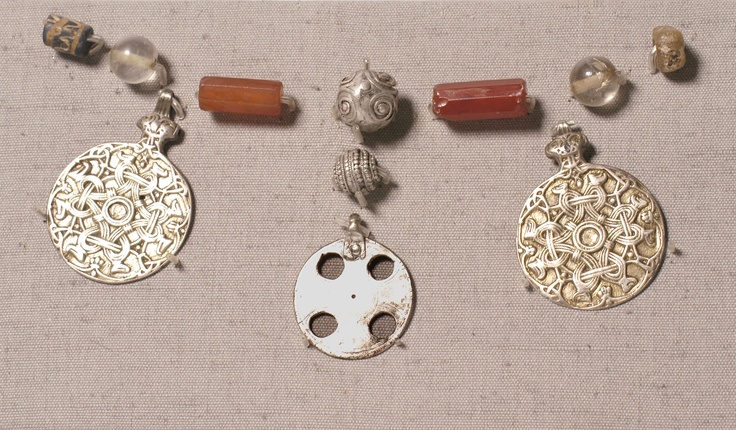
Female friendship in the Viking world is difficult to see not because women lacked bonds with one another, but because the surviving archive was not designed to preserve them. The evidence that reaches us was shaped by genre, literacy, status, religion, preservation, and the priorities of later writers. Archaeology preserves objects, bodies, houses, tools, ornaments, and landscapes, but rarely the emotional relationships that gave those things meaning. Law preserves rules, penalties, inheritance structures, marital arrangements, and social categories, but not the texture of confidence between women. Sagas preserve speech, memory, and domestic drama, but they do so through literary forms written down long after many of the events they claim to remember. The result is not a complete silence, but a patterned one. Women appear everywhere, yet their friendships often appear only where labor, kinship, marriage, feud, commemoration, or household crisis briefly make them visible.
The male archive did not necessarily deny that women’s relationships mattered. More often, it treated them as background conditions rather than subjects of historical explanation. Male friendship could be narrated as alliance, loyalty, lordship, sworn obligation, political strategy, or feud settlement because those forms of relationship aligned with the public action that medieval writers considered consequential. Female friendship, by contrast, was often embedded in the ordinary systems that made public action possible: raising children, keeping stores, managing textile production, attending births, preparing the dead, preserving memory, and interpreting household danger. These were not small matters, but they were easily naturalized as women’s work and left underdescribed. A saga might remember the quarrel that led to killing, but not the years of female conversation that taught a household how to understand that quarrel. A runic stone might name a woman as sponsor or commemorated kin, but not the friends who mourned with her, advised her, or helped preserve the dead person’s memory.
This problem is intensified by the nature of saga literature. The sagas are rich enough to tempt the historian into overconfidence and late enough to demand restraint. They give women voices, motives, judgments, dreams, accusations, griefs, and moments of startling authority, but those voices are mediated through later authors, Christian literary culture, and narrative conventions that prized feud, honor, genealogy, and moral consequence. Women’s friendships enter the saga world when they serve those narrative purposes. Confidence between women may be shown because it explains vengeance. Domestic conversation may appear because it reveals a marriage’s failure. A woman’s memory may matter because it keeps a feud alive. What disappears is the uneventful continuity of friendship: the daily exchange of help, affection, irritation, humor, and loyalty that did not lead directly to public crisis. The historian has to ask what kind of relationship must already exist for a woman to speak frankly to another, to seek her counsel, to trust her with grief, or to share a dangerous interpretation of household events. The saga may record only the charged moment, but that moment often assumes a deeper background of acquaintance, confidence, and shared social knowledge. Literature preserves what becomes narratively charged, not necessarily what was most common. Its silences are not empty spaces; they are signs of selection. They remind us that the archive is not a mirror of life, but a record of what certain writers, genres, and communities believed was worth carrying forward.
Archaeology offers a different kind of silence. It can show that women worked, traveled, managed households, wore distinctive objects, participated in burial traditions, and occupied meaningful social positions, but it cannot easily distinguish friendship from kinship, status, labor, ritual, or proximity. Two women buried in related contexts may suggest shared community, but not necessarily personal intimacy. Textile tools may reveal labor systems that brought women together, but not whether those women loved, resented, protected, or feared one another. Keys may suggest household authority, but not the trusted servant, sister-in-law, daughter, neighbor, or enslaved woman who helped that authority function. The material record is indispensable because it prevents the historian from relying only on male-authored texts, yet it also requires discipline. It allows us to reconstruct the conditions in which female friendship was likely to form, not to invent individual friendships where none can be proven.
Law and institutional memory create still another distortion. Legal texts tend to record women at moments of regulation: marriage, inheritance, property transfer, divorce, sexuality, illegitimacy, violence, compensation, and household status. They show what society tried to control. They are less capable of showing how women endured, negotiated, softened, resisted, or made meaning within those controls. A woman may appear in law as wife, widow, daughter, heir, concubine, enslaved person, or litigant, but friendship has no stable legal category. It becomes visible only indirectly, through the relationships that helped women navigate those roles. The absence of female friendship from law should not be mistaken for its absence from life. Law records power at its points of formal recognition. Friendship often works through informal recognition, through the person one trusts before speaking publicly, the woman one calls before a birth, the neighbor one warns before danger arrives, or the companion who remembers what official settlement has chosen to forget.
The historian must read the Viking world through a double discipline: refusing invention while refusing erasure. It would be irresponsible to turn every scene of women working together into evidence of friendship, or every female conversation into proof of emotional intimacy. But it would be equally irresponsible to accept the archive’s priorities as the boundaries of reality. Female friendship existed in the spaces where evidence is most fragmentary because those were also the spaces where much of women’s life unfolded: household, labor, childbirth, fosterage, marriage, mourning, memory, and neighborhood. The task is to reconstruct the social grammar that made such relationships necessary while remaining honest about what cannot be known. This requires a method that moves carefully between source types, allowing archaeology to show material conditions, sagas to reveal literary and social imagination, law to expose constraint, and runic commemoration to preserve public traces of memory. None of these sources alone can recover female friendship fully. They show why women’s bonds were likely central to the functioning of households and communities even when those bonds were not named as such. The male archive makes female friendship hard to see, but not impossible. Its traces remain in the work women shared, the speech literature preserved, the commemorations they sponsored, the children they raised, the conflicts they interpreted, and the households they helped hold together. To read for those traces is not to force modern sentiment onto the Viking world. It is to recognize that no society survives on formal institutions alone, and that some of its strongest bonds may be precisely those its record-keepers least thought to explain.
Conclusion: The Bonds the Sources Forgot to Name
Female friendship in the Viking world is difficult to recover because it rarely stands alone in the sources as a named institution. It appears instead through the work women shared, the households they sustained, the marriages they endured or stabilized, the children they raised, the griefs they carried, and the memories they refused to let disappear. This does not make it imaginary. It makes it historically embedded. The surviving record was better prepared to remember men’s alliances than women’s confidences, better trained to describe feud than the emotional labor that preceded it, and more likely to preserve public action than the daily bonds that made public action possible. Yet when the evidence is read across archaeology, saga literature, law, runic commemoration, and household history, a pattern emerges. Women’s relationships with one another were part of the practical structure of Viking Age life.
Those relationships were never simple. They could be affectionate, strategic, protective, coercive, unequal, or dangerous. A sister-in-law might become a confidante or a rival. A neighbor might be a lifeline during childbirth, illness, or male absence. A servant or enslaved woman might share intimate labor with a free woman while still living under dependency or force. A widow might rely on female kin to preserve her household’s standing. A foster mother might turn political alliance into lived attachment. A woman in a new settlement might find in another woman the emotional substitute for kin left behind. Friendship in this world was not always born from free choice, and it did not float above hierarchy. It often emerged inside obligation, proximity, danger, and need. That complexity does not weaken the subject. It gives it historical weight.
The central argument, then, is not that Viking Age women possessed a hidden sisterhood untouched by patriarchy. That would be too easy, and it would be false. The better argument is that women’s bonds were necessary precisely because the world around them was unstable, hierarchical, and often dangerous. Women needed one another to interpret households, manage labor, survive childbirth, preserve children, navigate marriage, endure migration, remember the dead, judge settlements, and decide when silence, warning, counsel, or pressure was required. Their friendships were not always visible because they were woven into the ordinary actions through which society reproduced itself. They were present where food was stored, cloth was made, children were watched, stories were told, grievances were remembered, and women tested the truth of what could not yet be said publicly.
The Viking world remembered men as friends when they swore loyalty, exchanged gifts, settled feuds, followed leaders, or died beside one another. Women’s friendships were more often remembered indirectly, if remembered at all. They belonged to the household rather than the battlefield, to memory rather than monument, to practical trust rather than public oath. But societies do not survive only through the relationships they choose to celebrate. They survive through the relationships that make daily life possible. The bonds the sources forgot to name were not marginal to the Viking world. They helped keep households coherent, settlements viable, children alive, memories active, and communities intelligible. To recover them is not to sentimentalize the past. It is to admit that the Viking Age, like every human age, depended on forms of trust its official stories did not always know how to honor.
Bibliography
- Abrams, Lesley. “The Conversion of the Danelaw.” In Vikings and the Danelaw: Select Papers from the Proceedings of the Thirteenth Viking Congress, edited by James Graham-Campbell, Richard Hall, Judith Jesch, and David N. Parsons, 31–44. Oxford: Oxbow Books, 2001.
- Barrett, James H., ed. Contact, Continuity, and Collapse: The Norse Colonization of the North Atlantic. Turnhout: Brepols, 2003.
- The Book of Settlements: Landnámabók. Translated by Hermann Pálsson and Paul Edwards. Winnipeg: University of Manitoba Press, 1972.
- Brink, Stefan, and Neil Price, eds. The Viking World. London: Routledge, 2008.
- Byock, Jesse L. Viking Age Iceland. London: Penguin Books, 2001.
- Clover, Carol J. “Hildigunnr’s Lament.” In Structure and Meaning in Old Norse Literature: New Approaches to Textual Analysis and Literary Criticism, edited by John Lindow, Lars Lönnroth, and Gerd Wolfgang Weber, 141–183. Odense: Odense University Press, 1986.
- —-. “Regardless of Sex: Men, Women, and Power in Early Northern Europe.” Speculum 68:2 (1993): 363–387.
- Clunies Ross, Margaret. The Cambridge Introduction to the Old Norse-Icelandic Saga. Cambridge: Cambridge University Press, 2010.
- Egil’s Saga. Translated by Bernard Scudder. In The Sagas of Icelanders: A Selection, edited by Örnólfur Thorsson. New York: Penguin, 2000.
- Fernstål, Lotta. “Spoken Words: Equality and Dynamics within a Group of Women Skalds in the Third Century AD, Skovgårde, Denmark.” World Archaeology 39:2 (2007), 263-280.
- Gisli Sursson’s Saga. Translated by Martin S. Regal. In The Sagas of Icelanders: A Selection, edited by Örnólfur Thorsson. New York: Penguin, 2000.
- Graham-Campbell, James. The Viking World. London: Frances Lincoln, 1980.
- Graham-Campbell, James, and Colleen E. Batey. Vikings in Scotland: An Archaeological Survey. Edinburgh: Edinburgh University Press, 1998.
- Jesch, Judith. Women in the Viking Age. Woodbridge: Boydell Press, 1991.
- Jochens, Jenny. Old Norse Images of Women. Philadelphia: University of Pennsylvania Press, 1996.
- —-. Women in Old Norse Society. Ithaca, NY: Cornell University Press, 1995.
- Karras, Ruth Mazo. Slavery and Society in Medieval Scandinavia. New Haven: Yale University Press, 1988.
- Larrington, Carolyne. The Norse Myths: A Guide to the Gods and Heroes. London: Thames & Hudson, 2017.
- Miller, William Ian. Bloodtaking and Peacemaking: Feud, Law, and Society in Saga Iceland. Chicago: University of Chicago Press, 1990.
- Nedkvitne, Arnved. Norse Greenland: Viking Peasants in the Arctic. London: Routledge, 2018.
- Njáls Saga. Translated by Robert Cook. London: Penguin Classics, 2001.
- Price, Neil. Children of Ash and Elm: A History of the Vikings. New York: Basic Books, 2020.
- Roesdahl, Else. The Vikings. Rev. Ed. London: Penguin, 1999.
- The Sagas of Icelanders: A Selection. Edited by Örnólfur Thorsson. New York: Penguin, 2000.
- The Saga of the People of Laxardal and Bolli Bollason’s Tale. Translated by Keneva Kunz. In The Sagas of Icelanders: A Selection, edited by Örnólfur Thorsson. New York: Penguin, 2000.
- Sanmark, Alexandra. Power and Conversion: A Comparative Study of Christianization in Scandinavia. Uppsala: Department of Archaeology and Ancient History, Uppsala University, 2004.
- Sawyer, Birgit. The Viking-Age Rune-Stones: Custom and Commemoration in Early Medieval Scandinavia. Oxford: Oxford University Press, 2000.
- Sawyer, Birgit, and Peter Sawyer. Medieval Scandinavia: From Conversion to Reformation, circa 800–1500. Minneapolis: University of Minnesota Press, 1993.
- Self, Kathleen M. “The Valkyrie’s Gender: Old Norse Shield-Maidens and Valkyries as a Third Gender.” Feminist Formations 26:1 (2014), 143-172.
- Smith, Michèle Hayeur. The Valkyries’ Loom: The Archaeology of Cloth Production and Female Power in the North Atlantic. Gainesville: University Press of Florida, 2020.
- Sørensen, Marie Louise Stig. “Gender, Material Culture, and Identity in the Viking Diaspora.” Viking and Medieval Scandinavia 5 (2009), 253-269.
- Van Deusen, Natalie M. “Sworn Sisterhood? On the (Near-) Absence of Female Friendship from the Íslendingasǫgur.” Scandinavian Studies 86:1 (2014), 52-71.
- Winroth, Anders. The Conversion of Scandinavia: Vikings, Merchants, and Missionaries in the Remaking of Northern Europe. New Haven: Yale University Press, 2012.
Originally published by Brewminate, 05.27.2026, under the terms of a Creative Commons Attribution-NonCommercial-NoDerivatives 4.0 International license.
About the Author