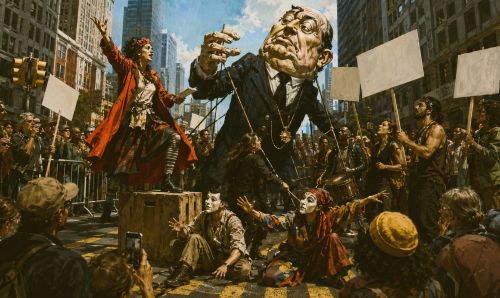
From Old Comedy to viral protest, street theater has used satire, spectacle, and interruption to make power publicly answerable.

By Matthew A. McIntosh
Public Historian
Brewminate
Introduction: The Street as Courtroom, Theater, and Public Square
Political theater begins wherever power is made visible enough to be mocked. Long before modern activists carried puppets through summit streets, staged mock sermons in corporate stores, or impersonated executives before cameras, public performance had already taught citizens that laughter could be a form of judgment. The stage, broadly understood, has never been confined to the formal theater. It can appear in the marketplace, the festival, the churchyard, the factory gate, the public park, the subway platform, the courtroom steps, or the plaza outside a seat of government. In those spaces, performance becomes something more dangerous than entertainment. It becomes a public act of accusation, a way of making authority answer before people who may never have been invited into official channels of power.
Modern guerrilla and street theater emerged with particular force in the political turbulence of the 1960s, but its deeper logic is older. Like ancient Greek Old Comedy, it uses ridicule, exaggeration, parody, bodily humor, direct address, and public familiarity to cut powerful figures down to civic size. Yet modern street theater also belongs to a different world, one shaped by mass media, police surveillance, racial struggle, war protest, anti-capitalist activism, decolonization, and later digital circulation. Its practitioners often reject the architecture of cultural respectability itself. Instead of asking audiences to buy tickets, sit quietly, and receive a finished artistic object, guerrilla theater interrupts ordinary life. It turns the passerby into a witness, the spectator into a participant, and the street into a temporary public square where political legitimacy can be challenged in real time.
I trace that modern tradition chronologically, while treating it as part of a longer history of performance as accountability. Ancient comedy provides one point of departure, not because contemporary activists simply imitate Aristophanes, but because Old Comedy reveals an enduring political grammar: rulers, generals, intellectuals, judges, merchants, and moralists become vulnerable when their claims to seriousness are exposed to public laughter. From that ancient civic theater, we move through older traditions of carnival, pageantry, agitprop, and popular satire before focusing on the radical performance cultures that took shape from the 1960s onward. The San Francisco Mime Troupe, the Diggers, Bread and Puppet Theater, El Teatro Campesino, Augusto Boal’s Invisible Theatre, anti-apartheid and anti-nuclear street performance, Reverend Billy and the Church of Stop Shopping, the giant puppets of the global justice movement, and the institutional pranks of The Yes Men all belong to this wider story. They differ in style, method, and ideology, but they share a conviction that politics should not be allowed to hide behind procedure, bureaucracy, spectacle, or professionalized speech.
The central argument is that guerrilla theater does not merely dramatize political dissent; it creates a public scene in which power can be seen, named, mocked, interrupted, and morally judged. Its accountability is not always legal or institutional. It cannot replace elections, journalism, courts, unions, or organized movements. Its force is more immediate and unstable. It produces embarrassment, recognition, solidarity, discomfort, and sometimes confrontation. It asks whether a society can still recognize injustice when injustice has learned to speak in respectable language. That is why the street matters. In the street, theater becomes less a building than a civic condition, less an art form than a democratic reflex. Power already performs itself every day through ceremony, policing, advertising, press conferences, architecture, and law. Guerrilla theater answers by performing back.
Ancient Precedent: Old Comedy and the Public Humiliation of Power
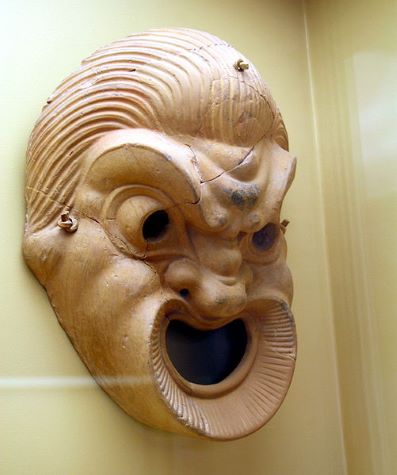
The most important ancient precedent for modern guerrilla theater is not a secret underground tradition, but one of the most public forms of performance in the classical world: Athenian Old Comedy. In fifth-century BCE Athens, comedy was not merely a recreational diversion attached to civic life. It was part of the ritual, competitive, and political culture of the city, staged before large audiences during festivals that gathered citizens into a shared space of judgment, laughter, recognition, and anxiety. The comic stage could make generals ridiculous, turn political leaders into grotesque bodies, mock intellectual fashion, ridicule legal obsession, and expose the contradictions of democratic self-rule. This did not make comedy a parliament, court, or assembly, but it did make it a public institution of humiliation. Power could be named, mimicked, sung about, anatomized, and laughed at before the people. In that sense, Old Comedy occupied a peculiar place within Athenian democracy. It did not legislate, command armies, issue verdicts, or conduct diplomacy, but it helped shape the civic atmosphere in which those acts were judged. It gave spectators a way to see public life as something constructed by language, ambition, fear, appetite, and performance. That insight is central to the later history of guerrilla theater, because street performance also begins from the assumption that authority is not only exercised; it is staged.
Old Comedy’s political force lay partly in its refusal of decorum. Its tools were song, dance, obscenity, parody, costume, masks, personal invective, fantasy, and direct address. It did not politely separate high politics from low bodily humor. On the contrary, it often collapsed them. Public men could be reduced to appetite, cowardice, greed, vanity, sexual absurdity, or rhetorical fraud. That collapse mattered because it stripped authority of the solemn distance on which authority often depends. A politician who could be turned into a comic type was no longer merely an officeholder or speaker in the assembly; he became a body among bodies, exposed to the laughter of those he sought to persuade, command, flatter, or deceive. The comic stage did not abolish hierarchy, but it made hierarchy unstable for the duration of performance.
Aristophanes’ surviving plays show how wide this field of comic accountability could be. The Knights attacks the demagogue Cleon through savage caricature and political allegory, presenting the Athenian people as a manipulable household master surrounded by corrupt flatterers. The Acharnians and Peace turn the misery of war into comic action by imagining private or fantastical exits from public catastrophe. Lysistrata transforms sexual abstinence into an antiwar strategy, using domestic and erotic comedy to expose the failures of male political leadership. The Clouds ridicules intellectual fashion, rhetoric, and sophistic education through the figure of Socrates, not as careful philosophical biography, but as a theatrical condensation of elite suspicion. These plays are not neutral historical reports, and they should never be treated as simple mirrors of Athenian opinion. Yet they reveal something essential about comic politics: satire works by turning public life into a scene where recognizable social forces can be exaggerated until their absurdity becomes visible.
The comparison to modern street theater becomes clearest in Old Comedy’s willingness to address the city as a city. Aristophanic comedy did not hide behind fictional remoteness. Even when its plots were wildly fantastical, its targets were close at hand: war policy, imperial ambition, jury culture, generational conflict, education, wealth, gender, and the manipulation of popular judgment. The parabasis, in which the chorus could address the audience more directly, made this civic dimension especially explicit. Comedy could step forward, comment on itself, instruct, boast, complain, accuse, and appeal. That directness made the audience more than a collection of amused spectators. It reminded them that they were also citizens, jurors, soldiers, litigants, householders, taxpayers, and participants in the political order being satirized. The joke did not remain sealed inside the fiction of the play. It returned to the city that had gathered to hear it. Modern guerrilla theater would later recover a comparable directness by leaving the enclosed theater and entering streets, parks, stores, and protest sites. The historical conditions were vastly different, but the theatrical principle was recognizably related: political performance becomes most dangerous when it refuses to let the audience remain detached from the public world being mocked.
The ancient precedent does not lie in an unbroken institutional chain from Aristophanes to the San Francisco Mime Troupe or Augusto Boal. It lies in a recurring democratic impulse: to use laughter as exposure, performance as confrontation, and public space as a place where authority can be made answerable. Old Comedy reminds us that ridicule has never been politically innocent. It can be cruel, conservative, emancipatory, reckless, clarifying, or distorted, sometimes all at once. Its power comes from its capacity to make public life physically and emotionally legible. Long before guerrilla performers carried oversized puppets into demonstrations or staged invisible scenes in restaurants and trains, Aristophanic comedy had already shown that public humiliation could function as a civic technology. It made power appear not as destiny, but as something performed, exaggerated, contested, and vulnerable.
Before the 1960s: Pageantry, Agitprop, Carnival, and the Long Politics of Public Performance
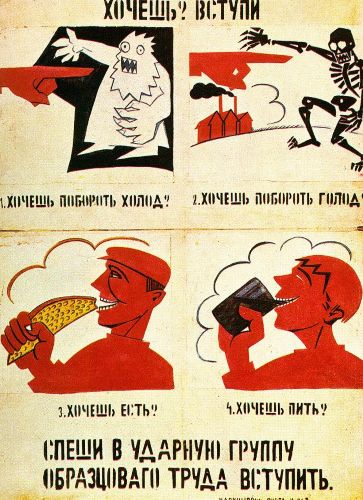
Modern guerrilla theater did not erupt from the 1960s as an entirely new invention. Its urgency belonged to that decade, but its techniques belonged to a much older politics of public performance. Long before American countercultural actors entered parks with satirical skits or antiwar puppeteers marched through city streets, popular performance had already taught communities how to turn public space into a theater of accusation, inversion, and collective memory. Processions, carnivals, religious dramas, marketplace farces, charivaris, pageants, strike performances, and revolutionary spectacles all carried political meanings even when they did not speak the modern language of activism. They worked because public performance gathers bodies into a shared scene. It gives grievance a visible shape, turns hierarchy into costume, and allows ordinary people to imagine authority as something that can be mocked rather than merely endured. The 1960s inherited that older grammar and radicalized it for a world of war, television, civil rights struggle, decolonization, and mass protest.
Carnival offers one of the most important premodern precedents because it made inversion public, physical, and communal. In the carnival square, solemn authority could be temporarily displaced by grotesque bodies, parody kings, mock rituals, unruly laughter, eating, drinking, sex, insult, and exaggeration. Mikhail Bakhtin’s influential reading of François Rabelais placed this festive culture at the center of a popular counterworld, one in which official seriousness was challenged by the material body and the laughter of the crowd. That interpretation has been debated, qualified, and sometimes criticized for romanticizing popular festivity, but its value here lies in the connection it draws between laughter and hierarchy. Carnival did not necessarily overthrow power. Often, it was licensed, seasonal, and contained. Yet even temporary inversion mattered because it revealed that social order was not natural, eternal, or immune to ridicule. It could be dressed up, turned upside down, exaggerated, degraded, and made strange before those who lived under it. This made carnival politically ambiguous, which is precisely why it became so enduring as a precedent. Authorities could tolerate it as a safety valve, a sanctioned interval after which hierarchy returned intact; participants could experience it as a rehearsal of other possibilities. The same scene could discipline and liberate, absorb unrest and sharpen it, trivialize rebellion and keep alive the memory that rulers were human, institutions were theatrical, and obedience depended on repeated performance. For modern street theater, that ambiguity would remain central. Guerrilla performance often operates in the same unstable territory, somewhere between permitted festivity and punishable disruption.
Early modern comic traditions carried this public grammar into more theatrical forms. Commedia dell’arte, with its stock characters, masks, lazzi, improvisation, servants, braggarts, pedants, lovers, fools, and tricksters, created a repertoire of social types that could travel across regions and adapt to local audiences. Its politics were rarely identical to modern protest, but its technique was deeply relevant to later guerrilla theater. It reduced social power to recognizable behavior: the greedy old man, the foolish master, the boasting soldier, the clever servant, the hungry body, the manipulative fraud. Farce and popular comic drama worked similarly, drawing laughter from the gap between social pretension and bodily exposure. These traditions trained audiences to read performance as a social language. A mask could condense a class position, a gesture could expose an institution, and an improvised joke could puncture the solemnity of those who claimed superiority.
The nineteenth and early twentieth centuries added new political pressures to this older repertoire. Industrialization, urbanization, labor organizing, nationalism, imperialism, and mass literacy created publics that could be reached through marches, songs, banners, tableaux, pageants, and street demonstrations. Labor movements used performance not merely to decorate protest but to make collective identity visible. Workers marched in formation, carried symbolic objects, staged allegorical scenes, sang political songs, and dramatized exploitation through public ritual. Suffrage movements, abolitionist memory cultures, socialist organizations, and anti-imperial campaigns also learned to use spectacle as persuasion. Pageantry could be conservative, patriotic, radical, or reformist, depending on who organized it and what past it chose to display. Its power came from scale and legibility. It could transform a political argument into a moving image, allowing crowds to see themselves as part of a cause larger than private suffering. This was especially important in a modern world where politics increasingly depended on publics that were too large to gather in a single deliberative body. Performance helped produce imagined communities by giving them visible form: the nation, the working class, the people, the oppressed, the betrayed citizenry, the militant future. A procession could make a cause look inevitable; a strike tableau could turn economic exploitation into a moral scene; a pageant could arrange history so that the present appeared as the fulfillment or betrayal of a collective destiny. Public performance became a way of organizing feeling as well as argument, converting scattered grievances into shared recognition.
After the Russian Revolution, agitprop sharpened the connection between performance, mobility, and political instruction. Soviet agitation and propaganda theater used short scenes, songs, slogans, choral speech, living newspapers, workers’ clubs, and traveling performance to bring revolutionary messages into factories, villages, barracks, and public gatherings. The Blue Blouse movement, one of the best-known examples, combined current events, satire, physical movement, and direct address in a portable theatrical form that could respond quickly to political developments. Its style was energetic, anti-illusionistic, and openly didactic. It did not ask audiences to forget they were watching theater. It asked them to recognize theater as a tool for organizing consciousness. Later guerrilla theater would reject many features of state propaganda, especially its discipline and ideological command, but it retained the lesson that performance could be mobile, topical, cheap, collective, and aimed at immediate public response.
By the middle of the twentieth century, then, the ingredients of guerrilla theater were already present, though not yet assembled under that name. Carnival had supplied inversion, grotesque laughter, and the temporary degradation of authority. Commedia and farce had supplied masks, types, improvisation, and social ridicule. Labor pageantry and reform spectacle had supplied collective visibility. Agitprop had supplied portability, topicality, direct address, and the fusion of performance with political education. These traditions differed sharply in context and purpose, and they should not be flattened into a single continuous lineage. Yet together they made the 1960s possible. When radical theater-makers later walked out of auditoriums and into streets, parks, campuses, stores, and protest sites, they were not abandoning theater’s history. They were recovering one of its oldest public functions: to make power appear before the crowd, stripped of inevitability, and available to judgment.
The 1960s Birth of American Guerrilla Theater: San Francisco Mime Troupe and the Politics of Leaving the Theater
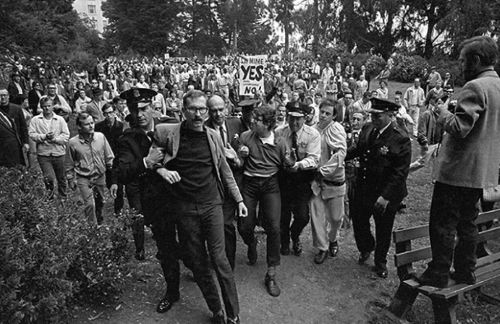
The San Francisco Mime Troupe occupies a central place in the modern history of American guerrilla theater because it turned a tactical dissatisfaction with conventional theater into a political method. Founded by R. G. Davis in 1959, the troupe emerged from avant-garde performance, commedia dell’arte, mime, satire, and the increasingly radical culture of San Francisco. Its later reputation rested not on withdrawal from politics, but on the opposite impulse: the insistence that theater should enter public life more directly, more cheaply, more dangerously, and with less deference to institutional permission. In that sense, the troupe’s importance lies not only in what it performed, but in where it chose to perform. By moving from lofts, basements, and enclosed artistic spaces into parks and open public settings, it challenged the social architecture of theater itself. The audience was no longer defined by ticket price, class habit, cultural credential, or willingness to enter a formal auditorium. It could be assembled from passersby, workers, students, countercultural wanderers, neighborhood residents, political organizers, and the simply curious.
That movement outdoors was not a decorative change of venue. It altered the political contract between performer and public. Conventional theater usually begins with consent: the audience agrees to enter a room, accept a frame, and watch a performance unfold at a scheduled time. Guerrilla theater weakens that agreement. It appears in a shared civic environment and asks public space to become theatrical without first being marked as such by architecture, ticketing, or institutional authority. For the San Francisco Mime Troupe, public parks became more than convenient stages. They became arguments. To perform freely in a park was to claim that culture belonged to the public, that political satire should not be restricted to those who could afford it, and that theatrical criticism of American power should occur within the everyday life of the city. This was especially significant in a decade shaped by civil rights struggle, the escalation of the Vietnam War, policing of dissent, countercultural experimentation, and mounting distrust of official language. The troupe’s outdoor performances challenged two hierarchies at once: the hierarchy of political authority and the hierarchy of cultural access. A park audience did not need to prove refinement before encountering satire. It did not need to accept the etiquette of silence, passivity, or distance that often governed respectable theater. The city itself became part of the performance, with its noise, interruptions, accidental witnesses, police presence, and unpredictable social mixture. That openness made the work less controllable, but also more politically honest, because democratic public life is never as orderly as a proscenium stage pretends.
The phrase “guerrilla theater” itself emerged from this world of tactical mobility and radical cultural ambition. Davis articulated the term in relation to the troupe’s practice, with Peter Berg closely associated with its naming and development. The language drew from guerrilla warfare, especially the idea that a small, mobile force could confront a larger power by choosing its own ground, refusing conventional battle, striking symbolically, and moving quickly. The metaphor was theatrical rather than military in any literal sense, but it mattered because it named an attitude toward power. Guerrilla theater would not wait for a state, university, foundation, critic, or theater board to authorize dissent. It would travel light, perform where audiences were already gathered or could be drawn, and treat cultural action as part of wider political struggle. The troupe’s practice fused avant-garde performance with a New Left impatience toward institutions that seemed complicit in war, racism, censorship, and bourgeois complacency.
The troupe’s use of commedia dell’arte was crucial because it gave radical politics a comic body. Commedia supplied masks, types, improvisation, repetition, appetite, cowardice, cunning, greed, and bodily exaggeration, all of which could be adapted to modern political satire. This made the San Francisco Mime Troupe’s work accessible without making it simple. The corrupt official, the pompous master, the servant who sees through power, the foolish authority figure, the opportunist, and the hungry body could all be translated into the idiom of American politics. That translation mattered because satire becomes politically potent when audiences recognize structures of power before they are named abstractly. A bureaucrat could be made ridiculous through posture. A capitalist could be exposed through appetite. A war advocate could be turned into a mask of absurd masculinity. In this respect, the troupe’s theatrical inheritance reached backward to older comic traditions while pointing forward to the more improvisational street politics of the late 1960s. The method also solved a practical problem for radical theater: how to make complex political critique legible in an immediate, noisy, public environment. A long theoretical argument about militarism, capitalism, or state authority might fail in a park, but a recognizable comic type could communicate almost instantly. The mask condensed analysis into image. Gesture carried ideology. Repetition made exploitation visible as habit. The audience could laugh before it agreed, and sometimes laughter itself opened the space in which agreement became possible.
The conflict over public performance became explicit in 1965, when Davis was arrested in Lafayette Park as the troupe attempted to perform Il Candelaio. The charge concerned performing without a park permit, but the deeper issue was whether public culture could exist without administrative permission. The arrest turned the troupe’s theory into an event. It demonstrated that leaving the theater did not simply make performance more democratic; it also exposed performance to policing. The park was public, but not neutral. It belonged to the people in principle and to regulation in practice. That contradiction sits at the heart of guerrilla theater. Public performance claims access to common space, but common space is already governed by law, permits, police authority, class expectations, and political fear. The San Francisco Mime Troupe’s confrontation with municipal power dramatized the very argument the troupe’s work had been making: theater in the street reveals how public the public sphere actually is. The arrest also clarified that censorship need not appear only as a ban on ideas. It can appear as procedure, scheduling, licensing, noise regulation, park management, or the bureaucratic demand that dissent first obtain permission from the authorities it intends to criticize. The permit dispute was not a side episode in the troupe’s history. It was part of the performance’s political meaning. The state did not merely watch guerrilla theater; it entered the drama by attempting to regulate the conditions under which public satire could occur.
The troupe’s political theater also differed from conventional propaganda because it was not only concerned with delivering a message. It sought to change the relation between performer, audience, and political consciousness. Its satire could be didactic, but its strongest work depended on immediacy, laughter, recognition, and the shock of seeing social authority stripped of polish. This made it especially suited to the 1960s, when many activists believed that established institutions had learned to absorb critique through respectable language while continuing destructive policies. Guerrilla theater answered respectability with unruliness. It brought art closer to demonstration, but also brought demonstration closer to art. The result was not merely theater about politics; it was theater as political behavior, a practice of appearing, speaking, mocking, risking arrest, and making contact with audiences outside the protected boundaries of cultural consumption.
The San Francisco Mime Troupe’s importance, then, lies in its conversion of theatrical form into civic tactic. It did not invent political performance, nor did it exhaust the possibilities of guerrilla theater, but it gave the American 1960s a language and model for performance as mobile public dissent. Its legacy can be seen in the Diggers’ “life-acting,” Bread and Puppet Theater’s pageantry, later street protest spectacle, and contemporary satirical interventions that refuse to stay inside approved venues. By leaving the theater, the troupe did not abandon theatrical seriousness. It recovered an older public function of comedy and performance: to confront power where people live, gather, argue, and pass by. The move outdoors made theater less protected, less polished, and less controllable. That was the point. Guerrilla theater was born not simply when actors performed political material, but when they understood the street itself as part of the script.
The Diggers and “Life-Acting”: When Performance Became Social Practice
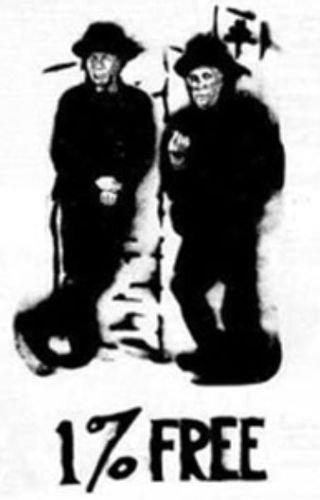
The Diggers carried guerrilla theater beyond the staged event and into the organization of everyday life. Emerging in San Francisco’s Haight-Ashbury district in the mid-1960s, they drew members and methods from the San Francisco Mime Troupe while pushing theatrical politics into a more radical register. The Mime Troupe had moved performance out of the auditorium and into the park; the Diggers asked whether performance could move still farther, into food distribution, neighborhood ritual, free stores, street games, anonymous manifestos, and temporary forms of communal life. Their name invoked the seventeenth-century English Diggers, who had challenged private property and imagined a world beyond buying and selling. The San Francisco group adapted that memory to a countercultural city shaped by war protest, psychedelia, poverty, police surveillance, racial tension, youth migration, and a growing sense that American consumer society had become both spiritually empty and politically violent. Their theater did not always announce itself as theater. It often appeared as a social fact that should not have existed: free food in a capitalist city, free goods without exchange, free medical care, free lodging, and public events that treated the street as a living stage.
The Diggers’ most important theatrical concept was “life-acting,” a phrase that captured their refusal to separate art from social practice. In conventional theater, actors perform roles inside an accepted frame; in life-acting, the frame expands until behavior itself becomes the performance. The point was not simply to pretend that another society existed, but to create fragments of that society in public, however briefly and precariously. A free meal in the Panhandle was not merely charity. It was a staged contradiction of the market. A Free Store was not simply a place where goods changed hands without money. It was an enacted argument against property, scarcity, and consumer identity. A public event such as the Death of Money or the Death of Hippie/Birth of Free was not reducible to spectacle, protest, or prank, because it was trying to make symbolic action and actual social reorganization meet in the same gesture. The Diggers made one of the decisive moves in the history of guerrilla performance: they turned the question from “What can theater say?” to “What can theater make temporarily real?”
This is why the Diggers matter in a discussion about political accountability. They did not usually hold named leaders accountable in the Aristophanic manner, nor did they simply satirize officeholders from a makeshift stage. Their target was broader and harder to personify: the everyday discipline of capitalism itself. They attacked the assumption that food, clothing, shelter, medicine, and social recognition must pass through price, ownership, branding, and exchange. They shifted guerrilla theater from ridicule of rulers to exposure of systems. The ordinary transaction became theatrical because the Diggers interrupted it. The shopper, the tourist, the hungry teenager, the merchant, the policeman, the journalist, and the drifting countercultural pilgrim could all find themselves inside an unannounced performance whose central question was brutally simple: why should life be organized this way? This was accountability without a courtroom, because the accused was not only a politician or corporation. It was the whole moral arrangement of scarcity in a society of abundance. That is what made the Diggers’ practice more radical than charity and stranger than protest theater. Charity can leave the structure of need untouched by offering relief within it; protest theater can denounce injustice while still remaining symbolic. The Diggers tried to collapse those distances. Their free meals did not merely feed bodies, though they did that too. They exposed hunger as a political condition in a city full of surplus. Their Free Store did not merely redistribute objects. It forced people to confront how deeply identity, desire, and self-worth had been trained by purchase. Their performances made capitalism appear not as an abstract economic system, but as a set of daily rituals that could be interrupted, mocked, refused, and briefly replaced.
The Diggers’ tactics also depended on anonymity, rumor, and the creation of myth. Their broadsides, street actions, and public rituals circulated through Haight-Ashbury not only as events but as stories about events. That mattered because the Diggers were operating inside a media environment that increasingly packaged the counterculture as lifestyle, tourism, and spectacle. Their resistance to fixed leadership and personal fame was political as well as aesthetic. To sign everything, own everything, explain everything, and become visible as celebrity activists would have been to surrender to the very logic they opposed. The Diggers instead cultivated a style of disappearance. They staged events, distributed texts, created conditions, and often refused stable authorship. This gave their work a strange power. It could seem less like an organization issuing commands than like an atmosphere moving through the neighborhood. Yet this also created limits. Anonymity could protect collective action, but it could also blur responsibility, mask internal hierarchy, and make it difficult to sustain institutions once the energy of spectacle faded.
Their relationship to the broader counterculture was equally tense. The Diggers helped create some of the most memorable forms associated with Haight-Ashbury, but they also attacked the commercialization of the “hippie” identity. As the district became a destination for journalists, tourists, runaways, entrepreneurs, and spiritual consumers, the Diggers saw the counterculture itself being absorbed into the market. The “Death of Hippie” ritual in 1967 symbolized that critique. It was not simply a denunciation of young people in beads and long hair; it was a funeral for a cultural image that had become profitable, manageable, and safe for consumption. Here again, performance became accountability. The Diggers staged a rebuke not only to mainstream America, but to the counterculture’s own susceptibility to branding. Their theater exposed how quickly dissent could become style, how quickly liberation could be sold back to those seeking it, and how easily rebellion could become another costume in the marketplace.
The Diggers mark a crucial expansion in the history of guerrilla theater. The San Francisco Mime Troupe had shown that political theater could leave the building; the Diggers showed that theater could become a temporary social system. Their free food, free stores, street events, manifestos, and life-acting did not solve poverty, end capitalism, or build a durable alternative city. They were fragile, improvised, contradictory, and often dependent on the same abundance they criticized. Yet their importance lies precisely in their refusal to let performance remain symbolic only. They insisted that political imagination had to be embodied, fed, clothed, staged, and tested in public. In that sense, the Diggers transformed guerrilla theater from a weapon of satire into a rehearsal of social possibility. Their work asked whether accountability might begin not only by mocking power, but by living, for a moment, as though power’s rules had already lost their authority.
Bread and Puppet Theater: Pageantry, Antiwar Moral Witness, and the Monumental Body
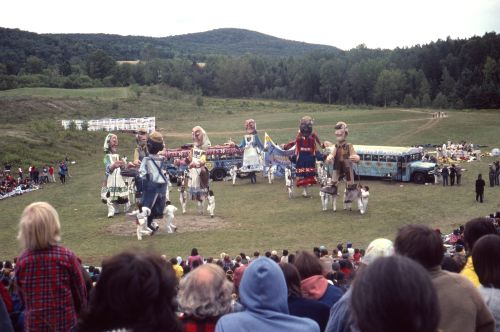
Bread and Puppet Theater gave guerrilla performance a monumental visual language. Founded by Peter Schumann in 1963 on New York City’s Lower East Side, the company began with neighborhood concerns as immediate as rents, rats, police, and children’s puppet shows, but it quickly developed a larger theatrical vocabulary in which sculpture, music, dance, language, procession, and public ritual worked together. Its puppets grew in size as its moral horizon widened. What began in local urban performance became one of the most recognizable forms of American political pageantry, especially during the Vietnam War, when Bread and Puppet’s processions and giant figures turned protest into a moving image of grief, accusation, and communal witness. If the San Francisco Mime Troupe made the park into a comic political stage, Bread and Puppet made the street into a procession of bodies too large to ignore.
The company’s power came partly from scale. Giant puppets do something that ordinary theatrical realism cannot do: they make systems visible as bodies. War can become a skull, empire a towering figure, hunger a hollow face, death a procession, and mourning a collective movement through space. This was not spectacle in the commercial sense, designed to overwhelm viewers into passive admiration. Bread and Puppet’s spectacle was rough, handmade, materially obvious, and morally insistent. Cardboard, cloth, papier-mâché, sticks, paint, masks, banners, and bodies remained visible as humble materials, reminding spectators that political imagination did not require institutional wealth or technical polish. The very crudeness of the objects was part of their argument. A puppet made by hand in public opposition to war carried a different political meaning from a polished stage effect produced for consumption. It declared that ordinary materials, like ordinary people, could be assembled into forms of judgment. Scale also changed the emotional register of protest. A giant puppet does not merely illustrate an idea; it alters the space around it. It slows the movement of a crowd, changes the horizon line of a street, and makes spectators look upward at forms that seem at once fragile and overwhelming. That tension between vulnerability and immensity was central to Bread and Puppet’s force. The puppets were visibly breakable, carried by human bodies, and dependent on collective labor, yet they gave moral injury a size that ordinary political speech often denied it. They made suffering appear larger than policy language allowed.
Bread and Puppet’s antiwar work mattered because it gave public dissent an image of sorrow as well as outrage. Much guerrilla theater depends on mockery, and Bread and Puppet certainly used satire, caricature, grotesque exaggeration, and ridicule. Yet its distinctive contribution was the fusion of accusation with lament. The Vietnam War was not only represented as a policy failure or imperial crime; it was staged as a wound in the moral body of the world. Processions of large figures, silent faces, skeletal forms, and communal movement allowed grief to enter protest without becoming private or sentimental. The dead and endangered could be represented not through documentary realism, but through figures whose size suggested that violence exceeded ordinary speech. Bread and Puppet’s pageantry created a public language for suffering that was neither bureaucratic nor merely rhetorical. It asked viewers to feel the weight of war before they argued about it.
The ritual dimension of Bread and Puppet was equally important. Schumann’s work did not treat political theater as a sequence of slogans interrupted by visual effects. It built events with processional movement, repetition, music, banners, masks, communal participation, and seasonal or sacred echoes. The distribution of bread to audiences was central to this theatrical world. Bread was not a prop added to a performance for quaint authenticity; it was a sign of sustenance, sharing, and anti-commercial community. The company’s own name joined puppetry to bread because art, in this vision, was not a luxury item for cultivated spectators. It was basic nourishment. By giving bread to audiences, Bread and Puppet made spectatorship bodily and communal. People did not simply watch political theater. They received, chewed, waited, gathered, and participated in a small economy of gift rather than purchase. That act connected the company’s antiwar and anti-capitalist sensibilities to a deeper moral claim: public art should feed the civic imagination as bread feeds the body.
Bread and Puppet also expanded the meaning of participation. Its performances often involved large numbers of people, including community members, volunteers, children, musicians, marchers, and puppeteers who animated objects collectively. The giant puppet is never fully individual. It requires many hands, coordinated movement, shared labor, and a willingness to disappear into the larger figure. That makes it an unusually apt form for political performance. It embodies collective action while representing collective injury or collective hope. A puppet head may appear as a single face, but its life depends on hidden cooperation. Bread and Puppet’s form matched its politics. The company’s pageants did not merely speak about community. They required community in order to exist. The audience saw not only images of resistance, but the labor of resistance made visible in procession, balance, scale, and motion. This participatory structure also challenged the hierarchy between artist and public. Bread and Puppet did not present political vision as the private property of a solitary genius, even though Schumann’s aesthetic was unmistakably central to the company’s identity. The work depended on workshops, volunteers, apprentices, local participants, and shared physical discipline. People learned by carrying, painting, singing, marching, building, and inhabiting forms larger than themselves. Political theater became a practice of collective embodiment. It asked participants to feel, in their own muscles, what it meant to sustain a public image of resistance.
The company’s later move to Vermont did not remove it from political life; it changed the ecology of its performance. Bread and Puppet’s work became associated with rural pageantry, outdoor gatherings, the Domestic Resurrection Circus, cheap art, printmaking, and a durable alternative institution that continued to address war, poverty, capitalism, state violence, and ecological crisis. This rural setting complicates any simple idea that guerrilla theater belongs only to dense urban streets. Bread and Puppet showed that public political performance could also inhabit fields, barns, roads, museums, fairs, and seasonal gatherings. It remained oppositional not because it always appeared in the middle of an urban confrontation, but because it preserved an anti-commercial, handmade, morally urgent theatrical practice outside the dominant circuits of cultural production. Its theater was at once archaic and contemporary, drawing on procession, ritual, folk art, and sacred imagery while responding to modern war and modern power. Vermont also allowed Bread and Puppet to cultivate duration, which is often difficult for guerrilla performance. Street interventions can be brilliant but fleeting, burning intensely and then disappearing into memory, rumor, or documentation. Bread and Puppet built a place where radical pageantry could recur, accumulate, teach, and archive itself through practice. The fields and barns did not replace the street; they extended it into a landscape of political rehearsal. Public dissent became seasonal, communal, and repeatable, not merely reactive to a single march or crisis.
Bread and Puppet’s place in the history of guerrilla theater rests on its transformation of political accountability into pageantry of the monumental body. It did not primarily make power answer through verbal debate or satirical impersonation, though those elements could appear. It made power answer by enlarging the consequences of power until they could no longer be politely minimized. The dead became processional. The hungry became visible. War acquired a face. The crowd became a moving chorus. This was accountability as moral enlargement, an insistence that public violence must be given public form. In that sense, Bread and Puppet stands beside Old Comedy, the San Francisco Mime Troupe, and the Diggers while also differing sharply from them. It shared their refusal of cultural enclosure, but it replaced quick comic exposure with a slower, heavier theatrical witness. Its giant figures did not merely decorate protest. They made protest impossible to see as small.
El Teatro Campesino and the Farmworker Stage: Labor, Satire, and Chicano Political Theater
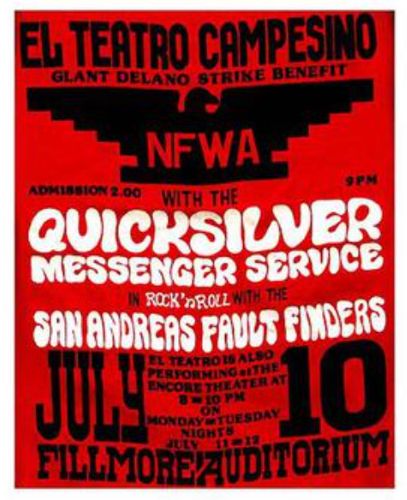
El Teatro Campesino expanded guerrilla theater by rooting it in labor struggle, Chicano identity, and the immediate demands of farmworker organizing. Founded by Luis Valdez in 1965 on the Delano grape strike picket lines, the company began not as a conventional repertory theater but as a theatrical arm of collective action. Its first audiences were not primarily urban bohemians, university students, or countercultural spectators, but farmworkers and their allies gathered around one of the most significant labor conflicts in modern American history. That origin matters because it shifts the center of guerrilla theater away from the image of the artist intervening in politics and toward the worker using performance as a practical instrument of struggle. El Teatro Campesino did not merely represent the farmworker movement. It helped organize, clarify, energize, and dramatize it. It exposed a blind spot in many accounts of the 1960s counterculture, which too often imagine radical performance through urban youth rebellion alone. The farmworker stage was different. It emerged from agricultural labor, racialized poverty, migrant precarity, strike discipline, Catholic symbolism, Mexican American community memory, and the daily bodily exhaustion of people whose work fed the nation while leaving them politically marginalized. Its theatrical urgency came from that contradiction. The field, the picket line, and the flatbed truck became stages because the formal institutions of American public life had rarely allowed farmworkers to appear as historical subjects in their own right.
The company’s earliest form was the acto, a short, direct, portable dramatic sketch designed for immediate recognition. Actos were often performed on flatbed trucks, picket lines, union halls, campuses, churches, and community spaces, using minimal scenery and highly legible characters. This was theater stripped down to its political essentials: a conflict, a social type, a moral exposure, and a call to collective understanding. The grower, the contractor, the strikebreaker, the worker, the patron, the union organizer, and the scab could appear not as psychologically complex individuals but as recognizable forces within a system of exploitation. That simplification was not artistic weakness. It was tactical compression. El Teatro Campesino needed a form that could travel quickly, speak to mixed audiences, survive rough conditions, and make labor politics intelligible without academic mediation.
Satire was central to this work because it allowed the company to expose power while sustaining the energy of resistance. The actos used caricature, bilingual humor, physical exaggeration, parody, and direct address to make the structures of agricultural capitalism visible. They mocked growers, labor contractors, racist assumptions, police intimidation, and internalized fear. But the satire was not aimed only at oppressors. It also challenged farmworkers to see themselves as political actors rather than isolated victims. Laughter became a means of demystification. A grower could be made ridiculous. A contractor could be exposed as a mediator of exploitation. A strikebreaker could be dramatized not simply as a villain, but as a symptom of economic pressure and divided consciousness. Through comedy, the audience could recognize both the cruelty of the system and the possibility of refusing it. That double movement made the humor politically valuable. If exploitation remained only tragic, it could reinforce despair; if it became only comic, it could lose its moral gravity. El Teatro Campesino worked in the tense space between those possibilities, using laughter to break fear without trivializing suffering. Satire allowed workers to look at the machinery of domination from a slight distance, to see its rituals, accents, excuses, gestures, and lies as theatrical performances rather than natural facts. Once power could be laughed at, it could also be named, resisted, and collectively answered.
El Teatro Campesino’s political theater was also inseparable from language. Its bilingual and bicultural performance style did not merely translate English ideas into Spanish or Spanish experience into English. It created a theatrical space in which Mexican American, Mexican, Indigenous, Catholic, working-class, and American political vocabularies could collide and recombine. Spanish, English, caló, farmworker idiom, union rhetoric, religious imagery, and popular comic traditions all helped shape the company’s style. This linguistic mixture mattered because farmworker exploitation was not only economic. It was also racial, cultural, and linguistic. Workers were often treated as disposable bodies whose language, memory, and dignity could be ignored. El Teatro Campesino answered by making those voices central to the performance. The stage became a place where the community could hear itself speak with force.
The company’s relation to the United Farm Workers was both practical and symbolic. The performances helped explain the strike, encourage solidarity, strengthen morale, and dramatize the logic of unionization. Yet they also did something deeper: they gave the farmworker struggle a public image of itself. Labor organizing often depends on transforming private hardship into collective identity. El Teatro Campesino helped make that transformation visible. The exploited worker became not simply a sufferer, but a protagonist. The picket line became not merely a site of protest, but a stage on which dignity could be performed before growers, police, journalists, supporters, and the workers themselves. The company’s theater did not stand beside the movement as commentary. It moved within the movement as one of its expressive organs.
As El Teatro Campesino developed, its work moved beyond immediate strike theater into broader Chicano cultural and political consciousness. Plays such as Los Vendidos satirized the commodification of Mexican American identity, exposing how Anglo institutions and Mexican American assimilation could both reduce people to marketable types. The company’s later development drew on myth, ritual, Indigenous memory, Catholic symbolism, corridos, popular comedy, and nationalist Chicano thought, especially as the Chicano Movement sought forms of cultural recovery and political self-definition. This expansion did not erase the company’s labor origins. Rather, it showed that farmworker exploitation belonged to a larger history of conquest, migration, racial hierarchy, language suppression, and cultural survival. The farmworker stage became a Chicano stage, and Chicano theater became one way of asking who had the right to define America’s public memory. That question was not abstract. Mexican Americans had long been represented through stereotypes of docility, criminality, servility, exoticism, or comic backwardness, while their labor and historical presence were made useful but politically invisible. El Teatro Campesino seized those stereotypes and turned them against the society that produced them. In Los Vendidos, the “models” of Mexican American identity become theatrical commodities, but the joke exposes the buyer, not merely the figures being sold. The play’s satire belongs to the same larger politics as the actos: it reveals identity itself as something power tries to manufacture, price, display, and control.
The company also complicates the history of guerrilla theater because it joined immediacy to institution-building. Many street performances burn brightly and vanish, leaving memory, photographs, or police records behind. El Teatro Campesino began in urgent improvisation but developed into a lasting theater company with national and international influence. That movement created opportunities and tensions. Greater visibility allowed the company to reach wider audiences, tour, publish, and help establish Chicano theater as a major field of American performance. But it also raised questions that haunt many radical artistic movements: what happens when a theater born on picket lines enters festivals, universities, and formal stages? Can a movement theater preserve its urgency after it becomes an institution? El Teatro Campesino’s history does not offer a simple answer, but it shows that guerrilla theater can mature without necessarily abandoning its founding wound.
El Teatro Campesino belongs at the center of any serious account of modern political street theater. It brought together satire, labor organizing, racial critique, bilingual performance, popular humor, and collective self-recognition. Like Old Comedy, it made social power ridiculous. Like the San Francisco Mime Troupe, it rejected the confinement of theater to elite venues. Like the Diggers, it treated performance as a way of remaking social relations in public. Yet its distinct contribution was to place farmworkers at the center of the stage, not as symbols of suffering created for outside sympathy, but as performers, witnesses, organizers, and makers of political meaning. El Teatro Campesino transformed the picket line into theater and theater into a weapon of dignity. Its accountability was grounded in the field, the strike, the body, the language, and the worker’s right to appear before the nation as fully human.
The Living Theatre, Happenings, and the Collapse of Actor and Audience
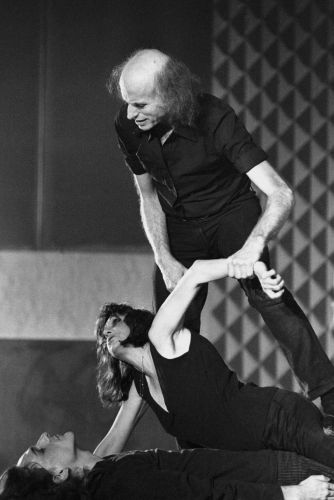
The Living Theatre and the broader world of happenings changed guerrilla performance by attacking one of theater’s most durable conventions: the separation between actors and audience. Founded in 1947 by Judith Malina and Julian Beck, The Living Theatre began before the 1960s, but its influence became especially important in the era of antiwar activism, sexual liberation, anarchist politics, and experimental performance. Its work rejected the theater as a space of passive consumption, asking instead whether performance could become a shared event in which spectators were morally, physically, and politically implicated. That question mattered deeply for the history of guerrilla theater. Once the audience was no longer safely outside the action, theater could become confrontation rather than representation. It could refuse the comfort of watching politics happen somewhere else.
The Living Theatre’s most famous late-1960s work, Paradise Now, pushed this logic toward ritualized participation. The production was not simply a play in the conventional sense, but a structured sequence of chants, physical actions, improvisations, provocations, and collective aspirations toward liberation. Performers confronted spectators, invited participation, attacked complacency, and imagined the dissolution of social repression through theatrical intensity. The work’s anarchist and pacifist politics were not merely spoken as content; they were embedded in the form itself. Hierarchy between stage and house, actor and audience, art and life, was treated as one more repressive structure to be challenged. The event could be exhilarating, irritating, coercive, embarrassing, or transformative depending on where one stood within it. That instability was central to its meaning. The spectator could no longer remain a protected observer because the performance made spectatorship itself politically suspect.
Happenings, associated above all with Allan Kaprow, offered a parallel attack on theatrical separation from the direction of visual art and everyday experience. Kaprow and others created events that blurred boundaries among painting, sculpture, music, dance, theater, environment, chance, and ordinary action. A happening might not have a conventional plot, stable characters, or a single privileged viewpoint. It might unfold in a gallery, loft, street, store, classroom, or outdoor space, asking participants to move, wait, listen, touch, carry, speak, or simply become aware of their own presence inside the event. The point was not to improve theater by adding novelty. It was to unsettle the category of art itself. Kaprow’s famous insistence that the line between art and life should remain fluid captured a broader impulse that would deeply shape guerrilla practice. If life could be treated as artistic material, then public behavior, social ritual, and political confrontation could all become theatrical without needing a conventional stage. This was especially important because happenings did not always announce a single meaning to be decoded. They often produced situations rather than messages, requiring participants to assemble significance from movement, timing, materials, space, and their own uncertainty. That uncertainty would become valuable for later political performance. A street action, a staged interruption, or a public prank could work not by explaining itself immediately, but by forcing people to ask what kind of event they had entered. In that moment of interpretive confusion, ordinary habits could become visible.
Richard Schechner’s environmental theater and the work of The Performance Group further developed this collapse of boundaries. Schechner’s formulation of the theatrical event as a set of transactions among performers, spectators, text, space, and environment helped theorize what radical performers were already testing. The room, the street, the bodies of the audience, the pathways of movement, the architecture, and the social expectations brought into the event all became part of the performance. Productions such as Dionysus in 69 did not simply retell an ancient text; they used physical proximity, ritual, nudity, participation, and confrontation to unsettle the spectator’s position. This mattered for political theater because authority often survives by controlling distance. Citizens watch officials, police, corporations, and media spectacles from assigned positions. Environmental and participatory performance challenged that arrangement by making distance unstable, forcing viewers to ask where they stood, what they permitted, and whether their passivity was itself a form of consent.
This collapse of actor and audience gave guerrilla theater a powerful but dangerous tool. It allowed performance to escape the safe frame of fiction and enter the ethical uncertainty of real encounter. A passerby drawn into street theater, a shopper interrupted by a satirical sermon, a restaurant patron witnessing Invisible Theatre, or a protest spectator surrounded by puppets and chants all occupy a position shaped by the experiments of the 1950s and 1960s avant-garde. The audience becomes part of the event, sometimes willingly and sometimes not. That is politically potent because it can reveal hidden habits of obedience, prejudice, fear, or complicity. But it also raises serious problems. Participation can become manipulation. Liberation can feel like coercion. A performance that claims to dissolve hierarchy may still impose the performer’s agenda on people who did not choose to enter the frame. The history of guerrilla theater inherits not only the avant-garde’s freedom, but also its ethical burden.
The Living Theatre, happenings, and environmental performance did not create guerrilla theater by themselves, nor were they always tied to clear political organizing. Some happenings were more concerned with perception, chance, and aesthetic experience than with direct protest. Some participatory theater risked mistaking intensity for transformation. Yet their contribution was decisive because they changed what performance could be understood to include. They made the audience active, the environment meaningful, the frame unstable, and the event inseparable from the social world around it. For later political performers, this opened a crucial path. If actors and spectators could no longer be cleanly divided, then public life itself could be staged as a field of responsibility. Guerrilla theater would take that lesson into streets, churches, stores, summits, and government spaces, where the question was no longer simply what the audience saw, but what the audience was now forced to do with having seen it. This legacy also complicates the meaning of accountability. In conventional political theater, accountability might be directed outward, toward a corrupt official, a violent state, or an exploitative institution. In participatory and environmental performance, accountability also turns back toward the spectator. What does it mean to watch and do nothing? What does it mean to laugh, refuse, join, recoil, or remain silent? The avant-garde did not always answer those questions responsibly, but it made them theatrically unavoidable. That is why its influence on guerrilla theater was so profound: it transformed the audience from a witness to a problem.
Augusto Boal and Invisible Theatre: The Public Who Did Not Know It Was an Audience
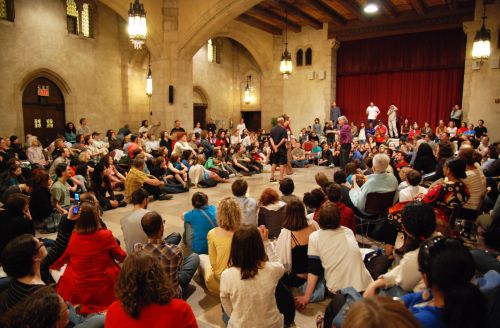
Augusto Boal gave guerrilla theater one of its most ethically provocative and politically influential forms: Invisible Theatre. A Brazilian dramatist, director, and theorist, Boal developed Theatre of the Oppressed as a set of practices meant to transform spectators from passive observers into “spect-actors,” people capable of analyzing oppression and rehearsing action against it. His work emerged from Latin American histories of dictatorship, censorship, poverty, class violence, and political education, and it was deeply shaped by the wider intellectual world of liberation pedagogy associated with Paulo Freire. Boal’s theater was not simply interactive in the shallow sense of inviting audience response. It asked whether theater could become a method for recognizing structures of oppression and testing possible responses before those structures hardened into resignation. In that sense, Boal extended the participatory ambitions of the avant-garde into a more explicitly political and pedagogical system. Where happenings and environmental theater often unsettled perception, space, and spectatorship, Boal pressed that instability toward social analysis. The point was not only to make audiences aware that they were watching differently, but to make them aware that they were living inside rehearsed patterns of domination. Theater became a tool for seeing those patterns, interrupting them, and imagining behavior that had not yet become socially permissible.
Invisible Theatre pushed that system into ordinary public life. In this form, actors rehearse a problematic social situation and then perform it in a public place without announcing that it is theater. A restaurant, street, subway, market, office, or waiting room becomes the stage; the people nearby become participants without knowing they have entered a performance. The goal is not to entertain them with a hidden prank, but to provoke genuine discussion about an oppression already present in everyday life. Because the event is not framed as theater, bystanders respond as citizens, customers, workers, witnesses, or neighbors rather than as protected spectators. The illusion is not designed to deceive them for amusement. It is designed to prevent the comforting distance that theater can create. Invisible Theatre makes the public confront itself before it has time to retreat into the safety of aesthetic judgment.
The famous example of the restaurant scene in Buenos Aires captures the method’s force. An actor eats a meal and then says he cannot pay the bill, offering instead to work off the debt. Other actors, placed among the patrons, introduce information about wages and labor, drawing real customers into an unplanned debate about money, work, dignity, and economic value. The issue is ordinary enough to be believable yet structured enough to reveal a system. The scene does not begin with a lecture on exploitation. It begins with a bill. It lets an everyday transaction expose the hidden assumptions behind wages, service, class, and worth. This was Boal’s genius: he found theatrical pressure points inside ordinary life, then staged them so that people who might never attend political theater could become politically activated in the middle of their routines. Invisible Theatre converted public space into a rehearsal room without ever calling it one. The restaurant mattered because it was already a miniature social order, complete with roles, expectations, money, labor, embarrassment, authority, and spectatorship. The waiter, the customer, the manager, and the bystander all occupied familiar positions, and the performance worked by making those positions suddenly unstable. Once the unpaid bill became a question about wages, the everyday ritual of eating out could no longer remain innocent. The people present were not asked to interpret a distant allegory. They were asked, without warning, to decide what justice looked like at the next table.
Yet Invisible Theatre also carries a serious ethical tension. Its power depends on withholding the theatrical frame from those who encounter it. The participants do not consent to being part of a performance, and they may experience embarrassment, anger, fear, or vulnerability without knowing the event has been constructed. Boal understood this danger, but he justified the method by arguing that the oppression being exposed was already real and that the performance merely intensified what daily life usually disguises. That defense is powerful but not complete. A theater that seeks liberation can still manipulate. A scene designed to awaken public conscience can still use people as material. For this reason, Invisible Theatre belongs to the most complicated branch of guerrilla performance. It asks whether democratic confrontation sometimes requires discomfort, but it also forces performers to ask who controls the terms of that discomfort.
Boal’s importance for modern street and guerrilla theater lies in his insistence that performance should not end with recognition. It should move toward action. Theatre of the Oppressed did not imagine the audience as a mass to be persuaded by superior artists, nor did it treat politics as a message delivered from the stage to the street. It understood oppression as something reproduced through habits, gestures, silences, fears, and rehearsed social roles. Invisible Theatre attacked those roles by interrupting them at the point of use. Boal joined the long history of public performance as accountability while also transforming it. Old Comedy mocked power before an audience; the San Francisco Mime Troupe brought satire into parks; the Diggers made social life itself performative; Bread and Puppet enlarged moral injury into pageantry. Boal added another crucial possibility: the public might already be inside the play, unaware that its daily responses were the very drama politics needed to expose.
Street Theater Against Apartheid, Nuclear Power, and State Violence
From the 1970s through the 1980s, street theater became an increasingly global language of public resistance. Its portability made it useful wherever formal political speech was censored, ignored, criminalized, or absorbed into official procedure. Anti-apartheid activists, anti-nuclear campaigners, community theater groups, feminist performers, peace movements, and artists confronting state violence all found in public performance a way to make danger visible before it could be hidden behind bureaucratic language. The street mattered because it was not only a location. It was a contested field of appearance. To perform there was to insist that power’s victims, critics, and witnesses had a right to be seen outside the permissions of state, party, corporation, university, or theater board. In this period, guerrilla and street theater became less a countercultural novelty than a practical grammar of survival, accusation, and solidarity.
Apartheid South Africa offers one of the clearest examples of political theater developing under conditions of censorship, surveillance, and racialized state violence. Oppositional performance there did not exist only in conventional theaters, though institutions such as the Market Theatre became important spaces for anti-apartheid drama. It also developed through township performance, community theater, church gatherings, worker culture, student protest, music, dance, oral storytelling, and public ritual. Under apartheid, the division of space was itself political: who could live where, move where, gather where, speak where, and be visible where. Performance carried unusual force because it could temporarily assemble a public that apartheid law was designed to fragment. A play, procession, song, or street scene could name what the state tried to normalize: dispossession, pass laws, police terror, forced removals, racial humiliation, and the militarization of everyday life.
The declaration of states of emergency in the mid-1980s sharpened that political atmosphere. South African History Online notes that the apartheid government’s 1985 State of Emergency involved intensified policing, restrictions on media coverage, curfews, movement controls, and pressure on organizational life. Public performance became both riskier and more necessary. It could communicate through indirection, allegory, satire, song, gesture, and communal recognition when open political speech invited repression. Theatricality helped expose the state’s own performance of order. Police uniforms, checkpoints, raids, identity documents, courtroom procedures, military parades, and official broadcasts were themselves spectacles of power. Anti-apartheid street and community theater answered those spectacles by staging counter-images: the people gathered, the dispossessed speaking, the absurdity of racial rule made visible, and the suffering body refusing to remain silent. The performance did not merely describe oppression. It occupied space against the state’s attempt to choreograph public life.
Anti-nuclear street theater in Europe and North America emerged from a different political geography but a similar problem of visibility. Nuclear weapons and nuclear energy were abstract, technical, distant, and often shielded by official expertise. They were discussed through megatonnage, deterrence theory, strategic balance, civil defense planning, reactor safety, and national security language that could make annihilation sound administrative. Street theater attacked that abstraction. Performers used skeletons, death masks, mock funerals, mushroom-cloud imagery, die-ins, clowning, processions, banners, and satirical military rituals to return the nuclear question to the human body. The anti-nuclear movement’s theatricality was not incidental decoration. It made invisible risk visible. It translated policy into mortality. It asked publics to imagine not only what governments said about security, but what bodies would endure if that security failed.
The peace and anti-nuclear movements also showed how street performance could organize emotion across large publics. A march or rally could include speeches, but theatrical elements gave participants images through which fear, grief, anger, absurdity, and hope could be shared. Performers and Artists for Nuclear Disarmament, community arts groups, and local protest collectives treated performance as a way to broaden the peace movement’s reach beyond policy specialists and activists already fluent in disarmament language. Theatrical protest could speak to children, workers, clergy, students, parents, and passersby because it did not require technical expertise to understand a body lying down as if dead, a puppet of war devouring the world, or a clownish general celebrating catastrophe. This accessibility sometimes led critics to dismiss such performance as simplistic, but that criticism misses the point. Street theater’s task was not to replace strategic analysis. It was to break the emotional numbness that strategic language often produced.
Across these movements, street theater’s political value lay in its ability to confront state violence at the level of public perception. Apartheid, nuclear militarism, police repression, and bureaucratic power all depended partly on making violence appear normal, remote, necessary, technical, or invisible. Performance interfered with that work. It put bodies where power preferred documents, laughter where power preferred obedience, mourning where power preferred statistics, and spectacle where power preferred secrecy. Yet the method remained vulnerable. Street theater could be policed, ridiculed, commodified, misunderstood, or reduced to image without consequence. Its victories were rarely immediate or measurable. Still, it gave movements a way to make public reality emotionally and morally legible. In that sense, the street theater of the 1970s and 1980s continued the deeper tradition: when official institutions failed to hold power accountable, performance created a temporary public in which power could be seen, judged, and refused.
Culture Jamming and Corporate Space: Reverend Billy and the Church of Stop Shopping
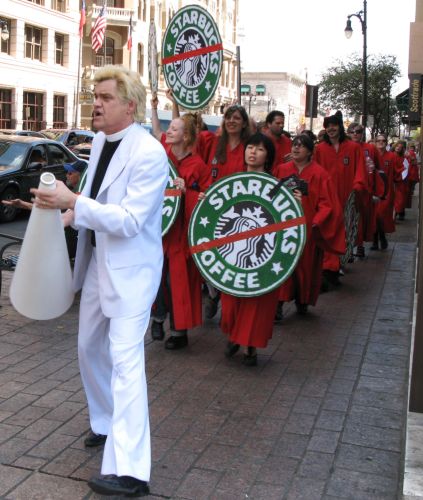
Reverend Billy and the Church of Stop Shopping carried guerrilla performance into the corporate interiors of late capitalist life. If earlier street theater had occupied parks, picket lines, plazas, and protest marches, Reverend Billy entered stores, banks, lobbies, research facilities, sidewalks, and branded spaces where consumer culture performed its own rituals of desire. Created by actor and performance artist Bill Talen, with Savitri D as a central collaborator, director, and organizer, Reverend Billy used the recognizable form of the revival preacher to attack shopping, corporate power, ecological destruction, gentrification, and the spiritual habits of consumer capitalism. The point was not simply to parody religion from the outside. The performance used religious style because American consumer culture already behaved liturgically: it had temples, offerings, hymns, saints, rituals, promises of salvation, and rules of belonging. Reverend Billy’s white suit, clerical collar, shouted sermons, choir responses, comic exorcisms, and “Earthalujah” language made the shopping environment strange by revealing how much belief it already demanded.
This was culture jamming in a specifically theatrical form. Culture jamming interrupts dominant messages by rerouting their signs, exposing their contradictions, and turning the language of power against itself. Reverend Billy did not simply stand outside a corporation with a placard. He entered corporate space and treated it as a church whose theology had to be challenged from within. Disney stores, Starbucks locations, Walmart, JPMorgan Chase branches, Monsanto offices, and other corporate targets became stages where the polished choreography of consumption could be broken by song, sermon, absurdity, and moral accusation. This mattered because corporate power often hides in the ordinariness of transaction. A store appears neutral. A bank appears procedural. A brand appears friendly. A purchase appears private. Reverend Billy’s interventions made those spaces public again. They turned shopping into a scene of judgment by asking what kinds of labor, land, debt, extraction, surveillance, desire, and ecological damage were being disguised by the smooth surface of consumer experience. The intervention worked because it used the corporation’s own environment as evidence. Fluorescent aisles, counters, logos, uniforms, security cameras, product displays, and checkout lines became part of the performance, not merely its backdrop. In that sense, Reverend Billy’s theater was site-specific political critique. It did not need to build a fictional world to expose power. The world had already been built by the corporation, arranged to guide feeling, movement, attention, and obedience. The performance simply interrupted that arrangement long enough for spectators to notice it. Culture jamming here became a form of theatrical trespass, not only across physical thresholds, but across the invisible boundary that tells consumers not to ask moral questions inside a place designed for buying.
The Church of Stop Shopping also reworked the relationship between satire and sincerity. Its performances are funny, deliberately excessive, and often ridiculous, but they are not merely ironic. The group’s anti-consumerist critique has increasingly become an ecological critique, framed through what it calls Earth Justice. That evolution matters because it moves the performance beyond a narrow moralism about individual shopping choices. Reverend Billy does not simply scold consumers for buying things. The performance exposes consumerism as a system that organizes attention, land, labor, climate, neighborhood life, and spiritual longing. The choir is crucial here. A lone street preacher might appear as an eccentric scold, but a singing community transforms rebuke into ritual. The call-and-response form creates a temporary congregation, even among people who do not share religious belief. In that moment, spectators are not asked only to agree with a political message. They are invited, amused, irritated, or startled into experiencing anti-consumerism as public feeling.
Corporate space is especially important because it changes the risk and meaning of public performance. A sidewalk or plaza may be publicly accessible, but a store or bank is a managed environment designed to produce predictable behavior. Customers browse, employees assist, security watches, music softens the air, products glow under controlled lighting, and the brand defines the emotional atmosphere. Reverend Billy’s actions interrupt that choreography. They expose how little spontaneity corporate space permits, and how quickly private security or police can appear when the ritual of consumption is disturbed. The New Yorker’s account of Talen’s performances emphasizes this attraction to spaces designed for other purposes, where surprise, uncertainty, and arrest become part of the theatrical stakes. The arrest risk is not incidental. It reveals that shopping spaces are not merely commercial. They are governed stages where certain performances, especially purchase, obedience, and brand loyalty, are welcomed, while other performances are treated as disorder.
Reverend Billy and the Church of Stop Shopping belong within the larger history of guerrilla theater because they make corporate power answerable through parody, ritual, and spatial trespass. Their work inherits Old Comedy’s ridicule, the San Francisco Mime Troupe’s public satire, the Diggers’ attack on capitalist common sense, Bread and Puppet’s moral witness, El Teatro Campesino’s portable directness, and Boal’s challenge to passive spectatorship. Yet their distinct contribution is to show that modern authority does not reside only in the state. It also resides in brands, platforms, banks, supply chains, advertising, and the emotional architecture of consumption. By preaching inside the marketplace, Reverend Billy makes visible what consumer capitalism tries to hide: that buying is never only buying, and that the corporate stage is already political before the performer arrives.
Seattle 1999 and the Return of the Giant Puppet: Globalization, Spectacle, and the Visual Politics of Protest
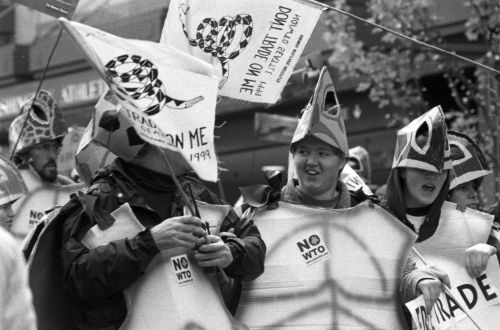
The 1999 World Trade Organization protests in Seattle marked one of the clearest late twentieth-century convergences of street theater, direct action, labor protest, environmental activism, and media spectacle. From November 28 through December 3, 1999, activists gathered around the World Trade Organization Ministerial Conference to challenge the social, environmental, and labor consequences of global trade policy. The protests were not a single march with one message, but a coalition of unions, environmentalists, students, anarchists, faith groups, Indigenous activists, global justice organizers, consumer advocates, and international critics of neoliberal globalization. That diversity mattered because the World Trade Organization itself was difficult to dramatize. It was an institution of rules, negotiations, trade language, dispute mechanisms, and ministerial procedure. Street theater helped translate that abstraction into public images: turtles and Teamsters, giant heads and corporate monsters, puppets and banners, mock rituals and marching bodies, all turning trade policy into something the public could see. The theatrical problem was also a democratic problem. How could ordinary people hold accountable a structure of authority that seemed to operate through acronyms, closed meetings, technical expertise, legal documents, and international procedures far removed from daily life? Seattle answered by making the invisible visible and the distant immediate. Protesters did not merely say that globalization had consequences. They staged those consequences in the streets, using bodies, costumes, puppets, chants, and blockades to force a supposedly abstract system into public view.
Seattle’s theatricality was not incidental to the protest. It was one of the ways the movement made itself legible. The giant puppets built and carried by Art and Revolution and allied activists gave visual form to forces otherwise hidden inside technical language. The Museum of History & Industry identifies Art and Revolution as a street theater troupe that built giant puppets for the protest marches, including a large “Liberation” puppet used during the early morning actions. The University of Washington’s protest archive likewise preserves images and footage of large street puppets, including figures marked by opposition to the World Trade Organization and unsustainable global systems. These puppets did not merely decorate the march. They made the protest readable from a distance, photographable by media, memorable to participants, and emotionally accessible to people who might never read a trade agreement. The giant puppet returned as a political technology: the monumental body that could make invisible power grotesque, vulnerable, and available to public judgment.
The visual politics of Seattle drew from older traditions while adapting them to a new political terrain. Bread and Puppet Theater had already shown how large handmade figures could transform protest into moral pageantry. Anti-nuclear movements had used skeletons, death masks, and die-ins to make abstract risk bodily. The Diggers had turned countercultural life into performance, while Boal had insisted that public space itself could become a site of political recognition. Seattle absorbed these inheritances into the global justice movement. The puppet, the banner, the costume, the street dance, the blockade, the chant, the satirical sign, and the affinity-group formation all became parts of one protest dramaturgy. The goal was not only to oppose a meeting. It was to stage the World Trade Organization as a visible concentration of power and to stage the protesters as a counter-public capable of interrupting it.
The first major day of disruption, November 30, revealed how theatrical spectacle and direct action could reinforce each other. Protesters blocked intersections and delegate access to the opening plenary session, while many actions remained disciplined, choreographed, and visually symbolic. The University of Washington archive notes that thousands of largely peaceful protesters blocked delegates from reaching the opening session and that Seattle police responded with tear gas and pepper spray beginning that morning. The city later declared emergency measures as downtown space became the object of struggle. What mattered theatrically was that the protest did not simply surround the official event; it competed with it as public drama. The ministerial conference had its own choreography of arrival, credentials, security, speeches, and closed negotiation. The protesters created a rival choreography of bodies, puppets, lockdowns, songs, costumes, and street occupation. The city became a stage on which two claims to legitimacy confronted one another.
Labor’s presence gave the spectacle a crucial social grounding. The Seattle protests are often remembered through images of turtles, anarchists, puppets, and tear gas, but union participation was central to their scale and symbolism. The famous “Teamsters and Turtles” alliance joined labor and environmental activism in a way that visually challenged the old claim that jobs and ecological protection were natural enemies. The labor march brought tens of thousands into the streets and signaled that the critique of globalization was not only aesthetic, youthful, or subcultural. It was also rooted in anxieties about wages, industrial relocation, worker protections, democratic accountability, and the power of transnational institutions to shape domestic life. Street theater helped dramatize those alliances. Costumes and puppets could compress contradictions that speeches often left abstract: workers and sea turtles marching in the same political image, trade policy represented as a devouring monster, and corporate globalization staged as a force whose smooth language masked uneven suffering.
Seattle also mattered because it took place at a transitional moment in media history. It was before social media, before smartphones, and before livestream culture as later movements would know them, but it was not pre-digital. The Independent Media Center emerged from the protests and helped model a new form of activist documentation and distribution. KUOW’s retrospective notes that the protests helped activists wield a new technology, the internet, even in a moment when many participants did not have cell phones and social media did not yet exist. This made Seattle a bridge between older embodied street theater and later digitally amplified protest. The giant puppet was built for the street, carried by people, exposed to weather, police, crowds, and exhaustion. Yet its political afterlife depended increasingly on images, video, websites, alternative media, and circulating memory. Seattle showed that street theater could operate in two registers at once: as physical disruption in a contested city and as visual narrative in a widening media ecology. That dual register would become central to twenty-first-century protest. A performance now had to succeed not only for those physically present, but also for those who would encounter it later through photographs, video clips, news framing, activist archives, and digital retellings. Seattle did not invent that condition, but it made it newly visible. The street action and the media image became mutually dependent, each amplifying and reshaping the other. A giant puppet blocking a city street was both an object in space and a future image in circulation.
The legacy of Seattle lies not simply in the disruption of the World Trade Organization meetings, but in the way it revealed protest as a struggle over visibility. Globalization was often presented as inevitable, technical, and beyond ordinary democratic reach. Street theater refused that invisibility. It gave trade policy a body, corporate power a face, and popular opposition a public choreography. Its giant puppets, costumes, banners, and theatrical actions did not replace organizing, research, coalition-building, or direct action. They made those efforts visible as a shared public drama. Like Bread and Puppet’s processions, El Teatro Campesino’s actos, and Reverend Billy’s corporate sermons, Seattle’s visual protest made accountability appear where official institutions preferred distance. The World Trade Organization meeting belonged to ministers and delegates; the street belonged, for a few extraordinary days, to those who insisted that global power should have to answer before the public it claimed to govern.
The Yes Men and Identity Correction: Satire as Counterfeit Authority
The Yes Men transformed guerrilla theater by moving political performance into the informational machinery of corporate and governmental authority. Founded by Jacques Servin and Igor Vamos, better known through their performing identities Andy Bichlbaum and Mike Bonanno, the group became known for impersonating institutions, creating spoof websites, staging fake press conferences, giving absurd presentations, and manipulating media conventions to expose corporate and political hypocrisy. Their tactic, often called “identity correction,” depends on a simple but destabilizing premise: instead of merely denouncing powerful institutions from the outside, performers temporarily become those institutions and make them speak truths they would never willingly admit. This shifted guerrilla theater from the street corner and protest march into a world of websites, television interviews, conference podiums, press releases, email invitations, branded documents, and professional manners. Authority itself became the costume.
The Yes Men’s work developed in the aftermath of the anti-globalization movement and belongs closely to the political media environment that Seattle 1999 helped reveal. Their early World Trade Organization interventions began when a parody website was mistaken for an official one, leading the performers to accept invitations to speak as representatives of the organization. That accident became method. If global power depended on acronyms, jargon, suits, PowerPoint, official logos, and carefully managed speech, then satire could enter through those forms. A fake World Trade Organization representative did not need a giant puppet to make power grotesque; he needed a plausible conference badge, a confident tone, and a proposal that extended neoliberal logic until its cruelty became absurd. The comedy lay in how little had to be exaggerated. By speaking the language of power too perfectly, The Yes Men exposed the moral vacancy hidden beneath its professional calm.
Their most famous intervention came in 2004, when Andy Bichlbaum, appearing on BBC World as “Jude Finisterra,” claimed that Dow Chemical would accept responsibility for the Bhopal disaster and establish a multibillion-dollar compensation plan for victims. For a brief period, the fake announcement created a world in which the corporation did what critics believed justice required. Then the deception was exposed, Dow denied the claim, and the cruelty of the actual situation became newly visible. The performance’s power and controversy lay in that brief interval of false hope. Supporters argued that the hoax forced renewed attention on Bhopal and exposed the gap between corporate public relations and moral responsibility. Critics could reasonably object that victims and viewers were made to experience an emotional whiplash they had not consented to. The action stands as one of the clearest examples of guerrilla theater’s ethical danger: counterfeit authority can reveal truth, but it can also injure precisely because it borrows the emotional force of truth. The Bhopal intervention was especially charged because it did not invent a trivial corporate embarrassment; it touched one of the worst industrial disasters in modern history and the long struggle over accountability that followed it. That made the hoax morally weighty in a way a simple prank could never be. The false announcement briefly dramatized the difference between what justice might look like and what corporate responsibility had actually produced. In that gap, the performance found its force. It allowed the public to glimpse an alternate reality in which apology, compensation, and repair were possible, then forced viewers back into the existing world where such action had not occurred. The cruelty of that return is precisely why the action remains so difficult, and so revealing.
Identity correction differs from ordinary parody because it does not begin by declaring itself comic. Like Boal’s Invisible Theatre, it withholds the frame. Yet the site of deception is different. Boal placed actors inside everyday public life; The Yes Men placed performance inside institutional communication systems. Their stage was the press conference, the broadcast interview, the corporate website, the trade conference, the news cycle, and the administrative document. That makes their work especially revealing for the history of modern authority. In bureaucratic and corporate cultures, credibility often appears through surface forms: fonts, logos, titles, microphones, suits, credentials, jargon, and the right kind of calm. The Yes Men exploit that dependence on surface. They show that institutional seriousness is itself theatrical, a performance maintained through costume, script, architecture, and audience trust. When they impersonate a corporation or agency, they do not create theater out of nothing. They interrupt a theater that power has already built.
The method also exposes a tension between satire and misinformation. The Yes Men’s hoaxes aim to reveal concealed truths by staging plausible lies, but they operate in a media ecosystem where deception can also be used cynically, destructively, or authoritarianly. That problem has grown sharper in the age of viral falsehood, deepfakes, and politically weaponized distrust. The Yes Men rely on a distinction between deception that exposes power and deception that protects it, but that distinction must be argued rather than assumed. Their best actions work because they punch upward, identify a concrete injustice, and eventually reveal the performance as critique. Their weakest or most dangerous possibilities arise when the people most affected by an issue bear the emotional cost of the exposure. This is why identity correction belongs in the same ethical lineage as Invisible Theatre. Both forms ask whether a temporary violation of ordinary consent can produce a larger public recognition. Both can illuminate oppression. Both can also make people feel used. The difference between emancipatory exposure and manipulative spectacle is not guaranteed by the performer’s intention. It depends on target, context, timing, disclosure, and the distribution of harm. A hoax aimed at a corporation may still pass through victims, workers, patients, consumers, or communities before it reaches the powerful. That passage matters. Guerrilla satire can expose institutional cruelty, but it must also account for the vulnerability of those who are made to feel the revelation first. The Yes Men’s work is strongest when the emotional burden falls upward, on the institution forced into embarrassment, rather than downward, on those already waiting for justice.
The Yes Men mark a decisive stage in the evolution of guerrilla theater from public spectacle to counterfeit administration. They inherit Old Comedy’s ridicule, Bread and Puppet’s moral enlargement, Reverend Billy’s invasion of corporate space, and Seattle’s media-conscious protest, but their distinct contribution is to make authority perform against itself. Instead of showing a monster puppet labeled “corporation,” they briefly become the corporation and let its logic confess. Instead of denouncing a public relations system, they hijack its tone and show what justice would sound like if corporate speech were forced to tell the truth. Their work reminds us that modern power does not only march, police, or legislate. It drafts statements, manages brands, hosts panels, issues reports, and appears on television. Identity correction turns those forms into stages of accountability, revealing that the mask of institutional reason can itself be made to slip.
Digital Amplification: When Street Theater Became Shareable Protest

Digital media did not replace street theater. It gave it a second stage. The central logic of guerrilla performance still depends on bodies in space: the interruption, the crowd, the risk, the police line, the store aisle, the public square, the march route, the bystander who did not expect to become a witness. Yet by the early twenty-first century, those embodied events increasingly acquired another life through photographs, video clips, livestreams, hashtags, activist archives, news feeds, and algorithmic circulation. A street action now often speaks to two publics at once: the people physically present and the dispersed audience that will encounter the event later through screens. This changed the dramaturgy of protest. Performers, activists, and organizers had to think not only about what an intervention meant in its immediate location, but how it would read as an image, a clip, a caption, or a shareable fragment moving through digital networks.
The shift was not simply technological. It altered the politics of visibility. Earlier forms of guerrilla theater often struggled to be seen beyond the immediate site of performance unless journalists covered them, photographers documented them, or participants carried the story elsewhere. Digital platforms lowered some of those barriers. A die-in, flash mob, puppet procession, mock trial, satirical intervention, or choreographed occupation could be recorded by participants themselves and circulated without waiting for elite media permission. This gave marginalized groups new tools for counternarrative, especially when mainstream coverage framed protest as disorder or ignored it altogether. Hashtags could gather dispersed performances into a recognizable political field. A single action could be repeated, remixed, imitated, and localized elsewhere. Protest became not only an event but a template, capable of traveling through networks and returning to the street in altered form.
This digital afterlife also changed the meaning of theatrical scale. Bread and Puppet needed giant figures because the street required visibility across distance; Seattle’s puppets worked partly because they were readable to crowds and cameras. In digital protest, scale can operate differently. A small gesture, a kneeling body, a raised hand, a line of people lying in silence, a projected phrase, a banner dropped from a building, or a single confrontation with police can become monumental once circulated online. The screen can enlarge what the street might have missed. Yet digital scale is unstable. Algorithms reward intensity, novelty, outrage, recognizability, and emotional compression. They can amplify moral witness, but they can also flatten context. A complex performance designed for a specific place may become a decontextualized symbol, a meme, a scandal, or a partisan weapon. Street theater becomes shareable, but shareability is never neutral. It changes what performers emphasize and what audiences remember. A gesture that works powerfully in person because of silence, duration, exhaustion, or spatial pressure may be reduced online to a few seconds of visual impact. Conversely, a small act almost invisible to those nearby can become historically resonant because a camera catches it at the right angle and a network gives it circulation. This means that contemporary protest increasingly operates under a double demand: it must hold space and hold attention. Those are not the same task. Holding space requires bodies, patience, risk, and endurance; holding attention requires compression, legibility, emotional force, and sometimes visual surprise. The strongest digitally amplified street theater understands that tension without letting the clip replace the encounter.
Movements such as Occupy Wall Street, Black Lives Matter, climate justice campaigns, feminist protest movements, Indigenous rights actions, and antiwar demonstrations have all used theatrical forms that depend on both physical assembly and digital circulation. Occupy’s encampments made public space into a prolonged performance of inequality and refusal. Black Lives Matter protests used die-ins, chants, murals, memorials, street occupations, and the circulation of recorded state violence to turn public grief and anger into a visible political language. Climate activists have used mock funerals, red-robed processions, school strikes, blockades, projections, and symbolic occupations to make ecological crisis appear before publics trained to experience it as distant or abstract. These actions differ greatly in origin and aim, but they share a common structure: the street supplies the embodied scene, while digital media extends the scene’s reach, repetition, and memory. The movement from place to platform does not simply transmit the performance; it can also transform its meaning. A die-in witnessed on pavement communicates vulnerability through stillness, proximity, and the discomfort of bodies interrupting ordinary movement. The same die-in seen online may become a photograph of collective discipline, a provocation to opponents, a memorial image, or a rallying template for another city. A mural painted on a street exists first as local claim-making, marking a specific place with public memory, but its photographed circulation can turn it into a national or global emblem. Digital amplification multiplies the audience while multiplying interpretation. That expansion can strengthen movements, but it also means that no performance remains entirely under the control of those who made it.
The gains of digital amplification are real, but so are the dangers. Sociologist Zeynep Tufekci has argued that networked protest can mobilize quickly and powerfully while remaining fragile in organization, strategy, and long-term capacity. That problem matters for street theater because a performance can go viral without building durable power. Visibility can be mistaken for victory. A widely shared image may produce sympathy, outrage, or recognition, yet leave institutions unchanged. Digital platforms also expose activists to surveillance, harassment, misrepresentation, doxxing, and algorithmic suppression. The same tools that allow protesters to bypass traditional gatekeepers can allow states, corporations, and hostile publics to monitor, distort, and neutralize dissent. Guerrilla theater’s old problem returns in new form: how to interrupt power without being absorbed by the systems through which interruption becomes visible.
Digital amplification extends the history of guerrilla theater rather than ending it. The street remains indispensable because bodies still carry risk, vulnerability, solidarity, and moral pressure in ways that images alone cannot. But the feed has become part of the street’s afterlife, shaping how actions are remembered, copied, contested, and judged. Modern protest performance now moves through a loop: bodies gather, an image is made, the image circulates, circulation reshapes interpretation, and interpretation may bring bodies back into the street. This loop can deepen democratic accountability when it exposes violence, spreads testimony, and builds networks of solidarity. It can also cheapen accountability when performance becomes mere content. The challenge for contemporary guerrilla theater is to use digital reach without surrendering to digital consumption. Its task remains what it has always been: to make power visible, but now it must also fight over the conditions under which visibility itself is produced.
Does Guerrilla Theater Hold Power Accountable or Only Perform Accountability?
The following video from “VintageClipsAndMore” is a documentary about guerilla theater:
The history traced so far makes a strong case for guerrilla theater as a recurring instrument of political exposure, but that claim requires testing. To say that street theater “holds power accountable” risks overstating what performance can do. Accountability usually implies consequence: removal from office, legal penalty, public apology, policy change, restitution, institutional reform, or altered behavior. Guerrilla theater rarely commands those outcomes by itself. It does not possess subpoena power, electoral authority, military force, judicial standing, or administrative control. Its power is more unstable. It exposes, ridicules, dramatizes, embarrasses, interrupts, and makes visible. Those acts matter, but they are not the same as institutional accountability. The critical question, then, is whether guerrilla theater produces accountability or only stages the desire for it.
One answer is that performance can create the public conditions under which accountability becomes imaginable. Before courts, legislatures, journalists, unions, or social movements can compel consequences, a public must often be taught to see an injury as an injury. Street theater helps perform that preliminary work. It turns hidden relations into visible scenes: the farmworker confronting the grower, the consumer confronting the brand, the bystander confronting ordinary oppression, the citizen confronting police violence, the public confronting war or ecological danger. Guerrilla theater may not be the machinery of accountability, but it can be part of accountability’s cultural infrastructure. It makes recognition possible. It gives outrage form. It produces shared images through which a scattered public can understand that a private discomfort belongs to a larger political pattern. This is especially important when power depends on fragmentation, secrecy, technical language, or moral fatigue. A trade agreement, an environmental hazard, a police practice, a labor system, or a corporate supply chain can be difficult to confront because its harms are dispersed across documents, offices, procedures, and distant bodies. Performance gathers those dispersed harms into a scene. It gives the public something to look at, remember, repeat, and argue over. That does not complete accountability, but it may begin the social process by which accountability becomes demandable.
Yet there is a danger in mistaking visibility for consequence. Modern societies are highly skilled at absorbing images of dissent into the very circuits of attention they appear to oppose. A giant puppet, a die-in, a satirical sermon, or a hoax press conference can become a memorable image without changing the institution it criticizes. Indeed, the more visually striking a protest becomes, the more easily it may be detached from its political context and consumed as content. Spectacle can expose power, but it can also substitute the image of resistance for resistance itself. The danger is not that theatrical protest is false. The danger is that theatrical protest may satisfy the emotional need to have resisted while leaving power’s material arrangements untouched. In that case, performance does not hold power accountable; it stages accountability as a feeling.
This does not make theatrical protest empty. Jacques Rancière’s work on spectatorship helps complicate the charge of passivity. Spectators are not inert containers waiting to be activated by artists. They interpret, compare, remember, misread, connect, and carry meanings elsewhere. A street performance may not produce immediate policy change, but it can redistribute perception by changing what people notice and how they understand their own position. The person who watches a Boalian intervention, a Bread and Puppet procession, or a Reverend Billy disruption may not leave as a converted activist, but spectatorship itself can become a site of political labor. The question is not whether performance instantly transforms the world. The question is whether it alters the field of perception and relation in which later action becomes possible. That is a more modest claim, but also a stronger one. It also avoids the false choice between political effectiveness and symbolic meaning. Much of politics depends on symbols before it becomes law, policy, or institutional force. People must learn what to call injustice, where to locate responsibility, and how to imagine themselves in relation to others who suffer or resist. Performance can help reorganize that moral vocabulary. It can make a spectator feel implicated without yet knowing what action should follow, and that unsettled recognition may become the beginning of political education rather than its end.
Participatory performance introduces another difficulty. Claire Bishop’s critique of participatory art is especially important because she resists the assumption that participation is automatically democratic or emancipatory. A performance may include the public while still controlling the public’s role. It may invite participation while predetermining the moral lesson. It may turn people into raw material for an artist’s political project. This problem is central to Invisible Theatre, identity correction, and many forms of guerrilla intervention. When unsuspecting bystanders are drawn into an event, their reactions may reveal social truth, but their lack of consent cannot be ignored. Political urgency does not erase ethical responsibility. If guerrilla theater wants to challenge domination, it must ask whether its own methods reproduce smaller versions of the control it opposes. The problem becomes sharper when performers claim to speak for oppressed people while staging an encounter that primarily benefits the artist, activist group, or watching public. Participation can become a badge of moral credibility rather than a genuine redistribution of power. A passerby may be “activated,” but also embarrassed; a community may be “represented,” but not consulted; an audience may be “liberated,” but only according to a script written elsewhere. The ethical test is not simply whether a performance is participatory, but who sets the terms, who bears the risk, who receives the benefit, and whether those drawn into the event retain any meaningful agency.
There is also the problem of audience composition. Guerrilla theater often imagines itself as public, but publics are unevenly assembled. Some street actions reach hostile, mixed, or accidental audiences; others largely gather those already sympathetic to the cause. A protest puppet march, anti-consumerist sermon, or climate die-in may energize participants and supporters while doing little to persuade opponents or pressure decision-makers. That does not make such performances useless. Movements need morale, ritual, memory, and shared identity. Performance can allow people to feel what a better world might be like. Such moments are not policy victories, but they are not trivial either. They sustain political imagination. The risk is that internal affirmation may be mistaken for external accountability. A movement can feel powerful in performance while remaining politically isolated outside it.
State and corporate power also learn. They adapt to guerrilla theater, police it, mock it, ignore it, imitate it, or turn it into branding. Municipal governments regulate public assembly through permits, sound ordinances, barricades, curfews, “free speech zones,” and selective enforcement. Corporations absorb activist aesthetics into advertising, diversity campaigns, green branding, and public relations spectacle. Digital platforms monetize dissenting images even when the images criticize the conditions of monetization itself. This adaptability means that guerrilla theater cannot rely on disruption alone. Once disruption becomes predictable, power can choreograph around it. The more a tactic succeeds, the more likely it is to become recognizable, managed, and neutralized. The history of street theater is also a history of tactical exhaustion and reinvention.
The best answer to the counterpoint is that guerrilla theater holds power accountable only when it is connected to wider forms of pressure. It becomes strongest when linked to labor organizing, litigation, investigative journalism, electoral struggle, mutual aid, direct action, community education, archival work, and durable institutions. El Teatro Campesino mattered because it was embedded in the farmworker movement. Seattle’s puppets mattered because they were part of blockades, coalitions, labor marches, and independent media. Reverend Billy’s corporate interventions matter most when tied to campaigns around ecology, debt, labor, or neighborhood survival. Performance alone can reveal; movements can compel. Guerrilla theater’s democratic function is not to replace politics with art, but to make politics visible, felt, and publicly contestable. It performs accountability at its weakest when it offers catharsis without consequence. It aids accountability at its strongest when it helps publics recognize injury, name power, endure struggle, and act beyond the performance itself.
Conclusion: Laughter, Interruption, and the Democratic Stage
Guerrilla and street theater endure because politics is never only a matter of institutions. It is also a matter of appearance, gesture, space, rhythm, language, costume, repetition, and public emotion. Power governs through laws and budgets, but it also governs through ceremonies, uniforms, press conferences, corporate branding, official architecture, media performance, expert vocabulary, and the trained expectation that ordinary people should watch rather than interrupt. The tradition traced here answers that theatricality with counter-theatricality. From Old Comedy’s public humiliation of leaders to the San Francisco Mime Troupe’s park performances, from the Diggers’ life-acting to Bread and Puppet’s monumental bodies, from El Teatro Campesino’s farmworker actos to Boal’s Invisible Theatre, from anti-apartheid and anti-nuclear performance to Reverend Billy, Seattle’s giant puppets, The Yes Men, and digitally amplified protest, guerrilla theater has repeatedly insisted that power should not be allowed to perform unopposed.
Its methods differ widely, but its democratic impulse remains recognizable. It mocks what demands reverence. It interrupts what pretends to be natural. It makes abstract systems bodily, local, comic, grotesque, sorrowful, or absurd. It turns spectators into witnesses and sometimes into participants. It creates temporary publics in places where public judgment has been excluded: the park, the picket line, the store aisle, the restaurant, the street corner, the trade summit, the broadcast interview, the viral feed. These performances do not all produce justice, and they do not always avoid ethical danger. Some manipulate, simplify, overreach, or mistake visibility for consequence. Yet their failures do not erase their importance. They reveal the difficulty of democratic accountability in societies where power often hides inside procedure, spectacle, expertise, distance, and consumption.
The strongest forms of guerrilla theater do not imagine performance as a substitute for politics. They work best when joined to movements, organizing, memory, law, journalism, labor, mutual aid, and public education. Performance can expose hypocrisy, but movements must press the exposure toward consequence. Performance can gather outrage, but institutions must be forced to respond. Performance can give suffering a body, but justice requires more than recognition. This is the central distinction: guerrilla theater performs accountability most weakly when it becomes catharsis without pressure, but it aids accountability most powerfully when it helps people see what has been hidden, name what has been normalized, and imagine forms of action that seemed impossible before the interruption occurred.
The final lesson, then, is not that politics has become theatrical in some fallen modern age. Politics has always been theatrical. Ancient assemblies, royal entries, courtrooms, police lines, corporate launches, campaign rallies, military parades, and televised apologies all depend on performance. Guerrilla theater matters because it refuses to let the powerful monopolize the stage. It answers ceremony with parody, bureaucracy with interruption, branding with satire, silence with song, and distance with bodies in public space. Its laughter is not always gentle, and its disruptions are not always comfortable. But democracy has never survived on comfort alone. Sometimes it requires a fool, a puppet, a preacher, a worker, a prankster, a chorus, or a crowd to step into the street and remind power that the public is still watching, still judging, and still capable of performing back.
Bibliography
- Anti-Apartheid Movement Archives. “Students and Their Involvement with the Anti-Apartheid Movement.” Accessed May 30, 2026. https://www.aamarchives.org/who-was-involved/students.html.
- Aristophanes. Acharnians, Knights. Edited and translated by Jeffrey Henderson. Loeb Classical Library 178. Cambridge, MA: Harvard University Press, 1998.
- —-. Clouds, Wasps, Peace. Edited and translated by Jeffrey Henderson. Loeb Classical Library 488. Cambridge, MA: Harvard University Press, 1998.
- —-. Birds, Lysistrata, Women at the Thesmophoria. Edited and translated by Jeffrey Henderson. Loeb Classical Library 179. Cambridge, MA: Harvard University Press, 2000.
- —-. The Complete Plays. Translated by Paul Roche. New York: New American Library, 2005.
- Aronson, Arnold. American Avant-Garde Theatre: A History. London: Routledge, 2000.
- Bakhtin, Mikhail. Rabelais and His World. Translated by Hélène Iswolsky. Cambridge, MA: MIT Press, 1965.
- Beautiful Trouble. “Identity Correction.” Accessed May 30, 2026. https://beautifultrouble.org/toolbox/tool/identity-correction.
- Beck, Julian, and Judith Malina. Paradise Now: Collective Creation of the Living Theatre. New York: Random House, 1971.
- Bell, John. American Puppet Modernism: Essays on the Material World in Performance. New York: Palgrave Macmillan, 2008.
- —-, ed. Puppets, Masks, and Performing Objects. Cambridge, MA: MIT Press, 2001.
- Bichlbaum, Andy, and Mike Bonanno. The Yes Men Fix the World: How to Save the World in 24 Easy Steps. New York: Overlook Press, 2009.
- Bishop, Claire. Artificial Hells: Participatory Art and the Politics of Spectatorship. London: Verso, 2012.
- Boal, Augusto. Games for Actors and Non-Actors. Translated by Adrian Jackson. 2nd ed. London: Routledge, 2002.
- —-. Theatre of the Oppressed. Translated by Charles A. McBride and Maria-Odilia Leal McBride. New York: Theatre Communications Group, 1993.
- Bread and Puppet Theater. “About B & P’s 60 Year History.” Accessed May 30, 2026. https://breadandpuppet.org/about-b-ps-50-year-history.
- —-. “About Bread and Puppet.” Accessed May 30, 2026. https://breadandpuppet.org/about-bread-and-puppet.
- Brockett, Oscar G., and Franklin J. Hildy. History of the Theatre. 10th ed. Boston: Allyn and Bacon, 2007.
- Broyles-González, Yolanda. El Teatro Campesino: Theater in the Chicano Movement. Austin: University of Texas Press, 1994.
- Cohen-Cruz, Jan, ed. Radical Street Performance: An International Anthology. London: Routledge, 1998.
- Cohen-Cruz, Jan and Mady Schutzman, eds. A Boal Companion: Dialogues on Theatre and Cultural Politics. London: Routledge, 2006.
- —-, eds. Playing Boal: Theatre, Therapy, Activism. London: Routledge, 1994.
- Coyote, Peter. Sleeping Where I Fall: A Chronicle. Washington, DC: Counterpoint, 1998.
- Davis, R. G. The San Francisco Mime Troupe: The First Ten Years. Palo Alto, CA: Ramparts Press, 1975.
- Davis, Susan G. Parades and Power: Street Theatre in Nineteenth-Century Philadelphia. Berkeley: University of California Press, 1986.
- Debord, Guy. The Society of the Spectacle. Translated by Donald Nicholson-Smith. New York: Zone Books, 1967.
- Dencik, Lina, and Oliver Leistert, eds. Critical Perspectives on Social Media and Protest: Between Control and Emancipation. London: Rowman & Littlefield International, 2015.
- Dery, Mark. Culture Jamming: Hacking, Slashing, and Sniping in the Empire of Signs. Westfield, NJ: Open Magazine Pamphlet Series, 1993.
- The Diggers Archives. The Digger Papers. San Francisco: The Diggers, 1968. Reproduced in The Diggers Archives. Accessed May 30, 2026. https://www.diggers.org/digger_papers.htm.
- —-. “Free City Bloodlight.” Accessed May 30, 2026. https://www.diggers.org/digpaps68/bloodlit.htm.
- —-. “Staging the Revolution: Guerrilla Theater as a Countercultural Practice.” Accessed May 30, 2026. https://www.diggers.org/guerrilla_theater.htm.
- Dixon, Chris. “Five Days in Seattle: A View from the Ground.” Writing with Movements. Accessed May 30, 2026. https://www.writingwithmovements.com/five-days-in-seattle/.
- Dolan, Jill. Utopia in Performance: Finding Hope at the Theater. Ann Arbor: University of Michigan Press, 2005.
- Dover, Kenneth J. Aristophanic Comedy. Berkeley: University of California Press, 1972.
- El Teatro Campesino. “Luis Valdez.” Accessed May 30, 2026. https://elteatrocampesino.com/about-luis/.
- —-. “Our History.” Accessed May 30, 2026. https://elteatrocampesino.com/our-history/.
- Fleishman, Mark, ed. Performing Migrancy and Mobility in Africa: Cape of Flows. Cham, Switzerland: Palgrave Macmillan, 2015.
- Freire, Paulo. Pedagogy of the Oppressed. Translated by Myra Bergman Ramos. New York: Continuum, 1968.
- Gerbaudo, Paolo. Tweets and the Streets: Social Media and Contemporary Activism. London: Pluto Press, 2012.
- Goldensohn, Barry. “Peter Schumann’s Bread and Puppet Theater.” The Drama Review: TDR 8:2 (1977), 71-82.
- González, George. The Church of Stop Shopping and Religious Activism: Combatting Consumerism and Climate Change through Performance. New York: New York University Press, 2024.
- Gordon, Mel. Lazzi: The Comic Routines of the Commedia dell’Arte. New York: Performing Arts Journal Publications, 1983.
- Grogan, Emmett. Ringolevio: A Life Played for Keeps. Boston: Little, Brown, 1972.
- Harold, Christine. OurSpace: Resisting the Corporate Control of Culture. Minneapolis: University of Minnesota Press, 2007.
- Henderson, Jeffrey. The Maculate Muse: Obscene Language in Attic Comedy. 2nd ed. New York: Oxford University Press, 1991.
- Huerta, Jorge A. Chicano Theater: Themes and Forms. Ypsilanti, MI: Bilingual Press, 1981.
- Jackson, Sarah J., Moya Bailey, and Brooke Foucault Welles. #HashtagActivism: Networks of Race and Gender Justice. Cambridge, MA: MIT Press, 2020.
- James, Norman. “The Living Theatre: Its Use of the Stage.” The Journal of Aesthetics and Art Criticism 29:4 (1971), 475-483.
- Juris, Jeffrey S. Networking Futures: The Movements Against Corporate Globalization. Durham, NC: Duke University Press, 2008.
- Kanellos, Nicolás. A History of Hispanic Theatre in the United States: Origins to 1940. Austin: University of Texas Press, 1984.
- Kaprow, Allan. Assemblage, Environments & Happenings. New York: Harry N. Abrams, 1966.
- —-. Essays on the Blurring of Art and Life. Edited by Jeff Kelley. Berkeley: University of California Press, 1993.
- Kelley, Jeff. Childsplay: The Art of Allan Kaprow. Berkeley: University of California Press, 2007.
- Kershaw, Baz. The Politics of Performance: Radical Theatre as Cultural Intervention. London: Routledge, 1992.
- —-. The Radical in Performance: Between Brecht and Baudrillard. London: Routledge, 1999.
- Klein, Naomi. No Logo: Taking Aim at the Brand Bullies. New York: Picador, 1999.
- Kruger, Loren. The Drama of South Africa: Plays, Pageants and Publics Since 1910. London: Routledge, 1999.
- KUOW. “Before Protest Hashtags, There Was the WTO and Indy Media.” November 23, 2019. https://www.kuow.org/stories/before-protest-hashtags-there-was-the-wto-and-indy-media.
- MacDowell, Douglas M. Aristophanes and Athens: An Introduction to the Plays. Oxford: Oxford University Press, 1995.
- Mally, Lynn. “Exporting Soviet Culture: The Case of Agitprop Theater.” Slavic Review 62:2 (2003), 324–342.
- Martin, Bradford D. The Theater Is in the Street: Politics and Public Performance in 1960s America. Amherst: University of Massachusetts Press, 2004.
- MIT Press Reader. “Pranksters on a Mission: An Interview with the Yes Men.” January 26, 2021. https://thereader.mitpress.mit.edu/an-interview-with-the-yes-men/.
- Museum of History & Industry. “Art and Revolution’s Giant Liberation Puppet at WTO Protest, 1999.” Accessed May 30, 2026. https://mohai.org/collections-and-research/search/item/2000.107/-.19991130.20%23.01/.
- The New Yorker. “Buzzkill.” May 12, 2014. https://www.newyorker.com/magazine/2014/05/19/buzzkill-2.
- Orenstein, Claudia. Festive Revolutions: The Politics of Popular Theater and the San Francisco Mime Troupe. Jackson: University Press of Mississippi, 1998.
- Pace University. “Nuclear Freeze Campaign, 1970s–1980s.” NYC Nuclear Archive. Accessed May 30, 2026. https://disarmament.blogs.pace.edu/nyc-nuclear-archive/nuclear-freeze-campaign-1970s-1980s/.
- Perry, Charles. The Haight-Ashbury: A History. New York: Random House/Rolling Stone Press, 1984.
- Pritchard, David M. “Aristophanes and de Ste. Croix: The Value of Old Comedy as Evidence for Athenian Popular Culture.” Antichthon 46 (2012), 14–51.
- Rancière, Jacques. The Emancipated Spectator. Translated by Gregory Elliott. London: Verso, 2011.
- Reverend Billy and the Stop Shopping Choir. “About.” Accessed May 30, 2026. https://revbilly.com/about/.
- —-. “The Church of Stop Shopping.” Accessed May 30, 2026. https://revbilly.com/.
- —-. “Savitri D.” Accessed May 30, 2026. https://revbilly.com/savitri-d/.
- Roz Payne Sixties Archive. “San Francisco Mime Troupe.” University of Nebraska-Lincoln. Accessed May 30, 2026. https://rozsixties.unl.edu/items/show/171.html.
- Schechner, Richard. “6 Axioms for Environmental Theater.” The Drama Review: TDR 12, no. 3 (1968): 41–64.
- —-. Environmental Theater. New York: Hawthorn Books, 1973.
- —-. The Future of Ritual: Writings on Culture and Performance. London: Routledge, 1993.
- —-. Performance Theory. New York: Routledge, 1988.
- Schumann, Peter. “The Radicality of the Puppet Theater.” The Drama Review: TDR 35:4 (1991), 75-83.
- Seattle Municipal Archives. “World Trade Organization Protests in Seattle.” Accessed May 30, 2026. https://www.seattle.gov/cityarchives/exhibits-and-education/digital-document-libraries/world-trade-organization-protests-in-seattle.
- Solnit, David, and Rebecca Solnit, eds. The Battle of the Story of the Battle of Seattle. Oakland, CA: AK Press, 2009.
- Sommerstein, Alan H. Talking about Laughter: And Other Studies in Greek Comedy. Oxford: Oxford University Press, 2009.
- South African History Online. “State of Emergency, 1985.” Last modified July 21, 2015. https://www.sahistory.org.za/article/state-emergency-1985.
- Steele, Sean. “Playing for Keeps: The Diggers, Life-Acting and Guerrilla Theater in San Francisco’s Psychedelic 60s.” aspeers: Emerging Voices in American Studies 7 (2014), 105–124.
- Stourac, Richard, and Kathleen McCreery. Theatre as a Weapon: Workers’ Theatre in the Soviet Union, Germany and Britain, 1917–1934. London: Routledge and Kegan Paul, 1986.
- Talen, Bill. What Should I Do If Reverend Billy Is in My Store? New York: New Press, 2005.
- Tate. “Happening.” Accessed May 30, 2026. https://www.tate.org.uk/art/art-terms/h/happening/happening.
- Thompson, James. Performance Affects: Applied Theatre and the End of Effect. Basingstoke, UK: Palgrave Macmillan, 2009.
- Tillis, Steve. Toward an Aesthetics of the Puppet: Puppetry as a Theatrical Art. New York: Greenwood Press, 1992.
- Tufekci, Zeynep. Twitter and Tear Gas: The Power and Fragility of Networked Protest. New Haven: Yale University Press, 2017.
- Tytell, John. The Living Theatre: Art, Exile, and Outrage. New York: Grove Press, 1995.
- University of Washington Libraries. “Independent Media Center World Trade Organization Meeting and Seattle Protests Collection.” Accessed May 30, 2026. https://content.lib.washington.edu/filmarchweb/imcwto.html.
- Valdez, Luis. Early Works: Actos, Bernabé, and Pensamiento Serpentino. Houston: Arte Público Press, 1990.
- Yarbro-Bejarano, Yvonne. “The Female Subject in Chicano Theatre: Sexuality, ‘Race,’ and Class.” Theatre Journal 38, no. 4 (1986): 389–407.
- The Yes Men. “How Dow Did Right for the People of Bhopal… for an Hour.” Accessed May 30, 2026. https://theyesmen.org/project/dowbbc/behindthecurtain.
- —-. The Yes Men: The True Story of the End of the World Trade Organization. New York: Disinformation Company, 2004.
- —-. “Who Are We?” Accessed May 30, 2026. https://theyesmen.org/.
- Wired. “Twitter and Tear Gas: How Social Media Changed Protest Forever.” May 2017. https://www.wired.com/2017/05/twitter-tear-gas-protest-age-social-media.
Originally published by Brewminate, 06.01.2026, under the terms of a Creative Commons Attribution-NonCommercial-NoDerivatives 4.0 International license.
About the Author