Ancient Mesoamerican farmers transformed forests, wetlands, slopes, and lakebeds into productive landscapes that sustained cities, rituals, markets, and empires.

By Matthew A. McIntosh
Public Historian
Brewminate
Introduction: Agriculture as the Hidden Infrastructure of Mesoamerican Civilization
The history of ancient Mesoamerica is often told through its visible monuments: colossal Olmec heads, Maya temple pyramids, Zapotec hilltop cities, Mixtec codices, and the island capital of Tenochtitlán rising from the lakes of the Valley of Mexico. Yet beneath these more dramatic remains lay a quieter infrastructure without which none of them could have endured: agriculture. Mesoamerican civilization was built not simply on maize, but on a deep and varied body of ecological knowledge that allowed farmers to turn mountainsides, tropical forests, wetlands, lake margins, and seasonally dry basins into productive landscapes. From early village farming to the urban food systems of the Mexica, agriculture was the foundation of population growth, political authority, ritual life, market exchange, and imperial power. It was not a background condition of civilization; it was one of civilization’s central engines.
This agricultural world was never uniform. Mesoamerica stretched across sharply different environments, from the humid Gulf Coast lowlands to the limestone plains of the Maya region, the volcanic highlands of central Mexico, the valleys of Oaxaca, and the lake systems surrounding Tenochtitlán. Each demanded different answers, and no single agricultural model can explain the whole region. In some places, farmers relied on rotational milpa systems that combined maize, beans, squash, chili, and other crops in managed cycles of clearing, burning, cultivation, and fallow. In others, they built terraces into slopes, raised fields above swampy ground, reservoirs to capture seasonal rain, canals to move water and people, and chinampas to cultivate lakebeds with extraordinary intensity. These methods were shaped by local rainfall, soil depth, elevation, drainage, population density, and political demand. Lowland farmers faced the challenge of maintaining fertility in tropical soils and surviving seasonal droughts; highland farmers confronted erosion, uneven terrain, and the need to trap water before it vanished downhill; lake-basin farmers learned to make water itself part of the agricultural field. The result was not a single “Mesoamerican farm,” but a regional mosaic of engineered landscapes. These were not isolated tricks or primitive improvisations. They were accumulated technologies of place, refined over generations through observation, labor, inheritance, and adaptation.
To understand Mesoamerican agriculture as technology requires broadening the meaning of the word. The region did not depend on Old World plows, wheeled transport, or draft animals, and for that reason earlier observers sometimes underestimated the sophistication of its food systems. But technology is not limited to metal, wheels, or animal traction. It also includes seed selection, crop pairing, soil renewal, water storage, erosion control, managed succession, household gardens, tree cultivation, and the coordination of labor across seasonal calendars. A chinampa, a terrace wall, a clay-lined reservoir, a managed forest garden, and a milpa field were all technologies, even when they were made from mud, stone, reeds, ash, trees, and memory. Their power lay in the way they joined human labor to ecological process.
Ancient Mesoamerican agriculture developed as a plural, adaptive tradition rather than a single farming methodology. Its history runs from early domestication and intercropping through Formative water management, Classic Maya landscape engineering, Postclassic intensification, and the highly productive chinampa agriculture of the Mexica world. Chronology matters because the story is not merely one of invention, but of cumulative problem-solving: each society inherited crops, techniques, and landscape knowledge, then modified them under new pressures of population, climate, settlement, warfare, tribute, and urban demand. The result was one of the great agricultural traditions of the ancient world, not because it conquered nature in any simple sense, but because it learned how to negotiate with water, soil, slope, forest, and season.
Before Cities: Domestication, Experiment, and the Long Agricultural Revolution

Before Mesoamerica had kings, palaces, temple-pyramids, tribute arrangements, or imperial capitals, it had centuries of experimentation with plants. The agricultural history of the region began not with a sudden discovery but with a long, uneven process of observation, selection, cultivation, and adaptation. Foragers, gardeners, and early farming communities learned which plants could be encouraged, protected, transplanted, stored, exchanged, and gradually transformed. Domestication was not a single event but a relationship between people and landscapes. Ancient Mesoamerican farmers did not simply find maize, beans, squash, chili peppers, avocados, cotton, cacao, and amaranth waiting as ready-made crops. They helped make them through generations of use, preference, seed saving, and ecological knowledge. This process unfolded across many environments and many scales of human action: a family protecting useful plants near a camp, a village saving seed from the most productive ears of maize, a community learning when to burn, when to plant, when to leave a plot fallow, and when to shift attention to another food source. The first agricultural technologies of Mesoamerica were not monumental structures but habits of attention. They were the ability to read rainfall, soil, slope, seed, season, animal behavior, and plant response. Long before cities appeared, the foundations of urban civilization were being laid in small clearings, seasonal camps, household plots, village fields, and the inherited memory of which plants could be trusted to feed people when the wild landscape alone could not.
Maize became the most consequential of these crops, but its importance should not obscure how strange and labor-intensive its story was. Unlike wild grains that could be harvested in recognizable form, maize descended from teosinte, a grass whose small seed cases bear little resemblance to the large, exposed kernels of later corn. The transformation required sustained human selection, and that transformation changed Mesoamerican history. Maize offered calories, storability, portability, and ritual meaning. It could be dried, ground, cooked, carried, offered, taxed, and remembered. Maize became not only a staple food but one of the central metaphors through which Mesoamerican peoples understood human life itself. Yet its rise was gradual. Early communities did not instantly abandon hunting, fishing, gathering, or the use of wild plants. Agriculture emerged as part of a mixed economy before it became the dominant basis of village and urban life.
Squash and beans were equally important to this agricultural revolution, though in different ways. Squash provided edible flesh, seeds, containers, ground cover, and storage possibilities. Beans added protein and, when grown with maize, helped create a more balanced diet. The familiar “Three Sisters” system of maize, beans, and squash should be understood as a brilliant agricultural partnership rather than a simple list of crops. Maize provided a stalk on which beans could climb; beans contributed nitrogen to the soil through their relationship with bacteria; squash spread across the ground, suppressing weeds and helping conserve moisture. But even this triad was only part of a larger food world. Chili peppers, tomatoes, amaranth, maguey, cacao, vanilla, avocado, guava, sapote, and many other plants formed regional crop complexes that varied according to climate, elevation, and cultural preference. Mesoamerican agriculture was never merely maize agriculture. It was a wide botanical civilization.
The shift toward farming also changed settlement. As cultivated plants became more reliable, people could live in more permanent villages, invest more labor in houses and fields, and accumulate knowledge tied to particular places. Sedentism did not simply follow agriculture automatically, nor did farming eliminate mobility everywhere at once. But the two processes reinforced one another. Villages allowed people to tend crops more regularly, protect stored food, manage nearby resources, and develop more complex household economies. Fields, gardens, storage pits, grinding stones, and cooking practices gradually altered daily life. The repeated labor of planting, weeding, harvesting, drying, grinding, and cooking created new rhythms of time, binding households to seasonal cycles in ways that differed from more mobile patterns of subsistence. Storage also mattered profoundly. Stored maize, squash seeds, dried beans, and preserved foods made it possible to survive lean seasons, support gatherings, sustain ritual obligations, and buffer households against temporary scarcity. More permanent settlement encouraged people to invest in durable tools, improved dwellings, cleared plots, paths, storage spaces, and local exchange relationships. Women, men, children, elders, and specialists all participated in the labor of food production and preparation, though the archaeological record does not always reveal those divisions clearly. The long agricultural revolution was not only a technological transition. It was a transformation of time, labor, family life, diet, property, memory, and place.
This early agricultural world also produced new kinds of risk. Farming could support larger populations, but it could also make communities more vulnerable to drought, pests, crop failure, conflict, and dependence on stored food. A village that invested heavily in maize had to think about rainfall, planting schedules, seed reserves, soil fertility, and storage security. These concerns encouraged diversification rather than uniformity. Intercropping, garden plots, tree crops, hunting, gathering, fishing, and exchange all helped reduce the dangers of relying too heavily on one crop or one field. The later sophistication of Mesoamerican agriculture grew from this early recognition that survival required redundancy. A resilient food system needed annual crops, perennial plants, wild resources, seasonal knowledge, and social networks through which food could move in times of scarcity.
By the time larger ceremonial centers and regional polities began to emerge, Mesoamerican agriculture had already accumulated a deep inheritance. The later achievements of Olmec water management, Maya terraces and reservoirs, Zapotec hillside farming, and Mexica chinampas rested on a much older foundation of domestication and experimentation. The first agricultural revolution in Mesoamerica was not monumental in the architectural sense, but it was monumental in consequence. It created the biological, social, and cultural conditions that made later civilization possible. The history of Mesoamerican agriculture begins before cities because cities were its outcome. Before rulers could command tribute, priests could organize ceremonies, merchants could move goods, or builders could raise pyramids, generations of farmers had already remade the relationship between people, plants, soil, and season.
The Milpa World: Swidden, Fallow, Soil Renewal, and the Misunderstood Slash-and-Burn Cycle
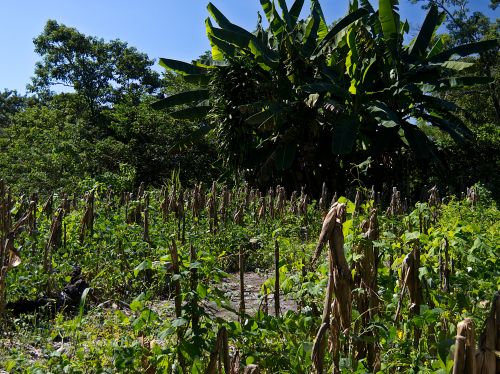
Few agricultural practices in Mesoamerica have been more misunderstood than the milpa cycle. Modern descriptions often reduce it to “slash-and-burn,” a phrase that suggests waste, destruction, and short-term exploitation. Yet in its historical and Indigenous contexts, milpa agriculture was far more complex than the careless clearing implied by that label. It was a rotational system of forest management, soil renewal, crop diversity, and ecological timing. Farmers cleared selected plots, allowed cut vegetation to dry, burned it under controlled conditions, planted crops into ash-enriched soil, cultivated the land for a limited number of years, and then allowed it to return to fallow. The fallow was not abandonment in a simple sense. It was part of the system itself, a period during which vegetation returned, soils recovered, useful plants could be protected, and the landscape moved through managed stages of regeneration.
The usefulness of fire lay partly in its ability to release nutrients quickly into tropical soils that were often difficult to farm continuously. In many lowland environments, heavy rainfall, leaching, acidity, and thin topsoil made permanent grain-style agriculture impractical without other forms of fertility management. Burning dried vegetation produced ash that temporarily enriched the planting surface, reduced weeds and pests, and opened the canopy to sunlight. It also transformed accumulated forest biomass into an immediate agricultural resource, concentrating minerals that would otherwise remain locked in plant matter. This mattered especially in landscapes where fertility was not evenly distributed and where farmers had to work with sharp differences in drainage, slope, vegetation cover, and soil depth. Fire, when used within a controlled cycle, could reset a plot for cultivation without requiring animal manure, metal plows, or permanent irrigation. But this fertility pulse was temporary, which is why fallow mattered. When population densities were low enough and land was available, a cultivated plot could be rested long enough for secondary growth to restore organic matter and ecological balance. During this resting period, shrubs, grasses, young trees, insects, birds, and soil organisms helped rebuild the living structure of the field. The cycle depended on patience as much as clearing. Its success rested not on the burn alone, but on knowing when to burn, how much to burn, what to plant afterward, and how long to let the land recover.
Milpa agriculture also worked because it was polycultural. The classic combination of maize, beans, and squash was not merely symbolic or dietary; it was practical agronomy. Maize offered height and calories. Beans added protein and climbed the maize stalks, while also contributing to soil fertility through nitrogen-fixing relationships. Squash spread along the ground, shading soil, discouraging weeds, and helping retain moisture. Chili peppers, amaranth, tomatoes, medicinal herbs, root crops, and other plants could be incorporated according to local conditions and household needs. A milpa was not a simple cornfield. It was a mixed field, a food system, and often the first stage in a longer sequence that might later include fruit trees, useful shrubs, palms, fuelwood, and managed forest growth. Its diversity helped protect households from total failure if one crop suffered from drought, pests, disease, or poor timing.
This is why the milpa should be understood not as the opposite of forest but as one phase in a forest-field cycle. In many Maya and broader Mesoamerican settings, cultivated plots, fallows, orchards, house gardens, and surrounding woodland formed a managed mosaic. A field might begin as a cleared and burned plot, produce annual crops for several years, then gradually become a young fallow where useful plants were tolerated or encouraged. The fallow could develop into a more mature secondary forest containing food, medicine, construction material, fuel, fiber, and habitat for game animals. The boundary between cultivated and wild land was porous. Ancient farmers often worked with ecological succession rather than against it, turning the forest’s return into part of the agricultural process. This does not mean that all milpa systems were gentle or perfectly sustainable, but it does mean that “slash-and-burn” is an inadequate name for a practice that included renewal, selection, and long-term landscape knowledge.
The social life of milpa agriculture was just as important as its ecological logic. Clearing, burning, planting, weeding, guarding, harvesting, drying, storing, and processing crops required coordinated labor. Households needed to know not only the soil and rainfall but also the ritual and social calendar. Planting and harvest were embedded in seasonal expectations, communal obligations, and relationships among families. Food production shaped gendered labor, household authority, exchange, feasting, and dependence between generations. The work of the milpa also organized movement through the landscape. Families had to travel between houses, fields, fallows, water sources, storage areas, and neighboring plots, creating a lived geography of labor and memory. A field was not simply a productive space; it was a place with a history, associated with previous harvests, family claims, remembered droughts, disputes, offerings, and inherited knowledge. Children learned the location of plots, the signs of weather, the difference between useful and harmful plants, and the timing of work by participating in the cycle. Elders carried memory of droughts, soil exhaustion, unusual rains, and successful adaptations. Such knowledge was practical but also cultural, preserved in stories, ritual habits, naming practices, and repeated bodily work. The milpa was also an institution of knowledge transmission. It taught people how to live in a particular landscape.
The milpa system had limits. It worked best when land could rest long enough between cultivation cycles. Under growing population pressure, warfare, restricted access to land, elite demands, or urban provisioning needs, fallow periods could shorten. When fields were returned to cultivation too quickly, soils could become exhausted, weeds more persistent, yields less reliable, and erosion more severe. This vulnerability is one reason Mesoamerican agricultural history cannot be reduced to swidden farming alone. In many regions, farmers supplemented or replaced rotational fields with terraces, raised fields, reservoirs, irrigation works, orchards, kitchen gardens, and more intensive techniques. The milpa was foundational, but it was not sufficient everywhere or at all times. Its strengths and weaknesses helped drive later innovations in landscape engineering.
The misunderstanding of the milpa has shaped interpretations of Mesoamerican history, especially in debates over the Classic Maya. Older models often imagined Maya farmers as depending overwhelmingly on extensive slash-and-burn agriculture, making dense urban populations seem improbable or environmentally doomed. More recent scholarship has complicated that view by emphasizing agricultural diversity, long-term investment, and local adaptation. Milpa agriculture remained central, but it coexisted with terraces, wetland fields, managed forests, reservoirs, and household gardens. The better question is not whether ancient Mesoamericans practiced slash-and-burn, but how rotational cultivation fit within wider constructs of resilience and intensification. Properly understood, the milpa was not a sign of simplicity. It was one of the oldest and most flexible components of Mesoamerican agricultural intelligence.
Formative Foundations: Olmec Agriculture, Settlement, and Early Hydraulic Engineering
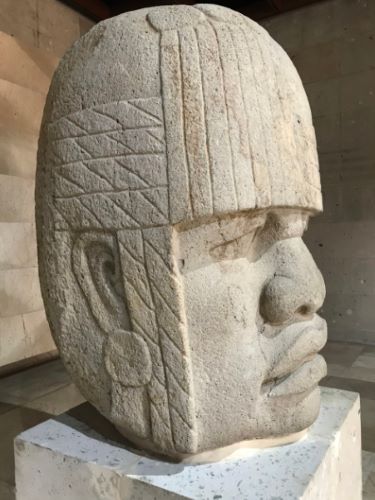
The emergence of Formative-period centers in Mesoamerica marked a new stage in the relationship between agriculture, settlement, and political life. By the second millennium BCE, farming communities had become increasingly stable in many regions, and some villages began to grow into larger ceremonial and administrative centers. Among the most important of these were the Olmec centers of the Gulf Coast lowlands, especially San Lorenzo, La Venta, and Tres Zapotes. The Olmec world did not invent Mesoamerican agriculture, but it shows how agricultural production could support denser settlement, craft specialization, elite authority, monumental construction, and long-distance exchange. The colossal heads and carved monuments of the Olmec have understandably drawn attention, yet those monuments depended on a less visible foundation: fields, riverbanks, floodplains, gardens, stored food, labor coordination, and water management.
The Gulf Coast lowlands offered both abundance and difficulty. Rivers, wetlands, lagoons, levees, and seasonally flooded landscapes created rich ecological zones, but they also required careful adaptation. The region could provide fish, turtles, waterfowl, reeds, useful plants, fertile alluvial soils, and transportation corridors, but too much water in one season and too little in another could make farming unpredictable. Olmec communities did not simply occupy a naturally generous landscape; they learned to use its variability. Farmers could plant on natural levees, exploit flood-replenished soils, cultivate maize and other crops near settlements, and draw on aquatic resources to supplement agricultural production. This mixed economy of fields, wetlands, rivers, and managed vegetation helped sustain populations large enough to support monumental centers. It also helped establish one of the recurring themes of Mesoamerican agricultural history: productive landscapes were rarely single-purpose landscapes. They were combinations of farming, fishing, gathering, transport, ritual, and settlement.
San Lorenzo, which flourished especially during the Early Formative period, illustrates the close connection between agricultural support and early political centralization. The site’s plateau, artificial modifications, monumental sculpture, elite residences, and evidence of craft production all point to a society capable of mobilizing labor beyond the household scale. Such mobilization required food. Farmers and food producers sustained not only themselves but also the people who carved stone, transported basalt, built platforms, maintained public spaces, participated in ceremonies, and served emerging elites. Agricultural surplus should not be imagined as a simple pile of stored grain automatically producing hierarchy, but it did create possibilities. When food could be produced, stored, redistributed, displayed, or demanded, it became part of political life. In the Olmec world, agriculture was not separate from authority; it helped make authority material.
Hydraulic engineering at San Lorenzo adds another layer to this picture. Archaeologists have identified carved stone drain and aqueduct elements, including U-shaped basalt conduits, associated with water movement at the site. These features demonstrate that Olmec builders understood how to channel water through construction, although their precise functions remain debated. They may have served drainage, drinking water supply, ritual display, elite consumption, or some combination of these purposes. In a lowland environment where water could be both resource and threat, such engineering represented a practical and symbolic mastery of landscape. Drains could protect built spaces from seasonal saturation, conduits could move water toward or away from important areas, and carefully worked stone channels could transform water control into a visible sign of organized labor and elite direction. The fact that these features were made from basalt, a heavy and valued material also used in monumental sculpture, suggests that water management could carry meanings beyond utility. It belonged to the same world of planned spaces, sacred geography, and political display that produced platforms, monuments, and offerings. What matters for the history of agricultural technology is not that every conduit directly irrigated crops, but that early Mesoamerican societies were already investing labor in the controlled movement of water. The ability to redirect, contain, drain, and display water was part of a wider technological imagination. Later reservoirs, canals, aqueducts, and irrigation did not appear from nowhere; they grew from older traditions of working with seasonal water and engineered landscapes.
La Venta, the great Middle Formative center located in a watery landscape near the Gulf Coast, further demonstrates the relationship between ecology and social power. Its monumental platforms, offerings, buried mosaics, and carefully planned ceremonial spaces reveal a society in which agricultural production, ritual authority, and environmental control were intertwined. Although La Venta is often discussed in terms of iconography and rulership, it too depended on food-producing communities spread through the surrounding region. Farmers, fishers, gatherers, and craft producers all contributed to a broader support system. The Olmec elite world was sustained not only by maize fields but by a regional ecology of rivers, swamps, fields, trees, animals, and transport routes. Food moved through this world alongside stone, shells, jade, obsidian, pigments, and ritual knowledge.
The Formative period also matters because it shows that agriculture was already becoming regional and social, not merely household-based. As settlements grew, food production had to be coordinated across wider landscapes. Some households may have farmed better soils, others worked wetter zones, and still others specialized in fishing, craft production, or exchange. Seasonal calendars became increasingly important because communal labor, ritual events, planting, harvest, and construction all had to be organized in time. Early elites likely drew power from their ability to mediate these relationships: commanding labor, sponsoring ceremonies, controlling access to prestige goods, and perhaps managing or symbolically claiming water, fertility, and agricultural abundance. In later Mesoamerica, rulers were often associated with rain, maize, mountains, caves, ancestors, and cosmic order. The roots of that political ecology are visible already in the Formative world, where food production and sacred authority developed together.
The Olmec contribution to Mesoamerican agricultural history should be understood less as a single invention than as an early intensification of relationships among farming, water management, settlement, and power. The Olmec inherited domesticated crops and village farming traditions from earlier centuries, but they helped demonstrate what those traditions could support when combined with dense settlement, labor organization, monumentality, and hydraulic skill. Their landscapes were not yet the chinampa fields of the Mexica or the reservoir cities of the Classic Maya, but they show the beginning of a long pattern: Mesoamerican civilizations grew by adapting food systems to difficult environments and then embedding those systems within political and ritual life. That pattern was never simply technological in a narrow sense. It required people to organize labor, claim land, store and redistribute food, coordinate seasonal work, and attach agricultural success to sacred authority. In the Olmec case, water and fertility were not abstract environmental facts; they were conditions around which social hierarchy, ritual performance, and monumental landscapes could be built. This makes the Formative period essential to the larger story, because it reveals the moment when farming was becoming more than subsistence. It was becoming infrastructure, ideology, and administration. The Formative foundations were agricultural, but they were also social and engineered. They made later urban worlds possible by proving that landscapes of water, soil, forest, and flood could be organized into centers of enduring power.
The Classic Maya Landscape: Farming the Forest, the Swamp, and the Slope

The Maya world forces any history of Mesoamerican agriculture to move beyond simple categories. For much of the twentieth century, Maya agriculture was often imagined through a narrow model of tropical swidden farming: forest was cleared, burned, planted for a few years, and then abandoned to fallow. That system certainly existed and remained important, but it cannot explain the scale, longevity, and density of Classic Maya civilization by itself. Cities such as Tikal, Calakmul, Caracol, Copán, Palenque, and many others required more than scattered fields rotating through forest. They required a varied food system capable of feeding rulers, priests, artisans, builders, merchants, farmers, warriors, and ritual specialists across landscapes that were anything but uniform. The Classic Maya did not farm a single environment. They farmed forests, bajos, hillsides, valleys, house lots, wetlands, seasonal depressions, and artificially modified terrain.
The Maya lowlands presented a set of contradictions. They could appear lush, green, and abundant, yet many zones had thin soils, porous limestone, uneven drainage, and pronounced seasonal drought. Water could vanish into the ground during the dry season and accumulate dangerously in bajos and depressions during the rainy season. Some areas had fertile soils; others demanded careful management to remain productive. These conditions meant that Classic Maya farmers had to think in patches rather than plains. A household might cultivate a milpa field, tend useful trees near the home, maintain kitchen gardens, gather forest products, use wetland margins, and rely on exchange with communities in different ecological zones. The same community could depend on several overlapping food strategies at once, shifting emphasis as rainfall, labor availability, political demands, or local environmental conditions changed. This patchwork approach was especially important because Maya cities were not surrounded by endless uniform farmland. Urban centers sat within landscapes broken by ridges, bajos, seasonal streams, sinkholes, uplands, forest zones, and pockets of more fertile soil. Farmers had to know where maize would grow best, where water would collect, where erosion threatened, where fruit trees could be protected, and where settlement expansion might compromise nearby production. The Maya landscape was not a simple division between city, field, and wilderness. It was a cultivated mosaic, where agricultural production depended on reading fine differences in soil, slope, moisture, vegetation, and access to water.
The forest itself was one of the most important parts of this mosaic. Older interpretations often treated tropical forest as an obstacle to civilization, something the Maya had to cut away farm. More recent scholarship has emphasized that the Maya forest was also a managed landscape. Useful trees, palms, medicinal plants, fuel sources, fiber plants, fruit-bearing species, and construction materials formed part of household and community economies. Around settlements, Maya families maintained gardens and orchards that blurred the line between agriculture and woodland. Avocado, cacao in suitable zones, zapote, ramon, annona, palms, and many other species could contribute food, shade, ritual materials, and marketable goods. These were not necessarily “fields” in the narrow sense, but they were part of the agricultural system because they helped sustain people and reduce dependence on annual crops alone. The forest was not simply outside the farm. In many places, it was part of the farm’s longer life cycle.
The Maya transformed wetlands and low-lying areas that might otherwise have seemed unsuitable for cultivation. Seasonal swamps and bajos could be dangerous to crops if left unmanaged, but they also held water, organic matter, and nutrient-rich sediments. In some regions, farmers constructed raised fields or planting platforms, using canals and ditches to control water, improve drainage, and build elevated surfaces safe from flooding. These systems could support crops while also creating aquatic environments rich in fish, turtles, water plants, and other resources. Wetland agriculture showed the same adaptive logic found elsewhere in Mesoamerica: a difficult environment was not merely avoided, but redesigned. The swamp became a field, the canal became both drain and reservoir, and the aquatic edge became part of food production. These wetland systems also complicate the assumption that Maya farmers relied primarily on extensive land clearance. Raised fields required planning, digging, maintenance, and repeated sediment management. Canals had to be kept open, planting surfaces rebuilt or refreshed, and water levels monitored through seasonal change. In return, farmers could gain access to moisture during dry periods, reduce the risk of flood damage during wet periods, and recycle organic material from canal beds back onto cultivated surfaces. Wetlands could become some of the most productive parts of the agricultural landscape, not marginal zones at the edge of civilization. This also required investment and maintenance, proving that Maya agriculture included durable landscape engineering rather than only temporary clearing.
Hillsides and slopes demanded another kind of solution. In upland areas and in hilly portions of the lowlands, Maya farmers built terraces to slow erosion, retain soil, capture rainfall, and create level planting surfaces. Terracing was labor-intensive, and its presence is important because it points to long-term commitment to particular landscapes. A terrace wall was not built for a single season. It represented accumulated labor, inherited land use, and repeated maintenance. Terraces also reveal the relationship between farming and settlement density. Where populations grew and access to easy farmland became more limited, slopes that might once have been marginal could be transformed into productive agricultural space. This was not merely adaptation to scarcity; it was intensification through engineering. Stone walls, check dams, contouring, and soil retention made the hillside into infrastructure.
Water management connected these different agricultural zones to the survival of Maya cities. Many major Maya centers were not located beside large permanent rivers, and seasonal rainfall had to be stored, directed, and protected. Reservoirs, aguadas, dams, canals, plastered surfaces, and drainage helped communities capture water during rainy months and survive dry ones. These water systems were essential for drinking, cooking, construction, ritual, and sometimes agriculture. They also had political significance. Control over water could strengthen royal authority, especially in cities where access to stored water became a matter of survival. The built environment of Maya cities often directed water through plazas, reservoirs, and ceremonial spaces, suggesting that practical hydraulics and sacred geography were deeply intertwined. Reservoirs could be placed near monumental cores, linked to causeways or public architecture, and maintained through collective labor that made water storage both a practical necessity and a political performance. In times of reliable rainfall, this may have seemed like proof of divine favor and royal competence; in times of drought, their failure or insufficiency could expose the limits of authority. Water management connected household survival to public power. It helped define where people could live, how densely they could settle, how ceremonies were staged, and how rulers presented themselves as mediators between human communities and the forces of rain, fertility, and abundance. Rain, fertility, kingship, and agricultural abundance were not separate categories in Maya political imagination.
The Classic Maya landscape, then, should be understood as a working landscape of remarkable diversity. Its productivity came from the combination of milpa fields, managed forests, house gardens, terraces, wetlands, reservoirs, and exchange networks. This complexity also changes how we think about Maya resilience and vulnerability. A diverse agricultural system could buffer communities against local crop failure, but it also required labor, coordination, maintenance, and political stability. Terraces had to be repaired, reservoirs cleaned, canals maintained, fields rotated, trees protected, and water stored. When drought, warfare, population pressure, or political breakdown disrupted these systems, the landscape could become harder to sustain. The achievement of Maya agriculture was not that it solved every environmental problem permanently, but that it created a flexible and layered method capable of supporting one of the most extraordinary urban civilizations of the ancient Americas. The Maya farmed the forest, the swamp, and the slope because their civilization depended on all three.
Raised Fields and Wetland Agriculture: Camellones, Bajos, Canals, and Aquatic Food Systems
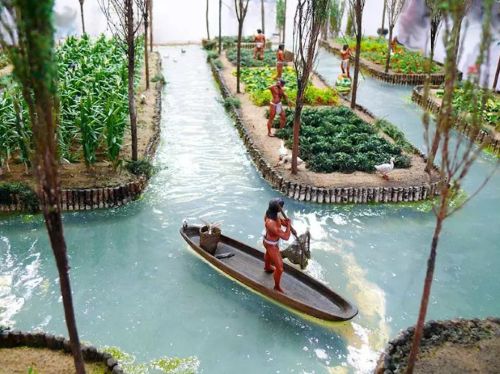
Wetlands were among the most important and most easily misunderstood agricultural landscapes of ancient Mesoamerica. To an outside observer, bajos, swamps, marshes, floodplains, and seasonally saturated depressions might appear marginal, unhealthy, or unsuitable for farming. Yet for Mesoamerican farmers, such places could be reservoirs of fertility if they were carefully managed. Wetland agriculture depended on a different logic from dry-field cultivation. Instead of simply trying to remove water or avoid it, farmers learned to work with fluctuating water levels, organic sediments, aquatic plants, fish, and seasonal flooding. Raised fields, sometimes described as camellones in broader Latin American contexts, were part of this technological tradition: planting surfaces were elevated above wet ground, while canals and ditches managed water around them. The result was not only a farm but a hybrid landscape, part field, part canal, part aquatic habitat, and part soil-renewal machine.
In the Maya lowlands, bajos presented both danger and opportunity. During the rainy season, they could flood or become waterlogged, drowning crops planted too low. During the dry season, they could retain moisture longer than upland fields, making them valuable in landscapes where seasonal drought was a constant concern. By cutting canals, digging ditches, and building raised planting platforms, farmers could transform these low-lying zones into usable agricultural surfaces. Mud and organic material excavated from canals could be piled onto field beds, lifting crops above flood levels while enriching the soil. The canals then served multiple purposes: they drained excess water, retained moisture, marked field boundaries, supplied sediment for renewal, and created aquatic corridors. This was especially important in a region where agricultural success depended on managing too much water and too little water within the same annual cycle. Raised fields allowed farmers to reduce the extremes of that cycle by elevating crops when floods threatened and keeping moisture nearby when drought returned. Their construction also turned wetland soil into a movable resource. Instead of treating mud as a problem, farmers used it as fertilizer, structure, and insurance. Repeated digging and redeposition could gradually build planting beds rich in organic matter, while the canal network helped regulate the flow and storage of water around them. This was landscape engineering on an intimate scale. It did not require monumental stone architecture to be sophisticated. Its sophistication lay in turning the instability of wetlands into a productive rhythm.
Raised-field agriculture also complicates any simple opposition between cultivation and aquatic life. The canals between field beds could support fish, turtles, shellfish, edible plants, reeds, insects, and birds, all of which contributed to household subsistence or local exchange. Aquatic vegetation could be harvested, composted, or allowed to decay into nutrient-rich material. Sediments from canal bottoms could be periodically lifted back onto the planting surfaces, renewing fertility in ways that resembled, in principle, the later chinampa practice of recycling lake mud. Water lilies and other aquatic plants may have helped shade water surfaces, reduce evaporation, and maintain more stable canal ecologies in some contexts. Farmers gained more than land from wetland modification. They created productive edges where crops, water, animals, and organic matter interacted. These edges made wetland systems especially resilient because food did not come from one source alone. A household using such a landscape might harvest maize or other crops from raised beds while also taking protein from canals, reeds for construction or craft use, aquatic plants for compost or food, and mud for field renewal. This joined agriculture, aquaculture, and resource gathering into one working environment. It also softened the risk of crop failure, because a poor harvest on the planting surface did not necessarily mean the entire wetland zone failed as a food source. The wetland became a diversified pantry, and its productivity depended on maintaining relationships among water depth, plant growth, sediment movement, and animal life. In that sense, raised-field farming was not merely about making dry ground in a swamp. It was about designing a living food system in which cultivated and aquatic resources reinforced one another.
The labor demands of these constructs were considerable. Raised fields had to be built, reshaped, cleaned, and maintained. Canals could silt up; field surfaces could erode or slump; water levels could change unpredictably; and vegetation had to be managed so that useful growth did not become obstruction. This labor likely tied households and communities to particular wetland zones across generations. A raised-field system represented accumulated investment, not a temporary experiment. It also required close environmental knowledge. Farmers had to know where water rose first, where it lingered, how deep canals should be, how high beds needed to stand, and when sediment should be moved. Wetland farming was not merely an agricultural technique but an inherited hydrological practice. It required people to read water as carefully as dry-field farmers read rainfall and soil.
Wetland agriculture was not confined to one civilization or one period, but its role in the Maya lowlands is especially important because it helps explain how dense populations could be supported in environments once thought too fragile for intensive settlement. Sites and regions associated with raised fields, canals, and modified bajos show that Maya farmers did not depend only on shifting milpa fields in cleared forest. They also invested in fixed agricultural infrastructure that could support repeated cultivation and local intensification. Such systems may have varied widely in scale. Some were probably modest household or community works, while others were larger and more coordinated. Their uneven distribution matters: not every Maya city or settlement relied equally on raised fields. But where they were used, they reveal a willingness to engineer wetlands rather than simply avoid them. They also show that ancient Mesoamerican farmers understood fertility as something that could be cycled through water, mud, vegetation, and labor.
These raised-field and canal methods also provide an important bridge to later developments in central Mexico, especially the chinampas of the Valley of Mexico. The two should not be treated as identical. Chinampas were highly developed lakebed agricultural plots associated especially with the Mexica world and the freshwater zones of Xochimilco and Chalco, while Maya raised fields emerged within different wetland ecologies and social conditions. Still, both shared a fundamental insight: wet ground could become intensely productive when water, soil, plants, and labor were organized together. In both cases, agricultural land was made rather than merely found. The swamp, the bajo, and the lake margin were not empty obstacles to civilization. They were among the places where Mesoamerican agricultural intelligence became most visible, turning saturated landscapes into food-producing systems that fed bodies, supported settlements, and reshaped the meaning of cultivable land.
Terraces and Hillside Engineering: Making Mountains Productive
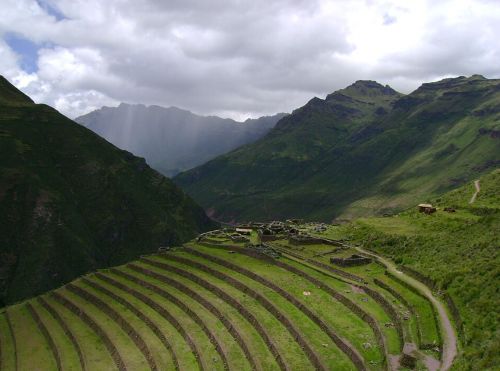
If wetlands required farmers to work with too much water, slopes required them to work against gravity. Much of Mesoamerica was not a broad, flat agricultural plain but a region of hills, ridges, volcanic highlands, mountain valleys, and uneven terrain. Rainfall could be both gift and threat. Water falling on a slope might nourish crops, but it could also carry soil downhill, strip fields of nutrients, expose stones, and make repeated cultivation impossible. Terrace farming answered this problem by turning inclined land into a sequence of controlled planting surfaces. Farmers cut fields into hillsides, supported them with stone retaining walls or earthen embankments, trapped eroding soil, slowed runoff, and created flatter spaces where crops could grow. A terrace was both field and machine: it held earth in place, managed water, and made mountains productive.
Terracing also reveals the long-term character of Mesoamerican agricultural investment. A milpa field could shift across a landscape according to fallow cycles, but a terrace was fixed in place. It required planning, construction, repair, and inheritance. Stone had to be gathered and arranged, slopes cut or reshaped, soil accumulated behind walls, and drainage carefully managed so that walls did not collapse during heavy rains. Such work made sense only where communities expected to return to the same land again and again. Terraces speak to settlement stability, population density, land pressure, and social organization. They were not casual improvements. They were durable infrastructure, what some scholars describe as “landesque capital”: investments in land that stored labor across generations and increased the long-term productive capacity of a place. This kind of investment also changed how people experienced agricultural time. A terrace did not belong only to one planting season; it belonged to a sequence of seasons, repairs, inheritances, and remembered harvests. Its usefulness depended on repeated attention, because walls could bulge, drains could clog, soils could thin, and runoff could cut new channels after storms. In that sense, terrace agriculture created a relationship of obligation between farmers and land. The hillside had been made productive by previous labor, but it remained productive only if later generations continued the work. Terraces were agricultural structures, but they were also archives of human persistence, preserving in stone and soil the accumulated labor of communities that chose to make difficult land worth returning to.
Among the Maya and other Mesoamerican peoples, terrace systems appeared in regions where slopes, erosion, and growing population made agricultural intensification necessary. In parts of the Maya lowlands, especially hilly zones such as northwestern Belize, terraces helped conserve soil and moisture while expanding cultivation beyond the easiest valley bottoms. In highland regions, terraces allowed farmers to exploit steep terrain that would otherwise have been difficult or dangerous to farm. These could vary from small household-built features to larger networks of walls, check dams, and contour fields. Some terraces were built primarily to retain soil; others also helped manage rainfall, direct runoff, or create pockets of deeper cultivation. Their variety matters because terrace agriculture was not a single standardized invention. It was a family of techniques adapted to slope, stone availability, soil depth, rainfall, crop choice, and local labor organization.
Hillside engineering also changed the social meaning of land. A terraced slope was visibly claimed, improved, and remembered. Unlike a temporary clearing, it bore the marks of previous labor. Families and communities could point to walls, paths, planting surfaces, and repaired sections as evidence of use and attachment. This made terraces agricultural, but also historical. They recorded human decisions in stone and soil. They could support staple crops such as maize, beans, and squash, but they could also exist within broader systems that included orchards, house gardens, managed forest, water storage, and exchange. Terraces were especially important because they reduced vulnerability in landscapes where soil loss could quickly become food loss. By slowing erosion and retaining moisture, they helped make cultivation more reliable in places where a heavy storm might otherwise undo months of work.
The importance of terraces lies not only in what they produced, but in what they reveal about Mesoamerican technological thinking. Ancient farmers did not simply seek naturally ideal farmland. They made farmland by reshaping difficult environments. Slopes became fields through retaining walls; runoff became useful moisture when slowed and captured; eroding soil became a resource when trapped behind stone. Terracing belongs beside raised fields, reservoirs, canals, forest gardens, and chinampas as part of the larger Mesoamerican tradition of landscape engineering. It also complicates any picture of ancient agriculture as either simple subsistence or environmental overreach. Terraces show a middle reality: careful, labor-intensive adaptation that could be highly productive when maintained, but vulnerable when population pressure, warfare, political instability, or neglect interrupted the work of repair. A terrace system could expand the food base of a community, but it could also tie that community more tightly to maintenance burdens and local land rights. Its success depended on cooperation, continuity, and access to labor. When those conditions held, terraced hillsides could sustain dense settlement and make marginal-looking land central to survival. When those conditions failed, the same walls could deteriorate, releasing the soil they once protected and exposing how fragile engineered abundance could be. Mountains could feed cities and villages, but only because generations of farmers learned how to hold them in place.
Forest Gardens and Pet Kot: Agroforestry, Biodiversity, and the Cultivated Forest
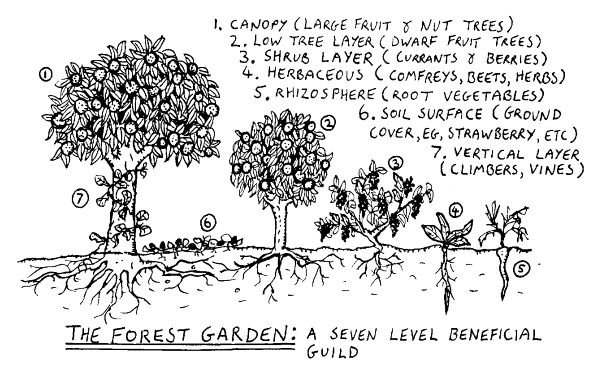
The forest garden was one of the most sophisticated and least obvious agricultural technologies of ancient Mesoamerica. Modern observers have often imagined agriculture and forest as opposites: a farmer clears the trees, plants a field, and replaces wild nature with cultivated land. But in much of the Maya world and elsewhere in Mesoamerica, the relationship was more complicated. Forests could be cultivated, protected, edited, and guided. Useful trees were spared, encouraged, transplanted, or planted near homes and fields. Annual crops could give way to shrubs, fruit trees, palms, medicinal plants, and secondary growth. A landscape that might look like “forest” to an outsider could actually be a long-managed food system shaped by generations of human choice. The cultivated forest was not a failure to clear land fully; it was a different kind of agriculture.
The Maya practice often discussed in relation to pet kot illustrates this broader agroforestry logic. Pet kot, sometimes described as enclosed or bounded garden plots, involved managed spaces in which useful plants could be cultivated within or alongside forested settings. Low stone walls or boundary features could mark off areas where households protected fruit trees, medicinal species, fuelwood, fiber plants, and other resources. These spaces were not necessarily fields in the familiar sense of open rows of annual crops. They were mixed, layered, and long-lived. A single garden might contain trees, vines, herbs, shrubs, root crops, and volunteer plants that had been tolerated because they were useful. Its productivity came from vertical layering as much as horizontal extension: canopy trees, understory plants, ground cover, climbers, and cultivated annuals could occupy the same managed space in different ways. Such gardens also helped stabilize soil and moisture, especially in environments where exposed ground could dry, erode, or lose fertility. Boundaries mattered because they made care visible. A wall or enclosure did not simply keep animals out or mark property; it signaled that the space had been selected, protected, and incorporated into household labor. Such spaces remind us that ancient Mesoamerican agriculture did not always seek maximum openness. Sometimes the goal was complexity: shade, moisture, diversity, soil cover, and a steady supply of different foods and materials across the year.
Agroforestry also extended the life of the milpa cycle. A cleared plot might first produce maize, beans, squash, chili, and other annual crops. After several years, as soil fertility changed and weeds increased, the field might shift into fallow. But fallow did not have to mean abandonment. Farmers could protect useful seedlings, encourage fruit trees, cut unwanted growth, gather firewood, harvest medicinal plants, and allow the plot to develop into a managed secondary forest. The milpa did not end when annual cultivation stopped. It could become part of a longer sequence of production, moving from field to garden to woodland. This succession-based system made ecological recovery productive rather than idle. The forest returned, but it returned through human guidance, carrying traces of earlier cultivation and continuing to feed, shelter, and supply the community. This sequence also offered a practical solution to the limits of tropical soil management. Rather than forcing one plot into permanent annual production, farmers could rotate the kind of productivity expected from it. In one phase, it yielded staple crops; in another, it yielded fuel, fruits, medicines, fibers, game habitat, and eventually renewed fertility. The same piece of land could serve different purposes, and the farmer’s task was not simply to extract one harvest but to guide a changing ecological process. Agroforestry made time itself part of agricultural technology.
The biodiversity of forest gardens mattered economically and nutritionally. Maize could provide the caloric base of daily life, but tree crops and managed woodland resources broadened the diet and reduced risk. Avocado, cacao in suitable humid zones, sapote, ramon, annona, guava, palms, and other useful species offered fruit, seeds, oils, shade, animal habitat, construction material, and trade goods. Medicinal plants, resins, fibers, dyes, and fuelwood added further value. This diversity was especially important in a world where drought, pests, political disruption, or local crop failure could threaten annual fields. A household with access to managed trees and forest resources had more ways to survive a bad season. Forest gardens also spread food production through time. Instead of depending entirely on one harvest, families could draw on plants that fruited, matured, or became useful at different moments of the year.
The cultivated forest also had social and cultural importance. Trees outlived individual planting seasons and often outlived individual farmers. They tied households to places through memory, inheritance, and care. A fruit tree planted or protected by one generation could feed another; a walled garden or managed grove could become part of a family’s identity and local history. These spaces also blurred the line between subsistence and ritual life. Cacao, copal, flowers, medicinal plants, and other forest products could carry ceremonial meanings as well as practical value. The forest was not merely a storehouse of resources but a living landscape of obligation, knowledge, and sacred association. In Maya thought especially, caves, mountains, trees, rain, maize, and ancestors were deeply connected. Agroforestry participated in a larger worldview in which fertility was maintained through relationship rather than extraction alone. To care for trees and useful plants was also to care for continuity: between household and land, between the living and the dead, and between ordinary food production and sacred order. This is why forest gardens cannot be understood only as economic adaptations. They were places where practical knowledge, family memory, ritual value, and ecological management overlapped. A managed grove could feed the body, supply the household, mark belonging, and connect human labor to a larger landscape of fertility.
Forest gardens and pet kot techniques complicate the older image of ancient Mesoamerican farmers as people who simply cut down tropical forests until the land failed. Deforestation and erosion certainly occurred in some places, especially under population pressure or political stress, and the cultivated forest should not be romanticized as perfect sustainability. But the evidence for managed woodland, household gardens, orchards, and long-cycle milpa systems shows that many farmers understood forest regrowth as part of production rather than as the enemy of agriculture. They did not merely clear forests; they composed them. This makes agroforestry central to the larger argument of Mesoamerican agricultural history. Alongside terraces, raised fields, reservoirs, canals, and chinampas, forest gardens reveal a civilization that repeatedly transformed difficult environments into productive ones, not always by imposing rigid control, but often by guiding ecological abundance in forms that could endure.
Water, Drought, and Urban Survival: Reservoirs, Canals, Aqueducts, and Stored Rain

Water management was one of the great hidden technologies of ancient Mesoamerican urban life. Agriculture depended on rainfall, but rainfall was rarely dependable in the simple way cities needed it to be. Much of Mesoamerica lived with seasonal contrast: wet months could bring sudden abundance, erosion, flooding, and saturation, while dry months could expose the fragility of settlements whose populations had grown beyond what nearby springs, streams, or household storage could easily support. The challenge was not merely how to grow crops, but how to make water available in the right place, at the right time, and in usable form. Reservoirs, canals, aqueducts, drains, dams, clay-lined basins, plastered catchments, and modified natural depressions all belonged to this larger effort. They were technologies of survival, but also technologies of authority, because whoever organized water could help organize the city.
This was especially true in the Maya lowlands, where the apparent lushness of the forest concealed a recurring dry-season problem. Many major Maya centers were built in landscapes without large permanent rivers immediately beside them. Limestone geology, seasonal rainfall, and uneven drainage meant that water could be present in abundance at one moment and scarce at another. Rain might fall heavily during the wet season, but porous bedrock, evaporation, and the absence of dependable surface streams could make that abundance difficult to hold. Maya communities responded by reshaping urban surfaces to capture, direct, and store rain. Plastered plazas and sloped architectural surfaces could channel runoff toward reservoirs. Aguadas and natural depressions could be enlarged or modified. Dams, channels, and retaining features helped hold water in place. In some cities, reservoirs became part of the planned civic landscape rather than peripheral storage pits. They could be located near monumental architecture, integrated into causeways, and positioned where runoff from public spaces could be gathered efficiently. This meant that architecture itself participated in water collection. A plaza was not only a ceremonial surface; it could also be a catchment. A raised platform was not only a political or ritual stage; it could help direct rainwater toward storage. Water storage was built into urban design. The city itself became a catchment, gathering rain from roofs, plazas, courtyards, and hillsides and moving it toward places where it could sustain life through dry months.
Reservoirs were not simply passive containers. They required construction, maintenance, cleaning, protection from contamination, and social regulation. Silt accumulated. Walls and linings needed repair. Access had to be managed, especially during dry seasons when stored water became more valuable. Some systems may have used plants, sediments, or controlled settling to improve water quality, while others depended on repeated dredging and renewal. The maintenance of reservoirs required labor beyond the individual household, and that labor connected water to hierarchy. Rulers who sponsored, controlled, or ritually associated themselves with reservoirs could present themselves as guardians of abundance. In a society where rain, maize, kingship, caves, mountains, and divine forces were deeply intertwined, stored water was never only practical. It was also political and sacred. A full reservoir could confirm the order of the world; a failing one could expose the limits of royal power.
Canals and drainage systems served a different but related purpose. In some contexts, they moved water toward fields, settlements, or storage areas; in others, they moved excess water away from built spaces. The same society that feared drought also had to manage flooding, erosion, and saturation. Urban centers with plazas, platforms, causeways, and dense residential zones could not simply wait for water to go where it pleased. Drains protected architecture, canals helped regulate wetland fields, and channels shaped the movement of water through both agricultural and ceremonial landscapes. Water management was not one technology but a family of related practices. A canal could be irrigation, drainage, transportation, boundary, fish habitat, sediment trap, or ritual feature depending on its location and use. This flexibility helps explain why water systems appear across so many different Mesoamerican settings. They answered local problems, but they also reflected a wider habit of treating water as something that could be guided, stored, displayed, and made socially meaningful.
Aqueducts and more formal water-conveyance technologies show another dimension of this technological tradition. From early Formative examples such as the stone conduits associated with San Lorenzo to later systems in central Mexican urbanism, the movement of water through constructed channels demonstrated both engineering knowledge and organized labor. Aqueducts could supply settlements with cleaner water, move water from springs or elevated sources, or serve elite and ritual precincts. They also made water visible as an achievement of planning. A conduit, drain, or aqueduct transformed a natural flow into an architectural event. It showed that water had been captured by design. These also required decisions about route, gradient, material, maintenance, and destination. Water does not move usefully through a construct simply because a channel exists; it has to be guided by slope, contained by durable surfaces, protected from blockage, and integrated with the spaces it serves. That made hydraulic construction both a practical science and a social project. People had to quarry, carve, line, repair, clear, and monitor the structures that carried water. In densely settled landscapes, this mattered because water access was never merely environmental. It was social. Who received water, who maintained the channels, who controlled access, and who claimed credit for abundance were all questions of power. Hydraulic engineering linked the physical flow of water to the political flow of authority.
Agricultural water management varied by region. In dry or seasonally dry highland basins, irrigation and canal systems could support more predictable cultivation. In wetlands, canals controlled saturation and renewed soils. In Maya cities, reservoirs stored rainfall for urban survival. In central Mexico, lakes, springs, canals, and later chinampa landscapes made water part of an intensely productive food network. These regional differences matter because there was no single “Mesoamerican irrigation system.” Instead, there were many water technologies adapted to local environments. Some were monumental and public; others were small, domestic, or agricultural. Some served crops directly; others served cities whose populations made agriculture possible through labor, markets, tribute, and administration. Water management should be understood as the connective tissue between environment and society. It linked household survival to urban planning, crop production to ritual, and seasonal rainfall to long-term settlement.
Drought reveals both the strength and vulnerability. Stored rain, reservoirs, canals, and aqueducts could buffer communities against seasonal dryness and short-term irregularities, but they could not eliminate climate risk altogether. When droughts became prolonged, when populations expanded, when reservoirs silted up, when warfare disrupted maintenance, or when political authority failed to coordinate labor, water systems could become points of stress. This does not mean that Mesoamerican water management failed in any simple sense. On the contrary, its very scale and variety show how successfully ancient communities managed difficult hydrological conditions for centuries. But water technologies created obligations as well as solutions. They had to be repaired, cleaned, guarded, and ritually legitimated. Ancient Mesoamerican cities survived by storing rain, redirecting flows, and transforming water into infrastructure. Their achievement was not that they escaped drought, but that they built worlds capable of enduring its return again and again.
Postclassic Intensification: Agriculture, Markets, Tribute, and Regional Food Systems

The Postclassic period brought a new intensity to the relationship between agriculture and power. Farming had always supported settlement, ritual, and hierarchy, but in the centuries after the decline of many Classic centers, food production became increasingly tied to markets, tribute obligations, fortified communities, mobile merchants, and expanding regional states. Agricultural systems had to support not only households and local elites but towns, armies, craft specialists, marketplaces, and imperial administrations. This did not mean that older techniques disappeared. Milpa fields, terraces, gardens, orchards, irrigation works, and wetland cultivation remained important. What changed was the scale of integration. Food moved through broader political and commercial networks, and agricultural landscapes became more tightly connected to taxation, exchange, warfare, and urban demand.
Postclassic Mesoamerica was not a single political world, but many regions experienced sharper forms of competition and consolidation. In central Mexico, the Toltec and later Mexica worlds drew food and tribute from surrounding agricultural zones. In Oaxaca, Mixtec and Zapotec communities continued to farm valleys, slopes, and irrigated lands while participating in regional exchange and dynastic politics. In the Maya area, Postclassic communities reorganized around coastal trade, smaller centers, fortified locations, and shifting political alliances. Across these different settings, agriculture remained the base from which other forms of wealth were made possible. Maize, beans, squash, chili, cacao, cotton, amaranth, maguey products, salt, honey, feathers, and forest goods could circulate through markets or tribute systems. Some crops fed ordinary people; others carried prestige, ritual value, or commercial importance. Cacao, for example, was not merely a food but a high-status drink, ritual substance, and medium of exchange in some contexts. Cotton could be transformed into cloth, tribute garments, armor, and trade goods. Maguey supplied fiber, food, drink, and useful materials in drier highland zones. Agriculture was not only the production of calories. It was the production of value.
Markets became crucial institutions in this intensified world. They connected rural producers, urban consumers, craft specialists, merchants, and political authorities. A farmer might produce crops for household use, local exchange, tribute demand, and sale or barter in the marketplace. Marketplaces allowed ecological diversity to become social abundance. Highland goods could be exchanged for lowland products; lake-basin foods could reach urban populations; cacao, salt, cotton, obsidian, pottery, baskets, cloth, and prepared foods could move through regional circuits. This mattered because no single environment produced everything. Mesoamerican food networks depended on complementarity between zones: wet and dry, highland and lowland, forest and lake, valley and coast. Markets helped stabilize those differences by allowing households and communities to access goods beyond their immediate ecological setting. They also encouraged specialization, since some communities could focus on particular crops, crafts, or resources for exchange.
Tribute transformed agriculture in a different way. Where markets were negotiated through exchange, tribute was tied to obligation, conquest, hierarchy, and state power. Subject communities could be required to deliver maize, beans, chili, cotton mantles, cacao, feathers, firewood, labor, or other goods at regular intervals. In the Mexica imperial system, tribute lists and pictorial records reveal the enormous importance of agricultural and craft production to imperial administration. Food and agricultural goods moved upward through political structures, sustaining rulers, nobles, warriors, priests, festivals, and urban populations. Tribute also reshaped the meaning of productive land. A field was not merely a household resource; it could become part of an imperial calculation. The capacity of a region to produce cotton, cacao, maize, or other valued goods affected its political significance. Conquest was not only about territory in the abstract. It was also about access to productive ecologies.
Intensification carried benefits and burdens. Larger exchange systems could move food across regions and reduce local isolation, but they could also increase pressure on farmers. Tribute demands might force households to produce beyond their own needs or devote labor to crops and goods valued by elites. Market opportunity could encourage production, but it could also expose communities to inequality, price fluctuation, and dependence on exchange networks. Irrigation, terracing, chinampa cultivation, orchards, and other intensive techniques could raise yields, but they also required labor, maintenance, and social coordination. Postclassic agriculture was both dynamic and demanding. It supported urban growth and political expansion, but it did so by drawing rural labor more deeply into constructs of power. The same surplus that fed cities could also feed armies, ceremonies, and elite display.
By the time the Mexica Empire rose in the Late Postclassic period, Mesoamerican agriculture had become part of a highly organized regional food economy. Tenochtitlán could not have survived on nearby fields alone, even with the extraordinary productivity of chinampas. It depended on tribute, markets, lake transport, surrounding towns, specialized producers, and long-distance exchange. The Postclassic world prepares the ground for understanding chinampa agriculture not as an isolated marvel but as one component of a broader system. Wetland fields, upland terraces, irrigated plots, forest products, tribute towns, and bustling markets all helped feed urban life. The great achievement of Postclassic intensification was not simply that farmers produced more food. It was that Mesoamerican societies built mechanisms for moving food, valuing it, taxing it, exchanging it, and turning it into political power. Agriculture remained rooted in soil and water, but by the Postclassic period its reach extended through marketplaces, tribute routes, imperial ledgers, and the daily hunger of cities.
Chinampas and the Mexica Urban Food Machine: Farming the Lakes of the Valley of Mexico
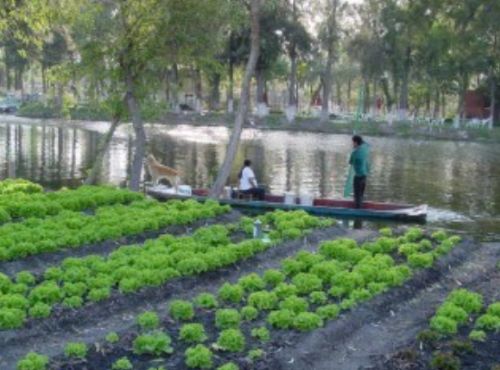
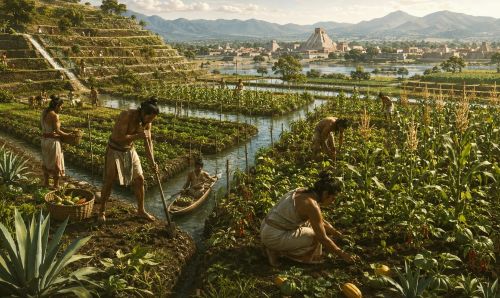
Chinampa agriculture was one of the most remarkable forms of intensive farming in the ancient Americas. In the lake basin of central Mexico, especially around Xochimilco and Chalco, farmers transformed shallow freshwater zones into highly productive agricultural landscapes. These fields are often called “floating gardens,” but that phrase is misleading if taken literally. Chinampas did not simply drift on the surface of the water. They were constructed plots, built up from lake mud, vegetation, reeds, sediment, and soil, bordered by canals and often stabilized by trees such as willows. Their genius lay in the way they joined land and water into a single productive system. Instead of draining the lake completely or avoiding wet ground, farmers made the lakebed itself into farmland.
The construction of chinampas required careful planning and repeated labor. Farmers marked out rectangular plots in shallow water, using stakes, reeds, brush, and woven materials to define the edges. Mud and organic matter were dredged from the surrounding canals and piled onto the beds, gradually raising the planting surface above the waterline. Trees planted along the edges helped hold the soil in place, while the canals provided constant moisture, transport routes, and a renewable source of nutrient-rich sediment. The system was self-replenishing when properly maintained. Canal mud could be returned to the fields, plant matter could decay into fertilizer, and water could reach crops without the need for rainfall alone. A chinampa was not just a field placed beside water. It was a field made by water, fed by water, and renewed through the movement of water, mud, and human labor.
The productivity of chinampa agriculture came from this constant relationship between fertility and maintenance. Because the fields remained moist and could be fertilized with dredged sediment and organic material, they could support intensive cultivation and multiple plantings. Maize, beans, squash, chili, tomatoes, amaranth, flowers, and other crops could be grown in these lake landscapes, while seedbeds and transplanting techniques helped maximize yields. The canals also moderated temperature and provided transportation, allowing produce to move efficiently by canoe through the lake system and into markets. In a dense urban region, this mattered enormously. Food did not have to travel only by foot over difficult terrain. It could move through water corridors directly into the heart of the Valley of Mexico’s commercial and political life. Chinampa fields could also specialize according to demand, producing not only staples but fresh vegetables, herbs, flowers, and other goods valued in urban markets. Their productivity rested on a cycle of constant attention: dredging canals, rebuilding edges, planting seedlings, harvesting crops, clearing vegetation, and returning organic matter to the beds. This made chinampa agriculture labor-intensive, but it also made it unusually responsive. Farmers could adjust plantings to seasonal conditions, market needs, and household requirements. Chinampa agriculture was not merely productive in biological terms; it was logistically brilliant.
The rise of Tenochtitlán made the chinampas even more important. The Mexica capital was an island city whose population placed extraordinary pressure on surrounding food systems. No single agricultural technique could feed such a metropolis by itself, and chinampas should not be treated as the sole source of the city’s food. Tenochtitlán depended on tribute, markets, lake transport, surrounding towns, long-distance exchange, and regional agricultural zones. Yet chinampas formed one of the most efficient nearby systems for producing fresh food at high intensity. Their proximity to the city, their connection to canoe transport, and their ability to yield repeated harvests made them central to the urban food machine. The city’s splendor (its temples, markets, palaces, causeways, and ceremonial life) rested partly on the muddy, carefully tended fields of the lake margin.
Chinampas also show how agricultural technology could become political geography. The Mexica expansion into the southern lake zone was not simply a matter of territorial ambition. Control over places such as Xochimilco and Chalco meant access to productive wetland agriculture, labor, transport routes, and food supplies. Conquest and alliance were tied to the basin’s agricultural infrastructure. Communities that built, maintained, and farmed chinampas were not peripheral to imperial power; they were part of its foundation. Their work helped sustain the capital and its markets, while imperial structures helped direct the movement of goods, tribute, and labor. The lake system became a political landscape, where canals, fields, towns, causeways, and markets linked food production to the expansion of Mexica authority. This connection between agriculture and power was visible in the way the basin itself functioned as a network. Canoes carried crops from chinampa zones to market centers; tribute obligations tied subject communities to imperial demand; causeways linked the island capital to surrounding settlements; and military expansion secured access to productive regions. Food production, transportation, and political control were inseparable. To command the lake world was not simply to rule over water and towns, but to influence the movement of nourishment into the capital. Chinampas made imperial life possible not only by feeding people, but by binding rural labor, wetland ecology, and urban consumption into one system.
The chinampas also belong within a longer Mesoamerican history of wetland adaptation. It was not identical to Maya raised fields or other canalized agricultural constructs, but it shared with them the basic insight that saturated landscapes could be made productive through careful engineering. Like raised fields, chinampas used canals, organic sediments, elevated beds, and water control to turn wetlands into food-producing networks. But in the Valley of Mexico, this logic reached an extraordinary scale and intensity because it was tied to a major urban and imperial center. Chinampas were simultaneously agricultural plots, water-management devices, transportation networks, property units, and ecological foundations. Their canals did not simply separate fields; they connected producers to consumers, allowed movement through the agricultural landscape, stored moisture, and supplied the mud that renewed fertility. Their trees did not merely mark boundaries; they stabilized soil, shaped microclimates, and made the constructed fields more durable. Their beds did not merely receive crops; they embodied cycles of dredging, composting, transplanting, and harvesting that kept land and water in continuous exchange. They remind us that ancient Mesoamerican farmers did not merely adapt to landscapes; they created new landscapes in which natural processes and human design worked together.
The enduring significance of chinampa agriculture lies in how completely it overturns assumptions about technological sophistication. It did not require metal plows, draft animals, or wheeled transport to be advanced. Its materials were humble: mud, reeds, water, trees, seeds, canoes, and labor. Yet from those materials, farmers built one of the most productive agricultural systems of the premodern world. Chinampas reveal the larger pattern running through ancient Mesoamerican agriculture: difficult environments became opportunities when understood deeply enough. Forests could become gardens, slopes could become terraces, swamps could become raised fields, and lakebeds could become farms. In the Valley of Mexico, the Mexica and their neighbors turned water into land without fully ceasing to treat it as water. That was the brilliance of the system. The lake did not disappear beneath agriculture; it became agriculture.
Agriculture, Cosmology, and Social Order: Food as Sacred Technology

Agriculture in ancient Mesoamerica was never merely an economic activity. It fed households, cities, armies, markets, and empires, but it also organized the sacred imagination. Maize, rain, earth, mountains, caves, trees, springs, and ancestors formed part of a world in which food production linked human labor to cosmic order. A field was not simply a plot of land; it was a place where people entered into relationship with forces that exceeded them. Planting, watering, harvesting, storing, grinding, cooking, offering, and eating all carried meanings that reached beyond subsistence. To farm was to participate in the renewal of life. The agricultural year gave shape to ritual time, and ritual gave agriculture a language of obligation, gratitude, fear, and hope.
Maize stood at the center of this sacred technology. Across Mesoamerica, and especially in Maya and central Mexican traditions, maize was more than the primary staple. It was a substance of identity. Mythic traditions associated human beings with maize, making the crop not only food for the body but a sign of what humans were made from and what sustained them. The maize plant’s life cycle (burial as seed, emergence as green shoot, maturation, cutting, drying, grinding, and transformation into food) provided a powerful model for death, rebirth, ancestry, and renewal. The daily labor of making tortillas, tamales, atole, and other maize foods was not detached from cosmology. It repeated, at household scale, the larger transformation of earth’s fertility into human life. The kitchen, the grinding stone, and the field were all places where sacred processes became ordinary and ordinary processes became sacred.
Rain and water deities made this relationship even clearer. Agriculture depended on rainfall, but rainfall could not be commanded in any purely technical way. Reservoirs, canals, terraces, and chinampas helped manage water, but they did not remove dependence on clouds, storms, springs, and seasonal cycles. Mesoamerican peoples understood water as both material and divine. Rain gods, storm beings, mountain spirits, and watery underworld forces were not decorative additions to an agricultural economy; they expressed the reality that food production depended on powers beyond direct human control. Mountains could be imagined as storehouses of water and fertility. Caves and springs could connect the human world to hidden sources of abundance. Agricultural ceremonies, offerings, and calendrical observances were ways of maintaining relationship with these forces. Farmers engineered landscapes, but they also petitioned, thanked, feared, and fed the powers that made engineering meaningful.
This sacred understanding of agriculture also shaped political authority. Rulers throughout Mesoamerica often presented themselves as mediators between human communities and the forces of fertility, rain, maize, and cosmic balance. Their legitimacy depended not only on military success or noble descent but on their ability to preside over abundance. Public rituals, calendrical ceremonies, feasts, offerings, and monumental architecture made this claim visible. A ruler who sponsored agricultural rites, controlled reservoirs, organized tribute, or presided over harvest festivals could appear as the person through whom cosmic order entered civic life. This did not mean that rulers literally produced the crops themselves. Farmers did that. But political authority claimed the power to organize, protect, symbolize, and redistribute the conditions of fertility. Agricultural abundance could be staged in public ceremony, gathered in tribute storehouses, consumed in elite feasts, and displayed through offerings that linked rulers to gods and ancestors. Control over water systems, fertile lands, labor drafts, and food redistribution allowed political leaders to turn practical administration into sacred performance. Agriculture helped make hierarchy persuasive. It gave rulers a language through which power could appear not merely coercive, but necessary to the maintenance of cosmic balance. In drought, famine, or crop failure, that claim could become dangerous, because agricultural crisis could expose the limits of royal mediation.
Agriculture also structured social order at the household and community level. The labor of producing food was distributed through families, neighborhoods, age groups, gendered responsibilities, and communal obligations. Fields had to be cleared, planted, weeded, watched, harvested, and renewed. Water systems had to be cleaned, terraces repaired, canals dredged, and stored food protected. These tasks created social rhythms that were both practical and moral. To participate in agricultural labor was to participate in the maintenance of community life. Feasting transformed harvested food into social relationship, binding families, lineages, neighbors, elites, and dependents through obligation and display. Tribute transformed food into hierarchy, drawing rural production into political centers. Market exchange transformed food into value, allowing goods from different ecological zones to circulate through society. In each case, food was not only consumed. It was used to make relationships visible.
To call agriculture a sacred technology is to recognize that Mesoamerican food systems joined material skill to cosmological meaning. Terraces, milpas, reservoirs, forest gardens, raised fields, and chinampas were practical technologies, but they operated within worlds where maize could be ancestral, rain could be divine, mountains could be fertile bodies, and food could become offering, tribute, feast, or identity. The technical and the sacred were not separate spheres. They reinforced one another. A canal moved water, but water also carried ritual power. A maize field produced calories, but maize also explained humanity. A ruler organized labor, but also performed fertility. A household garden fed a family, but also preserved memory and continuity. This integration is essential to understanding why agricultural systems were maintained with such care and why their failure could carry consequences beyond hunger. A broken terrace, an empty reservoir, a failed harvest, or a neglected field could signal not only practical strain but a disturbance in the relationships that bound people to land, rulers, ancestors, and gods. Conversely, a successful harvest affirmed more than technical competence. It confirmed that human labor, ecological timing, social obligation, and sacred order had briefly aligned. Ancient Mesoamerican agriculture endured because it was embedded not only in soil and water, but in the deepest structures of social and sacred life.
Collapse, Resilience, and Environmental Debate: Did Agricultural Success Create Ecological Risk?

The success of ancient Mesoamerican agriculture created one of the central interpretive problems in the region’s history: could the very systems that sustained large populations also generate ecological risk? The question is especially sharp for the Classic Maya, but it applies more broadly to Mesoamerican societies that intensified production through terraces, raised fields, reservoirs, irrigation, forest management, and urban provisioning networks. Agricultural achievement allowed villages to become towns, towns to become cities, and cities to support rulers, specialists, markets, armies, and monumental construction. Yet the larger and more complex these societies became, the more they depended on maintaining the landscapes that fed them. A productive terrace had to be repaired, a reservoir cleaned, a canal dredged, a milpa properly rested, a forest garden managed, and tribute flows sustained. Agricultural success did not remove environmental vulnerability. It often made societies more dependent on the continued performance of their own engineered landscapes.
The Classic Maya collapse has long stood at the center of this debate, partly because the archaeological record shows both extraordinary agricultural adaptation and dramatic political disruption. In parts of the southern lowlands, major centers declined or were abandoned between the eighth and tenth centuries CE, royal monument production slowed or stopped, populations shifted, and political networks fragmented. Environmental explanations have often focused on drought, deforestation, erosion, soil exhaustion, and population pressure. These factors should be taken seriously, but not in isolation. Maya farmers were not passive victims of a fragile rainforest, nor were they reckless destroyers of their own world. They had developed diverse method of milpa rotation, terracing, wetland use, forest management, and water storage. Those systems helped support large populations for centuries, which means that collapse cannot be explained by assuming agricultural incompetence. The difficulty is that resilience at one scale can produce vulnerability at another. A city that successfully stores water, expands cultivation, mobilizes labor, and concentrates population becomes more powerful, but also more dependent on coordination and continuity. If drought reduced water supplies while warfare disrupted movement, elites demanded labor, soils required repair, and trade networks faltered, then even a sophisticated agricultural system could come under pressure. The problem was not that Maya agriculture was simple. The problem may have been that complexity can become vulnerable when multiple pressures converge: prolonged drought, warfare, elite competition, demographic stress, trade disruption, and the breakdown of labor coordination.
Soil and forest change are important parts of the question. Agricultural expansion, construction demand, lime plaster production, fuelwood needs, and population growth could all increase pressure on surrounding vegetation. In some regions, erosion and sedimentation suggest that hillsides were cleared, soils moved downslope, and reservoirs or bajos received increased runoff. These processes did not necessarily mean immediate catastrophe. Many Mesoamerican farmers knew how to manage slopes, rebuild soils, and use secondary forest productively. But ecological stress could accumulate when land was cultivated too intensively, fallow periods shortened, terraces failed, or political demands pushed communities to produce beyond sustainable rhythms. The same techniques that made land productive could become fragile if maintenance faltered. A terrace wall that held soil for generations could release it after neglect. A reservoir that secured dry-season survival could become less reliable if silted, contaminated, or insufficient during prolonged drought.
Water intensified both resilience and risk. Reservoirs, canals, aguadas, and engineered catchments allowed cities to survive seasonal dryness, but they also concentrated dependence on stored water. In ordinary years, such systems could buffer households and strengthen political authority. In severe or repeated droughts, they could become points of crisis. Water storage required rainfall to replenish it; engineering could delay scarcity but not create rain. If rulers claimed sacred or political authority through their association with rain, fertility, and abundance, then hydrological failure also threatened legitimacy. A drought was not merely a meteorological event. It could become a political and cosmological crisis, exposing the limits of kingship, ritual mediation, and administrative control. Water shortages could force households to move, intensify competition among neighborhoods, weaken confidence in rulers, and make stored resources more politically volatile. Reservoirs that once symbolized order could become sites of anxiety if levels fell or access became contested. The same infrastructure that gathered people together could magnify crisis when it no longer met demand. This is why environmental stress cannot be separated from social structure. The same dry years might have different consequences depending on how food was stored, how labor was organized, how water was allocated, and how communities trusted or resisted authority.
Collapse should not be confused with disappearance. This is one of the most important corrections to older narratives. The decline of particular cities, dynasties, or monumental traditions did not mean the end of Maya people, Maya agriculture, or Mesoamerican ecological knowledge. Populations moved, political centers shifted, communities reorganized, and many farming practices continued. In some places, agricultural landscapes were abandoned; in others, they were modified, reduced, or absorbed into new settlement patterns. Resilience often operated below the level of royal monuments. Households, farmers, local communities, and regional networks could survive even when courts failed. The persistence of milpa systems, forest gardens, terrace use, wetland knowledge, and water-management practices into later periods and, in transformed ways, into the present shows that agricultural knowledge outlived many political regimes. The failure of a state was not necessarily the failure of a civilization’s food wisdom.
The environmental debate modifies the larger argument rather than overturning it. Ancient Mesoamerican agriculture was neither a timeless model of perfect sustainability nor a cautionary tale of inevitable ecological collapse. It was a set of adaptive systems that worked under particular conditions and became vulnerable under others. Its brilliance lay in diversity, local knowledge, and the ability to transform difficult environments into productive landscapes. Its risk lay in the labor, maintenance, coordination, and ecological balance that such transformation required. Agricultural success made large cities possible, but large cities intensified the demands placed on agriculture. That tension is central to the history of Mesoamerica. The same technologies that fed civilization also bound civilization to the fragile work of repair.
Were These Systems Truly Sustainable, or Are We Romanticizing Indigenous Agriculture?
The following video from TIMELINE discusses Mesoamerican agriculture:
The risk here is turning ancient Mesoamerican agriculture into a story of ecological harmony. Terraces, chinampas, milpas, reservoirs, raised fields, and forest gardens can easily be described in language that makes them seem permanently sustainable, as if Indigenous knowledge automatically solved the environmental problems that later societies created. That interpretation is tempting because these systems were genuinely sophisticated, and because older colonial and modern stereotypes often dismissed Indigenous agriculture as primitive or destructive. But correcting one distortion can create another. Ancient Mesoamerican farmers were neither careless exploiters nor timeless ecological saints. They lived in real historical conditions shaped by population growth, political coercion, drought, warfare, inequality, labor pressure, and changing access to land and water. Any serious interpretation must hold the brilliance of these systems together with their limits.
The evidence itself warns against romantic simplicity. Milpa agriculture could be sustainable when fallow periods were long enough, but it could become damaging when land pressure shortened recovery cycles. Terraces conserved soil when maintained, but they required constant repair and could fail if neglected. Reservoirs helped cities survive dry seasons, but they could silt up, become contaminated, or prove inadequate during prolonged drought. Chinampas were extraordinarily productive, but they demanded labor-intensive upkeep, canal dredging, edge stabilization, water management, and access to functioning lake ecologies. Forest gardens preserved biodiversity and diversified household economies, but they did not prevent all deforestation, erosion, or habitat change. The archaeological record contains evidence not only of adaptation and resilience, but also of stress, sedimentation, abandonment, and political breakdown. These realities do not discredit Mesoamerican agricultural knowledge, but they do prevent us from treating it as a simple model of balance.
The problem is partly the word “sustainable” itself. If sustainability means permanent ecological stability without degradation, conflict, or crisis, then no ancient agricultural civilization fully qualifies. Agriculture is always intervention. It redirects energy, labor, water, fertility, and species relationships toward human needs. Mesoamerican systems were no exception. They transformed forests, moved soil, altered wetlands, concentrated populations, and supported social hierarchies. Some of those hierarchies extracted food and labor from rural producers in ways that may have increased stress on land and people. Tribute systems, urban demand, monumental construction, and elite competition could push agricultural landscapes beyond ordinary household subsistence rhythms. A chinampa farmer, terrace builder, or milpa household was not operating in an untouched ecological commons. They were often working inside political economies that shaped what had to be produced, who benefited, and who bore the cost.
Yet the counterpoint should not be allowed to collapse into the opposite error. Evidence of environmental stress does not mean Mesoamerican agriculture was a failure, nor does political collapse prove ecological incompetence. Many of these systems lasted for centuries, supported dense settlements, and survived changing regimes. Some endured because they were diversified rather than rigid. A household could combine milpa plots, orchards, gathered foods, managed trees, market exchange, and stored crops. A city could rely on reservoirs, fields, tribute, trade, and regional supply networks. A landscape could shift between cultivation, fallow, garden, and secondary forest. This flexibility was not perfect protection against crisis, but it was real resilience. It allowed communities to adjust, move, reorganize, and preserve knowledge even when particular dynasties, cities, or imperial structures failed. The survival of Indigenous agricultural practices into the colonial and modern periods also reminds us that conquest and political disruption often damaged these systems more than their own internal logic did.
The better conclusion, then, is not that ancient Mesoamerican agriculture was simply sustainable, but that it was adaptively resilient. Its power lay in accumulated local knowledge, biodiversity, redundancy, water control, soil management, and the capacity to make difficult landscapes productive. Its vulnerability lay in the maintenance burdens and social pressures that such productivity created. This strengthens my main argument by making it less romantic and more historical. Ancient Mesoamerican agriculture was not a lost paradise of perfect ecological wisdom. It was a demanding, inventive, sometimes fragile, often brilliant set of relationships among people, plants, water, soil, labor, ritual, and power. Its achievement was not that it escaped environmental risk, but that it developed so many ways to live with risk, delay it, distribute it, ritualize it, and sometimes survive it.
Conclusion: The Engineered Earth of Ancient Mesoamerica
Ancient Mesoamerican agriculture was not a single system, a single crop complex, or a single answer to environmental difficulty. It was a long tradition of experimentation through which farmers learned to make food from forests, slopes, wetlands, lakebeds, dry basins, and seasonally unpredictable landscapes. Domestication created the biological foundation; the milpa cycle organized field, fallow, and forest; Olmec and later societies developed early water-management practices; Maya farmers built mosaics of terraces, raised fields, reservoirs, house gardens, and managed woodland; Postclassic states tied agriculture to markets, tribute, and imperial supply; and Mexica chinampas turned shallow lakes into one of the most intensive food-producing landscapes of the ancient world. Across these systems, the central pattern was not passive adaptation but active, cumulative landscape-making.
That landscape-making depended on a broader understanding of technology than the one often imposed from Old World comparisons. Mesoamerican farmers did not need metal plows, draft animals, or wheeled transport to produce sophisticated agricultural systems. Their tools were ecological as much as mechanical: seed selection, intercropping, controlled burning, fallow timing, canal dredging, terrace repair, sediment recycling, tree management, water storage, and the organization of labor across seasons. A reservoir, a chinampa, a milpa, a terrace wall, a pet kot garden, and a raised field were all technologies because each transformed relationships among soil, water, plants, people, and time. They reveal a world in which engineering did not always mean hard separation from nature. Often it meant guiding natural processes into durable forms of productivity.
The achievement of Mesoamerican agriculture becomes more impressive, not less, when its limits are acknowledged. These systems were not magically sustainable or free from environmental cost. They required maintenance, social coordination, political stability, and ecological balance. Terraces could collapse, reservoirs could silt up, fallows could shorten, forests could be overused, and urban demand could place pressure on rural producers. Drought, warfare, tribute, and social inequality could turn successful food systems into vulnerable ones. But this tension is precisely what makes the history so important. Mesoamerican agriculture was not a utopian alternative to environmental risk; it was a historically grounded tradition for living with risk. Its resilience came from diversity, redundancy, inherited knowledge, and the ability to adjust landscapes without depending on one technique alone.
The engineered earth of ancient Mesoamerica asks us to rethink what civilization rests upon. Temples, palaces, markets, codices, rituals, and empires were visible expressions of power, but beneath them lay the quieter labor of farmers who held soil on slopes, lifted fields from swamps, stored rain for dry months, guided forest regrowth, and made lakes produce food. Their work fed cities and shaped cosmologies, sustained rulers and households, supported markets and rituals, and survived the rise and fall of political regimes. Ancient Mesoamerican agriculture was not the conquest of nature, nor a passive dependence on it. It was a negotiated technology of survival, built from water, soil, seed, memory, and time.
Bibliography
- Armillas, Pedro. “Gardens on Swamps.” Science 174:4010 (1971), 653–661.
- Atran, Scott, Ximena Lois, and Edilberto Ucan Ek’. Plants of the Petén Itzá’ Maya. Ann Arbor: Museum of Anthropology, University of Michigan, 2004.
- Barrera-Bassols, Narciso, and Victor M. Toledo. “Ethnoecology of the Yucatec Maya: Symbolism, Knowledge and Management of Natural Resources.” Journal of Latin American Geography 4:1 (2005), 9–41.
- Bassie-Sweet, Karen. Maya Sacred Geography and the Creator Deities. Norman: University of Oklahoma Press, 2008.
- Beach, Timothy, Sheryl Luzzadder-Beach, Duncan Cook, Nicholas Dunning, Douglas J. Kennett, Samantha Krause, Richard Terry, Debra Trein, and Fred Valdez Jr. “Ancient Maya Impacts on the Earth’s Surface: An Early Anthropocene Analog?” Quaternary Science Reviews 124 (2015), 1–30.
- Beach, Timothy, Sheryl Luzzadder-Beach, Nicholas Dunning, Jon Hageman, and Jon Lohse. “Upland Agriculture in the Maya Lowlands: Ancient Maya Soil Conservation in Northwestern Belize.” Geographical Review 92:3 (2002), 372–397.
- Benz, Bruce F. “Archaeological Evidence of Teosinte Domestication from Guilá Naquitz, Oaxaca.” Proceedings of the National Academy of Sciences 98:4 (2001), 2104–2106.
- Berdan, Frances F. The Aztecs of Central Mexico: An Imperial Society. 2nd ed. Belmont, CA: Wadsworth, 2004.
- Berdan, Frances F., Richard E. Blanton, Elizabeth Hill Boone, Mary G. Hodge, Michael E. Smith, and Emily Umberger. Aztec Imperial Strategies. Washington, DC: Dumbarton Oaks Research Library and Collection, 1996.
- Bernal, Ignacio. The Olmec World. Translated by Doris Heyden and Fernando Horcasitas. Berkeley: University of California Press, 1961.
- Blake, Michael. Maize for the Gods: Unearthing the 9,000-Year History of Corn. Berkeley: University of California Press, 2015.
- Blanton, Richard E., Gary M. Feinman, Stephen A. Kowalewski, and Linda M. Nicholas. Ancient Oaxaca: The Monte Albán State. 2nd Ed. Cambridge: Cambridge University Press, 2022.
- Boone, Elizabeth Hill, ed. The Aztec Templo Mayor. Washington, DC: Dumbarton Oaks, 1987.
- Calnek, Edward E. “Settlement Pattern and Chinampa Agriculture at Tenochtitlán.” American Antiquity 37:1 (1972), 104–115.
- Carrasco, David. Religions of Mesoamerica: Cosmovision and Ceremonial Centers. 2nd ed. Long Grove, IL: Waveland Press, 2014.
- Christenson, Allen J., trans. Popol Vuh: The Sacred Book of the Maya. Norman: University of Oklahoma Press, 2007.
- Clark, John E. “The Arts of Government in Early Mesoamerica.” Annual Review of Anthropology 26 (1997), 211-234.
- Coe, Michael D. and Rex Koontz. Mexico: From the Olmecs to the Aztecs. 7th ed. London: Thames & Hudson, 2013.
- Coe, Michael D., and Richard A. Diehl. In the Land of the Olmec. 2 vols. Austin: University of Texas Press, 1980.
- Coe, Michael D. and Stephen Houston. The Maya. 10th ed. London: Thames & Hudson, 2022.
- Cyphers, Ann. Escultura Olmeca de San Lorenzo Tenochtitlán. Mexico City: Universidad Nacional Autónoma de México, 2004.
- Demarest, Arthur A. Ancient Maya: The Rise and Fall of a Rainforest Civilization. Cambridge: Cambridge University Press, 2004.
- Díaz del Castillo, Bernal. The True History of the Conquest of New Spain. Translated by Alfred Percival Maudslay. London: The Hakluyt Society, 1910.
- Diehl, Richard A. The Olmecs: America’s First Civilization. London: Thames & Hudson, 2004.
- Dunning, Nicholas P., and Timothy Beach. “Soil Erosion, Slope Management, and Ancient Terracing in the Maya Lowlands.” Latin American Antiquity 5:1 (1994), 51–69.
- Dunning, Nicholas P., Timothy Beach, and David Rue. “The Paleoecology and Ancient Settlement of the Petexbatun Region, Guatemala.” Ancient Mesoamerica 8:2 (1997), 255–266.
- Dunning, Nicholas, Timothy Beach, and Sheryl Luzzadder-Beach. “Kax and Kol: Collapse and Resilience in Lowland Maya Civilization.” Proceedings of the National Academy of Sciences 109:10 (2012), 3652–3657.
- Ebel, Roland. “Chinampas: An Urban Farming Model of the Aztecs and a Potential Solution for Modern Megalopolis.” HortTechnology 30:1 (2020), 13–19.
- Evans, Susan Toby. Ancient Mexico and Central America: Archaeology and Culture History. 3rd ed. London: Thames & Hudson, 2013.
- Fedick, Scott L. “Agriculture in the Ancient Maya Lowlands, Part 1: Persistent Debates and Current Methods.” Journal of Archaeological Research 28 (2020), 353–421.
- —-. “The Economics of Agricultural Land Use and Settlement in the Upper Belize River Valley.” Research in Economic Anthropology 4 (1989), 215-253.
- —-, ed. The Managed Mosaic: Ancient Maya Agriculture and Resource Use. Salt Lake City: University of Utah Press, 1996.
- Flannery, Kent V., ed. Guilá Naquitz: Archaic Foraging and Early Agriculture in Oaxaca, Mexico. Orlando, FL: Academic Press, 1976.
- Flannery, Kent V., and Joyce Marcus. The Creation of Inequality: How Our Prehistoric Ancestors Set the Stage for Monarchy, Slavery, and Empire. Cambridge, MA: Harvard University Press, 2012.
- Fonteyne, Simon, José B. Castillo Caamal, Santiago López-Ridaura, Jelle Van Loon, and Juan Espidio Balbuena. “Review of Agronomic Research on the Milpa, the Traditional Polyculture System of Mesoamerica.” Frontiers in Agronomy 5 (2023), 1030231.
- Ford, Anabel, and Ronald Nigh. The Maya Forest Garden: Eight Millennia of Sustainable Cultivation of the Tropical Woodlands. Walnut Creek, CA: Left Coast Press, 2015.
- Gómez-Pompa, Arturo, Michael F. Allen, Scott L. Fedick, and Juan J. Jiménez-Osornio, eds. The Lowland Maya Area: Three Millennia at the Human-Wildland Interface. Binghamton, NY: Food Products Press, 2003.
- Harrison, Peter D., and B. L. Turner II, eds. Pre-Hispanic Maya Agriculture. Albuquerque: University of New Mexico Press, 1978.
- Hassig, Ross. Trade, Tribute, and Transportation: The Sixteenth-Century Political Economy of the Valley of Mexico. Norman: University of Oklahoma Press, 1985.
- Hirth, Kenneth G. The Aztec Economic World: Merchants and Markets in Ancient Mesoamerica. Cambridge: Cambridge University Press, 2016.
- Hodell, David A., Jason H. Curtis, and Mark Brenner. “Possible Role of Climate in the Collapse of Classic Maya Civilization.” Nature 375 (1995), 391–394.
- Kennett, Douglas J., et al. “Development and Disintegration of Maya Political Systems in Response to Climate Change.” Science 338:6108 (2012), 788–791.
- Killion, Thomas W., ed. Gardens of Prehistory: The Archaeology of Settlement Agriculture in Greater Mesoamerica. Tuscaloosa: University of Alabama Press, 1992.
- Lentz, David L., Nicholas P. Dunning, Vernon L. Scarborough, Kevin S. Magee, Kim M. Thompson, Eric Weaver, Christopher Carr, and others. “Forests, Fields, and the Edge of Sustainability at the Ancient Maya City of Tikal.” Proceedings of the National Academy of Sciences 111:52 (2014), 18513–18518.
- Lucero, Lisa J. Water and Ritual: The Rise and Fall of Classic Maya Rulers. Austin: University of Texas Press, 2006.
- MacNeish, Richard S. The Prehistory of the Tehuacán Valley. Vol. 1, Environment and Subsistence. Austin: University of Texas Press, 1967.
- Masson, Marilyn A., and David A. Freidel, eds. Ancient Maya Political Economies. Walnut Creek, CA: AltaMira Press, 2002.
- Miller, Mary Ellen, and Karl Taube. An Illustrated Dictionary of the Gods and Symbols of Ancient Mexico and the Maya. London: Thames & Hudson, 1993.
- Nations, James D., and Ronald B. Nigh. “The Evolutionary Potential of Lacandon Maya Sustained-Yield Tropical Forest Agriculture.” Journal of Anthropological Research 36:1 (1980), 1–30.
- Netting, Robert McC. Smallholders, Householders: Farm Families and the Ecology of Intensive, Sustainable Agriculture. Stanford, CA: Stanford University Press, 1993.
- Piperno, Dolores R., and Deborah M. Pearsall. The Origins of Agriculture in the Lowland Neotropics. San Diego: Academic Press, 1998.
- Pohl, Mary E. D., Kevin O. Pope, John G. Jones, John S. Jacob, Dolores R. Piperno, Susan D. deFrance, David L. Lentz, John A. Gifford, Marie E. Danforth, and J. Kathryn Josserand. “Early Agriculture in the Maya Lowlands.” Latin American Antiquity 7:4 (1996), 355–372.
- Pool, Christopher A. Olmec Archaeology and Early Mesoamerica. Cambridge: Cambridge University Press, 2007.
- Sahagún, Bernardino de. Florentine Codex: General History of the Things of New Spain. Translated by Arthur J. O. Anderson and Charles E. Dibble. Santa Fe: School of American Research, 1950.
- Sanders, William T., Jeffrey R. Parsons, and Robert S. Santley. The Basin of Mexico: Ecological Processes in the Evolution of a Civilization. New York: Academic Press, 1979.
- Scarborough, Vernon L. The Flow of Power: Ancient Water Systems and Landscapes. Santa Fe: School for Advanced Research Press, 2003.
- Scarborough, Vernon L., and William R. Burnside. “Complexity and Sustainability: Perspectives from the Ancient Maya and the Modern Balinese.” American Antiquity 75:2 (2010), 327–363.
- Scarborough, Vernon L., et.al. “Water and Sustainable Land Use at the Ancient Tropical City of Tikal, Guatemala.” Proceedings of the National Academy of Sciences 109:31 (2012), 12408–12413.
- Smith, Bruce D. The Emergence of Agriculture. New York: Scientific American Library, 1995.
- Smith, Michael E. The Aztecs. 3rd ed. Malden, MA: Wiley-Blackwell, 2011.
- Smith, Michael E., and Frances F. Berdan, eds. The Postclassic Mesoamerican World. Salt Lake City: University of Utah Press, 2010.
- Tainter, Joseph A. The Collapse of Complex Societies. Cambridge: Cambridge University Press, 1988.
- Tankersley, Kenneth B., et.al. “Catastrophic Volcanism and Its Implication for Agriculture in the Maya Lowlands.” Journal of Archaeological Science Reports 5 (2016), 465-470.
- Taube, Karl A. The Major Gods of Ancient Yucatan. Washington, DC: Dumbarton Oaks, 1992.
- Tedlock, Dennis, trans. Popol Vuh: The Mayan Book of the Dawn of Life. Rev. ed. New York: Simon & Schuster, 1995.
- Turner, B. L., and Peter D. Harrison, eds. “Prehistoric Raised-Field Agriculture in the Maya Lowlands.” Science 213:4509 (1981), 399–405.
- —-. Pulltrouser Swamp: Ancient Maya Habitat, Agriculture, and Settlement in Northern Belize. Austin: University of Texas Press, 1983.
- Webster, David. The Fall of the Ancient Maya: Solving the Mystery of the Maya Collapse. London: Thames & Hudson, 2002.
Originally published by Brewminate, 06.08.2026, under the terms of a Creative Commons Attribution-NonCommercial-NoDerivatives 4.0 International license.
About the Author