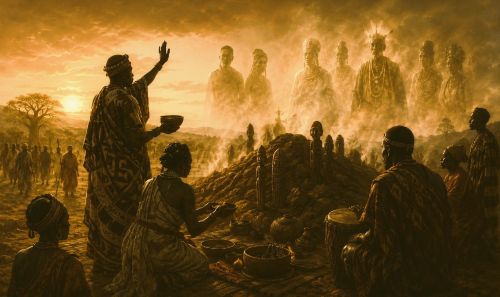
Across ancient African cultures, mourning was more than sorrow. It was the ritual work of guiding the dead from rupture into memory, ancestry, and belonging.

By Matthew A. McIntosh
Public Historian
Brewminate
Introduction: Death as Passage, Not Disappearance
Death in many ancient and traditional African cultures was not understood as a clean break between existence and nonexistence. It was a passage, a dangerous and sacred movement from one condition of being into another. The body died, but the person did not simply vanish from the moral universe of the living. The dead might remain near the household, become part of the lineage’s ancestral presence, require offerings or remembrance, return through rebirth, or linger as a troubling spirit if the transition had not been properly completed. Mourning was not only an emotional response to loss. It was a ritual obligation, a communal labor through which grief, memory, kinship, and spiritual responsibility were brought into order.
This does not mean that all African societies shared one uniform doctrine of death. Africa’s funerary traditions were as diverse as its languages, landscapes, political systems, and religious histories. The mortuary worlds of ancient Nubia, the forest and savanna societies of West Africa, the lineage-based ancestor traditions described in many ethnographic records, and the later Islamic and Christian reinterpretations of death cannot be collapsed into a single “African belief.” Yet across many of these societies, one recurring pattern appears with striking force: death required social management. The deceased had to be washed, wrapped, mourned, buried, accompanied, remembered, and ritually placed. Without these acts, death remained unfinished.
Here I approach ancient African mourning as a process of transition rather than as a static collection of customs. Public lamentation, grave goods, bed burials, tumuli, second funerals, mourning cloth, household burial, feasting, dancing, and the invocation of ancestors all belonged to a larger ritual grammar in which the living helped the dead cross a threshold. That threshold was not merely theological. It was social and political as well. A funeral confirmed relationships, displayed lineage strength, redistributed obligations, marked status, repaired rupture, and gave the community a shared language for loss. It also drew boundaries around the dead: who had died well, who had died badly, who could be remembered as an ancestor, who required special ritual caution, and who remained spiritually unsettled. Mourning was not passive remembrance but active classification. It interpreted the meaning of a life, the circumstances of a death, and the responsibilities that now fell upon descendants, kin, neighbors, ritual specialists, and political authorities. The dead person’s passage into the ancestral realm was bound to questions of household continuity, inheritance, gender, age, prestige, land, and collective identity.
My central argument is that grief in many African cultures was not private sorrow alone but a transformative act. Mourning helped turn the dead from a crisis into an ancestor, from absence into presence, from bodily remains into social memory. Archaeology cannot recover every cry, song, prayer, or gesture, and later ethnography must be used carefully when interpreting ancient evidence. Still, the material and ritual record points toward a powerful idea: the dead were not simply gone. They had to be accompanied, situated, and remembered. In that work of transition, the living did not merely say farewell. They made the dead belong again.
The Living Dead: Ancestors, Memory, and the Social Afterlife
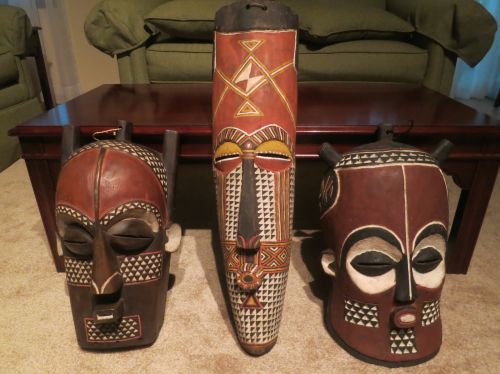
The dead in many African religious cultures were not imagined as utterly absent. They remained bound to the living through memory, descent, land, ritual speech, household obligation, and moral authority. John Mbiti famously described some of them as the “living-dead,” a phrase meant to capture the strange nearness of those who had biologically died but remained personally known, named, and socially active within the community. These dead were not remote abstractions. They were parents, grandparents, lineage founders, former rulers, ritual elders, mothers, fathers, and household members whose presence continued to shape the world of the living. Death changed their mode of existence, but it did not necessarily erase their relationships.
Ancestorhood was not simply the automatic destiny of every dead person. In many societies, to become an ancestor was to achieve a recognized status after death. The transition depended on the nature of one’s life, the circumstances of one’s death, the performance of funeral rites, and the continuing attention of descendants. A person who died at an advanced age, left children, upheld lineage obligations, and received proper burial could be incorporated into the ancestral community with honor. A person who died violently, prematurely, shamefully, childless, away from home, or without proper rites might occupy a more ambiguous position. The dead were not all equal, and the afterlife was not always imagined as a single undifferentiated realm. This made death a moral event as well as a biological one. The community had to ask not only who had died, but how that person had lived, how they had died, and whether their passage could be ritually stabilized. In many traditions, elderhood, fertility, social generosity, ritual knowledge, and fulfillment of kin obligations mattered because ancestorhood was tied to the continuation of life. The honored dead were those who had helped reproduce the lineage, sustain the household, preserve memory, and transmit authority. Those who died outside these expected patterns might require special rites, additional caution, or forms of exclusion that reveal how carefully societies distinguished between the dead who protected and the dead who troubled.
This distinction matters because it shows that being an ancestor was social as much as spiritual. The ancestor was not merely a soul who survived death. The ancestor was a relationship maintained by the living and acknowledged by the dead. Names, offerings, invocations, libations, shrines, graves, stools, masks, songs, and genealogies helped keep that relationship active. To remember the dead was not only to think about them privately; it was to place them within an ordered network of descent and obligation. Memory itself became a form of ritual labor. The living called the dead into presence, and the dead, in turn, were expected to guard the fertility, health, prosperity, and continuity of the lineage.
The social afterlife could be both comforting and demanding. Ancestors were often approached as protectors, but they were not harmless sentimental figures. They could bless, warn, discipline, punish, or withdraw favor. Their authority rested partly on seniority: they had crossed the boundary that the living had not yet crossed, and they belonged to the deeper memory of the family or community. They could see what the living could not see and judge conduct from a position beyond ordinary human life. The moral life of the community extended backward as well as forward. The dead watched the living, and the living acted under the weight of ancestral expectation. This is why the relationship between descendants and ancestors was often framed in reciprocal terms. The living owed respect, remembrance, offerings, proper speech, and adherence to inherited norms; the ancestors, when properly honored, could return protection, fertility, rain, healing, and continuity. But reciprocity also meant vulnerability. Misfortune might be interpreted as a sign that the relationship had been neglected or disturbed. Illness, infertility, crop failure, conflict, or repeated bad luck could provoke questions about whether the dead had been forgotten, offended, or improperly settled. Ancestors belonged not only to ritual occasions but to the everyday moral imagination of the community.
In ancient Northeast Africa, particularly Egypt and Nubia, the relationship between the dead and the living appears with particular material and textual richness. Egyptian funerary texts, offering formulas, tomb inscriptions, and mortuary cults show the dead as beings who required provisioning, remembrance, and ritual speech to flourish beyond death. Nubian evidence is less textually abundant but archaeologically powerful: graves, tumuli, bed burials, offerings, and burial goods indicate that the dead were placed into carefully constructed relationships with body, household, status, and landscape. These practices were not identical to later West African ancestor traditions, and they should not be forced into a single model. Yet they share a broad concern with the same problem: the dead had needs, powers, identities, and continuing claims upon the living.
Across many lineage-based societies, memory also had limits. The recently dead, especially those still remembered by name, occupied a different position from remote, generalized ancestors. An individual might eventually pass from personal memory into collective ancestry, from “my father” or “my grandmother” into the deeper category of “the ancestors.” This movement could be understood as a second transition. Biological death began the passage, but social memory determined its continuing form. To be remembered was to remain distinct; to be forgotten was not necessarily to disappear entirely, but to merge into a wider ancestral presence. The afterlife not only a place or condition. It was also a history of remembrance.
The idea of the living dead helps explain why mourning was so important. Mourning did not merely respond to the pain of separation; it helped establish what kind of presence the deceased would have after death. A funeral could mark the dead as honored, dangerous, incomplete, polluted, powerful, peaceful, or unsettled. It could place them among ancestors or hold them at the threshold until further rites were performed. Grief was part of social construction. The living did not invent the dead, but they did help define the dead person’s continuing role. Mourning gave form to absence and turned memory into obligation. It made the dead visible in the only way they could remain visible: through ritual, kinship, story, and continued belonging. This also means that grief was not merely an inward feeling but an outward act with consequences. A mourner’s cry, a lineage elder’s speech, a libation poured at the grave, a body placed correctly, a name recited in the right setting, or a second funeral performed at the proper time could all help move the deceased into a stable social afterlife. Mourning translated loss into order. It allowed the living to say that the dead had not been abandoned to silence, and it allowed the dead to be transformed from a source of rupture into a participant in continuity. The ancestor was not simply what remained after death. The ancestor was what mourning, memory, and lineage responsibility made possible.
Grief as Communal Obligation
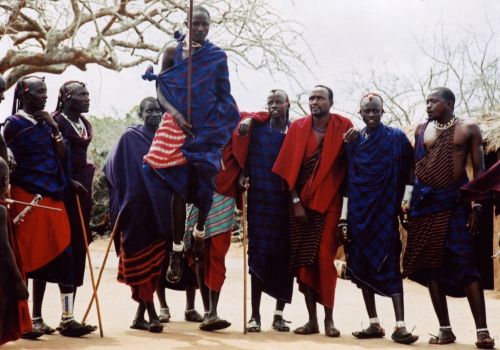
If ancestorhood was a relationship maintained across the boundary of death, then grief was one of the first duties by which that relationship was made visible. In many African societies, mourning was not treated as a private emotional state belonging only to the closest relatives. It was a public obligation, shared by kin, neighbors, age-mates, ritual specialists, political authorities, and sometimes entire villages or towns. The death of one person disturbed more than one household because personhood itself was understood relationally. A human being belonged to a lineage, a compound, a community, a field of obligations, and a network of remembered and living kin. When that person died, the rupture spread outward. The community gathered not simply to comfort the bereaved but to acknowledge that the social order had been wounded.
This communal character of grief gave mourning its intensity. Public wailing, lamentation, song, drumming, dance, praise, silence, fasting, seclusion, shaving, special dress, and ritualized gestures of distress could all become ways of making loss socially legible. These practices should not be mistaken for uncontrolled emotion. They were often patterned, expected, and meaningful. A cry at the right moment, a dirge sung by the proper person, a procession through familiar space, or a formal visit by affines and lineage members turned sorrow into recognized action. The bereaved were not left to carry grief alone because grief itself belonged to the community’s moral economy. To mourn was to say publicly that the dead mattered, that the living had not failed in their obligations, and that the passage from living person to remembered dead would not be neglected.
This also meant that insufficient mourning could be dangerous or shameful. A family that buried too quickly, failed to gather kin, neglected ritual specialists, ignored expected offerings, or did not display appropriate grief might be judged socially as well as spiritually. Such failure could suggest poverty, alienation, conflict within the lineage, disrespect for the deceased, or neglect of ancestral duty. In societies where the dead were believed capable of becoming restless, offended, or spiritually unsettled, mourning was not optional ceremony but protective work. The tears of mourners, the presence of the community, and the correct performance of rites helped assure both the living and the dead that the transition was being handled properly. Grief guarded the boundary between worlds. It protected the bereaved from suspicion, the lineage from accusation, and the deceased from the danger of being socially misplaced. A person who had not been properly mourned could remain an unresolved presence, not fully incorporated among the ancestors and not safely separated from the everyday life of the living. The community’s visible grief did more than honor emotion. It helped prove that obligations had been fulfilled. It announced that the dead had not been abandoned, that kinship still held, and that the living accepted the burden of guiding the deceased through the uncertain passage after death.
The communal obligation to mourn also redistributed the burden of death. Relatives arrived with food, labor, money, animals, cloth, drink, music, ritual knowledge, or public speech. Women might organize lamentation, washing, cooking, or ritual care of the body; men might dig graves, slaughter animals, speak for the lineage, negotiate inheritance, or receive delegations; elders might determine ritual order; specialists might mediate between the living and the dead. These roles varied widely, but the larger principle was that grief required collective participation. Mourning gathered the social body around the physical body. It transformed the house of death into a place of movement, sound, obligation, and witness.
Communal grief did not erase personal sorrow. The fact that mourning was ritualized does not mean it was artificial. Structured grief could intensify emotion rather than suppress it. A widow’s lament, a mother’s cry, a sibling’s praise, or the silence of an elder could carry real pain within a socially recognized form. Ritual gave grief a path. It allowed mourners to express anguish without leaving that anguish shapeless. The community’s presence did not solve the loss, but it prevented the loss from becoming solitary. In many African mortuary settings, grief became bearable not because it was minimized, but because it was shared, repeated, answered, and held within inherited forms of meaning. The mourners’ voices could echo one another until private pain became a collective sound, and that sound itself became part of the work of transition. Lamentation could name the deceased, recall virtues, accuse death, plead with the departed, or speak aloud the wounds that ordinary language could not carry. Such performances did not make grief less real; they made it communicable. They gave sorrow an audience, a rhythm, and a ritual shape, allowing the bereaved to move through loss without being severed from the moral and emotional support of the wider community.
This is why mourning could become one of the most powerful expressions of social belonging. To be mourned was to be recognized as part of a human world that extended beyond death. To mourn another was to affirm one’s place within that same world of kinship, memory, and obligation. The funeral was not only a farewell to the dead but a reaffirmation of the living community. In gathering around the deceased, the living rehearsed the values that made society possible: reciprocity, remembrance, seniority, descent, compassion, reputation, and continuity. Grief was sorrow, but it was also duty. It was the community’s first answer to death’s attempt to separate what kinship, ritual, and memory struggled to keep joined.
The Dangerous Dead: Improper Burial, Restless Spirits, and Ritual Failure
If proper mourning could help transform the dead into ancestors, improper mourning could leave them dangerously unresolved. In many African religious systems, death created a temporary instability that had to be ritually managed. The newly dead occupied a threshold: no longer fully among the living, but not yet safely incorporated into the realm of ancestors or spirits. This transitional condition made the period after death quite charged. The corpse, the house, the mourners, the grave, and even the words spoken around the dead could become sites of danger because the ordinary order of life had been broken. Funeral rites existed, in part, to repair that break. They gave the living a sequence of actions through which fear could be contained, responsibility assigned, and the dead moved from a raw and uncertain presence into a more intelligible spiritual condition. Without that sequence, death could remain too close. The deceased might linger at the edge of domestic life, neither accepted among the ancestors nor fully separated from the living household. This is why the first days after death were often surrounded by restrictions, watchfulness, ritual speech, and bodily care. The danger was not simply that someone had died, but that death had opened a passage that had not yet been safely closed.
The danger did not usually come from death in the abstract, but from death mishandled. A person denied proper burial, mourned inadequately, buried in the wrong place, forgotten by descendants, or excluded from the rituals of kinship might remain restless. Such a spirit could be imagined as wandering, hungry, angry, jealous, or confused, troubling the living through illness, dreams, infertility, crop failure, misfortune, madness, or repeated household disorder. These beliefs were not simply ghost stories in the modern sense. They expressed a moral and social claim: the dead had rights, and the living had obligations. When those obligations were broken, the consequences could return through the very relationships death had failed to sever.
Improper burial could be threatening because burial was a form of placement. To bury the dead correctly was to locate them within land, lineage, household, and memory. To bury them incorrectly was to leave them socially displaced. A person who died away from home, whose body could not be recovered, whose grave was neglected, or whose corpse was treated carelessly might not be easily settled among the dead of the family. In societies where belonging was tied to descent and land, the dead needed to be returned, named, and situated. The grave was not merely a disposal site for remains. It was a point of relationship, a place where the living could acknowledge the dead and where the dead could be anchored within the moral geography of the community.
The character of the death itself also mattered. Violent deaths, sudden deaths, suicides, deaths in childbirth, deaths by epidemic disease, deaths of children, deaths caused by witchcraft or suspected spiritual aggression, and deaths outside the expected order of age could require special interpretation. Such deaths threatened the idea of a completed life. They raised questions: Why had this person been taken? Who or what had caused the rupture? Had an offense been committed? Was the deceased innocent, polluted, dangerous, or wronged? In some traditions, those who died badly could not be mourned in the same way as elders who died after long and socially fulfilled lives. Their deaths carried a different ritual charge because they did not fit the model of peaceful transition into honored ancestry. A child’s death might be surrounded by grief but not the same ancestral expectations as the death of an elder; a death by violence might demand investigation, vengeance, purification, or ritual cooling; a death during epidemic disease might require distance and restraint even when affection called for closeness. These distinctions were not signs of indifference. They reflected the belief that different deaths produced different spiritual conditions. The dead person’s future status depended partly on whether the community could interpret the rupture and respond to it in the proper ritual language.
This distinction between honored and dangerous dead reveals the moral structure behind many mortuary practices. The goal was not only to honor the deceased but to clarify their status. Rituals could separate the dead from the living, cleanse the household, cool anger, redirect spiritual force, protect mourners, or prevent the deceased from lingering too near. The language of pollution, heat, danger, or disorder varied from society to society, but the underlying concern was often similar: death had released a force that had to be contained and transformed. Washing the body, watching the corpse, restricting mourners, avoiding certain foods, shaving hair, wearing mourning cloth, purifying the house, making offerings, or performing later rites could all help move the deceased from instability toward a more settled condition. These acts also helped the living move from shock into responsibility. The washing of the body marked care and control; the guarding of the corpse acknowledged that the dead were not yet ordinary remains; the restrictions placed on mourners signaled that grief had altered their social condition; purification rites announced that the household could eventually return to ordinary life. Mortuary ritual worked in two directions at once. It transformed the dead, but it also transformed the living, guiding them through a period when they were themselves vulnerable, marked by contact with death, and temporarily set apart from ordinary social rhythms.
The dangerous dead also show why mourning was inseparable from justice and memory. A restless spirit might be understood not only as someone improperly buried but as someone improperly remembered or morally unresolved. The dead could demand recognition. They could expose hidden conflict, unsettled debts, broken kinship obligations, or violence that the living wished to conceal. Beliefs about restless spirits gave the dead a continuing voice in social life. They could not be dismissed as finished simply because the body had been buried. If the community failed to reckon with the meaning of the death, the dead might return symbolically or spiritually until the rupture was addressed.
This fear of ritual failure complicates any overly comforting picture of ancestorhood. The dead were not automatically benevolent guardians waiting peacefully beyond the grave. They had to be made safe, and the living had to perform that work correctly. Mourning, burial, offerings, lamentation, and remembrance were not decorative additions to grief but necessary acts of spiritual and social management. The ancestor was the hoped-for result of a successful transition. The restless dead represented what could happen when that transition failed. Between the two stood the funeral, where the living tried to transform danger into belonging, rupture into continuity, and the frightening nearness of death into a relationship that could be endured.
Bodies, Graves, and the Archaeology of Mourning
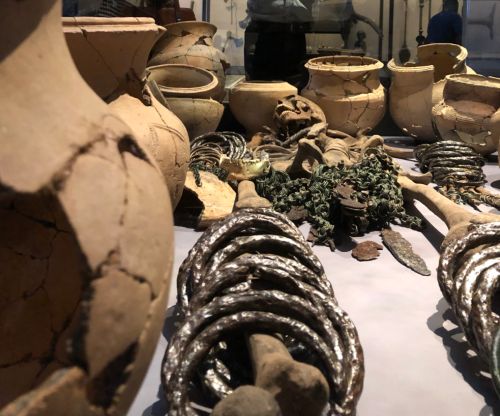
Archaeology offers one of the most powerful ways to study ancient African mourning, but it also forces caution. Graves preserve bodies, objects, architecture, spatial relationships, and traces of ritual action; they do not preserve grief itself in any simple or transparent form. A skeleton cannot tell us exactly who cried, what words were spoken, what songs were sung, or how mourners understood the last hours of the deceased. Yet mortuary archaeology can reveal how communities organized the dead, how they distinguished status, how they imagined bodily integrity, how they marked belonging, and how much labor they were willing to invest in the passage from life to death. The grave is not emotion made visible, but it is grief structured in material form.
This distinction is essential because burials are not merely biological deposits. A grave is a decision. The body may be flexed, extended, wrapped, placed on a bed, seated, covered, painted, adorned, isolated, grouped with others, buried under a mound, laid in a chamber, or accompanied by goods. The grave may be near a settlement, inside a domestic compound, in a formal cemetery, under a tumulus, beside earlier ancestors, or separated from ordinary habitation. Each choice reflects a system of meaning, even when that meaning is not fully recoverable. Archaeology studies not only what the dead were buried with, but how the living arranged death. The dead body becomes a point where religion, memory, hierarchy, kinship, labor, and landscape meet. It is also a point where the living made claims about the dead person’s identity: whether they belonged to a lineage, held rank, possessed ritual importance, died as an adult or child, or occupied a place of honor, danger, dependence, or exclusion. Even silence in the grave can matter. The absence of goods, the simplicity of a burial, the distance from other bodies, or the lack of monumentality may indicate poverty, humility, marginality, ritual distinction, or simply a different funerary expectation. The archaeological record requires interpretation rather than assumption. A grave is evidence of action, but the meaning of that action must be reconstructed through pattern, comparison, context, and caution.
Ancient Nubia demonstrates the richness of this evidence. At Kerma, Tombos, and other Nile Valley sites, burials show long traditions of bodily care, grave construction, and funerary display. Some Nubian burials placed the deceased on beds, a striking practice because it preserved a domestic and bodily image within the grave. The dead person was not merely discarded into the earth but arranged as someone still possessing posture, dignity, and social identity. Tumuli, grave goods, animal remains, pottery, jewelry, weapons, and architectural variation all point to mortuary worlds in which the dead were carefully staged. These burials suggest that the transition into death required not only ritual speech but material work: digging, building, wrapping, carrying, arranging, provisioning, sealing, and remembering.
The body itself was central to this work of transition. Across many mortuary traditions, the treatment of the corpse marked the beginning of the dead person’s altered status. Washing, dressing, wrapping, positioning, decorating, or protecting the body helped transform it from the vulnerable remains of a known person into a ritual object capable of burial. Archaeology can sometimes detect these transformations through textiles, beads, body position, resin, pigment, coffins, mats, beds, or traces of organic materials that once surrounded the dead. Even where preservation is poor, the orientation and posture of the skeleton may suggest rules about how the dead should face, rest, bend, or lie. These were not arbitrary gestures. They were ways of making the dead body socially intelligible at the moment when ordinary personhood had begun to dissolve. The corpse existed in a charged condition: still recognizable as the person mourners had known, but already entering another order of existence. Care for the body expressed affection, fear, duty, and transformation at once. To wrap, adorn, or position the dead was to intervene in the unsettling ambiguity between person and remains. The living could not prevent bodily decay, but they could give the body a final social form before the grave closed around it.
Grave goods further complicate the picture. Weapons, tools, vessels, ornaments, clothing, food remains, animal offerings, and prestige objects can be read in more than one way. They may have equipped the dead for an afterlife, marked rank, signaled gendered labor, represented household affection, displayed lineage wealth, or fulfilled obligations to spiritual powers. A pot placed beside a body might be provision, symbol, memory, or ritual necessity. A weapon might identify the deceased as a warrior, hunter, elite man, or protector, but it might also be part of a broader vocabulary of status. Jewelry might reveal gender, age, rank, beauty, exchange networks, or the family’s desire to send the dead away properly adorned. The danger is to reduce grave goods to simple “things for the afterlife.” Their meanings were often layered, and the same object could speak at once to identity, grief, display, and cosmology. Grave goods also remind us that funerals were performed before audiences. Objects deposited with the dead may have been hidden after burial, but their selection, preparation, and placement were usually social acts. People saw what was chosen. They saw what a family could provide, what a lineage considered appropriate, what an elite household could command, or what ritual specialists required. Even when objects disappeared into the earth, they had already done visible work among the living. They helped narrate the dead person’s life, dramatize the family’s obligations, and materialize beliefs about what the dead might need beyond the grave.
The arrangement of graves also reveals the social life of the dead. Cemeteries are not neutral spaces. They organize people after death according to patterns that may reflect kinship, rank, age, gender, occupation, ritual status, political authority, or exclusion. Some bodies are placed near others; some are separated. Some graves are monumental; others are modest. Some are reopened, reused, visited, or expanded; others remain isolated. Archaeology can see how communities imagined continuity between generations. A cemetery could become a map of belonging, a landscape where the living placed the dead into relationship with one another and with the community’s memory of itself. The graveyard, tumulus field, royal cemetery, or household burial area was not simply a place of disposal. It was a historical archive of social order.
Mortuary archaeology also exposes inequality. Not everyone received the same burial, and not every death was given the same material care. Elite graves may contain imported goods, animal sacrifices, elaborate architecture, or numerous retainers, while poorer graves may hold little beyond the body itself. These differences do not necessarily mean that some people were unloved and others were loved more. They show that mourning was shaped by access to wealth, labor, ritual privilege, political power, and social rank. A ruler’s grave could display sovereignty as much as sorrow. A family grave could advertise descent and continuity. A modest burial could still be ritually complete even without luxury goods. The material record must be read carefully: richness of burial shows investment, but investment may express authority, obligation, competition, theology, or status as much as personal affection.
The archaeology of mourning reminds us that the dead were made through action. A burial was not a single moment but the result of many coordinated acts: preparing the body, selecting the place, gathering goods, assembling mourners, marking the grave, closing the tomb, and sometimes returning later for additional rites. Even when the songs and prayers are lost, the grave preserves the aftermath of those choices. It shows that ancient African communities did not treat death as a merely natural event. They worked upon it. They arranged bodies, built spaces, deposited objects, and created places where the dead could be remembered, feared, honored, or transformed. Archaeology cannot recover every emotion, but it can reveal the disciplined labor by which grief became social memory.
Ancient Nubia: Beds, Tumuli, and the Architecture of Transition
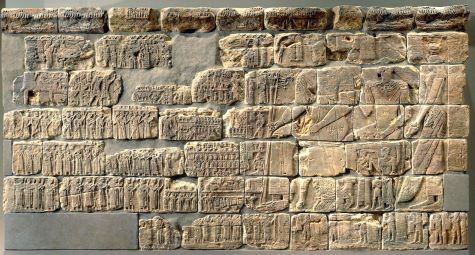
Ancient Nubia offers one of the richest bodies of evidence for thinking about death as transition in Africa, not because it provides a single unbroken funerary system, but because its graves show repeated efforts to build a social and spiritual architecture around the dead. From Kerma through Napatan and Meroitic periods, Nubian mortuary traditions changed dramatically, absorbing, resisting, adapting, and reworking Egyptian influences while retaining distinctive local forms. The dead were not simply placed in the ground. They were arranged, enclosed, elevated, accompanied, and monumentalized. Burial created a space where the deceased could be transformed from a living member of society into a being situated within lineage, rank, memory, and the sacred landscape of the Nile Valley. This makes Nubia relevant when discussing mourning because its funerary evidence is not limited to doctrine or later description. It survives in the physical grammar of death: beds, mounds, chambers, pottery, ornaments, weapons, animal remains, and the placement of cemeteries in relation to settlements and power centers. These material forms show that death required design. The grave was an engineered threshold, a place where the body was handled, identity was preserved or reshaped, and the living announced that the deceased had entered a new condition without vanishing from the human world.
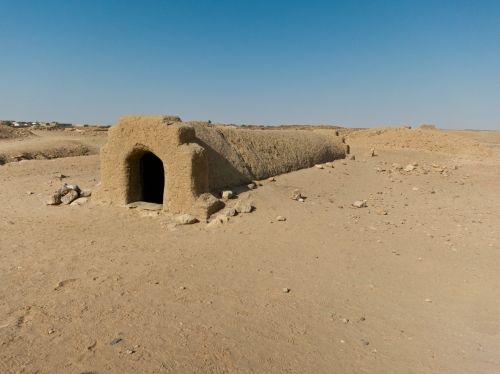
The Kerma tradition is important because it reveals a Nubian funerary world that was powerful before and beyond Egyptian domination. Kerma burials often involved tumuli, circular grave mounds whose form marked the grave as a built feature in the landscape rather than an invisible deposit beneath the earth. The mound mattered. It gave death a visible architecture, turning the grave into a place that could be seen, approached, remembered, and possibly revisited. In elite contexts, the scale of the tumulus could become a statement of authority. The larger the mound, the more labor it required, and the more clearly it announced that the dead person’s status continued after death. Such monuments made the deceased socially present even after burial, anchoring memory in earth, stone, and communal labor.
Bed burials are among the most evocative features of Nubian mortuary practice. In these burials, the deceased could be placed on a wooden bed or bed-frame before interment, sometimes in a flexed position that preserved a sense of bodily posture and domestic familiarity. The bed carried the dead into the grave not as anonymous remains but as a person still associated with rest, household life, dignity, and social identity. This was not the same symbolic vocabulary as Egyptian mummification, which emphasized preservation, transformation, and rebirth through a highly developed mortuary theology. Nubian bed burial worked through a different visual and bodily language. It placed the deceased in a form that recalled the social body rather than erasing it. The person entered the grave still arranged as someone who had occupied a household, a lineage, and a world of human relationships.
The tumulus and the bed together suggest that Nubian burial was not only about disposal but about controlled passage. The bed held the body in a recognizable human form; the mound enclosed and marked the transition; the grave goods provisioned, identified, or honored the deceased; and the cemetery placed that death among other deaths. In elite Kerma burials, the scale of funerary investment could be extraordinary. Animal offerings, pottery, weapons, ornaments, and architectural elaboration all point to ceremonies in which the dead person’s importance was materially displayed. In some royal and elite contexts, sacrificed retainers or attendants appear in the mortuary record, a grim reminder that funeral architecture could also express hierarchy, coercion, and political power. The passage of the powerful dead could require the subordination of others, making the grave a monument not only to grief and belief but to authority. This is one reason Nubian mortuary evidence must be read with both sympathy and severity. The grandeur of a burial may speak to reverence for the dead, but it may also reveal the social cost of rank. A great mound gathered labor, objects, animals, and sometimes human lives into the service of one person’s transition. Mourning was not only a family act; it was a public display of power, a performance of order, and a declaration that status endured beyond biological death.
Nubian burial traditions were never static. Egyptian expansion into Nubia during the New Kingdom created zones of cultural contact in which mortuary practices could combine elements from both worlds. Tombos is one of the clearest examples. There, archaeologists have found burial patterns that show Egyptian-style coffins, body positions, and mortuary features alongside Nubian traditions such as tumuli and bed burials. This mixture should not be read as simple imitation. Funerary practice was one of the arenas in which identity was negotiated. A person buried with Egyptianizing elements was not necessarily “Egyptian” in any simple ethnic sense, and a Nubian feature did not necessarily mean cultural isolation. The cemetery became a place where families, officials, soldiers, settlers, and local communities expressed belonging through the language of death.
This hybrid mortuary world matters because death rituals often preserve identity under pressure. In life, political domination, trade, intermarriage, administrative service, and imperial power could blur social boundaries. In death, communities made choices about how a body should be treated, what goods should accompany it, what architecture should cover it, and which traditions should be honored. The combination of Egyptian and Nubian practices at sites such as Tombos suggests that the dead could carry multiple identities into the grave. A burial might express local descent, imperial affiliation, household memory, religious aspiration, and social ambition. Rather than seeing Egyptian influence as replacing Nubian practice, it is better to see Nubian funerary architecture as adaptive, selective, and deeply creative. These choices also remind us that identity was not always a matter of pure opposition. Nubian and Egyptian elements could be combined because people lived in worlds where power, marriage, office, ancestry, and ritual language overlapped. A coffin, a tumulus, a bed, or a burial position could each speak to different audiences and different claims. The grave was not a simple ethnic label. It was a layered statement about where the deceased belonged, which traditions mattered, and how the living wanted that person’s memory to endure.
Ancient Nubia strengthens my larger argument: mourning and burial were technologies of transition. Beds, tumuli, grave goods, cemetery placement, and hybrid architectural forms did not merely reflect beliefs about death; they helped produce the dead person’s new status. The grave made claims about who the deceased had been and what relationship they would continue to hold with the living. It gave the body a form, the memory a place, and the transition a structure. In Nubia, the dead were not abandoned to disappearance. They were built into the landscape, carried into the grave with dignity or power, and placed within an architecture that made death visible, social, and enduring.
Grave Goods and the Needs of the Dead
Grave goods are among the most immediate signs that the dead were not treated as finished with the world. Across many ancient African mortuary settings, objects placed with the deceased suggest that death was imagined as a transition requiring equipment, honor, identity, and provision. Pots, food remains, jewelry, beads, weapons, tools, clothing, furniture, amulets, animal offerings, and luxury items could all accompany the body into the grave. These objects did not speak with one meaning. Some may have been practical provisions for a journey beyond death; others marked rank, gender, occupation, household affection, ritual status, or family wealth. What they share is the assumption that the dead still mattered and that the living had responsibilities toward them.
In Nubia, grave goods could be expressive because they formed part of a larger funerary architecture of placement and transition. Kerma burials, Napatan and Meroitic graves, and royal cemeteries of Kush reveal the careful selection of goods meant to accompany, identify, or elevate the deceased. Pottery vessels, weapons, ornaments, beds, leather, textiles, food offerings, and animal remains show that burial was a constructed environment rather than an empty cavity. The dead were surrounded by things that had meaning in life and meaning beyond it. A vessel might imply nourishment, hospitality, ritual offering, or continuity with household practice. A bed might preserve the dignity of the social body. A weapon might signal elite status, masculine identity, protection, or authority. Grave goods helped make the grave into a world in miniature, a place where the deceased could be recognized and sustained. They also connected the dead to the labor and affection of the living, because every object had to be selected, prepared, carried, and surrendered. To place a vessel, ornament, blade, or food offering in the grave was to remove it from ordinary circulation and dedicate it to the deceased’s changed condition. This giving away of useful or valuable things made mourning materially visible. It demonstrated that the family or community accepted the cost of transition and believed that the dead still required relationship, not abandonment.
Ancient Egyptian evidence, though culturally distinct from Nubian practice, helps clarify how deeply material provision could be tied to afterlife imagination in Northeast Africa. Egyptian funerary texts, tomb scenes, offering formulas, amulets, food deposits, shabti figures, and elaborate burial assemblages all point to a sustained belief that the dead required ritual support, protection, and nourishment. The deceased needed words, offerings, names, images, and objects to survive and flourish. When Egyptian and Nubian traditions interacted, notably in periods of colonial contact or Kushite rule, grave goods became part of a shared and contested language of death. Egyptian-style objects in Nubian graves do not simply prove imitation; they show that objects could carry religious prestige, political meaning, and claims about identity. To choose what went into a grave was to choose how the dead would be represented.
Yet grave goods must not be read too narrowly as “things for the afterlife.” They also operated among the living before the tomb was sealed. Funerals were public or semi-public events, and the selection of burial goods could display the family’s resources, the lineage’s solidarity, the rank of the deceased, or the ritual seriousness of the occasion. A necklace placed on the dead might comfort mourners, honor the body, signal beauty or status, and accompany the deceased all at once. A sacrificed animal might feed guests, mark wealth, serve ritual obligation, and provision the dead. A luxury import might identify the deceased with long-distance exchange networks or elite consumption. Even after burial hid these objects from view, the memory of their placement remained part of the social meaning of the funeral. This is important because burial goods often existed at the intersection of devotion and performance. The family may have given objects out of love or duty, but those gifts also communicated publicly that the deceased was worthy of honor and that the household had fulfilled its responsibilities. In elite graves, this public dimension could become unmistakable: imported materials, elaborate ornaments, weapons, furniture, and animal offerings did not merely accompany the dead but staged the dead person’s importance before the community. The grave was both hidden and remembered. Its contents disappeared beneath the earth, but the act of furnishing it remained in social memory as proof of status, care, ritual correctness, and the living community’s willingness to spend wealth on the dead.
The unequal distribution of grave goods also reveals how death reflected social hierarchy. Some graves were richly furnished; others were sparse. Some dead were buried with imported goods, animals, weapons, beds, servants, or elaborate architecture; others received only modest objects or none that survive archaeologically. This difference should not be reduced to a simple measure of love. A poor burial could still be ritually complete within its own cultural expectations, while a lavish burial could express political authority as much as grief. The material richness of a grave often tells us about access to labor, wealth, rank, and ritual privilege. Grave goods could comfort the dead, but they could also announce power. The dead carried social inequality with them into the earth.
The needs of the dead were never only physical or spiritual. They were social needs: to be named, placed, honored, remembered, equipped, and interpreted. Grave goods helped answer those needs by giving material form to the relationship between the living and the deceased. They made visible the belief that death had not erased identity and that the dead still occupied a position within a moral and cosmic order. Whether a pot, a bead, a blade, a bed, a loaf, an amulet, or an animal offering, the object in the grave stood at the border between worlds. It belonged to the living long enough to be chosen and given away; then it belonged to the dead, carrying with it a final act of care, obligation, display, and hope.
Proximity to the Living: Ancestors at Home, in the Compound, and in the Land
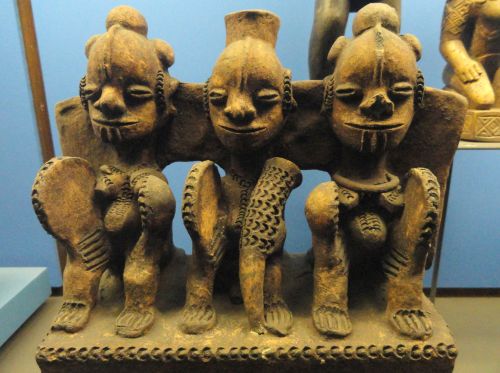
In many African societies, the dead were not ideally imagined as distant beings removed from the world of the living. They remained close through graves, shrines, names, stools, compounds, homesteads, fields, and lineage land. The place of burial mattered because the dead belonged somewhere. They were not only souls moving into an unseen realm; they were members of families, houses, descent groups, and territories whose continuing presence was anchored in recognizable space. To bury the dead properly was to place them within a geography of belonging. The grave did not merely hide the body. It marked where memory, kinship, and land met.
This proximity could take many forms. In some communities, the dead were buried within or near the family compound, keeping ancestors close to descendants and making the household itself a place of layered presence. In others, burial in lineage land, near ancestral graves, or in a designated cemetery tied the deceased to a broader descent group rather than to a single dwelling. Shrines, graves, and ritual places could become points of address, where the living poured libations, spoke names, made offerings, or sought protection. These practices varied widely, but the underlying principle was often similar: the dead remained socially located. They did not become anonymous. Their power and memory were attached to place. The compound was important because it was not simply a residence. It was a social organism, a place where kinship was lived daily through cooking, sleeping, childrearing, labor, ritual obligation, and the authority of elders. To place the dead within or near that world was to acknowledge that death had changed their condition without severing their membership. The ancestor at home could be invoked as guardian, witness, judge, or source of continuity. Children grew up in spaces shaped by the memory of those who had died before them. The dead were not constantly visible, but they were built into the moral architecture of ordinary life. Their presence could be felt in prohibitions, blessings, inherited land, family stories, ritual gestures, and the authority of senior kin.
Burial near the living also gave physical form to the idea that ancestors mediated between past and future. A grave in the family compound or on lineage land was a reminder that the living occupied space inherited from the dead and held in trust for descendants not yet born. Land not merely economic property. It was ancestral ground, thick with memory and obligation. To cultivate a field, inherit a house, occupy a compound, or maintain a grave was to participate in a relationship that crossed generations. The dead guaranteed continuity because they had already passed into the past that legitimized the present. Their graves could make claims stronger than documents: this is where we belong because this is where our dead are.
The political implications of this were considerable. Control over burial places could support claims to land, seniority, office, and lineage legitimacy. A family that could point to ancestral graves could assert depth in the landscape. A ruler buried among predecessors could be incorporated into a genealogy of authority. A stranger, captive, client, migrant, or person who died away from home might face more complicated burial questions because burial was bound to belonging. Where one was buried could say who had rights over the body, which kin group claimed the deceased, and whether the person was fully incorporated into local memory. Mortuary space helped organize social boundaries. The grave was a sacred place, but it was also a political fact. Proximity to the dead was not always comforting. Ancestors near the household could protect, but they could also discipline. A grave close to home was a reminder of obligation as much as affection. The living had to remember, respect, and sometimes appease those whose presence remained embedded in domestic and lineage space. Neglected graves, broken taboos, disputes over inheritance, or failures of ritual attention could disturb the relationship between living and dead. Nearness made the ancestors powerful precisely because they were not remote. They inhabited the same moral world as their descendants, watching over fields, households, marriages, births, quarrels, and acts of remembrance. The dead were close enough to bless and close enough to trouble.
The placement of the dead near homes, compounds, and ancestral land reveals one of the deepest features of many African mortuary traditions: death did not remove a person from society so much as relocate that person within it. The grave became a point of contact, the compound a dwelling of memory, and the land a body of ancestral presence. Mourning did not end when the body was buried, because burial itself created an enduring relationship between place and person. To live among the dead was not necessarily morbid. It was to inhabit a world in which belonging stretched backward, where the ancestors remained near enough to be addressed, and where the living understood themselves as temporary occupants of a landscape already filled with those who had gone before.
Second Funerals and the Completion of Mourning
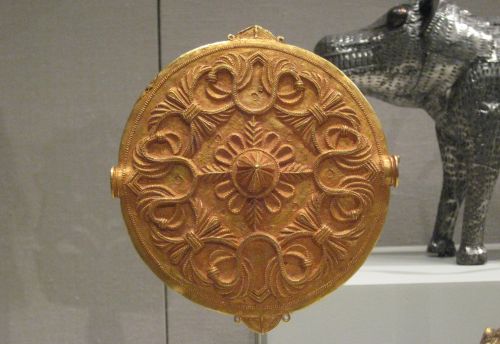
In many African mortuary traditions, death was not completed in a single ceremony. The first burial addressed the immediate crisis of the corpse, the household, and the closest mourners, but a later rite could complete the deceased’s social and spiritual transition. This later observance, often described broadly as a “second funeral,” made visible a crucial idea: death unfolded over time. The body might be buried quickly for reasons of decay, danger, climate, or ritual necessity, but mourning itself could require a longer process. Kin had to be summoned, debts recognized, contributions gathered, ritual specialists consulted, property and lineage obligations clarified, and the deceased’s new status formally acknowledged. The second funeral transformed grief from an emergency into a public act of completion. It gave the living time to move beyond the first shock of death and to assemble the social world that the deceased had belonged to in life. Those who could not arrive for the burial might appear later; those who owed support could make their obligations visible; those who had claims upon the dead person’s memory could speak, sing, mourn, or contribute. The second funeral expanded death from a household event into a broader communal reckoning.
The importance of delayed or secondary funerary rites appears clearly in classic anthropological discussions of death as a two-stage process. Robert Hertz argued that many societies distinguish between the first crisis of bodily death and the later incorporation of the deceased into a stable spiritual condition. Though Hertz was not writing specifically about Africa alone, his framework helps illuminate African cases in which the first burial does not fully settle the dead. The initial rite separates the body from ordinary life; the later rite resolves the social and spiritual consequences of that separation. The second funeral is not repetition. It is completion. It marks the point at which mourning can be reorganized, the deceased can be more securely placed among the dead, and the living can begin to return to a less disrupted social order.
Among the Asante of Ghana, funerals became powerful public events in which mourning, lineage prestige, wealth, cloth, music, dance, and social obligation converged. The timing and scale of funerary observances could depend on the deceased’s status, the family’s resources, and the need to gather dispersed relatives and affines. A burial might occur earlier, while the larger funeral celebration followed later, allowing the family to mobilize the money, food, drink, cloth, drummers, mourners, and public attendance appropriate to the deceased’s standing. Such events were not merely displays of sorrow. They were acts of social accounting. Who came, who contributed, who wore the proper cloth, who spoke, who failed to appear, and how the family performed its obligations all mattered. The second funeral gave the community time to see whether the dead had been honored properly and whether the living had fulfilled the demands of kinship.
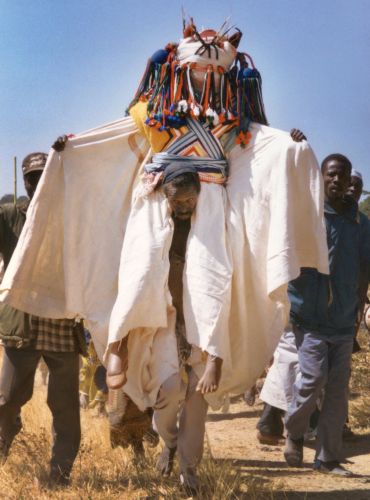
In parts of West Africa, including communities associated with Bobo and related mask traditions in Burkina Faso and neighboring regions, funerary completion could also involve performance, masking, music, and delayed ritual action. Masks were not decorative additions to mourning; they could mediate between the living, the dead, and the powers that ordered community life. Funerary performances helped transform an individual death into a collective event, situating the deceased within a wider religious and social cosmos. The timing of such rites mattered because the dead were not always understood as immediately settled. The community had to move through stages: the shock of loss, the handling of the body, the period of mourning, and the eventual ritual acts that restored balance. As with Asante funerary practice, the later ceremony could gather people who were absent at the moment of death and turn dispersed grief into a shared public memory. It could also give ritual form to the difference between merely disposing of the body and truly completing the death. Through music, masked presence, dance, sacrifice, public attendance, and formalized remembrance, the community could bring the deceased into a new relationship with the living. The dead person’s identity was no longer defined only by the recent rupture of death but by the place that person would now occupy in memory, lineage, and ritual order.
Second funerals reveal that mourning was not simply the expression of pain after death but a process through which death became socially intelligible. They allowed time for grief to mature into remembrance, for the household to gather resources, for kinship obligations to be performed, and for the deceased’s identity to be ritually stabilized. They also show that the dead could remain in an unfinished condition until the living had done what was required. To complete mourning was not to forget the dead; it was to change the relationship. The deceased moved from crisis to memory, from dangerous nearness to ancestral presence, from a death that had disrupted the household to a continuing place within lineage, land, and ritual life. The second funeral stands at the heart of my thesis: in many African cultures, the dead were not simply buried. They were gradually transitioned.
Mourning as Performance: Wailing, Singing, Dance, Drums, and Public Emotion
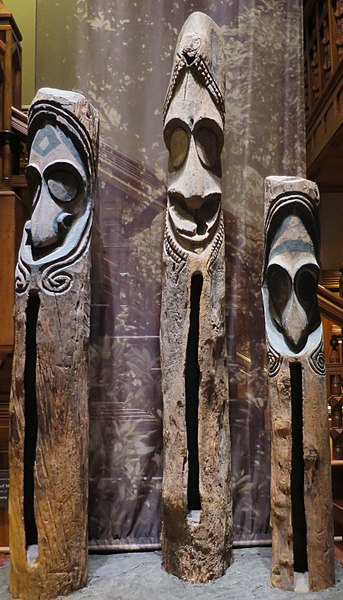
Mourning in many African societies was not silent, hidden, or merely interior. It was often performed in sound, movement, gesture, clothing, rhythm, and public assembly. This does not mean that grief was theatrical in the sense of being false. Rather, performance gave grief a recognizable form. Wailing, singing, drumming, dancing, praise, lament, and procession allowed sorrow to become communicable. The bereaved did not simply feel loss; they voiced it, moved through it, and placed it before the community. Public emotion was not an interruption of ritual order. It was part of that order.
Wailing and lamentation were powerful because they transformed grief into speech at the very edge of speech’s failure. A death could be too large for ordinary language, but lament gave anguish a disciplined vocabulary. Mourners might cry out to the deceased, accuse death, ask why the person had gone, praise the dead person’s virtues, recall kinship ties, or describe the devastation left behind. Such laments could be improvised, inherited, poetic, formulaic, or led by skilled mourners who knew how to give sorrow its proper voice. The cry was personal, but it was also social. It told everyone present that the dead had been recognized, that their absence wounded the living, and that the community had gathered to answer that wound. Lamentation did not simply express grief after the fact; it helped create the public meaning of the death. The mourner’s voice could identify the deceased as parent, elder, spouse, child, friend, ruler, provider, or lineage member, reminding the gathered community what had been lost and what obligations remained. A lament might move between tenderness and accusation, praise and protest, memory and bewilderment. It could ask questions no one expected to answer, because the purpose was not explanation alone but recognition. The dead had to be named into absence, and the living had to hear that absence made audible.
Among Akan-speaking peoples, funeral dirges provide a particularly rich example of mourning as verbal art. Dirges could praise the dead, narrate loss, invoke lineage identity, and place the deceased within a moral world of kinship, age, obligation, and memory. Their force lay not only in their words but in their performance: the voice, the occasion, the response of listeners, and the social position of the mourner all mattered. A dirge could be an act of grief, but it could also be an act of interpretation. It told the community what the death meant. It could present the deceased as beloved elder, abandoned kin, noble ancestor, tragic loss, or person whose absence exposed the fragility of the household. Through lament, grief became history spoken aloud.
Music and drumming extended this public language of mourning beyond words. Drums could announce a death, summon people, mark transitions in the funeral sequence, accompany dances, or communicate status and identity. In some traditions, drums were not merely background instruments but voices within the ritual field. Their rhythms organized movement, shaped emotional intensity, and helped the assembled community move together through sorrow. Drumming could deepen lament, intensify collective feeling, or shift the atmosphere from raw grief toward remembrance and celebration. This was important in funerals where mourning did not remain fixed in sadness but moved through stages: shock, lament, praise, procession, feasting, dance, and eventual reintegration.
Dance, too, could be part of grief’s discipline. To dance at a funeral was not necessarily to deny sorrow. It could honor the dead, accompany the spirit, display lineage strength, or enact the community’s refusal to let death dissolve social life. Movement allowed mourners to embody transition. Slow, restrained, heavy movement could express grief; energetic dance could mark celebration, prestige, or the successful completion of a life. In funerals for elders who had lived long and fulfilled lives, dance and song might signal that the deceased had passed into honored ancestral status rather than being lost in tragic incompletion. The body of the mourner answered the body of the dead: where the corpse had become still, the living moved. This contrast was not accidental. Funeral dance could dramatize the fact that death had entered the community but had not conquered it. The living moved around, toward, or away from the dead in patterned forms that acknowledged rupture while refusing collapse. In some settings, dance also allowed different emotional registers to coexist: grief for the loss, pride in the deceased, gratitude for a long life, anxiety about the spirit’s transition, and confidence that the community still possessed the ritual strength to carry the dead forward.
Public mourning also carried a gendered dimension in many societies, though the pattern was never universal. Women often played central roles as wailers, singers, corpse attendants, cooks, organizers of mourning space, or keepers of kinship memory. Their grief could be expected to sound openly and powerfully. Men might be associated more often with grave preparation, animal sacrifice, public speech, inheritance negotiations, ritual authority, or political representation of the lineage. But these divisions were flexible and culturally specific. What matters is that mourning distributed labor through the social body. It required voices, hands, feet, food, cloth, ritual knowledge, and authority. Public emotion was not simply released; it was organized through roles.
Performance also made funerals events of social judgment. A poorly attended funeral, weak lamentation, insufficient music, inadequate dance, or failure to provide appropriate ritual display could damage a family’s reputation. Conversely, a powerful funeral demonstrated that the deceased had belonged to a network capable of remembering them well. The sound of mourning carried social evidence. It told the community who had come, who had contributed, who had spoken, who had wept, and who had failed to appear. Performance was not decorative. It was a public measure of belonging. The dead were honored through the visible and audible participation of the living. This public dimension could place heavy pressure on families, because mourning required resources as well as feeling. To assemble musicians, feed guests, provide cloth, host visitors, and maintain the expected emotional atmosphere could be costly. Yet the cost itself helped demonstrate obligation. A funeral that sounded full, crowded, and ritually ordered announced that the deceased had not been socially abandoned. The community’s performance became evidence that the dead person’s life had weight and that the surviving kin possessed the relationships necessary to honor that weight.
Mourning as performance stands at the center of death as transition. Wailing gave grief a voice; song turned memory into form; drums gathered the community into rhythm; dance made sorrow bodily; public attendance proved that the deceased had not been abandoned. These practices did not erase pain. They gave pain a path through which it could become obligation, remembrance, and social repair. In the performed funeral, grief was not locked inside the mourner. It moved outward into sound, movement, and collective presence, helping the dead pass from immediate loss into a remembered and ritually sustained place among the living and the ancestors.
Age, Status, and the Good Death
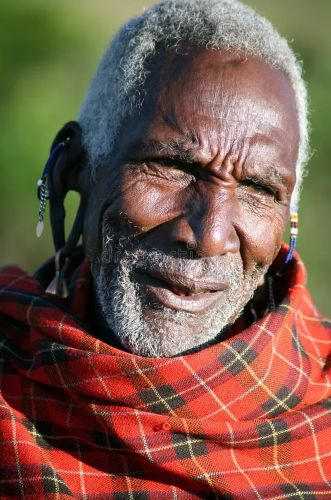
Not all deaths carried the same meaning. In many African societies, the death of an elder who had lived long, produced descendants, fulfilled obligations, and occupied a recognized place in the lineage could be understood very differently from the death of a child, a young adult, a pregnant woman, a person who died violently, or someone whose life ended outside the expected rhythm of social completion. Grief was still present, but the interpretation of the death changed. A long life could make death appear less like theft and more like arrival. The deceased had passed through the major stages of human existence, contributed to the continuity of the family, and approached the threshold of ancestorhood with a biography that made ritual incorporation possible. The “good death” was not simply a peaceful death. It was a socially completed death. It marked the end of a life that had moved through the expected sequence of childhood, maturity, reproduction, seniority, and eventual withdrawal into ancestral memory. Such a death could still wound the living deeply, but it did not necessarily create the same ritual anxiety as a life cut short or a death surrounded by violence, ambiguity, or exclusion. The community could grieve while also recognizing that the deceased had reached the kind of ending that made continuity possible.
Age mattered because elderhood carried moral and ritual weight. Elders were not merely older individuals; they were living links between generations, keepers of memory, mediators of conflict, transmitters of custom, and visible signs of the lineage’s endurance. To die as an elder could mean that one died with accumulated authority. Such a person had often seen children and grandchildren, participated in communal obligations, witnessed the deaths of others, and become part of the remembered structure of the household. The funeral of an elder could mourn separation while also celebrating completion. Songs, dancing, feasting, praise, cloth, and public attendance could announce that the deceased had reached the kind of death that made ancestral elevation thinkable. The sorrow was real, but it was surrounded by recognition that the life had ripened into social fullness.
Status also shaped the meaning of death. Chiefs, titled elders, ritual specialists, lineage heads, successful farmers, warriors, mothers of many children, wealthy householders, and persons known for generosity or wisdom might receive funerals that reflected more than personal affection. Their deaths touched offices, dependents, followers, clients, ritual responsibilities, and political relationships. The funeral could become a public reckoning with authority: who would inherit, who would speak, who would succeed, who would contribute, and who had the right to claim closeness to the dead. Mourning did not simply accompany a loss; it managed succession, reputation, and social order. The more socially embedded the deceased had been, the more work the funeral had to perform.
By contrast, deaths that seemed premature or disordered could carry a different ritual charge. The death of a child, for example, could be devastating without being interpreted as ancestral completion. A child had not yet married, reproduced the lineage, achieved elderhood, or become a source of social memory in the same way as an older person. Death in childbirth, sudden accident, suicide, murder, epidemic disease, drowning, lightning strike, or suspected witchcraft might likewise require special rites or interpretations because such deaths appeared to rupture the expected pattern of life. They raised questions of danger, pollution, spiritual aggression, misfortune, or unfinished destiny. The issue was not that these lives lacked value, but that their deaths did not fit the ritual and social logic through which a person normally moved toward honored ancestry. A premature death could leave mourners not only sorrowful but disoriented, searching for an explanation that would restore moral order. The young dead had not yet completed the relationships that made ancestorhood secure; the violently dead might require cleansing, vengeance, or ritual separation; the socially ambiguous dead might unsettle inheritance, kinship, and memory. Such deaths demanded careful handling because they seemed to expose a break in the expected covenant between life, lineage, and time.
The good death was deeply connected to ideas of fertility, descent, and continuity. In lineage-based societies, a person’s life was often judged not only by individual virtue but by contribution to the ongoing life of the group. To leave descendants was to leave living memory. To have children who could mourn, bury, name, invoke, and remember was to secure a path into the social afterlife. This helps explain why childlessness, estrangement, exile, or death far from home could become ritually troubling. The dead needed descendants, mourners, and a place among kin. Without those relationships, the person’s passage could become uncertain. Ancestorhood depended not only on the soul’s survival but on the social structures that could receive and sustain the dead.
Yet the ideal of the good death should not be romanticized as a simple celebration of old age. It also reveals how strongly communities linked personhood to social achievement. Those who died without descendants, without status, without proper burial, or outside accepted categories could be mourned differently, sometimes with reduced rites or ritual caution. This distinction gave funerals moral force, but it could also reproduce hierarchy. The elder with descendants and wealth was more easily transformed into an honored ancestor than the marginal, the young, the enslaved, the stranger, or the socially unresolved. The good death illuminates both the tenderness and the discipline of African mortuary thought. It shows a world in which grief was shaped by hope for ancestral continuity, but also by hard judgments about age, belonging, fertility, status, and whether a life had reached the form of completion that death required.
Mourning Colors, Cloth, and the Visible Language of Loss
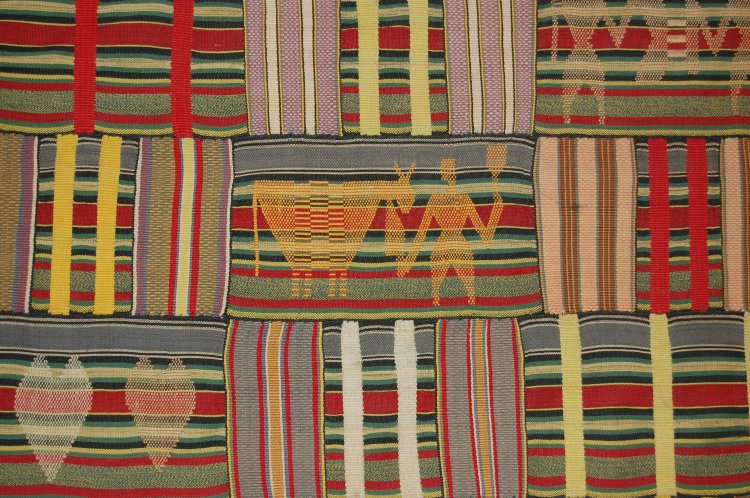
Mourning was not only heard in lament or seen in procession; it was also worn. Across many African societies, cloth, color, body covering, shaving, adornment, and deliberate changes in appearance helped make grief publicly visible. Mourning attire marked the bereaved as people temporarily altered by death. It told others that ordinary social life had been interrupted, that a household had entered ritual danger or sorrow, and that the dead were in the process of being honored. Clothing did not merely express emotion. It organized emotion into a visible code that the community could recognize. This visible language varied widely, and it should not be reduced to a simple opposition between “Western black” and “African color.” Some communities used dark cloths, others white, red, brown, indigo, raffia, bark cloth, animal skins, beads, head coverings, or deliberately plain dress. Colors could signify grief, danger, blood, transition, purity, elderhood, victory, ancestral elevation, or ritual seriousness depending on the society and the circumstances of death. A color associated with sorrow in one setting might be associated with completion or sacredness in another. Mourning color was not a universal symbol but a cultural grammar. It had to be read locally.
Among the Asante, mourning cloth became one of the most famous and elaborate examples of this grammar. Dark colors such as black and deep red were associated with grief, seriousness, danger, and the disruptive force of death. Red cloth, often connected with intense emotion, blood, conflict, and spiritual heat, could mark mourning as a charged and powerful condition. Black could signify sorrow, loss, and the gravity of the funeral. Yet white also had a place in funerary symbolism, especially when the deceased was elderly and had lived a full life. White could suggest victory, completion, blessing, or a successful passage into ancestral status. The contrast reveals a crucial point: the meaning of mourning attire depended not only on death itself but on the kind of death being mourned.
Cloth also communicated social position. A grand funeral required not only mourners but properly dressed mourners. Families, lineages, chiefs, officeholders, affines, friends, and visitors could all be visually distinguished by cloth, quality, pattern, color, and manner of wearing. The funeral crowd became a field of signs. One could see who belonged closely to the deceased, who came as a political representative, who was wealthy, who was obligated, who was bereaved, and who had chosen to honor the dead with visible seriousness. Mourning attire helped organize the crowd into relationships. The funeral was not merely a gathering of bodies but a gathering of socially marked bodies, each dressed into its role.
The economics of mourning cloth could also be significant. To dress properly for a funeral required resources, and in societies where funerals became major public events, cloth could become part of the burden of grief. Families might be expected to provide or wear appropriate textiles, and mourners might invest in new cloth to show respect. This could create pressure, but it also demonstrated obligation. Mourning was costly because the dead mattered. The expense of cloth, like the expense of food, music, drink, or grave goods, made visible the willingness of the living to honor the deceased. Mourning attire belonged to the same economy of care and display that shaped the funeral. Changes to the body could also function as mourning signs. Shaving the head, neglecting adornment, removing jewelry, wearing plain clothing, covering the body, or avoiding certain forms of beauty could signal that the mourner had entered a liminal condition. The bereaved were not simply ordinary people feeling sadness; they were ritually marked persons who had been touched by death. Their altered appearance separated them from everyday life until the mourning period had been completed. Such practices could protect mourners, warn others, and make grief legible in daily space. Even after the funeral ended, clothing and bodily signs could extend mourning into the weeks or months that followed.
Mourning colors and cloth reveal death as a visible social condition. They turned grief into a language that could be read at a glance, but that language was never simple. Black might speak of sorrow; red might speak of danger, power, or violent grief; white might speak of completion, elderhood, or ancestral triumph; plainness might speak of humility; rich cloth might speak of honor and status. The dressed mourner stood between the dead and the living community, carrying loss on the surface of the body. In that visible form, mourning became public knowledge. The dead had passed, the living had been marked, and the community could see that transition was underway.
Power, Wealth, and the Politics of Funeral Display
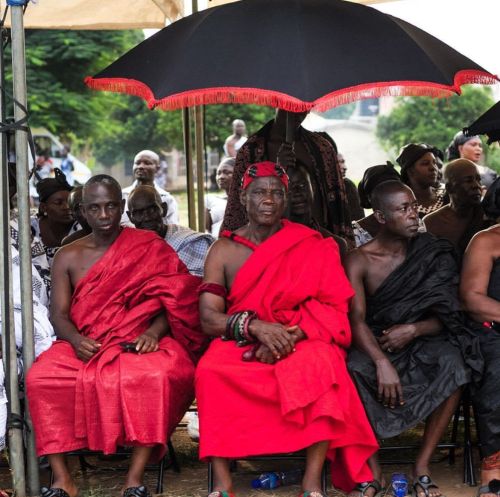
Funerals were acts of mourning, but they were also public demonstrations of power. In many African societies, the burial of the dead required food, drink, cloth, music, grave construction, ritual specialists, animal sacrifice, travel, hospitality, and the coordination of kin and dependents. These were not small matters. They required resources, organization, and authority. A funeral could reveal the strength of a household, the reach of a lineage, the prestige of an office, or the wealth of a political elite. The dead were honored, but the living were also seen. The funeral became a stage on which families and communities displayed their capacity to remember properly. This was visible in elite mortuary contexts. In ancient Nubia, large tumuli, rich grave goods, animal offerings, beds, weapons, ornaments, and elaborate cemetery arrangements could mark the social importance of the deceased. In the royal cemeteries of Kush, funerary architecture and burial assemblages made power durable in the landscape. The grave did not merely preserve a body; it preserved a hierarchy. It announced that the deceased had belonged to a ruling order whose authority extended beyond ordinary life. Such burials remind us that mortuary display could turn grief into political memory. The dead ruler, chief, or elite person became part of a visible genealogy of power, and the grave itself became a monument to continuity.
Yet funeral display was not limited to kings or rulers. Among lineage-based societies, funerals could become occasions for families to demonstrate solidarity, respectability, and social depth. A well-attended funeral showed that the deceased had belonged to a wide network of kin, affines, neighbors, clients, friends, and ritual associates. Contributions of money, food, cloth, animals, labor, and music became public signs of obligation fulfilled. The social question was not only “Who has died?” but “Who has come?” Attendance itself was evidence. A sparse funeral could imply isolation, poverty, conflict, or neglect; a full funeral could show that the deceased remained socially powerful even in death. Mourning became a test of relationship.
Among the Asante and other Akan-speaking communities, funerals became particularly important arenas of social visibility. Cloth, drumming, dancing, public attendance, announcements, gifts, and the careful performance of lineage obligation could all contribute to the honor of the dead and the reputation of the living. A funeral for a person of status could be lavish because the deceased’s name, office, age, and family demanded visible recognition. But this display was never purely decorative. It helped settle the dead into memory, confirmed the family’s place in the community, and allowed social relationships to be counted, performed, and judged. Mourning was inseparable from prestige. To bury well was to show that the family had not failed the dead.
The politics of funeral display also had a darker edge. Lavish burial could reproduce inequality, place heavy financial burdens on families, and turn grief into competition. A family might feel compelled to spend beyond its means to avoid shame. Elite burials could consume labor and wealth that only powerful households could command. In ancient contexts, some mortuary displays involved the sacrifice or burial of retainers, attendants, or animals, making the transition of the powerful dead depend on the bodies and lives of others. These practices complicate any simple picture of funerals as communal tenderness. Mortuary display could express love, reverence, fear, ambition, domination, and social pressure all at once.
Power, wealth, and display do not weaken the spiritual meaning of African funerals; they reveal how deeply spiritual transition was embedded in social life. The dead needed ritual care, but that care was always performed through living structures of rank, gender, wealth, kinship, and authority. A funeral could send the dead toward ancestral status while also reorganizing inheritance, confirming office, measuring loyalty, displaying prestige, and exposing inequality. Mourning was sincere, but sincerity did not remove politics. The funeral was powerful precisely because it joined grief to public order. In honoring the dead, the living also declared who they were, what they possessed, whom they could gather, and how they wished to be remembered when their own passage came.
Change over Time: Islam, Christianity, Colonial Rule, and Modern Funeral Economies
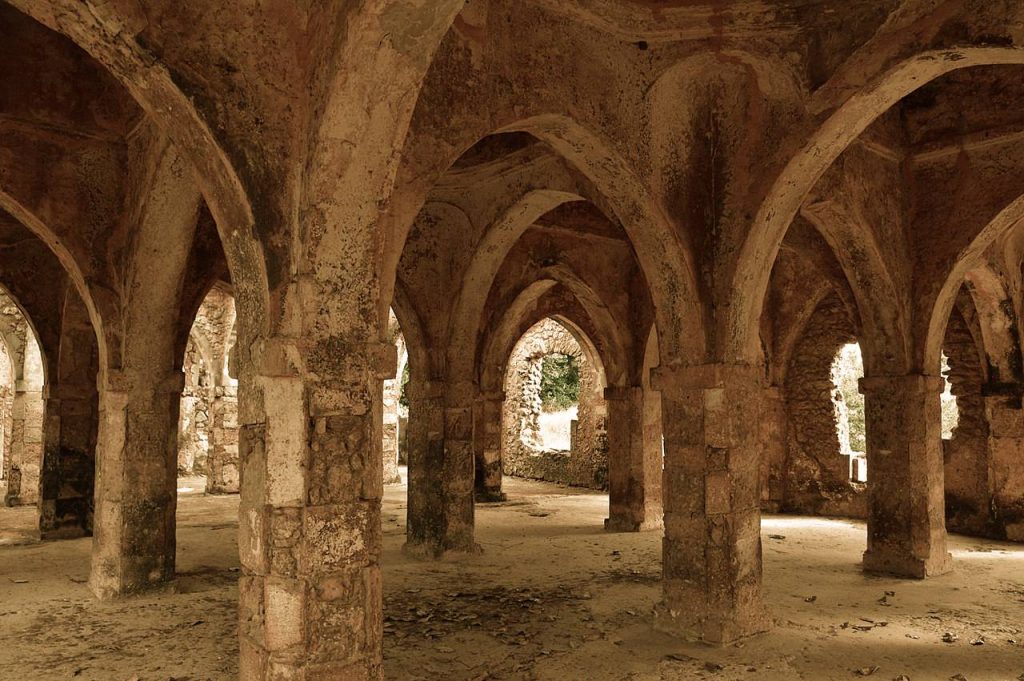
African funerary traditions were never frozen survivals from an untouched past. They changed as communities encountered new religions, new states, new economies, new technologies, and new forms of social mobility. Islam, Christianity, colonial administration, wage labor, urban migration, public health regulation, print culture, radio, photography, funeral homes, and global consumer markets all reshaped how people mourned. Yet change did not simply erase older ideas of ancestral obligation, communal grief, or proper transition. More often, new practices entered an already meaningful world of kinship, land, memory, and the dangerous passage of the dead. Funerals became sites where old and new moral orders met.
Islam transformed deathways across large parts of Africa, particularly in North Africa, the Sahel, the Horn, and coastal and inland trading regions. Islamic burial ideals emphasized prompt burial, washing and shrouding the body, prayer for the deceased, bodily orientation, simplicity before God, and the rejection of excessive display or practices judged incompatible with Islamic teaching. These principles could challenge older forms of grave goods, elaborate ritual delay, sacrifice, or ancestor-oriented observance. But Islam in Africa was not simply imposed as an abstract legal code. It was lived through local communities, scholarly lineages, Sufi networks, trading families, rulers, and ordinary households. In many places, Islamic funerary discipline coexisted with local ideas about kinship, blessing, saints, land, and the continuing moral importance of the dead.
Christianity likewise reshaped African mourning, but it did so unevenly. Missionaries often criticized ancestor veneration, libation, sacrifice, masking, divination, and funerary expense as pagan, superstitious, or wasteful. Christian burial introduced church services, hymns, Bible readings, coffins, cemeteries, crosses, sermons, and ideas of heaven, resurrection, judgment, and salvation. Yet African Christians did not simply abandon older obligations to kin and the dead. In many communities, the Christian funeral became a layered event: church liturgy might frame the soul’s destiny, while family gatherings, mourning cloth, feasting, public attendance, lineage obligations, and memorial practices continued to express social belonging. The result was not replacement but negotiation. The dead could be entrusted to God while still being mourned as members of a lineage, household, and community. This layering could create tension where church leaders condemned practices that families considered necessary to honor the dead properly. A household might avoid explicit sacrifice or ancestral invocation while preserving the wider communal structure of mourning: the gathering of kin, the public display of grief, the feeding of guests, the wearing of appropriate cloth, and the insistence that the deceased be remembered with dignity. Christianity changed the language of death, but it did not always change the social demand that death be witnessed, interpreted, and ritually completed.
Colonial rule added another layer of pressure. Colonial officials, missionaries, doctors, and sanitary authorities often viewed African funerals through the language of disorder, waste, contagion, superstition, or inefficient labor. Epidemics, urban crowding, cemetery regulation, forced removals, and public health campaigns gave colonial states reasons to intervene in burial practice. Authorities might restrict where bodies could be buried, regulate cemeteries, discourage burial near homes, condemn certain rites, or try to shorten funerary gatherings. These interventions were rarely neutral. They attacked not only methods of disposing of the dead but also local relationships among kinship, land, ancestors, and authority. To regulate burial was to regulate memory, space, and belonging.
Colonial economies helped enlarge funerals in new ways. Wage labor and migration meant that relatives often lived far from home, making delayed funerals more important as opportunities for return. Roads, railways, lorries, and later motor transport made it easier to move bodies, mourners, food, cloth, and goods over longer distances. Cash economies changed how families paid for funerals, turning contributions, donations, and public accounting into highly visible parts of mourning. Imported cloth, manufactured coffins, printed funeral programs, photographs, brass bands, newspaper notices, and later radio announcements expanded the public language of grief. Modernity did not make funerals less communal. In many places, it gave communal grief new media, new costs, and new audiences. It also changed the scale of obligation. A person who died in a city might still need to be returned to a rural hometown; migrants might be expected to contribute money even when they could not attend; relatives abroad might participate through remittances, recorded messages, photographs, or later digital media. The funeral became a bridge between dispersed lives and ancestral places. Mobility scattered families, but death called them back, physically or financially, to the communities that still claimed the dead.
Ghana, especially Asante society, provides a powerful example of these changes. Modern Asante funerals can be enormous public events involving church services, traditional mourning cloth, music, photography, printed posters, video recording, public donations, elaborate seating arrangements, and carefully managed displays of family prestige. Scholars such as Marleen de Witte and Sjaak van der Geest have shown that these funerals are not merely survivals of older custom or simple expressions of modern consumerism. They are moral economies in which the living negotiate respect, reputation, Christianity, tradition, kin obligation, status, and public memory. A funeral can be criticized as too expensive and still be understood as necessary. Families may complain about the cost while also fearing the shame of failing to bury well.
The modern funeral economy has intensified old tensions rather than eliminating them. On one hand, elaborate funerals can bring scattered kin together, honor elders, support bereaved families, and publicly affirm that the dead still matter. On the other hand, they can burden households with debt, encourage competitive display, and make grief vulnerable to social pressure. Coffins, cloth, catering, transport, music, photography, obituary posters, mortuary fees, church payments, and hospitality can turn mourning into a major financial undertaking. This does not mean that modern funerals are hollow performances. It means that ritual obligation now often moves through cash, markets, media, and public spectacle. The dead still require care, but care has become expensive. This expense can sharpen questions that were already present in older funerary systems: Who owes what to the dead? How much display is honorable, and how much is vanity? When does proper mourning become social competition? The modern funeral economy exposes the uneasy relationship between sincerity and spectacle. Families may spend because they love, because they fear shame, because they respect tradition, because they seek status, or because all of these motives have become impossible to separate.
Change over time complicates my argument without overturning it. Islam, Christianity, colonial rule, and modern funeral economies all altered African mourning practices, sometimes sharply. They changed burial timing, ritual language, cemetery space, theological interpretation, bodily treatment, public display, and the material culture of grief. But they did not remove the fundamental problem death posed: how to move the deceased from rupture into memory, from danger into order, from absence into a continuing relationship with the living. Whether through Islamic prayer, Christian hymn, ancestral libation, mourning cloth, printed obituary, or crowded urban funeral, communities continued to ask what the dead needed and what the living owed. The forms changed, but the work of transition remained.
Are We Turning Many African Deathways into One Ancestral System?
The following video from “Spirits of Africa” discusses ancestral spirits in African traditional religions:
It may seem that I am gathering many African deathways into one overarching ancestral pattern. That danger is real. Africa’s mortuary traditions did not form a single system, and the evidence used to study them comes from very different times, places, and genres: ancient Nubian archaeology, Egyptian funerary texts, West African oral and ritual traditions, early colonial ethnographies, missionary records, modern anthropology, and contemporary funeral economies. To speak too easily of “African” mourning risks making Nubian tumuli, Asante funerals, Yoruba divination, LoDagaa ancestor rites, Bobo mask performance, Islamic burial, and Christian memorial practice appear as variations of one timeless tradition. Such an approach can flatten history, blur geography, and turn comparison into oversimplification.
There is also a deeper methodological problem. Much of what is known about African mourning comes through sources shaped by outsiders, colonial categories, missionary hostility, administrative curiosity, or anthropological theory. Early ethnographers often recorded valuable information, but they did so within unequal political worlds and sometimes treated African religions as static survivals rather than changing thought constructs. Even sympathetic scholars could over-systematize ritual life, turning flexible practices into rigid “beliefs.” Archaeology poses a different difficulty: graves reveal bodies, objects, spatial choices, and material investment, but they cannot directly reveal grief, theology, or emotional experience. A bed burial, a tumulus, a pot, or a bead may suggest care, identity, or transition, but the precise meanings attached to those objects must be reconstructed with caution.
The concept of ancestorhood itself can also become too neat. Not every dead person became an ancestor, and not every African society emphasized ancestors in the same way. Some traditions placed stronger emphasis on reincarnation, spirits, saints, divinities, ritual specialists, royal dead, or the destiny of the soul before God. Islam and Christianity reshaped or rejected many ancestor-focused practices, even when older social obligations persisted beneath new theological language. Some dead were feared, excluded, forgotten, or ritually separated rather than lovingly incorporated. Others were remembered through family, land, office, or local shrine without fitting the model of the “living-dead” in any simple sense. The ancestor should not be treated as a universal African category into which all mortuary practice can be poured.
Yet this does not require abandoning my argument. It requires refining it. The claim is not that all African peoples shared one doctrine of death, nor that every burial rite was secretly about ancestor worship. The stronger and more careful claim is that many African societies faced a recurring ritual problem: death had to be made socially manageable. Whether through burial near the home, public lament, second funerals, grave goods, mourning cloth, Islamic prayer, Christian hymnody, royal tumuli, or family compounds, communities had to decide what the dead needed, where they belonged, how they should be remembered, and what obligations remained among the living. The point of comparison is not sameness of belief but similarity of problem: how to transform death from rupture into order.
This makes the diversity of African deathways more important, not less. Nubian burial architecture shows transition through body, mound, and landscape; Asante funerals show transition through cloth, public attendance, and lineage prestige; LoDagaa mortuary practices show death as property, kinship, and ancestral obligation; Islamic and Christian funerals show how new religious languages could alter older forms of mourning while still preserving communal responsibility. My final interpretation must be comparative without being homogenizing. African mourning should be understood not as one ancestral system but as a family of historically changing practices through which communities confronted the same human crisis in different ritual languages. The dead did not simply disappear, but neither did they all become the same kind of ancestor. They were placed, remembered, feared, honored, prayed for, transformed, or contested according to the worlds their communities made for them.
Conclusion: Grief as the Work of Transition
Grief in many ancient and traditional African cultures was not simply the sorrow that followed death. It was work: ritual work, social work, emotional work, and spiritual work. The dead did not move automatically from the world of the living into a settled ancestral or spiritual condition. They had to be mourned, washed, wrapped, buried, remembered, accompanied, named, placed, and sometimes celebrated again through later rites. Each act mattered because death created an interval of danger and uncertainty. The deceased had changed, but the meaning of that change still had to be made. Mourning gave the living a way to answer death not with silence, but with action.
Across the traditions considered here, the funeral appears as a threshold-making institution. Public lament gave grief a voice; drums and dance gave sorrow rhythm and movement; grave goods equipped and identified the dead; beds, tumuli, compounds, and ancestral land gave the dead a place; second funerals completed what burial alone could not finish; mourning cloth made loss visible on the body; and communal attendance proved that the deceased had not been abandoned. These practices were not identical from Nubia to Asante, from LoDagaa mortuary obligations to Islamic and Christian reinterpretations, and they should never be collapsed into a single African system. Yet they repeatedly confronted the same problem: death had broken a relationship, and ritual had to remake it in another form.
That remaking could be tender, but it was not always gentle. Funerals also exposed hierarchy, wealth, gendered obligation, political authority, family conflict, and social pressure. The good death was easier for the elder with descendants than for the child, the stranger, the enslaved, the violently killed, or the person who died outside accepted patterns of completion. Lavish burials could honor the dead while also displaying inequality. Modern funeral economies could preserve communal obligation while burdening families with cost and spectacle. These complications do not weaken the argument. They show that mourning mattered because it stood at the center of real social life, where love, fear, memory, obligation, rank, and belief could not be separated cleanly.
The dead were not merely gone. They had to be transformed into ancestors, memories, warnings, names, graves, stories, spirits, saints, or souls commended to God. The living performed that transformation through the disciplined labor of grief. To mourn was to carry the deceased across a threshold and to carry the community through the rupture left behind. In that sense, African deathways reveal one of the deepest human purposes of ritual: not to deny death, but to make a world in which the dead can still belong. The ancestor was not simply the person who had died. The ancestor was the relationship that mourning made possible.
Bibliography
Affiliate disclosure: Amazon links on this site are paid links. As an Amazon Associate I earn from qualifying purchases.
- Abimbola, Wande, ed. and trans. Ifa Divination Poetry. New York: NOK Publishers, 1977.
- Adams, William Y. Nubia: Corridor to Africa. Princeton, NJ: Princeton University Press, 1977.
- Addison, James Thayer. “Ancestor Worship in Africa.” The Harvard Theological Review 17:2 (1924), 155-171.
- Allen, James P., trans. The Ancient Egyptian Pyramid Texts. 2nd ed. Atlanta: Society of Biblical Literature, 2015.
- Appiah, Kwame Anthony. In My Father’s House: Africa in the Philosophy of Culture. New York: Oxford University Press, 1992.
- Aronson, Lisa. Akwete Weaving: A Study of Change in Response to Palm Oil Trade in the Nineteenth Century. Ann Arbor: University Microfilms International, 1986.
- Assmann, Jan. Death and Salvation in Ancient Egypt. Translated by David Lorton. Ithaca, NY: Cornell University Press, 2005.
- Basden, G. T. Among the Ibos of Nigeria. London: Seeley, Service & Co., 1921.
- Bloch, Maurice, and Jonathan Parry, eds. Death and the Regeneration of Life. Cambridge: Cambridge University Press, 1982.
- Buzon, Michele R. “A Bioarchaeological Perspective on Egyptian Colonialism in Nubia during the New Kingdom.” Journal of Egyptian Archaeology 92 (2006), 165–181.
- Chernoff, John Miller. African Rhythm and African Sensibility: Aesthetics and Social Action in African Musical Idioms. Chicago: University of Chicago Press, 1979.
- Comaroff, Jean, and John L. Comaroff. Of Revelation and Revolution, Volume One: Christianity, Colonialism, and Consciousness in South Africa. Chicago: University of Chicago Press, 1991.
- de Witte, Marleen. Long Live the Dead! Changing Funeral Celebrations in Asante, Ghana. Amsterdam: Aksant, 2001.
- Drewal, Henry John, and Margaret Thompson Drewal. Gelede: Art and Female Power among the Yoruba. Bloomington: Indiana University Press, 1983.
- Dunham, Dows. Royal Cemeteries of Kush. 5 vols. Boston: Museum of Fine Arts, 1950–1963.
- Edwards, David N. The Nubian Past: An Archaeology of the Sudan. London: Routledge, 2004.
- Emberling, Geoff, and Bruce Williams, eds. The Oxford Handbook of Ancient Nubia. Oxford: Oxford University Press, 2021.
- Evans-Pritchard, E. E. Witchcraft, Oracles and Magic among the Azande. Oxford: Clarendon Press, 1937.
- Fabian, Johannes. Time and the Other: How Anthropology Makes Its Object. New York: Columbia University Press, 1983.
- Faulkner, Raymond O., trans. The Ancient Egyptian Book of the Dead. Austin: University of Texas Press, 1990.
- Fisher, Marjorie M., Peter Lacovara, Salima Ikram, and Sue D’Auria, eds. Ancient Nubia: African Kingdoms on the Nile. Cairo: American University in Cairo Press, 2012.
- Fortes, Meyer. Oedipus and Job in West African Religion. Cambridge: Cambridge University Press, 1959.
- Gatto, Maria Carmela. “The Nubian Pastoral Culture as Link between Egypt and Africa: A View from the Archaeological Record.” Archéo-Nil 19 (2009), 21–29.
- Gillow, John. African Textiles: Colour and Creativity across a Continent. London: Thames & Hudson, 2003.
- Goody, Jack. Death, Property and the Ancestors: A Study of the Mortuary Customs of the LoDagaa of West Africa. Stanford, CA: Stanford University Press, 1962.
- —-. The Myth of the Bagre. Oxford: Clarendon Press, 1972.
- Hertz, Robert. Death and the Right Hand, translated by Rodney Needham and Claudia Needham. Glencoe, IL: Free Press, 1960.
- Hobsbawm, Eric, and Terence Ranger, eds. The Invention of Tradition. Cambridge: Cambridge University Press, 1983.
- Huntington, Richard, and Peter Metcalf. Celebrations of Death: The Anthropology of Mortuary Ritual. 2nd ed. Cambridge: Cambridge University Press, 1991.
- Ibn Baṭṭūṭa. The Travels of Ibn Battuta, A.D. 1325–1354. Translated by H. A. R. Gibb. 5 vols. Cambridge: Cambridge University Press, 1958–2000.
- Ikram, Salima, and Aidan Dodson. The Mummy in Ancient Egypt: Equipping the Dead for Eternity. London: Thames & Hudson, 1999.
- Kendall, Timothy. Kerma and the Kingdom of Kush, 2500–1500 B.C.: The Archaeological Discovery of an Ancient Nubian Empire. Seattle: University of Washington Press, 1997.
- Kopytoff, Igor. “Ancestors as Elders in Africa.” Africa: Journal of the International African Institute 41:2 (1971), 129–142.
- Le Moal, Guy. Les Bobo: Nature et fonction des masques. Paris: ORSTOM, 1980.
- Levtzion, Nehemia, and J. F. P. Hopkins, eds. and trans. Corpus of Early Arabic Sources for West African History. Princeton, NJ: Markus Wiener, 2000.
- Levtzion, Nehemia, and Randall L. Pouwels, eds. The History of Islam in Africa. Athens: Ohio University Press, 2000.
- Magesa, Laurenti. African Religion: The Moral Traditions of Abundant Life. Maryknoll, NY: Orbis Books, 1997.
- Mbiti, John S. African Religions and Philosophy. Portsmouth, NH: Heinemann, 1969.
- McCaskie, T. C. State and Society in Pre-Colonial Asante. Cambridge: Cambridge University Press, 1995.
- Metcalf, Peter, and Richard Huntington. Celebrations of Death: The Anthropology of Mortuary Ritual. Cambridge: Cambridge University Press, 1979.
- Meyer, Birgit. Sensational Movies: Video, Vision, and Christianity in Ghana. Berkeley: University of California Press, 2015.
- —-. Translating the Devil: Religion and Modernity Among the Ewe in Ghana. Edinburgh: Edinburgh University Press, 1999.
- Mudimbe, V. Y. The Invention of Africa: Gnosis, Philosophy, and the Order of Knowledge. Bloomington: Indiana University Press, 1988.
- Nketia, J. H. Kwabena. Funeral Dirges of the Akan People. Achimota: Achimota Press, 1955.
- —-. Drumming in Akan Communities of Ghana. Edinburgh: Thomas Nelson, 1963.
- Nukunya, G. K. Tradition and Change in Ghana: An Introduction to Sociology. 2nd ed. Accra: Ghana Universities Press, 2003.
- Nunn, Nathan. “Religious Conversion in Colonial Africa.” The American Economic Review 100:2 (2010), 147-152.
- Parrinder, E. G. “Monotheism and Pantheism in Africa.” Journal of Religion in Africa 3:1 (1970), 81-88.
- Parrinder, Geoffrey. West African Religion: A Study of the Beliefs and Practices of Akan, Ewe, Yoruba, Ibo, and Kindred Peoples. London: Epworth Press, 1969.
- Pearson, Mike Parker. The Archaeology of Death and Burial. College Station: Texas A&M University Press, 1999.
- Peel, J. D. Y. Religious Encounter and the Making of the Yoruba. Bloomington: Indiana University Press, 2000.
- Picton, John, and John Mack. African Textiles: Looms, Weaving and Design. London: British Museum Publications, 1989.
- Pobee, John. “Aspects of African Traditional Religion.” Sociological Analysis 37:1 (1976), 1-18.
- Rattray, R. S. Ashanti. Oxford: Clarendon Press, 1923.
- —-. Religion and Art in Ashanti. Oxford: Clarendon Press, 1927.
- Ray, Benjamin C. African Religions: Symbol, Ritual, and Community. 2nd ed. Upper Saddle River, NJ: Prentice Hall, 1999.
- Reisner, George A. Excavations at Kerma. 3 vols. Cambridge, MA: Harvard University Press, 1923.
- Ross, Doran H., ed. Wrapped in Pride: Ghanaian Kente and African American Identity. Los Angeles: UCLA Fowler Museum of Cultural History, 1998.
- Rovine, Victoria L. Bogolan: Shaping Culture through Cloth in Contemporary Mali. Washington, DC: Smithsonian Institution Press, 2001.
- Roy, Christopher D. Art of the Upper Volta Rivers. Meudon: Alain et Françoise Chaffin, 1987.
- Sarpong, Peter. Ghana in Retrospect: Some Aspects of Ghanaian Culture. Accra: Ghana Publishing Corporation, 1974.
- Schildkrout, Enid, and Curtis A. Keim, eds. The Scramble for Art in Central Africa. Cambridge: Cambridge University Press, 1998.
- Shipton, Parker. Mortgaging the Ancestors: Ideologies of Attachment in Africa. New Haven, CT: Yale University Press, 2009.
- Smith, Stuart Tyson. Wretched Kush: Ethnic Identities and Boundaries in Egypt’s Nubian Empire. London: Routledge, 2003.
- Taylor, John H. Death and the Afterlife in Ancient Egypt. Chicago: University of Chicago Press, 2001.
- Trimingham, J. Spencer. The Influence of Islam upon Africa. London: Longman, 1968.
- van der Geest, Sjaak. “Funerals for the Living: Conversations with Elderly People in Kwahu, Ghana.” African Studies Review 43:3 (2000), 103–129.
- Vansina, Jan. Oral Tradition as History. Madison: University of Wisconsin Press, 1985.
- Vaughan, Megan. Curing Their Ills: Colonial Power and African Illness. Stanford, CA: Stanford University Press, 1991.
- Waterman, Christopher Alan. Jùjú: A Social History and Ethnography of an African Popular Music. Chicago: University of Chicago Press, 1990.
- Welsby, Derek A. The Kingdom of Kush: The Napatan and Meroitic Empires. London: British Museum Press, 1996.
Originally published by Brewminate, 06.18.2026, under the terms of a Creative Commons Attribution-NonCommercial-NoDerivatives 4.0 International license.
About the Author