Around 400 BCE, an anonymous Hippocratic writer rejected divine explanations for epilepsy, traced it to the brain, and showed how sacred healers turned uncertainty into authority.

By Matthew A. McIntosh
Public Historian
Brewminate
Introduction: The Seizure That Looked Like a God
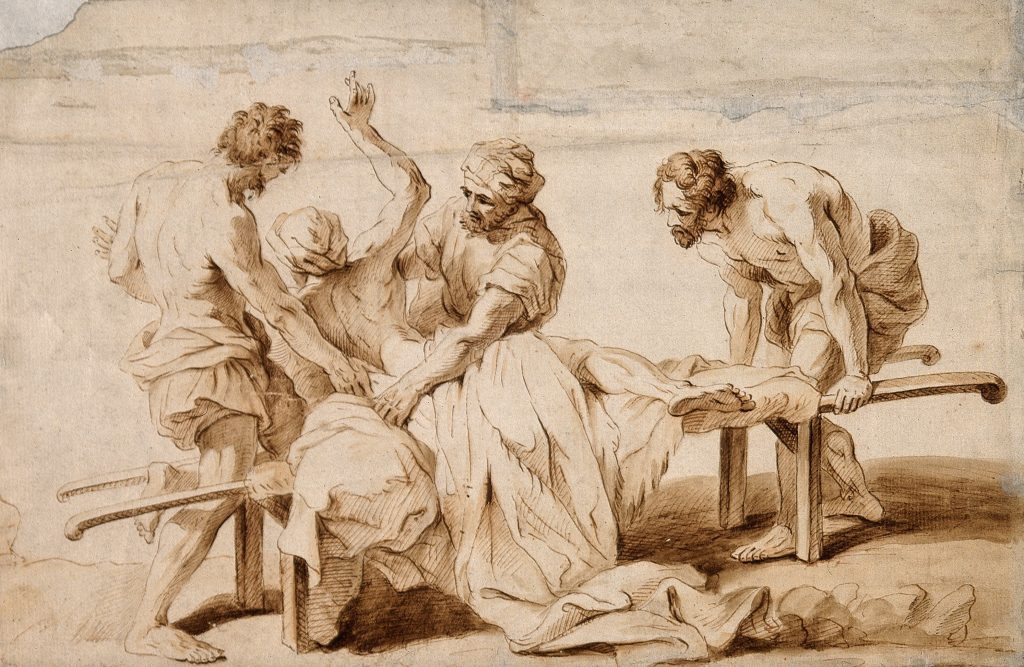
The body described in On the Sacred Disease seemed to have fallen under an invading power. A sufferer could lose speech and consciousness, grind or clench the teeth, distort the eyes, contract the hands, kick violently, foam at the mouth, and evacuate the bowels. Breath appeared to fail while the bloodied or pallid face registered a struggle the patient could neither explain nor control. No visible wound accounted for the collapse, and the violence of the symptoms made the ordinary boundaries of the self appear to dissolve. Then, sometimes as suddenly as the attack had begun, the sufferer recovered awareness. Recurrence made the experience no less frightening; it merely established that the unseen force might return. To witnesses living within a culture where gods disclosed themselves through extraordinary events, such a seizure could resemble punishment, pollution, possession, or direct divine assault. The disease seemed sacred because it was spectacular, unpredictable, and difficult to understand.
Yet “the sacred disease” did not name one universally accepted diagnosis or a single coherent Greek belief. The symptoms correspond most closely to recurrent convulsive seizures, but the ancient category cannot be mapped perfectly onto modern epilepsy. Nor did every Greek necessarily interpret an attack in the same way. What the surviving treatise reveals is a contested field in which certain ritual specialists assigned divine identities to particular symptoms and claimed the knowledge required to remove their influence.
Sometime during the later fifth century or around the beginning of the fourth century BCE, an anonymous medical writer entered that contest with unusual aggression. His work was eventually preserved within the Hippocratic Corpus, although there is no secure reason to identify him personally with Hippocrates of Kos. He attacked magicians, purifiers, begging priests, and boastful healers who treated the illness with incantations, ritual cleansing, dietary prohibitions, and rules governing clothing or behavior. In his telling, these practitioners transformed every variation in a seizure into evidence for a different god: one divine power explained grinding teeth, another a sharp cry, another nighttime terror or foaming at the mouth. Their system also protected its interpreters. Recovery demonstrated the healer’s ritual knowledge, while death could be attributed to divine will or to the patient’s failure to observe a prohibition. The author went further, alleging that men in need of a livelihood cultivated such explanations because mystery concealed their inability to provide effective assistance. That accusation cannot be accepted as an impartial description of every religious healer, but it exposes the practical conflict beneath the theological argument. In a medical marketplace without licensing institutions or agreed standards of expertise, the power to explain an illness was inseparable from the power to attract patients.
The writer answered sacred causation with a physiological theory centered upon the brain. He believed that inherited bodily disposition and an abnormal flow of phlegm obstructed vessels, interfered with the passage of air, and generated the frightening symptoms of a seizure. The mechanism was wrong, even by comparison with later understandings of the nervous system, and its use of phlegm belonged to an evolving field of humoral speculation rather than modern neurology. Nevertheless, the intellectual move was consequential. The author did not simply reject religion, for he could describe every disease as both divine and human and invoke conventional piety against those who claimed magical control over the gods. His sharper break concerned the rules of explanation: an illness did not acquire a supernatural cause merely because its symptoms inspired terror and wonder. On the Sacred Disease records more than an early theory of epilepsy. It captures a struggle over whether medical mystery should remain the property of ritual authority or become a problem for natural investigation and over who would gain the status, trust, and livelihood attached to the answer.
Before the Diagnosis: What the “Sacred Disease” Named
The expression “sacred disease” appears precise only when read backward through the categories of modern neurology. The Hippocratic writer is more cautious, repeatedly referring to the illness “called sacred,” as though its familiar name already contained the proposition he intended to challenge. He did not possess a diagnostic category equivalent to contemporary epilepsy, which encompasses multiple disorders characterized by an enduring susceptibility to seizures. His central description (sudden unconsciousness, muscular contraction, convulsive movement, fixed teeth, disordered breathing, foaming, and eventual recovery) closely resembles what would now be recognized as a generalized tonic-clonic seizure. Other observations, including the patient’s awareness that an attack is approaching and the unequal involvement of the body, could be associated with focal onset or an epileptic aura. Yet retrospective diagnosis remains uncertain because similar outward events can result from fever, metabolic disturbance, cerebral injury, poisoning, fainting, or nonepileptic seizures. No physician examined the people behind the text using a modern clinical history, neurological imaging, or electrical recording of the brain. “Epilepsy” is a useful translation of the ancient problem, not an exact diagnosis preserved across twenty-four centuries.
Greek vocabulary itself encouraged a particular way of imagining the attack. Words associated with epilepsis derived from a verb meaning to seize, take hold of, or attack, language that captured the sufferer’s abrupt loss of command over the body. To say that someone had been “seized” did not automatically identify a god or demon as the aggressor, since the same verbal imagery could describe an ordinary assault. In the context of violent convulsion, the language made external agency intuitively plausible. The body looked less like an organism malfunctioning from within than a person overpowered by something that could not be seen.
Neither the symptoms nor their careful observation began with Greek medicine. Cuneiform diagnostic traditions from Mesopotamia described seizure phenomena centuries before the Hippocratic treatise, distinguishing attacks by their timing, bodily movements, vocalizations, direction of the eyes, and other visible signs. Some Mesopotamian explanations associated these events with gods, ghosts, or demons, but their supernatural framework did not prevent disciplined attention to recurring patterns. This earlier evidence complicates any story in which rational Greek physicians suddenly began observing conditions that religious healers had merely imagined. Ancient ritual specialists could be exact observers because successful divination and treatment also depended upon recognizing differences among symptoms. The disagreement concerned what those observations meant, which causes connected them, and what sort of expertise they authorized. Nor was every seizure necessarily understood in the same way. A brief convulsion, an extended loss of consciousness, repeated childhood attacks, nocturnal terror, and strange behavior might be grouped together in one tradition but separated in another. Before epilepsy became a disease defined through neurological criteria, it existed as an unstable collection of events interpreted through the intellectual resources available to the observer.
Within Greek culture, calling an illness sacred could carry several overlapping implications. It might suggest divine punishment, ritual pollution, possession, hereditary wrongdoing, or simply a phenomenon so extraordinary that an ordinary bodily explanation seemed inadequate. Particular symptoms could also be assigned to different gods rather than to one supernatural source shared by every sufferer. The Hippocratic author’s opponents apparently treated variations within the seizure as clues to the responsible power, much as another interpreter might read an omen. Because the surviving description comes from a hostile critic, it cannot establish either the exact beliefs of ritual healers or their prevalence among the wider population.
The author’s most consequential act was one of reclassification. He did not deny that nature possessed a divine dimension, nor did he claim that human beings had ceased to inhabit a world governed by gods. Instead, he denied that an astonishing appearance entitled one disease to a separate order of causation. If recurring fevers, delirium, nighttime terrors, and inexplicable madness were not isolated as uniquely sacred, convulsions could not be granted that status merely because they were dramatic. Every illness had its own nature and arose through causes that belonged to the same world as the body experiencing it. The writer could even describe all diseases as both divine and human, thereby dissolving the boundary his opponents attempted to draw around this one affliction. What the “sacred disease” named was consequently more than a seizure disorder: it named a struggle over whether wonder was itself an explanation. The Hippocratic author did not yet diagnose epilepsy in the modern sense, but he insisted that terror before a symptom could not settle the question of its cause.
A Marketplace without Medical Licenses

Classical Greece recognized people called iatroi, or physicians, but possessed no central authority that licensed them, imposed a uniform curriculum, or reserved medical treatment exclusively for approved practitioners. A man could present himself as a physician on the basis of family training, apprenticeship, practical experience, reputation, or little more than confidence. Individual cities sometimes appointed public physicians, paid retainers, rewarded successful service, or honored doctors whose work had benefited the community. Such appointments constituted civic endorsement, but they did not create a regulatory system comparable to modern professional licensing. Most practitioners still depended upon patients who could choose among competing providers and abandon one healer for another. Because treatment outcomes were uncertain, physicians cultivated authority through appearance, conduct, persuasive speech, prognostic skill, testimonials, and claims of specialized knowledge. A correct prediction might impress a household even when the doctor could do little to alter the course of the illness. The “medical marketplace” was not a formal institution but a useful description of an environment in which authority had to be repeatedly won.
Training was equally varied. Medical knowledge often passed through families or apprenticeships, while some teachers accepted paying students bound by personal loyalty and professional obligation. Herodotus’s account of Democedes of Croton, who practiced in several Greek communities before serving at the Persian court, illustrates both the mobility of successful doctors and the readiness of cities or rulers to compete for their services. The familiar language of “schools” at Kos or Cnidus can mislead if it evokes permanent universities with standardized admission and graduation requirements. A healer’s education mattered, but patients could rarely verify it through an external credential.
The physician was only one figure within a much broader economy of care. Midwives managed pregnancy and childbirth, athletic trainers advised on diet and exercise, root cutters gathered medicinal plants, and drug sellers offered substances whose composition or effects could vary widely. Bone setters and surgeons possessed manual skills that a regimen-oriented physician might lack. Household members supplied nursing, remedies, food, bathing, and accumulated knowledge about recurring illnesses, often long before an outside practitioner was summoned. Seers interpreted signs, purifiers removed pollution, and ritual experts used prayers, sacrifice, incantation, amulets, or prescribed abstentions. These were not always distinct occupations separated by rigid intellectual boundaries. A practitioner might combine herbal remedies with ritual language, while a physician committed to bodily causes could employ purging, dietary restrictions, dream interpretation, or traditional substances whose supposed actions had never been systematically demonstrated. Patients likewise had no obligation to choose one method of explanation and reject all others. A family might consult a physician, perform a household purification, petition a god, and try a remedy recommended by a neighbor without perceiving any contradiction. Therapeutic pluralism was a practical response to suffering in a world where no healer could reliably promise success.
The sanctuaries of Asklepios occupied an important place. Suppliants traveled to healing sites, underwent purification, offered sacrifices, slept within sacred precincts, and sought a curative encounter with the god through dreams. The cult expanded during the same broad period in which the surviving Hippocratic treatises began articulating medicine as a rational techne. Yet the two traditions were not necessarily understood as enemies. Physicians could honor Asklepios, patients could pursue temple and medical treatment, and bodily remedies could be attributed to divine instruction.
This crowded field explains the vehemence of On the Sacred Disease. Its author could not invoke a license, institutional degree, or legally protected title to establish his superiority over the purifiers and magicians he condemned. He instead made causal explanation into a professional credential. By promising to show where the disease originated, how its symptoms developed, and why rival treatments appeared to work, he presented his reasoning as evidence that his medicine was a genuine art. His accusation that ritual healers exploited credulous patients also carried an unmistakable economic dimension, because reputation determined who received fees, gifts, patronage, or future recommendations. That competitive motive does not render his physiological argument insincere; intellectual conviction and professional interest could reinforce one another. It does mean that the division between medicine and magic was being actively constructed by participants who stood to gain from the boundary. The anonymous writer’s text functioned as part explanation, part demonstration of expertise, and part intervention in a marketplace where the right to treat began with the ability to persuade.
The Anonymous Writer behind “Hippocrates”
The name Hippocrates gives On the Sacred Disease an authority its original author never claimed for himself. Modern editions place the treatise within the Hippocratic Corpus, while popular histories commonly convert that classification into the statement that Hippocrates personally discovered the natural cause of epilepsy. The manuscript tradition does not justify such certainty. Nothing within the work identifies its author, recounts his life, names his teachers, or connects him directly to the historical physician from Kos. “Hippocratic” is consequently a useful description of the medical tradition and textual collection to which the treatise belongs, not a verified signature. The writer who attacked sacred explanations must remain anonymous.
The Hippocratic Corpus is itself not a single book composed according to one plan. It contains roughly sixty treatises conventionally attributed to Hippocrates, but they differ markedly in date, vocabulary, literary form, physiological theory, therapeutic preference, and intended audience. Some read like lecture texts or argumentative essays, while others preserve case histories, surgical instructions, prognostic observations, dietary programs, aphorisms, or professional regulations. Their authors sometimes disagree about the composition of the body, the origins of disease, the location of thought, and the proper limits of treatment. The collection accumulated through a long and imperfectly understood process, with works associated with different practitioners and intellectual traditions eventually transmitted under the Hippocratic name. Hellenistic scholarship probably played an important role in preserving and organizing the material, although the familiar story of a complete medical library from Kos being deposited at Alexandria cannot be demonstrated securely. Later commentators treated Hippocrates as the unifying authority behind an increasingly diverse body of writing, encouraging readers to harmonize contradictions that may originally have belonged to separate authors. The survival of the corpus is inseparable from the prestige of the name attached to it, but that prestige also obscured the plurality that produced it.
A historical Hippocrates of Kos almost certainly existed. Plato refers to Hippocrates the Asclepiad as a recognized physician and associates medical knowledge with the investigation of nature, while later ancient authors supplied additional traditions about his family, travels, teaching, and character. Those references establish that Hippocrates possessed a significant reputation by the fourth century BCE. They do not provide a reliable catalogue of his writings. No surviving treatise can be assigned to him simply because its ideas appear particularly perceptive or congenial to modern medicine.
Linguistic features and intellectual context generally place On the Sacred Disease in the later fifth century BCE or near the beginning of the fourth. Its environmental reasoning, interest in bodily fluids, and insistence upon natural causation connect it closely with Airs, Waters, Places. Both works explain human difference through climate and physical constitution, and both reject the designation of an unusual condition as uniquely divine. These parallels once encouraged confident attribution to a single author, but similarity does not establish identity. One writer could have borrowed from another, both could have drawn upon common medical arguments, or the surviving texts could reflect conversation within a broader network of practitioners. Differences in their treatment of divinity have also complicated attempts to merge their voices without remainder. The safest conclusion is that the two works share an intellectual environment and perhaps a more direct relationship whose precise nature can no longer be recovered.
Although the writer withheld his name, he created a forceful textual personality. He speaks in the first person, announces what he intends to demonstrate, catalogues competing explanations, and repeatedly contrasts his knowledge with the ignorance of other healers. The work does not resemble a private notebook in which a physician tentatively records observations. It is an organized case for the superiority of one way of reasoning about disease. Its sharp antitheses, adversarial structure, appeals to ordinary experience, and promises of causal explanation belong to the argumentative culture of the later fifth century, when sophists, philosophers, craftsmen, and medical writers publicly defended their respective forms of expertise. Julie Laskaris has accordingly interpreted the treatise as a protreptic performance intended to persuade an audience of the value and technical legitimacy of the author’s medicine. That interpretation need not reduce the work to cynical advertising. Rhetorical construction was one means by which a practitioner explained unfamiliar ideas, answered rivals, and demonstrated that his knowledge deserved recognition. The author’s physiological confidence and professional ambition could arise from the same conviction that he understood the disease better than those he condemned.
Anonymity changes the historical question. Instead of celebrating an isolated genius whose discovery created scientific medicine, the essay must examine a writer formed by competitive healing, contemporary natural philosophy, inherited physiological ideas, and the demands of persuasive speech. His identity cannot be reconstructed from the boldness of his argument, nor can every position in the Hippocratic Corpus be made to agree with him. What survives is not a medical biography but an intervention: a deliberate attempt to establish who could speak credibly about a terrifying illness. The later name “Hippocrates” preserved that intervention while gradually turning its unknown author into the representative of a single heroic founder. Recovering the anonymous writer restores the controversy that the legend conceals.
When Every Symptom Named a God
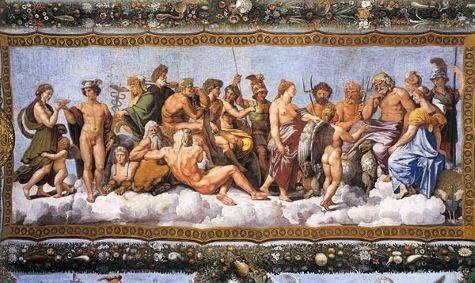
The divine interpretation attacked in On the Sacred Disease was more elaborate than the simple claim that an afflicted person had been possessed. According to the author, ritual specialists divided the seizure into signs and assigned those signs to different supernatural agents. A movement, vocalization, bodily discharge, or moment of terror could indicate which power had entered the event. The diagnosis depended upon resemblance: the patient sounded like an animal associated with a god, moved in a manner recalling a divine attribute, or produced something interpreted through an established religious symbol. Such distinctions allowed healers to present themselves as interpreters of a language invisible to ordinary witnesses. They did not merely announce that the disease was sacred; they claimed to know the identity and intention concealed within each variation. The convulsing body became a field of divine signatures.
When sufferers seemed to imitate a goat, ground their teeth, or convulsed on the right side, the healers reportedly blamed the Mother of the Gods. The goat supplied a potent connection because its voice, movement, skin, flesh, and ritual associations recurred throughout the treatment of the disease. Patients could be forbidden to eat goat meat, sleep on goatskins, or wear material made from the animal. To the Hippocratic writer, these rules exposed contradiction rather than sacred knowledge. To the practitioners he opposed, they may have joined symptom, divine identity, and therapeutic prohibition within one meaningful system.
A different sound could call forth another god. If the patient cried in a sharp or forceful voice that resembled a horse, Poseidon was identified as the cause, presumably through his strong association with horses and equine power. Involuntary defecation could point toward Enodia, a goddess connected with roads, boundaries, nighttime movement, and chthonic danger. If the excrement appeared in smaller and denser pieces resembling that of birds, the responsibility shifted to Apollo Nomios, whose pastoral title linked him with flocks and herds. These associations did not proceed from internal anatomy or a general theory of nervous disturbance. They translated visible particulars into mythic and cultic relationships already familiar to healer and audience. Each sign narrowed the field of possible divine agents, much as a bodily symptom might narrow a physician’s differential diagnosis. The contrast lay in the causal world to which the sign was referred.
Foaming at the mouth and violent kicking were attributed to Ares. The connection drew upon the god’s domain of physical fury, uncontrolled violence, and bodily struggle rather than upon a specific doctrine of disease. Nocturnal terrors, delirium, frightening apparitions, sudden leaps from bed, and attempts to flee were assigned to Hecate or described as attacks by heroes. Darkness and altered perception made such episodes open to supernatural interpretation. The sufferer appeared to encounter beings whom other witnesses could not see.
The author’s catalogue is valuable precisely because it preserves details of practices otherwise poorly documented, but it cannot be read as a neutral survey of Greek religious medicine. He writes to discredit his opponents and gathers several kinds of practitioners into a single hostile category. Their beliefs may have varied by locality, cult, teacher, clientele, and occasion, while the neat correspondence between symptom and god may partly reflect the polemicist’s organization of his material. There is no evidence that every purifier followed one standardized handbook or that Greek families universally recognized the same divine meanings. Some patients may have accepted these diagnoses, others may have doubted them, and many probably sought different explanations at different moments in an illness. Even the practitioners’ words reach the modern reader only after being selected and reframed by the man attacking them. The catalogue reveals that such interpretations were sufficiently recognizable to sustain his argument, but it cannot establish their exact frequency. It shows a contested repertoire rather than a unified religious orthodoxy.
Once a god had been identified, the symptom could guide a corresponding ritual response. Purification, incantation, abstention, rules about bathing, and restrictions involving food or clothing addressed an affliction understood to cross the boundary between body and sacred power. The patient’s conduct mattered because an incorrect action might aggravate the divine offense or obstruct removal of the pollution. These treatments also imposed order upon an unpredictable illness by giving families something definite to perform between attacks. Several prohibitions could possess dietary or practical effects independent of their sacred explanation, further blurring the line between ritual and regimen. The internal coherence of the system helps explain why denunciation alone could not make it disappear.
The Hippocratic writer nevertheless turned the specificity of these diagnoses against those who offered them. If the same recurring illness could be attributed to the Mother of the Gods in one form, Poseidon in another, and Ares or Hecate in still others, then divine multiplication appeared to follow the symptoms rather than explain them. The gods changed whenever the patient’s voice, movement, or bodily discharge changed, allowing the interpreter to preserve supernatural causation under every possible variation. For the author, this flexibility made the system impossible to disprove and unworthy of being called knowledge. Yet its adaptability was also a source of social power. Every new symptom created another opportunity for interpretation, while only the specialist claimed to recognize the responsible deity. The writer’s catalogue exposes more than a disagreement about epilepsy. It records a conflict over whether the frightening surface of disease revealed the actions of gods or the limits of human understanding.
“Ignorance and Wonder”: The Case against Sacred Causation
The opening attack in On the Sacred Disease turns upon a distinction between experiencing wonder and possessing an explanation. People called the illness divine, the author argues, because its symptoms differed dramatically from those of more familiar diseases and because they did not understand how those symptoms arose. Astonishment filled the space left by missing knowledge. Once that response hardened into tradition, the sacred name appeared to explain the disease even though it merely repeated the observer’s bewilderment in religious language. The author did not deny that a seizure was extraordinary to witness. He denied that its extraordinary appearance supplied evidence about its cause. Wonder might initiate an inquiry, but it could not be permitted to conclude one.
His first countermove was comparison. Recurrent fevers followed striking rhythms, people cried out or suffocated during sleep, and episodes of madness produced behavior for which no obvious external cause could be seen. These conditions could appear no less remarkable than convulsions, yet they were not consistently isolated as sacred diseases. If unusual appearance established divine causation, the sacred category would have to expand until it included nearly every poorly understood affliction. If it did not, epilepsy’s privileged status rested upon custom rather than reason.
The writer next tested sacred claims against differences observable in ordinary life. Ritual specialists reportedly forbade goat meat, goatskins, and other materials associated with the divine powers blamed for seizures. He answered that peoples who depended heavily upon goats did not suffer universally from the disease. The example of the Libyans was ethnographic and probably schematic, but it served a precise argumentative purpose: a proposed cause should correspond to the distribution of its supposed effect. If contact with goats carried a sacred danger, habitual exposure ought to produce a discernible pattern. If avoiding goat meat helped a particular patient, the benefit could instead arise from the food’s bodily effects without proving the intervention of a god. The same action could be detached from its ritual explanation and reconsidered within a physical regimen. This argument did not demonstrate what actually caused epilepsy, but it exposed a failure in the opposing account. The divine claim predicted either too much or too little, depending upon how broadly it was applied.
Purification presented another difficulty. If human rites could remove a disease sent by a god, similar actions might presumably produce it, making its cause dependent upon human technique rather than divine will. If ritual success demonstrated supernatural causation, every recovery following a purification could be counted as confirmation while failures remained unexplained. The author pressed against that asymmetry by asking what observable result would distinguish divine intervention from the ordinary course of a recurring illness. A condition that appeared and subsided unpredictably was capable of making an ineffective remedy look successful. Temporal sequence alone could not establish cause.
Against the sacred name, the writer proposed that the disease possessed its own physis, its characteristic nature, and arose through an intelligible process. This was not yet the modern distinction between scientific law and religious belief. Natural processes could themselves be called divine, and the author remained willing to reason from inherited assumptions about phlegm, air, heat, cold, winds, and bodily constitution. His advance lay in requiring the seizure to belong to the same causal order as other illnesses. Different symptoms had to be connected through a physiological mechanism rather than distributed among whichever gods their appearance happened to resemble. A proposed explanation gained strength by accounting for recurrence, bodily variation, age, environment, and recognizable sequences within an attack. It also had to survive comparison with people or animals who should have displayed the same effects if the proposed cause were correct. The author’s own theory did not always meet the demanding standard implied by his criticism, but he had articulated a standard against which explanations could be challenged.
The case against sacred causation was stronger as an epistemological intervention than as a medical demonstration. The writer could not prove his account of phlegm moving through unseen vessels, and confidence sometimes substituted for evidence in his own exposition. He nevertheless identified a durable error: naming ignorance does not resolve it, even when the name invokes a revered power. By comparing diseases and asking whether alleged causes produced consistent effects, he made explanation answerable to more than inherited authority. The frightening novelty of a symptom ceased to be sufficient proof of divine action. Ignorance, in his argument, became a condition to overcome rather than a mystery from which a healer could claim knowledge.
Purification and the Economics of Uncertainty
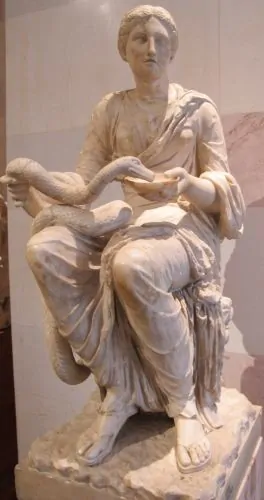
To the practitioners attacked in On the Sacred Disease, purification was not merely an ornament attached to treatment; it was treatment, at least as the Hippocratic writer represented it. Their patients were instructed to avoid baths, particular fish and meats, pungent plants such as garlic and onions, black clothing, and contact with goatskins. They were also warned against crossing one foot over the other or placing one hand across another, gestures that apparently risked obstructing or confusing the ritual order imposed upon the body. Such prohibitions translated an alarming and unpredictable illness into a sequence of actions that patients and households could perform. Instead of waiting helplessly for another seizure, they could regulate food, clothing, posture, and domestic space. The rules consequently offered something that an uncertain physiological explanation could not easily supply: an immediate sense of disciplined agency. They also made the healer indispensable as the person who knew which ordinary objects concealed danger and which observances might keep that danger away.
Purification culminated in the removal of contaminated materials from ordinary human contact. The writer reports that ritual substances were buried in the earth, thrown into the sea, or carried into the mountains, where no one would touch or tread upon them. These acts gave illness a spatial logic, treating affliction as something that could be transferred, contained, and expelled. Whatever the writer thought of their causal basis, such performances could make an invisible menace appear materially manageable.
It would be misleading to dismiss every restriction and cleansing procedure as meaningless theater. Dietary prohibitions might alter a patient’s physical condition, while abstention from bathing, alcohol, heavy foods, or environmental extremes could sometimes coincide with prudent care even when justified through ritual reasoning. More importantly, purification was not foreign to Hippocratic medicine itself. Medical writers also described bodies as burdened by harmful substances that had to be evacuated through vomiting, defecation, sweating, bleeding, or other forms of discharge. As Yulia Ustinova has emphasized, ritual and Hippocratic catharsis could draw persuasive force from the same embodied intuition: illness resembled an impurity lodged within the sufferer, and recovery required its removal. A violent purge made cleansing perceptible through taste, smell, pain, and visible bodily matter; a ritual disposal made it perceptible through the removal of polluted objects. These procedures belonged to different explanatory systems, but their experiential boundaries were less secure than the polemic in On the Sacred Disease suggests. The anonymous author was not contrasting action with inaction or practical therapy with pure fantasy. He was competing to determine which healer possessed the authority to explain why a cleansing action worked, when it should be attempted, and what its apparent success proved.
Epileptic symptoms made that contest difficult to adjudicate. A convulsive episode might end without intervention, while another might not occur for weeks, months, or years. Because the disease was intermittent, almost any observance performed after a seizure could appear to have prevented the next one. Families confronting terrifying symptoms had no controlled comparison by which to separate treatment from coincidence, and improvement naturally encouraged them to remember the ritual that preceded it. Apparent confirmation did not always require deliberate deception; the fluctuating course of the illness itself could manufacture convincing evidence.
The Hippocratic writer nevertheless alleged a more calculated exploitation of uncertainty. In his account, ritual healers constructed a system in which every outcome protected their reputation. If the patient recovered, the purifier acquired honor and the prescribed observances received credit; if the patient died or suffered another attack, responsibility could be transferred to a god, a broken taboo, or an improperly performed rite. The healer’s refusal to administer ordinary medicines, food, drink, or baths further insulated him from blame because he could deny having physically harmed the patient. This asymmetry is the economic heart of the author’s accusation. Successful cases could generate payment, gifts, prestige, and referrals, while failures could be explained without surrendering professional authority. The writer accordingly attributed such practices to people compelled by the “need of a livelihood,” suggesting that mystery became profitable when it prevented clients from testing a healer’s claims. Yet this statement remains an adversary’s charge rather than independent evidence that every purifier knowingly committed fraud. Some practitioners probably believed in their methods, and some patients may have valued ritual reassurance, communal recognition, and relief from pollution even when seizures continued. The polemic exposes a plausible structure of incentives, but it cannot by itself reveal the private motives of all those who worked within that structure.
Nor was uncertainty an economic resource available only to religious specialists. Hippocratic practitioners also treated illnesses they imperfectly understood, made forecasts that failed, and depended upon reputation in a competitive medical marketplace. Their regimens could coincide with spontaneous improvement just as readily as a purification rite could, while technical language might shield medical authority from scrutiny no less effectively than sacred language. The crucial distinction advanced by On the Sacred Disease was aspirational rather than absolute: natural explanations were supposed to make symptoms open to comparison, causal argument, and correction instead of assigning failure to an offended divinity. By exposing how blame could be redirected, the author connected an epistemological objection to a social one. A sacred diagnosis was dangerous not simply because it was mistaken, but because it allowed the person interpreting the gods to control the meaning of every possible result. Economic rivalry undoubtedly sharpened that accusation, yet rivalry does not empty it of intellectual importance; it reveals why arguments about causation were also struggles over trust, accountability, and authority. The writer’s next and most provocative move would be to deny his opponents even the religious high ground, recasting their claims of divine knowledge as evidence of impiety.
Against Magic in the Name of Piety
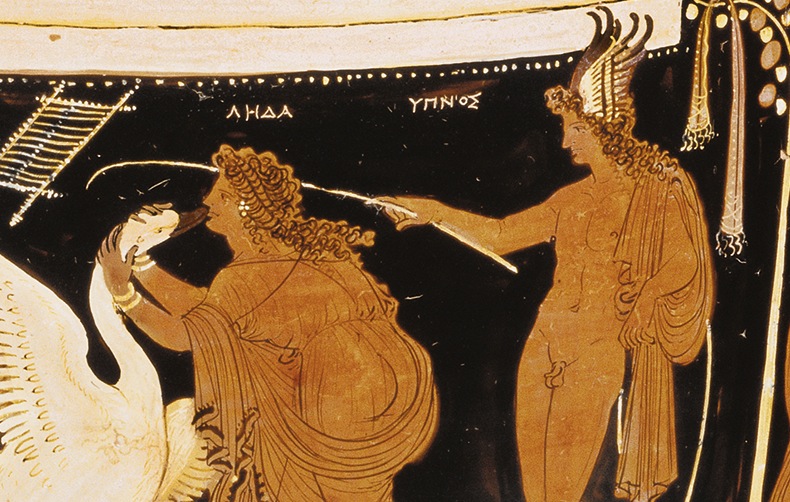
One of the most consequential maneuvers in On the Sacred Disease is the author’s refusal to concede that ritual healers possess the more religious explanation. He does not oppose belief in the gods or suggest that reverence must disappear before medicine can begin. On the contrary, he declares the disease divine in precisely the same sense that every disease is divine, since all possess their own nature and arise within the ordered world. Epilepsy is not uniquely sacred merely because its symptoms are spectacular. Its divine status provides no reason to remove it from natural investigation. The author’s target is not religion as such but the claim that particular healers can identify, appease, command, or circumvent a supernatural agent hidden behind every convulsion.
This distinction allows the writer to turn the accusation of impiety against those who presented themselves as experts in sacred affairs. He places ritual purifiers alongside magicians, wandering religious specialists, and impostors who allegedly conceal their ignorance beneath claims of privileged access to the gods. Some boasted that they could draw down the moon, obscure the sun, produce storms or clear skies, cause rain or drought, and make the land or sea fruitful or barren. Whether such boasts were commonly made or rhetorically enlarged, they supplied the author with an effective theological dilemma. If human techniques could force divine powers to act, then the gods were weaker than the practitioners manipulating them. If the ceremonies worked by compelling the gods, their performers were not devout servants but dangerous masters of divine beings. If the ceremonies had no such power, the practitioners were deceivers trading upon fear. Either conclusion stripped them of the religious authority they claimed and allowed the medical writer to occupy the position of genuine reverence.
The brevity of this dilemma conceals its audacity. A physician defended natural causation not by banishing divinity from the world but by insisting that the gods were too dignified to behave as ritual healers described. Divine power could not be rented, coerced, contaminated, or redirected by a sequence of human gestures. The supposedly irreligious investigation of bodily causes became, in the writer’s argument, the more pious course.
Purification created a sharp theological problem because it treated the afflicted person as polluted and the afflicting power as something that could be washed away or transferred. The author objects that the gods are themselves pure and cannot be cleansed from a human body as though they were stains. Sacred beings also could not plausibly contaminate mortals and then demand ceremonies to remove the contamination they had produced. When purifiers buried ritual remnants, threw them into the sea, or abandoned them in inaccessible places, they behaved as if divine agency could adhere to disposable material. The writer instead associates purification with people who have committed crimes, incurred curses, or become subject to hostile enchantment. To treat the epileptic patient in the same fashion imposed a moral and religious stigma upon someone suffering from a physical disorder. It implied guilt where no offense had occurred and transformed frightening involuntary movements into signs of spiritual corruption. The objection was more than theoretical: a supernatural diagnosis could alter the patient’s social identity, making illness appear to disclose impurity, wrongdoing, or dangerous proximity to hostile powers. By denying that a god had entered or polluted the sufferer, the author defended the patient from a burden of culpability that ritual interpretation could create.
Yet the categories in this controversy should not be made cleaner than they were. Greek religion included sacrifice, incubation, divination, vows, healing cults, protective objects, and purification without recognizing a single boundary equivalent to the modern division between religion and magic. Physicians likewise used regimens whose effectiveness was uncertain, shared concepts of purity and balance with the surrounding culture, and sometimes accepted dreams or divine assistance without surrendering bodily explanation. The labels applied to purifiers and magicians in On the Sacred Disease are consequently weapons within a professional dispute rather than neutral descriptions of clearly separated occupations. The writer constructed an objectionable category by grouping together rivals whose actual practices and social standing may have varied considerably.
That polemical construction does not erase the intellectual principle the author articulated. His decisive claim was that reverence for the gods did not require attributing unexplained symptoms to their immediate intervention. Indeed, assigning a different deity to each cry, gesture, or convulsion diminished divine majesty by making the gods responsible for bodily irregularities that followed observable patterns. Natural causation offered a theological advantage because it preserved consistency: diseases operated according to their constitutions, while the gods remained free from the arbitrary cruelty, contamination, and susceptibility to coercion implied by magical healing. This was not secular medicine in the modern sense, and it did not establish an impermeable border between science and religion. It was instead an argument that nature provided the proper field in which divine order could be understood. By making piety compatible with investigation, the anonymous writer deprived sacred healers of their strongest defense and prepared the way for epilepsy to be relocated from the realm of offended gods to the structures and processes of the human body.
The Brain Takes the Blame
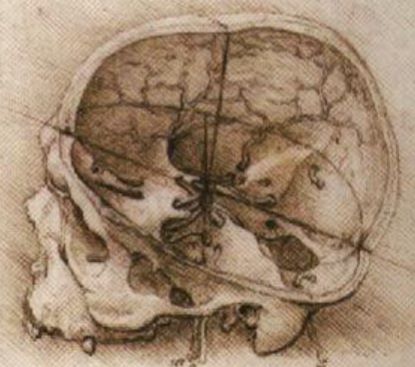
Having denied that epilepsy resulted from divine visitation, the author of On the Sacred Disease had to identify an alternative source powerful enough to explain its extraordinary symptoms. He located that source in the brain. The seizure did not descend from heaven, enter through ritual pollution, or reveal the anger of a particular god; it began through physical processes within the patient’s body. This was not a diagnosis of epilepsy in the modern neurological sense, and the writer possessed no knowledge of neurons, electrical discharges, or distinct seizure syndromes. His explanation depended upon humors, bodily channels, and the movement of air. Even so, assigning causation to the brain converted the seizure from a supernatural message into a physiological event. The patient’s loss of consciousness, distorted movements, and inability to speak now demanded an account of bodily malfunction rather than an interpretation of divine intention.
The proposed mechanism began with phlegm, one of the substances through which Hippocratic writers explained health, disease, temperament, and bodily change. According to the treatise, people constitutionally dominated by phlegm were susceptible to the sacred disease, whereas those of a more bilious constitution were less vulnerable to it. The brain should normally purge itself of excessive moisture during early development, but defective drainage could leave it abnormally phlegmatic. Under certain conditions, accumulated phlegm flowed from the brain into the vessels and obstructed the passage of air. Because the author regarded air as essential to sensation, movement, and intelligence, this blockage interrupted the body’s ordinary coordination. Speech failed, awareness disappeared, the hands contracted, the eyes became fixed or distorted, and the limbs moved convulsively. Foam appeared at the mouth, while urine, feces, or semen might be expelled as the body underwent violent internal pressure. The sufferer seemed possessed because the very organ responsible for perception and voluntary action had temporarily lost control of the rest of the body. What spectators interpreted as an invading power was, within this model, the visible consequence of interrupted circulation and cerebral dysfunction.
This explanation made the bewildering features of a seizure parts of a single causal sequence. Collapse, silence, convulsion, frothing, incontinence, and altered breathing no longer required separate gods or omens. Each could be traced back to the same obstruction and its effects upon the brain and body. The theory was erroneous, but it possessed an explanatory economy that the symptom-by-symptom assignment of divine agents lacked. A frightening collection of signs had become one disease process.
The author’s emphasis upon the brain extended beyond epilepsy. He described it as the organ through which people understood, perceived, judged, remembered, experienced pleasure and sorrow, and distinguished what was beneficial from what was harmful. Madness, delirium, nightmares, irrational fears, and disordered behavior likewise arose when the brain became excessively moist, dry, hot, cold, or otherwise disturbed. This cerebral emphasis was not wholly unprecedented, since earlier Greek thinkers, most notably Alcmaeon of Croton, had already associated the brain with sensation and cognition. Nor did it become the uncontested position of ancient medicine; Aristotle would later assign central importance to the heart and treat the brain largely as a cooling organ. What distinguishes On the Sacred Disease is the force with which it uses cerebral physiology to explain experiences commonly taken as evidence of supernatural occupation. The same organ that made rational thought possible could, when physically disordered, produce terror, involuntary movement, hallucination, and apparent estrangement from the self. Behavior that seemed to disclose an alien presence could arise from the material conditions of the person experiencing it.
The achievement should not be exaggerated into the birth of modern neurology. The author’s invisible flows of phlegm and air were speculative constructions, and his confidence often exceeded what dissection or systematic observation could have demonstrated. Yet an incorrect natural theory differed consequentially from a sacred attribution because its errors remained within the body’s presumed operations. Later investigators could reject humoral obstruction while preserving the more fundamental proposition that seizures originated in physical disturbances of the brain. The writer had changed the kind of question that epilepsy invited: not which god had attacked, but what process had disrupted consciousness and movement. That relocation did not immediately liberate people with seizures from stigma, ritual treatment, or supernatural suspicion. It nevertheless established an enduring intellectual possibility, the seizure that looked least human and most divine might be produced by the organ that made human thought itself possible.
The Search for Proof
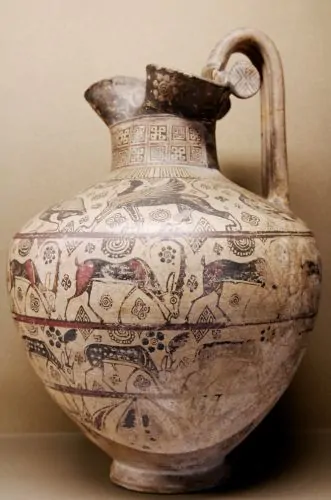
Once the author of On the Sacred Disease had placed epilepsy within the brain, assertion alone was not enough. A natural explanation had to account for observable patterns more coherently than the claim that a god had entered the sufferer. The writer appealed to animals, bodily constitutions, age, weather, and the physical condition of the brain. His most memorable evidence came from goats, creatures whose apparent susceptibility to seizures made them useful participants in his argument. His most ambitious causal correlations involved the winds, which supposedly altered both the atmosphere and the moisture within human bodies. Rather than treating each seizure as an isolated supernatural event, he searched for recurring relationships that might reveal an underlying process.
Goats occupied an awkward position between the ritual healers’ symbolic world and the medical writer’s physiological one. Certain seizure behaviors could be interpreted as goatlike, while the animal was closely associated with the Mother of the Gods, one of the divinities whom ritual specialists allegedly blamed for particular symptoms. Prohibitions against eating goat meat or wearing goatskins consequently possessed a recognizable sacred logic. The Hippocratic author appropriated the same animal for a radically different purpose. Goats, he observed, also suffered from the disease, and examination of affected animals after death supposedly revealed brains that were abnormally wet, filled with fluid, and foul-smelling. To him, this material condition demonstrated that disease rather than divinity had damaged the brain. The goat was no longer a sacred clue identifying the responsible goddess; it became a comparative anatomical witness. Its suffering also weakened explanations based upon human guilt, ritual transgression, or moral pollution, since an animal could display the same convulsions without having violated a religious obligation. The argument was rhetorically ingenious because it took evidence used by the writer’s opponents and made it testify against them.
The anatomical claim was much less conclusive than the author believed. A wet or foul-smelling brain could result from decomposition, another disease, or conditions unrelated to the animal’s seizures. The treatise provides no controlled series of examinations establishing that affected goats consistently differed from unaffected ones. Nevertheless, opening the animal’s head redirected attention from symbolic resemblance to material alteration. Even weak anatomical evidence could challenge an explanation that never looked inside the sufferer at all.
The winds provided a second form of proof by connecting seizure attacks to changes in the surrounding environment. In Hippocratic thought, bodies remained permeable to climate, season, water, diet, and air; health depended upon their ability to adjust to alterations in the world around them. The north wind was cold and drying, while the south wind was warm, moist, and dissolving. As winds changed, the author believed that the brain contracted, relaxed, dried, or accumulated moisture, causing phlegm to separate and enter the vessels. Sudden transitions were dangerous because the body might not accommodate them smoothly. A seizure could follow a meteorological disturbance without being sent by the divine power associated with that wind. The explanation drew heavily upon analogy: just as winds separated, condensed, or dispersed moisture in clouds, seas, and soil, so they acted upon fluids within the human body. Atmospheric change became a mechanism linking the patient’s environment to the obstruction that supposedly interrupted sensation and movement.
The writer also sought regularity in differences among patients. A phlegmatic constitution created greater vulnerability, while age and the size of the bodily passages supposedly influenced whether an obstruction proved fatal or temporary. Children faced particular danger because their smaller vessels could be blocked more completely, whereas the larger passages of mature bodies allowed air and fluids more room to move. Such claims blended observation with assumptions inherited from humoral physiology. Even so, they treated variation in outcome as something requiring a physical explanation rather than as evidence that one god had shown mercy while another remained angry.
None of this amounted to controlled experimentation in the modern sense. The author selected observations that agreed with his theory, relied upon analogies between weather and anatomy, and interpreted ambiguous animal remains through a humoral model already assumed to be true. His causal system could also absorb contrary outcomes by invoking differences in constitution, age, season, or the quantity of phlegm. Yet his search for proof marked a real change in the terms of argument. Goats could be examined, weather patterns compared, symptoms grouped, and bodily mechanisms debated; divine displeasure could not be investigated in the same manner without depending upon the authority of its interpreter. The natural account remained speculative, but it directed disagreement toward shared features of bodies and environments. The enduring achievement was not that the writer proved his physiology correct, but that he insisted an explanation of epilepsy should answer to recurring evidence rather than derive its immunity from mystery.
The Patient Who Ran Away
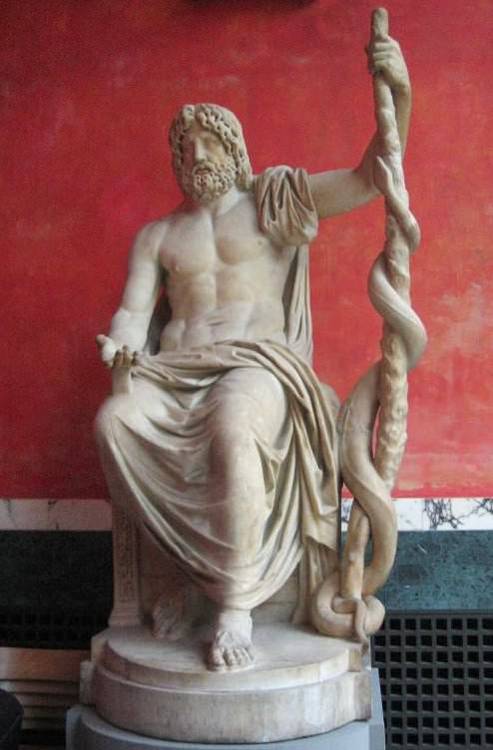
On the Sacred Disease briefly turns from humors, winds, and bodily channels to a person who knows that a seizure is coming. This is not a named patient or a fully narrated case history, but a generalized figure drawn from repeated experience. Adults accustomed to the illness, the author explains, sometimes recognized an approaching attack and hurried away from other people. If home was nearby, they returned there; otherwise, they sought a secluded place where as few witnesses as possible would see them fall. They hid not because a god was pursuing them, according to the writer, but because they were ashamed of what was about to happen. The episode reveals a patient momentarily restored to the center of a treatise otherwise dominated by arguments among healers. Before the body became ungovernable, the sufferer attempted to control where and before whom that loss of control would occur.
The warning that preceded the seizure supplied the writer with another kind of natural evidence. It showed that an attack could announce itself through a recurring bodily sequence perceptible to the person who had experienced it before. Modern readers may be tempted to identify this foreknowledge straightforwardly as an epileptic aura, but the text does not describe its sensory or cognitive form. It might have included unusual sensations, changes in perception, bodily discomfort, fear, or other prodromal experiences, and different seizure disorders would not have produced identical warnings. What mattered to the Hippocratic author was the patterned relationship between an internal sign and the convulsion that followed. The patient learned this relationship through repetition, much as a practitioner learned to associate certain bodily conditions with a likely outcome. Foreknowledge here was neither prophecy nor divine revelation. It was practical knowledge generated by living within an unpredictable body. The sufferer could not necessarily stop the seizure, but recognition created a narrow interval in which purposeful action remained possible.
Children, the author claims, reacted differently. During their earliest attacks they fell wherever they happened to be, but repeated seizures taught them to recognize the approaching danger and run toward their mothers or another familiar person. Their response arose from fear rather than shame because, in the writer’s judgment, they were not yet old enough to have acquired an adult sense of disgrace. The contrast is schematic, but it recognizes that the social meaning of illness was learned as well as experienced.
Adult shame becomes understandable when the public realities of a convulsion are reconstructed. A seizure could cause collapse, contorted limbs, fixed or rolling eyes, foaming, incontinence, strange vocalizations, and an apparent disappearance of awareness. These symptoms exposed processes ordinarily kept private and defeated the disciplined bodily presentation expected in communal life. The sufferer could neither explain the event while it occurred nor prevent spectators from assigning meanings to it. Witnesses might see divine punishment, pollution, madness, dangerous supernatural proximity, or a grotesque loss of humanity. Even sympathetic observers could turn the patient into an object of fearful attention. Withdrawal protected more than modesty; it reduced the risk that an involuntary episode would redefine the sufferer’s reputation. The home offered concealment, assistance, and the presence of people already familiar with the disease, while an isolated place exchanged immediate help for freedom from public scrutiny. Running away was not an irrational symptom of epilepsy but a rational response to the social consequences of being seen.
The passage nevertheless preserves the physician’s interpretation rather than the patient’s testimony. No sufferer speaks directly, and the author does not report asking why an adult withdrew or why a child sought a parent. His distinction between shame and fear may have captured common responses, but it also imposed tidy motives upon behavior that could have reflected both emotions at once. Someone anticipating a fall might seek privacy from embarrassment while also fearing injury, suffocation, helplessness, or death. The scene grants the patient experiential knowledge, yet the medical writer retains the authority to explain what that experience means.
Naturalizing epilepsy could weaken one source of shame without eliminating shame itself. If the seizure arose from the brain rather than guilt, pollution, or divine attack, the patient no longer needed to be treated as a wrongdoer marked by supernatural displeasure. Yet a physiological explanation could not prevent public staring, restore bodily control during an attack, or erase the vulnerability of collapsing before others. The Hippocratic writer’s achievement was morally significant but socially incomplete. He separated disease from religious culpability while revealing how deeply humiliation could persist after culpability had been denied. The fleeing patient embodies that tension: knowledgeable enough to recognize the body’s warning, powerless to halt what followed, and painfully aware of how other people might interpret the spectacle. In this moment, the treatise shows that explaining a disease and relieving the burden of living with it were never quite the same task.
Medicine as Techne: Turning Explanation into Authority

By relocating epilepsy from divine intervention to the brain, the author of On the Sacred Disease did more than propose a cause. He presented medicine as a technē: an organized craft whose practitioners possessed knowledge unavailable to the untrained. The physician could identify bodily mechanisms, distinguish relevant symptoms from misleading appearances, and select treatments according to the patient’s condition. Such abilities justified professional authority without requiring initiation into sacred mysteries. Explanation became evidence that the healer understood what he was doing. The argument against supernatural causation was inseparable from an argument about who deserved to direct the patient’s care.
The Greek concept of technē did not correspond exactly to either modern science or manual technique. It encompassed skilled practices whose successful exercise depended upon knowledge, disciplined judgment, and experience. Shipbuilding, navigation, agriculture, rhetoric, and medicine could all be discussed as crafts, although their reliability and intellectual status remained subjects of dispute. A genuine technē was expected to possess a definable field, an intelligible purpose, and some account of the procedures by which it achieved its results. Its knowledge should be teachable rather than confined to private revelation. Practitioners also needed to distinguish competent work from accident, since a fortunate result reached through ignorance did not demonstrate mastery. Medicine faced a difficult challenge because bodies varied, diseases changed, and treatments often failed despite careful judgment. Its defenders consequently had to show that uncertainty did not make the medical craft nonexistent. They argued that knowledgeable practice could still be recognized through causal reasoning, appropriate treatment, and informed prediction.
In this struggle for legitimacy, explanation performed professional work. The ritual specialist claimed authority by knowing which god had acted and which purification might appease or remove the power involved. The Hippocratic writer claimed authority by describing how phlegm moved from the brain, obstructed bodily passages, and interrupted consciousness. Both interpretations made an invisible cause intelligible, but only the second presented itself as knowledge of nature that could be discussed, taught, and revised.
The physiological theory also supported a corresponding therapeutic program. If epilepsy resulted from an imbalance involving moisture, temperature, phlegm, and the movement of air, treatment had to modify those conditions rather than cleanse a divine presence. The author proposed using regimen and medicines to counteract the qualities producing the disorder, drying what had become excessively moist or otherwise restoring an appropriate bodily balance. Effective care required attention to age, constitution, diet, season, and the moment at which intervention occurred. A treatment suitable for one patient could be harmful to another because their bodies did not possess identical mixtures or react uniformly to environmental change. Timing mattered as much as the remedy itself, especially when an illness fluctuated between visible attacks and periods of apparent health. The physician’s task was not to apply a universal recipe but to judge relationships among the patient, the disease, and the surrounding conditions. That demand for discrimination enhanced the status of the practitioner because it made successful treatment depend upon trained interpretation rather than possession of a charm. It also protected medicine from simplistic testing, since an unsuccessful result could be attributed to an incurable condition, an unsuitable moment, or an error in applying otherwise valid principles.
Prognosis supplied another means of demonstrating that medicine was a real craft. A practitioner who recognized approaching danger, anticipated the likely course of an illness, or explained why a patient would recover appeared to possess knowledge before the outcome made it obvious. Prediction could reassure households and prepare them for deterioration, but it also advertised the physician’s competence. Hippocratic texts repeatedly treat foreknowledge as a source of credibility because correct forecasts distinguished expertise from lucky intervention. Prognosis joined therapeutic care to professional performance: the physician established authority partly by narrating the patient’s future.
That performance complicates any simple contrast between rational physicians and manipulative sacred healers. The author accused his rivals of hiding ignorance, exploiting uncertainty, and claiming credit for recoveries they had not caused, yet Hippocratic practitioners operated within the same unstable economy of reputation. They competed for patients without licenses, standardized credentials, or institutions capable of conclusively testing rival therapies. Their technical language could impress an audience unable to evaluate humoral anatomy any more readily than it could verify the alleged action of a god. A detailed causal narrative might function as a badge of expertise even when its underlying physiology was incorrect. Defining medicine as a specialized craft transferred interpretive control from religious authorities to medical ones. The patient was relieved of divine blame but increasingly described through categories established by the practitioner: constitution, prognosis, bodily balance, and susceptibility to treatment. Naturalization could make illness less morally accusatory while still placing the sufferer beneath an expert gaze. The medical writer’s criticism of unaccountable authority must be read alongside his attempt to secure authority for his own profession. His argument was intellectually serious, but it was never professionally disinterested.
The distinction he sought nevertheless remained consequential. Medical authority was ideally grounded in causes that operated consistently, observations that other practitioners could compare, and techniques that could be learned without supernatural privilege. Ancient Hippocratic medicine often fell short of those standards, and its humoral theories could be made flexible enough to explain contradictory results. It was not modern experimental science waiting fully formed in the fifth century BCE. Yet describing medicine as technē created an expectation that a healer should offer more than ritual status or claims of access to divine intentions. Authority now had to be defended through an account of how disease arose and why a particular intervention followed from that account. The writer’s victory was neither the cure of epilepsy nor the immediate defeat of sacred healing; it was the assertion that medical power should rest upon reasons capable of being examined rather than mysteries controlled by the person selling them.
After the Polemic: No Sudden Victory over Sacred Healing

The force of On the Sacred Disease can create the illusion that its argument settled the controversy it describes. There is no evidence that ritual healers disappeared, that patients abandoned purification, or that cerebral explanations quickly became dominant. The treatise reveals the confidence of one medical writer, not the verdict of Greek society. Its survival within the Hippocratic Corpus eventually gave it canonical importance, but preservation does not establish immediate influence. Even the date and original audience of the work remain uncertain enough to discourage claims of a decisive public confrontation. What followed was not the replacement of sacred healing by rational medicine but their prolonged coexistence.
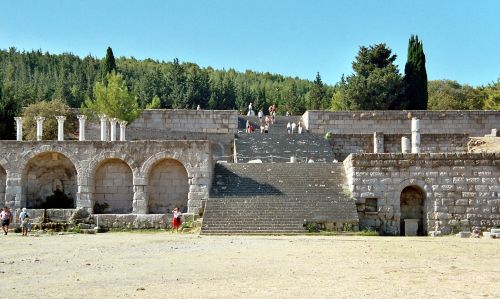
During and after the period in which the treatise was probably composed, the cult of Asklepios expanded rather than retreated. The healing god arrived formally in Athens from Epidaurus in 420 or 419 BCE, and sanctuaries dedicated to him became prominent institutions throughout the Greek world. Patients traveled to these sites, performed preliminary observances, offered sacrifices, and slept within sacred precincts in the hope of receiving a divine dream. In some accounts, Asklepios appeared during sleep and personally treated the sufferer; in others, he prescribed an action to be performed after waking. Successful patients dedicated offerings or recorded narratives of healing that advertised the god’s power to later visitors. The surviving cure inscriptions from Epidaurus describe restored sight, removed growths, recovered pregnancies, extracted weapons, and other extraordinary interventions. Such stories accumulated into a public archive of divine effectiveness, providing sacred healing with its own testimonials and institutional memory. The inscriptions were not clinical records in a modern sense, but neither were they private rumors circulating without material support. Displayed within the sanctuary, they made previous cures part of the therapeutic environment encountered by every new petitioner.
Asklepian healing should not simply be equated with the itinerant purifiers and magicians attacked in On the Sacred Disease. A sanctuary supported by civic recognition, priestly administration, monumental architecture, and communal ritual occupied a different social position from an individual practitioner selling secret rites. The Hippocratic author’s insults cannot be transferred indiscriminately to every religious form of healing. Greek sacred medicine included multiple institutions and practices whose relationships with physicians ranged from rivalry to accommodation.
Patients had little reason to observe a firm boundary between those alternatives. A person might consult a physician, visit a sanctuary, make a vow, alter a diet, and wear a protective object without perceiving these actions as mutually exclusive. Medical treatment could address the body while prayer sought divine favor for the treatment’s success. Sanctuary prescriptions sometimes resembled ordinary regimen, involving exercise, bathing, food, or the application of substances, while medical writers could recommend prayer alongside bodily precautions. Texts gathered under the Hippocratic name invoked healing gods, interpreted dreams, and accepted that nature itself belonged within a divinely ordered world. The famous Hippocratic Oath begins by calling upon Apollo the Physician, Asklepios, Hygieia, Panakeia, and the other gods as witnesses. Such evidence makes it impossible to divide Greek healers neatly into religious believers on one side and secular scientists on the other. The more important division concerned the kinds of explanations advanced, the authority claimed for them, and the circumstances in which particular practices were judged credible.
Epilepsy itself retained sacred associations long after cerebral and humoral accounts became available. Greek and Roman medical authors continued to discuss seizures as bodily disorders, but popular remedies, amulets, ritual protections, and supernatural interpretations remained in circulation. Galen and other learned physicians refined natural explanations without eliminating the religious meanings attached to sudden collapse and altered consciousness. Jewish and Christian traditions later supplied additional frameworks involving divine testing, miraculous healing, and demonic affliction, even as medical treatments inherited from Greek authorities continued to be copied and practiced. This was not a simple reversal from reason to superstition. Different causal systems remained available because each answered needs that the others did not completely satisfy.
The absence of a sudden victory clarifies what the Hippocratic polemic actually accomplished. It did not disenchant Greek medicine, empty sanctuaries, or prevent later communities from interpreting seizures through sacred narratives. It articulated a durable challenge: extraordinary symptoms did not by themselves prove extraordinary causation. Once a writer had shown how epilepsy might arise from the brain, appeals to divine attack could be confronted with a competing explanation grounded in recurring bodily processes. That argument remained available even when most patients continued to combine physicians, prayers, rituals, and household remedies. Its historical importance lies less in immediate conversion than in the creation of an alternative intellectual standard. Sacred healing survived, but it no longer occupied the field uncontested.
Was This a Scientific Break or a Rival Healer’s Sales Pitch?
The following video from “All Shook Up_My Epilepsy Journey” discusses historical epilepsy treatment:
The strongest challenge to interpreting On the Sacred Disease as an intellectual breakthrough is that such a reading may reproduce the author’s own advertisement for his craft. Everything known about his opponents comes through a writer determined to portray them as ignorant, deceptive, and impious. Their explanations appear incoherent partly because he arranges them that way, while his physiological account appears systematic because he supplies it with an extended causal narrative. The contrast may reveal more about competitive rhetoric than about the relative sophistication of the practitioners involved. Ritual healers could have possessed accumulated experience, established procedures, and sincere theories that the polemic deliberately caricatured. From this perspective, the treatise was not a declaration of science against superstition but one healer’s attempt to discredit rival suppliers in an unregulated therapeutic marketplace.
The writer’s own explanation hardly qualifies as scientific by modern standards. He offered no controlled comparison demonstrating that phlegmatic patients experienced more seizures, that particular winds reliably precipitated attacks, or that the brains of affected goats differed consistently from those of healthy animals. His anatomical mechanism depended upon invisible movements of phlegm and air that he could not directly observe. Weather, constitution, age, diet, and bodily moisture provided enough variables to accommodate almost any outcome after it occurred. A patient’s recovery could confirm that treatment had restored balance, while failure could be attributed to the severity or chronicity of the disease. This flexibility resembled the self-protective reasoning for which the author condemned sacred healers. Ritual treatment also sometimes included diet, behavioral restrictions, and purification procedures that produced genuine physical or psychological effects, even when their supernatural justification was mistaken. The difference between the two camps was not simply that one observed bodies while the other ignored them. Both interpreted ambiguous experience through explanatory systems that made sense within their cultural worlds.
The familiar opposition between science and religion creates an additional distortion. The author did not deny the gods, reject piety, or describe nature as independent of divine order. He called every disease divine while denying that epilepsy was uniquely so, and other Hippocratic writings comfortably combined bodily care with prayers, oaths, or attention to dreams. His disagreement concerned how divine power operated, not whether it existed.
Calling the treatise a sales pitch captures something real about its aggressive tone, but the phrase can also oversimplify the evidence. The author repeatedly exaggerates the failings of competitors, questions their motives, and presents mastery of causes as proof that people should trust practitioners like himself. His accusation that purifiers invented sacred explanations from the “need of a livelihood” directly connects doctrine with economic survival. Yet the same suspicion applies to the medical writer, whose professional standing benefited from persuading households that technical training mattered more than ritual expertise. Natural causation was not advanced from a socially neutral position; it helped construct the physician as the person entitled to interpret the patient’s body. Still, no evidence shows that the treatise functioned as a commercial advertisement, that it was read directly to prospective clients, or that its author cynically invented a theory he did not believe. A professional interest in winning authority does not make an argument insincere, just as sincere belief does not make it correct. The work is better understood as polemical advocacy in which intellectual conviction and occupational competition reinforced one another.
When claiming a scientific break, if “scientific” means experimental proof, modern neurology, or the immediate triumph of secular medicine, the description is indefensible. If it identifies a shift in the standards by which extraordinary symptoms should be explained, it remains useful when carefully qualified. The author insisted that seizures arose through regular bodily processes, connected them to the brain, and treated apparent supernatural signs as effects requiring causal analysis. His humoral mechanism failed, but it could be criticized through competing observations without requiring privileged knowledge of a god’s intentions. That move made medical explanations more contestable even as it enhanced the authority of those who offered them. On the Sacred Disease was consequently both a rival healer’s bid for status and an important reorientation of inquiry; its lasting significance lies precisely in the uneasy union of those two purposes.
Conclusion: Making Mystery Answerable
A seizure in the Greek world could look like evidence that an unseen power had seized control of a human body. Collapse, convulsion, foaming, altered consciousness, and involuntary cries appeared to exceed the ordinary vocabulary of illness. The author of On the Sacred Disease refused to accept that appearance as proof. Epilepsy was no more sacred than any other disease because it possessed a nature and arose from physical causes. By placing its origin in the brain, he made the most frightening symptoms consequences of bodily disorder rather than messages from an offended god. That relocation was wrong in its humoral details but transformative in its direction.
The argument reached beyond the identification of a diseased organ. Ritual purifiers offered explanations that assigned meaning to each symptom, prescribed observances, and gave distressed households actions to perform. Their treatments operated within a competitive marketplace where reputation depended upon persuasive interpretations as much as demonstrable cures. The Hippocratic writer accused them of arranging responsibility so that recovery brought honor while failure could be blamed upon divine hostility or a violated prohibition. He answered their claims not with atheism but with a rival conception of piety in which the gods could not be polluted, manipulated, or held responsible for arbitrary bodily disturbances. His physiological account simultaneously elevated medicine as a technē requiring specialized judgment. Natural explanation served both an intellectual principle and a professional ambition. It challenged the supernatural stigmatization of patients while transferring authority over their bodies to a new class of interpreters.
The victory was neither immediate nor complete. Sacred healing flourished, patients continued to combine ritual and medical remedies, and supernatural interpretations of epilepsy survived for centuries. The author’s evidence was selective, his opponents were presented through hostile caricature, and his cerebral theory depended upon imaginary flows of phlegm and air. His polemic opened a path of inquiry without proving that those who claimed to follow it would always be correct, humane, or free from economic self-interest.
What endured was a demand that frightening appearances be made answerable to causes. The goat’s diseased brain, the changing wind, the patient’s foreknowledge, and the repeated sequence of symptoms all became matters for comparison rather than tokens whose meaning belonged exclusively to a sacred expert. Once illness was situated within nature, explanations could be challenged by further observations even when the first explanation failed. That possibility did not abolish error; it made error accessible to correction. It also weakened the logic by which involuntary suffering became evidence of guilt, possession, or punishment. The anonymous author could not cure epilepsy or end its stigma, but he insisted that mystery conferred no right to exploit fear. In On the Sacred Disease, mystery ceased to function as a verdict and became a problem that human inquiry was obligated to confront.
Bibliography
Affiliate disclosure: Amazon links on this site are paid links. As an Amazon Associate I earn from qualifying purchases.
- Collins, Derek. Magic in the Ancient Greek World. Malden, MA: Blackwell Publishing, 2008.
- Craik, Elizabeth M. The “Hippocratic” Corpus: Content and Context. London: Routledge, 2015.
- Eadie, Mervyn J., and Peter F. Bladin. A Disease Once Sacred: A History of the Medical Understanding of Epilepsy. Eastleigh, UK: John Libbey, 2001.
- Garland, Robert. The Eye of the Beholder: Deformity and Disability in the Graeco-Roman World. London: Bristol Classical Press, 1995.
- Hankinson, R. J. “Magic, Religion and Science: Divine and Human in the Hippocratic Corpus.” Apeiron 31:1 (1998), 1–34.
- Herodotus. Histories. Translated by Robin Waterfield. Oxford: Oxford University Press, 1998.
- Hippocrates. Hippocrates, Volume II: Prognostic. Regimen in Acute Diseases. The Sacred Disease. The Art. Breaths. Law. Decorum. Dentition. Edited and translated by Paul Potter. Loeb Classical Library 148. Cambridge, MA: Harvard University Press, 2023.
- Holmes, Brooke. The Symptom and the Subject: The Emergence of the Physical Body in Ancient Greece. Princeton, NJ: Princeton University Press, 2010.
- Jouanna, Jacques. Hippocrates. Translated by M. B. DeBevoise. Baltimore: Johns Hopkins University Press, 1999.
- King, Helen. Hippocrates Now: The “Father of Medicine” in the Internet Age. London: Bloomsbury Academic, 2019.
- Laskaris, Julie. The Art Is Long: On the Sacred Disease and the Scientific Tradition. Studies in Ancient Medicine 25. Leiden: Brill, 2002.
- LiDonnici, Lynn R. The Epidaurian Miracle Inscriptions: Text, Translation, and Commentary. Atlanta: Scholars Press, 1995.
- Lloyd, G. E. R. Magic, Reason and Experience: Studies in the Origin and Development of Greek Science. Cambridge: Cambridge University Press, 1979.
- —-. The Revolutions of Wisdom: Studies in the Claims and Practice of Ancient Greek Science. Berkeley: University of California Press, 1987.
- Longrigg, James. “Epilepsy in Ancient Greek Medicine—The Vital Step.” Seizure 9:1 (2000), 12–21.
- —-. Greek Rational Medicine: Philosophy and Medicine from Alcmaeon to the Alexandrians. London: Routledge, 1993.
- Nicholson, Nigel, and Nathan R. Selden. The Rhetoric of Medicine: Lessons on Professionalism from Ancient Greece. Oxford: Oxford University Press, 2019.
- Nutton, Vivian. Ancient Medicine. 2nd ed. London: Routledge, 2012.
- —-. “Healers in the Medical Market Place: Towards a Social History of Graeco-Roman Medicine.” In Medicine in Society: Historical Essays, edited by Andrew Wear, 15–58. Cambridge: Cambridge University Press, 1992.
- Parker, Robert. Miasma: Pollution and Purification in Early Greek Religion. Oxford: Clarendon Press, 1983.
- Plato. Phaedo. In Plato: Complete Works, edited by John M. Cooper. Indianapolis: Hackett Publishing, 1997.
- Renberg, Gil H. Where Dreams May Come: Incubation Sanctuaries in the Greco-Roman World. 2 vols. Leiden: Brill, 2017.
- Rose, Martha L. The Staff of Oedipus: Transforming Disability in Ancient Greece. Ann Arbor: University of Michigan Press, 2003.
- Samama, Évelyne. Les médecins dans le monde grec: Sources épigraphiques sur la naissance d’un corps médical. Geneva: Droz, 2003.
- Scott, Calloway. “Physician Authority, Patient Agency, and the Divine in Ancient Greek Medicine.” Transactions of the American Philological Association 153:1 (2023), 175–211.
- Smith, Wesley D. The Hippocratic Tradition. Ithaca, NY: Cornell University Press, 1979.
- Stol, Marten. Epilepsy in Babylonia. Groningen: Styx Publications, 1993.
- Temkin, Owsei. The Falling Sickness: A History of Epilepsy from the Greeks to the Beginnings of Modern Neurology. Baltimore: Johns Hopkins University Press, 1971.
- Thumiger, Chiara. A History of the Mind and Mental Health in Classical Greek Medical Thought. Cambridge: Cambridge University Press, 2017.
- Ustinova, Yulia. “‘Hands of Gods’ at Work: Magic and Hippocratic Catharsis.” Journal of Cognitive Historiography 8:1-2 (2023), 45–68.
- van der Eijk, Philip J. “‘Airs, Waters, Places’ and ‘On the Sacred Disease’: Two Different Religiosities?” Hermes 119:2 (1991), 168–176.
- —-. Medicine and Philosophy in Classical Antiquity: Doctors and Philosophers on Nature, Soul, Health and Disease. Cambridge: Cambridge University Press, 2010.
- —-. “The ‘Theology’ of the Hippocratic Treatise On the Sacred Disease.” Apeiron 23:2 (1990), 87–119.
- Wickkiser, Bronwen L. Asklepios, Medicine, and the Politics of Healing in Fifth-Century Greece: Between Craft and Cult. Baltimore: Johns Hopkins University Press, 2008.
Originally published by Brewminate, 09.07.2026, under the terms of a Creative Commons Attribution-NonCommercial-NoDerivatives 4.0 International license.
About the Author