Louis XI ruled through information, cultivating courtiers, diplomats, towns, and messengers to learn what rivals were doing and act while the news still mattered.

By Matthew A. McIntosh
Public Historian
Brewminate
Introduction: The King Who Needed to Know
Louis XI of France ruled as though distance were an enemy. From his accession in 1461 until his death in 1483, he confronted powerful princes, shifting alliances, rebellious towns, foreign rulers, ambitious relatives, and courtiers whose loyalties could never be assumed to be permanent. None of these dangers was unusual for a late medieval king. What distinguished Louis was the intensity with which he tried to know about them: who was negotiating with whom, which town could be trusted, what an enemy intended, whether a noble was wavering, what had been said at another court, and how quickly that information could be placed in his hands. His surviving correspondence reveals a ruler persistently questioning, instructing, persuading, correcting, warning, rewarding, and demanding news. Philippe de Commynes, who knew both the Burgundian and French courts from the inside, remembered a king unusually attentive to people and circumstances, capable of changing his methods as political conditions changed. The later image of Louis as the “Universal Spider,” sitting motionless at the center of a web of intrigue, is misleading if taken literally. Louis did not possess omniscience. He possessed something more historically plausible and practically often more useful: a determination to hear quickly, compare reports, cultivate sources, and act before information grew stale.
The network through which that knowledge moved did not resemble a modern intelligence service. There was no centralized espionage bureau, no professional corps neatly divided into intelligence officers and surveillance agents, and no sharp boundary between gathering political information and conducting ordinary government. Royal officials, diplomats, clerics, merchants, messengers, nobles, household servants, urban elites, relatives, friends, clients, and lovers could all become sources of politically valuable knowledge. A person did not need to be a “spy” to tell the king something another ruler wished to keep concealed. Antoinette de Maignelais illustrates the ambiguity particularly well. Closely associated with Charles VII and later mistress of Francis II, duke of Brittany, she occupied precisely the kinds of intimate and aristocratic environments in which politically consequential information circulated. Traditions connecting her with the future Louis XI and later with the transmission of intelligence from Brittany should be treated cautiously, because the evidence does not justify turning her into a professional secret agent in the modern sense. Yet that uncertainty is not an obstacle to understanding medieval surveillance; it is part of the explanation. Political intelligence often emerged from relationships whose purposes were simultaneously personal, dynastic, financial, sexual, diplomatic, and political.
That world had little need for the technological surveillance associated with the modern state. A ruler who wanted to know what was happening inside another household might cultivate someone already inside it. A man who attended a council could report who had spoken angrily; a servant might know that horses were being prepared for an unexpected journey; a merchant could carry rumors across political boundaries; a diplomat might observe which foreign ambassador received an unusually long private audience; a courtier could reveal that a prince had suddenly begun meeting with an old enemy. Letters themselves created another vulnerable space, connecting people across distances while leaving messages to be carried, delayed, intercepted, copied, summarized, or repeated. Medieval political privacy rested less upon an enforceable right to seclusion than upon control of access: to rooms, conversations, documents, households, and trusted relationships. Louis XI’s political style exploited the permeability of those boundaries. His surveillance was frequently relational: people watched people because they lived, traveled, negotiated, worshiped, traded, dined, slept, and corresponded together. The most valuable observer might not look like an observer at all.
Louis’s reign consequently offers a way to examine a larger transformation in the relationship between information and royal power. French kings had long employed messengers, cultivated informants, received diplomatic reports, and governed through correspondence; Louis invented none of these practices from nothing, and the consolidation of monarchy under Charles VII had already provided institutions upon which his son could build. What changed under Louis was partly intensity and partly expectation. Information increasingly had to move because government increasingly depended upon the king being able to respond while events were still developing. His extraordinary correspondence and his use of mounted messengers belong within that political logic, as does the more systematic organization of royal communications traditionally associated, sometimes too confidently, with a postal ordinance of 1464. The important historical question is not whether Louis created the first French “surveillance state,” an anachronistic claim that the evidence cannot sustain. It is whether he helped make command of information (its acquisition, verification, transmission, and speed) more central to the exercise of French kingship. If so, Louis’s advantage over his opponents was never that he knew everything. It was that, often enough, he could know something before they knew that he knew it, and in the unstable politics of fifteenth-century France, that interval could be a form of power.
A Dauphin Who Learned to Live on Information, 1438–1461
Long before Louis XI became king, political insecurity taught him that authority and knowledge were not the same thing. As dauphin he possessed rank, dynastic importance, and expectations of future sovereignty, but he repeatedly found himself operating under a father whose power he could challenge only at considerable risk. The surviving correspondence beginning in the late 1430s already places the young prince within a world of written orders, petitions, intermediaries, and negotiated loyalties, while his early military and political experiences exposed him to the difficulty of controlling events occurring beyond his immediate sight. Louis’s subsequent reputation can make it tempting to read these years backward, imagining the teenage prince already as the calculating “Universal Spider” of later legend. The evidence warrants something less dramatic but more useful: a young prince learning, through repeated confrontation and displacement, that political survival depended upon obtaining reliable knowledge of other people’s intentions and maintaining channels to people whom he could not personally command. Information was not yet a system for Louis, but it was becoming a means of compensating for the limits of his power.
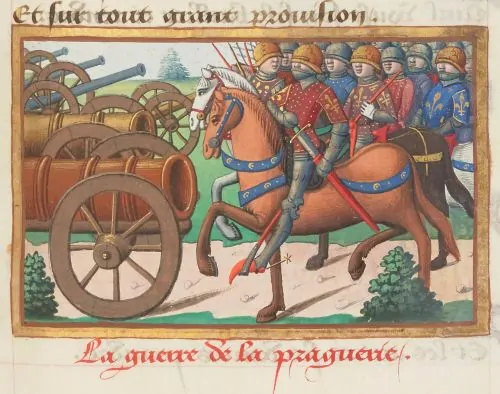
The Praguerie of 1440 gave him a harsh education in those limits. Still only sixteen, Louis joined a coalition of great nobles opposed to Charles VII and to the crown’s growing efforts to discipline military and political disorder. The rebellion collapsed rapidly once Charles retained sufficient support among officers, towns, and other political interests, and Louis submitted to his father rather than carry resistance toward destruction. Whatever private conclusions he drew from the humiliation cannot be recovered, but the episode demonstrated something fundamental about late medieval politics: noble rank meant little without functioning networks of allegiance, communication, money, fortified places, and military obedience. A conspiracy among magnates was also an information problem, because every participant had to judge who could be trusted, who might defect, what the king already knew, and when negotiation had become safer than continued resistance.
Louis nevertheless continued to acquire responsibilities that enlarged his political field of vision. He commanded troops during campaigns associated with the closing phases of the Hundred Years’ War and in 1444 led forces eastward into Alsace and toward the Swiss, experiences that demanded the coordination of commanders, supplies, routes, negotiations, and reports across considerable distances. More important was the Dauphiné, the southeastern principality attached to the heir to the French throne. Louis had possessed the title and rights of dauphin from childhood, but in January 1447 he established himself personally in the province and began nearly a decade of unusually active government there. The Dauphiné was sufficiently connected to the French crown to provide institutional resources yet sufficiently distinct to permit Louis to exercise powers that approached those of an independent prince. He appointed officials, intervened in justice and finance, dealt with towns and ecclesiastical lordships, managed territorial claims, raised forces, issued ordinances, and negotiated with neighboring rulers. Under his government the Council delphinal was strengthened and transformed into a parlement, while the administration of the principality became more closely centered upon the prince and men answerable to him. None of these practices amounted to intelligence gathering in a narrow sense, but together they forced Louis to confront the informational foundations of government: before a prince could command a territory, he needed to know who held what rights, where jurisdictions ended, what revenues existed, which officials were dependable, and how local communities were likely to respond.
The work of men such as the jurist and councillor Matthieu Thomassin illustrates the kind of knowledge upon which this government depended. Thomassin investigated the history, rights, jurisdictions, and geographical extent of the Dauphiné, using documentary learning to defend the claims of his prince and even experimenting with cartographic representation of disputed space. Louis governed amid an administrative culture in which old charters, legal precedents, boundaries, fiscal records, and local testimony could become political weapons. His personnel choices also mattered. Research into Dauphinois officeholding shows an increasing tendency to place men connected with the dauphinal household into important local positions, reducing the degree to which offices automatically remained embedded within older regional aristocratic networks. Such appointments strengthened authority, but they also created channels through which information about local society could travel toward the prince.
The Dauphiné also taught Louis to think beyond the borders of France because the principality sat amid a dense political geography of Savoyard, imperial, papal, Italian, Provençal, and Burgundian interests. He maintained relations with neighboring princes and conducted diplomacy with a freedom that increasingly angered Charles VII; Italian documentation, for example, reveals the dauphin maneuvering diplomatically in connection with Milan as early as the 1440s. His marriage in 1451 to Charlotte of Savoy without his father’s consent was both a dynastic act and a declaration that Louis intended to control his own political relationships. Father and son became progressively less able to trust one another, and that distrust itself generated a politics of watching, reporting, and counter-reporting. Charles’s councillors sought information about Louis’s activities, while Louis had every reason to know what was being planned at the royal court. Men who moved between political circles could become dangerous precisely because information followed them: a confidant might become an accuser, a servant might change patrons, and someone aware of private plans might transform knowledge into favor with another prince. By the mid-1450s, conflict between king and dauphin was no longer merely a dispute within a family; it had become a struggle between overlapping networks of officials, noble supporters, diplomats, and intermediaries. When Charles VII finally moved decisively against his son in 1456 and royal forces entered the Dauphiné, Louis understood that remaining in his principality could mean capture. His government there had taught him how much could be accomplished by controlling territory, but its loss forced him to discover how much might still be accomplished without controlling territory at all.
Louis fled in late August 1456 and placed himself under the protection of Philip the Good, duke of Burgundy. The decision reversed the normal geography of royal power: the heir to France now depended upon one of the French crown’s most formidable princely rivals for security, money, residence, and freedom of movement. Philip received him generously and Louis established his principal residence at Genappe in Brabant, yet the comfort of his surroundings could not disguise his vulnerability. He could no longer govern the Dauphiné directly, could not safely appear at his father’s court, and could not compel French political actors to obey him. What remained available were relationships, letters, envoys, conversation, patronage, and observation. Exile made information not merely useful but indispensable.
The five years Louis spent in Burgundian lands were not a political intermission before his accession. He traveled through territories ruled by Philip the Good, encountered one of Europe’s wealthiest and most elaborate princely courts, observed the commercial cities of the Low Countries, maintained diplomatic contacts, and continued maneuvering in anticipation of the succession that everyone knew would eventually come. Burgundian chroniclers could watch him in return, and his presence became one element in the deteriorating relationship between Philip and Charles VII; the dauphin was simultaneously guest, dependent, potential ally, future king, and dangerous repository of political knowledge. Surviving letters show him still attempting to intervene through correspondence even when physical access to France had been curtailed, while Burgundian evidence reveals how much diplomatic activity surrounded his presence. When Charles VII died on July 22, 1461, Louis had spent almost five years outside his father’s effective reach, but he had not spent them isolated from politics. He returned to claim the crown carrying memories of failed rebellion, ten years of governing experience in the Dauphiné, extensive exposure to neighboring courts, and intimate knowledge of how rapidly alliances could dissolve when interests changed. It would be too deterministic to claim that these experiences inevitably produced the methods of Louis XI’s kingship, but they established a recurring pattern: when direct authority failed him, Louis sought another route through people, correspondence, negotiation, and knowledge. Before he became the king who needed to know, he had been the prince who repeatedly learned that knowing could substitute, at least temporarily, for the power he did not yet possess.
The Woman Between Two Courts: Antoinette de Maignelais and the Problem of the “Spy”

Antoinette de Maignelais is an unusually revealing figure precisely because the evidence refuses to make her into the kind of person later historians have often wanted her to be. She has repeatedly been described as a spy for the future Louis XI, first inside the court of Charles VII and later beside Francis II, duke of Brittany, as though she had pursued a recognizable career in clandestine intelligence. That formulation is much too certain. The surviving evidence establishes Antoinette as a woman of substantial access, wealth, political visibility, and influence, but it does not establish a continuous sequence of secret missions directed by Louis. Indeed, recent scholarship has made even some apparently basic elements of her traditional biography less secure than they once seemed, including the precise character of her relationship with Charles VII. Rather than diminish her importance, the uncertainty makes Antoinette a useful guide to a political world in which intimacy, patronage, brokerage, faction, personal loyalty, and the circulation of privileged information were difficult to separate.
Antoinette entered that world through unusually favorable connections. She was a first cousin of Agnès Sorel, the celebrated favorite of Charles VII, and royal favor toward the Maignelais family was already visible before Agnès’s death in 1450. In August 1449 Charles transferred the disputed land of Maignelais to Antoinette, an act sometimes treated as evidence that she had already attracted the king sexually, although the grant could just as plausibly have represented favor toward Agnès’s family. After Agnès died, Antoinette married André de Villequier, one of Charles VII’s favored courtiers, and the couple received extensive royal benefits, including lands and financial rewards. Contemporary chroniclers nevertheless portrayed Antoinette as Agnès’s successor in royal favor, and Jacques Du Clercq went further, claiming that she “governed” the king and surrounded him with other attractive women. Such descriptions helped establish a durable image of Antoinette as calculating, sexually manipulative, and politically corrosive. Yet chronicles written by clerical or courtly men were hardly neutral accounts of female access to rulers, and Tracy Adams has recently stressed how easily moralized anecdotes about powerful women became historical “facts” through repetition. Adams even raises the possibility that Antoinette may not have been Charles VII’s sexual mistress in the conventional sense at all, although contemporaries clearly believed her sufficiently close to the king for the assumption to become part of her reputation.
What is considerably harder to dismiss is Antoinette’s political visibility. Jean Chartier described André de Villequier and Antoinette as possessing great authority at court, while diplomatic instructions from Savoy placed Madame de Villequier among those whom an ambassador should approach alongside the king and members of his council. In 1453 representatives of plague-stricken Compiègne sought the intervention of Antoinette and the royal secretary Étienne Chevalier in attempting to secure relief from taxation, suggesting that outsiders understood her access to the king as something that could be converted into practical political influence. These episodes do not prove espionage, but they demonstrate something more fundamental for the history of information: Antoinette occupied a recognized point of access through which requests, arguments, interests, and presumably news could move toward the sovereign.
The famous claim that she secretly informed Louis about his father is much less secure. Its foundation lies largely in the Cronique martiniane, which relates an intrigue involving letters supposedly written by the dauphin to an unnamed woman of high standing around Charles VII and implicating Antoine de Chabannes, count of Dammartin, one of the king’s important servants. Historians later identified the unnamed woman as Antoinette and interpreted the episode as evidence that she had been reporting Charles’s affairs to his estranged son; Louis’s later financial dealings with her were then used retrospectively to reinforce the identification. Christine Juliane Henzler has shown why this reconstruction is problematic. The chronicle never names Antoinette, the transmission and authenticity of the incriminating correspondence are troublesome, and the logic of the supposed operation is itself strange: if Antoinette had genuinely been Louis’s valuable informant inside his father’s court, deliberately exposing her through a compromising letter would have destroyed the very access that made her useful. Henzler suggests that, if the episode occurred substantially as reported, Louis may instead have been attempting to discredit both Dammartin and an influential woman at his father’s court. Under that interpretation Antoinette was not the dauphin’s spy but one of the targets of his information warfare. The most defensible conclusion is consequently not that Antoinette certainly spied for Louis, nor that she certainly did not, but that the evidence cannot carry the confident claim that later biographies have often placed upon it.
Her move into the orbit of Francis II of Brittany made the ambiguity still greater. By the beginning of Louis XI’s reign Antoinette was established at the Breton court and became Francis’s mistress, bearing him children and accumulating substantial property and influence, notably around Cholet. Once again she occupied a position from which extraordinarily valuable information could potentially be obtained: private conversations, factional alignments, diplomatic visitors, relations among the duke’s advisers, and changes in Francis’s intentions might all become visible to someone at the center of his household. Louis had every reason to cultivate people in such positions, and royal pensions, gifts, negotiations, and personal contacts formed ordinary instruments for influencing another prince’s entourage. Yet there is no surviving series of intelligence reports from Antoinette that would justify imagining her regularly dispatching secret memoranda from Francis’s bedchamber to Louis.
More damaging still to the image of an unwavering French agent, Antoinette demonstrably supported Breton interests when relations with Louis deteriorated; during the conflicts of the 1460s she contributed valuables to Francis’s war effort, while Louis retaliated against her property. Whatever earlier understandings may have existed between them, Antoinette’s loyalties were neither permanently owned nor easily reduced to secret service for the French crown.
That instability is exactly what makes her important to the larger history of Louis XI’s information politics. A modern intelligence organization tries to distinguish the professional agent from the target, the handler from the source, and official duty from private life; fifteenth-century politics provided no such clean divisions. Antoinette could possess information because she was a wife, widow, favorite, landholder, patron, mother, court figure, political intermediary, or intimate companion, and several of those identities could operate simultaneously. She may at times have passed information to Louis, just as countless courtiers communicated useful knowledge across political boundaries, but calling her simply “Louis XI’s spy” replaces the historical problem with a modern occupational label. The more significant fact is that rulers understood how politically valuable intimacy could be and continually attempted to cultivate people whose relationships gave them access to otherwise restricted spaces. Medieval surveillance often depended less upon an apparatus designed specifically to watch than upon preexisting networks of proximity through which observation could become information. Antoinette de Maignelais stood at the intersection of two royal or princely courts, and whether or not she ever performed the sustained espionage later attributed to her, her career demonstrates why Louis XI’s political world could turn a relationship itself into an instrument of intelligence.
Intelligence Before Intelligence Agencies: How to Recognize Medieval Surveillance
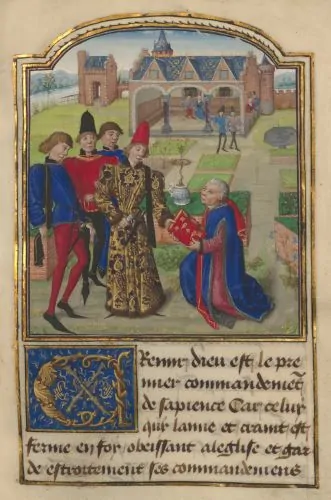
To search fifteenth-century France for an intelligence agency is to begin with the wrong question. Louis XI inherited no permanent organization whose members carried standardized ranks, filed regular intelligence assessments, or understood themselves primarily as professional spies. Yet medieval rulers constantly sought information that other people preferred to conceal, employed individuals to discover it, evaluated competing reports, protected their own secrets, intercepted communications when opportunities arose, and cultivated people close to potential enemies. Contemporary terminology itself could be unstable: a man described in one document as a messenger, servant, herald, merchant, secretary, or envoy might perform functions that a modern observer would classify as intelligence gathering. The absence of a specialized institution does not imply the absence of surveillance. What historians must identify are not bureaucratic labels but recurring informational functions: observation, reporting, verification, concealment, interception, transmission, and the deliberate cultivation of access.
The surviving record makes those functions unusually difficult to reconstruct because successful secrecy rarely advertises itself. Official accounts might record payments to a messenger without specifying everything he had been instructed to learn along the road, while a diplomatic letter could contain observations whose acquisition depended upon conversations never committed to writing. Chroniclers such as Philippe de Commynes and Georges Chastellain sometimes reveal the circulation of rumors, hidden negotiations, intercepted intentions, and private conversations, but their narratives were shaped by hindsight, political loyalties, literary purposes, and personal memory. Royal correspondence presents the opposite problem: Louis’s letters often show the king urgently seeking or reacting to information while leaving unclear precisely who first supplied it, through what chain it traveled, or how confidently he believed it.
The most important characteristic of medieval surveillance was its dependence upon ordinary social structures. Courts were crowded communities in which servants, officers, clerics, nobles, petitioners, visiting ambassadors, merchants, physicians, confessors, relatives, and favored companions repeatedly encountered one another, and every encounter created opportunities for observation. A princely household could conceal deliberations behind doors, but it could not entirely conceal the arrival of an envoy, preparations for a journey, the sudden promotion of a councillor, the mobilization of horses, the gathering of armed retainers, or visible changes in a ruler’s mood and health. Knowledge also moved through patronage. A nobleman who accepted money or favors from one prince while serving another need not have signed a recognizable contract as an informant for his loyalties to become politically useful. Municipal officers could report the movements of troops; merchants could describe conditions in neighboring territories; clergy could carry news between politically divided communities; and household servants might possess information inaccessible even to senior officials. The same person could serve several informational purposes at once without regarding any of them as a distinct occupation. Surveillance consequently emerged from relationships already embedded within society rather than from a separate organization standing outside it. This fluidity also makes the modern distinction between diplomacy and espionage difficult to impose upon late medieval politics. Envoys were expected to negotiate, but competent envoys also watched, listened, cultivated contacts, evaluated personalities, collected rumors, and reported signs that might reveal intentions not formally stated at the negotiating table. Messengers likewise carried more than written words, because they could return with observations about roads, military movements, political sentiment, or conversations encountered during their journeys. Royal officials supplied information as an ordinary consequence of administration: fiscal disputes, legal proceedings, complaints, petitions, and municipal correspondence continually informed the crown about conditions within the kingdom. Gathering intelligence was often not a separate activity added to government; it was one of the things government naturally produced. The increasingly important question was whether a ruler could gather those fragments rapidly enough, compare them intelligently enough, and transmit decisions before circumstances changed.
Louis XI’s methods become more comprehensible once surveillance is understood in this broader sense. His strength did not lie in possessing an invisible army of secret agents reporting exclusively to him, although he certainly used covert sources when circumstances demanded them. It lay instead in his unusual willingness to treat almost every relationship as a possible conduit of useful knowledge. A town councillor, foreign ambassador, Burgundian defector, royal secretary, Breton courtier, merchant, cleric, military captain, household favorite, or traveling messenger might each know only one part of a larger situation, but Louis could attempt to combine those fragments. Such a system inevitably produced errors, exaggerations, contradictory reports, and opportunities for manipulation, which is why intelligence gathering must never be confused with omniscience. Yet even imperfect information could confer an advantage when received sooner than an opponent expected. Medieval surveillance under Louis XI is best understood not as an undeveloped version of a modern secret service but as an information ecology in which political power depended upon access to people, control of communication, judgment of credibility, and the speed with which scattered observations could be turned into royal action.
Governing by Letter: Louis XI’s Extraordinary Correspondence
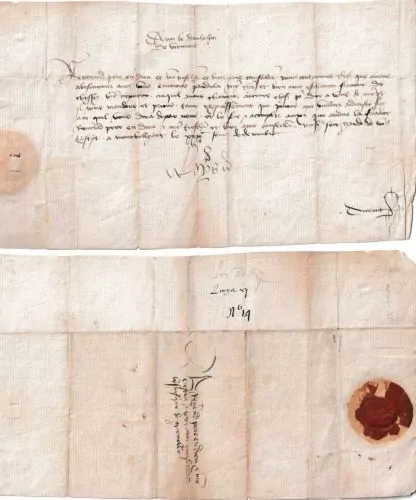
Louis XI’s correspondence is one of the clearest windows into the informational character of his kingship because letters allowed him to govern beyond the limits of physical presence. More than a thousand of his letters survive, addressed to princes, towns, officers, ecclesiastics, military commanders, diplomats, household servants, and individuals whose usefulness might arise from remarkably local circumstances. They do not read like the records of a ruler content to issue broad commands and leave implementation entirely to subordinates. Louis repeatedly asked questions, requested confirmation, transmitted rumors, altered previous instructions, reminded recipients of promises, demanded speed, and directed attention toward details that another king might have delegated. The surviving corpus reveals not simply a monarch who wrote frequently but one who treated communication as a continuing political process. An order sent yesterday might require correction today because new information had arrived overnight.
The tone of these letters is often strikingly personal. Louis could cajole one correspondent, flatter another, issue a veiled threat to a third, and write with apparent familiarity to men whose obedience rested as much upon patronage and expectation as upon formal office. Such informality should not be mistaken for political looseness. On the contrary, it allowed the king to insert himself directly into relationships that might otherwise have been mediated through layers of household or administrative hierarchy. A distant official receiving a letter in Louis’s recognizable political voice was reminded that the king had noticed his actions and expected an answer. Correspondence extended royal presence into places where Louis himself could not be.
Letters also created an iterative form of government in which information and command moved in opposite directions along the same channels. A captain might report military conditions and receive new instructions; a town could petition the king and then be required to explain its conduct; an ambassador could describe negotiations abroad and be told how to adjust his position in response. Louis frequently wanted recipients not merely to perform a task but to keep him informed about what followed from it. This habit mattered because late medieval government operated under conditions of chronic uncertainty. Messages could arrive late, reports could contradict one another, circumstances could change during transit, and local actors could interpret royal instructions in ways the king had not intended. Written government demanded continuing correction rather than a simple sequence of orders obeyed at a distance. Louis’s correspondence shows him repeatedly attempting to close that gap by asking for news, sending supplementary directions, and relying upon multiple people whose reports could overlap. The result was not centralized control in the modern bureaucratic sense, but it did create a denser relationship between the king’s decisions and events occurring far from his immediate household.
This density also made correspondence a form of surveillance. When Louis asked one official what another was doing, sought reports on the mood of a town, questioned whether a noble remained loyal, or demanded information about the movement of troops, he was using administrative communication to watch political society. No special intelligence dossier was required if routine letters could reveal who had appeared where, which gates had been opened, what supplies had been purchased, or whether an anticipated supporter had failed to act. The same letter might combine government, intelligence gathering, patronage, and discipline.
Yet the richness of Louis’s surviving correspondence requires caution. Historians possess an unusually substantial body of his letters, but documentary abundance can produce the illusion that a ruler was more innovative than predecessors whose communications have survived less completely. Charles VII and other medieval kings had long governed through written orders, messengers, councils, and local officials, and the expansion of royal documentary practices was already well underway before Louis’s accession. What does stand out is the intensity with which Louis appears to have personalized and accelerated those practices, treating letters less as occasional proclamations than as instruments within an ongoing conversation about rapidly changing events. Philippe de Commynes’s portrait of the king as persistently attentive to men, motives, and opportunities accords with what the correspondence itself suggests: Louis wanted information not as an abstract accumulation of knowledge but because knowledge could alter his next move. A report from Burgundy, Brittany, a provincial town, or a military frontier mattered when it reached him soon enough to affect what he ordered afterward. Correspondence linked observation to action. Before the later development of more regular relay arrangements could shorten transmission times, Louis had already made the central political demand clear: the monarchy had to keep talking to the kingdom, and the kingdom had to keep talking back.
People as Sensors
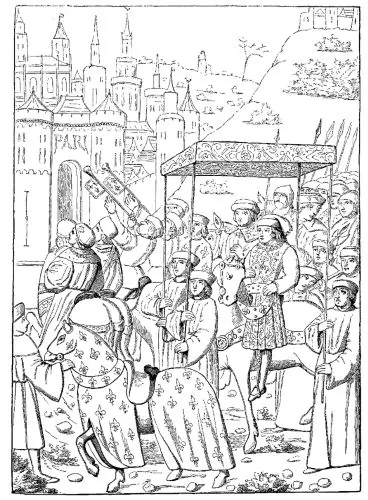
Louis XI could not personally see most of the kingdom he ruled, much less the neighboring courts whose decisions might threaten it. His practical solution was not to construct a separate body of observers but to draw information from people whose ordinary occupations already placed them where politically useful things could be seen and heard. The courtier knew who had gained access to a prince; the officer knew whether a district was quiet; the merchant knew whether roads remained open and armies were buying supplies; the municipal government knew who approached its gates. None of those observations was automatically intelligence. They became intelligence when someone recognized their significance, communicated them to another political actor, and placed them within a larger picture of events. Louis’s information network consequently depended upon a dispersed population of human observers whose usefulness arose from where they stood in society.
Courtiers possessed perhaps the most obvious advantage because proximity to rulers exposed them to information unavailable outside the household. A court was both a political institution and a living community, filled with repeated signs of changing power: who was summoned to private consultation, who suddenly ceased to appear, which ambassador received favorable treatment, what noble arrived unexpectedly, and which familiar servant had been entrusted with a journey. Even movements that carried no official explanation could invite interpretation. A ruler preparing to travel required horses, servants, lodging, provisions, and advance arrangements, while preparations for war produced disturbances difficult to conceal completely from people living around a princely household. Personal access could reveal still more, because political discussion did not occur exclusively in formal councils. The histories of Antoinette de Maignelais and Philippe de Commynes demonstrate different aspects of this phenomenon: one gained potential informational value through intimate and courtly proximity, while the other eventually carried extraordinary knowledge from Burgundian service into the entourage of Louis XI. But proximity never guaranteed loyalty. A courtier could serve one prince, accept favors from another, maintain family interests elsewhere, or report selectively according to what advanced his own position, making the person who supplied information simultaneously a source of uncertainty.
Clerics and royal officers occupied different but equally important points within this landscape. Bishops, canons, abbots, clerks, royal secretaries, and other educated churchmen participated in networks that crossed territorial boundaries, while ecclesiastical careers could connect local communities with princely households, universities, cathedral chapters, Rome, and other centers of power. Their literacy and mobility made some clerics particularly useful as diplomats, councillors, secretaries, or intermediaries, although ecclesiastical status obviously did not make a person an agent of the crown. Royal officers presented a more formal channel. Baillis, sénéchaux, prévôts, receivers, captains, commissioners, and other officials encountered disputes, petitions, fiscal problems, military preparations, local factions, and complaints as part of their normal duties. When they reported such conditions upward, administration itself became a mechanism for political observation. Fifteenth-century French government remained heavily dependent upon personal patronage and overlapping loyalties, so the possession of royal office did not transform an official into an impersonal servant of a centralized state; information still traveled through relationships as well as institutions.
Merchants occupied yet another kind of observational territory because commerce required movement across political boundaries. Traders, carriers, financiers, and their associates learned which roads were dangerous, where soldiers were gathering, whether currencies or prices were fluctuating, which ports or markets were disrupted, and what political rumors circulated among travelers. A merchant arriving from Burgundy, Flanders, England, Brittany, or Italy could know something that had not yet reached a royal officer by formal channels. Governments did not need to employ every such traveler as a secret informant to benefit from this mobile reservoir of knowledge. Commercial circulation created an informal communications environment from which rulers, diplomats, towns, and courtiers could draw whenever political circumstances made ordinary observations suddenly valuable.
The kingdom’s towns were important because they concentrated several kinds of information in the same place. Municipal governments corresponded with the crown and with neighboring communities, received travelers and delegations, maintained fortifications, monitored gates, raised money, purchased supplies, and negotiated with royal officers and noble patrons. Their officials possessed knowledge both of local political sentiment and of movements passing through surrounding regions. The War of the Public Weal in 1465 exposed their importance with exceptional clarity. When Louis learned that his brother Charles had fled toward Brittany and that a coalition of princes was developing against him, he quickly wrote to towns asking them to remain loyal and to deny access to his enemies. Neil Murphy’s reassessment of the conflict demonstrates that urban communities were not merely passive prizes over which king and princes fought; they were active political actors whose brokerage networks and communications made them crucial to both sides. Louis used personal connections within those networks as well as royal authority. At Amiens, for example, the crown sent Chancellor Philippe de Morvilliers, who had familial connections to the mayor, to reinforce the royal case before the city’s political elite. Elsewhere the king received reports about which communities appeared dependable, intervened against suspected officials, appealed directly to municipal councils, and tried to counter princely claims that rebellion served the public good. Towns functioned simultaneously as fortified places, political constituencies, logistical centers, and information nodes, making possession of their loyalty valuable for reasons extending far beyond their walls.
Thinking of these people as “sensors” is useful only if the metaphor does not imply mechanical accuracy. Human observers interpreted what they saw, withheld what endangered them, exaggerated what might bring reward, and transmitted rumors they could not verify. An official reporting that a town was loyal might misunderstand its factions; a merchant could repeat a false story heard on the road; a courtier might deliberately misrepresent another man’s intentions; an urban council could tell the king what it believed he wished to hear while privately preparing for several possible outcomes. Louis’s task was not simply to acquire more reports but to judge them against one another and decide when uncertain knowledge justified action. The breadth of his relationships mattered because overlapping channels offered at least the possibility of comparison: news arriving from a royal officer might be tested against a letter from a town, information from a court acquaintance, or the observations carried by someone arriving from the same region. His monarchy’s informational reach was consequently neither centralized nor consistently reliable, but it was extensive precisely because so much of political society could become observational infrastructure when the king knew whom to ask.
Diplomacy as Intelligence: Watching Europe Through Other Courts
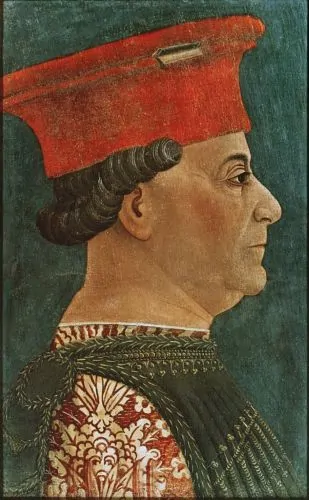
Diplomacy gave Louis XI something that domestic administration could not: observers inside political environments he did not control. An envoy sent to Burgundy, Savoy, England, Italy, or another princely court formally carried instructions, negotiated defined questions, presented credentials, and represented his sovereign, but those tasks rarely exhausted his usefulness. Diplomatic agents watched who surrounded a ruler, listened to explanations offered for changing policies, cultivated people capable of supplying additional knowledge, and tried to distinguish serious preparations from empty threats. They reported rumors precisely because an unverified rumor might still matter if it revealed what courtiers believed, feared, or wanted others to believe. Louis operated within a late medieval diplomatic culture in which negotiation and information gathering were inseparable. The foreign court was not simply a place where policy was discussed; it was an environment to be read.
The Burgundian world made that function particularly important because the rivalry between Louis and Charles the Bold unfolded across several courts simultaneously. Charles maintained extensive diplomatic relations with Italian states, Savoy, England, the Empire, and numerous territorial princes, while Louis attempted to understand and disrupt combinations that might turn Burgundian ambitions into an effective coalition against France. Milanese diplomatic dispatches from Charles’s court provide an unusually detailed demonstration of what ambassadors actually observed. Giovanni Pietro Panigarola, resident with Charles during critical portions of the campaigns of 1475–1476, did not merely transmit formal Burgundian statements to Galeazzo Maria Sforza. His dispatches reported military developments, personalities, negotiations, political moods, movements of armies, relations among Charles’s allies, and news arriving from elsewhere; Milanese diplomats also copied and translated letters when those documents contained information useful to their duke. Such correspondence reminds us that Louis was not uniquely watching Europe. Other governments were watching him, Charles, and one another with comparable intensity. A diplomatic court could become a dense marketplace of information in which ambassadors exchanged reports, approached courtiers, compared rumors, and sometimes learned developments that their hosts would have preferred to control. Louis’s advantage depended not upon possessing a monopoly over intelligence but upon competing effectively within a European system already crowded with political observers.
Italy was important because diplomatic practices there were becoming unusually continuous and information-rich during the fifteenth century. Milan, Florence, Venice, Ferrara, the papacy, and other powers increasingly relied upon sustained diplomatic correspondence, detailed instructions, frequent dispatches, and agents whose responsibilities went well beyond ceremonial representation. Isabella Lazzarini has emphasized that information itself became one of the principal currencies of Italian diplomacy, gathered and exchanged through networks that combined official representatives with clients, merchants, clerics, household contacts, and less formal intermediaries. Louis had encountered Italian affairs before becoming king, and after 1461 his dealings with Milan, Florence, Genoa, Naples, Savoy, and the papacy repeatedly exposed him to this environment. His relationship with Francesco Sforza of Milan became particularly useful during the earlier part of his reign, while subsequent changes in Italian politics demanded continual reassessment. It would be too simple to claim that Louis imported an Italian diplomatic system wholesale into France, but Italian practice provided developed examples of how regular political communication could turn distant courts into continuing sources of intelligence.
England presented a different problem because information gathering there was inseparable from Louis’s struggle to prevent an Anglo-Burgundian combination. Charles the Bold’s marriage to Margaret of York in 1468 strengthened the political relationship between Burgundy and the Yorkist monarchy, while Edward IV retained both dynastic claims in France and practical reasons to consider military intervention. Louis needed to know not merely what Edward publicly declared but how firmly English magnates supported an expedition, how much money could be raised, what Charles had promised, and whether disagreements between the allies might be exploited. That problem became urgent when Edward landed at Calais with an army in 1475. Louis responded characteristically by combining information, personal negotiation, money, diplomatic theater, and an acute assessment of interests rather than rushing automatically toward battle. The resulting meeting at Picquigny in August produced an agreement under which Edward withdrew in exchange for substantial French payments and other concessions. Philippe de Commynes later presented the episode through his characteristic attention to personalities, incentives, private conversations, and the management of access, showing politics operating at a level deeper than the formal treaty text. Louis did not need to defeat the English army if he could determine that Edward might prefer a profitable settlement to a dangerous campaign. Nor did he need to destroy the Anglo-Burgundian alliance permanently if he could separate its members at the moment Charles most needed English assistance. Intelligence was valuable here because diplomacy allowed the king to discover what an opponent actually wanted and then act upon the difference between public posture and negotiable interest.
Other political frontiers produced the same demand on a smaller scale. Savoy mattered because its territories connected France with northern Italy and because Louis’s marriage to Charlotte of Savoy embedded French interests in a complicated dynastic network; Brittany mattered because Francis II could shelter French dissidents and cooperate with princely opposition; the Swiss Confederates, imperial princes, Lorraine, and the Habsburgs became increasingly important as Charles the Bold’s ambitions moved eastward. Louis consequently dealt with Europe less as a collection of isolated bilateral relationships than as an interlocking field in which information from one court could change policy toward another. A report about Burgundian negotiations in the Empire could affect French approaches to the Swiss, while knowledge of English intentions could alter the value of an agreement with Charles.
Diplomatic intelligence nevertheless remained vulnerable to the same weaknesses as every other part of Louis’s informational world. Ambassadors could misunderstand ceremonies, believe cultivated rumors, exaggerate their own influence, or judge another ruler through assumptions formed at home. Hosts understood that foreign representatives were observing them and could deliberately stage displays of strength, leak misleading information, restrict access, or tell different stories to different envoys. Diplomatic reporting was less a transparent window into foreign policy than an accumulation of partial views requiring interpretation. Louis’s political skill lay partly in recognizing that uncertainty could seldom be eliminated and that decisions often had to be made before every report could be confirmed. He used envoys, foreign correspondents, defectors, visiting diplomats, and informal intermediaries as overlapping sources through which European politics might be reconstructed from fragments. In that respect diplomacy belonged at the center of his information-centered kingship. Louis could not place an observer inside every council chamber, but by cultivating channels into enough courts he could sometimes learn where alliances were shifting, where ambitions exceeded resources, and where a confident public position concealed a negotiable private interest. Watching Europe meant listening to what its rulers said, but it also meant learning to notice what their representatives, servants, allies, and rivals revealed when they thought they were merely conducting diplomacy.
The King’s Ears Had Horses: The Geography of Speed
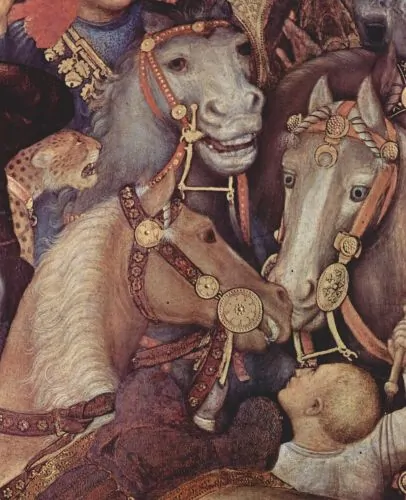
Information was politically valuable to Louis XI only if it reached him while there was still time to act upon it. That requirement transformed communication from a clerical problem into a logistical one, because every royal letter had to cross a physical landscape of roads, rivers, forests, towns, mountain passes, hostile territories, and uncertain weather. Fifteenth-century France was large enough that the king could be days away from events occurring within his own realm, while foreign developments might take considerably longer to reach him. A letter could be carefully composed and accurately informed yet become almost useless if the situation it described had already changed before delivery. Louis’s intense correspondence depended upon a less glamorous infrastructure of human endurance and animal power. The king’s ears, in a very literal sense, needed horses.
Mounted royal couriers known as chevaucheurs, particularly those associated with the king’s stable, occupied an important place within this communications world. They were not simply interchangeable postal employees in the modern sense, and their duties could overlap with those of messengers, heralds, pursuivants, servants, clerks, and other men entrusted with letters or oral instructions. What distinguished the mounted courier was primarily his ability to move rapidly and his connection to princely service. A chevaucheur might carry sealed correspondence, seek out a recipient whose precise location was uncertain, wait for an answer, and return with both written material and observations acquired during the journey. Some missions required extraordinary urgency, and royal accounts record departures ordered at night or undertaken “with all diligence,” language that indicates how closely speed could be tied to political necessity. Jacques Heers found roughly 150 recorded journeys in one accounting period from late 1469 to late 1470 alone, involving considerable expenditure on the king’s messengers and mounted servants. Such figures do not represent the whole volume of communication, but they show how much human and financial effort Louis was willing to devote to keeping information in motion.
The courier himself could also become part of the information he carried. A messenger who arrived at a fortified town could observe whether its gates were guarded unusually closely, whether soldiers were gathering nearby, or whether officials seemed frightened by the news he brought. He might learn that the intended recipient had unexpectedly departed and discover where he had gone. Even when his formal task was delivery, movement through political space made the messenger an observer.
Speed nevertheless had hard biological limits. A single horse could travel rapidly for a time, but sustained hard riding exhausted the animal, and a courier who depended upon one mount could not indefinitely maintain the pace demanded by urgent government. Roads varied enormously in quality, and winter mud, floods, snow, damaged bridges, military activity, or simple darkness could transform an apparently straightforward journey into a succession of delays. Major rivers imposed particular constraints because reliable crossings clustered around bridges, ferries, and towns that could themselves be politically vulnerable. The geography of royal communication was consequently unequal: some corridors permitted relatively rapid travel, while others remained difficult regardless of the king’s impatience. Distance was measured not merely in miles or leagues but in the availability of horses, safe passage, lodging, crossings, and people willing to help the courier continue. These realities explain why communications systems based upon relays represented such a significant improvement. Once a tired horse could be exchanged for a fresh one, the effective limit on speed shifted from the endurance of a particular animal toward the organization of the route itself.
Louis’s itinerant kingship made this problem even more complicated because correspondents could not always assume that the king would remain where the last message had found him. Like other medieval rulers, Louis moved among residences, towns, military theaters, shrines, hunting grounds, and diplomatic meeting places, often bringing portions of his household government with him. A courier might be instructed to find the king, an admiral, a governor, or another official wherever that person happened to be rather than deliver a letter to a permanent administrative headquarters. Royal communication depended upon knowledge of movements as much as knowledge of roads. Messengers had to learn where important people were expected to travel next, while members of the household needed to ensure that incoming correspondence could follow the king. The monarchy was becoming more administratively capable, but much of its information system still revolved around a moving human sovereign.
Urgency also cost money. Couriers required wages or allowances, horses had to be maintained or hired, exceptional journeys generated additional expenses, and lost or exhausted animals represented material losses rather than abstractions on an administrative chart. A king who wanted information quickly had to spend resources specifically to overcome distance. Louis’s willingness to do so reveals that rapid communication was becoming part of the practical cost of governing rather than an occasional luxury reserved for spectacular emergencies.
Nor did speed merely improve administrative convenience; it could alter the political relationship between places. If Louis learned that a noble was negotiating with Burgundy before the negotiation had been completed, he might send warnings or competing offers before loyalties hardened. If news of military movement reached him quickly, he could redirect troops or order a town to prepare its defenses while an opponent still expected surprise. Messages could also be dispatched in several directions at once, allowing a single piece of information received by the king to generate a cascade of instructions across the kingdom. The communications advantage was cumulative: faster incoming news enabled faster outgoing decisions, and those decisions could themselves produce new reports requiring further adjustment. By the later 1470s, Louis’s government was moving toward more deliberately organized arrangements for changing horses and maintaining rapid routes for royal communications. Those developments did not appear from nowhere, nor should they be projected backward into a fully formed “postal service” operating from the beginning of his reign. They emerged from the older world of chevaucheurs, messengers, household servants, and improvised journeys, sharpened by a ruler who increasingly regarded delay as a political weakness. Louis’s communications network became powerful not because medieval geography ceased to matter, but because his government invested growing effort in making geography matter less.
Did Louis XI Create the French Post? The 1464 Problem and the Royal Relay System

Few claims about Louis XI have been repeated more confidently than the assertion that he created the French postal service by an ordinance issued on June 19, 1464. According to the traditional story, the king promulgated an edict at Lucheux, or Luxies, near Doullens, establishing mounted relays along the principal roads of France so that royal dispatches could travel with unprecedented speed. The purported ordinance is almost perfectly suited to Louis’s political personality. It declares the necessity of receiving news rapidly from all directions, provides for horses stationed at regular intervals, regulates the men responsible for them, and presents faster communications as essential to the king’s affairs and government. Generations of postal historians consequently treated 1464 as a convenient birth date for the French royal post, while popular histories transformed Louis into something resembling the founder of a national mail service. The image remains attractive because the document appears to give institutional form to exactly the informational appetite visible throughout his reign. Unfortunately, the document on which the neat chronology depends is almost certainly not an ordinance issued by Louis XI at all.
Serious doubts about the supposed Edict of Lucheux were raised by Gaston Zeller in 1937 and developed in greater detail by Eugène Vaillé, whose work remains fundamental to the history of the early French posts. No fifteenth-century original has survived, and the text does not appear in contemporary collections where an ordinance of such importance might reasonably be expected. Its vocabulary and institutional arrangements contain features difficult to reconcile with documented postal practice under Louis XI. Most damagingly, the document describes in mature form procedures for which firm contemporary evidence appears only substantially later. The edict cannot safely be used to prove what the royal communications network looked like in 1464.
The history of the document itself increases the suspicion. The text appears to have entered circulation only in the seventeenth century, when it was printed in a 1660 collection of documents relating to the posts, and Vaillé argued that its insertion was connected with contemporary administrative and financial interests rather than the recovery of a lost medieval original. Features of the printed volume suggested that the purported ordinance had been added during production, while the wording conveniently supplied ancient royal authorization for privileges claimed by later postal officials. Zeller had already identified chronological and terminological anomalies severe enough to reject the document as authentic medieval legislation. The problem is deeper than the ordinary loss of an original charter whose contents survive in trustworthy copies. Historians are dealing with a text that seems to describe a later postal institution retrospectively and place that developed organization under the authority of a king already famous for his concern with rapid news. The apparent perfection with which the edict expresses Louis’s political needs is consequently reason for caution rather than confidence. Once the 1464 text is removed, the larger history does not collapse. It simply becomes less tidy: instead of a postal system created instantaneously by one legislative act, the evidence points toward an evolving royal communications structure whose increasingly recognizable organization appears during the final years of Louis’s reign.
The strongest documentary landmark comes in 1479. Letters patent issued by Charles VIII in January 1487 recalled that his father had created an office of controller of the chevaucheurs of the royal stable in October 1479 and had appointed Robert Paon to supervise the mounted couriers whose negligence had been delaying royal business. This retrospective testimony is considerably more valuable than the supposed edict because it comes from the immediate institutional aftermath of Louis’s reign and describes a specific officeholder whose position continued under his successor. Paon’s responsibility was not merely ceremonial. Supervision implied that the crown wanted journeys monitored, delays reduced, and the movement of royal messengers subjected to more regular oversight. Evidence from 1480 further reveals riders serving relay arrangements extending across strategically important routes, while the surviving administrative record suggests that some routes were established in response to current military and diplomatic needs and could disappear when those needs changed. The earliest royal network was consequently not yet a fixed national grid covering France uniformly. It was a flexible communications architecture developing around the places where the king most urgently needed information and commands to move.
What Louis created or consolidated must also be distinguished sharply from a postal service for the general population. Medieval France already possessed numerous means of transmitting letters: universities employed messengers, merchants maintained commercial correspondence, towns dispatched their own representatives, ecclesiastical institutions communicated across long distances, and private travelers could be entrusted with written messages. Louis neither invented letter carrying nor suddenly nationalized all of these channels. His royal relays were designed primarily to make the king’s communications move faster by giving authorized riders access to fresh horses along important routes. The essential innovation was not a letter box, public counter, regular delivery round, or universal right to send mail. It was the organized replacement of exhausted mounts so that the message could continue at a pace impossible for a courier dependent upon a single horse. Even the word “post” can mislead when read through modern expectations, because in early usage it referred to stages or relay points along a journey before it came to signify the enormous communications institution familiar in later centuries.
Louis XI should neither be credited with a public postal system that did not yet exist nor stripped of his importance merely because the famous ordinance of 1464 is spurious. The more persuasive interpretation lies between those extremes. Older royal messengers and mounted servants supplied the personnel from which more organized communications could grow; practical arrangements for securing horses and accelerating journeys existed before Louis; and other European powers, especially in Italy, offered examples of increasingly sophisticated courier networks. What Louis’s reign added was sustained royal pressure toward regularity, supervision, and speed, visible most securely in the institutional evidence of the late 1470s. The appointment of Robert Paon is particularly revealing because it addressed not the abstract need to send letters but the concrete problem of couriers whose delays harmed royal affairs. Louis was trying to make communication dependable enough to become an instrument of government. That distinction matters for the larger argument about information and power. An isolated messenger could carry a secret; a relay network could help a monarchy make rapid communication repeatable. The historical significance of Louis’s royal post lies not in the mythical precision of June 19, 1464, but in a slower institutional change during which the crown increasingly attempted to control the time required for information to cross political space. Louis did not create the modern French Post Office. He helped create something more immediately useful to a fifteenth-century king: a communications system increasingly capable of moving royal knowledge and royal decisions faster than one exhausted horse could carry them.
The War of the Public Weal: Information Under Pressure, 1465
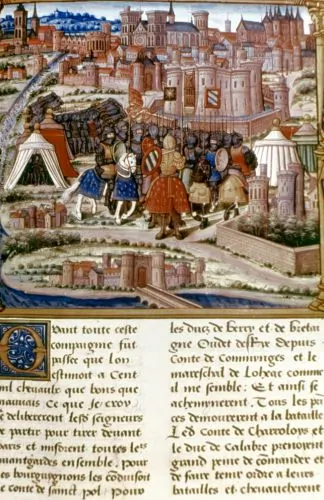
The War of the Public Weal in 1465 subjected Louis XI’s methods of government to their first great crisis. On March 3, his younger brother Charles, duke of Berry, fled the royal court at Poitiers and made his way toward Brittany, transforming long-standing princely discontent into open rebellion. The coalition that assembled against the king was formidable, bringing together Charles of Berry, John II of Bourbon, Francis II of Brittany, Charles of Charolais, the future Charles the Bold, and other major lords who claimed to be acting for the reform and “public good” of the kingdom. Louis could not know at the outset how widely their cause would spread or which nobles, officers, and towns would remain loyal once princely armies began to move. His response was revealing. Among his first actions after learning of his brother’s flight was to write to towns across France, warning them against the coalition and urging them to keep their gates closed. The opening of the conflict was immediately a contest over information as well as military force: Louis had to learn where rebellion was spreading while simultaneously attempting to shape what people believed the rebellion meant.
The princes understood the same problem and did not leave the field of persuasion to the crown. Their proclamations presented Louis’s government as burdensome and badly advised, attacked taxation, promised reform, and appropriated the language of the “public weal” to justify resistance to the king. Such arguments had a long political history in France, where complaints about excessive taxation and corrupt counsel could turn rebellion into an ostensibly moral defense of the community rather than a naked struggle among aristocrats. Louis answered by constructing a rival narrative. In letters to towns he portrayed his brother as having been deceived by ambitious princes, accused the coalition of disturbing the peace, defended expenditures that had provoked resentment, and claimed that the rebels’ promises of fiscal relief could not be trusted. He was doing more than issuing propaganda from above. Each royal message entered a local political environment where municipal officers, merchants, guild interests, noble connections, and competing factions had their own memories and calculations. Louis relied upon personal intermediaries when possible. At Amiens he sent Chancellor Philippe de Morvilliers, who possessed family connections with the mayor, to reinforce the royal appeal before the city’s elite. The maneuver captured a defining characteristic of Louis’s information politics: official authority became more effective when carried through relationships already embedded in the place the king wished to influence.
Towns were worth this attention because control of them shaped nearly every dimension of the war. Their walls and artillery made them military strongpoints, their markets and stores could provision armies, their bridges and roads controlled movement, and their municipal networks circulated news across surrounding regions. Louis’s early campaign in the Bourbonnais consequently became a struggle for urban submission as much as a campaign against princely armies. Saint-Amand fell to royal forces, Montluçon submitted after siege, and Louis used clemency there deliberately, hoping neighboring communities would conclude that surrender offered better terms than resistance. Aigueperse, Varennes, and Vichy were among those persuaded to submit, while other places resisted or reversed their allegiance when conditions changed. The lesson was uncomfortable for any theory of straightforward royal centralization: an oath of loyalty was information about what a town promised at one moment, not a guarantee of what it would do when another army appeared.
That uncertainty extended across the kingdom. Bourges, deeply associated with Valois power under Charles VII, supported Charles of Berry and became an important center for the princely cause, while towns in Bourbon lands often followed their regional lord rather than the king. Auxerre resisted Louis’s attempts to win it away from Burgundian allegiance, whereas Amboise, Orléans, Tours, and Poitiers formed part of a more dependable royal heartland. In the northeast, strategically valuable communities faced particularly intense pressure because Burgundian forces could threaten or bypass them according to circumstances; Amiens and Abbeville remained royalist, while other towns welcomed or submitted to Burgundian authority. Even inside ostensibly loyal communities Louis worried about factions that might open gates to his enemies. At Saint-Quentin he demanded action against men suspected of favoring Charles of Charolais, and at Poitiers arrests followed suspicions that influential townsmen had assisted the king’s brother before his flight. These episodes turned municipal politics into intelligence problems. Knowing that a council had declared for Louis was insufficient if a faction within the walls possessed the means to reverse the decision. The pitched battle at Montlhéry on July 16, fought as Louis and the princely forces maneuvered around Paris, underscored the same uncertainty on a larger scale: both sides claimed advantages from a confused engagement that failed to destroy either army. Louis succeeded in reaching Paris, an enormous strategic achievement, but survival did not mean mastery. During the ensuing months he negotiated while continuing to receive news, reposition forces, cultivate towns, and search for divisions among opponents whose coalition depended upon interests that did not entirely coincide. The conflict remained fluid because military events, political negotiations, and changing local allegiances continuously altered one another.
The late stages of the war demonstrated just how quickly such information could transform Louis’s bargaining position. In September, while negotiations between king and princes appeared capable of producing a settlement, Rouen moved into the princely camp and supported the establishment of Louis’s brother Charles as duke of Normandy. Other Norman towns followed, giving the coalition a territorial success that strengthened its hand just as agreement seemed near. The resulting treaties of Conflans and Saint-Maur in October forced Louis to make extensive concessions, including territorial grants that he would spend the following years undermining, recovering, or rendering ineffective. The War of the Public Weal was hardly a demonstration of a king exercising flawless informational control. Louis misjudged loyalties, lost important towns, confronted hostile urban factions, and discovered that letters and personal contacts could not compel communities whose interests pointed elsewhere. Yet the crisis also revealed why information had become so central to his way of ruling. He fought the rebellion partly by learning which places were wavering, communicating directly with urban governments, sending trusted intermediaries, adjusting rewards and punishments, and contesting his enemies’ interpretation of events almost as vigorously as he contested their armies. The “public weal” itself became something both sides tried to control through communication. In 1465 Louis learned that possessing information could not eliminate political uncertainty, but he also demonstrated that surviving a kingdom-wide rebellion required a ruler to fight simultaneously over roads, towns, allegiances, and the stories through which people decided whom to obey.
When Knowing Failed: The Danger of Parallel Operations, 1468
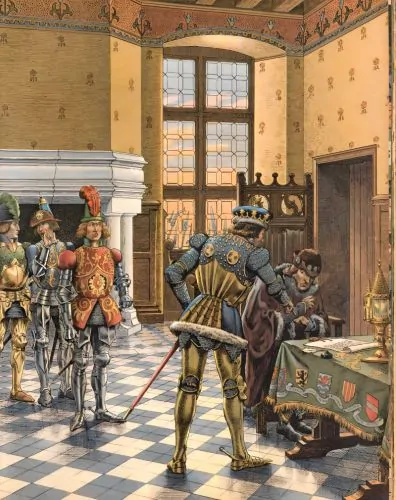
The meeting between Louis XI and Charles the Bold at Péronne in October 1468 has become one of the classic stories of a clever ruler suddenly caught by his own cleverness. Louis entered Burgundian territory hoping to settle disputes directly with the duke at a moment when relations between France and Burgundy remained dangerously unstable. He did so voluntarily and with a relatively modest entourage, apparently trusting both the safeguards surrounding the meeting and his ability to manage Charles personally. That decision alone exposed him to an unusual degree of dependence upon the intentions of another prince. More important, Louis arrived at Péronne while events he had previously encouraged around Liège were moving beyond his immediate control. The king who normally sought to exploit informational asymmetry had placed himself in a situation where another ruler could receive catastrophic news while Louis lacked the freedom to control either the timing of its arrival or the interpretation placed upon it.
Liège had long provided the French monarchy with a means of applying indirect pressure against Burgundy. Its inhabitants had repeatedly resisted the authority of their prince-bishop, Louis de Bourbon, whose position was closely connected with Burgundian power, and French policy had cultivated opponents of Burgundian influence within the principality. During the 1460s Louis XI maintained contacts with Liégeois leaders and municipal authorities, sometimes through ambassadors and material assistance. Raes de Heers and other opponents of the prince-bishop had particularly strong associations with the French cause, although Liège’s internal politics cannot be reduced to a simple struggle between French and Burgundian parties. By 1467 Charles had already crushed a major Liégeois rising at Brustem and imposed severe terms upon the principality, leaving exiles and defeated factions with powerful reasons to seek French support.
In September 1468 those tensions exploded again. Exiled opponents returned, Liège rose against the imposed regime, and the rebels proclaimed their attachment to the French king while anticipating assistance or mediation from him. What Louis personally ordered at every stage is difficult to establish, and this uncertainty matters. Older narratives, heavily dependent upon Philippe de Commynes, often present Louis as having dispatched agents to provoke the Liégeois deliberately while somehow forgetting those instructions when he decided to visit Charles. The actual situation was more complicated. Louis certainly had a history of using Liège as a counterweight to Burgundian power, and French agents remained connected to the Liégeois opposition, but modern scholarship has cautioned against treating every action of the rebels as the product of direct royal command. Before Louis reached Péronne, he appears to have attempted to use intermediaries to influence the developing crisis and to preserve a role for himself as protector or mediator. Meanwhile the Liégeois themselves possessed political objectives, factions, resentments, and expectations that did not simply switch on and off according to orders from France. That distinction reveals the structural danger in Louis’s methods: cultivating an allied movement could give him leverage without giving him control. Once people had been encouraged to regard the French king as their patron, they could act in his name at precisely the moment when their actions became inconvenient to him.
Louis and Charles met at Péronne beginning on October 9. Almost immediately, reports arrived of a dramatic Liégeois attack in which Bishop Louis de Bourbon, the papal legate Onofrio de Santa Croce, and Charles’s lieutenant Guy de Brimeu, lord of Humbercourt, had been seized. Initial stories were even worse than the reality, including rumors that the bishop and Humbercourt had been killed. The presence or alleged presence of French agents among the insurgents made the news extraordinarily dangerous for Louis. Charles could reasonably interpret the rebellion not as an unrelated disturbance but as evidence that the king was negotiating peace with him face-to-face while simultaneously encouraging violence behind his back.
Commynes’s celebrated account turns the moment into a lesson in political imprudence. According to him, Louis had failed to remember, when coming to Péronne, that he had sent two ambassadors to Liège to incite opposition to Charles, and the discovery threw the duke into furious suspicion. Commynes describes Louis becoming deeply frightened as Charles’s advisers debated how to respond, helping to establish the enduring image of the king virtually imprisoned in the castle and fearing for his life. That narrative cannot simply be discarded: Commynes was then serving Charles and was unusually close to the political world in which the crisis unfolded. Yet he wrote his Mémoires decades afterward, after defecting to Louis, and his narrative repeatedly constructs political episodes as lessons about princely wisdom, folly, character, and fortune. Jean-Marie Cauchies has urged a more careful reading of Péronne, questioning the melodramatic tradition in which Louis becomes helpless prey inside a Burgundian prison. The king’s freedom was unquestionably constrained by circumstances, and the presence of Burgundian forces made his position dangerous, but the surviving evidence does not require every detail of the later captivity legend. What can be said securely is damaging enough: Louis entered negotiations expecting to exercise initiative and abruptly found Charles controlling the immediate political environment because news from Liège had transformed the meaning of the meeting.
The settlement signed at Péronne on October 14 imposed substantial concessions upon Louis, but his humiliation did not end with the treaty. To demonstrate that he had not treacherously sponsored the Liégeois revolt, or at least to satisfy Charles sufficiently to escape the crisis, Louis accompanied the duke’s expedition against Liège. The spectacle was politically brutal. People who had invoked the French king and expected his assistance now saw that king marching with the Burgundian ruler sent to punish them, and Louis was compelled by circumstance to participate in the destruction of a political relationship he had previously found useful. At the end of October Burgundian forces captured and devastated Liège after desperate resistance, while Louis witnessed the elimination of a pressure point he had repeatedly employed against Burgundy. Péronne exposes the limit at the center of an information-based style of rule. Louis could cultivate several relationships simultaneously, send different agents toward different objectives, encourage pressure on an opponent while negotiating with that opponent, and preserve ambiguity about his own commitments, but those methods depended upon the operations remaining sufficiently separated in time and space. In 1468 they collided. Information arrived not merely late or inaccurately but at the worst possible political moment, and autonomous allies acted faster than the king could redefine his policy. The result was not simply an intelligence failure; it was a failure of coordination among overlapping political operations. Louis survived it and would eventually recover much of what he conceded, but Péronne demonstrated that a ruler who tried to keep many pieces moving at once could become trapped when one of them moved without him.
Stealing Men as Well as Secrets: Philippe de Commynes and the Information Value of Defection
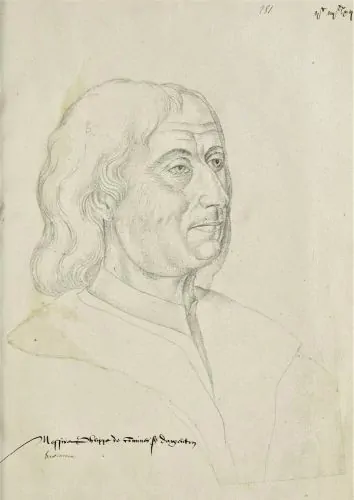
When Philippe de Commynes abandoned Charles the Bold in August 1472 and entered the service of Louis XI, the French king acquired far more than another capable courtier. Commynes had grown up politically inside the Burgundian world and had served Charles closely during some of the most important episodes of the previous decade. He had been present during the War of the Public Weal, accompanied his master through negotiations and campaigns, participated in diplomatic missions, and enjoyed the kind of personal access that exposed him to conversations and judgments unavailable to outsiders. At Péronne in 1468 he had been close enough to Charles to observe the duke during the crisis surrounding the Liège revolt and to intervene in discussions concerning Louis’s predicament. By 1472 he carried with him an accumulated understanding of Burgundian government that could not have been captured in a stolen document. He knew personalities, rivalries, habits of decision-making, diplomatic relationships, and the strengths and vulnerabilities of the prince he had served. His defection illustrates one of the most valuable forms of medieval intelligence acquisition: instead of stealing an enemy’s secrets individually, a ruler could sometimes acquire the person who already knew them.
Commynes’s knowledge was valuable precisely because much of it was tacit. He could explain not merely what Charles had done but how he tended to react, which advisers he trusted, whose counsel irritated him, how easily his anger could distort calculation, and where apparent confidence might conceal political difficulty. Such knowledge mattered in a political culture governed heavily through personal relationships. Written reports might identify the members of a council; a former insider could help Louis understand which members of that council actually influenced its prince. Memory itself became an intelligence archive carried from one court into another.
The circumstances of the defection also reveal how deliberately Louis cultivated people rather than waiting passively for useful information to reach him. Contacts between Louis and Commynes predated the final break with Burgundy, and the king had recognized the usefulness of the young Burgundian courtier well before he formally entered French service. During the night of August 7–8, 1472, Commynes left Charles’s camp during the Burgundian campaign in Normandy and made his way to Louis, who was then at Ponts-de-Cé. Charles responded by confiscating the fugitive’s Burgundian property, while Louis compensated his new servant with extraordinary generosity. Commynes became a royal councillor and chamberlain, received substantial financial support and territorial rewards, and in 1473 married Hélène de Chambes, whose family connections and wealth helped establish him securely within the French political elite. These rewards should not be interpreted simply as payment for a packet of secrets. Louis was purchasing loyalty, expertise, access to networks, diplomatic skill, and a long-term capacity for political judgment. Commynes subsequently served him in negotiations extending well beyond Burgundy, especially in Italy, demonstrating that what Louis acquired in 1472 was a political practitioner rather than a temporarily useful informant. The transaction nevertheless had a powerful intelligence dimension: Louis had succeeded in converting one of Charles’s trusted servants into one of his own most knowledgeable advisers.
The episode should not be romanticized into a story of Louis brilliantly recruiting a modern double agent. Commynes had interests of his own, and his transfer of allegiance has been interpreted variously as betrayal, self-preservation, political calculation, dissatisfaction with Charles, attraction to Louis, or some combination of these motives. Fifteenth-century aristocratic service remained intensely personal, and allegiance to a prince did not operate according to modern concepts of nationality or professional civil service. Commynes’s decision was morally and politically serious without fitting neatly into the later categories of either patriotic loyalty or bureaucratic treason.
What makes the defection strikingly revealing is that Louis’s gain could not be separated from Charles’s loss. Charles not only forfeited a servant who knew his affairs but had to assume that information once confined within his entourage might now be available to his most dangerous rival. That possibility altered the security of everything Commynes knew, including knowledge that had never been intentionally collected as intelligence. Conversations remembered from years earlier, assessments of Burgundian councillors, details of diplomatic relationships, impressions of Charles’s temperament, and familiarity with foreign contacts could all acquire new value after the change of allegiance. Commynes’s later Mémoires demonstrate the extraordinary observational habits he brought to political life: he repeatedly analyzed rulers through their character, advisers, resources, fears, errors, and capacity to understand changing circumstances. Louis did not obtain an infallible interpreter of Burgundy, and Commynes remained capable of pursuing his own interests, but he gained something more useful than a static cache of information, a man able to interpret new developments through years of accumulated experience. His case consequently clarifies why surveillance through relationships could be so powerful and so unstable. Political knowledge resided inside people, and people could move. For Louis XI, recruiting an opponent’s intimate servant could achieve what no interception of correspondence could fully reproduce: the transfer of an entire remembered political world from one prince’s service into another’s.
The Long Contest with Burgundy
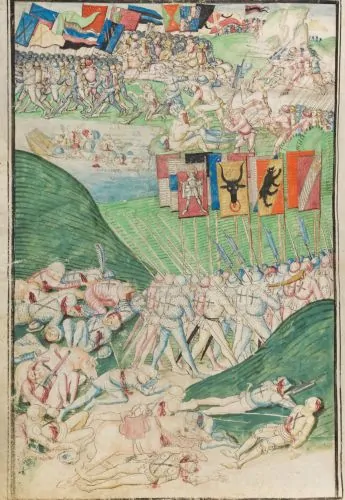
Péronne did not end the struggle between Louis XI and Charles the Bold; it changed its methods. Louis emerged from the crisis of 1468 with good reason to avoid placing himself so completely within his rival’s power again, and during the following years the conflict became an extended contest of military pressure, diplomatic maneuvering, contested loyalties, and increasingly careful calculation. Open war resumed in 1470 after Louis moved to challenge concessions imposed at Péronne, but neither ruler possessed an easy means of destroying the other. Burgundy was too powerful to be treated as an ordinary rebellious principality, while Charles could threaten the kingdom without possessing the resources necessary to conquer France outright. Information mattered because each ruler continually needed to judge not merely the other’s army but the stability of his alliances and the willingness of supposedly friendly princes to fulfill their promises. Louis gradually became less interested in defeating Charles through a single dramatic confrontation than in making the duke confront too many political problems at once.
The Burgundian invasion of 1472 demonstrated both the danger Charles still represented and the limitations of direct military aggression. His forces captured and brutally sacked Nesle in June, creating a reputation for severity that traveled far beyond the town itself, but they encountered determined resistance at Beauvais later that month. Louis did not offer the decisive pitched battle Charles might have preferred. He maneuvered, reinforced threatened places, watched for opportunities, and allowed the difficulties of campaigning to work upon the Burgundian army. Reports of atrocities, resistance, troop movements, and changing intentions became part of the political contest because reputation influenced whether the next town resisted or submitted. Charles could use terror to encourage surrender, but excessive violence could also strengthen the determination of communities that concluded submission offered little protection.
During the next several years the geography of the struggle shifted eastward. Charles’s ambitions increasingly involved the Rhineland, Lorraine, Alsace, the Empire, and the territorial connection of his scattered possessions, bringing him into conflict with political actors whose interests were independent of Louis XI. The meeting between Charles and Emperor Frederick III at Trier in 1473 dramatized the duke’s widening ambitions but failed to produce the royal crown and durable agreement he sought. Meanwhile resentment of Burgundian administration in the Upper Rhine helped produce an anti-Burgundian alignment involving Sigismund of Austria, Alsatian cities, and members of the Swiss Confederacy. Louis encouraged that environment and spent money to strengthen relationships useful against Charles, but the familiar image of the “Universal Spider” secretly manufacturing every anti-Burgundian coalition exaggerates French control. The Swiss cities and their allies had territorial interests, commercial concerns, local grievances, and political calculations of their own. Louis’s achievement was less the creation of obedient proxies than the recognition that their independent interests could be made temporarily compatible with his. A Franco-Swiss agreement in October 1474 formalized cooperation and included substantial French financial commitments, part of a broader policy in which pensions and subsidies allowed Louis to purchase access, goodwill, military assistance, or simply the expectation that potential partners would remain hostile to Burgundy.
Charles meanwhile became absorbed by the siege of Neuss on the Rhine, which began in 1474 and consumed enormous resources into 1475. Louis watched the campaign with obvious interest because Burgundian concentration in the east reduced the duke’s ability to act elsewhere, yet he could not assume that Charles’s difficulties had removed the danger. The most serious threat came from England. Edward IV landed at Calais in July 1475 with a substantial army and longstanding English claims to the French crown, expecting cooperation from his Burgundian ally. Charles, exhausted by Neuss and pursuing objectives of his own, failed to provide the kind of coordinated support Edward had anticipated. Louis responded not by gambling the monarchy on battle but by investigating whether the English king could be persuaded that withdrawal was more profitable than war. Negotiations culminated at Picquigny on August 29, where the two kings met across a specially constructed barrier and agreed to terms under which Edward returned to England in exchange for a large immediate payment and the promise of an annual French pension. Louis’s willingness to spend money was not evidence of weakness in the simple sense implied by later heroic narratives of warfare. Money allowed him to remove an invading army without risking thousands of soldiers or the uncertainties of battle, while simultaneously separating England from Charles at a critical moment. The intelligence achievement lay in recognizing the difference between Edward’s public posture as an invading monarch and his private willingness to bargain. Louis paid because he understood that an enemy’s price could sometimes be more useful to know than an enemy’s battle plan.
Picquigny left Charles increasingly exposed, but what followed should not be rewritten as a French operation conducted through puppets. Charles conquered Lorraine in 1475 and occupied Nancy, threatening to create a stronger territorial bridge between the northern and southern components of his dominions. Yet his advance collided with enemies whose resistance had acquired momentum of its own. At Grandson on March 2, 1476, the Swiss defeated the Burgundian army and captured an enormous quantity of matériel and treasure after Charles’s forces fled. On June 22 he suffered a much more destructive defeat at Morat, where the losses to his army were severe. News of these disasters circulated throughout Europe, affecting calculations about Burgundian strength before the political consequences were fully known. For Louis, every defeat altered the problem: he needed to exploit Charles’s weakening position without intervening so aggressively that frightened neighboring powers began to regard France rather than Burgundy as the greater danger.
Charles nevertheless refused to abandon his attempt to recover Lorraine. René II regained Nancy in October 1476, and Charles soon placed the city under siege again, despite the damage already inflicted upon his military resources. René assembled forces that included Lorrainers and substantial Swiss and Alsatian contingents before marching to relieve the city. On January 5, 1477, the armies met outside Nancy, where Charles’s forces collapsed and the duke himself was killed. The famous discovery of his body only after the battle had an important political consequence beyond the drama later attached to it: before other rulers could act confidently, they needed to know whether Charles was actually dead. Initial reports circulating through the Burgundian Netherlands were uncertain, and political authorities there prepared for crisis while confirmation was still emerging. Louis appears to have received the decisive news within days, by January 9. A struggle that had shaped most of his reign had ended not through a French victory over Charles in battle but through information arriving from a battlefield on which the king of France had not fought.
Louis immediately confronted the difference between knowing of a rival’s death and deciding what that knowledge permitted him to do. Charles had left no son, only his daughter Mary of Burgundy, and the legal status of the Burgundian lands varied considerably: some were French fiefs, others belonged to the Empire, while the Duchy of Burgundy itself provided Louis with a particularly strong argument for reversion to the French crown. Royal officers and armies moved quickly into territories Louis claimed, and the king sought possession of the duchy while exerting pressure in Picardy, Artois, and the Franche-Comté. He also explored the possibility of marrying Mary to the dauphin Charles, a dynastic solution that might have brought an extraordinary portion of the Burgundian inheritance under eventual Valois control. Yet speed did not eliminate resistance. Mary’s subjects possessed political interests of their own, Burgundian loyalties survived Charles, and Louis’s aggressive demands encouraged opposition rather than passive acceptance of French rule. Mary’s marriage to Maximilian of Habsburg in August 1477 ensured that the Burgundian inheritance would remain an international problem long after Charles’s death. The final irony is important. Louis had spent years using rumor, negotiation, payments, correspondence, and other people’s conflicts to narrow Charles’s possibilities until Burgundy’s military project collapsed, but the disappearance of his great rival did not hand him complete control of the result. Information allowed Louis to act quickly; it did not allow him to dictate how everyone else would respond. His triumph over Charles the Bold was consequently real but incomplete, demonstrating once again that the greatest advantage of knowing sooner was the opportunity to move first, not the certainty of having the last move.
Relational Surveillance: A Court Without Privacy
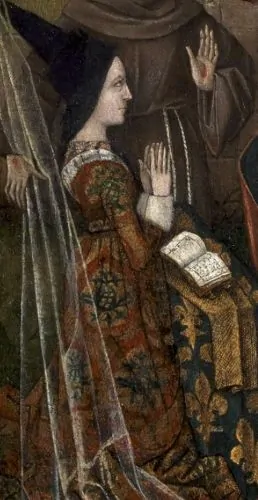
To describe Louis XI’s world as one “without privacy” requires care, because fifteenth-century French society did not organize privacy around the modern legal distinction between a protected private sphere and an intrusive state. Medieval people nevertheless understood secrecy, confidence, restricted access, household boundaries, and the danger of having conversations repeated outside the circle for which they were intended. Letters could be sealed, councils could deliberate behind closed doors, servants could be dismissed before sensitive matters were discussed, and rulers could restrict who entered their chambers. The very existence of such precautions demonstrates that contemporaries recognized gradations of access to people and information. Yet elite households were also crowded environments in which political life penetrated spaces that modern observers might instinctively classify as personal. A prince’s chamber could be a sleeping space at one hour and a setting for patronage or political conversation at another. For Louis, this permeability created opportunities: information became available not because privacy was absent in every sense, but because the boundaries surrounding privileged knowledge were maintained by people, and people could talk.
The bedchamber is the most obvious example because proximity to the ruler conferred significance well beyond sexuality. Chamber servants helped dress, feed, guard, entertain, and attend their master during portions of the day when formal audiences had ended, while favored nobles or intimates might be admitted into spaces closed to ordinary petitioners. Access itself became a political resource. A person who knew who had entered a ruler’s chamber late at night might possess valuable information even without hearing the conversation. The central fact was not that medieval bedrooms were permanently public, but that a ruler’s supposedly personal environment was populated by attendants whose presence made absolute secrecy exceptionally difficult.
Households magnified that problem because they were simultaneously domestic communities and political institutions. A great lord did not travel alone with a few anonymous employees; he was surrounded by officers, servants, clerks, chaplains, retainers, visitors, petitioners, and members of associated noble families whose lives repeatedly intersected. Preparations themselves communicated information. Extra horses being readied, armor removed from storage, unusual purchases of provisions, a messenger arriving after dark, or rooms suddenly prepared for an important visitor could reveal activity before anyone announced its purpose. Household members also possessed different fragments of the same event. One servant might know that an envoy had arrived, another that the ruler had changed his travel plans, while a secretary knew that letters had been prepared for dispatch. None necessarily possessed the whole picture, but someone able to combine reports could infer intentions from otherwise ordinary observations. Louis’s government did not need to plant a clandestine operative beside every rival if it could maintain relationships with people who already inhabited these politically productive spaces.
Friendship and patronage opened comparable channels. Medieval political friendship was not necessarily a private emotional relationship detached from public affairs; friendship could entail reciprocal service, advocacy, protection, gifts, recommendation, and expectations of assistance. A person might communicate news to Louis because he was a royal client, hoped to become one, owed the king a favor, or believed that useful information would strengthen an existing relationship. Such motives are difficult to classify as espionage because the same communication might also constitute perfectly ordinary patronage.
Women at court expose clearly why relational surveillance cannot be reduced to professional spying. Antoinette de Maignelais had potential informational value because her circumstances gave her unusual access, not because surviving evidence places her within a formal intelligence organization. Other elite women could similarly mediate petitions, exchange letters, carry family information across dynastic boundaries, maintain contacts with natal relatives after marriage, and cultivate dependents whose interests extended beyond a single court. Their political influence has often been distorted by chronicles that sexualized female proximity to rulers or treated it as evidence of improper domination, which makes modern reconstruction particularly delicate. Yet dismissing those narratives entirely would create a different distortion by obscuring the political importance of intimacy itself. A mistress, wife, widow, lady-in-waiting, or female relative could know things because household and dynastic life placed her near people whose decisions mattered. The crucial historical point is not that women were naturally covert informants, but that court politics turned proximity of many kinds into potential access to restricted knowledge.
Louis’s own conduct reveals the other side of this problem: a ruler eager to obtain information also had reasons to fear what others might learn about him. His movements, health, advisers, negotiations, and reactions to news could themselves become intelligence for Burgundy, Brittany, England, or dissatisfied French princes. Foreign ambassadors watched court behavior, servants changed patrons, and courtiers who lost favor could carry memories elsewhere, as Philippe de Commynes had demonstrated in reverse when he transferred knowledge of the Burgundian court into Louis’s service. Controlling access to the king could serve a defensive as well as ceremonial purpose. The same social architecture that allowed Louis to observe others made him observable.
This mutual vulnerability helps explain why the history of surveillance under Louis XI cannot be written simply as a story of an expanding monarchy looking downward upon passive subjects. Political observation moved sideways between courts and upward toward rulers as readily as royal officials gathered news from towns or provincial society. Charles the Bold watched Louis; Italian ambassadors watched both men; urban governments maintained their own correspondents; noble households exchanged information through kinship and service. Louis operated within a political culture saturated with observation, but he appears to have exploited that culture with exceptional persistence. His achievement was not the invention of intimacy as intelligence. It was the repeated conversion of ordinary human relationships into channels through which political knowledge could move toward the crown. That process also reveals the limits of speaking too casually about medieval privacy. What Louis penetrated was not a clearly bounded private sphere recognizable to modern law, but a collection of confidences, restricted spaces, household loyalties, and expectations about who should know what. Surveillance occurred whenever those boundaries proved porous. The court needed no mechanical eye watching continuously from above: people already occupied the rooms where power lived, and Louis’s problem was to ensure that some of what they saw eventually reached him.
The Dark Side of Knowing
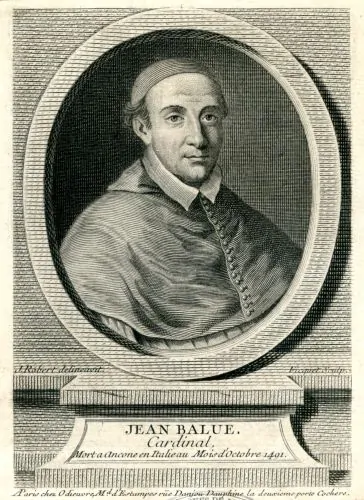
The more Louis XI depended upon information, the more he encountered a problem that no communications network could solve: knowing more did not necessarily mean knowing what was true. Reports reaching the king came from people with interests of their own, and politically useful information was often inseparable from accusation, rumor, interpretation, and deliberate deception. A courtier could damage a rival by portraying an ambiguous conversation as conspiracy; an official might exaggerate danger to demonstrate vigilance; a frightened town could report military threats that existed mainly in rumor. Louis himself frequently encouraged overlapping channels precisely because one source could be checked against another, but multiplication of reports created its own dangers. Once the king suspected someone, new information could easily be interpreted as confirmation of what he already feared. His reign reveals an uncomfortable paradox of surveillance: increased observation can reduce uncertainty, but it can also generate additional suspicions requiring still more observation.
The fall of Cardinal Jean Balue illustrates how quickly a relationship founded upon privileged information could reverse itself. Louis had raised Balue rapidly, employing him in major political and diplomatic affairs and helping him obtain the cardinalate, so the prelate had acquired extraordinary knowledge of royal intentions. After Péronne, Balue fell from favor, and in 1469 correspondence connecting him and Guillaume de Harancourt, bishop of Verdun, with Charles the Bold was discovered after the interception of an intermediary. The evidence indicated that men who had possessed the king’s confidence had communicated sensitive political information outside it, including matters concerning Louis’s plans for his brother Charles of France. Balue’s arrest was not simply the product of an irrational king inventing enemies. Yet his subsequent imprisonment for roughly eleven years without a completed judicial resolution demonstrates the harsher side of Louis’s security politics. Later tradition embellished Balue’s captivity with dramatic stories of prolonged confinement in a tiny iron cage, claims that should not be repeated uncritically, but the documented detention was severe enough without them. The episode would have reinforced one of Louis’s deepest political lessons: the more information a trusted adviser possessed, the more dangerous that person could become if loyalty changed.
Louis de Luxembourg, count of Saint-Pol and constable of France, offered an even clearer example of divided allegiance. Saint-Pol had gained enormous rewards from Louis but spent years maneuvering among France, Burgundy, and England, repeatedly attempting to preserve his own position by preventing any one of the competing powers from becoming completely dominant. Such behavior was not unusual in an aristocratic world where great lords possessed territorial and familial interests crossing political boundaries, but Saint-Pol pushed flexibility to a point that became intolerable to rulers who increasingly demanded exclusive loyalty. His correspondence and negotiations supplied Louis with evidence that the constable had communicated with enemies of the crown while holding one of its highest offices. After Charles the Bold surrendered him to French custody in November 1475, Saint-Pol was tried before the Parlement of Paris, condemned for treason, and executed on December 19. Here surveillance had uncovered something real: the king’s suspicions were supported by a substantial record of political double-dealing.
The prosecution of Jacques d’Armagnac, duke of Nemours, carried that logic still further and shows how information gathering could merge with judicial power. Nemours had participated in the War of the Public Weal and later became entangled again in princely combinations opposed to Louis, including contacts associated with Saint-Pol and other dissatisfied magnates. He received pardons and opportunities for reconciliation, but renewed suspicions eventually led the crown to move against him. Besieged at Carlat, he surrendered in 1476 and entered a judicial process in which the king took an unusually active interest. Surviving documentation includes extensive interrogations, depositions, memoranda, and instructions concerning the conduct of the case, allowing historians to see how scattered knowledge was converted into an accusation of treason. Louis wanted investigators to reconstruct relationships: who had communicated with whom, what had been discussed, which promises had been made, and how separate acts might demonstrate a continuing intention against the crown. The procedure was not simply a theatrical execution ordered without law, since royal commissions, legal doctrine, testimony, and eventually established judicial institutions all played roles. Modern studies of the trial make clear how forcefully Louis shaped the process and how difficult it is to separate prosecution from political necessity as the king understood it. Nemours was condemned and executed in Paris on August 4, 1477. The case reveals a significant transformation in the political meaning of information: reports once useful for deciding how to manage a potentially disloyal prince could be accumulated, organized, and reframed as evidence demonstrating a crime against royal majesty.
By the final years of Louis’s reign, the problem of surveillance increasingly turned inward toward the king himself. Serious attacks of illness beginning in 1481 made his health a matter of European political importance, because every neighboring court understood that the death of the king would alter alliances, succession calculations, and the balance of power. Louis consequently had strong reasons to control information about his condition and about access to his person. He spent much of his last period at Plessis-lès-Tours, surrounded by a more restricted circle and increasingly concerned with who approached him, what news circulated about his health, and whether royal authority would continue to be obeyed while he was physically weakened. His desire for recovery led him to physicians, religious intercession, relics, pilgrimages by proxy, and eventually Francis of Paola, the Calabrian holy man whom Louis urgently wanted brought to France. To later writers these behaviors provided irresistible material for a portrait of a terrified, superstitious tyrant barricaded inside a fortress and desperately bargaining with heaven for additional life. Contemporary evidence supports an aging ruler intensely afraid of illness and determined to preserve control, but the gothic elaborations should be treated with the same skepticism applied to stories of ubiquitous iron cages and casually ordered murders. Louis remained capable of political calculation even while his physical condition deteriorated.
The darker interpretation of Louis XI consequently requires balance. He was suspicious, could be vindictive, employed prolonged imprisonment, pursued major political trials aggressively, and increasingly guarded both his person and his authority. Yet many of the conspiracies he feared were not inventions: Balue communicated with Burgundy, Saint-Pol repeatedly negotiated across incompatible loyalties, Nemours became involved in renewed princely opposition, and Louis had already experienced rebellion, exile, betrayal, and humiliation at Péronne before old age intensified his insecurity. The danger lies in allowing that reality to transform every royal suspicion into proof of conspiracy, just as earlier historians allowed hostile chroniclers to transform Louis into a pathological monster.
Thomas Basin, a bitter political opponent writing from exile, contributed powerfully to the black legend, while Philippe de Commynes offered a more complicated ruler whose caution could coexist with intelligence and whose calculations could still fail. The most revealing conclusion is neither that Louis was merely paranoid nor that his suspicions were always justified. A government built upon continual reporting encouraged the king to imagine politics as a field filled with concealed intentions waiting to be discovered. Information could expose genuine betrayal, but it could also make absence of certainty feel like evidence that further secrets remained hidden. By the end of his reign, Louis had demonstrated both the power and the psychological danger of information-centered kingship: the ruler who insisted upon knowing more than his enemies could eventually confront the unsettling possibility that he could never know enough.
The Information Advantage: Could Louis Act Before His Enemies Knew What He Knew?

Louis XI’s information system did not make him omniscient, but omniscience was unnecessary. Political advantage could arise from something much narrower: receiving a significant report early enough to act before opponents understood that their intentions had been discovered or their circumstances had changed. In a world where messages traveled at the speed of horses and where rulers, armies, and councils might be separated by several days of communication, even a modest temporal advantage could have substantial consequences. Louis could send warnings to threatened towns, alter instructions to commanders, approach an uncertain noble, offer money to an ally, or open negotiations before an adversary knew that the information prompting those actions had reached the king. Information became powerful not simply because of what it revealed, but because of the interval between knowledge and acknowledged knowledge. During that interval Louis could attempt to change the situation his information described.
His correspondence repeatedly shows government operating through such sequences. News arrived, Louis evaluated it, and new letters departed toward people capable of affecting the next stage of events. The process could be remarkably personal: instead of waiting for a council to formulate a general policy, Louis might write directly to an officer, town, diplomat, or political intermediary whose cooperation was immediately useful. This gave his style of kingship a provisional quality. Instructions could be revised when another report arrived, promises adjusted when loyalties shifted, and pressure redirected toward a more vulnerable point. Such flexibility helps explain why Louis sometimes appeared inconsistent to contemporaries and later historians. A king who treated policy as a response to changing information would inevitably contradict decisions made under earlier circumstances.
The War of the Public Weal showed both the potential and the limits of this temporal advantage. Louis wrote rapidly to towns after his brother’s flight in 1465 because preventing rebellion from spreading required reaching municipal governments before princely appeals completely shaped their decisions. During the struggle with Burgundy he likewise benefited when he could detect divisions among potential enemies before those divisions had been resolved. The English invasion of 1475 offered a particularly clear example. Edward IV arrived in France as Charles the Bold’s ally, but Louis learned enough about the disappointments, expectations, and material interests surrounding the English expedition to recognize that the coalition was less solid than its military appearance suggested. Negotiation at Picquigny transformed that knowledge into action: money and diplomacy removed the English army without a decisive battle and deprived Charles of the coordinated offensive he had hoped to obtain. Louis did not possess secret knowledge of Edward’s mind in any mystical sense. He gathered enough information about circumstances and incentives to act on a possibility before the alliance against him could become more dangerous.
Charles the Bold’s death in January 1477 illustrates the same principle on a larger scale. News from Nancy initially traveled amid uncertainty because Charles had disappeared during the collapse of his army and his death required confirmation. Once Louis became convinced that his rival was dead, the political map changed immediately in his calculations. Royal officers and forces could move toward territories claimed as reverted French fiefs, negotiations could begin with local elites, and dynastic schemes involving Mary of Burgundy could be considered before the Burgundian succession had stabilized. Yet what followed also demonstrates why informational advantage should not be confused with control. Mary’s subjects resisted some French claims, Maximilian of Habsburg entered the contest through marriage, and Louis’s aggressive exploitation of Charles’s death sometimes encouraged precisely the opposition he hoped to forestall. Knowing first gave him initiative, but initiative could still be squandered through misjudgment or encounter interests too strong to override. The most defensible way to describe Louis’s achievement is not as surveillance supremacy but as a sustained attempt to compress political time. His letters, messengers, informants, diplomatic contacts, urban relationships, defectors, and increasingly organized courier arrangements all helped shorten the distance between an event occurring and the king responding to it. That compression could never eliminate false reports, difficult roads, hostile intermediaries, autonomous allies, or the possibility that an enemy would act unexpectedly; Péronne had demonstrated those limits with exceptional force. But Louis’s reign suggests that late medieval royal power was beginning to depend increasingly upon the capacity to receive, interpret, and redistribute information quickly enough to influence events still in motion. His monarchy possessed an advantage that was temporal before it was bureaucratic. The king did not need to see everything happening across France and Europe. He needed enough reliable eyes, ears, and horses that on crucial occasions he could know what had happened while there was still time to make something else happen next.
An Information State or Simply a Very Busy Medieval King?
The following video from Passé sanglant discusses the reign of Louis XI:
The strongest challenge to interpreting Louis XI as the maker of an “information state” is that almost none of the practices examined here began with him. French kings had used spies, messengers, diplomats, royal officers, urban correspondents, household contacts, and confidential intermediaries for centuries. Charles VII’s government had already expanded royal administration dramatically during the final stages of the Hundred Years’ War, strengthening taxation, military organization, judicial institutions, and the crown’s ability to communicate with provincial society. Great territorial princes operated substantial information networks of their own, while Burgundy under Philip the Good and Charles the Bold maintained sophisticated diplomatic contacts across Europe. Italian governments had developed exceptionally intensive traditions of diplomatic reporting, and towns routinely exchanged news long before Louis became king. Nor was the king’s interest in secrecy exceptional: any ruler facing aristocratic opposition needed advance warning of conspiracy and some means of discovering what neighboring princes intended. Viewed against this wider political culture, Louis can appear less like the creator of a new system than an energetic participant in practices characteristic of later medieval government.
Institutionally, the objection becomes stronger. Louis possessed no permanent intelligence department, no standardized corps of professional agents, and no archive comparable to the organized intelligence bureaucracies of much later states. Many people who supplied information served the king for entirely different reasons and would not have understood information gathering as their principal occupation. Even the royal relay system developed incrementally rather than springing into existence through the famous but unreliable ordinance attributed to 1464. Calling Louis’s monarchy an “information state” can become misleading if the phrase implies an institutional structure that contemporaries would have recognized as something distinct from ordinary royal government.
The surviving evidence creates another methodological difficulty: historians may be seeing Louis differently simply because they can see so much of him. His extensive correspondence preserves his questions, anxieties, instructions, personal interventions, and reactions to incoming news with unusual immediacy. A ruler whose letters survive richly will almost inevitably appear more communicative than one whose correspondence has disappeared. Medieval archival survival is uneven enough that numerical comparisons between royal letter collections can easily produce false impressions of innovation. Philippe de Commynes compounds the effect because his Mémoires offer an exceptionally vivid portrait of Louis as a ruler fascinated by personalities, changing circumstances, hidden motives, and political calculation. Commynes knew Louis well, but he also wrote retrospectively and constructed episodes around lessons about good and bad princely judgment. Later biographers then intensified those themes until Louis became the legendary “Universal Spider,” a ruler imagined as controlling Europe through invisible threads. The historian must distinguish the Louis who can be documented from the Louis created by unusually abundant documentation and centuries of narrative repetition.
There is also a larger problem with the word “state.” Fifteenth-century France was not governed by an impersonal central administration capable of penetrating society uniformly from Paris. Royal power remained negotiated through privileges, jurisdictions, noble lordship, urban liberties, ecclesiastical authority, and deeply personal relationships of service. John Watts’s work on late medieval European polities, like earlier studies by P. S. Lewis and Bernard Guenée, cautions against describing political change simply as the steady march of centralized states replacing fragmented medieval structures. Louis himself continually depended upon precisely the personal forces that a strong version of the “information state” argument might seem to transcend. He needed towns to cooperate, officers to remain loyal, diplomats to exercise judgment, and courtiers to tell him things that no administrative mechanism could automatically supply. His failures at Péronne and after the death of Charles the Bold further demonstrate that superior access to information did not confer systematic control over autonomous political actors. If “state” means a centralized surveillance apparatus functioning independently of the personality of the sovereign, Louis XI plainly did not create one.
Yet this objection modifies the argument more persuasively than it destroys it. Louis’s historical significance does not depend upon having invented the individual instruments he used, and calling his monarchy information-centered need not require imagining a prematurely modern secret service. What distinguishes his reign is the unusually visible integration and political valuation of information: correspondence, diplomatic observation, household relationships, urban reporting, mounted communications, and personal recruitment repeatedly converged upon a king who wanted to respond while circumstances were still fluid. Older practices became more politically consequential when their outputs could be compared, redirected, and moved more quickly across an expanding field of royal action. The process remained dependent upon Louis’s personality and was far from complete, which is precisely why “information state” should be treated as an analytical description of direction rather than a formal institutional category. Louis was indeed a very busy medieval king, and much of what he did remained recognizably medieval. But his busyness had a pattern: he persistently tried to reduce the political handicap of distance by making more people report, making communications move faster, and treating timely knowledge as an ordinary requirement of effective kingship. The strongest counterpoint leaves the central interpretation narrower but firmer: Louis XI did not create a surveillance state; he demonstrated how increasingly coordinated information practices could become one of the foundations upon which a stronger monarchy was built.
Conclusion: Power at the Speed of News
Louis XI did not build a surveillance state, and the evidence becomes less persuasive rather than more if his reign is forced into that modern category. He inherited a political world already filled with messengers, diplomatic observers, royal officers, household confidants, urban correspondents, merchants, clerics, and courtiers who carried news across jurisdictions and between rival centers of power. What distinguished Louis was the intensity with which he tried to draw those scattered channels toward himself and make their information usable before circumstances changed. His kingship depended not upon seeing everything, but upon reducing the delay between an event occurring somewhere beyond his sight and the arrival of knowledge that allowed him to respond. The most important instrument of Louis’s surveillance was neither the spy nor the letter alone. It was speed.
Antoinette de Maignelais brings that system back to its human foundations. Whether she ever served Louis as consistently or deliberately as later writers claimed cannot be demonstrated, and turning her into a professional secret agent obscures more than it explains. Her importance lies in the access created by intimacy, patronage, household position, and movement between courts. The same principle appears more securely in Philippe de Commynes, whose defection transferred years of accumulated knowledge about Burgundy into Louis’s service. Neither case required a specialized intelligence bureaucracy. People themselves carried political archives in their memories, relationships, observations, and loyalties, and those archives could change hands when relationships changed.
The machinery surrounding those relationships nevertheless mattered increasingly because information that could not move quickly remained hostage to geography. Louis’s extraordinary correspondence reveals a king continually sending questions outward and receiving reports back, while mounted couriers and eventually more organized relay arrangements shortened the time required for written commands and news to cross distance. The famous claim that he created the French postal service through an ordinance of 1464 does not withstand scrutiny, but abandoning that legend actually clarifies his achievement. What emerged during his reign was not a public mail system suddenly founded by decree but a more deliberate effort to make royal communications faster, more supervised, and more dependable. The distinction matters because Louis’s objective was fundamentally political: he wanted the monarchy to acquire and transmit knowledge rapidly enough for the king’s decisions to reach events that were still unfolding.
Yet Louis’s career also demonstrated that information could never abolish uncertainty. At Péronne in 1468, the collision between his negotiations with Charles the Bold and the renewed Liégeois revolt showed how parallel operations could escape coordination and place the king himself in danger. Reports could be wrong, informants could manipulate their patron, towns could reverse allegiance, allies could pursue interests Louis did not control, and the discovery of genuine betrayal could encourage suspicion of dangers that remained invisible. Even the death of Charles the Bold in 1477 proved that learning decisive news early supplied opportunity rather than mastery: Louis moved rapidly against the Burgundian inheritance, but Mary of Burgundy, Maximilian of Habsburg, local elites, and foreign powers still possessed choices of their own. This is why Louis’s importance in the history of surveillance lies neither in the legend of the all-seeing “Universal Spider” nor in any claim that fifteenth-century France had already become a modern information state. His reign instead reveals a crucial stage in the changing practice of monarchy, when acquiring information, comparing reports, protecting secrets, cultivating access, and accelerating communications became increasingly inseparable from effective rule. A medieval king still governed through people, privileges, negotiations, and relationships, but Louis understood with unusual clarity that those relationships produced information and that information acquired value when it arrived in time. His monarchy points toward a larger transformation in political power: authority belonged not only to the ruler who possessed armies, revenues, courts, and titles, but increasingly to the ruler who could learn what had happened soon enough to determine what happened next.
Bibliography
- Adams, Tracy. Queens, Regents, Mistresses: Reflections on Extracting Elite Women’s Stories from Medieval and Early Modern French Narrative Sources. New York: Peter Lang, 2023.
- Ambühl, Rémy. Le séjour du futur Louis XI dans les pays de Philippe le Bon (1456–1461). Vieux-Genappe: Cercle d’histoire et d’archéologie du pays de Genappe, 2002.
- Basin, Thomas. Histoire de Charles VII. Edited and translated by Charles Samaran, with Henry de Surirey de Saint-Remy. 2 Vols. Paris: Société d’édition Les Belles Lettres, 1933–1945.
- Bittmann, Karl. Ludwig XI. und Karl der Kühne: Die Memoiren des Philippe de Commynes als historische Quelle. 2 vols. Göttingen: Vandenhoeck & Ruprecht, 1964–1970.
- Blanchard, Joël. Louis XI. Paris: Perrin, 2015.
- —-. “Commynes on Kingship.” In War, Government and Power in Late Medieval France, edited by Christopher Allmand, 106–123. Liverpool: Liverpool University Press, 2000.
- —-. Commynes l’Européen: L’invention du politique. Geneva: Droz, 1996.
- —-. Philippe de Commynes. Paris: Fayard, 2006.
- Canestrini, Giuseppe, ed. Négociations diplomatiques de la France avec la Toscane. Published by Abel Desjardins. 6 vols. Paris: Imprimerie impériale and Imprimerie nationale, 1859–1886.
- Cauchies, Jean-Marie. Louis XI et Charles le Hardi: De Péronne à Nancy (1468–1477): Le conflit. Brussels: De Boeck Université, 1996.
- —-. “Repenser l’entrevue de Péronne entre le roi Louis et le duc Charles (1468): Un épisode tragi-comique?” Bulletin de la Classe des Lettres et des Sciences Morales et Politiques de l’Académie Royale de Belgique 25 (2014), 27–42.
- Charles VIII. Lettres patentes du 27 janvier 1487 concernant Robert Paon et le contrôle des chevaucheurs de l’écurie du roi. In Origine des postes chez les anciens et chez les modernes, by Louis Le Quien de La Neufville. Paris: Pierre Delaulne, 1708.
- Chartier, Jean. Chronique de Charles VII, roi de France. Edited by Auguste Vallet de Viriville. 3 vols. Paris: P. Jannet, 1858–1859.
- Chastellain, Georges. Chronique: Les fragments du Livre IV révélés par l’Additional Manuscript 54156 de la British Library. Edited by Jean-Claude Delclos. Geneva: Droz, 1991.
- —-. Œuvres de Georges Chastellain. Edited by Joseph Kervyn de Lettenhove. 8 vols. Brussels: F. Heussner, 1863–1866.
- Chevalier, Bernard. Les bonnes villes de France du XIVe au XVIe siècle. Paris: Aubier-Montaigne, 1982.
- Commynes, Philippe de. Les lettres de Philippe de Comynes aux Archives de Florence. Edited by E. Benoist. Lyon: Imprimerie de Louis Perrin, 1863.
- —-. Mémoires de Philippe de Commynes. Edited by Joël Blanchard, with the collaboration of Michel Quereuil. 2 vols. Paris: Chez Jules Renouard, 1863.
- Cuttler, S. H. The Law of Treason and Treason Trials in Later Medieval France. Cambridge: Cambridge University Press, 1981.
- Du Clercq, Jacques. Mémoires de J. Du Clercq, imprimés sur les manuscrits du roi, et publiés pour la première fois. Edited by Frédéric de Reiffenberg. 4 vols. Brussels: Arnold Lacrosse, 1823.
- Duby, Georges, ed. A History of Private Life. Vol. 2, Revelations of the Medieval World. Translated by Arthur Goldhammer. Cambridge, MA: Belknap Press of Harvard University Press, 1988.
- Dufournet, Jean. La destruction des mythes dans les Mémoires de Philippe de Commynes. Geneva: Droz, 1966.
- Escouchy, Mathieu d’. Chronique de Mathieu d’Escouchy. Edited by Gaston du Fresne de Beaucourt. 3 vols. Paris: Veuve Jules Renouard, 1863–1864.
- Favier, Jean. Louis XI. Paris: Fayard, 2001.
- Frizet, Yannick. Louis XI, le roi René et la Provence. Aix-en-Provence: Presses Universitaires de Provence, 2015.
- Gingins-La Sarra, Frédéric de, ed. Dépêches des ambassadeurs milanais sur les campagnes de Charles-le-Hardi, duc de Bourgogne, de 1474 à 1477. 2 vols. Paris and Geneva: J. Cherbuliez, 1858.
- Guenée, Bernard. States and Rulers in Later Medieval Europe. Translated by Juliet Vale. Oxford: Basil Blackwell, 1985.
- Guitton, Laurent. “Fastes et malheurs du métier de favorite. Antoinette de Maignelais, de la cour de France à la cour de Bretagne (1450–1470).” In Maîtresses et favorites dans les coulisses du pouvoir du Moyen Âge à l’Époque moderne, 155–170. Saint-Étienne: Presses universitaires de Saint-Étienne, 2019.
- Hardy, Duncan. Associative Political Culture in the Holy Roman Empire: Upper Germany, 1346–1521. Oxford: Oxford University Press, 2018.
- Harsin, Paul. Liège et Bourgogne. Actes du colloque de Liège, 28-30 octobre 1969. Liège: Université de Liège, 1972.
- Haynin, Jean de. Mémoires de Jean, sire de Haynin et de Louvignies, 1465–1477. Edited by Dieudonné Brouwers. 2 vols. Liège: Société des Bibliophiles Liégeois, 1905–1906.
- Heers, Jacques. Louis XI: Le métier de roi. Paris: Perrin, 1999.
- Henzler, Christine Juliane. Die Frauen Karls VII. und Ludwigs XI.: Rolle und Position der Königinnen und Mätressen am französischen Hof (1422–1483). Cologne, Weimar, and Vienna: Böhlau, 2012.
- Isambert, François-André, Alphonse-Honoré Taillandier, and Athanase-Jean-Léger Jourdan, eds. Recueil général des anciennes lois françaises, depuis l’an 420 jusqu’à la Révolution de 1789. Vol. 10. Paris: Belin-Leprieur, 1825. [Contains the later-transmitted text attributed to Louis XI under the date June 19, 1464.]
- Kanao, Takemi. “L’organisation et l’enregistrement des messageries du duc de Bourgogne dans les années 1420.” Revue du Nord 76:305 (1994), 275–298.
- —-. “Les messagers du Duc de Bourgogne au début du XVe siècle.” Journal of Medieval History 21:2 (1995), 195–226.
- Kendall, Paul Murray. Louis XI: The Universal Spider. New York: W. W. Norton, 1971.
- Lazzarini, Isabella. Communication and Conflict: Italian Diplomacy in the Early Renaissance, 1350–1520. Oxford: Oxford University Press, 2015.
- Le Clerc, Jean. Cronique martiniane: Édition critique d’une interpolation originale pour le règne de Charles VII. Edited by Pierre Champion. Paris: Honoré Champion, 1907.
- Le Roux, Muriel, and Sébastien Richez, eds. A Concise History of the French Post Office: From Its Origins to the Present Time. With Eugène Vaillé. Translated by Ken Berry and Georgina Banfield. Brussels: P.I.E. Peter Lang, 2018.
- Lemonde, Anne. “Mathieu Thomassin, conseiller du dauphin Louis II, à la recherche d’une identité dauphinoise.” Les Cahiers du CRHIPA 4 (2001): 313–354.
- Lewis, P. S. Later Medieval France: The Polity. London: Macmillan, 1968.
- Louis XI. Lettres de Louis XI, roi de France. Edited by Joseph Vaesen, Étienne Charavay, and Bernard de Mandrot. 11 vols. Paris: Renouard and Laurens, 1883–1909.
- Mattéoni, Olivier. “Les procès politiques du règne de Louis XI.” Histoire de la justice 27:1 (2017), 11–23.
- —-. Servir le prince: Les officiers des ducs de Bourbon à la fin du Moyen Âge (1356–1523). Paris: Publications de la Sorbonne, 1998.
- Murphy, Neil. “Towns and Princely Rebellion in Fifteenth-Century France: The War of the Public Weal, 1465.” English Historical Review 139:600 (2024), 1027–1058.
- Ordonnances des rois de France de la troisième race. Paris: Imprimerie Royale, 1723.
- Pilot de Thorey, Emmanuel. Catalogue des actes du dauphin Louis II, devenu le roi de France Louis XI, relatifs à l’administration du Dauphiné. 2 vols. Grenoble: Imprimerie de Maisonville, V. Truc, successeur, 1899.
- Prosser, Gareth. “‘Decayed Feudalism’ and ‘Royal Clienteles’: Royal Office and Magnate Service in the Fifteenth Century.” In War, Government and Power in Late Medieval France, edited by Christopher Allmand, 175–189. Liverpool: Liverpool University Press, 2000.
- Roye, Jean de. Journal de Jean de Roye, connu sous le nom de Chronique scandaleuse, 1460–1483. Edited by Bernard de Mandrot. 2 vols. Paris: Renouard, 1894–1896.
- Scott, Tom. The Swiss and Their Neighbours, 1460–1560: Between Accommodation and Aggression. Oxford: Oxford University Press, 2017.
- Vaillé, Eugène. Histoire générale des postes françaises. Vol. 1, Des origines à la fin du Moyen Âge. Paris: Presses Universitaires de France, 1947.
- —-. Histoire générale des postes françaises. Vol. 2, De Louis XI à la création de la surintendance générale des postes (1477–1630). Paris: Presses Universitaires de France, 1949.
- Vale, M. G. A. Charles VII. Berkeley and Los Angeles: University of California Press, 1974.
- Vale, Malcolm. The Princely Court: Medieval Courts and Culture in North-West Europe, 1270–1380. Oxford: Oxford University Press, 2001.
- Vaughan, Richard. Charles the Bold: The Last Valois Duke of Burgundy. Woodbridge: Boydell Press, 1973.
- Vion, Robert. Letter to Girard de Saint-Légier, November 12, 1468. In Mémoires de Philippe de Commynes, edited by Émile Dupont. Vol. 3. Paris: Société de l’Histoire de France, 1840–1847.
- Walsh, Richard J. Charles the Bold and Italy (1467–1477): Politics and Personnel. Liverpool: Liverpool University Press, 2005.
- Watts, John. The Making of Polities: Europe, 1300–1500. Cambridge: Cambridge University Press, 2009.
- Wijsman, Hanno. “Poésie, politique et emblématique dans un manuscrit enluminé. Le recueil Chartier d’Antoinette de Maignelais, maîtresse de Charles VII.” In Le Pouvoir des lettres sous le règne de Charles VII (1422–1461), edited by Florence Bouchet, Sébastien Cazalas, and Philippe Maupeu, 89–108. Paris: Honoré Champion, 2020.
- Zeller, Gaston. Un faux du XVIIIe siècle: L’édit de Louis XI sur la poste. Paris: Félix Alcan, 1937.
Originally published by Brewminate, 08.25.2026, under the terms of a Creative Commons Attribution-NonCommercial-NoDerivatives 4.0 International license.
About the Author