Between the ninth and eleventh centuries, expanding trade routes carried captives across Europe. Political fragmentation and rulers’ complicity helped the medieval slave trade thrive.

By Dr. Christopher Paolella
Professor of History
Valencia College
Introduction
In 905, Bertha, Margravine of Tuscany (c. 863–925) sent her regards to Al-Muktafi, the Abbasid Caliph (r. 902–908) in Baghdad. She sent him ‘50 swords, 50 shields, and 50 lances of the type used by the Franks, 20 garments woven with gold, 20 Slav eunuchs, 20 beautiful and elegant Slav slave girls,’ as well as birds of prey, silks, and other impressive gifts.1 If the sixth, seventh, and eighth centuries witnessed contraction, regionalization, and abatement in long-distance trade networks, then the ninth, tenth, and eleventh centuries witnessed an expansion and intensification of long-distance trade; the resultant intensification of long-distance trafficking is the focus of this section. Michael McCormick has found patterns of communication and trade routes that broadly follow a Northern Arc and a Southern Arc in the ninth century. I have found similar patterns in human trafficking activity between the ninth and eleventh centuries, which is not surprising because traffickers followed trade routes wherever possible. In this essay, therefore, I have borrowed McCormick’s model of a Northern and a Southern Arc and adapted it to the study of human trafficking patterns. I do not mean to suggest that local and regional trafficking were absent. Regional networks were the links in the chains of long-distance trade, the building blocks of the long-distance trafficking networks that we will examine, and local trafficking was certainly common, as the ninth-century deeds explored in the Introduction make clear.
Although the period between the ninth and the eleventh centuries is the subject of this essay, we must bear in mind that trade among the regions of the Latin West, the Muslim world, and Byzantium already had showed signs of intensifying from the latter half of the eighth century. However, it was in the ninth century that new overland, fluvial, and marine trade routes became firmly established and interlinked. These trends have been recognized by scholars such as Alice Rio, who argues that the peak of medieval slave-trading systems came during the ninth and tenth centuries, rather than during the fifth, sixth, and seventh centuries. Webs of long-distance trade expanded across the breadth of Europe but were particularly concentrated along the waterways of the North Atlantic, North, and Baltic Seas into the Russian river systems, and across the Mediterranean and Black Seas regions. The reasons for this intensification are many, and they differ for each arc.
Even as long-distance trafficking intensified, regional trafficking through the lands of the Carolingians continued unabated during this time, supplied by the endemic warfare of the ninth and tenth centuries and fueled by the demand of Byzantium, the Abbasid Caliphate, Andalusia, and – to a lesser degree – the Scandinavian settlements, and supported by connections to long-distance trafficking networks centered in Italy and Scandinavia. New trade routes established by Muslims and Vikings combined with a widespread demand for slaves to create an environment in which large-scale expeditions intent on procuring bodies became a permanent feature of medieval Europe. Interconnected regional markets created better opportunities for sale, which were as important as opportunities for organized large-scale slave raids, and those interconnected regional markets grew into international markets over the course of the early Middle Ages.2 It is not my intention to relate every recorded instance of raiding, sale, and gift exchange between Andalusia and the Black Sea or between Iceland and the Volga River, but rather to brief ly survey the main contours of human trafficking networks in order to provide a sense of their scope and breadth.
The Southern Arc
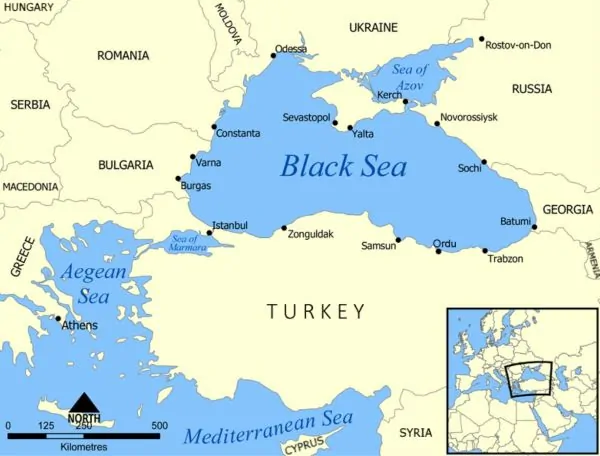
The Southern Arc through the Mediterranean and Black Seas, like its northerly counterpart, was a complex web of overlapping regional spheres of economic activity that were steadily expanding. In general, the western and eastern halves of the Mediterranean each experienced decline following the breakup of the Roman Empire. Yet while the Western Mediterranean experienced a longer and deeper decline, the Eastern remained economically vibrant throughout the sixth century. In time, however, economic decline set in in the East as well, and during the seventh century this decline occurred much faster than it had in the West. The wars between Byzantium and Persia, which were then followed by the Arab conquests, broke apart long-distance eastern Mediterranean trade networks.3 Byzantium lost much of its land and tax base, and decentralization and regionalization in former imperial territories followed in the wake of the Umayyad conquests, even as the areas of the Empire that Constantinople still controlled were bound ever tighter to the capital.4 With the overthrow of the Umayyad dynasty (661–750) by the Abbasids (750–1258) in 750, a greater emphasis was placed on centralized control in the Dhar al-Islam by the caliphal administration. Significantly, this greater centralized control in Byzantium and in the Caliphate meant that, although the Eastern Mediterranean might have crashed later and faster than the West, it also rebounded more quickly in the last half of the eighth century.5
By the ninth century, long-distance trade networks had reemerged across the Mediterranean, connecting Muslim, Byzantine, and Latin Christian economies despite the ongoing (albeit geographically limited) warfare among the various factions. Italy was at the center of the Mediterranean world and, not surprisingly, at the heart of these regional spheres of commercial activity. The ancient route between Italy and the Aegean, which had served as a major annona route providing grain to Rome from Alexandria, continued to function as the critical link for communications and trade between Constantinople and the West during the sixth, seventh, and eighth centuries. Although other sea and land routes began to open in the ninth and tenth centuries, this route nevertheless remained an important artery of travel. The Italy–Aegean route extended from Rome down the Tyrrhenian coast of Italy and crossed the Straits of Messina before emptying into the Ionian Sea. From there, sea routes rounded Peloponnesus and then forked northwards into the Aegean towards Constantinople and the Black Sea, and eastwards towards Cyprus and the Levant. These Eastern Mediterranean branches were later supported and supplemented by the opening of overland corridors linking Western Europe to the East through the Danube River valley, and also through the Balkan Peninsula in the middle of the ninth century. Running in the opposite direction from east to west, the Italy–Aegean route took travelers north and west from Rome towards Sardinia, Corsica, and Marseilles.6
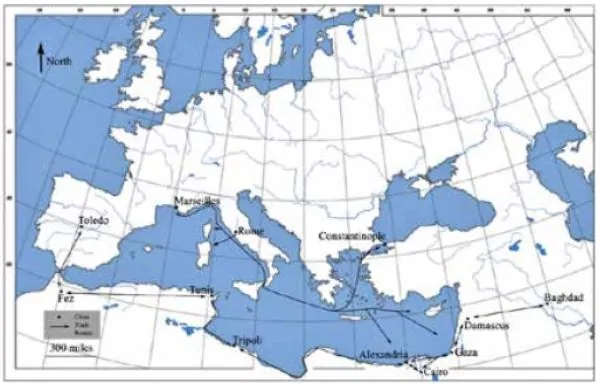
Meanwhile, in the Dhar al-Islam, major caravan routes ran along the North African coast linking Andalusia via the Straits of Gibraltar to the Maghreb, and thence to Egypt, the Levant, and the Tigris and Euphrates river systems. The caravan routes, marked across the oftentimes featureless desert using artificial landmarks such as cisterns for navigation, served the needs of pilgrims and officials, as well as traders – and thus traffickers – across the Muslim world.7
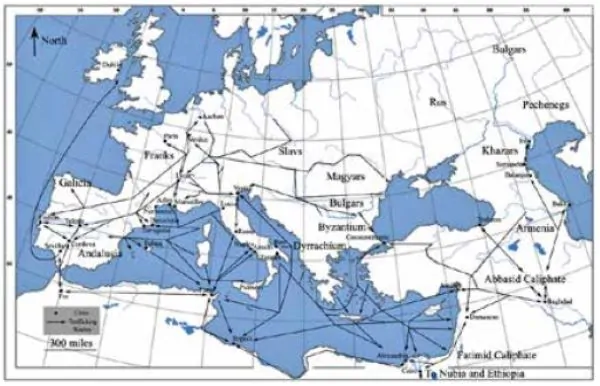
While trade across the Western Mediterranean declined over the late sixth and seventh centuries and reached its nadir around 700, by the ninth century trade between North Africa, Sicily, and the eastern coast of Andalusia was once again bustling. Western Mediterranean trade networks were encouraged by intensification in the volume and frequency of trade along the Italy–Aegean route – which had in turn spurred economic activity both in southern Italy and in the Aegean – as well as by pilgrims and European officials who availed themselves of expanding Muslim travel infrastructure. As a result of the intensification of trade networks in the Western Mediterranean overall, and their connections to the East via Italy and the Aegean, the ninth century can be characterized as a period of renewed long-distance trade across the Mediterranean.8 Yet these networks differed from the old imperial networks of the Late Empire in that these new routes crossed zones controlled by different polities, including the Latin West, the Caliphates, and Byzantium, and thus warfare and piracy on the high seas were ever-present dangers. Nevertheless, the risks of piracy and war were intermittent enough to make the risk of long-distance trade worth the effort. If anything, the combination of intensifying long-distance trade and political instability made the Mediterranean ripe for a robust traffic in human bodies.
Andalusia
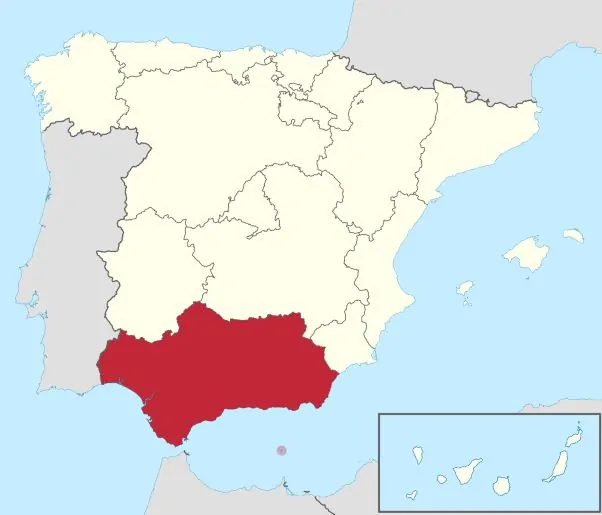
Andalusia participated in a brisk slave trade that extended east towards the islands of the Tyrrhenian Sea, south into Africa, and north into Carolingian Francia and Scandinavian Britain and Ireland.9 At the beginning of the conquest of Visigothic Iberia, the Muslims brought with them across North Africa slaves from Armenia, Egypt, Ethiopia, and Nubia.10 According to a sixteenth-century Muslim author, al-Maqqari, who McCormick suspects had access to earlier source material now lost, the conquest of the Visigoths in 711 ended with 30,000 enslaved captives being led off into the heart of the Umayyad Caliphate in Syria.11 During the eighth and ninth centuries, Andalusia bought large numbers of Christian Europeans captured in Francia and on the Tyrrhenian islands, but over the course of the tenth and eleventh centuries, Andalusian supply networks expanded farther into the Eastern Mediterranean, Sub-Saharan Africa, and Central Europe. The Umayyad Caliphate of Andalusia and its taifa successor-states purchased Italians captured by North Africans, as well as Byzantines captured in the Eastern Mediterranean and Slavic peoples whom Frankish and Muslim merchants brought through Francia into Andalusia via Verdun, a major center for castration. William D. Phillips Jr. has estimated that the number of slaves in Cordoba alone in the middle of the tenth century under Abd al-Rahman III (r. 929–961) may have reached 14,000, in a total population of perhaps a quarter of a million people.12
The fighting between Muslim and Christian forces in northern Iberia and in southern Francia resulted in a steady supply of captives; in particular, the fall of Narbonne in 721 and successful raids into Septimania in 793 produced massive hauls of captives, although it is impossible to determine an exact number. Primary sources suggest that the figure of the Septimanian raids was perhaps 225,000, but modern scholars have concluded that such numbers of captives are impossible.13
Less dramatically, regional and long-distance traffickers ensured a steady supply of bodies between the markets of Iberia and Europe using a combination of overland and fluvial routes. Abraham of Saragossa, a Jewish merchant from Muslim Saragossa, was licensed by Louis the Pious (778–840) in 828 to buy slaves and to sell them anywhere in Francia.14 The fact that he was also exempted from Frankish customs and tolls implies that many of his slaves were either foreign-born or were purchased outside Francia and then imported into Frankish lands. Traffickers like Abraham of Saragossa exported slaves from Francia into Andalusia via established routes that ran south along the Rhône River from Lyon to Arles and then southwest towards Muslim Cordoba, according to Agobard of Lyon (d. 840). Acknowledging Agobard’s unabashed anti-Jewish polemics, we can nevertheless discern the broad outline of these slaving routes in his account of a young Christian man who had supposedly been kidnapped as a boy by a Jewish slaver in Lyon, who then traff icked him into Andalusia.15
Andalusian slaving activities also extended eastward into the Western and Central Mediterranean, and raiders struck the islands repeatedly. For example, the Royal Frankish Annals tell us that as the Muslims were raiding the Balearic Islands, Christian forces from Galicia and Asturias in turn raided Lisbon in 798. After the raid on Lisbon, King Alfonso II of Asturias (c. 760–842) sent coats of mail, mules, and captive Muslims north to Charlemagne as a token of his victory.16 According to the Royal Frankish Annals, in 807, Arab raiders from Spain struck the monastery of Pantelleria off the Sicilian coast and carried off 60 Greek monks. Charlemagne was able to redeem some of their number and return them to the monastery, but the others presumably were sold.17 An unnamed town on Corsica was struck in 809, and all the inhabitants were abducted except the bishop, the elderly, and the inf irm.18 The raids grew in regularity and intensity such that the Annals tell us that a certain Irmingarius, Count of Ampurias, was able to plan and set an ambush on slavers returning to Iberia from Corsica that recovered 500 captives destined for the slave markets in 813.19 According to the Annals of St. Bertin, in 838, Muslims attacking Marseilles carried off all the men and all the nuns in the city, as well as much of its treasure, in a particularly successful expedition.20 In 869, they struck the Camargue region of southern France. They then ransomed Roland, the Archbishop of Arles, for ‘150 pounds silver, 150 swords, 150 cloaks, and 150 slaves,’ as noted earlier in the Introduction.21
By the tenth century, Iberian human trafficking networks had grown to encompass the Black Sea region, the whole of the Mediterranean basin, and Eastern and Central Europe. In the middle of the tenth century, Ibn Hawqal (d. 978) described trafficking networks that linked Andalusia to Slav (Saqaliba) and Bulgar territories, as well as to Byzantium and to the lands of the Khazars on the Caspian Sea. Closer to home, Andalusia imported slaves through raids on Christian territory in France, Italy, and northern Iberia, and also through commercial connections with Khorasan raiders who preyed upon Slavic communities in Central and Eastern Europe. Furthermore, Andalusia also served as a collection hub for eunuchs who were castrated in Francia and the Balearic Islands and then brought to Andalusia for export across the Mediterranean to Byzantium and the Caliphate. He writes,
A well-known export from Al-Andalus is slaves, boys and girls captured in Francia and Galicia, as well as eunuchs from the Saqaliba. All the Saqaliba eunuchs in the world come from Al-Andalus, they are castrated near this country. The operation is performed by Jewish merchants […] Raiders from Khorasan reach them [the Slavs] through the territory of the Bulghars. They are led in captivity to that province, their manhood left intact, their bodies unmutilated. [The southern half of Slavic territory] is raided throughout all its length, by the warriors of Khorasan, who live on its borders, while the northern regions are invaded by raiders from Al-Andalus via Galicia, Francia, Lombardy, and Calabria. Captives from these regions are still plentiful.22
While Central Europeans feature prominently in Ibn Hawqal’s account, Africa and the Levant were also major suppliers of Andalusian slave markets, whose human chattel were driven to market via North African caravan routes that crisscrossed the Sahara.23 As late as 1067, the Iberian Christian Arnallus Mironis and his wife Arsendis gifted ten Sub-Saharan slaves to Pope Alexander II (r. 1061–1073).24
Meanwhile in the Eastern Mediterranean, Muslim bases for raiding activities expanded beyond the North African shore. Although Alexandria remained an important staging ground for Muslim raids on Byzantium, over the course of the ninth century Crete increasingly became a launch point – starting when it fell to Muslim forces in 828 – and remained so until the Empire recaptured the island in the middle of the tenth century. While raiding was an unorganized, yet common, activity among the Muslims during the eighth century, it became increasingly organized and involved trained infantries more frequently over the course of the ninth and tenth centuries.25
Italy
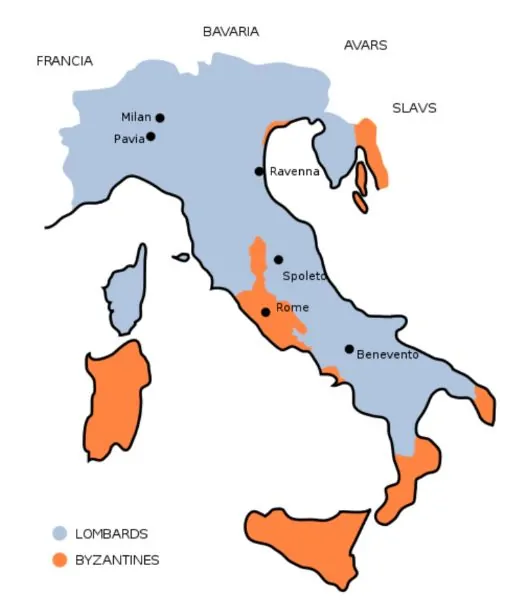
Italy was a major crossroads for human trafficking networks spanning the Mediterranean basin and Continental Europe. Because the Lombards never managed to completely conquer the peninsula, Italy remained politically fragmented and the Lombards, Franks, Byzantines, and later Muslims all claimed Italian and Sicilian territory, which then allowed each to use their landed holdings as staging grounds for raids against the others, both on the peninsula and on the surrounding seas.26 Because of increases in regional and long-distance trade, Italy experienced rapid urban growth in places such as Naples, Lucca, Bari, Taranto, and especially Amalfi and later Venice from the latter half of the eighth century and into the ninth.27
Long-distance trafficking routes followed major trade routes that extended to all points of the compass. Northwards, across the numerous Alpine passes, traffickers drove their human chattel from the lands of the Franks and the Slavs via the Rhine and Danube river systems into northern Italy towards Venice. Westwards, Italian, Byzantine, and Muslim forces all raided the coasts of Italy, North Africa, and the Tyrrhenian islands, creating tangled webs of shifting alliances. Eastwards, Venetians sold Christians and pagans in the Empire, in the markets of Alexandria and later Cairo, and in the markets of Baghdad. Southwards, traffickers moved captives between Italy and the ports of North Africa including Tunis, Tripoli, and Alexandria.
Although the Byzantine emperors had placed a trade embargo on the Muslim world, in practice it was nearly impossible to enforce. Local trade continued along the coasts, and even long-distance Italian convoys f louted the embargo. Venice, under the control of Byzantium, enjoyed privileged trading rights with the Empire, but nevertheless found ways to skirt imperial bans on commerce with Muslim lands. For example, in the Translation of the Relics of Saint Mark, a convoy of ten Venetian ships was supposedly blown off course by a sudden storm, and coincidentally landed in Alexandria, the largest Mediterranean port under Muslim control. Ostensibly stranded in Alexandria, the Venetians sold their wares to earn enough money to repair their ships and to prepare for the voyage home. During their time in Alexandria, they were persuaded to steal the relics of Saint Mark in order to bring them back to Christian lands; however, the Venetians initially hesitated, fearing that they ‘would be led away just like slaves to a land we have never seen’ if they were caught in the act of theft.28
Like the north, southern Italy, too, was enmeshed in webs of human trafficking. During the eighth and ninth centuries the region saw continual fighting among Lombard, Byzantine, and Muslim interests that resulted in widespread social upheaval. Political instability, constant warfare, and a favorable location at the center of growing Mediterranean commercial networks ensured fertile ground for human traffickers. As early as the first decades of the eighth century in Campania, John I of Naples (r. 711–719), the local duke under the protection of the Empire, reportedly carried off some 500 Lombard captives into the city at a time when Naples’ slave markets were f lourishing.29 Over a century later, a treaty from 836 between Campania and Benevento prohibited the purchase, transport, and sale of Lombards across the seas by Campanians. This treaty also reaffirmed the Campanians’ access to the Beneventan port of Taranto, provided that their merchants paid the customs and duties on goods including cattle, horses, and men.30 The Frankish monk Bernard witnessed six ships being loaded with enslaved Christians in Taranto, during his travels in the 860s. Although the monk put the number of enslaved at 9000, it is diff icult to imagine such a throng being loaded into six early medieval ships. Nevertheless, we can reasonably accept that Bernard witnessed a large group of slaves headed towards distant shores: two of the ships were bound for North Africa, two specifically for Tripoli, and two specifically for Alexandria.31
As warfare among Muslim, Byzantine, and Latin interests intensified in southern Italy during the latter half of the ninth century, the city of Naples broke with its coreligionists, switched sides, and allied with the Muslims. Naples gave its new allies safe harbor in its port, and allowed them to sell enslaved Christians in its slave markets.32 The late ninth-century chronicler Erchempert of Monte Cassino tells us that the Byzantines and the Italians under their authority hunted for Christian slaves or bought them from Muslim raiders who were active in the Italian countryside. They then either kept the slaves for themselves or drove their chattel down to the coast, where they ‘stuffed the beaches’ (oceani litora farciebant) with the enslaved during the first half of the ninth century. In 879, the Byzantines sold off most of the population of Taranto in the wake of their victory over the Muslims.33
Still farther south on Sicily, according to the Vita Eliae Iunioris, the future saint Elias and his family moved from their home in Enna to a fortified stronghold, known as the Castle of Saint Mary, to escape Muslim attacks upon the island that had grown more frequent and sustained over the course of the early decades of the ninth century, culminating in the fall of Palermo in 831. When he was eight years old, Elias dreamed that he would be enslaved and sold in Africa. Four years later, while the boy was at play outside the walls of the castle, Muslim raiders abducted him. They carried him down to the beach where they sold him to an African Christian slave trader, who put him on a ship to be taken to North Africa for resale. While en route, however, the Byzantine navy attacked the ship. In this instance, the Byzantines opted to return the boy to his family rather than resell him. Three years later however, when Elias was fifteen, the boy was again abducted outside the walls of the castle, sold to a Christian trafficker on the beach, and was shipped to Africa along with 220 other abductees. There in North Africa, a wealthy Christian tanner purchased him.34
The preeminence of North Africa in our sources as a destination for slavers and slaves, as in the examples above, is unsurprising. North African raiders were highly active in the slave trade, and trade networks spanned the Mediterranean coast of Africa linking Andalusia, Egypt, Sub-Saharan Africa, the Levant, and Mesopotamia, to Provence, Italy, Byzantium, and the islands of the Western Mediterranean. According to the tenth-century author Muhammed ibn ‘Umar ibn Yusuf, slaves (whether Muslim or infidel) were part of the typical cargo one might hire a ship to transport from Sicily to North Africa.35 Cities with permanent slave markets, such as Tunis, Tripoli, and Alexandria, provided ports of call for human traffickers across the Mediterranean. We have already seen how Muslim slavers cooperated with Christians in Venice, Naples, Rome, Taranto, and on Italian beaches to traffic captives into the Dhar al-Islam, yet their attacks upon those same Christian territories also provided periodic windfalls of bodies destined for the North African markets.
The Role of the Authorities in the Southern Arc
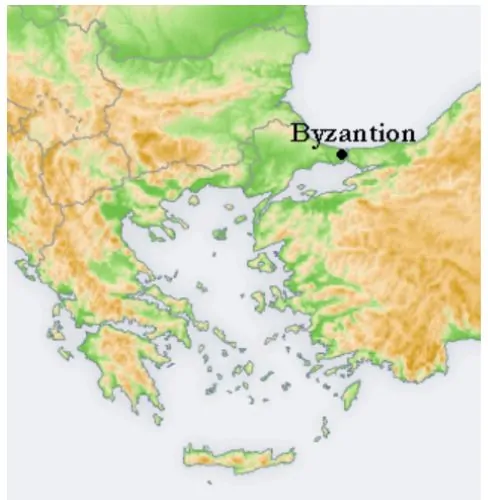
The role of the authorities in human trafficking activity differed greatly between Western Europe and Byzantium. In Western Europe, ninth-century rulers and prelates generally continued the eighth-century trend of attempting to curtail the sale of Christians to unbelievers. And, like their eighth-century predecessors, ninth-century rulers had few qualms about enslaving non-Christians. In 849, for example, after the Battle of Ostia, Pope Leo IV (r. 847–855) enslaved Muslim sailors who had survived the battle and set them to work building the Leonine Wall to surround the Vatican.36 Nevertheless, the pontifical efforts to restrict the traffic of Christians in Rome were surprisingly successful considering that the Roman slave market appears to have withered by the early ninth century, even as slave markets in Naples, Amalfi, Taranto, and Venice thrived.37
If the demise of the Roman slave markets was a noteworthy success story in the suppression of human trafficking, it was an exception to the rule of expanding networks and volume. Following the death of Louis the Pious in 840, authorities between the ninth and the eleventh centuries contended with political decentralization that limited the extent of their power and influence, and those limitations directly affected efforts to regulate human trafficking activity. As an example, let us consider the case of ninth-century Venice. The Venetians dealt not only with the consternation of popes and Byzantine emperors who sought to extinguish their slave trade – or at the very least to restrict and regulate it – but also with the anxiety of Frankish rulers to their north. Emperor Lothar I (795–855), son of Louis the Pious, was quite vocal about his concern that his subjects were being abducted from his lands in order to supply the Venetian demand for slave exports. In 840, his imperial envoys concluded a treaty with Venice by which Venetian authorities vowed to prohibit the sale and transport of Christians into foreign enslavement.38 The Venetians attempted to qualify the arrangement, adding that the agreement pertained only to subjects of Lothar himself. The envoys were suspicious of this caveat, and so they pressured the Venetians into promising that they would not transport any Christian under any circumstance that would lead to their sale among unbelievers. Furthermore, the Venetians promised to hand over to imperial authorities any trafficker who brought Christians into the duchy for sale. These traffickers were understood to be foreigners and not Venetian citizens, because the Venetian who apprehended the trafficker received the guilty party’s moveable goods as payment. If Christian slaves were discovered in the duchy, their captors were to be handed over to imperial authorities along with all their property and dependents before claiming payment. Finally, the duchy vowed to end the practice of castration, and castrators would suffer castration themselves as punishment unless they proved their innocence with twelve oath-helpers.
The treaty failed to stop the Venetian sale of Christians overseas. In 876 the doge, Urso Participacio I (r. 864–881), discovered that Venetian merchants had made black market contacts with raiders and were illicitly buying captives destined for foreign markets. Slave trading was again outlawed in the duchy.39 Yet only four years later in 880, the Venetians were again negotiating the terms of their slave trading activities. They renewed the treaty of 840 with the current emperor, Charles III, which was copied verbatim from the original agreement except for one notable qualification. The Venetians would refrain from buying, selling, or transporting Charles’s Christian subjects, provided that the victims in question were free persons (qui liberi sunt). Eight years later, in 888, the treaty was reaffirmed yet again; however, this time it was added that the penalty of castration would not be enforced retroactively (ab hoc die inantea) for those found guilty of the crime. Apparently, the earlier ban on castration from 840 had failed to stop the practice.40
The treaties between the Venetians and the Carolingian monarchs shed light on Venetian human trafficking in the latter half of the ninth century. The slave trade was a mainstay of the Venetian economy, and therefore its prohibition proved ineffectual, as the continual bans demonstrate. Corruption was rife and made enforcement difficult if not impossible.41 Moreover, the attempts to alter the wording of the treaties with exceptions, qualifications, and caveats strongly imply that the Venetians never had any real intentions of honoring the treaties from the beginning.
At the same time, Carolingian monarchs were hampered in their attempts to curb Venetian human traffickers, because during the ninth century Venice was still under the aegis of the Byzantine Empire. Thus the Franks could use the treaties to recover prominent Frankish Christians who had been abducted or captured during the ongoing wars in Western Europe at the time, but imperial protection of Venice meant that reclaiming ordinary Frankish Christians from Venetian traders would have been problematic from a diplomatic perspective. The Venetians would remain major players in human trafficking even as competition from rival Italian city-states, Muslims, Byzantines, and Jews grew during the ninth and tenth centuries. By 960, the Venetian trade remained so lucrative that the doge attempted to regulate it and bring it under the auspices of ducal authority.42 Attempts to regulate the slave trade particularly through Venice continued unsuccessfully into the eleventh century. For example, in 1006, Henry II, King of Germany (1002) and of Italy (1004), outlawed the sale of Christians to pagans on pain of anathema and excommunication.43
The role of the authorities differed markedly in Byzantium from Western Europe. Despite its diminished geographical extent, Byzantium was still arguably the single most powerful state in the Mediterranean region, and in the ninth century the Empire had begun to reconquer territories it had lost long ago.
Byzantium represented a state and a geographic area of tight centralized authority, but that centralized authority itself both facilitated and actively participated in systematic human trafficking activities. In 776, Pope Hadrian I argued in his letter to Charlemagne that a long-standing treaty between the Empire and the Lombards allowed Byzantine slavers to purchase Christians on the shores of Lombardy, whom they then sold to the Muslims in North Africa.44 As an official institution, the formidable Byzantine military engaged in regular slave-hunting expeditions, prowling the high seas of the Mediterranean and venturing inland into Slav, Bulgar, and Muslim territories.45 Eighth-century attacks on Dyrrachium and then mainland Greece were noteworthy for the volume of captives they produced, who were then absorbed by the imperial slave markets.46 The wars between the Bulgars and the Byzantines continued despite the conversion of the Bulgars to Christianity in 864, and even after the Bulgarian Church came under the auspices of the Patriarch of Constantinople. The number of slaves produced in these wars eventually necessitated a revision of the imperial tax code. The Novella of John Tzimisces I (r. 969–976), dated to between 972 and 975, fixed a tax that soldiers had to pay when they sold their enslaved prisoners of war, but these taxes only applied to sales involving civilian buyers. The enslaved prisoners were specifically noted as Bulgars. Yet slaving went both ways, as the Life of Luke the Younger makes clear. During the Bulgar attacks on the border, many were killed and captured, and those who survived were forced to f lee towards Byzantine lands along the Gulf of Corinth.47
The Levant and North Africa constituted a third important source of slaves for Byzantium. However, the Empire experienced less military success against the Muslims than it did against the Bulgars. Byzantine slave raids were conducted throughout the eighth century. Later during the reign of Theophilus (r. 829–842), Michael the Syrian (1126–1199) relates that the Romans (Byzantines) pillaged Antioch, carried captives off to their ships, and then departed.48 In an exchange of prisoners in 845, the number of Muslims under Byzantine enslavement was far greater than those of the Byzantines under Muslim enslavement, so much so that the Abbasid Caliph al-Wathiq (r. 842–847) ordered those Byzantines who had been sold in Baghdad and Raqqa to be ransomed as well, and he even released Byzantine women from his own harem. The Muslim author Ibn Hawqal tells us in 988 that the Byzantines were ‘relentless’ in their raids on Syria and Egypt, and that they captured Muslims ‘everywhere.’ Jews were also caught up in these raids and were then sold as slaves within the Empire or redeemed by their coreligionists, as the eleventh-century documents in the Cairo Genizah indicate.
The major goal of the raiding expeditions, whether Byzantine or Muslim, was the capture and sale of the enemy population.49 However, because the Byzantines and the Muslims competed for the same supplies of Slavic and Bulgar slaves, the Empire also actively seized slave traders moving between Andalusia and Iraq via the Levant or between the Black Sea and Alexandria. Muslim traffickers responded accordingly by circumnavigating Constantinople entirely, moving instead northeast from Alexandria to Baghdad. From Baghdad, their routes split, running northeast towards the Caspian Sea and northwest towards the Black Sea. Westbound Muslim traffickers bypassed Byzantine-controlled lands in order to reach Raffelstaffen by river and overland routes, and so they came to Andalusia via Francia.50
Byzantine slaving was already well established in the Black Sea in the eighth century, and it was expanding into the Russian interior during the ninth and tenth centuries. For example, during the second reign of Justinian II (r. 705–711) in the early eighth century, an imperial expedition against Cherson in the Crimea resulted in the deaths of all those captured, except for the children who were then sold into slavery by the Byzantine army. According to the Byzantine chronicler Theophanes the Confessor (c. 758–818), the enslavement of children outraged the Emperor, who had commanded the military to execute all of the city’s inhabitants; the monk considered the enslavement and sale of Cherson’s youths an act of mercy for sparing their lives. In central Anatolia, The Byzantines launched raids between 942 and 943 that captured many of the residents of Diyarbakir, before they raided as far as Arzen.51
By the tenth century, slaving activities in the Russian interior had become so robust that off icial regulations were necessary to avoid conf lict. According to the Laurentian Chronicle, two agreements were struck between the Rus and the Byzantines in 911 and in 944. In the treaty of 911, Byzantines agreed to return runaway slaves to the Rus traders. In 944, the conditions of the 911 treaty were made mutual, and the Rus agreed to return any escaped slave to Byzantine traffickers.52
Much can be said about Mediterranean human trafficking networks in the ninth, tenth, and eleventh centuries. Perhaps the most obvious is the increase in expanse and volume compared with the preceding centuries. While Eligius ransomed groups that ranged between 20 and 100 individuals in seventh-century Noyon,53 by the ninth and tenth centuries we find group numbers ranging from the hundreds to the thousands. Although the actual numbers are difficult to accept, the unmistakable trend is towards greater numbers of people being transported to farther places in more directions across the Mediterranean than at any time since the end of Roman hegemony.54
The overall impression is one of a buyer’s market. The extensive trade networks established between the Latin West, Andalusia, North Africa, Byzantium, and the Levant combined with chronic interregional political instability and periodic outbreaks of violence to ensure that more people were captured and trafficked to more places than in the latter half of the seventh and eighth centuries. Formal markets across the Mediterranean were certainly flourishing at this time, as Charles Verlinden so painstakingly demonstrated, but we must also bear in mind the ad hoc markets that arose on the beaches of Italy, North Africa, and on the shores of Mediterranean islands – wherever goods, coins, and bodies met in ample supply.
Raids often appear as the principal methods of gaining slaves. Over the course of the ninth century, opportunistic raiding increasingly took on greater institutional organization as infantries became involved and forays moved beyond littoral communities to strike deeper inland, as legal frameworks were developed, and as international agreements were concluded to handle the ever-increasing numbers of slaves flooding the markets. Alice Rio notes that slave raiding and slave trading are not necessarily the same thing, and that raids do not always lead to captives being sold on the block. This is true in part; captives taken in raids might be rescued, released, ransomed, or retained as personal servants and attendants. However, we nonetheless must recognize that many, if not most, of these captives did in fact end up in institutionalized slave markets such as in Naples, Alexandria, and Constantinople, or in informal markets that sprang up on the shores, as so many of the preceding examples demonstrate.55
Perhaps one anecdote truly encapsulates the volume of trade, shifting alliances, and long-distance networks of the Southern Arc. In 873, Muslim raiders struck the Tyrrhenian coast of Italy and carried off dozens of Lombard Christians, who were destined for the slave markets of North Africa. The Byzantine fleet intervened and attacked the ship, killed the Muslims, but they then kept the Lombard captives. After the attack, the Byzantines sold their captives to slave traders on Sardinia, who in turn resold many of the Lombards back to the Muslims, despite the protestations of Pope John VIII.56 As the Middle Ages progressed, slaving activity across the Southern Arc would eventually grow to encompass India and China, and would ensure that slavery never completely died out in Europe.
The Northern Arc
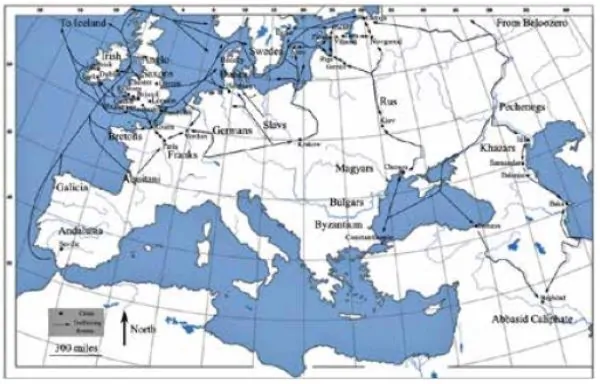
The ninth, tenth, and eleventh centuries witnessed the ‘Scandinavian Dias-pora,’ a time of widespread raiding, trading, and settlement by Scandinavian explorers, political refugees, and raiders, who were driven onto the high seas primarily by increasing population pressure, political consolidation, and social unrest.57 Settlements along the northern Atlantic rim of Europe in Iceland, Ireland, England, the Orkneys, and Normandy were gradually connected by ever-expanding trade networks that reached deep into Eurasia to other Scandinavian settlements in the environs of Kiev, which in turn connected to trade routes that linked to Constantinople, the Caliphate, and the lands of Khazars. This Northern Arc of trade consisted of overlapping spheres of regional economic activity that revolved around Dublin, Bristol, the Danelaw, Iceland, Rouen, Denmark, Sweden, Riga, and Kiev.
In general, the late eighth century and the first half of the ninth were a time of small, localized raids that primarily followed the coasts and major rivers of Europe and the islands of the North Atlantic. As time went on, the raids increased in size, intensity, and duration, and slave-hunting expeditions became more routine and successful.
The British Isles
According to the Annals of Ulster, Vikings had raided Ireland’s coast since at least 795 before a lull began in 814.58 Raids disappear from the Annals between 814 and 820, possibly owing to internal strife among the Scandinavians themselves during these years. In the year 821, however, a Viking attack on Howth (Etar) resulted in the abduction of ‘a great number of women.’59 The Annals give the impression that early ninth-century Viking attacks in Ireland were concentrated in certain areas of the country, and that Vikings usually selected targets of high value. For example, a fifteen-year stretch between 830 and 845 saw intense raids on monasteries; Donnchadh Ó Corráin notes that 50 monasteries are named as victims of specifically Viking raids, and on nine occasions the annalists comment further on extended territorial raids ‘on peoples and churches’ in the regions surrounding Dublin, such as Leinster and Brega. However, at the same time the Viking raids also became more intense in England and in mainland Europe as the Vikings grew more familiar with the local terrain and pushed farther inland. Therefore, it seems unlikely that these extended raids were specific to Irish environmental and sociopolitical conditions, and more likely that they were symptomatic of the Vikings’ increasing comfort and confidence in foreign lands. After 836, major territorial attacks in Ireland began in earnest. The Annals report: ‘The first prey was taken by the heathens from southern Brega; and they carried off many prisoners, and killed many, and led away very many as captives.’60
Major territorial attacks gradually increased in size and scope, and their focus shifted over the middle decades of the ninth century from looting and rapine to slave raiding. Larger, organized slave-raiding expeditions against major monasteries occurred by the latter half of the ninth century, but these prolonged large-scale raids should be seen in the wider context of overall increased organization and cooperation among Viking bands during this time.61 Amlaíb Conung, the first Norse King of Dublin (d. 874), plundered Armagh in 869 and is reported to have killed or captured 1000 people in retaliation for the death of his son in battle against the king of Tara and protector of Armagh, as well as for the loss of his fortresses at Clondalkin and Dublin in 867. Other major slave raids on monastic towns are recorded in 881 on Ciannan, on Duleek (where ‘many people were taken’), on Kildare in 886, when 280 captives were taken, including the prior of the monastery,62 and again on Armagh in 895, when 710 captives were taken.63
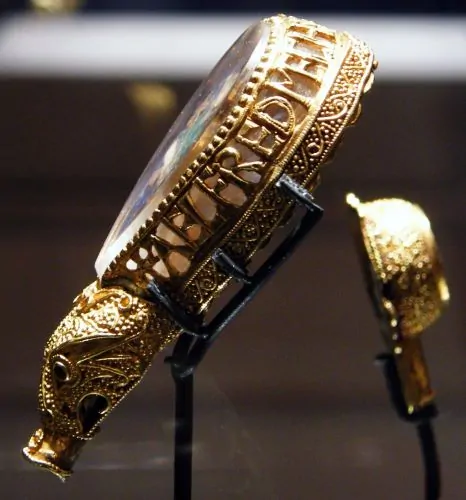
By 921, Dublin was ruled by Godfrid (r. 921–934), who had made his fortune as a raider and slaver in Armagh, and the settlement became the heart of slaving activities in eastern Ireland and occasionally beyond, as evidenced by a raid on the Aran Islands in 1015.64 Yet although raids were a major source of slaves for the Scandinavians, the slave trade between their merchants and local Irish warriors was equally important.65 Supplied with silver, Vikings bought Irish slaves from local native warbands and raiding parties, and thus encouraged native raids upon their neighbors. The presence of Irish kings and chieftains in those raids between the tenth and twelfth centuries indicates that the profits to be gained from the slave trade in Ireland remained great enough to attract royal attention. Once again, the local economic connections to wider regional and long-distance networks served as ‘a catalyst’ for local slave raiding.66
The line between raiding and trading was not so clear in medieval Europe in general, and Ireland was no exception. Once the victims were handed over to their Norse purchasers in exchange for silver and goods, they were caught in wider trafficking webs that connected Ireland to Iceland and Scandinavia in the north, Chester, Exeter, and Bristol in the east of England, Swansea and Cardiff in Wales, and the Atlantic seaboard of Europe to the south, all via the Irish Sea. The vita of Fintan of Rheinau (c. 804–878) offers a detailed glimpse of slave trading out of Ireland and into the Scandinavian trafficking networks. Although the events of Fintan’s abduction and enslavement occurred in the first half of the ninth century, his life was only recorded on the Continent later in the century as trafficking networks across the Irish, North, and Baltic Seas were growing. Thus we may expect that the details of the story reflect the reality of late ninth-century slaving activities more than those of the early ninth century. According to his vita, Fintan was betrayed by his fellow Irish and fell into the hands of Scandinavian raiders; although he was of noble lineage – his father being in the service of the princeps of Leinster – Fintan was nevertheless carried off by the Scandinavians sometime around 843. His traffickers took him northwards on the Irish Sea before turning eastwards into the North Atlantic. During his time as a captive he was sold four times aboard ship from trader to trader, his last purchaser being bound for Norway. However, before reaching Scandinavia, Fintan escaped his captors with divine aid and f led to a deserted island in the Orkneys.67
The story presents a scene of active, if haphazard, slave trading across the Irish Sea and North Atlantic. Other captives accompanied Fintan in multiple ships, which suggests that his experiences as chattel were hardly unique or extraordinary; thus, although the image of people being passed across the gunwales of clinker ships does not give the impression of structured, institutionalized slave trading, nevertheless it was probably an effective method of exchange. We may presume that deep water militated against escape and such confidence in security encouraged traffickers to conduct their business as opportunities allowed, even on the open seas.
Although many Irish were exported to England, Scandinavia, and the Continent via Viking trade routes, other peoples were trafficked into Ireland via these same regional and long-distance routes. For example, in Spain in 844, and again after the prolonged Viking expedition along the Iberian coast between 859 and 861, led by Hasting and the sons of Ragnar Lothbrok, the Vikings brought some of their unredeemed captives to Ireland. These Iberian raids were described by the tenth-century chronicler Ibn Hayyan, in his compilation of earlier ninth-century authors entitled Muqtabis: ‘The Norsemen, may God curse them, had arrived, ship after ship, and occupied the city of Seville. They spent seven days there, killing the men and enslaving the women and children.’68 The founding of Dublin and other trading centers along the coasts of Ireland provided the Vikings with strongholds from which they launched further raids across Britain and Scotland. For example, in 871, Olaf the White and Ivar the Boneless (d. 873) returned to Dublin, ‘and a great multitude of men, English, Britons, and Picts, were brought by them into Ireland in captivity.’69
This insular trade between England and Ireland thrived even into the eleventh century, according to later twelfth-century sources. In his Vita Wulfstani, William of Malmesbury (1095–1143) asserts that eleventh-century trafficking networks between England and Ireland had ensnared people from all over England, who were then brought to Bristol for transport to and eventual sale in Ireland.
For [the English] would buy men from all over England and sell them off into Ireland in the hope of profit, even putting up for sale girls who were now pregnant. You might well groan to see the long rows of young men and maidens whose beauty and youth might move the pity of the savage, bound together with cords, and brought daily to market to be prostituted, to be sold.70
William was not alone in noting the flow of English slaves to Ireland. Geraldus Cambrensis (1146–1223) makes a similar claim in his highly partisan work Expugnatio Hibernica, in which he claims that Ireland was a major market for English slaves during the eleventh and twelfth centuries.71 Although Geraldus was an unabashed Norman apologist, his observations nevertheless fit the contours of insular trafficking patterns outlined so far. Therefore, in this specific instance, it seems unlikely that Geraldus was being inaccurate or intentionally misleading in order to create justification for the Norman Conquest of Ireland during the reign of Henry II (1154–1189); reality served his aims nicely. The Irish memory of three and a half centuries of human trafficking across the Northern Arc was perhaps most poetically and poignantly expressed in the twelfth-century composition Cogadh Gaedhel re Gallaibh.
Many were the blooming, lively women; and the modest, mild, comely maidens; and the gentle, well-reared youths, and the intelligent, brave warriors, whom they carried off into oppression and bondage over the broad green sea. Alas! Many were the bright eyes filled with tears and dimmed with grief and despair at the separation of father from son and mother from daughter, brother from brother and kindred from race and tribe.72
Across the Irish Sea in England and Wales, the slave trade thrived within the island of Britain, driven in part by political decentralization not unlike circumstances on the Continent. The various peoples of Britain – the Welsh and Cornish in the west, the Scots and Picts of the north country, the Anglo-Saxons in the south and midlands, and later the Norse settlement of northern and eastern England – created numerous ‘others’ who were each susceptible to enslavement through raiding and conquest. The political consolidation across the island necessary to suppress traffickers would be a centuries-long process.73
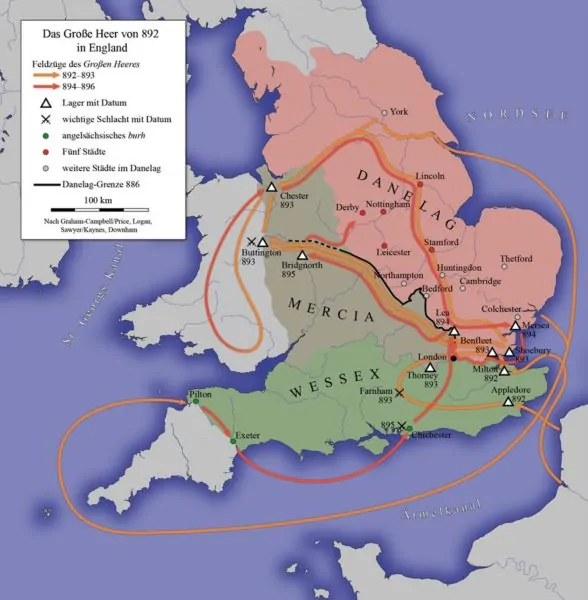
Generally, we find that some sections of the island, such as the West Country and northern and eastern Britain, experienced economic growth and expansion as a result of exchanges with the Norse settlements in Ireland and later with the establishment of the Danelaw in the middle of the ninth century. At the same time other areas of the island, such as the prosperous south and Kent, underwent decline as a result of the violence, economic insecurity, and political instability. Centers of economic activity on the south coast, such as Hamwic, were eventually superseded by other towns farther north such as London, Lincoln, and York, and by new commercial centers in the west such as Bristol, Exeter, and Chester.
In the West Country, local and regional trafficking activities were the result of not only Viking attacks but also internal political turmoil among the different peoples of Britain. The early ninth century witnessed the final subjugation of the Cornish by Wessex, under King Egbert (r. 802–839). However, the political integration of Cornwall into Wessex would nevertheless take nearly a century to complete, and during the process of consolidation Wessex enslaved many of the Cornish. As David Pelteret notes, from the tenth century on, West Saxon texts unambiguously use the term wealh to denote servitude, while previously the term had meant ‘Celt.’ It is difficult to imagine that opportunistic enslavement of individuals or small communities could have caused such a shift in definition from ethnic identity to legal status. More likely, as Pelteret argues, wholesale enslavement resulting from the conquest and subjugation of the Cornish peoples appears to be the reason for the change in meaning.74 We have further evidence for the widespread enslavement of Cornish peoples in multiple manumissions from Bodmin in Cornwall, beginning in the 920s and running into the early eleventh century, which record high numbers of both Anglo-Saxon and Welsh names among the slaves to be freed.75
To the north of Cornwall, Wales was also active in the slave trade, but the details are murky. We know that, as early as the middle of the fifth century, the Welsh were trading in slaves with the Picts to their north, as evidenced by Patrick’s letter to Coroticus. Local raiding between the Cornish and Welsh peoples was probably regular over the seventh and eighth centuries, and we can reasonably assume that these raids led to the enslavement of the conquered among the conquerors or to later sale among the West Saxons, as the canons from seventh-century Welsh councils and synods strongly suggest.76 However, the slave trade in Wales appears to have grown concomitantly with the growth in regional and long-distance Scandinavian trade, as the Vikings consolidated their control over the Irish Sea during the ninth century and established commercial relations with Ireland, England, and Scotland. Southern Welsh ports such as Swansea and Cardiff lay along the major sea routes that linked England to Dublin, and they hosted significant Scandinavian populations, which provided the Welsh with contacts in local, regional, and long-distance trade networks. Meanwhile, northern Wales was close enough to Chester to attract westbound Mercian, Scottish, and Northumbrian slave trading via the port.
For most of the tenth century, English imports of Irish slaves and exports of native slaves ran through the port of Chester, which handled the bulk of Dublin’s trade to England. In 980, however, the Vikings attacked and ravaged the port and its hinterlands, and following this incursion the prosperity of Chester declined rapidly, as did its prominence in the slave trade.77 Exeter rose to prominence when Chester’s position collapsed after the Viking attacks, since it was well positioned to accommodate displaced Irish and Norse traders, and quickly became a major hub of trade and, presumably, trafficking. The rapid increase in the productivity of its local mint after 980 suggests that it became the main port in western Britain for Hiberno-Norse trade during that short timespan between the raids on Cheshire in 980 and the rise of economic development in the Severn river system during the second reign of Aethelred II (1014–1016): a window of opportunity that would only last a little over 30 years. During that time, new economic development in Bristol and Gloucester led to these communities rapidly becoming major gateways to Ireland, and as a result they began to challenge Exeter’s dominance. Towards the end of Aethelred’s reign, Bristol supplanted Exeter as the main port to Ireland and the main English hub for human trafficking into the Northern Arc. By the reign of Canute (1016–1035), Exeter had begun to decline in the face of stiff competition; besides Bristol and Gloucester, Chester was recovering from the devastation, and the Welsh ports of Swansea and Cardiff were also on the rise.78 The rise and fall of Exeter should not obscure the startlingly rapid growth of the West Country over the course of the tenth and eleventh centuries; minting spread across western Britain, and Exeter and Chester remained prosperous towns.79 Bristol, Gloucester, Swansea, and Cardiff quickly developed into ports of call for traders and traffickers from Dublin, Wexford, Waterford, Limerick, and Cork.
Despite the rapid growth of commercial slave markets in western ports, raids continued to plague the West Country throughout the eleventh century, supplying local and transmarine markets with captives. For example, when Harold Godwinson (1022–1066) landed near Porlock from Ireland in 1052, the Anglo-Saxon Chronicle records that ‘he seized for himself whatever came his way in cattle, men, and property.’80 Later, in 1055, the Welsh King Gruffydd ap Llewelyn (r. 1055–1063) joined with the outlawed Earl Aelfgar in a raid on Hereford and after looting and burning, the two ‘led some [of the inhabitants of Hereford] away.’81 In the early years of the Norman Conquest, the biography of Gruffudd ap Cynan (1055–1137) tells how Hugh, Earl of Chester, fooled a Danish band of slave raiders:
Then, moreover, the perjured traitors of Danes who betrayed Gruffyd were expecting the promises which Hugh had promised them, and captives of men, women, youths, and maidens; and he paid them like a faithful man to the unfaithful, confirming the divine ordinance, for he had succeeded in collecting all the toothless; deformed, lame, one-eyed, troublesome, feeble hags and offered them in return for their treachery. When they saw this, they loosened their f leet and made for the deep toward Ireland.82
While the western regions were booming with trade across the Irish Sea, the southern regions were in a decline that had begun in the first half of the ninth century, but human trafficking in the region adapted and persisted nonetheless. The economic life of Hamwic had been deteriorating since the 830s, but after Danish raids in 840, which were successfully repelled, and again in 842, during which the town was plundered, Hamwic experienced a sharp decline. Furthermore, Viking raids on Dorestad in Frisia, Quentovic in Francia, and Rouen on the Seine exacerbated the withering of Hamwic by attacking the major Anglo-Frisian and Anglo-Frankish commercial connections, and thereby cutting the port’s economic lifeline to the Continent. Dorestad and Quentovic were ravaged as completely as their English counterpart; Dorestad experienced frequent attacks roughly between 830 and 863 that included the enslavement of its inhabitants and began to fade in tandem with Hamwic around 840; by 875, its prolific mint had shut down. Rouen was sacked in 841 and lost a substantial portion of its population to enslavement in the raid. Quentovic was raided the following year in 842, and the emporium vanished from the textual record after 864, although it was not entirely abandoned until the turn of the tenth century.83
In southeast England, particularly Kent, economic disruption was also widespread. Like Hamwic, Dorestad, and Quentovic, Kentish trading centers were raided at Sheppey in 835 and 841, and Canterbury and Rochester in 842, along with London in Middlesex that same year. By the 850s, Viking raids were becoming increasingly prolonged. Canterbury was raided again in 851, before the Vikings opted to winter at Thanet rather than to depart for Scandinavia. In 855, they wintered again in England, this time at Sheppey. The 860s saw increasing cooperation between Viking warbands, culminating in the formation of the ‘great heathen raiding-army’ as opportunistic raids steadily transitioned into settlement in northern and eastern England, and Kent was scoured repeatedly in 865, 885, and 892–893.84 During the upheaval, Kentish trading towns such as Minster-in-Thanet and Sarre fell into terminal decline; Sandwich was the only port in Kent to survive into the tenth century as a major settlement. Although the raids were sudden and local, the atmosphere of insecurity, the damage to infrastructure, and the social dislocation they created meant reductions in economic vitality across the south of England during the ninth century.
Yet by the beginnings of the tenth century, some economic growth can be seen again in the south of England; north of Hamwic, Winchester became the site of a new mint.85 As Peter Spufford argues, in tenth-century Wessex, the administration of mints was thoroughly centralized. Every town with a mint was to also have a permanent market,86 and we know that Winchester’s market participated in the slave trade, thanks to a passage in the Translatio et Miracula S. Swithuni, a work composed by the monk Lantfred of Winchester circa 1000. According to the vita, a thief stole a slave girl from a north-country man of ceorl origin and took her to Winchester, where he sold her ‘very quickly’ to a native of the town. After the sale, ‘The slave trader returned home; the girl remained in servitude, separated from her native land.’87 We do not know where the slave trader went when he ‘returned home,’ nor do we know where in the north the girl was kidnapped or anything about her new owner, the native of Winchester. Yet from this episode we can observe a few details about intra-island trafficking in Britain in the tenth century.
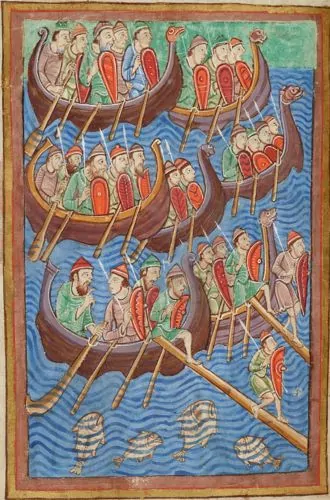
First, we can reasonably presume that commercial activity in the south continued even in the face of Viking aggression, albeit in attenuated form and displaced to centers farther north and inland from Hamwic. Second, we can observe by the speed of the sale that the demand for slaves had not abated, at least not in Winchester, despite the general economic instability of the region. This picture of an economically vibrant Winchester f its its small but growing profile in the south after the abandonment of Hamwic in the 880s, as its impressive tenth-century mint production suggests.88 Third, trafficking patterns followed these larger trade contours and human trafficking networks remained well represented in local markets, considering that the trader chose to bring his abducted slave girl to Winchester to begin with and quickly located a buyer there for her. Traffickers took advantage of institutional markets whenever and wherever they were available, and they compensated for the loss of established markets such as Hamwic by expanding into new markets such as Winchester. Fourth, we can glimpse late tenth- and early eleventh-century mentalities regarding local identity. A woman from the north was considered isolated from her ‘native land’ in the south of Britain. Geographically, this is not an extensive move; although we do not know how far north she was when she was kidnapped, we may surmise that she was in or near Anglo-Saxon lands and not deep into Wales or Scotland, because her former owner was a ceorl. Yet the differences in local dialects and accents, and in cultural and religious practices and points of reference between the north and south, as well as the unfamiliar terrain, were all enough to effectively isolate the woman ‘through many seasons’ – that is, regional trafficking measured primarily by cultural, rather than geographical, distance.
The east and the north saw the settlement of Danish communities in England, and with those communities came a figurative reorientation of Britain’s eastern coast towards Scandinavia. Close cultural, political, and economic connections between the Danelaw and Scandinavia, as well as the relatively close geographical distance between England and Scandinavia via the North Sea, all served to shift the trade routes of eastern and northern England away from Frisia and towards Denmark, Norway, and Sweden over the course of the ninth and tenth centuries. Yet the Danish settlements in Britain also created new cultural border zones that isolated enslaved Anglo-Saxon and Scandinavian captives, and they created new vulnerable populations and communities from which cross-border raiders could draw captives.
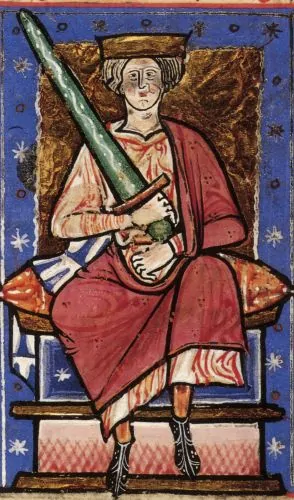
By the closing decades of the ninth century, the stalemate between the Danes and the Anglo-Saxons had reached the point where peace was in the best interests of the various parties. Alfred of Wessex (r. 871–899) and the Viking Guthrum (d. 890) concluded a treaty after the Anglo-Saxons recaptured London from the Scandinavians in 886. The treaty is terse and direct, and concerns the boundaries between Anglo-Saxon and Danish peoples, trade between the different peoples, the establishment of commensurate wergilds between the Anglo-Saxons and Danes, and in the fifth and final clause, the issue of harboring fugitive slaves. The parties agreed that neither camp would accept the slaves of the other, except if a slave wished to conduct trade with the opposing side, whereupon any transaction would occur only after hostages had been exchanged to ensure that the slave did not remain in the camp. We can read a couple of concerns that this clause addressed. First, slaves might use the opportunity of a neighboring army to seek liberation by joining with the opposing side, and thus remain beyond the reach of their former masters while bolstering enemy ranks. Second, the exchange of hostages was meant to ensure that the opposing forces did not abduct slaves during the course of trading activities.89 The treaty did not stop the fighting, and major raids occurred regularly across England and Wales from 892 until the fall of Erik Bloodaxe (c. 885–954) in Northumbria in 954.90
Despite the ongoing hostilities, the violence was sufficiently sporadic and localized that economic growth could occur in areas that maintained wider regional and long-distance commercial connections. Although the Straits of Dover ceased to be the major artery of commerce and trafficking over the latter half of the ninth century, new trade networks between England and Scandinavia encouraged the rapid growth of ports in the north and east of England such as at York on the Ouse River, Lincoln on the Witham River, and London on the Thames, over the course of the tenth and early eleventh centuries.91 These port towns anchored the regional and long-distance trade and trafficking networks that linked England into the wider Northern Arc.
Farther south, despite the devastation of the ninth century in northwest Francia and Flanders, there is once again evidence of human trafficking between England and this region in the early eleventh century; in fact, during the reign of Aethelred II, slaving across the English Channel appears to have rebounded. While Dorestad and Quentovic were no longer the main Continental termini for trans-channel commerce, Rouen remained an important destination for regional traffickers, which we will turn to later when we consider Continental Western Francia.
Scandinavia
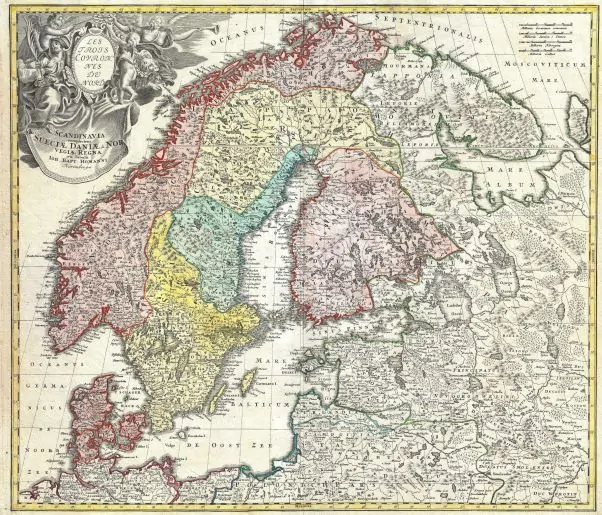
As captives moved into the wider Scandinavian regional and long-distance trafficking networks from Ireland, Britain, and Wales, many went north through the English Channel or the Irish Sea into the North Atlantic. From there, the routes diverged: east towards Scandinavia or northwest towards Iceland. There were certainly ready markets for Irish slaves in Iceland. As the population of the island expanded during the last quarter of the ninth century, perhaps to as many as 20,000 by 930, there would have been an equally growing demand for slaves in the new settlements.92
Slaves, and Irish slaves especially, are well represented in the Icelandic sagas. For example, in Njal’s Saga, Hallgerd convinced an Irish slave, Melkolf, to steal food during a prolonged famine that engulfed the island.93 In Egil’s Saga, the Irish slaves of Ketil Gufa abandoned their farmstead after burning and looting the local area.94 In Landnamabok, the Norwegian Leif raided across Ireland and brought back to Norway ten Irish slaves. The following summer,he and several of his companions settled in Iceland to avoid the political upheaval caused by Harold Finehair’s consolidation of power in Norway during the 860s and 870s. They took with them several of the Irish slaves they had captured the previous year, who then rebelled against their owners in Iceland, murdered them, and then stole their goods, boats, and wives before they were hunted down by the kin of the victims.95
The story of Melkorka from Laxdaela Saga is of interest because of the details of her purchase. Her owner, Hoskuld Dala-Kolsson, arrived for a gathering of Scandinavian political leaders from Iceland, Norway, Sweden, and Denmark on the Brenn Islands in Sweden at the mouth of the Göta älv River.96 At the gathering were a fair and a market where Hoskuld met a Russian trader (although the label tells us little of the trader’s ethnic origins) named Gilli, and Hoskuld asked the merchant if he had any bondswomen for sale. Gilli appeared to be slighted by the question, and in turn opened a curtain to display a dozen female captives. Hoskuld selected Melkorka and, having paid three times the average price for her, he made her his mistress. He returned to Iceland with Melkorka, much to the chagrin of his wife, Jorunn. Later it was discovered that Melkorka was in fact an Irish princess, who had been captured in war and then sold abroad when she was fifteen years of age.97
While there is much doubt over the historicity of the story, nevertheless the tale contains quite a bit of information on slave trafficking across the Northern Arc.98 Based on the combined travels of buyer and seller – that is, Hoskuld and Gilli – their personal connections spanned nearly the entirety of the Northern Arc, from Russia to Iceland. Ireland was also woven into their trafficking patterns, much like the examples from Landnamabok and the sagas, although in the case of Laxdaela Saga we do not know how or where Gilli acquired Melkorka. Let us also note that traffickers were not necessarily expected to be specialists, as Hoskuld’s doubts over Gilli’s inventory demonstrate. Traffickers thus continued to carry a variety of goods, including slaves, and trade networks and trafficking networks remained indistinguishable across the Northern Arc between the ninth and eleventh centuries. Although in all of the aforementioned examples Irish slaves were purchased off the island and then imported, nevertheless, I suspect that the Icelandic domestic slave trade made use of general markets (instead of specialized slave markets) to supply the demands for heavy labor to clear and cultivate new fields, for domestic labor to found and maintain a successful farmstead, and for personal relationships in remote settlements.
The volume of migration among Iceland, Norway, and the British Isles is impressive in aggregate. Proximity certainly made exchange convenient and relatively fast; from southern Iceland to western Ireland by sea took roughly five days and from Norway to Iceland took a week.99 Landnamabok gives the origins of 270 men, of which ten percent are Gaelic, and these represent mostly people of high socioeconomic status. We may suspect a higher, although unreported, proportion of Gaelic peoples among the lower strata of Icelandic society that would include slaves, particularly among the women. Of the Norwegians in Iceland, according to Landnamabok, a quarter of their population is reported to have settled first in the British Isles before moving to Iceland.100 While the percentages apply to both free and servile individuals, the high proportion of individuals who lived in the British Isles before moving to Iceland attest to substantial continuous social, economic, and political exchange among Norwegian, Icelandic, English, and Irish communities.
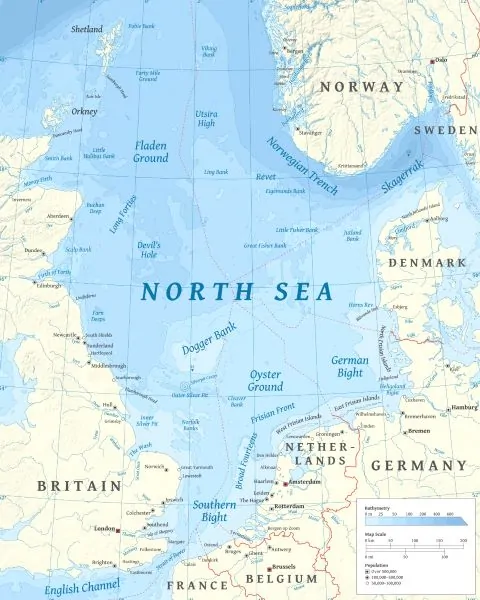
The Northern Arc hinged on Norway, Sweden, and Denmark. Their central locations at the meeting of the North and Baltic Seas made the region a crossroads for trafficking networks moving eastwards into Russia, westwards towards the British Isles and Iceland, and southward into Continental Europe. Bishop Anskar, upon arriving in Birka, found that ‘there were also many Christians who were held captive among them [the pagans of Birka], and who rejoiced that now at last they were able to participate in the divine mysteries.’ We do not know the origins of these Christian captives, but we may suspect that they were regional trafficking victims from the Continent or the British Isles because this episode is early in the conversion process of Scandinavia, and as such it is unlikely that there would have been ‘many’ native Scandinavian Christians to enslave in the first place.101 The fact that they ‘rejoiced that now at last they were able to participate in the divine mysteries’ vividly demonstrates the cultural isolation of captives in foreign lands.
Among Norway, Denmark, and Sweden, local and regional trafficking abounded. For example, Chapter XIX of the Vita Anskarii relates how the residents of Birka, faced with a Danish invasion led by a returning Swedish political outcast named Anoundus, fled to the neighboring town of Sigtuna for refuge even as they bought off Anoundus with 100 pounds of silver. The Danes, expecting more loot, were angered by the deal between Anoundus and the residents of Birka and decided to attack the latter in Sigtuna. Herigar, the Christian prefect of Birka, articulated the anxiety of Sigtuna’s inhabitants saying, ‘You have made many offerings and have given a hundred pounds of silver. What benefit has it been for you? See, your enemies are coming to destroy all that you have. They will lead away your wives and sons as captives, they will burn your city and town, and will destroy you with the sword,’ as he exhorted the people to abandon their idols and sacrifices and to pray to the Christian god for deliverance.102
The slave trade in Denmark connected with routes that passed across Sweden, but they also extended farther south into Central and Western Europe than did Swedish trafficking routes, which pushed farther eastwards into Russia.103 Danish traffickers reached into the depths of Slavic lands; Rimbert tells us that in the lands of the Danes (in partibus Danorum) Anskar was able to purchase Danish and Slavic boys (ex gente Danorum atque Slavorum) for ecclesiastical training at Turholt.104 According to his own vita, Archbishop Rimbert began to pray and to sing psalms aloud after seeing a multitude of Christians of unknown origins being led away north into captivity in Danish lands. In a demonstration of piety, the bishop reportedly paid for the redemption of a captive Christian woman with Church treasure and his own horse, and after he had secured her release, he then allowed the woman to return home.105
We know that the trade networks between the Franks and the Danes were a vital economic interest for both peoples in the later decades of the ninth century, because according to the to the Annals of Fulda in 873, the Danish King Sigifrid (r. 873–891), sent envoys to Louis II, as Louis dealt with judicial matters in Burstadt, near Worms. Sigifrid had charged his envoys with establishing peace between his kingdom and that of the East Franks under Louis by resolving border disputes between the two kingdoms, in order that merchants from both lands might be able to travel freely across the border and build greater commercial ties between the two peoples. Trade was apparently more important to Louis than territorial gain, because Louis promised the envoys that he would keep the peace and agreed to Sigifrid’s terms.106
Beyond Sweden and Denmark, long-distance and regional Scandinavian trafficking routes passed through Baltic ports and then penetrated the Russian interior. According to the Saga of Olaf Tryggvason, Vikings operating out of Estonia captured Olaf Tryggvason (c. 964–1000), the future King of Norway, then a child aged three, and his mother, Astrid, from their ship as they sailed eastbound for Novgorod. Astrid was purchased as a slave and later married her owner, a wealthy merchant named Lodin, who eventually freed her. Olaf remained in Estonia for six years under three different masters before his uncle, Sigurd, redeemed the then nine-year-old youth. Sigurd, who had commercial contacts both in Novgorod and among the Estonians, first met his nephew in an Estonian marketplace, but because the saga does not name the market in which Olaf and Astrid were sold, we are left with several possibilities for the location of the enslaved mother and child. Tallinn, for example, was a major trading center and a trafficking hub between the Baltic Sea and Russian terrestrial and fluvial trade networks, particularly on the outskirts of Reväla. However, there were other possible markets in which wealthy captives could be sold at a high price, particularly along the Volga trade routes, such as the port of Pärnu in southeast Estonia, or farther inland, the market towns of Viljandi and Tartu that were located along the Pärnu-Pleskau trade route that linked Novgorod with the Baltic.107
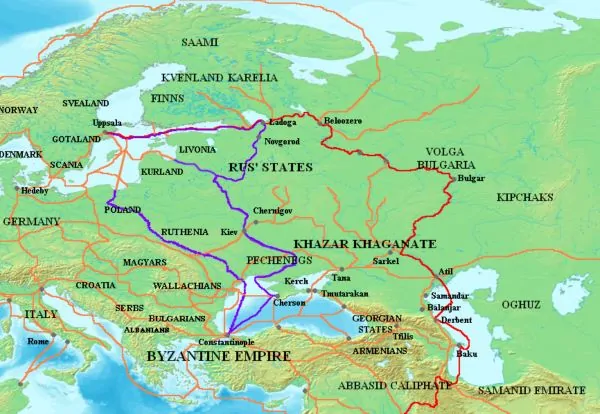
South from Finland, Viking trafficking routes passed through Tallinn and the Gulf of Finland, through Ladoga (modern day St. Petersburg) on Lake Ladoga, and then split south and southeast.108 The southern route took slaves through Novgorod, Cherson in the Crimea via Kiev, and thence across the Black Sea towards Constantinople. By the first decades of the tenth century, the trade was brisk enough to require regulation. As noted previously, the Laurentian Chronicle informs us of the formal treaties struck between the Rus and the Byzantine Empire, in which each side promised to return escaped slaves of the other party. The southeastern route continued east beyond Ladoga, where a major branch ran northeast towards Beloozero while the main trunk ran southeast towards the Volga river system and then followed the river south towards Itil, just north of the Caspian Sea. From Itil, trafficking routes hugged the western shores of the Caspian through the market towns of Samandar, Balanjar, and Baku, before entering the Abbasid Caliphate.109
Circa 885, Ibn Khordadbeh (c. 820–912), in his work entitled On Roads and Kingdoms, described the extensive trade routes that Viking and Jewish (Radaniya) traders operating in the region of the Black and Caspian Seas used in commerce with the Southwest Asian powers including the Byzantine Empire, the Caliphate, Khorasan, and the Slavic peoples:
[The Rus] transport beaver hides, the pelts of the black fox, and swords from the farthest reaches of the Saqaliba to the Sea of Rum [The Black Sea]. The ruler of Rum [Byzantium] takes a tithe of them. If they wish, they go to the Tnys river [The Tanais, or Don], Yitil [The Itil, or Volga], or Tin [possibly the Don], the River of the Saqaliba. They travel to Kamlij the city of the Khazars whose ruler takes a tithe of them. Then they betake themselves to the Sea of Jurjan [Caspian Sea] and they alight on whichever of its shores they wish. […] Sometimes, they carry their goods from Jurjan by camel to Baghdad. Saqlab [Slavic] slaves translate for them. They claim that they are Christians and pay the jizya.110
At the beginning of the tenth century, Ahmad Ibn Rustah Isfahani observed Rus settlers along the banks of the Volga River. He noted that the economies of these settlements were primarily based upon raiding and trading rather than agriculture and craft production (Ibn Hawqal made similar observations of the Khazars in the same region).111 In fact, the Vikings and Khazars appear to have shared close economic relations, and Viking raids upon the neighboring peoples were conducted with the goal of abduction for the regional slave trade with the Bulgars and the Khazars. Slaves were present within these Rus riverine communities, not just as wares but also as inhabitants. He writes,
They sail their ships to ravage the Saqaliba [the surrounding Slavs], and bring back captives whom they sell at Khazaran and Bolghar […] They have no estates, villages, or fields; their only business is to trade in sable, squirrel, and other furs, and the money they take in these transactions they stow in their belts. Their clothes are clean, and the men decorate themselves with gold armlets. They treat their slaves well, and they wear exquisite clothes since they pursue trade with great energy.112
However, Slavic peoples were certainly not the only peoples who supplied Vikings with human chattel. In some cases, the very peoples with whom the Rus traded became the victims of their raids and the chattel that they then sold to other peoples. In 913, for example, the Arab historian and geographer Al-Mas’udi (896–956) described widespread Viking raids across the Caspian Sea, writing, ‘The Rus spilled rivers of blood, seized women and children and property, raided and everywhere destroyed and burned.’113
Between 920 and 921, Ahmad Ibn Fadlan (877–960) was on an embassy for the Abbasid Caliph to the Bulgars, and during his travels he encountered Viking slave traders on the banks of the Volga. Like Ibn Khordadbeh and Ahmad Ibn Rustah Isfahani, Ibn Fadlan took notice of the varied goods of Viking merchants, which together with Hoskuld’s interaction with Gilli in Laxdaela Saga indicates that slaving was not a specialty among the Scandinavians so much as a part of their broader commercial exchange. Ibn Fadlan also noted the long distances the Rus had traversed and the concerns of merchants over limited supplies of currency, as he paraphrased the prayers of Viking merchants to their gods beseeching good fortune:
Each of them [Viking traders] prostrates himself before the great idol, saying to it, ‘Oh my lord, I have come from such a far country and I have with me such and such a number of young slave girls, and such and such a number of sable skins,’ and so on until he has listed all the trade goods he has brought. [The trader continues] ‘I would like you [the gods] to do me the favor of sending me a merchant who has large quantities of dinars and dirhams and who will buy everything that I want and not haggle with me over my price.’114
The Role of the Authorities in the Northern Arc
Generally speaking, authority figures across the Northern Arc actively participated in human trafficking activities or did little to suppress them. In the east, the Rus concluded treaties with Byzantium to regulate the slave trade through the Russian interior. In the west, Irish kings and chieftains participated in raids on their neighbors to supply Viking traders with captives, and Viking leaders such Godfrid of Dublin made their fortunes from the sale of those captives.
Welsh ports straddled the east-west trafficking networks across the Irish Sea, and although it is difficult to know precisely the volume of chattel moving through those ports during the ninth century, we can presume that it must have remained steady and lucrative enough for authorities to have occasionally made efforts to regulate it. By the tenth century, Welsh rulers were intervening in the market. For example, the Laws of Hywel Dda set a higher value on foreign slaves from ‘across the sea,’ which we can reasonably assume to mean Ireland or possibly Cornwall, than on locally enslaved peoples, while also considering the health and age of the victim:
The worth of a bondman, if of this island, is one pound; if from beyond the sea, one pound and sixscore pence. One pound and a half is the worth of a bondman from beyond the sea; if he be a native of this island, a pound is his worth; and so also, if he be maimed; or too old; or too young, that is, less than 20 years of age; a pound is his worth.115
Welsh law further confirmed the presence of both foreign born and native slaves and distinguished between them in its reaffirmation of social isolation, ‘Conventional bondmen and foreigners [alltuds] can be sold by their lords, and given by law; and amends are not to be made for them, if they be unlawfully killed; because they have no kindred who can demand it.’116
Meanwhile, English authorities were either powerless to stop the traffic in human beings because of political decentralization, as was the case for King Alfred, or openly profited from the sales, like Harold Godwinson and William I of Normandy, as we shall see. English ecclesiastical authorities were not blind to the massive trade in captives or to the role of English rulers in regulating that trade. In the early eleventh century, Wulfstan I (d. 1023), also known as ‘The Wolf,’ held several prominent episcopal offices in the English Church including the Bishopric of London (996–1002), and the Archbishopric of York (1002–1023) in plurality with the Bishopric of Worcester (1002–1016). His lofty positions in the English ecclesiastical hierarchy gave him access to and influence over successive English kings. From the pulpit, he excoriated human trafficking in his sermons delivered to his English audiences; his most famous work, Sermo Lupi ad Anglos, probably delivered sometime in 1014, touches on a number of themes including regional and long-distance slave trading, the reduction of children into slavery as the legal penalty for theft by their parents, the sexual abuse of enslaved women and children, and the sale of family members into slavery. He writes,
And poor men are sorely deceived and cruelly defrauded and sold far and wide out of this country into the power of foreigners, although quite innocent; and the children in the cradle are enslaved for petty theft [of their parents] by cruel injustice widely throughout this people, and the rights of freemen are withdrawn and the rights of slaves are restricted and charitable obligations are curtailed […] And too many Christian people have been sold out of this country now all the time; and all this is hateful to God […] Also we know well where that miserable deed has occurred that a father has sold his son for a price, and a son his mother, and one brother has sold another into the power of strangers […] Alas for the misery, and alas for the public shame which the English now have, all through God’s anger. Often two seamen or maybe three, drive droves of Christian men from sea to sea, out through this people, huddled together, as a public shame to us all.117
Wulfstan was most concerned about the sale of Christians abroad in non-Christian lands because of the danger of conversion and the loss of coreligionists, but nevertheless the sermon gives us a detailed view of human trafficking in England at the turn of the first millennium. The references to curtailed charitable obligations, fraud, and deception suggest that poverty and destitution were the main reasons why families sold off their own members into foreign enslavement. It is unclear how often infants and toddlers were actually enslaved for the crimes of their parents; it may well be that such penalties were rarely applied, but that they occurred at all was nevertheless a source of despair and outrage for the churchman and his audience.
In the last passage, the image that Wulfstan evokes is of a highly organized slave trade leading from the markets to the beaches for transmarine passage aboard ships. Whether only two or three sailors could have handled ‘droves of Christians’ cannot be said with any certainty, but it is notable that, by the eleventh century, relatively few men were necessary for security in proportion to the numbers of enslaved in their entourage. One would imagine that those who were enslaved, who were still on dry land, who spoke the language, who blended in physically, and who greatly outnumbered the traffickers would have multiple opportunities to escape. Yet Wulfstan observes that these people were effectively isolated from their kinship networks, driven ‘through these [the English] people,’ towards the shore. The passage suggests that powerful interests supported traffickers, which ensured that kin did not attempt to recover their family members and friends, and that those who were enslaved understood the futility of flight. William of Malmesbury implicates the Anglo-Saxon aristocracy in the sale of their fellow Anglo-Saxon Christians into foreign lands as a justification for the Norman invasion of 1066, and he also accuses King Canute’s sister of being a major player operating a lucrative Anglo-Scandinavian trafficking network across the North Sea during the 1020s.118
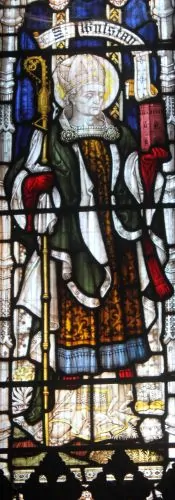
In order to stem the flow of people out of England west towards Ireland, north towards Scandinavia, and east towards Rouen, Wulfstan and his successors applied heavy pressure on English monarchs to prohibit regional and long-distance trafficking. Under the influence of the archbishop, Aethelred II banned the sale of Christians outside of England, and in particular into pagan lands, in subsection 2 of his 1008 law code (V Aethelred): ‘And it is the decree of our lord and his councilors that no Christian and uncondemned men are to be sold out of the country, and especially not among the heathen people, but care is earnestly to be taken that those souls be not destroyed which God bought with his own life.’119 This clause was repeated in VI Aethelred 9, VII Aethelred 5, and II Canute 3, all of which were influenced by Wulfstan. Initially, V and VI Aethelred allowed for the possibility that criminals could be sold out of the country, but this exception was struck from the later codes of Aethelred and Canute. Moreover, the issue of children being enslaved for the crimes of their parents, noted in Wulfstan’s sermon, was addressed in II Canute 76.2 and 76.3 (between 1020 and 1023), in which the practice was abolished.120
Despite royal proclamations, English trafficking from the east, north, and south into Bristol in the west persisted to such a degree that Wulfstan’s successor, Wulfstan II (1008–1095), Bishop of Worcester, devoted his energies to eradicating the slave trade specifically in that city during the middle of the eleventh century. While he seems to have been largely successful in haranguing the merchants of Bristol into ending the slave trade there, its reputation as a trafficking center lived on. The monk Hermann of Tournai (1095–1147) recalled that during his travels in Bristol in the early twelfth century, he was warned to be wary of boarding the ships of Irish traders, who were rumored to suddenly weigh anchor and depart the port with their guests (now turned prisoners), whom they would then ‘sell abroad to the barbarians.’121
Ecclesiastical thunder and royal decrees could not end the cross-border slave raids of the eleventh century, because in many cases the royal, noble, and local authorities needed to enforce the bans on trafficking were in fact the traffickers. When the fleet of nine ships commanded by Earl Harold Godwinson (1022–1066) landed in the West Country, the earl and his entourage seized men and property.122 In 1065, a Northumbrian force went south to Northampton in Mercia to seek royal dispensation for their choice of earl, Morcar of Northumbria. Although Edward granted the request, in the time it took for communications to travel between the Northumbrian and royal factions, the thegns of Northumberland and Yorkshire had ravaged the area around Northampton: ‘[they] captured many hundreds of men and led them north with them, so that that shire and other shires which were near there were for many years the worse.’123
Moreover, English royal decrees held no sway farther north. King Malcolm III of Scotland (r. 1058–1093), ‘killed many hundreds of men, and led home [to Scotland] much money and treasure, and men in captivity,’ after a raid in 1079.124 While we cannot say that every captive taken in these raids was enslaved and sold, since some were surely ransomed, nevertheless we can presume that many would find themselves on the auction block, unable to pay for redemption. In fact, the vita of Malcolm’s wife, Queen Margaret (1045–1093), which was authored in the early twelfth century at the behest of her daughter, Queen Matilda of England (c. 1080–118), supports this presumption. Margaret’s hagiographer – likely Prior Turgot of Durham (c. 1050–1115), a close personal confidant of Queen Margaret – asks rhetorically, ‘Who, moreover, would be able to calculate the numbers of those captives from the Anglo-Saxon nation for whom she paid for ransom? How often and how freely she would restore to liberty those who had been reduced to slavery by the violence of the enemy!’125 As noted earlier, the ransoming of captives was a trope of medieval hagiography. However, in this case the text’s reference to large numbers of Anglo-Saxons who had been enslaved through violence ‘by the enemy’ (likely the Scots, since Turgot notes in his prologue that Queen Matilda of England had commissioned the vita) both neatly supports the Anglo-Saxon Chronicle’s account of Malcolm’s cross-border slaving activities between England and Scotland in the late eleventh century, and further demonstrates the practical and political limits of English royal authority in enforcing bans on slaving in frontier zones.
With the Norman Conquest of England, Wulfstan II, possibly in collaboration with Lanfranc (1005–1089), managed to browbeat William the Conqueror (1028–1087) into outlawing the Anglo-Hiberno slave trade sometime between 1070 and 1087.126 William was probably reluctant to commit to the extermination of the slave trade considering that he was making a sizable income from it, according to the Doomsday Book. For example, fourpence was paid to the crown as a toll on every slave sold in Lewes alone.127 Yet even when William eventually outlawed the foreign slave trade in Willelmi I, articuli X.9, decreeing, ‘I prohibit the sale of any man by another outside the country on pain of a fine to be paid in full to me,’128 noticeably, the penalty incurred from the sale was paid in full to the crown. The tax had effectively become a fine, and there is no indication that the ‘penalty’ did anything to halt trafficking activities, because the slave trade was once again outlawed in England at the beginning of the twelfth century. Thus we may interpret the fines levied on the sales of individuals, when they were collected, as simply part of the cost of doing business in England.
It was only in 1102 that the Council of Westminster decreed ‘that no one is henceforth to presume to carry on that shameful trading whereby heretofore men in England used to be sold like brute beasts.’129 Slavery itself was not banned in this canon, only the foreign and domestic sales and trafficking in human beings, and while the proclamation was an important legal step towards the suppression of traffickers, proscription nevertheless requires strong, centralized authority dedicated to its enforcement. During the Anarchy, when civil war erupted between Stephen and Matilda (1135–1153), centralized political authority fractured once again, and traffickers took advantage of the political upheaval to launch slave raids. In 1136, the Worcester Chronicler described the violence during a period of upheaval between the Welsh and the Normans, during which, ‘besides those men taken into captivity there remained 10,000 captive women whose husbands with numberless children were drowned, consumed by flames, or put to the sword.’130 In 1138, Richard of Hexham (f l. 1141) tells us, in lurid detail, that after the battle of Clitheroe between the English and the Scots, the Scots took captive widows and maidens back with them north into Scotland. Some of the captives were divvied up as slaves, while others were sold or traded for cattle. He writes,
These bestial men, who regard as nothing adultery and incest and other crimes, after they were weary of abusing these most hapless creatures [widows and maidens] after a manner of brute beasts, either made them their slaves or sold them to other barbarians for cows.131
In the same year, the Annals of Loch Ce record that an Irish raiding party scoured the area near Westmorland and took countless captives.132 Finally, during the reign of Henry II there appears to be a dwindling of trafficking across England and Ireland. The Synod of Armagh in 1170 supposedly outlawed slavery in Ireland and redeemed any English enslaved there. However, the historical account of this synod is opaque. Only Geraldus Cambrensis mentions it, in his Expugnatio Hibernica, and there is no other reference to the synod in any other source.133 Regardless of the historicity of the 1170 Synod of Armagh, it would appear that even by the late twelfth century there were still substantial numbers of enslaved foreigners on Irish soil, or the anecdote would have made little sense to Geraldus’ audience. If we consider that major raids took place in 1138 according to the Annals of Loch Ce, then it seems likely that the children caught up in those incursions, or the future children of those victims, might well have been among the enslaved some 32 years later, regardless of whether a synod in 1170 freed them or not.
Like the Southern Arc, the Northern Arc was an extensive chain of overlapping spheres of regional economic activity that altogether spanned the distance between Iceland and the Caspian Sea. Viking raiding and trading fed the Northern Arc, but the Scandinavians were not alone in their trafficking activities. Local and regional traffickers operated in every link of this economic chain, encouraged by the possibilities for immense prof it offered in distant markets that were connected by Scandinavian ships plying the rivers and seas of Northern and Eastern Europe. Unlike the Southern Arc, the Northern Arc would not outlast the Middle Ages. By the end of the thirteenth century, it had fractured and regionalized in the face of economic pressure from the decline of slavery across Western Europe. Considering the participation of rulers and local officials in the slave trade, it is worth noting that the demise of the Northern Arc came not from political will or concerted action among different polities, but instead from sustained long-term socioeconomic changes across Western Europe.
Central and Western Europe
Central and Western Europe north of the Alps and Pyrenees fed both the Southern and Northern Arcs as local and regional traffickers connected with wider trade networks via Denmark, northern Italy, and Andalusia. The north–south flow of captives from Central Europe to the Mediterranean did not go unnoticed by contemporary observers. Echoing Tacitus, both Paul the Deacon in the eighth century and Regino of Prüm (d. 915) in the ninth contended that overpopulation in Germany was the reason why so many northern Europeans were sold into slavery around the Mediterranean, where a robust commercial economy offered consistent access to hard currency. Paul the Deacon observes that, ‘from this teeming Germany then, innumerable troops of captives are often led away and sold for gain to the people of the south.’ Regino quotes Tacitus in his own explanation of north-south trafficking patterns, ‘because Germany is so populous, innumerable groups of captives are often taken from there and sold to southern peoples for money.’134 The volume of the trade was made possible by a broad pattern of political decentralization over the course of the ninth century following the death of Louis the Pious in 840. The Ottonians in East Francia would eventually consolidate their political power in the tenth century, but part of that process involved protracted warfare against the Slavs and the Magyars, which in turn led to the enslavement of war captives and the reduction of whole populations to servitude.
Central and Western Francia had been fragmented politically since the Treaty of Verdun in 843. Carolingian royalty as a matter of course dealt with powerful aristocrats as individuals, rather than with ‘the aristocracy’ as a whole, and their rule remained supervisory rather than directive in that they appointed officials to rule locales in the name of the king or emperor. The late Carolingian Empire was not as politically centralized in either space or person as it had been under Charlemagne and Louis the Pious; instead, by the 890s, it was a collection of sub-kingdoms that were conscious of their own local cultural and political traditions. These sub-kingdoms were not arbitrary administrative units but rather coherent peoples with their own leaders and cultural reference points, who had had traditions of semi-autonomous rule before the eighth century and who would return to such rule later in the tenth century.135
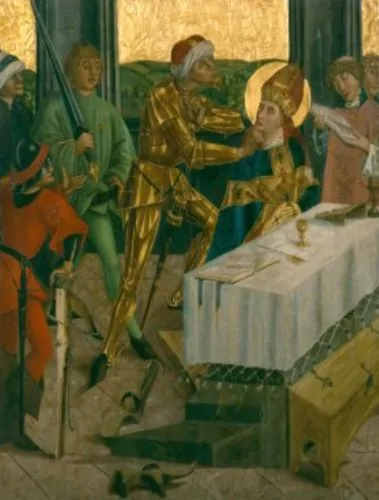
Regional trafficking dominates the annals and chronicles of the period, while local traffickers are primarily found in deeds of exchange such as those already noted, for example, in Passau, Friesing, and Salzburg discussed in the Introduction. Yet as the Life of Saint Emmeram reminds us, local traffickers could connect with regional operators to unload their captives quickly and funnel them into wider regional and long-distance trafficking networks. Raids appear most often in hagiography and chronicles as the principal means of obtaining captives for sale. The violence, destruction, and unpredictability of raids made them memorable for the abject terror they inflicted in the minds of their victims. Like the raids of the sixth, seventh, and eighth centuries, continental large-scale raids for the purpose of taking captives in the ninth, tenth, and eleventh centuries generally crossed cultural borders that demarcated major ethnic groups, such as the East Franks, West Franks, Aquitani, Slavs, Magyars, Bretons, and Scandinavians. Yet this was not always the case, and mass enslavement also remained a means of subjugating rivals in the internecine conflicts of major ethnic groups, even if such episodes appear relatively rarely in the sources.
Besides the north–south flow of captives commented upon by Paul the Deacon and Regino of Prüm, major trunks of regional and long-distance trafficking routes in Germany also ran east–west among the Slavic, Magyar, and Germanic peoples. The Danube river system was an especially important east–west artery of travel, trade, and trafficking, as the Life of Saint Naum and the Raffelstaffen Inquest make clear. East–west trafficking routes continued westward into West Francia, or they branched northward towards Denmark where they linked with the Northern Arc, or they branched southward, crossed the Alps along the major passes, and eventually continued south-east towards Venice. In West Francia, long-distance trafficking routes ran northeast towards Scandinavia with several routes branching off to the northwest towards Rouen and Frisia, or south towards Andalusia and the Mediterranean. North and southbound trafficking corridors followed the Meuse, Saone, and Rhône river systems between Verdun and Marseilles.
East Francia
East–west trafficking routes crossed a cultural border zone that surrounded the Elbe river system. Generally, Slavic peoples were predominant east of the Elbe, and Germanic and Frankish peoples west of the river; however, ethnic relations were disturbed in the 860s with the arrival of the Magyars, who raided Louis II’s lands in 862.136 Yet despite the entrance of the Magyars into the volatile mix of ninth- and tenth-century East Frankish political and ethnic relations, the complicated relations among the German and Frankish peoples of East Francia and the Slavic peoples farther to the east remained the principal sources of antagonism, conflict, and thus of cross-border raids and wholesale enslavement. For example, in 869, according to the Annals of Fulda, the Slavic Bohemians raided across the border into Bavaria, setting fire to homes and carrying Bavarian women off into captivity.137 Three years later, in 872, while the East Franks were busy raiding the Slavs of Moravia, the Moravians in turn raided the Frankish supply lines. In that raid, some Bavarians were killed, some drowned, and some were led away as captives in Slavic lands.138
The Life of Saint Naum gives an excellent opportunity to observe regional trafficking networks linking up with long-distance networks as captives passed from the territories of the Slavs, through Frankish lands and the duchy of Venice, before finally being sold into Byzantium. The Christian missionary Methodius (815–884) had established an active cathedral school in the middle of the ninth century possibly in Moravia or farther southeast in Sirmium. After he died in 884, the political enemies of the Moravian Church attacked the cathedral school, which housed some 200 disciples. The older men who had no value on the market were led out into the wilderness and then left to the elements. The younger boys, however, could command a fair price in Venice, especially after castration. According to the tenth-century hagiographer, after attacking the cathedral school:
The heretics [the Franks] tortured these men sorely, and the others, priests and deacons, they sold to the Jews at a price. And the Jews took them and led them to Venice, and they sold them in accordance with Divine Providence. Then came the Emperor’s man from Constantinople to Venice on imperial business. And when he heard of the men, he bought some of them, and others he took also, and led them to Constantinople and told the emperor Basil of them.139
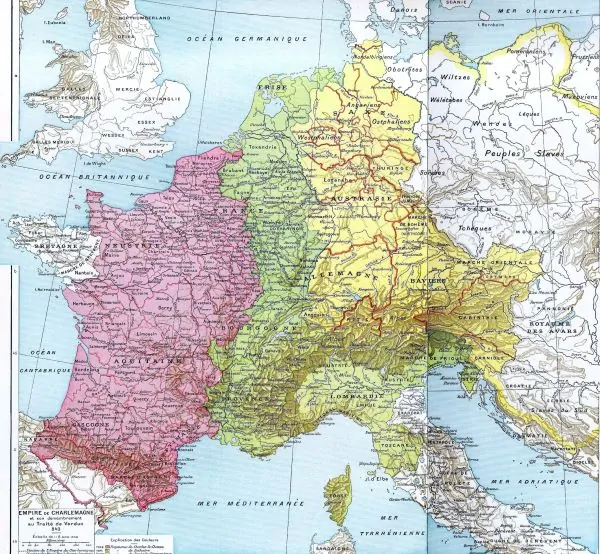
This sale of Moravian churchmen into captivity could have been difficult to justify without simply ignoring the 880 agreement between Charles and the Venetians. The treaty stipulated that the Venetians would not transport or sell free Christians into the hands of unbelievers, and the churchmen were obviously Christians. However, it would have been challenging for the Moravians to prove that they were also free persons as long as the Venetian slavers did not ask too many questions about the captives’ origins and maintained plausible deniability. If the Moravian captives could not prove that they were legally free, then the Venetians could sell them into captivity among the Christian Byzantines without violating the terms of the 880 treaty.
The sale of the Moravian ecclesiastics into captivity in Venice follows broader east–west traff icking patterns within East Francia and between Slavic lands and the Latin West. We know that a major northern east–west trade route ran between the Rhine and the Elbe, because it is mentioned in a royal grant to the convent of Gandersheim, originally issued by Louis II and confirmed by Otto I (r. 936–973) in 956, for a toll on all merchants traveling from the Rhine to the Elbe and the Saale.140 A second major overland thoroughfare ran southwest–northeast from Mainz to Erfurt in Thuringia by way of a crossing over the River Fulda, which then connected to Magdeburg, as Eigil notes in his comments on merchant traffic along the route in his Vita Sancti Sturmi.141 Farther south still, the traff ic between the eastern Slavs and the western Franks and Germans across the border zone was so great that merchants operating along the border petitioned Louis III for a formal set of policies to regulate tolls, customs, and duties along the Danube corridor and for a return to the taxation rates and practices of Louis III’s ancestors, Louis II and Karlomann, King of Bavaria (r. 876–880). The Raffelsteffen Inquest Concerning Tolls (903–906) describes trade policies around the turn of the tenth century that greatly encouraged exports out of East Francia and Bavaria towards Slavic lands farther to the east. Subsection 1 stipulates,
Boats coming from western regions, which after they have passed out of the Forest of Passau, wish to land at Rosdorf or wherever and hold a market shall render a semidragmam in toll, that is, one scot. If they intend to proceed farther downstream to Linz, they shall render three half-measures, that is, three bushels of salt per boat. With regards to slaves and other goods, they shall pay nothing more there. Rather, afterwards, they shall have permission to land and to sell wherever they wish, right up to the Bohemian Forest.142
Trade concessions to German and Frankish merchants continue in subsection 4: ‘If, moreover, Bavarians or those Slavs who live with this country [Bavaria] should enter those same parts to buy provisions using slaves or horses or cattle or their other possessions in payment, let them buy whatever is needed without tolls wherever they wish within that territory.’143
Traders moving upstream along the Danube (that is, from east to west) into East Francia were subject to heavier tolls and duties. According to subsection 6,
Slavs coming from among the Russians and the Bohemians, in order to trade, wherever they may set up trading posts, whether along the shores of the Danube or among the inhabitant of the Rotthal or Ried […] if he intends to sell slaves or horses, let him pay one tremissis [one-third of a shilling] for a female slave and the same amount for a stallion, but one ‘saiga’ [one twelfth of a shilling] for a male slave or a mare.144
Finally, subsection 9 draws a distinction between professional traders and those farmers and craftsmen who occasionally participated in the markets, as well as directly connects Jews and professional trading. ‘Professional merchants, that is, Jews and all other professional merchants, wherever they may come from, whether from this country or from other countries, shall pay all the lawful tolls, both for slaves and for other goods, as was always the case under the kings in earlier times.’145
The Raffelsteffen Inquest tells us a great deal about trafficking across the southern border zone between Bavaria and Bohemia. Markets were apparently regular enough for the crown to be able to levy customs and tolls upon merchants, and for the inquest to reference ‘trading-posts,’ yet these permanent markets also competed with informal temporary markets, which are mentioned in subsection 1 in reference to the toll of one scot on merchants wishing to land, ‘wherever and hold a market,’ as well as later in the same subsection that grants merchants the right to ‘land and sell wherever they wish.’
Trade was conducted both in currency and in kind, as the tolls indicate. Subsection 1 decrees a toll of one scot for domestic markets held within East Francia, but for merchants who wished to export, the toll was three bushels of salt per boat. Subsection 4 specifically refers to the barter of slaves for other goods and services with no associated tax on subjects of Louis III. Foreign merchants and Jews were expected to have coin, since Slavs who had done business with Russians or Bohemian Slavs prior to entry into East Francia, and Jews in general, were to be charged one third of a shilling per female slave and stallion, while only a twelfth of a shilling per male slave and mare. The tolls themselves also indicate that female slaves were in higher demand and could fetch a higher price than male slaves.
Despite brisk business across the border zone, the tense political and ethnic relations meant that trade was a risky endeavor between East Francia and the Slavic lands. Interregional commerce in no way guaranteed peace, particularly when the business of human trafficking was predicated upon, and therefore encouraged, organized large-scale raids to secure its captive merchandise. In the 920s Henry I (r. 919–936) led a raid on the Hevelli Slavs, part of the Weleti Confederation of Slavic peoples in southern Saxony, attacking and capturing the fortresses at Brandenburg and Gana. When Gana fell, Henry had the men and women executed while the maidens and children were led off as slaves.146 Henry succeeded in subduing many of the Slavic peoples on the border with Saxony, but one group, the Redarii, rebelled and captured several fortresses, including Lenzen on the east bank of the Elbe River, circa 929. The Saxons, under the command of Counts Bernhard and Thietmar, put down the rebellion and recaptured the fortress. They allowed the rebels to return home, but the Saxons kept the wives, children, and slaves of the rebel leaders who were also in the fortress and led them off into captivity into Saxon lands.147
In some cases, the political border was more important than the ethnic border regarding wholesale enslavement of populations. In 923, a pair of prominent West Frankish lords, Count Gislebert of Lotharingia (c. 890–939) and Archbishop Rudgar of Trier (r. 915–930), invited Henry I to invade and raid West Francia during the civil war between Charles III (r. 898–922) and Robert I (r. 922–923). Henry accepted their offer but took to raiding Lotharingia instead and carried off the Frankish inhabitants.148 In 954, during the civil war between Otto I and his son Liudolf, Otto’s armies scattered the rebel forces of Liudolf. Widukind tells us that the imperial forces then spread across Franconia, raiding and pillaging along the way, and took many people captive, including 1000 dependents of a certain Ernst, possibly the count of Sualafeld, who was part of the rebellion.149
Franks and Germans were not alone in enslaving their own when it was politically expedient. Slavs, for example, sometimes raided other Slavic peoples on the borders of Saxony. In 954, the Slavs took advantage of the political turmoil to raid East Saxony. The Cocarescemi peoples of the area, who were Slavs living under Ottonian rule, f led to an unidentified fortress. When the Slavic raiders surrounded the fortress, the Saxon commander decided against pitched battle since he was outnumbered and advised the Cocarescemi inside the fortress to seek the best possible terms of surrender they could from the raiders. The terms agreed upon stipulated that the men should lay down their arms, and the men, women, and children were to climb the walls, leaving their slaves and goods in middle of the fort for the raiders to claim. However, as the raiders entered the fort, one of them apparently identified, mistakenly or otherwise, a woman as his runaway slave. When he reached out to seize her, her husband struck the raider, and the raider shouted that the terms had then been broken. The raiders killed the men and led the women and children away as captives.150
Politics again trumped ethnic identity in 977, but this time to the benefit of the enslaved. The Polish King, Mieszko I (r. 960–992), raided in Saxony just west of the Elbe, and during the campaign his Slavic forces attacked the convent of St. Lawrence in Calbe. Oda, the eldest daughter of the Margrave of North March of Saxony (c. 955–1023), was removed from the convent by Mieszko’s forces. She later married the King of Poland, much to the consternation of the Church. However, Oda seems to have had a positive influence over her new husband, because she convinced him to release political prisoners and to allow enslaved captives in Poland to return to their homelands.151
Slave raids among the Franks, Germans, and Slavs continued unabated into the eleventh century, in some cases with dramatic success for the invaders. In 1003, Boleslav III, Duke of Bohemia (r. 999–1003), raided the Elbe region of Saxony and abducted the inhabitants of Lommatzch. Thietmar of Merseburg reports that the Slavic campaign of 1003 netted some 3000 captives for the Bohemians.152 During the Slav rebellion between 1011 and 1013, the Germans and Danes united to crush the rebellion. The Slavs were defeated, and the captives were presumably led back into German and Danish lands.153 In 1015, Ulrich, Duke of Bohemia (r. 1012–1034), led the Bavarians in a raid on the Slavs in his own lands. The Bavarians captured all the women and children and 1000 men in the environs of the fortress of Biesnitz.154 In 1017, the future King of Poland, Mieszko II (r. 1025–1031), raided Bohemia and after two days of plundering he brought back ‘innumerable multitudes of captives’ to Poland, to the ‘joy of his father,’ Boleslav I.155 The warfare between the German and Slavic peoples would continue to produce captives for slave markets across Central and Eastern Europe well into the eleventh century.156
The conflicts with the Magyars arguably had a smaller impact than the conflicts among the Franks, Germans, and Slavs on human trafficking networks in Central Europe, if only because the Magyars arrived late on the scene in 862 and were effectively crushed in 955 at the Battle of Lechfeld by Emperor Otto I. Nevertheless, for nearly a century the Magyars conducted territorial raids on the Latin West and became both active participants in and victims of the slave trade. Magyar raids on Bremen between 915 and 917 resulted in the enslavement of clerics and laity throughout the bishopric according to Adam of Bremen (c. 1040–1081/1085). Between 930 and 931, and again in 933, the Saxons and Thuringians skirmished with the Magyars, which led to the Germans taking Magyar captives. In the skirmishes of 933, the Saxons and Thuringians captured the camp of the Magyars and freed all the German captives they found.157 A similar situation occurred at the Battle of Lechfeld in 955. Captives were taken on both sides over the course of the battle, but Otto I inflicted a decisive defeat upon the Magyars, and as a result not only brought Magyar captives back to Germany, but also recovered Germans captives from the Magyar camp who would have been destined for sale in the east.158
While much of the fighting between Central Europeans and the Magyars took place on the eastern borders of the former Carolingian lands, Magyar raids could occasionally penetrate much farther west into the heart of West Frankish territory. In the environs of Rheims in 937, a Magyar raid resulted in a large number of Frankish captives being led off to the east.159 In 954, Duke Conrad of Lotharingia (r. 944–953) conspired with Magyars against his political rivals in West Francia, and led a joint raiding party through the lands of Hainault, Cologne, and then into West Francia, capturing many along the way. Although his own lands in Lotharingia were spared mass abduction and enslavement, once in the lands of his political opponents Conrad showed no compunction about the abduction and enslavement of his fellow Franks and Christians at the hands of his Magyar allies.160 Yet despite the spectacular success of some Magyar raids, it is difficult to argue that the Magyars had a lasting impact on the slave trade as a result of these raids, because they were sporadic and relatively isolated. They do not appear to have been frequent or sustained enough to have added to the regular traffic in bodies, even if their immediate victories provided periodic windfalls of captives.
In addition to the well-established regional trafficking networks between East Francia and the territories of the Slavs farther to the east, regional trafficking branch networks running north and south remained active and robust throughout the ninth and tenth centuries. We have already seen how Anskar and Rimbert purchased Danish and Slav boys in Denmark for ecclesiastical training, how Rimbert’s prayers miraculously broke the manacles of Christian slaves he found in Denmark being led off into the trade networks of the Northern Arc, and how Sigifrid and Louis concluded peace to foster trade relations between the Danish and Frankish peoples. The Vita Anskarii provides more information on trafficking networks on the rim of the North and Baltic Seas. Rimbert tells us that in the 850s or early 860s, Bishop Anskar was greatly concerned over news of regional traffickers operating in northwest Germany in an area inhabited by Saxons whom Rimbert calls ‘Northalbingians’ (gens Nordalbingorum). Pagans had taken Christians there,161 but some of these Christian captives later escaped to Christian lands in Northalbingia, where the local Christians then captured them. Rimbert makes it clear that these Northalbingian Christians lived next to the pagans (qui proximi noscuntur esse paganis), and they sold their captive coreligionists once more into slavery across the religious border among their pagan neighbors.162
In 882, Charles III concluded a peace treaty with a local Frankish magnate, Godafrid, who was an ally of Viking bands then raiding farther west in Frisia. After the treaty was concluded and the spoils of peace were divvied out among Godafrid and his allies, the Annals of Fulda report that the Scandinavians ‘sent ships back to their country, loaded with treasure and captives, 200 in number.’163 As late as the first decades of the eleventh century, captives were still moving between Germany and Scandinavia. The Danes raided Hamburg probably sometime around 1018, and the inhabitants of the bishopric were led off into captivity, presumably into Denmark, given the identity of the raiders and the proximity of Hamburg to the Danish border zone.164
A major north–south corridor connected northern Francia to the Mediterranean via Verdun and the Meuse, Saone, and Rhône river systems. Verdun’s central position in northern Francia, situated on the Meuse with easy access to the Saone and Rhône river systems, made it a popular slaving hub and castration center into the tenth century, as Bishop Liutprand of Cremona (c. 920–972) makes clear. In 949, Liutprand gifted four child-eunuchs, carzimasia, to the Byzantine Emperor Constantine VII Porphyrogenitus (r. 913–959), on behalf of his lord, Marquis Berengar II of Ivrea (c. 900–966). The bishop writes, ‘The merchants of Verdun do this [castration] on account of the immense prof it they can make, and they are accustomed to bring them [eunuch slaves] to Spain.’165 This description of the traffic in eunuchs from Verdun southwards towards Andalusia certainly fits well with Ibn Hawqal’s description of tenth-century Andalusia as a collection point for eunuchs who were then exported and distributed across the Mediterranean to Byzantium and the Caliphate.
West Francia
Political decentralization following the Treaty of Verdun in 843 created a situation in which raids and large-scale abduction across major ethnic and political divides occurred with regularity. As in previous centuries, raiding generally took place across the frontiers of the Franks, Bretons, and Aquitani, while Viking and Muslim attacks, as well as the occasional Magyar raid, across West Francia and Lotharingia added to the political tumult and confusion. These raids supplied bodies for the regional and long-distance traff icking networks that funneled Europeans north towards ports in Scandinavia, Frisia, and northwest Francia, or southwards towards Andalusia and Venice.
The ethnic divides, primarily cultural in nature, were major fault-lines in Western European society and provided Western Europeans with conveniently located ‘others’ who could be sold into wider regional and long-distance trafficking networks. The Frankish–Breton border was one such ethnic divide in Western Europe during the ninth and tenth centuries, which produced occasional large hauls of captives destined for the auction block. For example, in 843, the Bretons under their duke, Nominoe (d. 851), allied with the political rivals of Charles II (823–877), and killed Duke Rainald of Nantes, and then took many of the local inhabitants captive.166 In southwest Francia, the border between the Aquitani and the Franks also provided fertile ground for mass abduction, particularly during the mid-ninth-century struggles of Charles, Lothar, and Louis. The Annals of St. Bertin tell us that in 854, after the Aquitani requested aid from Louis II, Charles quickly moved his troops into Aquitaine, presumably provoked by the military threat that his nephew, Louis the Younger, presented to his southern borders. His troops, meanwhile, raided and burned the countryside of Aquitaine throughout the spring, taking many inhabitants captive.167
The Vikings crossed ethnic and religious borders throughout West Francia and actively raided for slaves in the region, as they did elsewhere. In 862 Charles II managed to corner the Vikings on the Marne near Meaux, pin-ning them between Frankish divisions along each bank and upon a bridge that spanned the river. The Vikings, recognizing that their position was hopeless, sued for peace. Part of the agreement between Charles and the Scandinavians involved the return of captives they had taken along Marne over the course of their raiding activities.168 In 892, according to Regino of Prüm, a Viking attack on the abbey of Prüm resulted in the plundering of the monastery, the widespread murder of clerics and lay people, and the enslavement of the survivors. After a stint of pillaging in the Ardennes, the Vikings, ‘went back to their f leet with great booty and, in their heavily laden ships, they returned to the lands across the sea with all their forces.’169 In 919, the Vikings launched a prolonged raid on the Bretons. Flodoard of Rheims (c. 893–966) tells us, ‘the Northmen ravaged, destroyed, and annihilated all of Brittany in Cournouaille, which is located on the seashore. The Bretons were abducted and sold, while those who escaped were driven out.’170 According to Flodoard, Viking incursions into West Francia from Rouen prompted retaliation from local Frankish magnates in 923; Count Heribert II of Vermandois (r. 907–943) joined forces with the local Frankish nobility against Rognvald, a Viking war leader. The Franks overcame the Scandinavians and reportedly liberated 1000 prisoners from captivity within the environs of the city.171 One thousand captives freed in a single military encounter seems exaggerated, yet nevertheless speaks to the size and importance of Rouen, its port, and its markets to the Northern slave trade.172 The city, unsurprisingly, features prominently in the works of the satirist Warner of Rouen (c. 996–1026) who wrote of the trials, travels, and ‘tribulations’ of an abducted Irish poet named Moriuht. In Warner’s stories, Norse raiders captured Moriuht and his wife, and the poet was then sold at a market called ‘Corbric,’ which may refer to Corbridge, Northumbria, the site of a royal residence and a hub of regional exchange among the Scots, Anglo-Saxons, and Scandinavians in the Kingdom of York. Moriuht was forced to flee his new owners, a monastery of women, after his ‘charms’ became known throughout the religious community, and during his flight he was recaptured by the Danes and sold again, this time overseas in an anonymous market among the Saxons. He eventually f led his new owner, a wealthy widow, after another tryst, before making his way west through Francia. In a village near Rouen, he found his wife enslaved to a poor man, from whom he redeemed her and took her into the town.173
I put forward two arguments. First, human trafficking adapts to the socioeconomic and political environments in which it takes place. The Introduction has already demonstrated the mutable roles of human chattel in different economic systems, but traffickers themselves also adapted to the circumstances of the moment. Traffickers may be opportunists who abduct when moments present themselves, such as the kidnappers in the Life of Saint Emmeram or the local slavers that Bishop Wilfrid met on the shores of Sussex; they may be raiders who abduct as part of larger raiding expeditions, such as the Viking raids throughout the ninth and tenth centuries, or they may be raiders who specialize in large-scale slaving expeditions, as the Muslim and Byzantine attacks on Italy and Dyrrhachium demonstrate. Traffickers may specialize in slave trading, such as the Galatians of Late Antiquity or the crews of the slave ships mentioned by Dorotheus of Gaza in the sixth century or in the Itinerary of the monk Bernard in the ninth century, but they may also be non-specialists, such as Gilli the Russian in Laxdaela Saga or the Rus merchants on the Volga River described by Ibn Fadlan in the tenth century.
Furthermore, trafficking networks themselves adapt as needs and opportunities arise. Augustine observed that traffickers operating in the Western Mediterranean had been driven from their usual places into Numidia by the Vandal invasions, where they continued their activity in the environs of Hippo. When Byzantium began raiding Muslim traffickers for their Slavic captives in the ninth and tenth centuries, traffickers responded by circumnavigating Constantinople entirely, and relied instead on eastbound routes that crossed the Levant and the Caliphate towards Black and Caspian seaports, and westbound routes towards Andalusia, using the Danube and Frankish river systems.
Regional trafficking networks could interlink to create long-distance networks across the North Atlantic, North and Baltic Seas, or across the Mediterranean and Black Seas, and could thus encourage and foster the growth of local traffickers, such as the local raiders who pillaged the countryside of Hippo in Augustine’s letter to Alypius, or those near Hamwic of whom Bishop Wilfrid writes in the seventh century. Yet trafficking routes could also operate independently of each other. Thus we see intense local, regional, and long-distance trafficking during the Late Empire, but in the sixth, seventh, and eighth centuries we find a reduction in long-distance trafficking and a continuation of local and regional trafficking networks across Western Europe. Over the ninth, tenth, and eleventh centuries, we witness an intensification of long-distance trafficking networks in addition to an intensification of local and regional trafficking. The mutable roles of slaves in socioeconomic systems, the mutable identities of traffickers, and the flexibility of trafficking patterns all ensure that human trafficking adapts quickly to ever-changing socioeconomic and political conditions. This adaptability is the key to its historical success and the crucial reason why it has proven so difficult to eradicate.
Second, I argued that, because human trafficking is so adaptable, centralized political authority is necessary to suppress trafficking activities, but that authority must actively commit to and maintain suppression efforts, since political authorities – as we saw with the Merovingian King Theuderic and Byzantium in general – may also actively encourage human trafficking. In the case of Theuderic, mass abduction and enslavement served to ensure political support among his retainers and to punish those whom he suspected of treachery. Byzantine institutions such as the imperial military raided in Italy, the Balkans, the Levant, and in the Black Sea. Centralized political authority, such as that represented by Rome and later Byzantium, may actively encourage human trafficking by sanctioning it through legal codes that regularize the slave trade, by institutionalizing permanent markets, by giving the slave trade religious sanction through festivals and rituals, or by authorizing the financial support of human trafficking activities, such as the services offered by the state bank of Rhodes to auctioneers, vendors, and customers who attended slave auctions.
Conversely, a centralized political authority may encourage human trafficking by ignoring or passively accepting the problem, for example through legislative inaction or through bureaucratic corruption or incompetence. Consider, for instance, the Roman generals Lucipinus and Maximus in Ammianus Marcellinus’ account of the Goths on the Danube, or the behavior of Roman army officials in the observations of Themistius, or Augustine’s sweeping indictments of local North African Roman authorities who participated in the trade or profited from it through bribery.
Finally, political decentralization allows human traff icking to f lourish by fracturing political authority and thus suppression efforts, as was the case in early medieval Britain, Italy, or Merovingian and late Carolingian Francia. Without political centralization, the fragmentation of society creates numerous ‘others’ who are considered beyond the borders of one’s own community and therefore legitimate targets for abduction and enslavement.
Local and regional authorities did periodically attempt to regulate and limit the slave trade, but without the sustained cooperation and coordination of neighboring polities and authorities, such regulation and suppression efforts were doomed to failure. The suppression of trafficking in Western Europe would be incomplete even after the twelfth century. It would require sustained economic pressure from medieval urbanization and both the widespread internalization of Latin Christian identity and its prioritization over other identities to create the socioeconomic conditions in which slavery, as a means of compelling agricultural production, would decline across Western Europe. However, even as agricultural slavery slowly faded and the long-distance slave trade adapted by reorienting itself towards the Mediterranean basin, local and regional trafficking networks persisted in Western Europe, now by supplying the growing commercial sex industry. In short, slavery may have declined, but human traff icking nevertheless survived.
Having examined the broad contours of human trafficking patterns and the responses of authorities to those patterns from Late Antiquity to the twelfth century, I now turn the experiences of trafficking victims. Men and women and children caught in the webs of traffickers had very different experiences and, as I will demonstrate, the experiences of women and children linked the early medieval slave trade and the sex trafficking networks of the late Middle Ages. For women and children, slave trading and sex trafficking were inextricably bound together to a degree that men did not experience. With the addition of a gendered perspective, I will set the stage for the high medieval pivot, when human trafficking patterns in Western Europe north of the Alps changed irrevocably from slave trading to sex trafficking.
See endnotes and bibliography at source.
Chapter 2 (83-142) from Human Trafficking in Medieval Europe: Slavery, Sexual Exploitation, and Prostitution, by Christopher Paolella (Amsterdam University Press, 10.05.2020), published by OAPEN under the terms of a Creative Commons Attribution-NonCommercial-NoDerivatives 4.0 International license.
About the Author