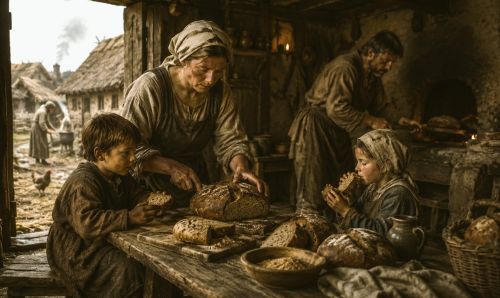
In medieval Europe, bread was never just food. It was labor made edible, law made measurable, faith made visible, and survival shaped into a daily loaf.

By Matthew A. McIntosh
Public Historian
Brewminate
Introduction: Daily Bread and the Medieval Measure of Life
In the medieval world, bread was not a side dish. It was the daily measure of survival, the food by which hunger was postponed, labor was made possible, and social order was tested. Across much of Europe, especially among peasants, servants, laborers, monks, soldiers, and the urban poor, bread and other grain-based foods supplied the foundation of ordinary nutrition. A person might eat vegetables from a garden, cheese when available, fish on prescribed days, meat on rare or privileged occasions, and pottage in endless variations, but bread remained the dependable center around which the rest of the meal was organized. To speak of “daily bread” in the Middle Ages was not metaphor alone. It was a literal description of what most people needed to keep working, walking, praying, paying rents, and enduring the long seasonal uncertainties of premodern life.
Yet medieval bread was never simply one food. It varied by region, class, grain, season, and circumstance, and those variations mattered because they exposed the unequal and highly local nature of medieval survival. The white wheat loaves associated with aristocratic tables, episcopal households, wealthy townspeople, and prosperous monasteries belonged to a different world from the dark rye, barley, oat, or maslin breads that sustained many rural families. In some places, wheat was the prestige grain; in others, rye or barley was less a mark of deprivation than an ecological necessity shaped by soil, climate, altitude, rainfall, and local agricultural practice. A northern peasant eating rye bread, an English laborer eating maslin, an upland household relying on oats, and an Italian urban household purchasing finer wheat bread were all participating in a shared bread culture, but not in identical ways. Bread could be fresh, stale, coarse, fine, leavened, unleavened, blessed, rationed, adulterated, taxed, stolen, or given in charity. It could serve as food, plate, payment, offering, punishment, and sacrament. Its apparent simplicity hides the dense network of labor and meaning that produced every loaf: plowmen, sowers, reapers, gleaners, millers, bakers, alewives, market inspectors, priests, landlords, servants, and hungry households all stood somewhere behind it. Even the texture and color of bread could communicate social meaning, since what appeared on a table often revealed access to land, milling, fuel, cash, storage, and market protection.
Bread also provides a way to see medieval society whole. It joined the countryside to the town, the manor to the marketplace, the body to the soul, and the household oven to the altar. Lords measured power partly through access to grain, mills, rents, and ovens; towns regulated bread because urban peace depended on fair weight and price; monasteries built routines of fasting, hospitality, and almsgiving around the distribution of food; theologians and worshippers encountered bread at the center of Eucharistic devotion. The loaf belonged at once to the economy of calories and the economy of salvation. It could reveal hierarchy in the contrast between white bread and coarse bread, but it could also reveal dependence, since every rank of society understood that failed harvests, spoiled grain, inflated prices, or dishonest bakers could turn ordinary need into crisis.
Bread was the central food infrastructure of medieval Europe: not because everyone ate the same kind, or because bread alone explains medieval diet, but because no other food so consistently connected survival, labor, law, religion, class, charity, and fear. Its importance lay precisely in that combination. Bread was ordinary enough to be taken for granted and essential enough to provoke regulation, ritual, and revolt. It was the edible form of dependence on land, weather, work, custom, and God. To follow bread through the medieval world is to follow the basic conditions of medieval life itself: the struggle to produce enough, distribute enough, trust enough, and believe enough that tomorrow’s loaf would come.
Before the Medieval Loaf: Roman, Biblical, and Early Christian Inheritances

Medieval bread did not emerge from nowhere. By the time medieval Europe took shape out of the ruins and transformations of the Roman world, bread already carried centuries of economic, political, and religious significance. The Roman Empire had made grain supply one of the foundations of public order, especially in great cities where dense populations could not feed themselves from nearby fields alone. Rome’s rulers understood that hunger was never only private suffering; it was a danger to civic peace and political legitimacy. The grain annona, the transport of wheat across the Mediterranean, the milling and baking trades, and the distribution of food to urban populations all gave bread a public character long before the Middle Ages. In this inheritance, the loaf was not merely what one ate after harvest. It was the final form of a vast network of landholding, taxation, shipping, storage, labor, and authority. North African fields, Egyptian grain, Mediterranean shipping lanes, imperial storehouses, and urban bakeries all stood behind the Roman loaf, making bread one of the most visible ways ordinary people encountered the power of the state. When imperial officials failed to secure grain or when prices rose too sharply, hunger could become unrest, and unrest could become a judgment on rulers. Medieval Europe would not reproduce the Roman system exactly, especially after the contraction of long-distance administration in the West, but it inherited the basic lesson that grain supply was inseparable from rule. To govern people was, in part, to keep bread within reach.
Roman food culture also established sharp distinctions between grains, breads, and social status. Wheat stood high in the hierarchy of cereals, while barley, millet, oats, and other grains could be associated with poverty, soldiers’ rations, animals, or regional necessity, depending on context. Elite Roman authors often judged foods morally and socially, using diet to distinguish refinement from rusticity, civilization from barbarism, and discipline from excess. These inherited assumptions did not pass unchanged into the medieval world, but they mattered. Later medieval preferences for fine white bread among elites did not simply appear in a vacuum; they drew on older Mediterranean associations between wheat, urbanity, purity, and status. The Roman world also preserved a practical awareness that bread was a food of workers, soldiers, households, and the poor. It could be refined and symbolic, but it was also the common fuel of bodies.
The Bible added another, deeper layer to the meaning of bread. In Hebrew scripture, bread appears as sustenance, hospitality, offering, divine gift, and sign of dependence. Manna in the wilderness taught that survival came from God’s provision, while the bread of the Presence placed bread within the ritual life of Israel. Ordinary acts of eating, sharing, withholding, and blessing bread became ways of thinking about covenant, justice, and need. The biblical world did not separate hunger from holiness. Bread could be daily food, but it could also reveal whether a community remembered the poor, welcomed the stranger, obeyed divine command, or trusted providence in times of scarcity. These themes entered medieval Christianity not as decorative metaphors, but as part of the sacred vocabulary through which people interpreted material life.
The New Testament intensified bread’s meaning by placing it at the center of Christ’s ministry and Christian worship. The feeding miracles presented bread as abundance in the face of want, while the Lord’s Prayer taught believers to ask for “daily bread” as the ordinary substance of dependence. Most important, the Last Supper and the Eucharist transformed bread into one of the central mysteries of Christian life. For medieval Christians, bread was not only a reminder of divine provision; in the Mass, it became the matter through which the presence of Christ was understood, debated, adored, and received. The Eucharistic host was physically small, but its theological weight was immense. It tied the most ordinary food in Europe to the highest claims of salvation. That connection gave bread an unusual doubleness in medieval culture. It could be handled by bakers, bought in markets, broken at tables, or given to beggars, yet it could also become the consecrated center of worship, surrounded by reverence, doctrine, ritual, and fear of profanation. The same basic substance that answered bodily hunger could, in liturgical form, express the deepest hunger of the soul. This did not erase the difference between common bread and sacramental bread, but it made the ordinary loaf impossible to understand as merely ordinary.
Early Christian communities and monastic institutions carried these inheritances into the emerging medieval world. The organization of Christian charity often centered on feeding the hungry, and bread became one of the most direct forms of mercy. Bishops, monasteries, and later parish communities distributed bread, maintained hospitality, and treated the giving of food as both social duty and spiritual discipline. Monastic rules made bread part of a regulated life: measured portions, fasting days, refectory silence, hospitality to guests, and care for the sick all turned eating into moral order. In these settings, bread was disciplined as much as consumed. It trained the body in moderation, marked the rhythm of holy time, and reminded monks and laypeople alike that material appetite could become a path toward obedience, charity, or sin.
The medieval loaf inherited two powerful traditions before it ever entered the village oven or urban bakery: the Roman tradition of grain as public infrastructure, and the Judeo-Christian tradition of bread as sacred necessity. Together, they help explain why medieval societies treated bread with such seriousness. A loaf was calories, but it was also order. It was household food, but it was also a sign of justice, hierarchy, charity, and divine care. When medieval towns regulated bread, when peasants owed grain dues, when monks distributed loaves to the poor, when priests elevated the host, and when hungry people prayed for daily bread, they were living within a long inheritance. The medieval world made bread its own, but it did so with Roman systems and biblical meanings already baked into the crust. That inheritance also helps explain why bread could become so emotionally and politically charged in moments of shortage. A failed loaf was not only a failed meal. It suggested disorder in the fields, weakness in authority, breakdown in markets, failure of charity, or even divine testing. Bread’s inherited meanings made it uniquely capable of carrying medieval anxieties about dependence: dependence on harvests, rulers, neighbors, priests, landlords, weather, and God. Long before the medieval peasant cut into a dark loaf or the urban buyer weighed a baker’s product in suspicion, bread had already become one of the central languages through which Europe imagined survival.
Fields, Mills, and Manors: Bread as the Product of Rural Power

Before bread became a loaf, it was land. The medieval table began in fields shaped by climate, soil, lordship, customary obligation, and the labor of rural communities. Grain was not simply grown; it was organized through structures of access and control. Open fields, strips, common rights, crop rotations, village customs, and manorial claims determined who could sow, reap, glean, grind, bake, sell, store, or consume the harvest. The loaf that appeared at a peasant hearth or an aristocratic table was the result of many prior arrangements, some ecological and some political. Bread may have seemed humble once broken by hand, but its production drew together the entire rural order.
In much of medieval Europe, especially in the regions shaped by manorial agriculture, peasants did not farm as isolated individuals. They worked within communities where landholding was fragmented, rights were layered, and obligations were negotiated through custom as much as command. A family might hold strips in the common fields, use shared pasture, gather fuel under restricted rights, and owe labor or rent to a lord. Grain cultivation required cooperation: plowing teams, oxen, seed selection, harvest timing, and access to storage all depended on relationships beyond the household. Even when peasants possessed customary protections, their ability to produce bread was shaped by a world in which land was never merely private property in the modern sense. It was embedded in dues, services, hierarchies, and expectations.
The grains themselves reflected both necessity and status. Wheat was desirable in many regions because it produced lighter, finer bread, but it demanded favorable soils and growing conditions. Rye tolerated colder and poorer lands, making it essential across northern and eastern Europe. Barley could become bread, ale, or animal feed; oats sustained people and horses in wetter and upland zones; maslin, a mixture of wheat and rye or other grains, offered practical security against uncertain harvests. Medieval bread culture was not a single wheat-centered system, even if elite taste often treated wheat as superior. The grain in a loaf recorded the environment as much as the household’s wealth. To eat dark bread was often to eat the climate, the soil, and the agricultural limits of one’s region. These distinctions also changed across time. As population expanded in the high Middle Ages, cultivation pushed into marginal lands where hardier grains could matter more than ideal ones, and households often balanced taste against reliability. Mixed sowing could reduce the danger of total failure, while poorer grains could stretch supplies when wheat was too costly or unavailable. The resulting loaf might have seemed coarse to an elite diner, but to the household that depended on it, coarseness could represent prudence, adaptation, and survival rather than simple deprivation.
The work of producing grain was long, seasonal, and physically punishing. Plowing broke the soil, sowing committed precious seed to the earth, weeding protected the crop, reaping demanded intense collective labor, and threshing separated grain from straw before milling could even begin. Every stage carried risk. Too much rain could rot the crop; drought could stunt it; frost could damage it; war could trample it; livestock could break into it; birds, rodents, and insects could take their share. The harvest was never guaranteed, and medieval people knew that hunger often began months before anyone lacked bread. A poor sowing season, a wet summer, or a damaged harvest created anxiety long before the granary was empty. Bread depended on time, weather, and work aligning well enough to carry households through the year.
Once harvested, grain still had to pass through another layer of power: the mill. Milling transformed grain into flour, but mills were expensive structures requiring waterpower, wind, animals, or heavy labor. In many manorial settings, lords claimed control over mills and compelled tenants to use them, taking a portion as multure or fee. This monopoly mattered because it converted technical necessity into revenue. A peasant who had grown grain through family labor might still have to pay the lord to make that grain usable as bread. The mill stood as one of the most concrete symbols of rural dependence. It was practical infrastructure, but it was also a point at which lordship touched daily hunger.
Ovens could function in a similar way. In some regions, especially where fuel was scarce or communal baking facilities were established, peasants might owe fees for the use of a lord’s oven or a village bakehouse. The control of baking, like the control of milling, made bread production visible to authority. Even household baking depended on access to fuel, vessels, leaven, time, and knowledge, much of it managed by women within domestic economies. The medieval loaf was not simply a product of fields and male agricultural labor. It also belonged to the daily expertise of women who mixed dough, judged fermentation, managed hearths, stretched supplies, and turned grain into meals that could sustain a family. Rural power operated through lordship, but survival operated through household skill. This domestic work was not marginal to the bread economy; it was the point at which grain became usable nourishment. A badly managed oven, spoiled dough, wasted flour, or careless storage could cost a household dearly. Women’s labor also connected bread to other grain foods, since the same supplies might be turned into pottage, ale, gruel, or cakes depending on need, season, fuel, and time. The household acted as a second economy within the larger rural economy, translating rents, harvests, and obligations into the practical question of whether everyone could be fed.
Manorial records reveal how closely grain, rent, and obligation were linked. Lords collected grain rents, required labor services at plowing and harvest, stored produce in barns, sold surpluses, and used grain to feed retainers, servants, animals, and guests. Peasant households, meanwhile, had to balance seed corn for the next year, dues owed to superiors, grain for household consumption, payments in kind, and possible market sale. The pressure was constant because eating the harvest too quickly could imperil the future, while saving too much could mean hunger in the present. Grain was not only food but planning, credit, rent, risk, and memory. A household’s survival depended on managing scarcity even in years that were not formally famine years.
Bread was the product of rural power before it became the emblem of daily life. Its making joined peasant labor, lordly rights, women’s domestic work, ecological constraint, communal custom, and technological infrastructure. Every loaf carried traces of the field strip, the tithe, the mill fee, the harvest boon work, the storage barn, the oven, and the household table. To understand medieval bread only as food is to see it too late in its journey. By the time it was eaten, it had already passed through the structures that defined medieval society itself: dependence on land, subjection to lordship, cooperation within village communities, and the fragile hope that enough grain could be transformed into enough bread to survive another year. This is why bread can serve as a map of medieval rural life. It shows how power operated not only through castles, courts, and armies, but through the ordinary channels of subsistence: who controlled the mill, who claimed the oven, who received the tithe, who owed harvest labor, who could glean after reaping, and who had enough stored grain to endure the hungry gap before the next crop. The loaf was small enough to hold in the hand, but the system that produced it was as large as medieval society itself.
Dark Bread, White Bread, and the Edible Hierarchy of Class
Medieval bread was never socially neutral. The grain from which it was made, the fineness of its flour, the color of its crumb, the texture of its crust, and the table on which it appeared all helped mark the eater’s place within the social order. Bread was universal enough to cross class boundaries, but it did not erase them. A lord, a monk, a prosperous merchant, a craft worker, a villein, and a landless laborer might all eat bread, yet they did not necessarily eat the same bread. The loaf was one of the most ordinary and visible expressions of medieval inequality. It entered the body as nourishment, but before it did, it announced rank.
The most familiar contrast was between white bread and dark bread. Fine white wheat bread, made from carefully sifted flour, was associated with wealth, refinement, and high status. It required access to better grain, more intensive processing, and often professional baking. Darker breads, made from rye, barley, oats, maslin, or less thoroughly bolted flour, were more common among rural households and poorer consumers. The difference was not only aesthetic. White bread signaled that a household could afford to remove bran and coarse particles, even though doing so reduced the total usable bulk of the grain. To eat fine bread was to consume not only wheat but surplus. It meant that one could afford waste, refinement, and distinction. The process of producing such bread intensified that distinction, because bolting flour through cloth or other sieving methods required extra labor and left behind material that poorer households could not easily discard. The whiter loaf represented an economy of selection: the best grain chosen, the flour refined, the coarser portions excluded, and the final product presented as more delicate, digestible, and socially appropriate for those who claimed higher rank. Its value came not only from what it contained, but from what had been removed.
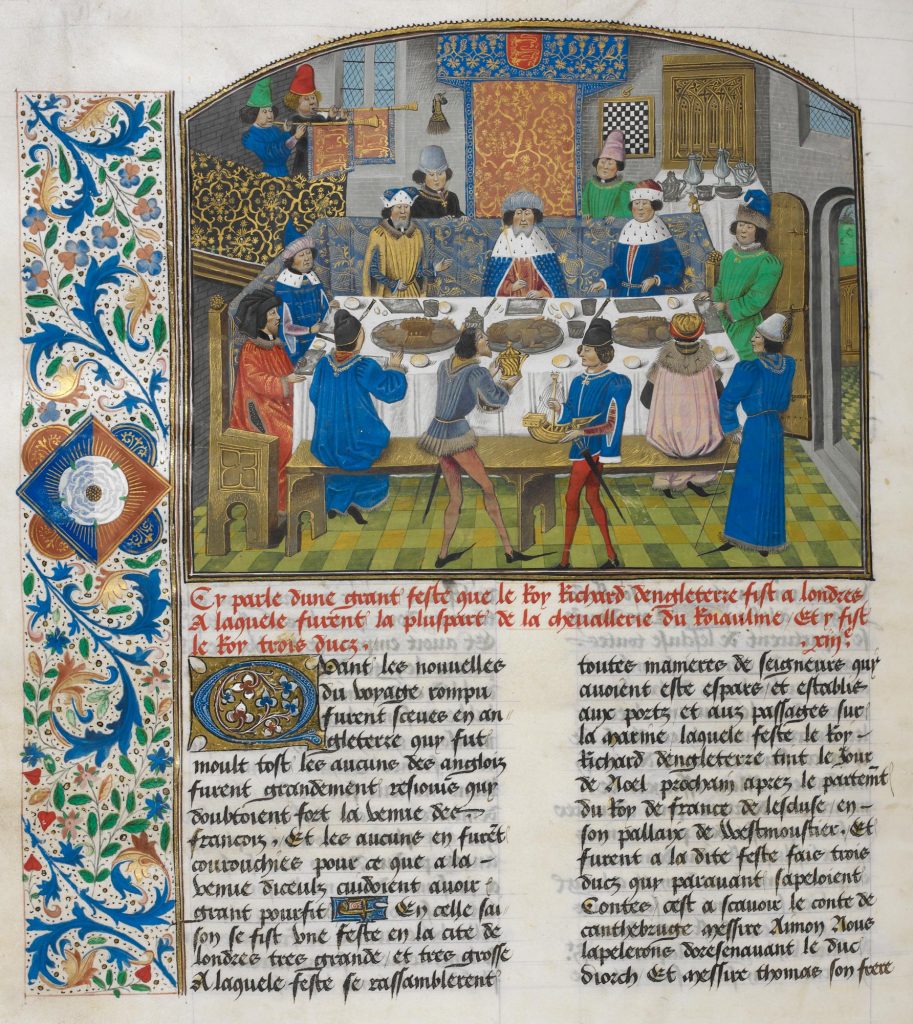
Elite households turned this hierarchy into a visible dining practice. Great households purchased or produced multiple grades of bread for different people and purposes. The lord’s table might receive the finest loaves, while servants, retainers, and lower-ranking members of the household received coarser bread. In aristocratic and ecclesiastical settings, the distribution of bread could mirror the distribution of honor. Who sat where, who was served first, who received the better loaf, and who ate from trenchers or leftovers all reflected the graded structure of medieval society. Bread was part of ceremonial order as well as diet. It helped stage hierarchy at every meal.
Yet the contrast between white and dark bread should not be reduced to a simple opposition between luxury and misery. Medieval people ate within environments, and environments mattered. Rye bread in a cold northern region was not the same thing as rye bread on a wheat-rich aristocratic table where it might appear as an inferior substitute. Barley, oats, and mixed grains could be signs of poverty in some contexts, but they could also represent sensible adaptation to local conditions. Maslin complicates the hierarchy because it combined grains in ways that could stabilize production and reduce risk. A mixed loaf might be less prestigious than fine wheat bread, but it could be agriculturally prudent, nutritionally substantial, and entirely normal for the people who ate it.
Still, medieval writers and records often reveal a strong cultural preference for whiteness, fineness, and wheat. Medical theory, culinary habit, and social taste could all reinforce the idea that refined wheat bread was more suitable for refined bodies. Coarser bread was associated with laboring people, stronger stomachs, rustic life, or necessity. This did not mean that white bread was always healthier. Indeed, darker breads could preserve more of the grain’s fiber and nutrients. But medieval food hierarchy was not organized according to modern nutritional science. It was organized through ideas about digestion, temperament, purity, labor, and rank. The better loaf was the loaf thought appropriate to the better body. Medieval dietetics often imagined foods as fitting particular bodies and ways of life, so the same bread could be interpreted differently depending on who ate it. A laborer might be thought capable of digesting coarse, heavy bread because his work and body were imagined as rougher and stronger, while a noble or cleric might be expected to consume finer, lighter foods suited to a less physically strenuous life. These assumptions naturalized inequality by making social rank appear almost physiological. Bread did not merely reflect class difference; it helped explain and justify it in the language of bodily order.
For the poor, bread quality was bound to vulnerability. A household with limited resources might eat bread made from coarser grain, older flour, mixed cereals, bran, or whatever could be purchased cheaply in the market. In hard times, the distinction between acceptable dark bread and desperation bread could become painfully thin. The poor might stretch grain with legumes, acorns, roots, or other fillers, while urban consumers depended on bakers whose loaves might shrink or decline in quality when grain prices rose. The darkness of bread, then, was not always merely a cultural marker; it could also be a record of scarcity. A coarse loaf might represent adaptation in one year and distress in another. This instability mattered because medieval households often lived close to the edge of subsistence even outside recognized famine years. A poor harvest, a rise in rents, a bad season of employment, illness within the household, or disruption in local markets could alter the quality of bread almost immediately. The loaf became a measure of household security: finer when grain was plentiful or wages stretched further, darker and more adulterated when pressure mounted. For those with little margin, bread recorded the movement from ordinary poverty to crisis before official chroniclers ever named a famine.
The edible hierarchy of bread reveals one of the central paradoxes of medieval food culture. Bread united society because everyone understood its necessity, but it also divided society because not everyone had equal access to the same loaf. It was the common food that made inequality visible. White bread did not simply feed the elite; it displayed their distance from the laboring majority. Dark bread did not simply feed the poor; it carried the marks of ecology, economy, and subordination. In the medieval world, class could be seen in clothing, housing, speech, and legal status, but it could also be seen at the table, in the color of bread broken by the hand.
Bread as Calories: Labor, Hunger, and the Medieval Body
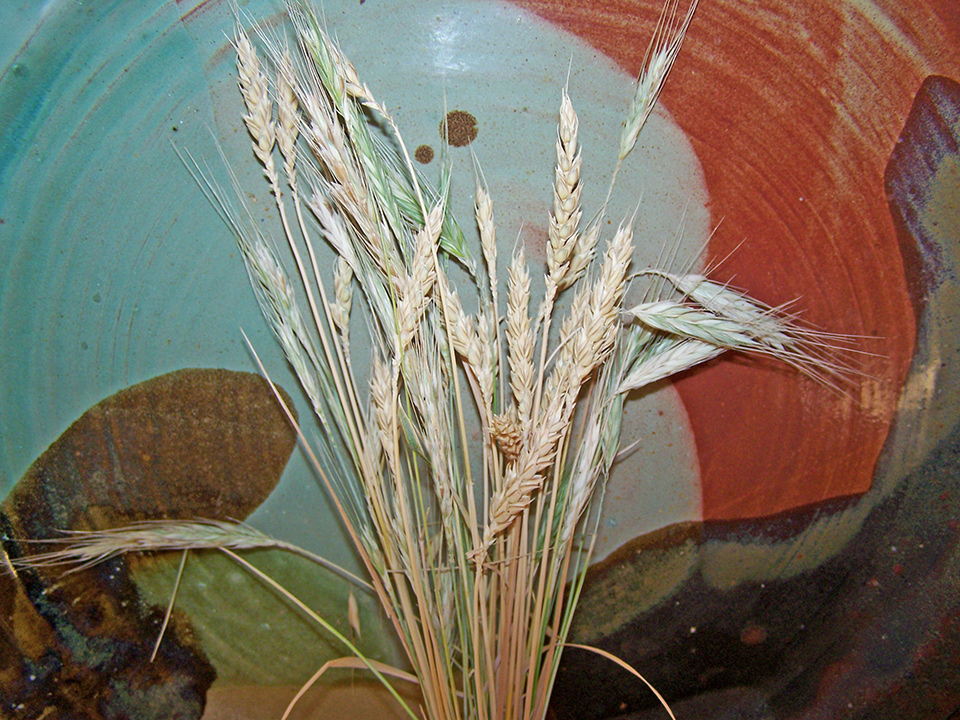
Bread mattered first because bodies needed fuel. Medieval life was physically demanding in ways that are easy to underestimate from a distance. Fields had to be plowed, seed carried, grain harvested, wood gathered, animals tended, water hauled, cloth spun, stone lifted, roads walked, and tools worked by hand. Even domestic labor required constant bodily effort: kneading dough, tending fires, washing, brewing, gardening, dairying, preserving food, and caring for children or the sick. Calories were not an abstract nutritional category. They were the energy that allowed a household to survive the week, a laborer to earn wages, a tenant to meet obligations, and a community to bring in the next harvest. Bread stood at the center of that energy system because it was relatively storable, divisible, transportable, and adaptable to daily eating. It could be baked in larger batches, carried into fields, shared among workers, eaten with pottage, softened in broth, paired with cheese or onions, or consumed plain when little else was available. Its usefulness lay not in variety but in dependability. For people whose lives were governed by season, daylight, weather, and bodily endurance, bread offered the kind of dense, repeatable nourishment that made continuous labor possible.
For much of the population, bread and other grain-based foods supplied the core of ordinary intake. The exact proportion varied by region, class, season, and century, and it is better to avoid treating any single percentage as universal. Still, the general pattern is clear: cereals dominated medieval diets, especially among the poor and laboring majority. Bread, pottage, ale, gruel, oatcakes, and other grain preparations formed a practical continuum rather than sharply separate categories. A household might eat bread with pottage, drink ale made from grain, thicken meals with meal or flour, and stretch small amounts of meat, fish, cheese, legumes, herbs, or vegetables around a cereal base. Bread was not merely one item on the table. It was part of the larger grain economy that made the table possible.
This caloric dependence shaped the medieval body and its social expectations. Laboring people were expected to eat foods that matched the demands of heavy work, and coarse bread could be imagined as appropriate to strong bodies and hard labor. Elite diet, by contrast, often prized refinement, variety, and foods thought suitable for more delicate digestion. These assumptions were cultural as well as practical, but they rested on an obvious truth: those who worked hardest needed reliable energy. Harvest laborers, builders, servants, carters, sailors, and soldiers could not live on symbolic food. They required dense nourishment that could be produced in quantity and eaten repeatedly. Bread served this need because it condensed the field into the hand. A loaf was stored sunlight, soil, rain, labor, and time made edible. It also helped regulate the working day, since meals and allowances were often organized around bread or grain-based sustenance. Field workers might receive food as part of their compensation, servants might be fed within households, and soldiers or travelers might depend on portable bread to carry them through long stretches of exertion. The body that ate bread was not simply a biological body; it was a working body placed within constructs of wage, service, discipline, and expectation. Bread fed muscles, but it also fed obligations.
Hunger, in this setting, was not simply the absence of food. It was the breakdown of the body’s capacity to work and the breakdown of the household’s capacity to survive. A poorly fed laborer could not harvest efficiently; a weakened tenant could not perform services; a sick household member increased the burden on everyone else; a hungry child marked both immediate distress and future vulnerability. Medieval people did not need modern nutritional science to understand that bread was strength. They measured food through endurance, fullness, warmth, and the ability to keep going. This is why grain shortages were so frightening. When bread became scarce or expensive, the problem was not only that people ate less. It was that the entire rhythm of work, rent, charity, and obligation began to fail.
Bread’s caloric importance also explains why it carried such emotional weight. It was ordinary, repetitive, and often monotonous, but repetition was part of its power. The daily loaf promised continuity: the household could rise, work, pray, and sleep because enough food remained to do it again. When bread was plentiful, it could fade into the background of life; when it was threatened, nothing seemed more urgent. To understand bread as calories is not to reduce it to biology. It is to recognize that medieval culture, law, religion, and economy all rested on the body’s need for energy. The medieval body was a hungry body before it was anything else, and bread was the food that most often stood between hunger and survival.
The Trencher and the Table: Bread in Medieval Dining Practice
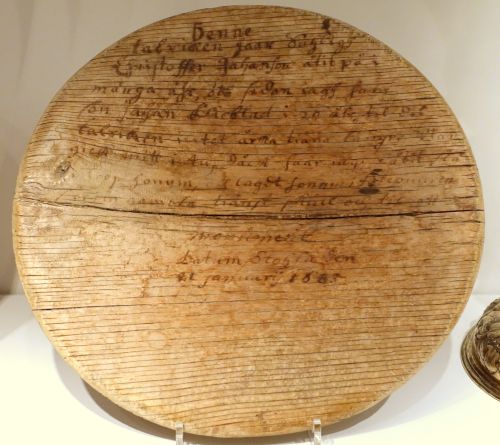
Bread did not only accompany medieval meals; it helped structure them. At the table, bread could serve as food, utensil, surface, portion marker, and sign of rank. The medieval meal was not a loose heap of meats and stews consumed without order, but a carefully organized social performance shaped by hierarchy, service, manners, and material objects. In elite and middling settings especially, bread helped make that performance possible. It absorbed sauces, carried morsels, separated foods, marked places, and sometimes replaced the plate itself. The loaf that began in the field and passed through the mill and oven now entered another world of meaning: the dining hall, where eating revealed not only appetite but status, discipline, hospitality, and dependence.
The trencher is the most famous example of bread’s role at the medieval table. Before ceramic, metal, or wooden plates became ordinary for all diners, thick slices or blocks of stale bread could be used as edible or semi-edible supports for food. These were not delicate slices of fresh bread, but sturdier pieces, often from older loaves, firm enough to hold meat, fish, pottage, or sauce without immediately collapsing. The trencher was practical because it used bread’s absorbency to advantage. It caught juices, fats, gravies, and drippings that might otherwise be wasted, turning the remains of a meal into something edible. In a food culture where fat, broth, and sauce carried both flavor and calories, the soaked trencher could become a concentrated record of the meal itself. Its usefulness also depended on the rhythm of household baking. Bread that had hardened beyond the pleasure of ordinary eating could still be put to work at the table, extending the value of grain after freshness had passed. This mattered in a world where waste was morally suspect, economically foolish, and socially visible. The trencher made old bread useful, turned sauces into sustenance, and allowed the table to function without requiring every diner to possess a separate durable plate.
Yet trenchers also reveal hierarchy. At high-status tables, the bread used as a trencher did not necessarily occupy the same position as the finer bread served for eating. Better loaves might be reserved for elite consumption, while coarser or older bread served more utilitarian purposes. The diner’s rank could determine not only where he sat and what dishes reached him, but what kind of bread was placed before him and what happened to it afterward. In great households, meals were organized through gradations of service, and bread participated in those gradations. The trencher was more than a clever substitute for a plate. It was a piece of edible material culture through which the household displayed order.
What happened to trenchers after a meal could be just as revealing as their use during it. Some were eaten by the diners themselves, especially if they had absorbed desirable juices. Others might be given to servants, dependents, or the poor, making bread a vehicle of redistribution. This practice could express charity, but it also reinforced inequality. The poor might receive food touched by the abundance of the elite table, while the elite gained spiritual or social credit for giving what they did not need. Leftover bread, soaked trenchers, and table scraps remind us that medieval charity was often embedded in hierarchy. Giving food did not abolish the distance between giver and receiver; it made that distance visible while softening its harshest edges. The trencher sat at the intersection of generosity and subordination. It could carry real nourishment to people who needed it, yet it also carried the social message that their access to that nourishment depended on another household’s surplus. The remains of the table became part of a broader economy of dependence, where alms, leftovers, hospitality, and reputation all met in the distribution of food.
Bread also shaped table manners. It could be used to hold food, push food, or accompany bites taken by hand, since forks were not yet common in much of medieval Europe. Diners were expected to behave with restraint: not grabbing greedily, not soaking bread sloppily, not fouling shared dishes, not wasting what should be eaten or distributed properly. Conduct literature and household ordinances show that eating required discipline. Bread sat at the center of these expectations because it was so often in the hand, on the board, or beneath the food. To handle bread properly was part of handling oneself properly. The table trained the body in social order. This training mattered because meals were public acts, especially in great households, monasteries, colleges, and guild settings, where eating occurred under the eyes of others. A diner’s treatment of bread could signal refinement, obedience, greed, carelessness, humility, or self-command. Even a basic act such as breaking bread rather than tearing at food wildly belonged to a larger code of bodily discipline. Medieval manners were not superficial decoration added to eating; they were ways of turning appetite into hierarchy, restraint, and recognizable social behavior.
The medieval table also connected bread to hospitality. Offering bread to a guest was one of the most basic gestures of reception, whether in aristocratic halls, monastic houses, urban homes, or humbler rural settings. Bread could begin a meal, fill out a meal, or rescue a meal from insufficiency. In monasteries, hospitals, and charitable institutions, bread distribution became a regularized expression of duty to strangers, pilgrims, the sick, and the poor. In elite households, generous provision of bread helped display lordship and abundance. The host who could feed many people demonstrated power, resources, and moral standing. Bread was both practical hospitality and public reputation.
The trencher and the table show that medieval bread cannot be understood only as agricultural product or nutritional necessity. Once placed before diners, it became part of a social choreography. It marked rank, absorbed value, disciplined behavior, enabled charity, and turned eating into a visible act of order. The same bread that sustained the poor could also support the sauces of the rich; the same loaf that symbolized daily need could become a tool of ceremony. Medieval dining practice transformed bread into a mediator between body and society. At the table, as in the field and market, bread revealed who had abundance, who served, who received, who gave, and who depended on the remains.
Monasteries, Fasting, and Holy Bread: The Religious Life of the Loaf

Bread’s medieval importance cannot be measured only by hunger, labor, or class. It also occupied the center of Christian imagination. The same food that filled the stomach appeared in prayer, liturgy, charity, monastic discipline, and sacramental theology. Medieval Christianity did not treat bodily need and spiritual meaning as separate worlds. Food could tempt, strengthen, humble, heal, or sanctify, depending on how it was used and understood. Bread was especially powerful because it was both ordinary and sacred. It was the food that most people needed every day, and it was also the material through which Christians encountered the mystery of Christ’s body in the Eucharist. No other medieval food moved so easily between kitchen, refectory, marketplace, poorhouse, altar, and imagination.
Monasteries made bread part of a disciplined life. The Rule of Saint Benedict did not romanticize eating; it regulated it. Food was necessary, but appetite had to be ordered by obedience, moderation, fasting, and communal rhythm. Bread appeared within a daily structure of prayer, labor, reading, silence, and shared meals. Monks ate not as isolated consumers but as members of a body whose habits were meant to train the soul. Portions, timing, abstinence, and exceptions for the sick or weak all mattered because food could become either a support for holiness or an opening for self-indulgence. In this world, bread was never merely fuel. It was part of the spiritual management of the body.
Fasting gave bread an even more complicated role. Medieval Christians lived within calendars of feast and fast, and monastic communities intensified those rhythms. Abstinence from meat, restrictions on quantity, seasonal disciplines such as Lent, and voluntary acts of self-denial all shaped how people understood eating. Bread could be the plain food that remained when richer foods were forbidden, but it could also become an object of restraint in itself. Holy men and women who limited their eating often did so not because food was evil, but because appetite had to be subordinated to God. Bread stood at the boundary between necessity and renunciation. To eat it was to acknowledge the body’s need; to limit it was to declare that the body’s need did not have final authority. This tension was especially important because bread was not a luxury that could be dismissed as mere indulgence. Refusing meat might signal discipline, but reducing bread pressed against the basic requirements of survival. For that reason, ascetic restraint around bread could appear spiritually powerful, even dangerous, because it tested the line between holiness and bodily collapse. Medieval religious culture often admired such discipline while also worrying about excess, deception, pride, or self-harm. The loaf, then, became a measure of spiritual seriousness precisely because it was so ordinary. To fast from rare delicacies was one thing; to restrict daily bread was to confront the body at its most basic point of dependence.
Charity gave bread another religious function. Feeding the hungry was among the most direct and visible works of mercy, and bread was one of the easiest forms that mercy could take. Monasteries, bishops, hospitals, confraternities, and wealthy lay households distributed food to the poor, pilgrims, travelers, the sick, and dependents. Such giving had practical consequences: it kept people alive. But it also carried spiritual meaning for the giver, who could see almsgiving as repentance, obligation, imitation of Christ, or preparation for judgment. Medieval charity was not modern social welfare, and it often preserved hierarchy even while relieving distress. Still, bread given at the gate of a monastery or distributed during a feast day made theology edible. It turned doctrine about mercy into something a hungry person could hold.
The Eucharist placed bread at the highest point of medieval religious life. In the Mass, bread was not simply blessed as a symbol of fellowship; it became the focus of profound claims about Christ’s real presence. By the high Middle Ages, Eucharistic devotion had intensified through theological debate, liturgical practice, visual adoration of the elevated host, processions, miracle stories, and the feast of Corpus Christi. The consecrated host was small, white, and fragile, yet it carried immense authority. It made bread the matter of salvation, not merely the metaphor of it. The daily loaf and the Eucharistic host were not identical things, and medieval people understood that distinction, but their relationship mattered. Because bread was already the food of life, its use in the sacrament made spiritual nourishment intelligible through the most familiar substance of bodily nourishment. The elevation of the host, the careful handling of consecrated bread, and the fear of sacrilege all show how profoundly the ordinary substance had been transformed within liturgical space. Stories of Eucharistic miracles, whether accepted, debated, or promoted in particular local contexts, often depended on the shock of bread becoming visibly more than bread. Such stories made theological claims dramatic and memorable, but they also reveal the emotional charge surrounding the host. Medieval Christians could encounter bread as something bought, baked, eaten, given, withheld, blessed, adored, and feared. The Eucharist gathered those meanings and raised them to their most intense form.
The religious life of bread deepened its social power. Bread could discipline monks, sustain fasting Christians, feed the poor, welcome travelers, express penance, and become the sacramental body of Christ. Its holiness did not remove it from ordinary life; rather, its ordinariness made its holiness more forceful. Medieval Christians knew what bread meant because they needed it. They knew the fear of lacking it, the comfort of receiving it, the labor required to produce it, and the gratitude attached to sharing it. When they prayed for daily bread, distributed bread in charity, fasted from abundance, or gazed upon the host, they were not leaving the material world behind. They were interpreting survival itself as a religious condition.
Towns, Markets, and Bakers: Bread as Urban Infrastructure
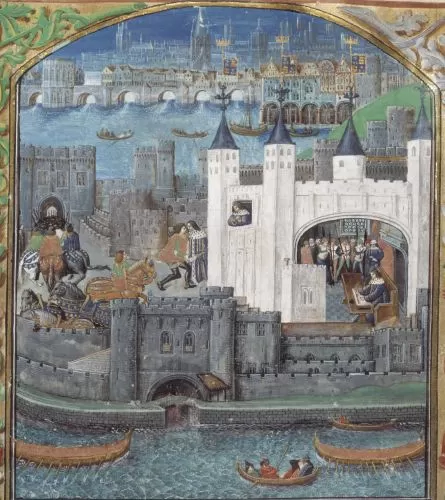
As medieval towns grew, bread became increasingly urban as well as rural. In the countryside, many households participated directly in the production of grain, even if they remained subject to lordship, dues, mills, and market pressures. In towns, a much larger share of the population depended on systems they did not control: grain merchants, millers, bakers, carters, river transport, market officials, and civic regulation. The urban household might not sow, reap, thresh, or grind at all. It might instead buy bread already baked or flour ready for use. This made bread a daily act of trust. Townspeople depended on others to bring grain into the city, turn it into flour, bake it honestly, and sell it at a price that did not threaten survival. That dependence was especially sharp for wage earners, servants, apprentices, widows, migrants, and the poor, whose access to bread could depend on the timing of payment, the availability of work, and the honesty of the market. Urban bread exposed a central tension of medieval town life: towns promised opportunity, specialization, and exchange, but they also separated many people from direct access to the land that fed them.
This dependence made bread one of the foundations of urban infrastructure. A town could possess walls, churches, guildhalls, bridges, courts, and markets, but if grain stopped arriving or bakers stopped producing, urban life became fragile very quickly. Dense populations could not easily feed themselves from nearby gardens or small livestock alone. They required regular supply from surrounding fields and, in larger cities, from more distant regions connected by roads, rivers, ports, and commercial networks. Bread linked urban prosperity to rural production. The town was never truly separate from the countryside; every loaf sold in a market carried the harvest into the street.
Professional bakers occupied an essential but uneasy place in this organization. They transformed grain or flour into the food most people needed most often, and they became indispensable to urban survival. Yet that indispensability made them objects of suspicion. Bakers could be accused of short weights, poor flour, excessive prices, adulteration, or manipulation of supply. Because ordinary buyers could not always know the quality of flour, the accuracy of measures, or the fairness of prices, the baker stood at a vulnerable point in the chain of trust. He was necessary enough to be protected by custom and guild organization, but dangerous enough to be watched by civic authority. Few trades were more ordinary, and few were more exposed to public resentment. The baker’s work was also unusually visible because its product entered nearly every household. A faulty tool might affect one buyer, but a dishonest batch of bread could anger an entire neighborhood. The baker became both a craft worker and a public figure, someone whose private profit was constantly measured against communal need.
Urban baking also required organization on a scale beyond the household hearth. Commercial ovens consumed fuel, demanded skill, and served customers whose needs could not wait for convenience. In many towns, bakers worked at night or in the early morning so that bread could be available when the day began. Their labor had to synchronize with milling, grain delivery, market hours, religious calendars, and household demand. This gave bread a rhythm within the city. The smell of baking, the movement of loaves, the inspection of weights, and the buying of daily food all formed part of urban time. Bread was not merely sold in the town; it helped set the town’s pace.
Markets made this system visible. Grain and bread were bought and sold under rules that tried to balance profit, supply, and public need. Civic officials had reason to fear both scarcity and fraud, because bread was too important to be left entirely to private bargaining. Marketplaces were not simply spaces of exchange. They were places where urban authority performed vigilance. Officials inspected weights, monitored prices, punished dishonest sellers, and attempted to maintain confidence in the food supply. Even when such regulation was imperfect, its existence shows how seriously towns took bread. A dishonest loaf was not only a private cheat. It was a small attack on the trust that allowed urban life to function. This trust depended on visible standards: measures that could be checked, loaves that could be weighed, prices that could be explained, and offenders who could be punished publicly enough to reassure buyers. The market became a theater of regulation as well as commerce. When authorities intervened in bread sales, they were not merely protecting consumers in a modern sense; they were asserting that the town had a moral and practical responsibility to keep necessity from becoming predation.
Guilds and craft organization added another layer to the urban bread economy. Bakers, like other craftspeople, could organize around rules of training, quality, membership, reputation, and mutual protection. Such organizations helped maintain standards and defend the interests of practitioners, but they also raised questions about monopoly, exclusion, and price. The baker’s craft was both skilled work and public service, both livelihood and responsibility. A town needed bakers to earn enough to continue producing, but it also needed them restrained from exploiting necessity. Bread’s special status made the usual tensions of urban craft life sharper. A badly made shoe or pot was a problem; a dishonest loaf could become a public crisis. The baker stood between guild privilege and civic accountability. He needed access to fuel, flour, ovens, labor, and credit, and he needed enough protection to operate in a risky market where grain prices could shift quickly. But the same protections that stabilized the craft could look dangerous to consumers if they seemed to shelter collusion or concealment. Urban authorities had to manage this balance carefully, allowing the trade to function while reminding bakers that bread belonged to the public order as much as to private enterprise.
The growth of towns also changed the relationship between women, households, and bread. In rural settings, women’s domestic labor often turned household grain into usable food. In towns, some households continued to bake, but others relied more heavily on commercial bakers, bakehouses, or purchased loaves. Women still played crucial roles as buyers, household managers, sellers, alewives, servants, and sometimes participants in food trades, but urbanization altered the balance between domestic production and market dependence. The daily loaf increasingly passed through public channels before reaching the family table. This did not remove bread from household management; it made household survival more dependent on cash, wages, prices, and urban supply.
Bread was one of the hidden systems that made medieval towns possible. It connected fields to markets, markets to households, households to wages, and wages to public order. The urban poor felt this most sharply, because they often lacked land, stored grain, livestock, or reserves. Their survival depended on the ability to buy bread regularly, and even small changes in price or loaf size could matter. In that sense, bread was as much infrastructure as a bridge, well, wall, or road. It allowed urban bodies to keep moving and urban economies to keep working. When bread was plentiful and fairly priced, the city could appear stable. When it was scarce, expensive, or mistrusted, the fragility beneath urban life became impossible to hide.
The Assize of Bread and Ale: Law, Price, Weight, and Public Trust
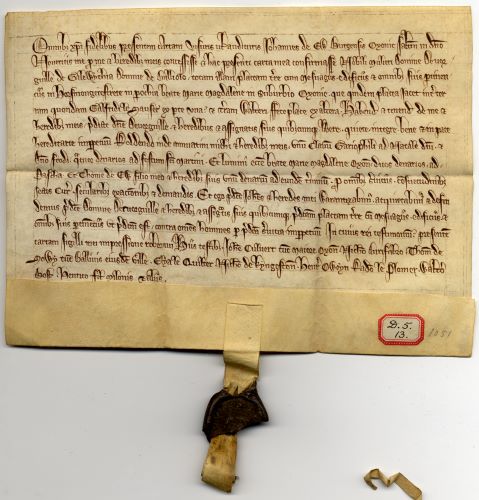
Because bread was indispensable, medieval authorities could not treat it as an ordinary commodity. A bad bargain over cloth, leather, or tools might injure a household, but dishonesty in bread threatened the daily food supply of an entire community. This was especially true in towns, where many people bought bread rather than producing it from their own grain. The customer could see the loaf, but not always the quality of the flour, the accuracy of the weight, the honesty of the measure, or the baker’s calculation of price. Law stepped into this uncertainty. Bread regulation sought to make necessity legible: grain had a market price, loaves had expected weights, bakers had obligations, and civic officials had the duty to maintain trust. The point was not to eliminate profit, but to prevent profit from becoming predation where survival was concerned.
The best-known English expression of this principle was the Assize of Bread and Ale, a regulatory framework that developed in the thirteenth century and shaped later local enforcement. Its basic logic was simple but powerful: the price of grain and the size or weight of bread had to correspond. When wheat became more expensive, the loaf might become smaller; when wheat became cheaper, the loaf was expected to become larger. This system recognized that bakers could not sell bread at a fixed size and fixed price regardless of grain costs, but it also denied them complete freedom to exploit scarcity. Bread law translated market fluctuation into public rule. It acknowledged economic reality while insisting that the community had a right to fairness in the food most essential to life. The assize also reveals a practical medieval solution to a recurring problem of measurement: how to protect buyers in a world where scales, ovens, grain quality, and market prices could all vary. Rather than assuming that justice meant an unchanging loaf, justice was treated as proportionality. The baker’s profit, the grain seller’s price, and the buyer’s need all had to be fitted into a publicly recognizable standard. This did not make the structure simple or perfectly fair, but it made bread accountable. A loaf became something that could be judged against a known expectation rather than against the baker’s private word alone.
Ale was regulated alongside bread because both belonged to the same grain-based survival economy. Ale was not merely recreational drink; in many settings it supplied calories, hydration, and daily nourishment, especially where water quality was uncertain or where weak ale formed part of ordinary household consumption. The regulation of bread and ale together shows how medieval authorities understood subsistence as a system. Grain could become loaf, pottage, or drink, and abuses in one form affected the wider balance of household survival. Bakers and brewers were monitored not only as tradespeople, but as custodians of necessities. Their products entered bodies every day, and that made their honesty a public matter.
Enforcement was often deliberately visible. Bakers who sold underweight loaves, used poor ingredients, or violated assize standards could face fines, confiscation, public shame, or humiliating punishments such as the pillory or tumbrel. These penalties were not simply theatrical cruelty. They performed civic reassurance. Public punishment told buyers that the authorities recognized the seriousness of food fraud and were willing to defend the community against it. The dishonest baker was not merely a clever merchant caught in sharp practice; he was someone who had tampered with the moral economy of daily bread. His offense lay in converting hunger into opportunity while hiding the theft inside a loaf.
The famous “baker’s dozen” belongs in this legal and moral world, though it should be treated cautiously. The traditional explanation holds that bakers gave thirteen loaves for the price of twelve to avoid penalties for short weight. Whether that custom can be tied neatly to a single medieval statute or moment is less certain than the legend suggests, but the story captures something historically important. Bakers operated under pressure in a trade where small variations in weight could bring accusation, punishment, and loss of reputation. Giving extra bread, whether as custom, prudence, or later memory, expressed the fear of being judged a cheat in a society where bread fraud carried unusual moral force. The phrase survives because it dramatizes a real medieval anxiety: when the law weighed bread, it also weighed trust.
The Assize of Bread and Ale reveals the central paradox of medieval bread law. Bread was bought and sold, but it was never merely private merchandise. It belonged to the market, yet it also belonged to public order. Its price had to respond to supply, but its sale had to remain morally accountable. Its production supported bakers, but its availability sustained communities. Regulation did not make medieval food systems fair in any modern sense, nor did it prevent scarcity, corruption, or inequality. But it shows that medieval people understood the loaf as a matter of civic life. To regulate bread was to declare that survival could not be abandoned entirely to appetite, profit, or chance.
Famine Bread: Scarcity, Substitution, and the Terror of Failed Harvests
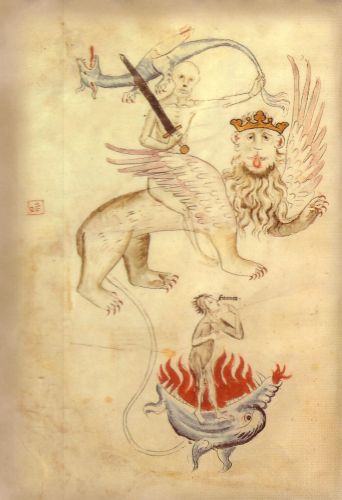
Bread meant survival most clearly when it began to disappear. In ordinary years, grain could seem like the predictable foundation of life, even if many households lived close to the edge. In bad years, that foundation cracked quickly. Failed harvests, heavy rain, drought, early frost, warfare, animal disease, transport disruption, hoarding, taxation, and rising prices could all turn the daily loaf into an object of fear. Medieval people did not experience famine as a sudden event only when food vanished entirely. They experienced it gradually, through smaller loaves, darker flour, higher prices, thinner pottage, fewer reserves, unpaid debts, weakening bodies, and the growing realization that the next harvest was still too far away. Scarcity was measured not only in empty barns, but in the steady degradation of bread.
The danger was intensified by the agricultural calendar. Grain societies depended on storage, planning, and the hope that one harvest could carry households until the next. Seed had to be reserved for sowing, rents and tithes had to be paid, laborers had to be fed, and animals had to be maintained. The months before harvest could become especially dangerous, since supplies from the previous year were already depleted while new grain was not yet ready. This “hungry gap” was not necessarily famine in itself, but it created a seasonal vulnerability that poor households knew well. When a bad harvest followed another bad harvest, or when weather ruined both autumn sowing and summer growth, ordinary hardship could become catastrophe. Bread was daily food, but grain was annual security, and a failed year could echo across several years of hunger.
In crisis, people turned to substitute foods that blurred the line between bread and desperation. Famine bread might contain bran, peas, beans, vetches, acorns, chestnuts, roots, weeds, bark, straw, or other fillers, depending on region and availability. Some substitutes were ordinary emergency resources; others were signs that a community had entered extreme distress. The purpose was simple: stretch grain, create bulk, quiet the stomach, and keep the body moving. But such bread could be difficult to digest, nutritionally inadequate, or dangerous if made from spoiled, contaminated, or unsuitable ingredients. The moral horror of famine bread lay partly in this inversion. Bread, the food of life, became a sign that normal life had failed. People were still eating “bread,” but the word now concealed the loss of quality, security, and hope. The act of substitution also revealed how deeply medieval households understood food in practical rather than abstract terms. They were not seeking ideal nutrition; they were seeking anything that could be ground, mixed, baked, boiled, swallowed, and made to resemble sustenance. A loaf stretched with acorns or bran might not have carried the cultural dignity of proper bread, but it could still mark the difference between motion and collapse. These substitute breads could intensify suffering by filling the stomach without truly restoring strength. They could create the appearance of food while failing to provide the stability that ordinary grain bread had promised.
The Great Famine of 1315–1317 stands as one of the clearest examples of this vulnerability in northern Europe. A series of disastrous weather conditions, especially excessive rain, damaged harvests, reduced yields, hindered drying and storage, and strained already dense populations. Grain prices rose sharply, livestock suffered, and disease followed hunger. The crisis was not merely a shortage of food but a breakdown in the systems that made food reliable: agriculture, transport, purchasing power, lordly management, charity, and household reserves. Chroniclers described suffering in moral and religious language, but behind those descriptions lay the material reality of failed grain. When bread could not be made in sufficient quantity or quality, medieval society’s dependence on cereal agriculture became brutally visible. The famine also showed that scarcity was cumulative. Wet weather did not simply reduce one harvest; it disrupted plowing, sowing, fodder supplies, animal health, storage, and labor capacity, creating a chain of consequences that carried hunger forward. Animals weakened or died, reducing traction and manure; seed grain became harder to preserve; poor households sold assets they would need later; and disease found bodies already thinned by want. Bread stood at the center of this chain because it was where all these failures became daily experience. A failed field became expensive grain; expensive grain became smaller loaves; smaller loaves became weaker workers; weaker workers became a damaged recovery.
Famine also exposed inequality. Wealthier households could buy grain longer, draw on reserves, reduce hospitality, switch suppliers, or use social power to secure food. Lords, monasteries, merchants, and towns might have storage capacity and institutional resources unavailable to the poor. Laborers and smallholders, by contrast, faced a double bind: they needed bread to work, but scarcity raised the price of bread beyond what their work could buy. Some sold goods, livestock, tools, or land rights; others migrated, begged, stole, entered service, or depended on charity. Hunger did not fall evenly across society. The same failed harvest could mean inconvenience for one household, debt for another, displacement for another, and death for another. Bread scarcity revealed the social structure with cruel precision.
Famine bread shows why bread carried such emotional and political force in the medieval world. In normal times, it could be ordinary enough to vanish into routine. In crisis, it became the most visible measure of survival itself. The shrinking loaf told people that weather, markets, landlords, rulers, and perhaps God had all become uncertain. Substitution did not simply feed people; it announced the collapse of the expected order of things. The terror of failed harvests was not only the terror of hunger, but the terror of watching the basic grammar of life break down. When daily bread became coarse, contaminated, stretched, or absent, medieval people confronted the fragility beneath every field, market, monastery, manor, and town.
Dangerous Grain: Ergot, Adulteration, Mold, and the Risks of Survival Food

Bread sustained medieval life, but it could also endanger it. The same dependence that made grain indispensable made contaminated, spoiled, adulterated, or poorly stored grain especially dangerous. Medieval households could not simply abandon bread when supplies became suspect, because bread was the food that kept bodies working and families alive. In good years, grain could be dried, stored, milled, and baked with reasonable confidence. In bad years, damp harvests, poor storage, fungal growth, exhausted reserves, desperate substitutions, and dishonest sellers could turn survival food into a source of illness. The danger was not only that people lacked bread, but that the bread available to them might harm the very bodies it was meant to preserve.
Ergot is the most dramatic example of dangerous grain. This fungal disease, especially associated with rye, could infect cereal crops and produce toxins capable of causing convulsions, hallucinations, burning sensations, miscarriage, and gangrenous symptoms. Later observers connected some outbreaks of “St. Anthony’s fire” and similar afflictions to ergot poisoning, though historians must be careful not to explain every medieval episode of mass illness, vision, or panic through a single cause. Medieval people did not possess modern mycology, and they often interpreted such suffering through religious, moral, environmental, or humoral frameworks. Still, ergot shows how grain could carry invisible danger. A loaf might appear to be the answer to hunger while containing the seeds of another disaster. Rye’s importance in colder and wetter regions made the problem especially ominous, because the grain that helped people survive difficult climates could, under certain conditions, become hazardous. The danger was intensified by the fact that contamination could be difficult to recognize consistently, especially once grain had been harvested, mixed, milled, or baked. A community might experience illness not as the result of one obviously poisoned food, but as a frightening pattern of bodily breakdown that seemed to emerge from the ordinary act of eating. This uncertainty made dangerous grain especially disturbing. It turned daily bread into something unstable: necessary enough to consume, familiar enough to trust, and yet capable of carrying harm that exceeded ordinary understanding.
Mold, spoilage, and poor storage created more ordinary but equally serious risks. Grain had to be dried properly and protected from moisture, vermin, rot, and contamination. Wet harvests could make this difficult, and the pressure to preserve grain through winter or through a hungry gap meant that people might consume supplies that were far from ideal. Flour could become stale or tainted; bread could be stretched with inferior ingredients; old grain could be mixed with new; and desperate households might accept food that wealthier people would reject. Adulteration added another layer of danger. Sellers might dilute flour, manipulate weights, or disguise poor quality, especially when scarcity made buyers less able to refuse. These practices did not always poison consumers directly, but they weakened trust and could deprive households of the nourishment they believed they were buying. In a world where the margin between adequacy and hunger was often narrow, inferior bread could be a slow form of harm.
The risks of dangerous grain were intensified by poverty. Wealthier households had better chances of securing higher-quality supplies, rejecting spoiled goods, storing grain properly, or shifting purchases when a supplier proved unreliable. The poor had fewer choices. They might buy cheaper bread, accept darker or older flour, stretch food with questionable fillers, or continue eating from damaged stores because there was nothing else. This made food safety a class issue long before the language of public health existed. The medieval poor were not ignorant of risk; they were often trapped by necessity. A loaf that looked suspect could still be better than no loaf at all. Survival forced calculations in which immediate hunger outweighed possible illness, especially for laboring households that needed enough strength to work the next day.
Dangerous grain complicates any simple celebration of bread as the foundation of medieval survival. Bread was indeed the food that most often stood between hunger and collapse, but that very centrality made its failures more devastating. Contaminated rye, moldy flour, adulterated loaves, and famine substitutes all reveal the darker side of dependence. The medieval loaf was not automatically wholesome because it was traditional, local, or essential. It was the product of weather, storage, honesty, poverty, knowledge, and chance. When those conditions failed, bread could become a vehicle of suffering as well as sustenance. Medieval people lived with this uncertainty constantly: the food they needed most was also the food whose corruption they could least afford. That uncertainty is crucial to understanding medieval attitudes toward regulation, charity, divine punishment, and communal responsibility. If bread could nourish or harm, then the systems surrounding bread mattered profoundly: the honesty of bakers, the vigilance of market officials, the storage practices of households and institutions, the generosity of those with reserves, and the ability of communities to respond before desperation forced people toward dangerous substitutes. Bread’s risks did not diminish its importance. They made its importance more urgent, because survival depended not merely on having a loaf, but on having a loaf that could be trusted.
Bread, Revolt, and Moral Economy: When Loaves Became Political

Bread became political because hunger was never only biological. When bread prices rose, loaf sizes shrank, grain disappeared from markets, or bakers were suspected of fraud, ordinary people understood the crisis as a failure of order. They might blame bad weather, but they also blamed hoarders, forestallers, negligent officials, greedy merchants, harsh landlords, corrupt bakers, or rulers who failed to protect the vulnerable. Medieval people did not necessarily imagine food justice in modern ideological terms, but they often believed that necessity imposed obligations. Grain should not be hidden while neighbors starved. Bread should not be sold underweight. Officials should enforce fair measures. Lords and monasteries should offer relief. Markets should serve the community as well as profit. When those expectations were violated, the loaf could become an object of anger as well as need.
This expectation is often described through the idea of a moral economy: the belief that basic subsistence goods carried social obligations beyond ordinary exchange. Although the phrase is most famously associated with later early modern and eighteenth-century food protests, its roots reach into medieval assumptions about just price, customary rights, Christian charity, civic regulation, and lordly responsibility. Bread was not simply whatever a seller could persuade a desperate buyer to pay. It belonged to a world of moral judgment. A merchant who profited from scarcity, a baker who reduced weight, or a landlord who extracted grain during shortage might be condemned not only as economically hard, but as morally disordered. The community’s anger came from the conviction that survival food should remain accountable to shared norms. Those norms were not always written in a single statute or expressed as a coherent political theory. They lived in custom, sermons, market practices, manorial expectations, urban ordinances, and popular memory. People knew, or believed they knew, what a fair loaf looked like, what a proper measure should be, when a price seemed exploitative, and when the powerful had crossed from ordinary privilege into sinful abuse. Bread made these judgments concrete. It gave moral economy a daily object, something that could be weighed, bought, broken, shared, withheld, or seized.
Medieval revolts were rarely about bread alone, but bread often lay close to the surface. Taxation, labor services, rents, enclosure, war levies, debt, and legal oppression could all become intolerable when food was scarce or wages failed to keep pace with prices. The English Rising of 1381, for example, cannot be reduced to hunger, but it unfolded within a world where labor, taxation, lordship, wages, and household survival were inseparable. Likewise, urban disturbances over prices, market abuses, or civic corruption often drew strength from the fact that ordinary people experienced policy through the cost of food. Bread translated large structures into daily injury. A tax might be recorded in government accounts, but the poor felt it in the loaf they could no longer buy.
The politics of bread also depended on visibility. Bread could be weighed, handled, compared, and judged. A coin spent in the market produced a loaf whose size could be seen immediately. This made bread an unusually concrete measure of fairness. People might not fully understand distant grain markets, royal finance, seigneurial accounting, or merchant networks, but they could see when the loaf was smaller, darker, dearer, or worse. Public suspicion gathered around these visible changes. If grain was known to exist somewhere, why was bread scarce here? If bakers claimed high costs, why did the loaves seem too light? If officials promised regulation, why did cheating continue? Bread made political economy tangible because it reduced complex systems to something held in the hand. That tangibility mattered because medieval politics often moved through rumor, reputation, and public performance. A lighter loaf could become evidence, whether fair or not, of hidden greed somewhere in the chain of production and sale. The baker, miller, merchant, or official became the visible face of an invisible structure. Bread condensed anxiety: about markets that seemed manipulated, rulers who seemed distant, landlords who seemed demanding, and neighbors who seemed to profit from distress. A loaf could become a small public document, read by the hungry as testimony that the moral order was fraying.
Authorities understood the danger. This is why bread regulation, public punishment, market supervision, and emergency relief mattered so much. They were not only practical measures; they were acts of reassurance. To punish a dishonest baker, inspect grain, prevent forestalling, or distribute bread in crisis was to show that rulers and civic officers had not abandoned the community to hunger. Failure to act invited more than resentment. It invited the belief that legitimate authority had broken its side of the social bargain. Medieval government often lacked the administrative reach of modern states, but it still depended on visible performances of justice. Bread was one of the places where those performances were most urgently required.
When loaves became political, they revealed the fragile pact beneath medieval society. Peasants, townspeople, workers, and the poor did not always demand equality, nor did they always reject hierarchy. Often they demanded that hierarchy fulfill its obligations: fair dealing, honest measures, customary access, relief in hardship, and restraint in profit-taking when lives were at stake. Bread made those demands immediate because it was the food of necessity. Its politicization did not contradict its everyday character; it came from that everyday character. The more ordinary bread was, the more explosive its failure became. A society could tolerate many inequalities, but when the daily loaf became unreachable or untrustworthy, the whole structure of authority could be called into question.
Regional Worlds of Bread: Europe Was Not One Loaf
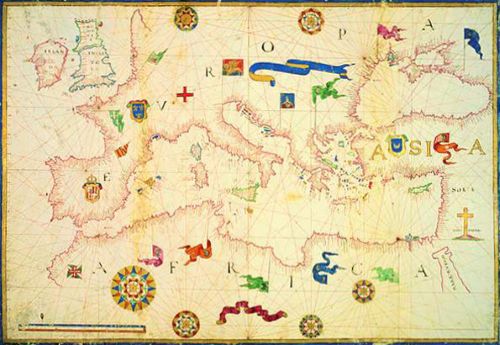
Medieval Europe did not eat one bread. The language of “daily bread” can make the loaf sound universal, but the thing actually placed on a table varied enormously by region, climate, soil, economy, religion, and social rank. Wheat bread, rye bread, barley bread, oatcakes, maslin loaves, flatbreads, chestnut breads, and mixed-grain foods all belonged to the broader world of medieval cereal consumption. Some were baked in ovens, some cooked on griddles or hearths, some eaten fresh, some stored, some leavened, and some closer to cakes or porridges than to the later image of a raised loaf. Bread was central, but it was not uniform. To understand medieval bread properly, one must resist imagining Europe as a continent of identical loaves and instead see a patchwork of local food systems tied together by the shared problem of survival.
Geography set many of the basic terms. Wheat thrived best in favorable soils and climates, especially in parts of the Mediterranean, northern France, southern England, and other productive grain zones. Rye was more tolerant of colder, poorer, or more acidic soils and became especially important across northern, central, and eastern Europe. Barley and oats mattered in wetter, upland, or marginal regions, where they could sustain both people and animals. In some areas, mixed sowing reduced risk by ensuring that if one grain failed, another might still produce something usable. The resulting bread cultures were ecological adaptations before they were culinary preferences. Medieval people did not choose their bread from an abstract menu of possibilities; they ate what their land, climate, labor systems, and markets made available. A river valley, a mountain village, a coastal town, and a forest-edge settlement could all belong to the same Christian Europe while depending on very different staples. Even within a single kingdom, bread might change from county to county according to soil quality, rainfall, manorial practice, and access to trade. Geography did not determine everything, but it set limits that no household could ignore. The medieval loaf was a local object before it was a cultural symbol, shaped first by what could actually grow.
The Mediterranean world had its own patterns. In many southern regions, wheat retained strong cultural prestige, shaped by Roman inheritance, urban markets, Christian ritual, and long-standing ideals of fine bread. Yet even there, ordinary people did not always eat pure white wheat loaves. Class, season, price, and local production shaped access. In Italy, southern France, Iberia, and other Mediterranean zones, bread existed alongside olive oil, wine, legumes, vegetables, fish, and regional grain preparations. Urban centers could draw grain from wider commercial networks, while rural communities relied more heavily on local harvests. Mediterranean bread culture combined prestige and vulnerability: wheat might be culturally prized, but access to it still depended on weather, trade, storage, and purchasing power. This was especially true in cities, where demand could exceed the immediate productive capacity of nearby fields and where rulers or civic governments had strong incentives to secure grain supply. The Mediterranean inheritance of wheat culture was also an inheritance of dependence on movement: carts, ships, ports, merchants, storehouses, and market regulation. A fine loaf on an urban table might embody not only local agriculture but also long-distance exchange and political management. Bread could display refinement while also exposing the fragility of cities that required grain to arrive from elsewhere.
Northern and eastern Europe complicate any wheat-centered story. In colder or less forgiving regions, rye could be the real foundation of bread survival. Dense rye loaves, sourdough traditions, and darker breads were not necessarily marginal substitutes but normal foods adapted to local conditions. The same was true, in different ways, of oats and barley in parts of the British Isles, Scandinavia, and upland zones. Oatcakes, barley breads, and mixed-grain foods challenge the idea that medieval bread always meant an oven-baked wheat loaf. They also challenge elite assumptions that darker or coarser breads were simply inferior. From the perspective of a household surviving in a difficult environment, a reliable rye harvest or oat-based diet could be more valuable than a prestigious grain poorly suited to the land.
Chestnut regions add another important variation. In parts of southern Europe, especially mountainous or wooded areas where cereal agriculture was difficult, chestnuts could function as a major staple and sometimes be dried, ground, and made into bread-like foods. Such regions show that the boundary between bread and substitute food was not always fixed. What might appear as famine fare in one region could be a normal staple in another. The same ingredient could carry different meanings depending on ecology and custom. This matters because historians must avoid treating wheat bread as the standard from which all other foods are deviations. Medieval survival was often built from whatever could reliably produce calories, store well, and be turned into daily nourishment. Chestnuts reveal the flexibility of the bread idea itself. They were not cereals, yet they could enter the same practical role: dried for storage, milled into meal, baked or boiled, and used to bridge the gap between landscape and hunger. For communities living where fields were poor but trees were productive, the forest could become a kind of granary. This does not mean chestnut bread occupied the same symbolic position everywhere as wheat bread or Eucharistic bread, but it does show how medieval people adapted the form and function of “bread” to the resources around them.
Regional bread worlds were also shaped by technology and fuel. Ovens, mills, hearths, griddles, and bakehouses were not distributed evenly. Where communal ovens or professional bakers were common, bread might take forms different from households relying on smaller hearths or simpler cooking surfaces. Fuel availability mattered as well. Baking large loaves required heat, wood, charcoal, or other fuel resources, and where fuel was expensive or scarce, households had to adapt. Some breads were baked in batches to conserve heat; others were cooked quickly on hot surfaces; still others gave way to porridges, gruels, or pottages that required different techniques. The form of bread was partly a history of energy use. A loaf records not only grain, but fire.
Seeing Europe as many bread worlds does not weaken the argument that bread was central to medieval life. It strengthens it. Bread’s importance lay not in a single recipe, shape, or color, but in its capacity to translate local environments into edible survival. The white wheat loaf of an elite household, the dark rye bread of a northern village, the oatcake of an upland region, the mixed maslin loaf of a cautious peasant family, and the chestnut-based bread of a mountain community all answered the same basic question: how could people turn land, labor, and season into food reliable enough to live on? Medieval Europe was not one loaf, but it was a continent organized around the need for daily sustenance in grain or grain-like form. Bread was universal not because it was identical everywhere, but because every region had to solve its own version of the bread problem.
Was Bread Truly the Center of Medieval Survival, or Are We Making One Food Carry Too Much Meaning?
The following video from “Tasting History with Max Miller” discusses medieval trenchers:
The strongest challenge here is that bread may be carrying too much interpretive weight. Medieval people certainly depended on grain, but they did not live on bread alone. Pottage, ale, legumes, garden vegetables, dairy products, fish, salted foods, fruit, nuts, and occasional meat all mattered, and in some regions oats, chestnuts, porridges, or gruels may have been more central to daily sustenance than the image of a baked loaf suggests. Even the word “bread” can mislead if it makes historians imagine a stable, familiar object where medieval people experienced a shifting range of cereal foods. A peasant household might have thought less in terms of “bread” as a symbolic center and more in terms of filling the stomach with whatever combination of grain, pulse, greens, broth, and drink could sustain work. If I am making bread the master key to medieval life, it risks simplifying a much more diverse food world.
There is also a problem of evidence. Much of what survives about medieval bread comes from elite households, monastic rules, urban regulations, medical writing, estate accounts, court records, cookbooks, sermons, and chronicles. These sources are valuable, but they do not represent all eaters equally. They often tell us more about what authorities wanted to regulate, what elites wanted to serve, what clerics wanted to teach, or what officials found worth recording than about the everyday experience of the rural poor. Legal records may exaggerate fraud because they preserve moments of conflict. Cookbooks may exaggerate refinement because they reflect elite kitchens. Monastic and theological sources may make bread appear more symbolically charged than it felt in the hands of a hungry worker. The danger is that historians, reading the archive from above, may mistake administrative, religious, and literary attention for universal lived meaning. There is also the problem of silence. The poorest consumers, casual laborers, widows, migrants, servants, and smallholders rarely left direct testimony about what bread meant to them day after day. Their experience must often be reconstructed from prices, wages, ordinances, manorial accounts, poor relief, or the complaints of others. That reconstruction is necessary, but it requires caution. A regulation against underweight bread proves that officials cared about measurement, but it does not by itself reveal how often buyers were cheated or how they interpreted the offense. A sermon invoking daily bread proves that clergy used bread as moral language, but it does not tell us exactly how every listener connected that language to hunger. The archive makes bread visible, but it also filters bread through institutions.
A second challenge is regional. Medieval Europe was not one food system, and the importance of bread varied across landscapes. In some areas, the daily staple was not a fine loaf but oatcake, rye bread, barley bread, chestnut meal, porridge, or pottage. In others, access to fish, dairy, wine, olive oil, legumes, or garden produce altered the balance of diet. If bread is defined narrowly as wheat bread, the argument collapses quickly outside certain elite, urban, or agriculturally favored settings. If bread is defined too broadly as almost any grain-based food, it risks becoming so elastic that it loses analytical precision. The counterpoint forces a necessary correction: bread was central only if understood historically and regionally, not as a single universal loaf imposed across the continent.
Yet this challenge modifies rather than destroys the argument. My claim is not that bread was the only medieval food, nor that every European ate the same bread, nor that ordinary people constantly reflected on the symbolic meaning of every loaf. The claim is that bread and bread-like grain foods occupied a uniquely dense position in medieval life because they connected so many systems at once: agriculture, labor, class, law, religion, charity, urban markets, famine, and public trust. Pottage might feed the body, ale might supply calories and hydration, dairy might sustain pastoral regions, and legumes might provide crucial protein, but bread had an unusual capacity to become visible as a measure of order. It could be weighed by officials, blessed by priests, distributed by monasteries, graded by class, stretched in famine, and punished through law when adulterated or underweight. Few foods moved so consistently across material, social, and symbolic registers.
The counterpoint strengthens the final interpretation by making it less absolute and more precise. Bread was not the whole of medieval survival, but it was one of survival’s most revealing forms. Its importance lay not in replacing every other food, but in showing how food itself worked as infrastructure. The loaf, whether white wheat, dark rye, mixed maslin, barley cake, oat bread, or chestnut-based substitute, condensed the conditions of medieval life into something daily and edible. It showed the dependence of people on land, weather, labor, markets, law, hierarchy, charity, and God. The best conclusion is not that medieval life can be reduced to bread, but that bread provides one of the clearest ways to see medieval life whole.
Conclusion: The Loaf as Medieval Infrastructure
Bread was humble only in appearance. In the medieval world, it was one of the basic structures through which life became possible. It began in fields shaped by climate, soil, custom, and lordship; passed through mills, ovens, households, markets, monasteries, and town regulations; and finally entered the body as daily strength. Its production required land, labor, seed, weather, storage, fuel, skill, and trust. Its consumption revealed class, region, discipline, hunger, and hope. A loaf could sit quietly on a table, but behind it stood the whole machinery of medieval survival.
That machinery was never neutral. Bread exposed the inequalities of medieval society as clearly as it sustained its people. White wheat bread could display refinement and privilege, while dark rye, barley, oat, or maslin breads spoke of ecology, adaptation, and often poverty. The trencher showed how even dining practice could convert bread into a marker of rank, charity, and dependence. The assize showed that bread was too important to leave wholly to the market. Famine bread showed how quickly survival could collapse into substitution, illness, and fear. Dangerous grain showed that necessity itself could become hazardous when weather, storage, poverty, or dishonesty corrupted the food people needed most.
Yet bread also connected medieval life to meanings beyond subsistence. It stood at the center of Christian prayer, fasting, charity, and Eucharistic devotion. It was given to the poor, withheld in scarcity, measured by officials, blessed at the altar, broken at the table, and invoked as the daily gift on which human life depended. Its religious power did not float above ordinary hunger; it drew force from it. Medieval Christians understood the sacred language of bread because bread already governed the material terms of existence. The loaf could represent divine provision because it was also the thing people needed to work, endure, and live until tomorrow.
To call bread medieval infrastructure is not metaphor alone. Like roads, mills, markets, churches, and fields, bread organized movement, obligation, authority, and survival. It translated land into calories, hierarchy into table practice, law into weight, charity into food, and theology into matter. Europe was not one loaf, and bread was never the only food that mattered, but few foods reveal so much at once. The medieval loaf was a small object with a vast social life. To follow it from field to mill, oven, market, altar, trencher, poorhouse, and hungry mouth is to see the medieval world not from above, but from the point where power, belief, labor, and need became edible.
Bibliography
Affiliate disclosure: Amazon links on this site are paid links. As an Amazon Associate I earn from qualifying purchases.
- Adam of Bremen. History of the Archbishops of Hamburg-Bremen. Translated by Francis J. Tschan. New York: Columbia University Press, 2002.
- Adamson, Melitta Weiss. Food in Medieval Times. Westport, CT: Greenwood Press, 2004.
- The Anonimalle Chronicle, 1307 to 1334. Edited by Wendy R. Childs and John Taylor. Leeds: Yorkshire Archaeological Society, 1991.
- Aquinas, Thomas. Summa Theologica. Translated by Fathers of the English Dominican Province. New York: Benziger Bros., 1947.
- Augustine of Hippo. Sermons. Translated by Edmund Hill. Hyde Park, NY: New City Press, 1990–1997.
- The Babees Book: Medieval Manners for the Young. Edited by Frederick J. Furnivall. London: Early English Text Society, 1868.
- Bateson, Mary, ed. Borough Customs. 2 vols. London: Bernard Quaritch, 1904–1906.
- Benedict of Nursia. The Rule of Saint Benedict. Edited and translated by Timothy Fry. Collegeville, MN: Liturgical Press, 1981.
- Bennett, H. S., ed. The Pastons and Their England: Studies in an Age of Transition. Cambridge: Cambridge University Press, 1922.
- Bennett, Judith M. Ale, Beer, and Brewsters in England: Women’s Work in a Changing World, 1300–1600. New York: Oxford University Press, 1996.
- —-. Women in the Medieval English Countryside: Gender and Household in Brigstock before the Plague. Oxford: Oxford University Press, 1987.
- Berman, Constance Hoffman. “Medieval Agriculture, the Southern French Countryside, and the Early Cistercians. A Study of Forty-Three Monasteries.” Transactions of the American Philosophical Society 76:5 (1986), i-xiv+1-179.
- Bloch, Marc. French Rural History: An Essay on Its Basic Characteristics. Translated by Janet Sondheimer. Berkeley: University of California Press, 1966.
- Braudel, Fernand. The Structures of Everyday Life: Civilization and Capitalism, 15th–18th Century. Vol. 1. Translated by Siân Reynolds. New York: Harper & Row, 1981.
- Britnell, Richard H. Britain and Ireland 1050–1530: Economy and Society. Oxford: Oxford University Press, 2004.
- —-. The Commercialisation of English Society 1000–1500. Manchester: Manchester University Press, 1996.
- Brown, Peter. The Rise of Western Christendom: Triumph and Diversity, AD 200–1000. 2nd ed. Malden, MA: Blackwell, 1996.
- Bynum, Caroline Walker. “Fast, Feast, and Flesh: The Religious Significance of Food to Medieval Women.” Representations 11 (1985), 1-25.
- —-. Holy Feast and Holy Fast: The Religious Significance of Food to Medieval Women. Berkeley: University of California Press, 1987.
- Caesarius of Heisterbach. The Dialogue on Miracles. Translated by H. von E. Scott and C. C. Swinton Bland. 2 vols. London: George Routledge & Sons, 1929.
- Campbell, Bruce M. S. The Great Transition: Climate, Disease and Society in the Late-Medieval World. Cambridge: Cambridge University Press, 2016.
- Constable, Giles. Three Studies in Medieval Religious and Social Thought. Cambridge: Cambridge University Press, 1995.
- Dobson, R. B., ed. The Peasants’ Revolt of 1381. 2nd ed. London: Macmillan, 1983.
- Duby, Georges. Rural Economy and Country Life in the Medieval West. Columbia: University of South Carolina Press, 1968.
- Dyer, Christopher. Making a Living in the Middle Ages: The People of Britain 850–1520. New Haven: Yale University Press, 2002.
- —-. Standards of Living in the Later Middle Ages: Social Change in England c.1200–1520. Cambridge: Cambridge University Press, 1989.
- Epstein, Steven A. Wage Labor and Guilds in Medieval Europe. Chapel Hill: University of North Carolina Press, 1991.
- Garnsey, Peter. Famine and Food Supply in the Graeco-Roman World: Responses to Risk and Crisis. Cambridge: Cambridge University Press, 1988.
- The Goodman of Paris: A Treatise on Moral and Domestic Economy by a Citizen of Paris, c. 1393. Translated by Eileen Power. London: George Routledge & Sons, 1928.
- Hammond, P. W. Food and Feast in Medieval England. Stroud: Sutton Publishing, 1993.
- Henisch, Bridget Ann. Fast and Feast: Food in Medieval Society. University Park: Pennsylvania State University Press, 1976.
- Higden, Ranulf. Polychronicon Ranulphi Higden Monachi Cestrensis. Edited by Churchill Babington and Joseph Rawson Lumby. 9 vols. London: Longman, 1865–1886.
- Hilton, Rodney H. Bond Men Made Free: Medieval Peasant Movements and the English Rising of 1381. London: Routledge, 1973.
- —-. “Medieval Market Towns and Simple Commodity Production.” Past & Present 109 (1985), 3-23.
- Holt, Richard. The Mills of Medieval England. Oxford: Basil Blackwell, 1988.
- The Holy Bible: Douay-Rheims Version. Charlotte, NC: Saint Benedict Press, 2009.
- Ibn Baṭṭūṭa. The Travels of Ibn Battuta, A.D. 1325–1354. Translated by H. A. R. Gibb. 5 vols. Cambridge: Cambridge University Press, 1958–2000.
- Jordan, William Chester. The Great Famine: Northern Europe in the Early Fourteenth Century. Princeton, NJ: Princeton University Press, 1996.
- Juvenal. The Satires. Translated by Niall Rudd. Oxford: Oxford University Press, 1991.
- Keene, Derek. Survey of Medieval Winchester. 2 vols. Oxford: Clarendon Press, 1985.
- Kershaw, Ian. “The Great Famine and Agrarian Crisis in England 1315–1322.” Past & Present 59 (1973), 3–50.
- Knighton, Henry. Knighton’s Chronicle, 1337–1396. Edited and translated by G. H. Martin. Oxford: Clarendon Press, 1995.
- Langdon, John. Mills in the Medieval Economy: England, 1300–1540. Oxford: Oxford University Press, 2004.
- Langland, William. Piers Plowman: A New Annotated Edition of the C-Text. Translated by George Economou. Philadelphia: University of Pennsylvania Press, 1996.
- The Liber Albus: The White Book of the City of London. Translated by Henry Thomas Riley. London: Richard Griffin and Company, 1861.
- Masschaele, James. “The Public Space of the Marketplace in Medieval England.” Speculum 77:2 (2002), 383-421.
- Matossian, Mary Kilbourne. Poisons of the Past: Molds, Epidemics, and History. New Haven, CT: Yale University Press, 1989.
- Mennell, Stephen. All Manners of Food: Eating and Taste in England and France from the Middle Ages to the Present. 2nd ed. Urbana: University of Illinois Press, 1995.
- Moffett, Lisa. “Bread, Beer, and Pottage: Food Production and Consumption in Anglo-Saxon England.” In Anglo-Saxon Studies in Archaeology and History 7, edited by Sonia Chadwick Hawkes, 205–217. Oxford: Oxford University Committee for Archaeology, 1994.
- Mollat, Michel. The Poor in the Middle Ages: An Essay in Social History. Translated by Arthur Goldhammer. New Haven, CT: Yale University Press, 1986.
- Montanari, Massimo. The Culture of Food. Translated by Carl Ipsen. Oxford: Blackwell, 1993.
- —-. Medieval Tastes: Food, Cooking, and the Table. Translated by Beth Archer Brombert. New York: Columbia University Press, 2015.
- Nicholas, David. The Later Medieval City, 1300–1500. London: Longman, 1997.
- Orrman, Eljas. “Rural Conditions.” In The Cambridge History of Scandinavia. Vol. 1, Prehistory to 1520, edited by Knut Helle, 250-311. Cambridge: Cambridge University Press, 2003.
- Lamond, Elizabeth, ed. and trans. Walter of Henley and Other Treatises on Estate Management and Accounting. London: Longmans, Green, and Co., 1890.
- Page, Frances M., ed. The Estates of Crowland Abbey: A Study in Manorial Organization. Cambridge: Cambridge University Press, 1934.
- Postan, M. M. The Medieval Economy and Society: An Economic History of Britain, 1100–1500. Berkeley: University of California Press, 1973.
- Riley, Henry Thomas, ed. Memorials of London and London Life, in the XIIIth, XIVth, and XVth Centuries. London: Longmans, Green, and Co., 1868.
- Rubin, Miri. Corpus Christi: The Eucharist in Late Medieval Culture. Cambridge: Cambridge University Press, 1991.
- Russell, Josiah Cox, ed. British Medieval Population. Albuquerque: University of New Mexico Press, 1948.
- Scully, Terence. The Art of Cookery in the Middle Ages. Woodbridge: Boydell Press, 1995.
- —-, ed. and trans. The Viandier of Taillevent: An Edition of All Extant Manuscripts. Ottawa: University of Ottawa Press, 1988.
- Sirks, Boudewijn. Food for Rome: The Legal Structure of the Transportation and Processing of Supplies for the Imperial Distributions in Rome and Constantinople. Amsterdam: J. C. Gieben, 1991.
- Slavin, Philip. “The Great Bovine Pestilence and Its Economic and Environmental Consequences in England and Wales, 1318–50.” Economic History Review 65:4 (2012), 1239–1266.
- Statutes of the Realm. Vol. 1. London: Record Commission, 1810.
- Thompson, E. P. “The Moral Economy of the English Crowd in the Eighteenth Century.” Past & Present 50 (1971): 76–136.
- Two Fifteenth-Century Cookery-Books. Edited by Thomas Austin. London: Early English Text Society, 1888.
- Watts, John. The Making of Polities: Europe, 1300–1500. Cambridge: Cambridge University Press, 2009.
- Woolgar, C. M. The Culture of Food in England, 1200–1500. New Haven, CT: Yale University Press, 2016.
- —-. The Great Household in Late Medieval England. New Haven, CT: Yale University Press, 1999.
Originally published by Brewminate, 06.09.2026, under the terms of a Creative Commons Attribution-NonCommercial-NoDerivatives 4.0 International license.
About the Author