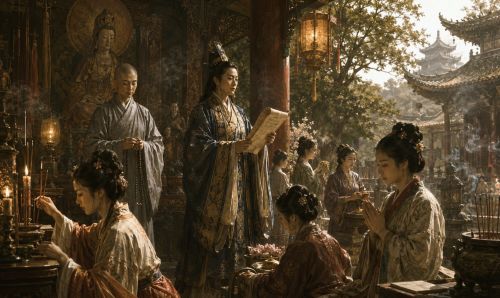
Women in China’s religious history navigated patriarchy through ritual, renunciation, goddess devotion, Christian service, and enduring forms of sacred authority.

By Matthew A. McIntosh
Public Historian
Brewminate
Introduction: The Paradox of Women’s Religious Power in China
Women’s religious history in China begins with a paradox that cannot be resolved by simple categories of oppression or liberation. For much of Chinese history, women lived under social systems that defined them through kinship: as daughters, wives, mothers, widows, daughters-in-law, and ancestors. Confucian moral teaching, lineage organization, and domestic ritual placed women inside a hierarchy that privileged male descent, male authority, and the continuation of the patriline. Yet the same civilization that restricted women so persistently also produced female shamans, Daoist adepts, Buddhist nuns, abbesses, temple patrons, spirit mediums, Christian teachers, consecrated virgins, Bible women, and some of the most powerful female divinities in East Asian religion. The result was not equality in any modern sense, but a long and unstable negotiation between containment and sacred capacity.
That negotiation unfolded across traditions that did not remain sealed from one another. Confucianism, though not a “religion” in the narrow Western sense, supplied the moral architecture of family life and public order. Daoism offered a different symbolic universe, one in which the feminine could signify hidden potency, cosmic receptivity, bodily cultivation, and transcendence. Buddhism introduced monastic alternatives to marriage and household obligation, allowing some women to live in female religious communities with access to learning, ritual authority, and institutional leadership. Popular religion elevated goddesses such as the Queen Mother of the West, Guanyin, and Mazu, whose divine power often exceeded the social power granted to ordinary women. Christianity, arriving in more sustained institutional form from the late imperial period onward, opened further spaces for female literacy, evangelism, education, medical work, and religious service, even as it carried its own patriarchal assumptions. Chinese women did not encounter “religion” as a single system. They moved through overlapping fields of family duty, ritual obligation, bodily discipline, divine patronage, renunciation, and communal labor.
The central question, then, is not whether religion oppressed or empowered Chinese women. It did both, often simultaneously. A Buddhist convent could free a woman from marriage while subordinating nuns to monks. A Daoist tradition could imagine female transcendence while preserving elite and male lines of textual authority. Confucian domestic ethics could confine women to the inner quarters while allowing mothers, widows, and mothers-in-law to exercise formidable moral influence within the family. Goddess worship could sacralize compassion, fertility, protection, and salvation in female form without granting living women equal access to formal authority. Even modern religious reform and Christian education could challenge practices such as footbinding and female illiteracy while replacing them with new ideals of disciplined, respectable womanhood. The history is not a clean movement from darkness to light, but a series of contested arrangements in which women used available religious languages to create authority where social structures often denied it.
I follow that tension chronologically, from early ritual worlds and classical gender ethics through Daoist revelation, Buddhist monasticism, Tang religious politics, late imperial domestic piety, Christian missions, Republican reform, Maoist suppression, and contemporary religious revival. Its argument is that women’s religious power in China was rarely a simple escape from patriarchy. More often, it was an art of conversion: turning obedience into moral prestige, motherhood into sacred authority, renunciation into institutional independence, bodily discipline into spiritual power, and devotion into social influence. Chinese religious history did not give women one path. It gave them competing scripts, some restrictive, some liberating, many deeply ambiguous. To study those scripts is to see women not merely as subjects of doctrine, but as interpreters, patrons, practitioners, teachers, and makers of religious life.
Before Orthodoxy: Ancestors, Shamans, and Women in Early Chinese Ritual Worlds
Before Confucian orthodoxy, Buddhist monasticism, or organized Daoist institutions gave Chinese religion its later vocabulary, the sacred world of early China was built around ancestors, sacrifice, divination, fertility, royal power, and communication with spirits. This was not a world of gender equality, and it would be misleading to imagine a lost matriarchal age before later patriarchy hardened. The evidence from the Shang and early Zhou periods already points toward hierarchy, elite male kingship, and the political centrality of patrilineal descent. Yet early Chinese ritual life had not yet been reduced to the later moral architecture of wifehood, widowhood, and domestic obedience. Women could appear as royal consorts, ancestral figures, mothers of lineage continuity, mourners, mediums, and ritual participants whose significance was inseparable from the sacred order of the household and the state.
The Shang dynasty offers the clearest early evidence because oracle bone inscriptions preserve royal questions about sacrifice, warfare, childbirth, illness, weather, and ancestral favor. These inscriptions reveal a society in which political authority and religious practice were not separate spheres. Kings divined, ancestors intervened, sacrifices mattered, and the dead remained active in the affairs of the living. Women entered this ritual universe through reproduction and kinship, but not only through passive domestic roles. Royal women could become ancestral powers after death, objects of sacrifice, and figures whose pregnancies, illnesses, and deaths were matters of divinatory concern. The female body was not merely private or biological. It was bound to lineage survival, dynastic anxiety, and communication between the human and ancestral worlds.
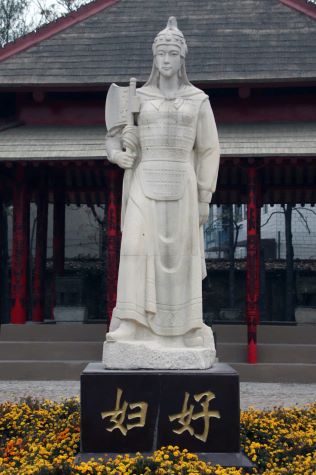
The most striking early example is Fu Hao, a consort of King Wu Ding of Shang, whose tomb at Yinxu was discovered intact in 1976 and remains one of the most important archaeological finds for the study of women in early China. Fu Hao is known from oracle bone inscriptions and from the extraordinary material record of her burial, which included bronze vessels, weapons, jade objects, bone artifacts, and sacrificial remains. Her historical significance lies in the way she disrupts later assumptions about female confinement. She appears in the record as a royal woman connected to military command, ritual activity, and elite authority. That does not make her representative of ordinary Shang women, nor does it prove broad female power across early China. It does show that elite women could occupy positions of sacred and political consequence before later ideological systems more tightly defined respectable womanhood through domestic subordination.
Fu Hao’s importance also lies in what she reveals about the fusion of gender, ritual, and violence in Shang kingship. Her tomb contained weapons as well as ritual bronzes, suggesting a life remembered through both martial and sacrificial authority. The oracle bone world was one in which war, hunting, childbirth, sacrifice, and ancestral favor belonged to a single field of power. Fu Hao’s presence within that field reminds us that early Chinese women’s religious history cannot be confined to later images of secluded wives and obedient daughters-in-law. Her exceptional status warns against romantic overcorrection. She was powerful because she stood close to the royal center, not because Shang society recognized women as equal ritual agents. Her authority came through rank, kinship, and proximity to kingship, which means her story illuminates both the possibilities and limits of female power in early ritual culture.
Beyond royal women, early Chinese sources also preserve traces of spirit mediums and ritual specialists, often discussed through the figure of the wu. The evidence is difficult and sometimes debated, but it points to a religious world in which communication with spirits could involve ecstatic performance, healing, rainmaking, exorcism, and embodied mediation. Later elite writers frequently treated such practices with suspicion, especially when associated with women, popular religion, or uncontrolled ritual power outside official sacrificial order. This suspicion is significant. It suggests that female religious agency did not disappear simply because it was absent from formal doctrine. It often survived in forms that male textual traditions distrusted, marginalized, or reclassified as dangerous excess. The medium, like the later nun, goddess devotee, or Christian Bible woman, occupied a threshold: necessary to religious life, but never fully secure within elite systems of authority.
The earliest phase of Chinese religious history establishes the pattern that will recur here. Women were rarely free from patriarchal structures, but they were also never religiously insignificant. They mattered as ancestors, mothers, consorts, mourners, mediums, and sacred bodies through whom lineage, fertility, sacrifice, and spirit communication were imagined. Later Confucianism would narrow women’s moral identity around obedience and domestic order, but it did not create female religious importance from nothing, nor did it erase older forms entirely. Beneath later orthodoxy remained an older religious landscape in which women could be feared, revered, consulted, sacrificed to, remembered, and made powerful precisely because they stood at the boundary between household, body, spirit, and lineage.
Classical Confucian Order: Family, Ritual, and the Moral Containment of Women
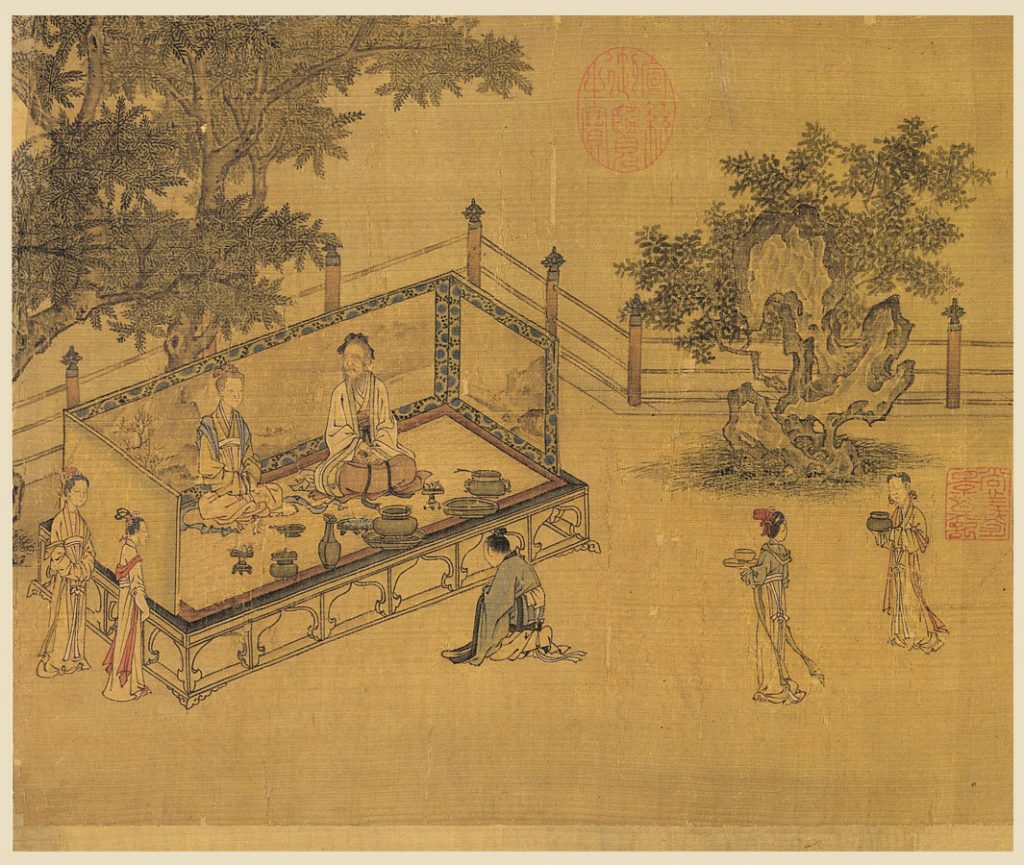
The classical Confucian order did not invent patriarchy in China, but it gave patriarchy one of its most durable moral languages. Earlier ritual worlds had already tied women to lineage, fertility, marriage exchange, mourning, and ancestral continuity. Confucianism reorganized those older patterns into a broader ethical system in which family hierarchy became the model for social and political order. The household was not merely private. It was the first school of obedience, reverence, ritual discipline, and moral self-cultivation. Within that structure, women were not imagined primarily as independent religious actors, but as daughters, wives, mothers, widows, and daughters-in-law whose conduct stabilized the patrilineal family. Their virtue mattered intensely, but precisely because it served a social order built around male descent, ancestral sacrifice, and hierarchical harmony.
The Confucian classics and ritual texts placed women within a world of differentiated roles rather than abstract individual equality. The Book of Rites and related ritual traditions emphasized separation between inner and outer domains, carefully ordered behavior between men and women, and the ritual importance of marriage as the means by which lineages continued. Marriage moved a woman from the household of her father to that of her husband, where she became responsible not only for domestic management but for incorporation into another ancestral line. Her religious significance was mediated through transfer: she left one lineage, entered another, bore heirs for that lineage, served parents-in-law, and eventually could become an honored ancestor herself. This movement was not merely social relocation. It was a ritual transformation, because marriage reclassified a woman’s obligations, loyalties, and sacred duties. Her body became tied to the future of her husband’s line, her labor to the stability of his household, and her moral reputation to the honor of families connected through alliance. The ancestral system required women, but it did not center them as independent lineage bearers. It made them indispensable conduits of continuity while assigning formal ancestral authority primarily to men. This was a powerful role, but it was not autonomous. It made women necessary to the ritual survival of the family while denying them equal authority over the family’s public and ancestral identity.
The moral vocabulary later summarized as the “Three Obediences” and “Four Virtues” crystallized this containment. A woman was expected to obey her father before marriage, her husband after marriage, and her son in widowhood. The four virtues emphasized moral conduct, proper speech, appropriate appearance or comportment, and diligent work. These ideals did not simply describe etiquette. They defined a gendered moral economy in which female virtue was measured by restraint, humility, labor, silence, and relational submission. The obedient woman was praised not because she lacked importance, but because her importance was supposed to be exercised through self-limitation. Confucian gender teaching made control appear ethical. It transformed hierarchy into duty, dependence into virtue, and domestic discipline into a sign of cosmic and social order.
Ban Zhao’s Lessons for Women is indispensable because it shows how this system could be articulated by a learned woman rather than only imposed by men. Writing in the Han period, Ban Zhao urged women to cultivate humility, obedience, industry, and respect within marriage. She advised girls to understand their subordinate position and to avoid arrogance, disorderly speech, and failure in domestic responsibility. Yet the text is more complex than a simple manual of submission. Ban Zhao herself was a scholar, historian, teacher, and court intellectual, which means her authority exceeded the ideal of silence she recommended to other women. Her writing reveals the paradox at the heart of Confucian female education: women could be taught, and sometimes could teach, but the knowledge deemed proper for them was meant to strengthen rather than overturn hierarchical family order. This is precisely why Lessons for Women matters so much for the history of Chinese religion and morality. It does not simply show women being crushed by ideology from the outside. It shows a woman of exceptional learning translating patriarchal order into a program of female discipline, survival, and respectability. Ban Zhao’s authority depended on her mastery of the textual culture that usually privileged men, yet she used that mastery to instruct women in humility and compliance. Her position exposes the inner contradiction of Confucian gender thought: female learning was valuable when it made women better servants of household order, but dangerous if it encouraged autonomy, public ambition, or resistance to ritual hierarchy.
This paradox created limited but real spaces of female authority. A young bride often entered her husband’s household from a position of vulnerability, subject to the authority of her husband, his parents, and especially her mother-in-law. Women could gain influence through motherhood, age, household management, ritual competence, and the successful production of sons. The mother of adult sons could become a formidable figure within the domestic hierarchy, commanding obedience from younger women and exercising moral force within the extended family. Confucianism did not make all women equally powerless. It arranged women along lines of age, marital status, fertility, and generational authority. The daughter-in-law might be subordinated, but the mother-in-law could become one of the household’s most feared and respected figures.
Ritual deepened this authority while also limiting it. Women mourned, prepared offerings, maintained domestic order, and participated in the emotional and practical labor that sustained ancestor reverence. Their work made ritual continuity possible, even when formal ancestral representation privileged men. Confucianism depended on women while restricting the terms under which their dependence could be acknowledged. A household could not reproduce itself physically, ritually, or morally without women, but the public language of lineage centered fathers, sons, and male ancestors. Women’s religious importance was often indirect, embedded in the ordinary labor of cooking, weaving, childrearing, mourning, instruction, and service. The sacred passed through their hands, but the official grammar of the sacred rarely placed them at the center.
The classical Confucian order established one of the most enduring tensions in Chinese women’s religious history. It contained women morally, spatially, and ritually, but it also made their conduct indispensable to the survival of family, lineage, and social order. Its ideal woman was obedient, restrained, productive, and loyal, yet she could become powerful as mother, educator, widow, manager, and ancestor. This was not liberation. It was authority under discipline, dignity under hierarchy, and religious significance under male-centered ritual control. Later Daoist, Buddhist, popular, and Christian traditions would offer women alternative languages of sacred power, but none of them operated outside the Confucian family system altogether. Even when women renounced the household, became nuns, worshiped goddesses, or entered Christian service, they did so in a society whose deepest moral reflex still asked how a woman stood in relation to father, husband, son, lineage, and home.
Han and Early Imperial Religion: Yin, Cosmology, and the Ambiguous Feminine
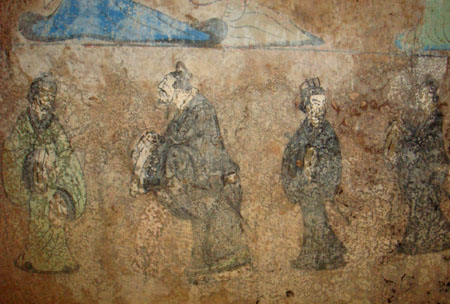
The Han and early imperial period gave Chinese gender thought a wider cosmological frame. Confucian family hierarchy did not disappear, but it increasingly operated within a universe imagined through patterned correspondences: Heaven and earth, ruler and subject, father and son, husband and wife, yang and yin. Gender became more than a household arrangement. It became part of the structure of reality itself. This mattered profoundly for women because social hierarchy could now be described as cosmic harmony. Male authority was not merely customary or political. It could be presented as an extension of the natural order. Yet the same cosmological language that subordinated women also made the feminine indispensable, because yin was not evil, accidental, or unnecessary. It was one of the two fundamental modes through which the universe operated.
Yin-yang thought associated yang with brightness, activity, heat, Heaven, masculinity, and outward motion, while yin was linked with darkness, receptivity, coolness, earth, femininity, and inwardness. Later readers sometimes reduce this to a simple hierarchy in which yang is superior and yin is inferior, but early Chinese cosmology was more complicated than that. Yin and yang were relational, alternating, and mutually dependent. Neither could exist as an isolated absolute. Day required night, heat required cold, activity required rest, and generation required the interplay of both forces. This gave the feminine a double meaning. On one level, it helped justify the social subordination of women by aligning them with what was lower, hidden, receptive, and domestic. On another level, it made the feminine part of the basic grammar of existence, without which neither life nor order could continue.
Han correlative cosmology intensified this ambiguity by linking human conduct to cosmic balance. The family, the state, the seasons, the body, ritual, music, medicine, and government could all be interpreted as parts of a single patterned world. Disorder in one realm could resonate through others. A household governed improperly, a ruler who failed in virtue, or a ritual imbalance might not be merely local failure. It could reflect a deeper disruption in the relation between Heaven, earth, and humanity. Women’s conduct, especially in marriage, sexuality, fertility, mourning, and domestic discipline, acquired a cosmological seriousness. Female behavior was not treated as private preference. It became part of the moral and ritual regulation of the world.
This did not give most women formal power, but it did give their bodies and conduct symbolic weight. Menstrual blood, pregnancy, childbirth, sexual activity, widowhood, and mourning all belonged to a world where bodily processes were read through moral and cosmological categories. The female body could be honored as generative, feared as unstable, disciplined as dangerous, and ritualized as necessary. Motherhood carried enormous significance because it joined biology, lineage, morality, and ancestral futurity. A woman who bore sons contributed to the survival of a patriline, but she also participated in the larger cosmic process of generation. Yet that generative power was rarely allowed to become independent authority. It was absorbed into the household and interpreted through male-centered lineage needs. The mother mattered deeply, but the system valued her most when her fertility served the continuity of fathers and sons.
Daoist thought drew different possibilities from the same symbolic field. The Daodejing repeatedly praises softness, yielding, receptivity, valley-like emptiness, and the mysterious female as images of the Dao’s power. This did not mean historical Daoist communities automatically treated women as equals, but it gave later Daoist religion a language in which the feminine could represent spiritual depth rather than mere subordination. The mother, the valley, the infant, and the soft overcoming the hard all challenged the most aggressive forms of masculine political and social ambition. In that sense, Daoist cosmology did not simply reverse Confucian hierarchy. It destabilized the assumption that visible dominance was the highest form of power. The feminine could become a metaphor for hidden strength, generative emptiness, and alignment with the deeper movement of the cosmos.
Medical and bodily traditions also helped make the feminine ambiguous rather than simply inferior. Early Chinese medicine understood bodies through dynamic balances of qi, blood, yin, yang, essence, and organ systems. Women’s bodies were often treated as distinct because of menstruation, pregnancy, childbirth, and lactation, and later medical texts developed specialized traditions concerning female health. These traditions could pathologize women or treat them as more vulnerable to imbalance, but they also preserved attention to female embodied experience in ways that mattered for religious life. Longevity practices, sexual cultivation, breath techniques, and inner alchemical traditions would later interpret gendered bodies as sites of transformation. The body was not merely a prison or a biological fact. It was a field of cosmic forces, and that meant women’s bodies could be disciplined, feared, healed, cultivated, and sacralized.
The early imperial feminine, then, was never one thing. It was subordinate in family hierarchy, necessary in cosmic balance, powerful in generation, suspect in bodily instability, and spiritually suggestive in Daoist symbolism. This ambiguity would shape every later religious tradition in China. Confucianism could use yin-yang thinking to naturalize women’s obedience. Daoism could use feminine imagery to articulate transcendence. Buddhism would encounter a Chinese world already prepared to see the female body as both powerful and problematic. Popular religion would elevate goddesses whose compassion, fertility, and protection drew on deep associations between femininity and generative force. The Han and early imperial period did not merely place women below men in a cosmic scheme. It created a symbolic vocabulary in which the feminine could be contained, feared, revered, and transformed.
Early Daoism: Revelation, Priestesses, and Female Transcendence
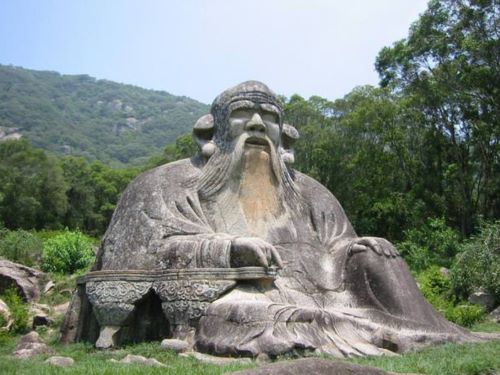
Early Daoism offered Chinese women a religious vocabulary that differed sharply from the Confucian grammar of household obedience. It did not abolish patriarchy, nor did it free women from family, class, or textual mediation by men. Yet it imagined sacred power in ways that could make the feminine more than a sign of domestic subordination. Daoist traditions valued hiddenness, receptivity, bodily refinement, cosmic alignment, and transformation beyond ordinary social rank. These ideals did not automatically translate into social equality, but they did create openings through which women could appear as adepts, priestesses, visionaries, transmitters of revelation, ritual specialists, and immortals. In a society where Confucian moral language most often measured women by daughterhood, wifehood, motherhood, and widowhood, Daoism preserved a rival possibility: the woman as one who could cultivate the body, receive the divine, command ritual knowledge, and transcend the limits of ordinary human existence.
The roots of this possibility lay partly in Daoism’s symbolic imagination. The Daodejing had already praised the soft over the hard, the low over the exalted, the valley over the peak, and the mysterious female as an image of inexhaustible generative power. Later Daoist religion inherited this language and gave it institutional, ritual, and visionary forms. The feminine could signify the hidden source of life, the womb-like depth of the Dao, and the power of yielding rather than domination. This did not mean that Daoist communities uniformly elevated living women above men. Symbolic femininity and actual women’s authority are never the same thing. Still, Daoism gave women a metaphysical advantage that Confucian hierarchy often denied them. If the deepest power of the cosmos was hidden, receptive, generative, and subtle, then qualities culturally associated with femininity could be reimagined as marks of spiritual depth rather than signs of weakness. This symbolic inversion mattered because it challenged the assumption that authority must always appear as command, office, domination, or public visibility. In Daoist language, power could be concealed, inward, quiet, bodily, and transformative. The valley nourished precisely because it was low; water overcame precisely because it yielded; the mother generated precisely because she did not grasp. Such images could never by themselves overturn household patriarchy, but they gave Daoist women and their later interpreters a religious grammar in which female-associated qualities could point toward the Dao rather than away from it.
Organized Daoist movements gave some women more concrete roles. The Celestial Masters tradition, emerging in the second century CE, developed communal registers, ritual offices, healing practices, confession rites, and structures of religious leadership. Women could participate in these communities not only as lay followers but also as ritual actors and religious functionaries. Early Daoist communities were not modern egalitarian spaces, but they sometimes allowed women to hold recognized religious positions in ways that contrasted with the more male-centered public order of Confucian officialdom. The Daoist priestess or female adept occupied a different kind of authority from the matriarch of the household. Her power came through ritual discipline, cosmic knowledge, bodily practice, and participation in a sacred bureaucracy that linked human communities to divine forces.
Female transcendence was also central to Daoist hagiography and religious imagination. Women could become immortals, ascend beyond ordinary mortality, and appear as teachers or divine beings whose authority exceeded social rank. These stories must be read carefully. They often come to us through male-authored or male-edited texts, and they could transform historical women into symbolic figures shaped by later religious ideals. Yet even that literary transformation matters. A tradition that repeatedly imagined women as adepts and immortals created sacred roles that could not be reduced to wife, mother, or widow. Female bodies, often treated in Confucian and medical discourse as vulnerable or morally regulated, could become sites of refinement, alchemical possibility, and divine transformation. The woman did not have to be merely the vessel of lineage continuity. In Daoist imagination, she could become a perfected being.
Wei Huacun became one of the most important figures for this history. Traditionally remembered as a foundational figure associated with the Shangqing, or Highest Clarity, revelations, she stands at the intersection of elite womanhood, family identity, visionary authority, and Daoist sanctity. Wei was not imagined as powerful because she abandoned every social category attached to women. Her later religious prestige remained connected to her identity as daughter, wife, widow, mother, and aristocratic woman. That connection is crucial. Daoism could open routes toward transcendence, but those routes were still interpreted through the social world women inhabited. Wei Huacun’s authority shows both possibility and constraint. She became a revered transmitter of sacred knowledge, yet her sanctity was made intelligible through the very family categories that Confucian society used to define respectable womanhood.
The Shangqing tradition deepened the connection between revelation and refined religious authority. Its scriptures described celestial beings, visionary journeys, inner visualization, bodily transformation, and access to higher realms. This was a more elite and textual form of Daoism than many local ritual practices, and women’s access to it depended heavily on status, education, patronage, and networks of transmission. Even so, the tradition’s association with Wei Huacun gave female sanctity a prestigious place in Daoist memory. A woman could be more than a participant in household rites or local cult. She could be remembered as a node of revelation, a mediator between celestial and human worlds, and a figure whose spiritual attainment reshaped the authority of an entire school. Shangqing practice also mattered because it shifted religious power inward, into visionary discipline, bodily imagination, and communion with perfected beings. That inward turn did not eliminate hierarchy, but it created a space in which sacred authority could be cultivated through practices not identical with public office or bureaucratic rank. For women, this was especially significant. If the household and state restricted formal authority, visionary religion could locate power in disciplined perception, purity, recitation, visualization, and bodily transformation. The female adept became legible not only through kinship but through her capacity to receive, embody, and transmit revelation. In that sense, Shangqing Daoism preserved a memory of female religious power that was neither purely domestic nor fully institutional, but something more elusive and potent: sanctity as interiorized access to the celestial order.
Early Daoism did not simply reverse Confucian gender hierarchy. It created a different field of religious possibility. Confucianism tended to make women morally legible through service to the family; Daoism could make them spiritually legible through receptivity to the Dao, bodily cultivation, visionary experience, and transcendence. The same woman might be judged in one register by her obedience and in another by her capacity for sacred refinement. This duality would remain central to Chinese women’s religious history. Daoist women did not live outside patriarchy, but Daoism gave them a language in which the feminine could be cosmic, the body could be transformative, and religious authority could flow from hiddenness rather than public office. In that sense, Daoism preserved one of the most enduring alternatives to the moral containment of women in the Chinese tradition.
The Arrival of Buddhism: Renunciation, Nunneries, and Escape from the Lineage
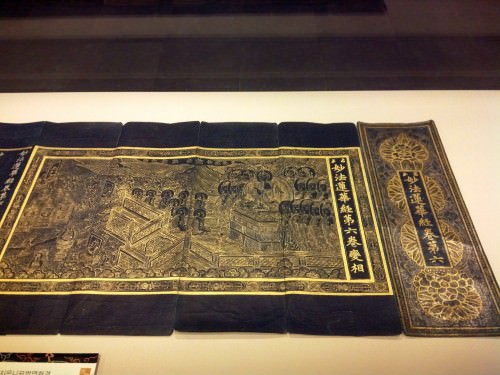
Buddhism entered China as a foreign religion, but its consequences for women cannot be measured only by doctrine. Its deepest disruption was social and institutional. In a world where Confucian family ethics tied women to marriage, fertility, service to parents-in-law, and the production of heirs, Buddhism introduced the possibility that a woman might pursue religious purpose outside the lineage. The Buddhist path did not abolish the family system, and it did not free women from hierarchy. Yet it made renunciation visible, respectable, and spiritually meaningful. A woman could leave the ordinary cycle of daughter, wife, mother, widow, and ancestor, not simply as a failed woman or social burden, but as a religious practitioner whose departure from household life could be interpreted as a higher vocation.
This was a radical possibility because the Chinese patrilineal household depended on women without granting them independent ritual identity. Marriage transferred a woman into her husband’s family, where her worth was measured through obedience, labor, fertility, and service. Buddhism did not merely offer consolation within that arrangement. It offered an alternative structure of belonging. The monastic community, or sangha, placed religious discipline above reproduction and ritual lineage. For men, this could create tension with filial duty, since leaving the family meant failing to continue the ancestral line. For women, the tension was sharper still, because their social identity had been so thoroughly bound to marriageability and domestic usefulness. To become a nun was to step outside the expected female life course and claim that the pursuit of liberation could outrank the obligations of wifehood and motherhood.
Yet Buddhism’s arrival did not create a simple story of emancipation. Buddhist traditions brought their own gendered hierarchies from India and Central Asia, including rules that subordinated nuns to monks and textual traditions that sometimes treated the female body as karmically disadvantaged, impure, or spiritually inferior. Mahayana Buddhism could affirm universal Buddha-nature and the possibility of salvation for all beings, while still preserving images of womanhood as unstable, seductive, polluted, or incomplete. This tension became part of Chinese Buddhism from the beginning. The female renunciant could be honored for discipline and devotion, but she could also be treated as requiring supervision, purification, and doctrinal justification. Chinese interpreters did not receive these ideas passively. They translated, adapted, softened, intensified, and sometimes redirected them through local assumptions about filial duty, ritual purity, and family hierarchy. This meant that Buddhist womanhood in China was shaped by two overlapping systems of suspicion: imported Buddhist unease about the female body and indigenous concern that women outside family control threatened social order. Buddhist doctrine also contained tools that could undermine those suspicions, especially the insistence that worldly identity was impermanent and that awakening could not finally be confined to gender, status, or birth. That unresolved contradiction gave Chinese Buddhist women both a burden and an opening.
The importance of nunneries lay in the fact that they made female religious community durable. A Buddhist nun did not simply become an isolated ascetic. She entered an institution with rules, teachers, ritual obligations, property, patrons, and public visibility. Convents could provide education, protection, collective discipline, and opportunities for leadership. They allowed women to learn scriptures, perform rituals, receive patrons, train disciples, and create networks of female authority that were not reducible to the household. This mattered especially because women’s authority in Confucian domestic life usually increased with age, motherhood, and control over younger women. In Buddhist convents, authority could be grounded instead in ordination, discipline, learning, spiritual charisma, and seniority within the religious community. It was still hierarchical, but it was not simply marital or reproductive.
The early Chinese record of Buddhist nuns is unusually valuable because Baochang’s Biographies of Buddhist Nuns, compiled in the early sixth century, preserved the lives of women from the fourth through sixth centuries. The text gives us nuns who study, preach, debate, endure hardship, heal, inspire patrons, resist family pressure, and become models of religious seriousness. It also shows how deeply embedded these women remained in social expectations. Some came from elite families. Some entered religious life after widowhood, illness, bereavement, or family crisis. Some faced opposition from relatives who expected them to marry or remain within household obligations. Their sanctity was often narrated through endurance, chastity, filial feeling, miraculous signs, and bodily discipline. The text does not show women simply escaping patriarchy. It shows them negotiating it through Buddhist categories of merit, renunciation, karmic destiny, and spiritual resolve.
For many women, Buddhism also transformed suffering into religious meaning. Illness, widowhood, child loss, domestic vulnerability, and the instability of war could all become occasions for turning toward the Dharma. This did not make suffering good, nor should it be romanticized. Rather, Buddhism gave women a language for interpreting suffering outside the narrow moral expectations of the family. A widow might refuse remarriage not merely as Confucian chastity but as Buddhist renunciation. A daughter might resist marriage by claiming a karmic vocation. A woman facing illness might understand the body not only as a site of weakness but as a reminder of impermanence. A nun might discipline hunger, sleep, sexuality, and speech not to become a better wife, but to cultivate liberation. These were powerful reinterpretations of female experience.
Laywomen also mattered. The Buddhist transformation of women’s religious life was not limited to those who took vows. Women inside households sponsored temples, copied sutras, made offerings, supported monks and nuns, observed vegetarian practices, joined devotional communities, and sought merit for parents, husbands, children, ancestors, and themselves. Buddhism entered the domestic world even as it offered an alternative to it. A woman did not have to leave the family to use Buddhist ritual and devotion as tools of moral agency. Merit-making allowed women to act religiously within the family while imagining consequences beyond lineage: rebirth, karmic purification, salvation, and compassion for all beings. Buddhism widened the horizon of female religious action. The household remained important, but it was no longer the only sacred frame. This was especially significant because Buddhist merit could move across boundaries that Confucian lineage ritual tended to police more narrowly. A woman could dedicate merit to deceased kin, living relatives, future rebirths, suffering beings, or her own liberation. Her ritual labor could still serve the family, but it could also exceed it. Through offerings, vows, chanting, sutra copying, and patronage, laywomen participated in a moral economy that connected domestic grief to cosmic compassion. That enlarged field did not dissolve patriarchal expectation, but it gave women religious work whose meaning was not exhausted by obedience, fertility, or service to the ancestral line.
The arrival of Buddhism changed the history of Chinese women not because it solved the problem of patriarchy, but because it multiplied the possible meanings of a woman’s life. Confucian order had made the family the central site of female virtue. Buddhism made renunciation, celibacy, convent life, scriptural learning, merit-making, and liberation available as competing ideals. That competition did not always free women, and Buddhist institutions themselves could reproduce male authority. Still, the existence of nunneries created one of the most significant alternatives to the patrilineal household in Chinese history. For the first time on a large and durable scale, women could belong to a religious community that defined them not primarily by the sons they bore, the husband they served, or the ancestors they sustained, but by vows, discipline, learning, and the pursuit of awakening.
Medieval Buddhist Women: Convents, Patronage, and the Sacred Politics of Female Community
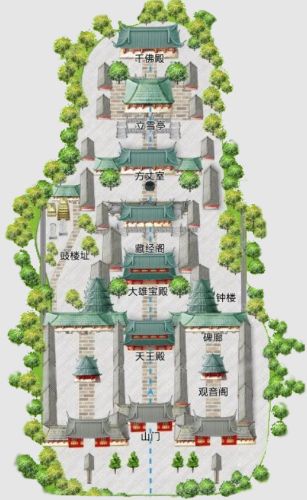
Once Buddhism had taken root in China, women’s religious lives were transformed not only by the possibility of renunciation but by the emergence of durable female institutions. The convent was one of the most important of these. It offered women a collective religious home outside the ordinary demands of marriage, childbirth, and service to a husband’s lineage. Yet convents were not merely shelters for women who had left the household. They were disciplined communities with rules, hierarchies, ritual obligations, patrons, property, teachers, disciples, reputations, and political vulnerabilities. A nun’s life was neither pure escape nor simple seclusion. It was participation in a female religious world that had to negotiate family expectations, monastic regulation, state suspicion, local patronage, and the authority of male Buddhist institutions.
The power of the convent lay partly in its ability to remake kinship. In the patrilineal household, a woman’s identity was defined through blood, marriage, fertility, and descent. In a convent, belonging could be organized through ordination, seniority, discipline, teaching, and shared practice. Nuns became religious sisters, disciples, teachers, abbesses, and ritual specialists. These bonds did not erase family memory, and many women remained connected to natal or marital kin through patronage, mourning, and merit-making. Still, convent life allowed women to imagine a community that was not governed primarily by husbands, sons, fathers-in-law, or mothers-in-law. It created a sacred household of another kind, one in which female authority could be measured by religious attainment rather than reproductive success.
This female community had public significance. Convents performed rituals, received donations, copied texts, educated novices, housed sacred images, and became sites of local devotion. Their survival depended on relationships with patrons, and those patrons could include elite women, aristocratic families, officials, lay devotees, and sometimes rulers. Patronage was never neutral. It protected convents, enriched them, and increased their prestige, but it also tied them to political and social expectations. A well-supported convent could become a respected religious center; a poorly protected one could be vulnerable to confiscation, scandal, or suppression. Buddhist women lived within a sacred economy in which spiritual authority, material support, and public reputation reinforced one another. This economy also gave women opportunities to act as patrons in their own right. Elite women could fund images, sponsor rituals, support ordinations, commission sutra copying, or attach family memory to Buddhist merit. Even when their gifts were framed through filial devotion, mourning, or concern for the salvation of relatives, such acts placed women inside the public life of Buddhist institutions. Patronage allowed women to convert wealth, grief, family obligation, and religious aspiration into visible sacred action. It also tied female piety to the material survival of the sangha, making women not simply recipients of Buddhist care but active builders of Buddhist religious worlds.
Abbesses occupied especially important positions in this world. They were not simply pious women at the head of quiet communities. They governed property, maintained discipline, managed relations with donors, oversaw ritual life, trained younger women, and represented the convent to the wider Buddhist and lay community. Their authority was institutional rather than domestic, which made it distinct from the power of mothers-in-law or elder widows within Confucian households. Yet that authority remained fragile. Abbesses had to demonstrate moral discipline, doctrinal seriousness, ritual competence, and social respectability in a world ready to suspect women’s communities of disorder if they appeared too independent. Female Buddhist leadership required both charisma and caution.
The biographies of early medieval nuns show how sanctity could be narrated through forms of discipline that were recognizable to both Buddhist and Chinese moral audiences. Nuns are praised for austerity, scriptural learning, meditation, preaching, filial concern, chastity, compassion, miraculous power, and endurance under pressure. These virtues bridged traditions. Filial devotion could reassure families that Buddhism did not destroy moral obligation; celibacy could be read as both Buddhist renunciation and a form of chastity; suffering could be interpreted as karmic seriousness and moral resolve. Medieval Buddhist women often gained authority by translating their religious choices into terms that Confucian society could partially respect, even when those choices challenged family expectations. This rhetorical balancing act mattered because Buddhist women had to make renunciation legible in a culture suspicious of abandoning household duties. A nun who left home could be accused of rejecting the family, but a nun who pursued awakening on behalf of parents, ancestors, patrons, or all sentient beings could be represented as morally serious rather than socially deviant. The language of merit was especially useful here. It allowed Buddhist women to redefine withdrawal from the household as a wider form of obligation, one that extended beyond the patriline to the suffering dead, the living community, and the cosmic field of rebirth. Buddhist female sanctity did not merely oppose Confucian values. It absorbed, redirected, and sometimes outflanked them.
Convents could produce conflicts precisely because they drew women away from the reproductive and labor needs of the household. Families might oppose a daughter’s ordination, resent a widow’s refusal to remarry, or fear the economic loss of a woman entering religious life. State authorities, too, periodically worried about the growth of monastic communities, the loss of taxable labor, and the accumulation of Buddhist property. These anxieties affected monks and nuns alike, but women’s communities were especially exposed because female autonomy was already culturally suspect. A convent could be revered as a site of holiness or criticized as a place where women escaped proper supervision. The same institution that made female religious community possible also made it visible enough to attract surveillance.
Medieval Buddhist women occupied a sacred politics of community. Their convents stood between household and monastery, family and state, renunciation and patronage, female solidarity and male oversight. They offered women one of the most powerful alternatives to lineage-centered life in premodern China, but that alternative remained negotiated rather than absolute. The nun did not simply vanish from society. She entered another social world, one built from vows, discipline, donors, ritual service, and female networks. In that world, women could govern, teach, remember, mourn, heal, and pursue awakening together. The significance of medieval Chinese Buddhist convents lies in that collective possibility: they gave women not only a path away from the household, but a sacred community in which female religious authority could endure beyond the exceptional life of any single woman.
Tang Dynasty High Point: Daoist Nuns, Buddhist Queenship, and Empress Wu

The Tang dynasty marked one of the most visible moments of female religious authority in premodern China. This does not mean that Tang women lived outside patriarchy, nor that religious institutions suddenly became egalitarian. Confucian expectations of marriage, family hierarchy, chastity, and lineage continuity remained powerful, and women’s access to religious authority was still shaped by class, court politics, and male textual control. Yet the Tang world created unusually dynamic spaces in which elite women, Daoist nuns, Buddhist patrons, princesses, empresses, and female deities could become publicly significant. The dynasty’s cosmopolitan culture, aristocratic social patterns, imperial patronage of religion, and rivalry between Buddhist and Daoist institutions all widened the field in which women could act. Female sacred power did not become ordinary, but it became harder to dismiss.
Daoism held special prestige under the Tang because the imperial house claimed descent from Laozi, whose surname Li matched that of the ruling family. This political association elevated Daoism at court and gave Daoist institutions unusual symbolic weight. For women, Daoism offered both institutional and imaginative possibilities. Princesses and elite women could enter Daoist religious life without disappearing into social disgrace. Becoming a Daoist nun could function as an act of devotion, a political arrangement, a form of retreat, or a way to inhabit religious identity while remaining close to aristocratic networks. The Daoist convent was not identical to the Buddhist nunnery, but both created spaces in which women could live outside ordinary marriage structures and claim sacred status. In the Tang context, Daoist female religious life could be refined, aristocratic, and publicly legible. It also allowed women of high status to remain socially consequential while stepping away from the ordinary reproductive expectations of marriage. A princess who became a Daoist nun did not necessarily vanish from politics or family strategy; she could continue to embody dynastic prestige, sponsor ritual activity, maintain ties to the court, and participate in a sacred order that reflected imperial legitimacy. This made Daoist renunciation particularly flexible. It could appear as piety, withdrawal, discipline, or political positioning depending on circumstance. For women whose lives were otherwise defined by marriage alliances and family management, Daoist ordination offered a rare religious identity that could preserve honor while redirecting authority toward ritual cultivation, purity, and transcendence.
Tang Daoist women occupied a world where renunciation and rank could reinforce one another. Elite status gave some women access to education, patronage, ritual specialists, sacred texts, and protected institutions. Religious status, in turn, could transform elite women into figures of purity, learning, and spiritual distinction. This was not available equally to all women. Poorer women, servants, concubines, and enslaved women did not experience Daoist religious life in the same way as imperial princesses or aristocratic daughters. Still, the presence of women in Tang Daoist institutions matters because it shows that religious vocation could become a respectable alternative to the marriage-centered life course, especially when protected by class and courtly culture. The female Daoist was not simply a failed wife or abandoned widow. She could be a disciplined religious actor whose status drew from both lineage prestige and sacred cultivation.
Buddhism also offered Tang women powerful forms of public religious identity. Elite women sponsored temples, commissioned images, supported monks and nuns, copied sutras, and attached their names to acts of merit. Buddhist patronage allowed women to enter public religious memory through devotion, wealth, and ritual generosity. Court women could use Buddhist institutions to honor relatives, seek healing, accumulate merit, and participate in the spiritual politics of the dynasty. Buddhism’s language of compassion, karmic merit, rebirth, and universal salvation gave women religious tools that exceeded the narrow framework of patrilineal obligation. A woman might still act for the sake of family, ancestors, or sons, but Buddhist devotion allowed that action to be imagined within a cosmic moral order broader than lineage alone.
The most extraordinary figure in this landscape was Empress Wu Zetian, who ruled first through existing imperial structures and then as emperor of her own Zhou dynasty. Her reign exposed the limits of Confucian political imagination because the classical order had no comfortable place for a woman occupying the supreme position of Son of Heaven. Wu turned with particular force to Buddhist cosmology, prophecy, and symbolism. Buddhism supplied languages of universal kingship, merit, karmic destiny, and sacred transformation that could help answer the ideological scandal of female sovereignty. Texts and rituals associated with her rule presented her not as a woman improperly seizing male authority, but as a divinely sanctioned ruler whose appearance fulfilled cosmic necessity. Religion did not merely decorate her politics. It helped make her rule thinkable.
Wu Zetian’s use of Buddhism should not be reduced either to cynical propaganda or pure devotion. It was both political and religious, strategic and sincere, personal and institutional. She patronized Buddhist clergy, supported major ritual projects, and drew upon ideas that elevated her above the gendered limits of Confucian rulership. Yet her case also reveals the fragility of female authority when it became too visible. Later historians, writing within male-centered Confucian frameworks, often treated her reign as unnatural, dangerous, manipulative, or monstrous. The very religious tools that enabled her rule became part of the controversy surrounding her memory. Wu Zetian showed that Buddhism could help authorize female sovereignty, but she also showed how fiercely later political culture could punish a woman who crossed from sacred influence into supreme public power.
The Tang high point was not a simple age of liberation, but a moment when the contradictions of women’s religious authority became unusually visible. Daoist nuns could claim sacred distinction, Buddhist women could build merit and institutions, princesses could inhabit religious roles, and Empress Wu could use Buddhist cosmology to challenge the gendered grammar of rulership itself. Yet every one of these openings depended on negotiation with dynasty, class, ritual hierarchy, and male-authored memory. Tang religion expanded what women could be imagined to do, but it did not remove the suspicion attached to women who acted too publicly or too powerfully. The period’s importance lies in that tension. It revealed how religion could open doors that Confucian political and family order kept closed, while also showing that women who walked through those doors remained vulnerable to moral containment after the fact.
Goddesses and Popular Religion: Guanyin, Xiwangmu, Mazu, and the Feminization of Compassion and Protection
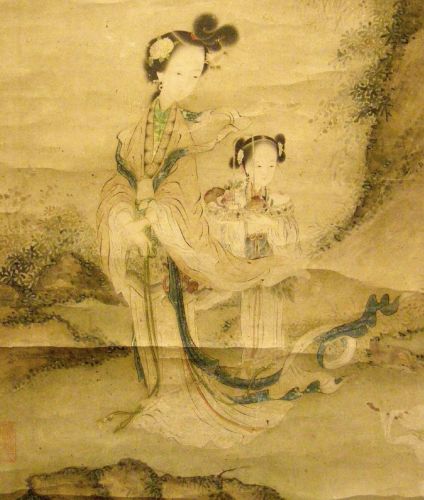
Female religious power in China did not appear only through women who became nuns, priestesses, patrons, or rulers. It also appeared through divine women, transformed women, feminized bodhisattvas, motherly saviors, and protective goddesses whose cults reached far beyond elite institutions. Popular religion gave the feminine a visibility that formal social hierarchy often denied to living women. Temples, festivals, vows, miracle tales, pilgrimage sites, household altars, and local legends allowed female sacred figures to become protectors of families, sailors, children, merchants, mothers, villages, and states. Yet this visibility created another paradox. Chinese religion could elevate female divinity to extraordinary heights while ordinary women remained subject to patriarchal control. A goddess might save men, command storms, grant children, heal illness, and receive imperial titles, even as living women struggled to claim comparable authority in family, lineage, or clergy.
The Queen Mother of the West, or Xiwangmu, shows how ancient and complex female divinity could be. Her figure developed across early mythology, Han visual culture, Daoist imagination, and medieval religious literature. At times she appears as a powerful western deity associated with immortality, cosmic geography, paradisal realms, and divine authority. Her sacred presence was not simply maternal or gentle. She could be majestic, dangerous, erotic, salvific, and sovereign. This matters because female divinity in China was never reducible to domestic motherhood. Xiwangmu represented a form of feminine power that exceeded household categories entirely. She belonged to mountains, heavens, immortals, cosmic order, and the promise of transcendence. Her religious career demonstrates that Chinese traditions could imagine female sacred authority as primordial and sovereign even when human women were expected to remain obedient within the family.
Xiwangmu also helped link feminine divinity to Daoist aspirations for transcendence. In medieval Daoist texts, she became associated with immortals, perfected beings, celestial banquets, and access to higher realms. Her court could be imagined as a sacred assembly in which human seekers encountered divine power beyond ordinary social limits. For women, this mattered indirectly but profoundly. Xiwangmu was not merely an object of devotion. She was a model of female cosmic authority, a divine queen whose power was not derived from husband, son, or father. Later female adepts and Daoist women could be associated with the broader world of immortality that figures like Xiwangmu governed or symbolized. The goddess preserved a religious imagination in which femininity could be linked to sovereignty, longevity, and divine transformation rather than only fertility or domestic service.
Guanyin represents a different but equally important transformation. Originating from Avalokiteśvara, a bodhisattva associated with compassion, responsiveness, and the hearing of cries, Guanyin gradually became feminized in China. This transformation did not occur in a single moment, nor did it erase earlier male or androgynous forms. Guanyin became one of the most beloved female sacred figures in Chinese religious life. She answered prayers, protected women in childbirth, rescued people from danger, granted children, comforted the suffering, and embodied compassion in a form that ordinary devotees could approach intimately. Her femininity was not only theological. It was devotional. People encountered Guanyin as a merciful presence whose saving power felt maternal, immediate, and emotionally accessible.
The feminization of Guanyin reveals how Chinese Buddhism adapted to local religious needs. A bodhisattva of universal compassion became increasingly legible through images of motherhood, mercy, purity, and salvific care. This made Guanyin especially important for women, but not only for women. Men, women, children, officials, monks, merchants, travelers, and the sick could all seek her aid. Her power crossed gender boundaries precisely because compassion itself was feminized without being confined to female devotees. Yet Guanyin’s popularity also exposes the difference between sacred femininity and social gender equality. A culture could adore a female savior while still expecting daughters-in-law to obey mothers-in-law, wives to serve husbands, and widows to preserve chastity. Guanyin softened the religious imagination, but she did not overturn the household order. Her appeal also rested on her ability to hold together contradictions that ordinary women were forced to live under more painfully. She could be maternal without being confined to biological motherhood, pure without being socially powerless, compassionate without being submissive, and responsive without being subordinate. This made her a uniquely flexible figure for devotees navigating grief, fertility anxiety, childbirth danger, illness, poverty, and family pressure. For women, especially, Guanyin could become a divine listener in a world where their own speech was often disciplined or ignored. For men, she offered protection and mercy without threatening the structures that gave them authority. That dual function helps explain her extraordinary durability: she could console the vulnerable while remaining acceptable to the powerful.
Mazu, the sea goddess, adds yet another dimension: protection, locality, and communal identity. Emerging from the cult of Lin Moniang, a young woman from the Fujian coast who became venerated after death, Mazu grew into one of the most important deities of coastal China and the wider maritime world. She protected sailors, fishermen, merchants, migrants, and communities bound to dangerous waters. Her cult expanded through local devotion, mercantile networks, imperial recognition, and migration across the South China Sea. Unlike Guanyin, whose compassion could feel universal and Buddhist-inflected, Mazu’s power was deeply tied to place, sea travel, danger, and community protection. She was a goddess of perilous movement, and her worship followed people across water.
Mazu’s cult also shows how female divinity could serve many social purposes at once. For women, she could be a protective presence, a divine figure whose story transformed feminine virtue into supernatural power. For sailors and merchants, she was a guardian against shipwreck and uncertainty. For local communities, she became a symbol of shared identity and territorial protection. For the state, she could be incorporated into official systems of recognition through titles and honors. This flexibility made Mazu powerful, but it also meant that her cult could be interpreted and controlled by male institutions, lineages, merchants, and officials. Her female sanctity did not belong only to women. Like many goddesses, she became a public resource, claimed by communities whose formal leadership was often male.
Popular goddess worship complicates any simple account of women’s religious status. On one hand, goddesses gave the feminine immense sacred prestige. They made female bodies, female compassion, female protection, female suffering, and female transformation central to religious life. They allowed devotees to imagine divine power in forms that were maternal, sovereign, merciful, dangerous, erotic, protective, and salvific. On the other hand, the elevation of divine women could coexist easily with the subordination of living women. Goddess worship did not automatically create female clergy, legal independence, household equality, or public authority. The goddess could be enthroned precisely because she was exceptional, supernatural, and safely removed from ordinary social competition.
The importance of Guanyin, Xiwangmu, Mazu, and other female sacred figures lies in this contradiction. They show that Chinese religious culture never lacked powerful feminine images. The issue was how those images were translated into social life. Sometimes they strengthened women’s devotional agency, giving women protectors, models, rituals, and languages of suffering and hope. Sometimes they reinforced conventional ideals of purity, sacrifice, chastity, and maternal care. Often they did both. Female divinity gave Chinese religion some of its most emotionally durable and publicly visible sacred forms, but it did not dissolve the structures that contained women in family and society. The goddess opened the imagination wider than the household. Whether living women could follow her through that opening depended on institution, class, locality, patronage, and power.
Song, Yuan, and Ming Transformations: Neo-Confucian Morality, Widow Chastity, and Domestic Piety

The Song, Yuan, and Ming periods marked a major transformation in the moral world surrounding women’s religious lives. The openings visible in Tang aristocratic culture did not disappear entirely, but they were increasingly disciplined by Neo-Confucian thought, lineage organization, and stricter ideals of gender separation. Song thinkers reworked classical Confucianism into a more systematic moral philosophy concerned with principle, self-cultivation, family order, and the regulation of desire. In that world, women’s conduct became even more tightly bound to the moral health of the household. Female virtue was not merely a social expectation. It became a sign of disciplined principle, proper hierarchy, and the containment of disruptive emotion, sexuality, and ambition.
Neo-Confucianism did not remove women from religious life. It relocated much of their recognized moral power into the domestic sphere. The home became an arena of ritual seriousness, ethical education, ancestral continuity, and everyday discipline. Women managed household labor, instructed children, prepared offerings, organized mourning practices, maintained domestic order, and participated in the emotional economy of family memory. Yet this authority remained enclosed. It was powerful because the household mattered, but it was limited because the household itself was ordered through patrilineal descent and male ritual representation. The mother’s influence could be immense, but it was ideally exercised through sons. The widow’s chastity could be celebrated, but often because it preserved the moral honor of her husband’s line rather than her independent spiritual will.
The ideal of widow chastity became especially important in this later imperial moral universe. Earlier Chinese society had not uniformly condemned widow remarriage, and practice varied widely by period, class, and circumstance. Elite moral discourse increasingly praised widows who refused remarriage and, in extreme cases, honored women who died rather than violate chastity. The chaste widow became a powerful symbol because she appeared to embody loyalty beyond death. Her body remained attached to the deceased husband and his lineage, turning private grief into public moral capital. This was religious as well as social. Chastity linked the living widow to ancestral memory, family honor, cosmic morality, and the larger Neo-Confucian effort to discipline desire under principle. A widow’s refusal to remarry could be interpreted as heroic self-mastery, but it also exposed the severity of a system that often valued female fidelity more than female survival.
This moral tightening did not mean that women ceased to engage Buddhism, Daoism, or popular religion. On the contrary, household piety often became the place where multiple traditions overlapped. A woman might honor ancestors according to Confucian expectations, pray to Guanyin for a child or safe childbirth, sponsor Buddhist rituals for the dead, seek healing through Daoist or local rites, observe vegetarian vows, and participate in temple festivals. These practices did not always fit neatly into elite categories of orthodoxy and heterodoxy. For women, religious life was often practical, relational, and embodied. It addressed illness, fertility, grief, danger, family conflict, childbirth, death, and the uncertain fate of souls. Domestic piety was not a lesser form of religion simply because it was associated with women. It was one of the primary ways religion entered daily life.
Neo-Confucian suspicion toward Buddhism and Daoism could affect women sharply. Buddhist nunneries and Daoist institutions continued, but female withdrawal from marriage remained morally sensitive. A woman who entered religious life could be revered for devotion or criticized for abandoning family obligations. Female religious specialists, spirit mediums, and healers could be sought in moments of crisis but distrusted by literati elites as disorderly, excessive, or superstitious. This ambiguity is important. Later imperial society needed women’s ritual labor and often relied on female religious expertise, yet it also feared women who acted outside the family’s direct control. The boundary between piety and danger was unstable. A mother praying for a son might be praised; a medium speaking with spirits might be condemned; a widow taking vows might be admired or suspected depending on context, family interest, and local reputation.
The Ming period further intensified the relationship between female morality, literacy, and domestic religious culture. Some elite women gained access to reading, writing, poetry, moral instruction, and devotional texts. This created new opportunities for women to shape religious and ethical life through the written word, but it also sharpened anxieties about what female literacy might produce. A learned woman could instruct children, preserve family virtue, read Buddhist or morality texts, and become a model of cultivated domesticity. Yet she could also be imagined as emotionally excessive, erotically vulnerable, spiritually unruly, or socially dangerous if learning drew her beyond sanctioned roles. The inner quarters became both a space of confinement and a space of cultural production. Women’s religious reading, moral reflection, and devotional practice could strengthen the household, but they could also give women inward worlds not fully governed by husbands, fathers, or sons. The circulation of women’s writings, biographies, moral prefaces, poetry collections, and devotional materials reveals how porous the boundary between seclusion and participation could be. A woman might remain physically within the domestic sphere while entering broader religious and literary networks through texts, correspondence, patronage, and shared devotional ideals. This was not public authority in the same sense as officeholding, preaching to mixed audiences, or controlling major institutions, but it was still authority. It allowed elite women to interpret virtue, grief, illness, widowhood, and religious longing in their own voices, even when those voices had to sound properly modest. The result was a distinctly late imperial tension: the more women’s virtue was praised as inward, silent, and enclosed, the more some women used the approved tools of moral cultivation to produce records, memories, and religious identities that survived beyond the walls meant to contain them.
The Song, Yuan, and Ming transformations both narrowed and deepened women’s religious position. Neo-Confucian morality placed stronger emphasis on chastity, hierarchy, and domestic discipline, but women continued to exercise religious agency through motherhood, widowhood, ritual labor, devotional practice, patronage, healing, and textual culture. Their authority was often indirect, but indirect did not mean insignificant. Women maintained altars, remembered the dead, transmitted moral habits, sought divine aid, sponsored rituals, and interpreted suffering through religious forms available to them. The post-Tang world did not erase the Buddhist nun, the Daoist adept, or the goddess devotee. It placed them in a more morally regulated landscape, where female sacred power had to pass through the languages of chastity, family duty, domestic virtue, and controlled piety.
Late Imperial Women’s Religious Culture: Literacy, Morality Books, Lay Buddhism, and Female Networks
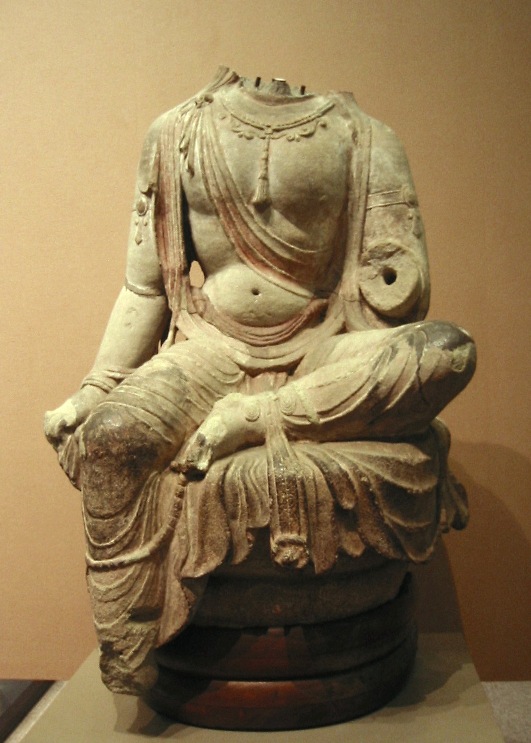
Late imperial women’s religious culture developed within the moral constraints of Neo-Confucian family order, but it was never confined to passive obedience. By the Ming and Qing periods, women’s piety moved through households, temples, printed books, devotional associations, Buddhist lay practice, poetry circles, kinship networks, and local ritual worlds. Some women entered nunneries or Daoist communities, but many more practiced religion without leaving family life. Their religious work took place through reading, chanting, copying texts, making vows, sponsoring rituals, instructing children, remembering the dead, venerating Guanyin, supporting monks or nuns, and participating in networks of female devotion. The household remained central, but it was not sealed. Religious texts, images, teachers, dreams, miracles, and ritual obligations crossed the threshold of the inner chambers.
Literacy was crucial to this transformation. Elite women’s access to reading and writing expanded unevenly, shaped by class, region, family culture, and the ambitions of fathers, husbands, brothers, and sons. Female literacy was often justified as a tool of domestic virtue: a woman who could read moral instruction, manage correspondence, educate children, or compose proper verse might strengthen the household rather than threaten it. Yet literacy also opened inward and social worlds that could not be fully controlled. A woman who read Buddhist sutras, morality books, biographies of exemplary women, poetry, or devotional writings encountered models of suffering, discipline, renunciation, compassion, and self-cultivation that exceeded daily household labor. Reading could make obedience more refined, but it could also give women a language for interpreting grief, illness, widowhood, desire, and religious longing in ways that were not entirely reducible to family service.
Morality books became one of the most important genres linking female literacy to religious practice. These texts circulated teachings about karmic retribution, filial piety, chastity, charity, household discipline, ritual propriety, and the consequences of hidden actions. They were not merely Confucian manuals, though many reinforced Confucian ethics. They often blended Confucian, Buddhist, Daoist, and popular religious ideas into a practical moral universe where every act had visible or invisible consequences. For women, morality books could reinforce submission, chastity, and domestic labor, but they also made women moral interpreters inside the household. A mother, widow, or elder woman who read, preserved, or transmitted such teachings could become a guardian of ethical memory. She might not hold public office or priestly status, but she could shape the religious conscience of children, daughters-in-law, servants, and kin.
Lay Buddhism gave late imperial women another powerful field of religious action. Many women remained within families while taking vegetarian vows, reciting the name of Amitabha, venerating Guanyin, sponsoring rituals for deceased relatives, copying sutras, supporting monasteries, or joining devotional circles. Pure Land practice was especially important because it did not require the same level of monastic learning or institutional access as some other forms of Buddhist cultivation. The promise of rebirth in Amitabha’s Pure Land gave women a salvific horizon that could be pursued from within domestic life. A woman burdened by household labor, grief, illness, widowhood, or family conflict could imagine religious hope beyond the immediate structures that constrained her. Devotion did not necessarily remove suffering, but it gave suffering a cosmic direction.
Women’s Buddhist piety also reshaped the meaning of family obligation. Merit could be dedicated to parents, husbands, children, ancestors, stillborn infants, deceased daughters, or suffering beings more broadly. This allowed women to work within the language of filial and familial duty while expanding its spiritual reach. A woman who sponsored a ritual for the dead was not simply performing domestic affection. She was participating in a transgenerational economy of salvation, karmic repair, and memory. In that sense, Buddhist practice let women transform grief into religious labor. It also gave them roles as patrons, donors, organizers, and interpreters of death. The family remained the starting point, but Buddhist merit-making enabled women to connect household sorrow to larger visions of compassion, rebirth, and liberation.
Female networks were equally important, though they often left less formal evidence than male institutions. Women gathered around kinship ties, neighborhood devotion, temple festivals, vegetarian associations, poetry exchanges, healing practices, and shared patronage. Some networks were elite and textual, visible in collections of women’s poetry, prefaces, biographies, and correspondence. Others were local and ritual, centered on vows, festivals, childbirth concerns, healing, mourning, or devotion to Guanyin and other deities. These networks could reinforce accepted forms of femininity, especially chastity, motherhood, filial piety, and compassion. Yet they also created spaces of mutual recognition among women. In a society that often placed women under the authority of fathers, husbands, sons, and mothers-in-law, religious friendship and devotional association allowed women to see one another as practitioners, sufferers, patrons, readers, and moral agents.
The late imperial period reveals a dense religious culture beneath the formal language of female containment. Women’s authority was often indirect, domestic, devotional, and textual rather than official or clerical, but it was real. Literacy allowed some women to interpret moral and religious life in writing. Morality books made women transmitters of ethical causality. Lay Buddhism gave them practices of salvation, mourning, and merit. Popular devotion gave them divine protectors and ritual tools. Female networks gave them companionship, memory, and shared discipline. None of this abolished patriarchy. Much of it worked inside patriarchal assumptions and sometimes strengthened them. Yet within those assumptions, women made religious worlds of considerable depth. They read, prayed, copied, taught, vowed, gave, mourned, organized, and remembered. The inner chambers were never only a prison. They were also, under pressure and with limits, a workshop of female religious culture.
Catholic Missions and Consecrated Women: Christianity Enters the Gendered Religious Landscape
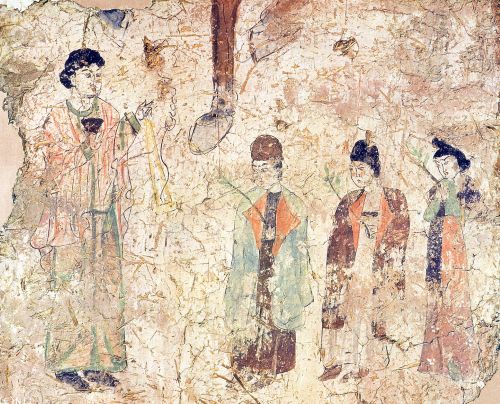
Christianity entered China long before the late imperial Catholic missions, most famously through the Church of the East in the Tang period, but its sustained impact on women’s religious lives became more visible with the Catholic missions of the late Ming and Qing. Jesuit, Dominican, Franciscan, and other Catholic networks brought new doctrines, institutions, devotional practices, and forms of community into an already complex religious landscape shaped by Confucian family ethics, Buddhist renunciation, Daoist ritual, and popular devotion. For women, Christianity did not arrive as a simple liberation from Chinese patriarchy. It carried its own male clergy, sacramental hierarchy, and ideals of obedience. Yet it also introduced new ways for women to imagine chastity, service, education, and spiritual belonging beyond marriage and lineage. Catholicism entered China as a foreign faith, but it became local through households, kinship networks, rural communities, and the labor of Chinese believers, including women whose work was often indispensable to the survival of the mission.
The greatest challenge Christianity posed to Chinese gender order was not simply theological difference. It was the way Catholic commitment could compete with ancestral ritual, marriage expectations, and family obligation. Chinese women who converted did not cease to be daughters, wives, mothers, widows, or daughters-in-law, but they now belonged to a religious community whose highest authority did not originate in the patriline. Baptism, confession, prayer, catechism, and devotion to saints reoriented spiritual identity around the church. This could create conflict with families, especially when Christian teaching rejected or modified practices surrounding ancestor rites, temple worship, spirit offerings, or arranged marriage expectations. For women, whose social security often depended on family approval, conversion could be risky. Christianity provided a new religious language in which female suffering, chastity, service, and fidelity could be honored as participation in a sacred community larger than the household.
Consecrated virgins became one of the most distinctive forms of female Catholic life in China. These women, often known in Chinese Catholic contexts as women who “kept chastity,” made vows or commitments of celibacy while frequently remaining embedded in family or local community rather than living in European-style convents. Their role was especially significant because it resembled, but did not simply duplicate, older Chinese alternatives to marriage such as Buddhist nunhood or widow chastity. A consecrated woman could reject marriage not as social failure or widowly mourning, but as a deliberate dedication to God. This choice challenged the reproductive logic of the patrilineal family, where women were expected to marry, bear sons, and strengthen lineage continuity. Yet because chastity itself was also a valued category within Chinese moral culture, Catholic women could sometimes make celibacy legible through familiar ideals of purity, discipline, and self-control. The result was a striking fusion: a Christian vocation that both disrupted and borrowed from Chinese gender morality.
These consecrated women were not merely symbols of piety. They performed practical religious labor. In communities where male missionaries were few, mobile, foreign, or restricted by gender norms, Chinese Catholic women could teach prayers, instruct children and other women, prepare catechumens, lead devotions, preserve local Christian memory, care for the sick, and help sustain worship when priests were absent. Because men and women often occupied segregated social spaces, female evangelists could enter homes and reach women whom male clergy could not easily teach directly. Their authority was rarely sacramental, but it was pastoral, educational, and communal. They carried doctrine across thresholds. They made Christianity livable in kitchens, courtyards, sickrooms, women’s quarters, and village networks. Without such women, Catholicism in many places would have remained far more fragile, dependent on foreign clergy and male converts alone.
This female labor also exposed a familiar tension: women could be indispensable while remaining controlled. Missionaries valued consecrated women because they extended the reach of the church, but they also worried about supervision, orthodoxy, sexuality, scandal, and independence. Families might value a daughter’s chastity if it brought honor, but resent it if it deprived the household of marriage alliances or descendants. Local communities might respect Christian women for discipline and charity, but suspect them as agents of foreign teaching or as women stepping outside proper domestic boundaries. Catholic female authority had to be carefully managed. It could be praised as holiness when obedient, disciplined, and useful to clerical goals; it could be viewed with suspicion when it seemed autonomous, mobile, or insufficiently supervised. The pattern was old, even if the religion was new: Chinese women gained religious power through service, purity, and discipline, but that power remained vulnerable when it exceeded the boundaries set by male institutions.
Catholicism’s arrival in the gendered religious landscape of late imperial China expanded women’s possibilities without removing the structures that constrained them. It offered women baptismal identity, devotional community, models of female sanctity, and the possibility of consecrated celibacy. It allowed some women to teach, serve, organize, and preserve religious life in ways that paralleled older Buddhist and Daoist female roles while remaining distinctively Christian. Yet it also placed them under clerical hierarchy, missionary oversight, family suspicion, and the political dangers attached to foreign religion. Chinese Catholic women were not simply converts receiving a new faith from Europe. They were translators of Christianity into local life. Through chastity, teaching, care, household devotion, and quiet endurance, they made Christianity part of China’s religious history and inserted themselves into the long pattern of women turning disciplined constraint into sacred agency.
Protestant Missions, Bible Women, and Girls’ Education in the Nineteenth and Early Twentieth Centuries

Protestant missions entered China in force during the nineteenth century, especially after the Opium Wars and the treaty-port system opened new spaces for foreign missionary activity. Like Catholicism, Protestant Christianity did not simply liberate Chinese women from patriarchy. Missionaries brought their own assumptions about gender, domesticity, modesty, marriage, and moral reform. Yet Protestant missions created new institutions and roles that affected women’s religious lives in distinctive ways. Schools for girls, medical missions, print culture, Bible study, women’s prayer groups, and female evangelistic labor all widened the space in which Chinese women could receive education, teach others, and participate in religious networks beyond the household. Christianity became one of the channels through which some women entered modern forms of literacy, public service, and reform, even as missionary culture often framed those opportunities through disciplined Christian womanhood.
The figure of the Bible woman was central to this transformation. Bible women were Chinese Christian women trained to teach scripture, visit homes, instruct other women, assist missionaries, lead prayers, and spread Protestant doctrine in spaces foreign men and even foreign women could not easily reach. Their work mattered because Chinese gender norms often restricted contact between unrelated men and women. A male missionary might preach publicly, but he could not always enter the inner quarters of a household or speak intimately with women about faith, illness, marriage, childbirth, grief, or domestic suffering. Bible women crossed that boundary. They carried Christian teaching through courtyards, alleys, villages, sickrooms, and women’s gatherings. Their authority was rarely formal in the clerical sense, but it was practical, relational, and often indispensable.
Bible women also complicate the idea that Protestantism was simply foreign intrusion. Many were Chinese converts who interpreted Christianity for other Chinese women in local idioms, dialects, and social situations. They knew the pressures of arranged marriage, mother-in-law authority, footbinding, widowhood, poverty, childbirth, and family obligation in ways foreign missionaries often did not. Their evangelism was not merely the repetition of missionary instruction. It involved translation at every level: language, gesture, moral expectation, household conflict, and emotional experience. A Bible woman could present Christianity as salvation, moral discipline, consolation, education, or refuge, depending on the listener’s circumstances. She could also embody a new kind of female religious worker, one who was neither nun, Daoist adept, temple medium, nor Confucian matriarch, but a lay Protestant teacher moving through the social world with scripture as her authority.
Girls’ education was another major Protestant intervention. Mission schools challenged the assumption that female literacy should be limited to domestic refinement or elite family culture. Protestant educators promoted reading so girls could study the Bible, become Christian mothers, teach children, assist in church work, and participate in a reformed moral society. This could reinforce domestic ideals, since educated Christian women were often imagined as better wives and mothers rather than autonomous public actors. Even so, literacy changed the possibilities available to girls. It gave them access to texts, correspondence, religious instruction, teaching roles, and eventually professional paths in education and medicine. In a society where many girls had been denied systematic schooling, mission education could become a profound disruption, even when its stated purpose remained morally conservative.
Medical missions also drew women into new religious and public roles. Mission hospitals, clinics, nursing programs, and medical schools created spaces where female patients could receive care from women and where Chinese women could train as nurses, assistants, and physicians. This mattered deeply because gender segregation and bodily modesty often made male medical treatment difficult for women. Female missionaries and Chinese Christian women used medical care as both service and evangelism, linking healing to Protestant compassion, discipline, and moral reform. The medical mission could challenge practices missionaries condemned, including footbinding, but it also carried the paternalism of Western reform. Chinese women were sometimes treated as objects of rescue rather than full agents of their own religious and social transformation. Yet many became agents anyway, using education and medical training to claim authority in forms that older household structures had not easily allowed.
By the early twentieth century, Protestant women’s work had become entangled with reform, nationalism, anti-footbinding campaigns, women’s education, and the emergence of modern Chinese womanhood. Christian schools and organizations helped produce female teachers, nurses, writers, reformers, and church workers who moved between religious and civic life. This did not mean that Christian women were free from patriarchal expectations. Churches still often reserved formal leadership for men, and missionary models of womanhood could be restrictive in their own way. But Protestant missions helped create a new female religious subject: literate, mobile, pedagogical, charitable, and increasingly public. The Bible woman and the schoolgirl stood at the edge of a changing world. One carried scripture into older domestic spaces; the other emerged from mission classrooms into a modernizing society where women’s education, public service, and religious agency could no longer be treated as marginal.
Republican China: Reform, Nationalism, Buddhist Nuns, Christian Women, and the Modern Female Religious Subject

Republican China transformed the language through which women’s religious lives were judged. After the fall of the Qing dynasty in 1911, older frameworks of dynasty, lineage, and imperial orthodoxy no longer organized public life in the same way, even though they remained powerful in families and local communities. Reformers, nationalists, educators, feminists, Christians, Buddhists, and secular intellectuals all argued over what a modern Chinese woman should become. Religion entered those arguments uneasily. It could be condemned as superstition, defended as ethical cultivation, reshaped as social service, or mobilized as part of national renewal. Women stood at the center of this debate because their bodies, education, marriages, clothing, labor, and beliefs became signs of China’s passage from empire to modern nation.
The New Culture and May Fourth era intensified criticism of the old family system. Arranged marriage, footbinding, concubinage, widow chastity, patriarchal authority, and female illiteracy became targets of reformist attack. Religion was often treated with suspicion because many intellectuals associated temples, ancestral rites, spirit mediums, and popular devotion with backwardness. Yet the attack on “superstition” did not affect all traditions equally. Elite reformers might criticize popular religion while defending ethical Buddhism, Christianity, or spiritually refined self-cultivation. Women’s religious practices were especially vulnerable to dismissal because so much of female devotion took place in household, healing, fertility, mourning, and temple settings. Practices that had long helped women interpret illness, grief, childbirth, and family vulnerability could now be labeled irrational obstacles to national progress.
Buddhist women responded to this modernizing climate by reworking older forms of renunciation and community. Buddhist nuns did not disappear into the past. They became part of broader efforts to reform Chinese Buddhism through education, institutional discipline, charitable work, publishing, and national service. In some cases, nuns sought modern schooling and doctrinal training so they could demonstrate that women’s monastic life was not merely a refuge for widows or unwanted daughters, but a serious religious vocation compatible with modern reform. This mattered because the Republican period forced Buddhism to defend itself against charges of social uselessness. Nuns, like monks, were increasingly expected to show that religious life could contribute to education, morality, social welfare, and the nation. Female monasticism had to present itself not only as spiritual discipline but as modern public service.
Christian women occupied a different but overlapping place in Republican modernity. Mission schools, women’s colleges, hospitals, churches, and reform organizations had already helped produce literate Christian women who could serve as teachers, nurses, doctors, social workers, evangelists, and public speakers. By the Republican period, some Chinese Christian women moved with increasing confidence between church, classroom, clinic, and civic reform. They participated in campaigns for education, health, anti-footbinding, temperance, child welfare, and women’s rights, though always within contested limits. Protestant and Catholic institutions continued to preserve patriarchal structures, but Christian networks gave many women training, organizational experience, and transnational connections that older religious systems had not provided in the same form. Christianity helped shape the modern female religious subject as educated, socially useful, morally disciplined, and publicly active.
Nationalism complicated these developments. Religious women had to prove that their commitments did not make them foreign, backward, or detached from the Chinese nation. Christian women faced particular suspicion because Christianity remained associated with imperialism, treaty ports, and foreign missionary power. Buddhist women faced a different burden: they had to show that monastic life was not parasitic, escapist, or unproductive. Popular religious women, including mediums, healers, and temple devotees, were often judged most harshly by reformers who equated modernity with rationalization and state control. The modern woman was supposed to be educated, hygienic, patriotic, and productive. Religious women could survive within that ideal if they framed their work as service, education, health, moral reform, or national strengthening. They were far more vulnerable when their practices appeared ecstatic, local, magical, or uncontrolled.
Republican modernity did not simply replace old patriarchies with freedom. The “new woman” was often expected to serve the nation just as earlier women had served the lineage. Education, public work, and religious service could expand women’s agency, but they also created new forms of discipline. Women were asked to become modern mothers, patriotic citizens, hygienic bodies, educated wives, efficient workers, and morally respectable public figures. Buddhist nuns and Christian women both navigated this pressure. They could use modern institutions to claim authority, but they had to do so in languages that reassured male reformers, religious leaders, and nationalist critics. Female religious agency became more visible, but visibility brought new scrutiny. The old question of whether a woman properly served father, husband, son, and lineage did not vanish. It was joined by a new question: whether she properly served China.
The Republican period created a modern female religious subject without resolving the contradictions of women’s religious history. Buddhist nuns, Christian teachers, nurses, social workers, lay devotees, and reform-minded women entered public life in new ways, but their authority remained shaped by respectability, national usefulness, institutional discipline, and male oversight. Religion could be a resource for women’s education and public service, but it could also be attacked as superstition or foreign dependency. The shift from empire to nation changed the vocabulary of female virtue from chastity and domestic order toward education, service, hygiene, and citizenship. Yet the deeper pattern persisted. Women continued to turn constraint into sacred agency, now not only within the household or convent, but within schools, hospitals, churches, Buddhist reform associations, anti-superstition campaigns, and the anxious public culture of a nation trying to define modernity.
Maoist China: Gender Equality, Religious Suppression, and the Displacement of Female Piety

The Maoist period transformed women’s religious history by attacking both the old patriarchal family order and the religious worlds through which women had long negotiated it. The People’s Republic of China, founded in 1949, presented itself as a revolutionary state committed to women’s liberation, class struggle, socialist labor, and the destruction of “feudal” remnants. The Marriage Law of 1950 challenged arranged marriage, concubinage, child betrothal, and some of the legal structures that had sustained patriarchal family authority. Women were called into public labor, political campaigns, production teams, literacy programs, and socialist citizenship. In theory, this promised a radical break from the older world in which a woman’s virtue had been measured by obedience to father, husband, son, lineage, and household. Yet the same revolutionary state that weakened some older forms of patriarchal control also attacked the religious practices that had given women ritual agency, devotional comfort, and female-centered community across centuries.
Maoist gender ideology redefined liberation through labor, production, and participation in socialist struggle. Women were no longer supposed to become exemplary primarily through chastity, widow fidelity, domestic piety, or ritual service to ancestors. They were to become workers, peasants, cadres, soldiers of production, and politically conscious subjects of the revolution. The famous slogan that women “hold up half the sky” captured this new symbolic order: women’s value was to be proven in collective labor and revolutionary commitment rather than in obedience to family hierarchy. This shift mattered. It gave many women access to public work, political language, education, and legal claims that had been far more restricted in late imperial society. But Maoist liberation also tended to treat women’s religious lives as backward attachments to be overcome. The good socialist woman was not the chanting lay Buddhist, the temple devotee, the Christian Bible woman, the Daoist ritual specialist, or the keeper of household offerings. She was modern, productive, secular, disciplined, and politically remade.
Religious suppression displaced many of the older forms of female piety without necessarily replacing them with emotionally equivalent forms of community. Buddhist convents, Daoist temples, Christian churches, ancestral halls, local shrines, spirit-medium practices, temple festivals, and household rituals all came under pressure, especially during periods of intensified campaign politics and most violently during the Cultural Revolution. Monastics were laicized, religious property was confiscated or repurposed, clergy were denounced, scriptures and ritual objects were destroyed, and public worship became dangerous or impossible in many places. These measures affected men as well as women, but their gendered consequences were significant. Women had often practiced religion in domestic, local, healing, mourning, and devotional spaces rather than through formal clerical office. When the state attacked “superstition,” it struck many practices through which women had historically addressed illness, childbirth, grief, infertility, death, family conflict, and the care of ancestors.
This disruption was not simply institutional. It altered the emotional and symbolic vocabulary available to women. Earlier religious cultures had often constrained women, but they also gave them languages for suffering: karmic causality, Guanyin’s compassion, ancestral obligation, merit transfer, vows, healing rites, spirit mediation, confession, purity, rebirth, Christian prayer, and divine protection. Maoist politics sought to replace these languages with class analysis, revolutionary optimism, collectivist discipline, and loyalty to the party-state. Personal grief, domestic hardship, and bodily vulnerability were to be interpreted through social struggle and political transformation rather than through ritual negotiation with gods, ancestors, buddhas, saints, or spirits. For some women, this shift may have been empowering, especially when religion had reinforced patriarchal control or economic dependency. For others, it narrowed the symbolic resources through which they could mourn, hope, repent, heal, or seek protection. The sacred did not vanish from daily life, but it was driven underground, privatized, disguised, or translated into politically safer forms.
Maoist campaigns also exposed the ambiguity of state feminism. The revolution attacked arranged marriage and promoted women’s labor, but it often assumed that equality meant women entering male-defined forms of production and political discipline. Domestic labor did not disappear, and women frequently carried the double burden of public work and household responsibility. In some contexts, older patriarchal habits survived under socialist language. A woman might be praised as equal because she worked in the fields or factory, while still being expected to cook, care for children, manage family needs, and absorb political pressure. Religion had sometimes reinforced such burdens, but it had also provided women with female networks, ritual authority, devotional consolation, and moral languages not entirely controlled by husbands or the state. Maoist secularization weakened oppressive religious and familial structures in some ways, yet it also expanded state power into the intimate spaces where women had once used religion to interpret and manage life’s most vulnerable moments.
The Maoist period should not be read as a simple victory of gender equality over religious patriarchy, nor as a simple tragedy of secular repression. It was both more transformative and more contradictory. The revolutionary state challenged older forms of family domination, gave women new public roles, and attacked customs that had long restricted female lives. It suppressed Buddhist, Daoist, Christian, ancestral, and popular religious worlds in which women had acted as devotees, patrons, nuns, catechists, healers, mourners, organizers, and ritual specialists. The result was a profound displacement of female piety. Women were invited into the nation as socialist subjects, but many inherited religious languages of compassion, mourning, protection, and transcendence were condemned as remnants of the past. Maoist China marks one of the sharpest ruptures in this history: a moment when the state promised to free women from old hierarchies while also dismantling many of the sacred practices through which women had long made meaning under hierarchy.
Reform Era and Contemporary China: Revival, Regulation, Underground Churches, Monastic Renewal, and Female Religious Labor
The following video from “UsefulCharts” covers different Buddhist denominations:
After Mao, religious life in China revived with remarkable force, but revival did not mean unrestricted freedom. The reform era reopened spaces for Buddhist monasteries, Daoist temples, Christian churches, local festivals, ancestral rites, pilgrimage, household devotion, and religious charity, but those spaces developed under state regulation. The contemporary state recognizes Buddhism, Daoism, Islam, Protestantism, and Catholicism as official religions, while religious organizations are expected to operate through state-sanctioned structures and registered venues. Revised regulations implemented in 2018 strengthened oversight of religious activity, especially unregistered groups and activities outside approved institutional channels. For women, this created a familiar but newly bureaucratic tension. Religious revival restored practices, communities, and symbols through which women had long acted, but the state now mediated legitimacy through registration, surveillance, patriotic associations, and political discipline.
Buddhist revival has been especially important for women because it restored monastic possibilities disrupted during the Maoist period. Nunneries reopened, temples were rebuilt, ordination networks recovered, and Buddhist education expanded in certain regions. Contemporary nuns have pursued scriptural training, ritual competence, meditation practice, charitable work, and institutional leadership, often with far more formal education than many of their predecessors could access. Yet renewal has remained uneven. Monastic women still navigate resource disparities, clerical hierarchies, state regulation, and the old assumption that male monastic authority is more normative. The revival of nunneries repeats an older pattern in modern form. Women gain sacred community, education, and disciplined authority, but they must still prove that female monasticism is respectable, socially useful, politically safe, and doctrinally serious.
Daoist women have also participated in religious renewal, though their presence is often less visible in public narratives than that of Buddhist nuns or Christian women. Temples, ritual lineages, local cults, pilgrimage centers, and forms of internal cultivation have reemerged in the reform period, sometimes under official Daoist structures and sometimes through more local or informal practice. Women may serve as clerics, ritual assistants, devotees, healers, organizers, donors, or custodians of temple life. As in earlier periods, Daoism gives the feminine a symbolic richness that does not automatically translate into equal institutional power. Female Daoists can draw on a tradition that honors immortals, goddesses, bodily cultivation, and the hidden potency of yin, but they still work inside social and institutional worlds shaped by patriarchy, state management, and uneven access to training.
Christianity’s contemporary growth has made women central to one of the most dynamic religious landscapes in China. In registered churches and unregistered house churches alike, women often sustain everyday religious life through prayer meetings, Bible study, teaching, hospitality, caregiving, evangelism, music, children’s ministry, charitable labor, and local leadership. The state distinguishes sharply between registered religious activity and independent communities, and unregistered Protestant house churches and underground Catholic communities have often faced pressure or repression when they refuse official oversight. This regulatory divide matters for women because much of their religious work occurs in intimate, flexible, home-based, or semi-formal settings. The very qualities that make female religious labor effective, including mobility through households, relational trust, and informal leadership, can also make it vulnerable when the state seeks legible, centralized, registered institutions.
Women’s labor in contemporary Chinese religion is often foundational precisely because it is underrecognized. Women organize festivals, clean temples, prepare offerings, maintain altars, host prayer groups, raise funds, teach children, chant sutras, care for the sick, support clergy, circulate devotional materials, and preserve local religious memory. Much of this work resembles older female religious labor, but contemporary conditions alter its meaning. Migration, urbanization, market reform, aging families, digital communication, consumer culture, and state regulation have changed how religious communities survive. A grandmother caring for a household altar, a Buddhist laywoman joining a chanting group, a Christian woman hosting Bible study, or a temple volunteer coordinating donations may not hold formal title, yet each helps keep a religious world alive. Female piety remains practical, relational, and labor-intensive.
The reform era also revived popular and local religious practices that women had long used to address illness, fertility, grief, childbirth, death, and family uncertainty. Guanyin devotion, ancestor remembrance, temple festivals, vows, pilgrimage, spirit practices, and local goddess worship have returned in many places, though often under the ambiguous categories of culture, heritage, tourism, folk custom, or regulated religion. This ambiguity can protect practices by making them appear cultural rather than politically threatening, but it can also obscure their religious depth. Women often stand at the center of these revived practices because they continue to bear much of the emotional labor of family continuity. They pray for children, mourn the dead, seek healing, sponsor rituals, and maintain the intimate ties between household vulnerability and sacred protection. What earlier elites dismissed as superstition and Maoist campaigns attacked as feudal residue often survives because it answers needs that neither market reform nor state ideology can fully absorb.
Contemporary China does not represent the end of the older pattern, but its reconfiguration. Women’s religious agency continues to move between empowerment and containment, visibility and invisibility, service and authority. Buddhist nuns rebuild monastic life; Daoist women participate in ritual and cultivation; Christian women sustain churches above and below the line of registration; laywomen keep temples, altars, vows, and devotional networks alive. State regulation adds a modern layer to older patriarchal structures, but it does not erase the religious creativity of women. The long history returns in new form: women remain essential to Chinese religious life, not because institutions consistently grant them equal power, but because they continue to carry religion through the spaces where life is most vulnerable. Birth, illness, migration, death, grief, education, caregiving, hope, and survival still pass through women’s hands.
Conclusion: The Sacred Uses of Constraint
Women’s religious history in China cannot be reduced to either subordination or empowerment, because its most persistent feature was the tension between the two. Across dynasties, doctrines, institutions, and local practices, women were repeatedly placed under systems that defined them by family relationship, sexual discipline, reproductive obligation, ritual propriety, and moral service. Confucian household ethics contained women within the hierarchies of father, husband, son, lineage, and ancestral continuity. Buddhist and Daoist institutions opened alternative paths, but those paths remained shaped by male authority, textual mediation, class privilege, and public suspicion. Christianity introduced new forms of education, chastity, evangelism, and service, yet it too operated through clerical structures and missionary assumptions that limited women’s formal power. Even the modern state, whether Republican, Maoist, or post-Mao, redefined women’s proper role through the demands of nation, labor, regulation, and political discipline. Constraint was not incidental to this history. It was one of the conditions under which female religious agency had to be made.
Yet constraint never meant absence. Women appear throughout Chinese religious history as ancestors, ritual participants, spirit mediums, Daoist adepts, Buddhist nuns, abbesses, patrons, lay devotees, readers, writers, moral instructors, healers, Christian teachers, consecrated virgins, Bible women, church organizers, temple volunteers, and keepers of household memory. They rarely held authority on the same terms as men, but they repeatedly created authority through the terms available to them. Obedience could become moral prestige. Widowhood could become disciplined sanctity. Motherhood could become ritual power. Renunciation could become institutional independence. Literacy could become religious interpretation. Devotion could become patronage. Caregiving could become ministry. The very qualities used to confine women, including purity, humility, sacrifice, compassion, and service, could be turned into instruments of sacred influence.
The great female divinities of Chinese religion sharpen this paradox. Xiwangmu, Guanyin, Mazu, and other sacred figures show that Chinese religious imagination could elevate feminine power to cosmic, salvific, and protective heights. The goddess could command immortals, hear the cries of the suffering, rescue sailors, grant children, heal illness, and gather communities around her cult. But the exaltation of divine women did not guarantee equality for living women. Sacred femininity could console and empower women, but it could also reinforce ideals of purity, sacrifice, maternal care, and exceptional holiness that ordinary women were expected to serve rather than embody freely. The goddess opened symbolic space, but institutions, families, and states decided how much of that space living women could inhabit.
The history, then, is not a march from oppression to liberation. It is a history of religious improvisation under pressure. Chinese women repeatedly took inherited systems that sought to define them and used those systems to make meaning, build communities, protect the vulnerable, remember the dead, educate the young, serve the suffering, and seek transcendence. Their power was often indirect, often disciplined, often made legible only when it appeared modest, filial, chaste, maternal, or useful. But indirect power is not the same as insignificance. The sacred life of China was carried not only by emperors, monks, priests, patriarchs, theologians, reformers, and officials, but also by women who prayed in households, governed convents, copied texts, tended altars, taught scripture, organized festivals, mourned the dead, and kept communities alive. The story of women in China’s religious history is the story of constraint made spiritually productive without ever becoming innocent. It is the story of women turning the walls around them into surfaces on which sacred meanings could still be written.
Bibliography
- Ban Zhao. Lessons for a Woman. In Pan Chao: Foremost Woman Scholar of China, translated and edited by Nancy Lee Swann. New York: Century, 1932.
- Baochang. Lives of the Nuns: Biographies of Chinese Buddhist Nuns from the Fourth to Sixth Centuries. Translated with commentary by Kathryn Ann Tsai. Honolulu: University of Hawai‘i Press, 1994.
- Bays, Daniel H. A New History of Christianity in China. Malden, MA: Wiley-Blackwell, 2011.
- Benn, Charles D. China’s Golden Age: Everyday Life in the Tang Dynasty. Oxford: Oxford University Press, 2004.
- Bokenkamp, Stephen R. Early Daoist Scriptures. Berkeley: University of California Press, 1997.
- Bossler, Beverly. Courtesans, Concubines, and the Cult of Female Fidelity. Cambridge, MA: Harvard University Asia Center, 2013.
- Brook, Timothy. Praying for Power: Buddhism and the Formation of Gentry Society in Late-Ming China. Cambridge, MA: Harvard University Asia Center, 1993.
- Cahill, Suzanne E. Transcendence and Divine Passion: The Queen Mother of the West in Medieval China. Stanford, CA: Stanford University Press, 1993.
- Campany, Robert Ford. To Live as Long as Heaven and Earth: A Translation and Study of Ge Hong’s Traditions of Divine Transcendents. Berkeley: University of California Press, 2002.
- Cao, Nanlai. Constructing China’s Jerusalem: Christians, Power, and Place in Contemporary Wenzhou. Stanford, CA: Stanford University Press, 2010.
- Chang, Kwang-chih. Shang Civilization. New Haven, CT: Yale University Press, 1980.
- Davin, Delia. “Women in the Countryside of China.” In Women in Chinese Society, edited by Margery Wolf and Roxane Witke, 243-276. Stanford, CA: Stanford University Press, 1975.
- Despeux, Catherine, and Livia Kohn, eds. Women in Daoism. Cambridge, MA: Three Pines Press, 2005.
- Dudbridge, Glen. The Legend of Miao-shan. Rev. ed. Oxford: Oxford University Press, 2004.
- Dunch, Ryan. Fuzhou Protestants and the Making of a Modern China, 1857–1927. New Haven, CT: Yale University Press, 2001.
- Ebrey, Patricia Buckley. Confucianism and Family Rituals in Imperial China: A Social History of Writing about Rites. Hartford: Princeton University Press, 2016.
- —-. The Inner Quarters: Marriage and the Lives of Chinese Women in the Sung Period. Berkeley: University of California Press, 1993.
- Forte, Antonino. Political Propaganda and Ideology in China at the End of the Seventh Century: Inquiry into the Nature, Authors and Function of the Tunhuang Document S. 6502, Followed by an Annotated Translation. Napoli: Istituto Universitario Orientale, 2005.
- Furth, Charlotte. A Flourishing Yin: Gender in China’s Medical History, 960–1665. Berkeley: University of California Press, 1998.
- Gernet, Jacques. Buddhism in Chinese Society: An Economic History from the Fifth to the Tenth Centuries. Translated by Franciscus Verellen. New York: Columbia University Press, 1995.
- Goossaert, Vincent, and David A. Palmer. The Religious Question in Modern China. Chicago: University of Chicago Press, 2011.
- Grant, Beata. Eminent Nuns: Women Chan Masters of Seventeenth-Century China. Honolulu: University of Hawai‘i Press, 2008.
- Henderson, John B. The Development and Decline of Chinese Cosmology. New York: Columbia University Press, 1984.
- Hershatter, Gail. Women in China’s Long Twentieth Century. Berkeley: University of California Press, 2007.
- Hinsch, Bret. Women in Early Imperial China. 2nd ed. Lanham, MD: Rowman & Littlefield, 2010.
- Honig, Emily, and Gail Hershatter. Personal Voices: Chinese Women in the 1980s. Stanford, CA: Stanford University Press, 1988.
- Huang, Weiyi. “War Captives, Left-Behind Wives, and Buddhist Nuns: Female Migrants in Early Medieval China (4th–6th Century CE).” Journal of Chinese History 5:2 (2021), 263–289.
- Hunter, Jane. The Gospel of Gentility: American Women Missionaries in Turn-of-the-Century China. New Haven, CT: Yale University Press, 1984.
- Idema, Wilt L., and Beata Grant. The Red Brush: Writing Women of Imperial China. Cambridge, MA: Harvard University Asia Center, 2004.
- Judge, Joan. The Precious Raft of History: The Past, the West, and the Woman Question in China. Stanford, CA: Stanford University Press, 2008.
- Keightley, David N. The Ancestral Landscape: Time, Space, and Community in Late Shang China, ca. 1200–1045 BCE. Berkeley: Institute of East Asian Studies, University of California, 2000.
- —-. Sources of Shang History: The Oracle-Bone Inscriptions of Bronze Age China. Berkeley: University of California Press, 1978.
- Kieschnick, John. The Impact of Buddhism on Chinese Material Culture. Princeton, NJ: Princeton University Press, 2003.
- Kinney, Anne Behnke, ed. Chinese Views of Childhood. Honolulu: University of Hawai‘i Press, 1995.
- Ko, Dorothy. Teachers of the Inner Chambers: Women and Culture in Seventeenth-Century China. Stanford: Stanford University Press, 1994.
- Kohn, Livia. Daoism and Chinese Culture. Cambridge, MA: Three Pines Press, 2001.
- Kwok Pui-lan. Chinese Women and Christianity, 1860–1927. Atlanta: Scholars Press, 1992.
- Laozi. Dao De Jing: Making This Life Significant. Translated by Roget T. Ames and David L. Hall. New York: Ballantine Books, 2003.
- Lau, Natalie Siu-han. “Equality of Access? Chinese Women Practicing Chan and Transnational Meditation in Contemporary China.” Religions 13:1 (2022), 61.
- Levering, Miriam L. “Miao-tao and Her Teacher Ta-hui.” In Buddhism in the Sung, edited by Peter N. Gregory and Daniel A. Getz Jr., 188–219. Honolulu: University of Hawai‘i Press, 1999.
- The Liji. Translated by James Legge. In The Sacred Books of China: The Texts of Confucianism, Part III. Oxford: Clarendon Press, 1885.
- Lutz, Jessie Gregory. Chinese Politics and Christian Missions: The Anti-Christian Movements of 1920–28. Notre Dame, IN: Cross Cultural Publications, 1988.
- MacInnis, Donald E. Religion in China Today: Policy and Practice. Maryknoll, NY: Orbis Books, 1989.
- Major, John S., Sarah A. Queen, Andrew Seth Meyer, and Harold D. Roth, trans. The Huainanzi: A Guide to the Theory and Practice of Government in Early Han China. New York: Columbia University Press, 2010.
- Mann, Susan. Precious Records: Women in China’s Long Eighteenth Century. Stanford: Stanford University Press, 1997.
- Masláková, Michaela. “The Catholic Church in Contemporary China: How Does the New Regulation on Religious Affairs Influence the Catholic Church?” Religions 10, no. 7 (2019): 446.
- Meisner, Maurice. Mao’s China and After: A History of the People’s Republic. 3rd ed. New York: Free Press, 1999.
- Menegon, Eugenio. Ancestors, Virgins, and Friars: Christianity as a Local Religion in Late Imperial China. Cambridge, MA: Harvard University Asia Center, 2009.
- Mu, Sihao. “Building the Largest Female Buddhist Monastery in Contemporary China.” China Perspectives 2021:1 (2021), 59–67.
- Nedostup, Rebecca. Superstitious Regimes: Religion and the Politics of Chinese Modernity. Cambridge, MA: Harvard University Asia Center, 2009.
- Nylan, Michael. The Five “Confucian” Classics. New Haven, CT: Yale University Press, 2001.
- Paul, Diana Y. Women in Buddhism: Images of the Feminine in Mahāyāna Tradition. 2nd ed. Berkeley: University of California Press, 1985.
- Raphals, Lisa. Sharing the Light: Representations of Women and Virtue in Early China. Albany: State University of New York Press, 1998.
- Rawson, Jessica, ed. The British Museum Book of Chinese Art. London: British Museum Press, 1996.
- Robinet, Isabelle. Taoist Meditation: The Mao-shan Tradition of Great Purity. Translated by Julian F. Pas and Norman J. Girardot. Albany: State University of New York Press, 1993.
- Rothschild, N. Harry. Wu Zhao: China’s Only Woman Emperor. New York: Pearson Longman, 2008.
- Sangren, P. Steven. “Female Gender in Chinese Religious Symbols: Kuan Yin, Ma Tsu, and the Eternal Mother.” Signs 9:1 (1983), 4–25.
- —-. History and Magical Power in a Chinese Community. Stanford, CA: Stanford University Press, 1987.
- Sen, Tansen. Buddhism, Diplomacy, and Trade: The Realignment of Sino-Indian Relations, 600–1400. Honolulu: University of Hawai‘i Press, 2003.
- Shahar, Meir, and Robert P. Weller, eds. Unruly Gods: Divinity and Society in China. Honolulu: University of Hawai‘i Press, 1996.
- Shemo, Connie A. The Chinese Medical Ministries of Kang Cheng and Shi Meiyu, 1872–1937: On a Cross-Cultural Frontier of Gender, Race, and Nation. Bethlehem, PA: Lehigh University Press, 2011.
- Sommer, Matthew H. Sex, Law, and Society in Late Imperial China. Stanford, CA: Stanford University Press, 2000.
- Standaert, Nicolas, ed. Handbook of Christianity in China, Volume One: 635–1800. Leiden: Brill, 2000.
- State Council of the People’s Republic of China. Regulations on Religious Affairs. Revised 2017, effective February 1, 2018.
- Strickmann, Michel. “The Mao Shan Revelations: Taoism and the Aristocracy.” T’oung Pao 63:1 (1977), 1–64.
- Tiedemann, R. G. “Controlling the Virgins: Female Propagators of the Faith and the Catholic Hierarchy in China.” Women’s History Review 17:4 (2008), 501–521.
- —-, ed. Handbook of Christianity in China, Volume Two: 1800 to the Present. Leiden: Brill, 2010.
- Tsai, Kathryn Ann. Introduction and commentary to Lives of the Nuns: Biographies of Chinese Buddhist Nuns from the Fourth to Sixth Centuries, by Baochang. Honolulu: University of Hawai‘i Press, 1994.
- Tsomo, Karma Lekshe, ed. Buddhist Women Across Cultures: Realizations. Albany: State University of New York Press, 1999.
- Twitchett, Denis, and Howard J. Wechsler. “Kao-tsung (Reign 649–83) and the Empress Wu: The Inheritor and the Usurper.” In The Cambridge History of China, Volume 3: Sui and T’ang China, 589–906, Part I, edited by Denis Twitchett, 242–289. Cambridge: Cambridge University Press, 1979.
- Waltner, Ann. Getting an Heir: Adoption and the Construction of Kinship in Late Imperial China. Honolulu: University of Hawai‘i Press, 1990.
- Wang, Robin R. Yinyang: The Way of Heaven and Earth in Chinese Thought and Culture. Cambridge: Cambridge University Press, 2012.
- Watson, James L. “Standardizing the Gods: The Promotion of T’ien Hou Along the South China Coast, 960–1960.” In Popular Culture in Late Imperial China, edited by David Johnson, Andrew J. Nathan, and Evelyn S. Rawski, 292–324. Berkeley: University of California Press, 1985.
- Wile, Douglas. Art of the Bedchamber: The Chinese Sexual Yoga Classics Including Women’s Solo Meditation Texts. Albany: State University of New York Press, 1992.
- Yang, Mayfair Mei-hui, ed. Chinese Religiosities: Afflictions of Modernity and State Formation. Berkeley: University of California Press, 2008.
- —-. Re-enchanting Modernity: Ritual Economy and Society in Wenzhou, China. Durham, NC: Duke University Press, 2020.
- Young, Ernest P. Ecclesiastical Colony: China’s Catholic Church and the French Religious Protectorate. New York: Oxford University Press, 2013.
- Yü, Chün-fang. The Renewal of Buddhism in China: Zhuhong and the Late Ming Synthesis. New York: Columbia University Press, 1981.
- Zeitlin, Judith T. The Phantom Heroine: Ghosts and Gender in Seventeenth-Century Chinese Literature. Honolulu: University of Hawai‘i Press, 2007.
Originally published by Brewminate, 05.29.2026, under the terms of a Creative Commons Attribution-NonCommercial-NoDerivatives 4.0 International license.
About the Author