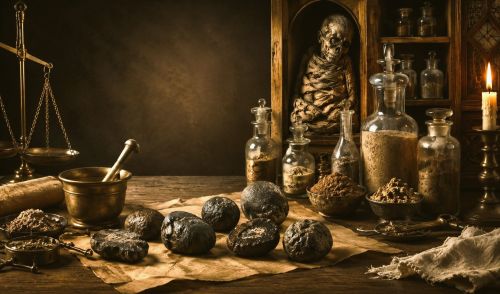
Bezoar stones and mummy powder promised protection, healing, and power over decay, but their real history reveals how fear, trade, prestige, and belief sustained bad medicine.

By Matthew A. McIntosh
Public Historian
Brewminate
Introduction: Medicines That Failed, Medicines That Made Sense
A bezoar stone could be carried like a jewel, dissolved like a drug, displayed like a marvel, and trusted like a shield against death. Mummy powder could sit in an apothecary’s shop as a therapeutic substance, a relic of ancient Egypt, a commercial commodity, and a fragment of the human dead. To modern eyes, both seem to belong to the grotesque cabinet of failed medicine: animal stomach stones praised as universal antidotes, Egyptian corpses ground into powder and swallowed for bruises, ulcers, bleeding, paralysis, and other afflictions they could not cure. Yet their long popularity cannot be explained by stupidity, superstition, or simple credulity. They survived because they made sense inside medical worlds that understood nature as a storehouse of hidden virtues, believed rare substances might concentrate unusual powers, and treated inherited authority, patient experience, sensory signs, and commercial reputation as meaningful forms of evidence.
The point is not merely that bezoar stones and mummy powder “did not work.” That is true enough if judged by the claims most often made for them. Bezoars were not reliable antidotes to poison in the sweeping, almost magical way premodern physicians, collectors, and elites often imagined. Powdered mummy did not restore damaged bodies by transferring the preservative strength of ancient flesh into living tissue. But failure in pharmacological terms did not always produce failure in social or medical practice. A remedy might appear to work because the patient recovered naturally, because symptoms fluctuated, because the physician’s confidence calmed fear, because the treatment was mixed with other ingredients, or because the ritual of taking rare medicine transformed terror into hope. A patient who survived after taking a bezoar might become evidence for the stone’s power, while a patient who died could be explained away as having received a false stone, an insufficient dose, a poison too strong for ordinary remedies, or treatment too late in the course of illness. Mummy powder worked within a similar circle of interpretation: if pain eased, bleeding slowed, or strength returned, the remedy could be credited; if nothing improved, the failure could be attributed to the body, the disease, the quality of the drug, or the will of God. Such reasoning did not require a modern placebo theory to function. It depended on a medical culture in which testimony, reputation, inherited texts, sensory qualities, and visible rarity could all support belief. In a world where poisoning was a political nightmare and illness was often poorly understood, a costly substance that promised control over invisible danger could be persuasive even when it lacked curative power.
These medicines also expose the porous boundaries of ancient, medieval, and early modern healing. Medicine was not yet separated cleanly from natural history, commerce, wonder, religion, magic, courtly display, or the moral imagination. A bezoar was not only a drug; it was a natural marvel formed inside an animal, a portable antidote, a princely possession, and a sign that the owner had access to the far reaches of the world. Mummy powder was not only a prescription; it was the product of translation, trade, corpse medicine, Egyptian antiquity, and European appetite for substances that seemed to defeat decay. Both remedies depended on a logic in which the strange was powerful, the old was authoritative, the exotic was potent, and matter carried histories that could be medically activated. Their appeal lay not in measurable efficacy alone, but in the stories their material forms seemed to tell.
Bezoar stones and mummy powder became famous failed medicines because they stood at the intersection of fear, prestige, bodily theory, and the marketplace of cure. They promised protection where medicine was weakest: against poison, internal injury, wasting illness, and the sudden vulnerability of the body. Their decline was not simply the victory of reason over nonsense, but the slow erosion of older standards of proof as chemistry, toxicology, anatomical knowledge, professional skepticism, and changing attitudes toward the dead altered what counted as a credible remedy. To study them seriously is not to rehabilitate them as lost cures. It is to understand why ineffective treatments could become powerful cultural objects, why patients and physicians could find them plausible, and why the history of medicine must account not only for what healed bodies, but also for what convinced societies that healing had occurred.
Strange Matter and Premodern Medicine: Why the Weird Could Heal
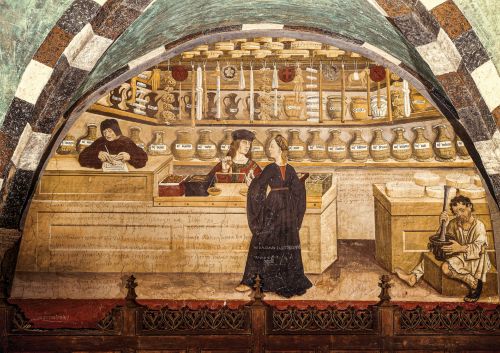
To understand why bezoar stones and mummy powder could become serious medicines, one must begin with a world in which matter was not inert in the modern sense. Ancient, medieval, and early modern physicians inherited a natural philosophy in which substances possessed qualities, temperaments, virtues, sympathies, antipathies, and hidden powers. Some of these qualities were visible or sensible: hot, cold, moist, dry, bitter, oily, resinous, fragrant, astringent, corrupting, preserving. Others were occult in the older philosophical sense, not necessarily demonic or supernatural, but hidden from ordinary perception. A stone formed inside an animal, a resinous substance associated with preservation, a horn from an exotic beast, a mineral drawn from the earth, or a powder made from the ancient dead could appear medically meaningful before anyone knew its chemical composition. The strangeness of a substance was not automatically a reason to reject it. It might be the very reason to suspect that nature had concentrated some unusual virtue within it.
Premodern pharmacology was built from a vast materia medica that mixed plants, minerals, metals, animal products, and human substances. Greek, Roman, Arabic, Jewish, and Latin medical traditions preserved long lists of simples and compounds, many arranged according to humoral theory and practical experience rather than modern mechanisms of action. A drug could purge, cool, heat, bind, soften, dry, stimulate, stupefy, preserve, or counteract corruption. Some remedies were valued because they produced an obvious physical effect, such as vomiting, sweating, sleep, salivation, urination, or evacuation. Others were valued because authoritative texts attributed powers to them, because generations of practitioners repeated their use, or because they seemed to operate through a hidden relationship between the substance and the body. This was true for antidotes, alexipharmics, and compound remedies meant to defeat poisons, plague, venom, and corruption. The desired action was often invisible: the medicine was supposed to resist a danger already hidden inside the body. That made proof difficult, but it also made rare and mysterious substances attractive. If poison itself could work secretly, entering through food, drink, breath, wound, or venomous bite, then an equally subtle counter-power did not seem implausible. In that setting, a bezoar did not have to resemble a modern antidote to be credible. It needed to fit into a larger therapeutic grammar in which poison could be opposed by counter-poison, corruption by preservative matter, imbalance by contrary quality, and danger by substances already marked as exceptional. Mummy powder, too, could be absorbed into this grammar because it seemed to unite several valued properties at once: antiquity, dryness, preservation, resinous strength, and contact with bodies that appeared to have resisted ordinary decay.
The category of “wonder” mattered deeply here. Medieval and early modern learned culture did not always treat marvels as violations of nature; often it treated them as rare expressions of nature’s deeper order. A monster, fossil, magnet, unicorn horn, bezoar, or incorrupt body might reveal that the natural world contained powers not yet fully understood. Wonder invited collection, classification, debate, and use. Cabinets of curiosity, princely treasuries, apothecary shops, and medical libraries all participated in this economy of marvels. The same object could be studied, displayed, sold, worn, prescribed, and mythologized. This is crucial for understanding bezoars, which were at once stomach stones, jewels, antidotes, diplomatic gifts, and signs of access to distant animals and faraway trade routes. Their authority came partly from medicine, but also from the culture of rare things. If ordinary herbs were common, a stone born in the secret interior of an animal seemed to belong to a different order of nature.
Mummy powder drew on a related but darker logic. Its supposed power depended on preservation, antiquity, and the useful ambiguity of the dead body. If Egyptian mummies appeared to resist decay, then the substance associated with that resistance could be imagined as medically active. Bitumen, resin, embalmed flesh, and the aura of ancient Egypt blurred into one another in European medical imagination. The dead body was not simply refuse; it could be a vessel of remaining force, a preserved material, or a therapeutic resource. This was not unique to mummy powder. Early modern European medicine also used human fat, skull, blood, and other bodily substances, particularly when they were believed to contain life, spirit, warmth, or concentrated vitality. Such remedies now appear macabre because modern medicine has largely separated pharmacology from the moral and symbolic power of human remains. But in the older medical world, a substance taken from the dead could be understood as part of nature’s pharmacy, especially if it seemed to carry the power to resist dissolution.
The weirdness of these remedies was also reinforced by the structure of medical authority. Premodern physicians did not work in a vacuum of random belief. They argued from ancient authors, Arabic commentators, scholastic interpretation, practical case histories, household recipes, apothecary knowledge, and personal observation. A remedy that appeared in respected texts or circulated through reputable physicians could acquire legitimacy even when its effects were uncertain. Repetition became a kind of evidence. So did expense, scarcity, and difficulty of acquisition. A rare drug from distant lands did not look suspicious merely because it was exotic; it often looked powerful because it was exotic. Medical authority also moved through layered trust: the trust placed in Galen, Dioscorides, Avicenna, or later compilers; the trust placed in merchants who claimed access to authentic eastern drugs; the trust placed in apothecaries who prepared substances according to recognized recipes; and the trust placed in physicians who could interpret when, how, and for whom a remedy should be used. This chain was vulnerable to error and fraud, but it was not formless. It created a working system in which a drug’s reputation could survive repeated ambiguity because each failure could be assigned to some defect in the chain rather than to the remedy itself. The stone might be false, the mummy badly sourced, the compound incorrectly prepared, the patient too far gone, the poison unusually violent, or the dose insufficient. The global movement of materia medica from the Indian Ocean, the Islamic world, the Mediterranean, Africa, and the Americas expanded European drug markets and widened the imagination of what nature might contain. Bezoar stones and mummy powder belonged to this broader world of medical commerce, where the promise of cure traveled with merchants, translators, physicians, collectors, pilgrims, soldiers, and imperial agents.
This does not mean that premodern people accepted every strange remedy without skepticism. Physicians disputed the quality, preparation, dosage, authenticity, and proper use of drugs. Apothecaries could be accused of fraud. Learned writers distinguished genuine substances from counterfeits. Practitioners tested remedies on animals, condemned prisoners, or desperate patients, sometimes with cruel confidence and sometimes with genuine uncertainty. But skepticism usually operated within the older framework rather than outside it. The question was often not whether strange matter could heal, but which strange matter was genuine, properly prepared, rightly administered, and suited to the disease. Bezoars and mummy powder became plausible because they joined several powerful assumptions at once: that nature hid extraordinary virtues in extraordinary substances, that ancient and foreign knowledge deserved respect, that the body responded to qualities and hidden powers, and that rare matter might answer rare danger. Their failure as modern medicines becomes historically intelligible only when we first see why, in their own world, the weird could heal.
Bezoars Before Europe: Antidotes, Animals, and the Eastern Origins of a Wonder Drug
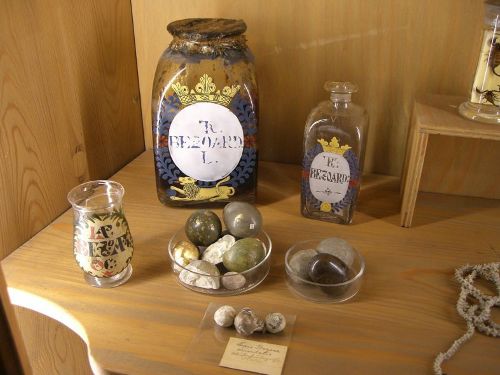
Long before bezoar stones became ornaments of European courts and symbols of princely protection, they belonged to a wider Afro-Eurasian medical world in which poison was both a bodily danger and a social fear. The word itself points eastward. European “bezoar” is usually traced through Arabic and Persian forms related to pādzahr or pāzahr, meaning something like “counter-poison” or “antidote.” The name did not merely describe an object; it announced a function. A bezoar was not first imagined as a curiosity that later acquired medicinal meaning. Its identity was already bound to the promise of resistance, reversal, and protection. To call a stone a bezoar was to place it within a long tradition of alexipharmic substances, medicines valued because they were believed to withstand venom, poison, corruption, and hidden internal attack.
The eastern history of bezoars was never confined to a single culture. Persian, Arabic, Indian, and Central Asian medical traditions participated in the movement of antidotal knowledge, while trade carried drugs, stones, resins, spices, and animal products across the Indian Ocean and overland routes. In Arabic medical writing, bezoars appeared alongside other celebrated simples and compounds, entering the same learned world that transmitted Greek medicine, Persian pharmacology, Indian materia medica, and local empirical practice. Islamic medicine was important because it did not merely preserve older knowledge; it reorganized, commented on, tested, translated, and transmitted it. By the time Latin Europe encountered many eastern drugs through Arabic texts, Mediterranean commerce, crusading contact, Iberian translation, and later direct trade, bezoars already possessed a medical reputation. They arrived not as nameless stones, but as substances already surrounded by textual authority and therapeutic expectation.
The animal origin of bezoars made their supposed power plausible. These stones formed in the stomachs or intestines of certain animals (wild goats, deer, antelopes, and related ruminants) though later markets would identify many varieties and alleged sources. Their formation inside the living body gave them a strange double authority. They were mineral-like, but not simply minerals; animal products but not flesh; internal growths, but not ordinary organs. They seemed produced by nature in secrecy, hidden within creatures thought to browse on mountain plants, bitter herbs, poisonous shrubs, or dangerous substances unavailable to ordinary humans. If such animals survived in harsh landscapes and consumed powerful vegetation, it was easy to imagine that the stone within them had absorbed, concentrated, or neutralized toxic force. The very location of the bezoar strengthened this interpretation. The stomach was the place where food, medicine, poison, digestion, heat, and transformation met. A stone born there could be imagined as the residue of struggle between animal vitality and harmful matter, a material proof that the body had defeated what might otherwise have killed it. In humoral and pharmacological terms, this made the bezoar more than a curiosity: it appeared to be a natural product of resistance. The animal did not merely carry the antidote; the animal’s body seemed to have manufactured it through repeated encounters with danger. The bezoar offered a compact story of natural defense: the animal encountered poison, the body formed a counter-poison, and humans could borrow that protection.
This mattered because premodern poison was rarely understood as a single chemical category. Poison could be venom, spoiled food, mineral toxin, plant toxin, corrupted air, malicious preparation, or mysterious internal disorder. It could kill openly or secretly. It could enter the body through a bite, a cup, a wound, a perfume, a garment, a cosmetic, or a meal. Antidotes had to possess a kind of general power against hidden danger. The best antidotes were not necessarily those tied to one precise mechanism; they were those believed to oppose poison as a class of threat. Bezoars fit this need beautifully. They were rare, portable, durable, and symbolically concentrated. They could be scraped, powdered, steeped, swallowed, dissolved, worn, touched to liquid, or placed in vessels. The same stone could serve as medicine, test object, talisman, and prestige possession.
In eastern and Islamic medicine, bezoars also entered a wider culture of antidotal compounds such as theriac-like preparations and complex recipes designed to resist venom, plague, and poison. The bezoar’s fame did not depend only on the stone alone. It was part of a pharmacological environment that valued compound action, graded potency, and careful classification. Physicians and drug writers differentiated substances by source, color, texture, quality, and region. A bezoar from one animal or landscape might be more esteemed than another; a stone of a certain appearance might be praised as stronger, purer, or more reliable. This classificatory impulse mattered because it gave the remedy a learned structure. Bezoars were not simply magical lumps dropped into medicine from folklore; they were discussed, compared, ranked, and incorporated into the technical language of drugs. The question of authenticity became crucial early, because a valuable antidote invited substitution and fraud. A true bezoar had to be distinguished from an ordinary stone, a manufactured imitation, or a weaker variety. Such concerns show that belief in bezoars was not simply naïve acceptance. Practitioners were already aware that the medical and commercial value of the stone depended on origin, quality, and proper identification. The very anxiety over counterfeits helped preserve the remedy’s prestige, because failure could be blamed on false material rather than on the concept of the bezoar itself. If a patient died, the stone might not have been genuine; if the antidote failed, perhaps the wrong kind had been used. This made the bezoar unusually durable as a medical idea, since skepticism about individual specimens could coexist with confidence in the category.
When bezoars traveled westward, they carried this reputation with them. Latin Europe did not invent their power from nothing; it received them through channels of translation, commerce, and medical borrowing. The same pattern can be seen in many other eastern drugs that entered European medicine: substances acquired authority because they were attached to respected physicians, exotic geographies, and established pharmacological networks. European buyers, physicians, apothecaries, and princes encountered the bezoar as an eastern antidote already shaped by Arabic and Persian naming, Islamic medical commentary, and Indian Ocean trade. That eastern origin increased rather than weakened its prestige. Distance made the drug harder to obtain, and difficulty of acquisition reinforced the assumption that it must be powerful. A common remedy could be useful, but a rare antidote from far away seemed to belong to the hidden treasury of nature.
The early history of bezoars complicates any simple story of medieval credulity. Their reputation emerged from a serious premodern effort to classify danger and locate protection within nature. The logic was wrong in its grandest claims: bezoars were not universal antidotes, and their supposed power was vastly exaggerated. Yet the belief was historically intelligible. A stone formed inside an animal, named as a counter-poison, praised in learned traditions, circulated through long-distance trade, and authenticated by physicians and merchants could become more than an oddity. It became a portable answer to one of the oldest medical fears: that death might enter the body invisibly and require an equally mysterious force to drive it out.
Bezoar Stones in the Age of Poison: Courts, Assassination Anxiety, and Elite Fear

By the time bezoar stones became fashionable in European courts, poison had acquired a political imagination far larger than its ordinary medical reality. It was feared not only as a substance that damaged the body, but as a secret weapon that dissolved trust. A sword, arrow, or plague might be terrifying, but poison was intimate. It could hide in wine, fruit, broth, sweetmeats, medicine, perfume, gloves, cosmetics, letters, or the hands of servants. It required no open confrontation and left room for rumor even when no poison had been used. In courts where meals were staged, access to the ruler was controlled, and favor could rise or fall with dangerous speed, poisoning became a language of suspicion. The bezoar stone entered this atmosphere as a material promise that invisible danger might be met by invisible protection.
Courtly fear made the bezoar more than a remedy. It became part of the politics of survival. Princes, nobles, bishops, ambassadors, and wealthy households lived in environments where bodily vulnerability and political vulnerability overlapped. To be poisoned was not merely to suffer a private medical event; it was to become the victim of conspiracy, betrayal, factional rivalry, dynastic ambition, or household treachery. The antidote held an emotional value that ordinary drugs did not. It offered the fantasy that the powerful could defend themselves against the one form of violence most suited to their world: concealed, deniable, domestic, and difficult to prove. This fear was intensified by the structure of elite life itself. Rulers and courtiers depended on cooks, cupbearers, physicians, servants, tasters, lovers, relatives, clerics, and attendants, all of whom could be imagined as possible conduits of danger. The most intimate spaces of protection (the bedchamber, dining room, chapel, wardrobe, and medicine chest) could become the imagined sites of attack. Poison anxiety made ordinary dependence feel politically dangerous. A bezoar could not actually neutralize the wide range of poisons people feared, but it answered the form of fear perfectly. It was rare, portable, secretive, and elite, just like the imagined threat.
The stone also fit older stories of antidotal sovereignty. Classical and medieval traditions remembered rulers who feared poison so intensely that they sought universal antidotes, most famously Mithridates of Pontus, whose name became attached to compound antidotes meant to fortify the body against toxins. Early modern Europe inherited this tradition through theriac, mithridate, and other complex preparations. The ideal ruler was not simply armed against enemies outside the palace; he was fortified against corruption entering the body itself. The political body and the natural body overlapped here. A poisoned ruler could mean a broken succession, a disputed inheritance, a factional victory, a religious crisis, or the sudden collapse of a household’s fortunes. To defend the ruler’s stomach was, symbolically, to defend the realm, the dynasty, or the lineage. Bezoars joined this symbolic lineage. Unlike long compound recipes, the bezoar compressed antidotal power into a single object. It could be held in the hand, mounted in gold, locked in a treasury, dipped into liquid, grated into drink, or displayed before guests. Its physical durability helped make antidotal power visible. Where poison worked by disappearance, the bezoar reassured by presence.
This visibility helps explain why bezoars became luxury objects as well as medicines. Many were not kept as plain lumps in apothecary drawers. They were mounted, encased, suspended, polished, engraved, paired with precious metals, or stored among other marvels such as unicorn horn, rhinoceros horn, coral, pearls, ambergris, and exotic nuts. Such treatment did not trivialize their medical role; it enhanced it. A medicine fit for a ruler had to look like a ruler’s medicine. The mounting of a bezoar in gold or silver made its value legible and protected it from ordinary handling, while also transforming it into an object of ceremonial use. The courtly bezoar could be both emergency antidote and princely display, a cure and a jewel, a pharmacological object and a political emblem. Its splendor announced that the owner possessed access to rare nature, global trade, learned medicine, and the resources to command them.
The social logic of the bezoar was inseparable from hierarchy. A poor patient might rely on local herbs, household remedies, parish healers, or inexpensive apothecary mixtures. A prince could command drugs from India, Persia, Arabia, Africa, or the New World. The bezoar embodied this inequality in concentrated form. Its very cost made it seem more credible, because price and potency were easily imagined as linked. If a stone could be worth enormous sums, if it could circulate as a diplomatic gift, if physicians praised it and collectors coveted it, then its reputation reinforced itself. Its rarity also made ordinary verification difficult. Few people had enough access to compare specimens, test them repeatedly, or distinguish genuine stones from imitations. The bezoar’s elite status protected it from the kind of everyday scrutiny that common medicines might receive. It belonged to a world where possession itself was evidence.
Yet the anxiety that sustained bezoars also produced skepticism. Because poison was hidden and antidotes were expensive, fraud was always near. A courtier who purchased a false bezoar had not merely wasted money; he had acquired a useless shield against a feared death. Physicians, naturalists, merchants, and rulers worried about authenticity, source, color, texture, weight, and testing. Some stones were scraped into liquid; others were placed in poisoned drinks; still others were compared against known specimens. Tests might involve animals, servants, or condemned prisoners, turning the search for proof into a violent performance of elite security. These trials did not necessarily resemble modern controlled experiments, but they did show that bezoars occupied a contested space between belief and verification. The owner wanted reassurance, the physician wanted authority, the merchant wanted trust, and the observer wanted visible proof that the stone did what reputation promised. But the more elaborate the verification rituals became, the more they revealed the uncertainty beneath the confidence. A universal antidote should have been self-evidently powerful, yet bezoars required networks of testimony, expert judgment, merchant reputation, and dramatic trials to sustain belief. Court culture made the bezoar famous, but it also exposed the fragility of its claims.
The age of poison did not create the bezoar stone, but it gave the stone its most potent European setting. Courts needed objects that promised mastery over invisible threats, and the bezoar supplied a perfect material metaphor for that desire. It was born in secrecy, drawn from animals associated with distant landscapes, authenticated by learned and commercial authorities, and transformed into a jewel of survival. Its medical failure becomes clearer to modern eyes than it could have been to many of its owners, but its emotional success is unmistakable. The bezoar mattered because it allowed elites to imagine that nature had hidden an antidote to conspiracy itself inside the body of an animal. In a world where poison turned the table, cup, servant, lover, physician, and courtier into possible instruments of death, that fantasy was almost irresistible.
Trade, Empire, and Authenticity: The Global Commerce in Bezoars
The European rise of the bezoar stone cannot be separated from the expansion of long-distance commerce. Its reputation had older Persian, Arabic, Indian, and Mediterranean roots, but its early modern fame depended on the same networks that carried pepper, cloves, nutmeg, musk, pearls, porcelain, indigo, precious stones, drugs, and curiosities across oceans and courts. Portuguese, Dutch, English, Armenian, Persian, Gujarati, Malay, and other merchants moved not only commodities but claims about commodities: where they came from, how they should be used, which varieties were genuine, and why they deserved extraordinary prices. A bezoar was not merely found in an animal and sold as medicine. It was translated through ports, brokers, physicians, collectors, imperial agents, and apothecaries before it reached the European patient or prince. Each stage of movement added authority, uncertainty, and value.
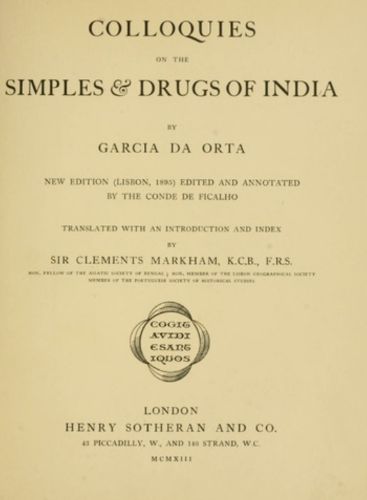
The Portuguese empire was important in bringing bezoars into more direct European view. Sixteenth-century Portuguese expansion into the Indian Ocean did not create Asian drug markets, which were already old and sophisticated, but it inserted European buyers into established systems of exchange. Goa, Malacca, Hormuz, and other commercial centers connected Europe to medicinal substances whose origins were often distant even from the ports where they were sold. Garcia da Orta’s Colloquies on the Simples and Drugs of India is valuable precisely because it shows a European physician in Portuguese India trying to understand drugs through conversation, comparison, local knowledge, and commercial experience rather than through inherited Latin texts alone. Bezoars belonged to this world of encounter. They were discussed as eastern remedies, handled as precious goods, and judged through a mixture of learned medicine, merchant testimony, and practical familiarity with the drug trade. Orta’s world was not one in which European medicine simply imposed itself on Asian knowledge; it was one in which European practitioners depended on interpreters, local physicians, brokers, patients, and traders who already knew the reputations of these substances. That dependence matters because it complicates the later European fantasy that empire merely “discovered” exotic cures. Empire often purchased, renamed, reclassified, and redirected remedies that had already circulated through older medical and commercial routes. The bezoar’s authority in Europe rested partly on Asian and Islamic traditions that European buyers did not fully control, even as they increasingly tried to own the trade.
Yet global commerce made authenticity both more important and more unstable. A remedy that cost little and grew locally could disappoint without shaking a household economy. A bezoar, by contrast, could command enormous prices, especially if it was believed to be from the proper animal, region, or variety. The more valuable the stone became, the more profitable it became to imitate, adulterate, mislabel, or exaggerate it. Ordinary stones could be passed off as bezoars. Inferior bezoars could be sold as superior ones. Manufactured compounds could be presented as natural stones. A buyer needed to know not only whether bezoars worked, but whether this particular bezoar was truly a bezoar at all. In that sense, the medical question and the commercial question were inseparable. The promise of antidotal power depended on the credibility of the supply chain.
The market responded by producing elaborate cultures of recognition. Physicians, merchants, and collectors debated the signs of a true bezoar: color, surface, weight, polish, smell, internal layers, reaction to scraping, behavior in liquid, and reputation of origin. Some stones were ranked according to geography or animal source, and some varieties were treated as notably potent. Porcupine bezoars, for example, became prominent in early modern Asian and European trade, developing their own mythology, pricing, and problem of forgery. The fact that buyers worried so much about identification did not undermine the category of the bezoar; paradoxically, it often strengthened it. Fraud confirmed value. Counterfeits existed because the true object was believed to be powerful. Every warning against false stones helped preserve the idea that somewhere, in the right animal and the right market, the genuine antidote existed.
This same commercial logic helps explain the so-called Goa stone, an artificial or composite antidotal object associated with Indo-Portuguese medical trade. Unlike natural bezoars, Goa stones were manufactured from medicinal ingredients and shaped into precious, stone-like forms. They imitated the authority of the bezoar while also adapting it to a market hungry for portable, elite antidotes. Their existence reveals an important transition: the power of the bezoar had become so culturally recognizable that it could be reproduced in manufactured form. The stone no longer had to be only a natural accident inside an animal. It could become a crafted medical object, blending pharmacology, luxury, colonial trade, and performance. Goa stones also show that authenticity did not always mean untouched natural origin. In some settings, a manufactured antidote could claim legitimacy precisely because it was expertly composed from valued ingredients and shaped according to an established ideal of medicinal power. The artificial stone borrowed the prestige of the natural bezoar, but it also promised improvement: regularity, portability, refinement, and controlled preparation. This placed it somewhere between drug, jewel, and branded commodity. It was a medicine made for a world in which elite consumers wanted not only therapeutic hope, but also objects that could be recognized, displayed, gifted, and trusted as part of a broader culture of rare cures.
The global commerce in bezoars exposes one of the central tensions of premodern medicine: the farther a remedy traveled, the more authority and uncertainty it acquired. Distance made drugs prestigious, but it also made their stories harder to verify. Empire widened European access to materia medica, but it also multiplied dependence on translators, brokers, sailors, apothecaries, and colonial intermediaries. Bezoars became famous not because they were simply effective, but because they moved through a world in which rarity, danger, exotic origin, and commercial trust could be converted into medical value. Their failure as universal antidotes did not prevent them from succeeding as global goods. They were objects made powerful by movement: from animal stomach to merchant chest, from Indian Ocean port to European cabinet, from apothecary shelf to princely hand, from natural curiosity to medicine against invisible death.
Testing the Stone: Poison Trials, Ambroise Paré, and the Limits of Experience
The credibility of the bezoar stone did not rest only on inherited authority, exotic origin, or princely display. It also entered a harsher world of testing, spectacle, and professional rivalry. Early modern Europe was not a place where all famous remedies passed unchallenged. Physicians, surgeons, natural philosophers, merchants, and rulers argued over drugs, demanded proofs, staged demonstrations, and sometimes used desperate or condemned bodies as instruments of verification. The bezoar’s reputation as an antidote made it vulnerable to this demand. If it truly countered poison, then its power should be visible at the very moment poison threatened life. Yet this apparent simplicity created a terrible problem: to test an antidote convincingly, someone or something had to be poisoned.
Poison trials occupied a disturbing space between medicine, punishment, and theater. Condemned criminals, animals, servants, or marginal people could become test subjects in experiments designed to show whether a drug resisted venom or toxin. These trials were cruel, but they were not meaningless spectacles. They belonged to an early modern culture in which experience, observation, and witnessed events were increasingly important, even though they did not yet operate according to modern standards of controlled experimentation. A successful trial could elevate a remedy, a physician, or a patron. A failed trial could damage reputation, expose fraud, or shift authority from one practitioner to another. The drama of the test mattered because the audience mattered. A prince, court physician, surgeon, apothecary, merchant, or crowd of witnesses could transform a single event into public evidence. Such trials also made medical knowledge visibly hierarchical. The person whose body bore the risk was rarely the person whose reputation, fortune, or authority was being tested. The condemned prisoner or animal became the medium through which elite observers debated the truth of a drug. This gave poison trials an unsettling moral structure: they pursued knowledge about saving life by staging the possibility of death among those whose lives had already been socially discounted. The bezoar’s supposed power was tested not in a neutral laboratory, but in a world where punishment, spectacle, mercy, and scientific curiosity could blur together.
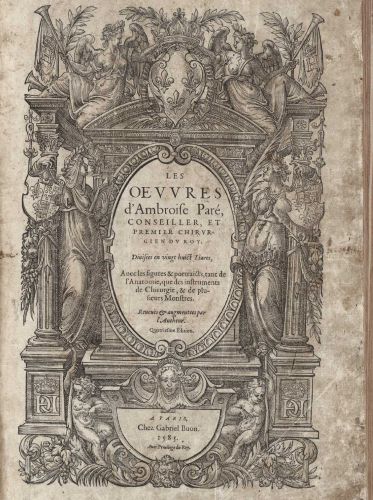
Paré’s famous account of testing a bezoar stone stands at the center of this history because it gives the modern reader exactly what the myth of the universal antidote tries to avoid: a dead body. Paré, the great French surgeon, described a condemned cook who had stolen silver and was offered the chance to take poison followed by a bezoar as a possible reprieve. The cook reportedly accepted, hoping to escape execution if the stone worked. He was poisoned, given the bezoar, and died in agony. For Paré, the lesson was blunt: the bezoar did not deserve the confidence placed in it. The episode is often retold as a moment of empirical clarity, with Paré cast as a proto-modern skeptic exposing a fraudulent old remedy. It is a powerful story because it compresses the whole conflict into one scene: courtly belief, medical testing, human suffering, and the collapse of a celebrated antidote before the evidence of death.
Yet Paré should not be turned too quickly into a modern scientist surrounded by medieval fools. His skepticism emerged from the medical culture of his own century, not from a fully developed laboratory medicine. He valued experience, surgery, observation, and the body, but he also worked within a world still shaped by humoral theory, classical authorities, providence, and traditional remedies. His criticism of the bezoar did not mean he rejected every inherited medicine or every rare substance. Rather, he objected to exaggerated claims when experience seemed to contradict them. This distinction matters. Paré’s story shows that premodern medicine contained internal skepticism. It was not divided neatly between gullible believers and rational moderns. The same world that prized bezoars also produced practitioners willing to question them when a remedy’s reputation outran its visible effects. Paré’s authority as a surgeon is important here, because surgery placed unusual weight on the visible body, manual practice, wounds, pain, and outcomes that could be observed directly. Surgeons often had less prestige than university physicians, but their work forced them to confront bodily failure with a practical immediacy that learned theory could not always soften. In that context, the death of the poisoned cook was not merely a philosophical objection to bezoars; it was an experiential challenge grounded in the witnessed collapse of a body that the stone was supposed to save.
The trial also reveals the limits of experience as proof. A single failed test could be interpreted in several ways. To Paré, the death of the cook suggested that the bezoar was ineffective against the poison administered. To a defender of bezoars, the conclusion might have been less decisive. Perhaps the stone was false. Perhaps the dose was too small. Perhaps the poison was too violent. Perhaps the antidote was given too late. Perhaps the patient’s body was already corrupted, fearful, weak, or divinely condemned. These explanations were not mere evasions; they belonged to a medical culture in which substances varied, bodies differed, and timing mattered. Modern readers may see special pleading, and sometimes it surely was. But for early modern practitioners, variability was a constant feature of medicine. Drugs did not act upon standardized bodies in standardized conditions. One patient’s constitution might differ from another’s; one poison might be hotter, colder, subtler, more corrosive, or more malignant than another; one preparation might retain virtue while another had lost it through age, corruption, or mishandling. Experience could challenge belief, but it did not automatically destroy it. It had to be interpreted, and interpretation was precisely where older authorities, professional interests, commercial stakes, and expectations about nature reentered the discussion. The failed trial could become evidence against the bezoar, but it could also become evidence of bad materia medica, bad timing, bad procedure, or a poison that exceeded ordinary antidotal power.
This is why the bezoar survived criticism. Its reputation was not dependent on one story, one trial, or one physician. It rested on a network of authorities, merchants, collectors, courtly owners, medical texts, anecdotes of recovery, and authenticated specimens. A failed poison trial could weaken confidence, but it could also be absorbed into the larger system by shifting blame onto the specimen, the circumstances, or the operator. Even apparent empirical testing could end up reinforcing the need for experts: someone had to determine whether the bezoar was genuine, whether it had been prepared correctly, whether the poison was of the proper kind, and whether the procedure had been fair. The test did not eliminate authority; it relocated authority into the interpretation of the test. In that sense, poison trials could both challenge and sustain the bezoar’s power.
The history of testing the bezoar complicates the story of failed medicine. The problem was not that premodern Europeans never tested their remedies. They did test them, sometimes brutally. The problem was that tests occurred inside social, legal, medical, and commercial worlds where evidence was unstable and interpretation was contested. Paré’s dead cook exposed the fragility of the bezoar’s claim to universal antidotal power, but he did not immediately end the stone’s career. The bezoar persisted because experience itself had limits. A death could disprove one stone, one dose, one poison, or one physician’s confidence, but it did not necessarily disprove the whole category. The stone’s authority weakened only slowly, as repeated skepticism, chemical explanation, toxicological precision, and changing standards of proof made it harder to preserve the older belief that rare matter could answer poison by hidden sympathy alone.
Bezoars in Law and the Marketplace: Fraud, Warranty, and Chandelor v. Lopus
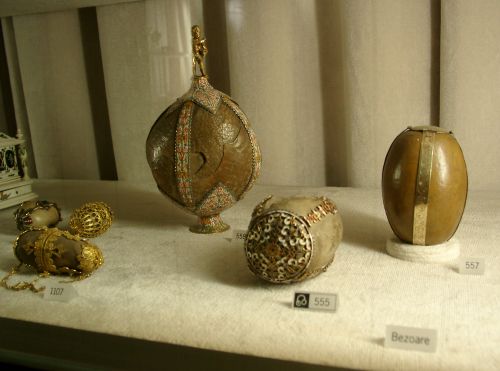
The bezoar stone did not belong only to physicians, courts, apothecaries, and collectors. It also entered the world of law. That fact is revealing. A substance becomes legally interesting when it is valuable enough to fight over, uncertain enough to misrepresent, and recognizable enough for courts to imagine a difference between the genuine and the false. The bezoar met all three conditions. It was expensive, medically prestigious, and notoriously difficult to authenticate. Its power depended on trust, but the marketplace that carried it was filled with reasons for distrust. Merchants, apothecaries, physicians, travelers, and collectors all participated in a trade where the buyer often had to rely on the seller’s word about origin, quality, and medicinal virtue. In that setting, fraud was not incidental to the history of the bezoar. It was built into the object’s commercial life.
The most famous legal episode involving a bezoar is Chandelor v. Lopus, decided in England in 1603. The case concerned the sale of a stone represented as a bezoar. The buyer, having paid a very large sum, later claimed that the stone was not genuine and brought an action against the seller. To a modern reader, the moral logic may seem simple: if a seller says a thing is a bezoar and it is not a bezoar, the buyer has been deceived. But early modern common law did not frame the problem so simply. The court treated the seller’s mere affirmation that the stone was a bezoar as insufficient unless there was an express warranty or a properly pleaded allegation of knowing deceit. The case became famous in the history of sales law because it marked the sharp difference between praise, assertion, warranty, and actionable fraud. The buyer’s disappointment was not enough. The law wanted a legally recognizable promise or a legally recognizable lie.
That distinction matters for the history of medicine because it shows how the value of a remedy could depend on categories outside medicine itself. The court did not have to decide whether bezoars actually cured poisoning. It had to decide what kind of legal responsibility attached to selling something as a bezoar. The question was not efficacy, but authenticity and representation. Was this stone truly the kind of object the market recognized as a bezoar? Had the seller merely described it, or had he guaranteed it? Did the buyer assume the risk, or had the seller crossed into deceit? The law’s caution reflected the uncertainties of early modern commerce, where buyers and sellers constantly negotiated the line between ordinary bargaining and fraudulent misdescription. A bezoar stone was an ideal object for that problem because its value was almost entirely bound to identity. If it was genuine, it might be worth a fortune. If it was not, it was only a stone. But this also means that the law treated the bezoar less as a therapeutic event than as a commercial category. The court was not testing the stone on poison; it was testing the language of sale. That shift is important. The bezoar’s meaning in the marketplace depended on whether words could attach value to matter and whether those words created enforceable responsibility. In medicine, the buyer wanted hidden virtue. In law, the court wanted visible obligation. The gap between those two forms of proof made the bezoar a perfect object for dispute.
The case also exposes the limits of “buyer beware” as a historical principle. Chandelor v. Lopus is often remembered as a hard example of caveat emptor, but the more interesting point is that the marketplace was not imagined as free from moral danger. The law did recognize deceit and warranty; it simply required them to be pleaded and proven in specific ways. This legal formalism mattered because early modern markets were filled with goods whose qualities were invisible, technical, foreign, or dependent on specialized knowledge. Drugs were particularly vulnerable. A buyer could inspect cloth, grain, or livestock more easily than he could judge whether an imported stone contained hidden antidotal virtue. Even if the object could be seen and handled, the quality that made it valuable was not fully visible. The bezoar created a gap between possession and knowledge. The buyer might hold the stone in his hand and still be unable to know whether he possessed a medical treasure or a fraud. This problem was not unique to bezoars, but bezoars dramatized it unusually well because their supposed value exceeded ordinary sensory evidence. A buyer could see smoothness, color, weight, polish, or shape, but not the power to resist poison. The most important feature of the object was precisely the one least available to direct inspection. That made the transaction depend on statements, reputations, prior owners, expert opinions, and the assumed honesty of the seller. The law’s reluctance to transform every confident assertion into a warranty may look harsh, but it also reflects a world in which many valuable goods were sold through claims that hovered between description, opinion, advertisement, and promise.
That gap was filled by reputation. Sellers relied on stories of origin, prior ownership, merchant networks, expert recognition, and the authority of apothecaries or physicians. Buyers relied on the same things, often uneasily. A bezoar’s market value was created by a chain of testimony stretching backward through ports, caravans, animal hunters, drug merchants, colonial brokers, physicians, and collectors. At every point, the object could be renamed, misidentified, substituted, or enhanced by narrative. This did not make the trade irrational. It made it structurally fragile. The more distant and specialized the commodity, the more the market depended on words. In that sense, the bezoar was a medicine made out of matter and testimony together. The stone’s physical form mattered, but so did the claim attached to it: where it came from, what animal produced it, who had authenticated it, what poisons it had resisted, and what authorities had praised it.
The legal history of the bezoar helps explain why ineffective medicine could persist in a sophisticated society. The problem was not that people lacked concepts of fraud, authenticity, or proof. They had them, and they argued about them intensely. But those concepts did not automatically lead to modern medical skepticism. A court could question whether a particular stone was a true bezoar without questioning the entire premise that true bezoars might defeat poison. A buyer could sue over a false stone while still believing genuine stones existed. A physician could denounce counterfeits while preserving confidence in authenticated specimens. Fraud, paradoxically, helped protect the ideal remedy. Every false bezoar implied the possibility of a true one. Every market warning suggested that failure belonged to deception, not necessarily to the medical theory behind the object. This was one of the most durable mechanisms by which doubtful remedies survived. The category remained pure because individual examples could be blamed. The stone failed because it was false, old, badly kept, wrongly scraped, improperly administered, or sold by an unreliable merchant. The concept of the bezoar did not have to collapse when a specimen disappointed; the disappointment could be absorbed into the commercial and legal problem of authenticity. In that way, skepticism became selective rather than destructive. It policed the boundary between genuine and fraudulent goods while leaving the larger promise of the bezoar intact.
Chandelor v. Lopus is more than a curiosity in contract law. It is a small window into the world that allowed the bezoar to thrive: a world of expensive remedies, dangerous claims, uncertain expertise, and legal systems struggling to manage trust. The case reminds us that failed medicine was not always sold in a naïve marketplace. It could circulate through courts, contracts, lawsuits, professional disputes, and careful distinctions between assertion and guarantee. The bezoar’s history in law shows that the stone’s power was never only pharmacological. It depended on credibility, and credibility had to be manufactured, defended, purchased, and sometimes litigated. By the early seventeenth century, the bezoar was not simply an antidote against poison. It was also an object through which early modern people tested the risks of buying knowledge they could not see.
Mummia Before Mummy Powder: Bitumen, Translation, and Medical Confusion
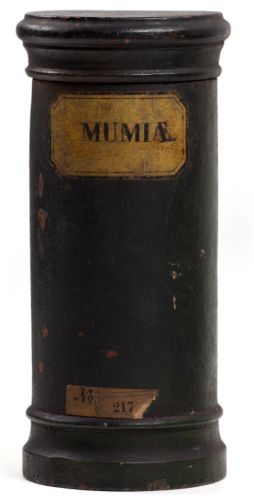
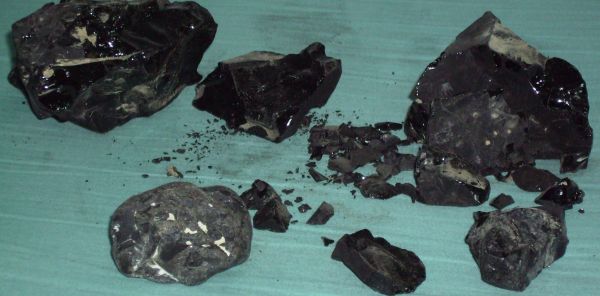
Before “mummy powder” became a scandalous symbol of Europeans consuming the Egyptian dead, mummia referred to something more complicated than ground-up corpses. The word belonged first to the history of mineral substances, resins, and bituminous matter. In ancient and medieval medicine, dark, tar-like materials associated with pitch, asphalt, petroleum, and natural bitumen were credited with drying, binding, healing, and preserving powers. Such substances could be applied to wounds, taken internally in small quantities, or incorporated into compound medicines. Their value came partly from their physical character. Bitumen was dark, dense, sticky, aromatic, resistant to ordinary decay, and associated with the earth’s hidden depths. It looked like matter that had already defeated corruption. Long before Egyptian bodies became central to the European drug trade, this mineral mummia was understood as a substance with medical force.
The confusion began because words, substances, and trade routes rarely moved cleanly. In Persian and Arabic medical traditions, terms connected to bitumen and pitch circulated through pharmacological writing. When these terms passed into Greek, Latin, and later European vernaculars, they carried overlapping meanings. A word that had once identified a mineral substance could become attached to substances found on or in embalmed bodies. Egyptian mummies, especially those darkened by resins, oils, natron, and age, seemed to contain or embody the very material that physicians valued. The medicinal substance and the preserved corpse began to blur. Was mummia the bitumen used in embalming? Was it the dark exudation found on ancient bodies? Was it the embalmed flesh itself? Translation did not merely carry a remedy from one language to another; it changed what the remedy was imagined to be. The problem was intensified by the way learned medicine depended on inherited words whose meanings had accumulated over centuries. A physician might encounter mummia in a text, an apothecary might receive it as a commercial drug, and a merchant might identify it according to the substance available for sale. Each could be using the same name while imagining a slightly different object. In that space between philology, pharmacy, and trade, ambiguity became productive. It allowed mineral pitch, embalming resin, grave matter, and corpse powder to occupy the same medicinal category without requiring a clean distinction among them.
This linguistic drift was reinforced by the visible mystery of Egyptian mummification. To European observers, mummies appeared as bodies that had resisted the ordinary fate of flesh. Their skin, wrappings, resins, and blackened surfaces seemed to testify to preservation across centuries. If medicine valued substances that dried, sealed, preserved, and resisted putrefaction, then the mummy looked like a medicinal argument made material. The corpse seemed to possess what the living body lacked: durability against decay. It was easy for physicians, apothecaries, and merchants to imagine that the preservative power associated with mummification could be transferred back into the living body. The logic was analogical rather than chemical. A substance that kept the dead from dissolving might help stop bleeding, close wounds, dry ulcers, strengthen weakened organs, or resist internal corruption.
But this was not simply a case of ignorant Europeans mistaking Egyptian funerary practice for pharmacy. The creation of medicinal mummy depended on a series of substitutions, each one plausible within its own commercial and medical context. Natural bitumen could be scarce, variable, or expensive. Imported substances could be misidentified or adulterated. Apothecaries and merchants had incentives to supply what physicians and patients demanded, even when the original substance was uncertain. If ancient mummies were believed to contain the desired bituminous medicine, then fragments of those bodies could become acceptable substitutes. The substitute could overtake the original. The drug that began as mineral matter could become corpse matter, and the authority of the older term could cloak the new and more disturbing material. This process also depended on the marketplace’s ability to turn uncertainty into opportunity. If one kind of mumia was unavailable, another could be offered as equivalent or even superior. If true bitumen was difficult to obtain, mummy flesh could be praised as bitumen enriched by age, embalming, and bodily contact. If ancient Egyptian bodies were scarce, newer corpses could be dried, treated, darkened, and sold into the same category. The history of mumia is a history of replacement as well as confusion. A medical word created demand; trade supplied matter to fit the word.
The result was a medicine built from confusion but stabilized by repetition. Learned authors debated the proper meaning and quality of mummia, and some criticized the use of Egyptian corpses or doubted the authenticity of mummy sold in apothecary shops. Yet the very debate helped keep the category alive. To argue over true and false mummy was to assume that a true medicinal substance existed somewhere. As with bezoars, doubt often attached itself to particular specimens rather than to the entire therapeutic idea. A powder might be condemned because it came from the wrong body, had lost its virtue, contained too little bitumen, had been adulterated, or was made from fresh corpses passed off as ancient remains. The remedy’s failure could be displaced onto supply, quality, translation, or fraud. Medical confusion did not destroy mummia; it gave merchants and physicians room to keep redefining it.
This prehistory of mummy powder is essential because it prevents us from treating corpse medicine as a sudden eruption of grotesque appetite. Mummy powder was grotesque, but it was also the end point of a long semantic and commercial transformation. A mineral drug associated with bitumen became entangled with embalming materials, then with Egyptian mummies, then with the powdered dead. The shift reveals how premodern medicine could create remedies through language as much as through experiment. Names carried authority. Translations carried ambiguity. Markets supplied substitutions. Bodies became materials when they could be inserted into an existing therapeutic category. Mummy powder did not begin simply because Europeans wanted to eat the dead. It began because a word for preservative matter wandered through medical languages until the preserved human body itself became the drug.
Eating Egypt: Apothecaries, Corpse Trade, and the European Demand for Mummy
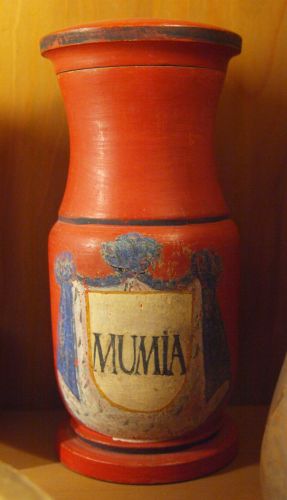
Once mummia became attached to Egyptian bodies, the preserved dead entered European medicine not merely as curiosities but as marketable drugs. Apothecaries stocked mummy in chunks, shavings, powders, and prepared compounds, selling it to physicians, household healers, and patients who believed that the material carried drying, binding, preservative, or restorative force. The remedy was used for bruising, internal bleeding, wounds, ulcers, coughs, digestive disorders, paralysis, and a wide range of conditions that could be interpreted through the language of corruption, weakness, obstruction, or internal injury. Its appeal did not require a precise anatomical mechanism. Mummy seemed to be medicine because it was old, dark, aromatic, foreign, preserved, and bodily. It looked like matter that had passed through death without surrendering entirely to decay. In the logic of premodern materia medica, that appearance mattered. The darkened fragment or powder did not present itself as ordinary flesh; it seemed transformed by time, embalming, resin, dryness, and burial into something medicinally concentrated. For physicians and patients who understood disease as a struggle against imbalance, putrefaction, rupture, and bodily dissolution, the mummy appeared to offer a material answer: a dead body that had not fallen apart might lend its preservative power to a living body in danger of doing so.
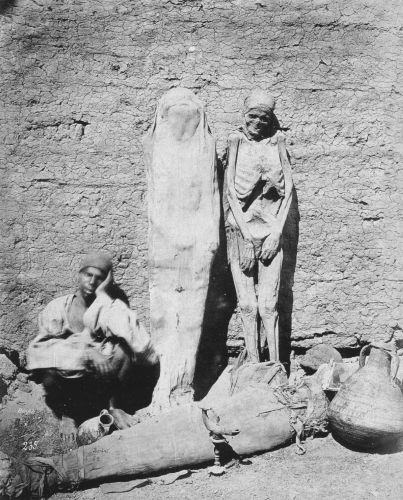
The European demand for mummy transformed Egyptian antiquity into pharmacological supply. Mummies were no longer only ancient persons, religiously prepared bodies, or remains embedded in funerary landscapes; in the European marketplace, they became raw material. Their wrappings, resins, bones, flesh, and blackened surfaces could be broken apart and reclassified as useful substances. Apothecaries did not need the whole body to sell the drug. A fragment could stand for Egypt. A powder could stand for antiquity. A dark mass could stand for bitumen. The body was reduced, transported, scraped, ground, and absorbed into the ordinary routines of pharmacy. This reduction is central to the violence of the trade. The mummy’s value depended on its human origin, but the commercial form of the drug made that origin easier to ignore.
The trade also depended on distance. Most European consumers did not see tombs opened or bodies dismantled. They encountered mummy as a substance already processed through merchants, physicians, ports, and shops. By the time it reached the patient, it had often lost the visual integrity that might have made its human identity harder to overlook. The powdered drug could be measured by weight, mixed with wine, incorporated into prescriptions, or stored beside other materia medica. Distance made the dead body abstract. It allowed Egyptian remains to become less a person than a therapeutic category, less a corpse than an ingredient. The same process made moral unease easier to manage. What would have seemed horrifying if performed on a neighbor’s body could appear medically respectable when mediated by antiquity, foreignness, and commercial preparation.
Apothecaries occupied the crucial middle ground between learned prescription and consumer demand. They supplied what physicians ordered, what recipe books repeated, and what patients believed worth purchasing. Their shops were places where medicine, commerce, sensory judgment, and reputation converged. A buyer might not know whether a powder was genuine Egyptian mummy, mineral bitumen, embalmed flesh, or fraudulent substitute, but the apothecary’s label and authority gave it form. This was not unique to mummy. Early modern pharmacy was full of imported substances whose identity depended on trust: spices, gums, resins, stones, roots, animal products, and compounds from distant markets. Yet mummy carried an unstable identity because its value depended on a chain of transformations that was unusually vulnerable to deception. The apothecary’s jar could turn corpse matter into medicine, but it could also conceal how uncertain that medicine was.
The hunger for mummy created predictable fraud. Genuine ancient Egyptian mummies were limited, difficult to obtain, and variable in condition. Demand could be expanded by language and substitution. If patients wanted mummia, suppliers could provide something that looked, smelled, or behaved like the expected drug. Writers complained that bodies of executed criminals, the recently dead, or other corpses might be dried, treated, darkened, and sold as ancient mummy. Whether every such story can be verified is less important than what the accusations reveal: early modern people understood that the mummy trade invited fabrication. The drug’s prestige made it vulnerable to imitation, just as the bezoar’s prestige did. A false mummy did not necessarily destroy belief in medicinal mummy. It could instead reinforce the distinction between true and false material, allowing confidence in the ideal remedy to survive the exposure of particular frauds. Indeed, fraud could become part of the remedy’s mythology. The warning that some mummy was counterfeit implied that authentic mummy remained desirable, powerful, and worth seeking. Failure could be blamed on bad sourcing rather than bad theory. A powder that did nothing might not discredit mummia itself; it might only prove that the apothecary had supplied the wrong corpse, the wrong resin, the wrong age, or the wrong preparation. The market protected the dream of the drug by multiplying explanations for disappointment.
The commerce in mummy also belonged to a broader European habit of consuming, collecting, and repurposing Egypt. Mummies were ground for medicine, displayed in cabinets, dissected for curiosity, transported as antiquities, and later used in pigments, spectacle, and popular entertainment. The medical trade was one part of a larger transformation of Egyptian dead bodies into European objects. This transformation was not simply scientific, artistic, or pharmacological. It was also imperial and extractive, even before the full machinery of modern colonial archaeology took shape. Egyptian bodies were removed from their funerary settings and made to serve foreign meanings. They became proof of ancient wisdom, evidence of exotic preservation, material for druggists, commodities for collectors, and eventually symbols in European fantasies about death, time, and civilization. The mummy could be admired as ancient, consumed as medicine, studied as evidence, and destroyed as raw material, often by the same culture that claimed to revere antiquity. This contradiction is essential. Europe’s fascination with Egypt did not protect Egyptian dead bodies from exploitation; often, it made them more available for it. Reverence and consumption were not opposites. They could reinforce one another, because the same aura that made the mummy seem ancient and wondrous also made it valuable enough to buy, unwrap, grind, display, or swallow.
The practice also reveals an uncomfortable intimacy between medicine and desecration. Mummy powder was prescribed in the language of healing, yet its availability depended on the disturbance of graves and the conversion of the dead into goods. That contradiction was softened by several forms of distancing: the bodies were ancient, foreign, pagan, nameless, already broken, already traded, already medicinally classified. Their humanity could be thinned by time and geography. But the remedy still depended on a human corpse becoming useful to another body. The living European patient consumed the preserved Egyptian dead in the hope of stopping bleeding, strengthening tissue, or resisting decay. Even when the patient did not imagine the act in those stark terms, the structure remained: one body was turned into material for another.
European demand for mummy shows how an ineffective remedy could become powerful through commerce, translation, and desire. Mummy powder did not heal because Egyptian flesh possessed medicinal virtue. It succeeded because it brought together several persuasive forces: the authority of ancient pharmacology, the mystery of preservation, the prestige of Egypt, the credibility of apothecary practice, and the market’s ability to supply matter under a trusted name. It was a cure made from misunderstanding, but also from appetite: appetite for rare drugs, ancient bodies, exotic materials, and control over decay. To “eat Egypt” was not simply to swallow a bad medicine. It was to participate in a medical economy that turned the foreign dead into therapeutic promise.
Corpse Medicine: Mummy Powder, Blood, Fat, Skull, and the Useful Dead
Mummy powder was shocking, but it was not alone. Early modern European medicine included a broad and unsettling range of substances taken from human bodies: blood, fat, bone, skull, marrow, skin, hair, urine, afterbirth, and even the moss believed to grow on exposed human skulls. These materials were not always marginal, secret, or purely “folk” remedies. They appeared in learned discussions, apothecary practice, household medicine, printed recipes, and elite therapeutic culture. The same society that condemned cannibalism as savagery could accept, prescribe, purchase, and ingest human remains when those remains had been translated into medicine. That contradiction is central to the history of corpse medicine. The dead body became unacceptable as food, but acceptable as remedy; horrifying as an object of appetite, but useful as a substance of cure.
The logic behind corpse medicine depended on the belief that human matter retained human force. The body was not simply a machine that stopped at death. It could contain spirits, heat, vitality, moisture, dryness, magnetic sympathy, or the residue of violent life. Certain parts were thought to carry special powers because of what they had done in life, where they were located in the body, or how death had occurred. Blood was associated with vitality and warmth. Fat could be rendered into ointments and applied to wounds or painful joints. Skull might be used for epilepsy, convulsions, bleeding, or diseases of the head. Powdered bone could be taken internally. Human moss, sometimes called usnea, was valued precisely because it grew on skulls exposed to air. These remedies followed a grim but coherent principle: like might answer like, and human matter might act most directly upon human disorder. A diseased head might require skull; a failing vitality might require blood; a wound might require fat or fleshly substance; a disorder understood as spiritual, nervous, or convulsive might demand material touched by sudden death. The body became a map of possible remedies, with each part imagined as retaining some relationship to the function, force, or symbolic meaning it had possessed in life. Corpse medicine did not simply treat the dead body as undifferentiated matter. It divided, ranked, interpreted, and medicalized the corpse part by part.
Execution sites were important in this medical imagination. The bodies of the condemned seemed to possess unusual potency because death came suddenly, violently, and publicly. A person who died by hanging, beheading, or breaking had not faded slowly into decay; life had been interrupted while the body was still warm and forceful. That made the corpse medically attractive. Fresh blood from the executed was sometimes sought as a remedy, while fat from criminal bodies could be rendered into salves. The became more than a place of punishment. It became a terrible pharmacy. The state killed the criminal, the crowd witnessed justice, and healers or sufferers might gather the remains as medicine. This convergence of punishment and cure reveals how easily social exclusion could become medical availability. The condemned person’s body was already marked as forfeit, already placed outside ordinary protections, and already exposed to public handling. That made it easier for the living to imagine the corpse as usable. Yet the very stigma of the criminal body could intensify its medical aura. The executed dead were polluted and powerful at once: legally degraded, spiritually alarming, physically fresh, and symbolically charged by violence. Their remains carried the drama of the scaffold into the pharmacy, allowing patients to seek healing from the same body that society had just destroyed.
This was not merely a practice of the poor or desperate. Learned medicine, chemical medicine, and household remedy culture all helped sustain the useful dead. Physicians and compilers could place human substances within the same pharmacological universe as herbs, metals, minerals, animal products, and exotic drugs. Chymical medicine in particular encouraged interest in extraction, distillation, essences, spirits, salts, and the hidden virtues of matter. If nature’s powers could be separated, purified, and concentrated, then the human body was an obvious place to search for potent substances. The corpse became a reservoir to be processed. Grinding, drying, distilling, rendering, calcining, and compounding transformed remains into medical ingredients. Technique made the dead usable, and pharmacy gave the act a professional language.
Mummy powder belonged comfortably inside this larger world. It was not simply “Egyptian” or “ancient”; it was one version of a wider European willingness to treat the dead as medically active. What made mummy distinctive was the way it combined corpse medicine with antiquity, foreignness, preservation, and trade. Human skull from a local execution might draw power from sudden death and bodily sympathy. Mummy powder drew power from age, resin, dryness, and the reputation of Egyptian embalming. Both remedies assumed that human remains could transfer something valuable to the living body. The difference lay in the story attached to the material. The executed criminal offered fresh vitality violently interrupted; the mummy offered preserved substance resistant to time. In each case, the dead were made useful because they seemed to possess what the sick lacked.
The moral boundaries of corpse medicine were unstable. Europeans could denounce cannibalism in distant peoples while practicing medicinal cannibalism at home. The distinction rested partly on purpose. Eating human flesh for nourishment, ritual, or violence could be condemned as barbaric, while consuming human matter as medicine could be framed as rational, compassionate, or necessary. Preparation also mattered. A powder, tincture, salve, or distilled essence looked less like a body than a severed limb or fresh corpse. Commerce further softened the act. Once human remains passed through apothecaries, recipes, Latin names, and medical authorities, they could appear as drugs rather than desecrated persons. The transformation from body to ingredient did moral work. It made the unthinkable administrable.
The history of corpse medicine makes mummy powder less exceptional and more disturbing. It was not an isolated absurdity but part of a larger therapeutic culture that converted human remains into remedies through theories of vitality, sympathy, preservation, and hidden virtue. These cures failed in the ways their advocates most often claimed. Human skull did not cure epilepsy by transferring cranial power. Mummy powder did not heal ulcers because embalmed flesh resisted decay. Rendered fat did not carry moral or vital force from the dead into the wounded living. Yet these remedies reveal how deeply medicine could be shaped by fear, analogy, and the desire to make death serve life. The useful dead promised that mortality itself might be harvested, processed, and turned back against illness. That promise was false, but it was powerful enough to make the corpse a medicine cabinet.
What Did Patients Think Was Happening? Taste, Ritual, Expectation, and the Body’s Response
To ask why patients took bezoar stones, mummy powder, blood, skull, fat, and other strange remedies is also to ask what they thought a medicine was supposed to do. Premodern patients did not usually imagine drugs as modern pharmaceuticals acting through isolated biochemical mechanisms. They experienced medicine through taste, smell, heat, texture, color, timing, preparation, ritual, cost, authority, and bodily sensation. A medicine that was bitter, aromatic, resinous, burning, drying, purging, sedating, or difficult to obtain could feel powerful before it produced any measurable cure. Sensory intensity mattered. It told the patient that something active had entered the body. A powder scraped from a mummy, a shaving from a bezoar, or a tincture made from human remains did not look like ordinary food. It looked, smelled, and tasted like intervention.
This sensory drama helped create expectation. The patient who swallowed mummy powder was not simply consuming inert dust; the patient was participating in a story about preservation, antiquity, bodily repair, and the defeat of corruption. The patient who drank liquid touched by a bezoar was participating in a story about hidden antidotal force, animal resistance, and protection against invisible poison. These stories mattered because illness itself was often frighteningly invisible. A person might feel pain, weakness, dizziness, fever, trembling, bleeding, or nausea without knowing what force had entered or overtaken the body. A remedy with a powerful narrative gave shape to that uncertainty. It told the sufferer that the danger had a counterforce. Even when the substance did not cure the disease, the act of taking it could make the illness feel more ordered, more interpreted, and less abandoned to chance.
The body’s response could also be ambiguous enough to support belief. Many illnesses fluctuate. Pain lessens and returns. Bruises fade. Fevers break. Bleeding slows. Digestive distress passes. Fear sharpens symptoms, and reassurance can soften them. If a patient improved after taking bezoar or mummy, the remedy could receive the credit; if the patient worsened, the failure could be explained by counterfeit material, late administration, divine judgment, an unusually malignant disease, or the patient’s own constitution. This interpretive flexibility did not make patients fools. It reflected the ordinary difficulty of knowing why bodies change. A sick person rarely experienced illness as a controlled sequence of causes and effects. Symptoms rose and fell across hours or days, and every change invited explanation. A physician’s arrival, a family’s care, a change in diet, sleep, prayer, purging, bleeding, wine, opiates, cordials, or the natural course of disease might all coincide with the taking of a famous remedy. It was difficult to separate the effect of the named drug from the effect of the whole therapeutic situation. Before modern diagnostic testing, controlled trials, and statistical reasoning, temporal sequence often stood in for causation. The medicine came first, improvement came after, and the connection felt real.
Here the modern term “placebo” must be used carefully. Premodern physicians and patients did not think they were administering inactive controls. They believed these substances had powers. Yet modern placebo studies help explain why treatments without direct pharmacological efficacy could still produce perceived relief. Expectation, ritual, practitioner confidence, touch, attention, social authority, and the patient’s desire for improvement can alter the experience of pain, fear, nausea, fatigue, and other symptoms. That does not mean mummy powder cured ulcers or bezoars neutralized systemic poison. It means that healing experience and disease cure are not identical. A patient might feel calmer, stronger, watched over, or temporarily relieved without the underlying condition being corrected. The subjective reality of improvement could coexist with the objective failure of the remedy.
The ritual setting of treatment intensified these effects. Medicines were not always swallowed casually. They could be prepared according to instructions, measured carefully, mixed with wine or cordial waters, administered at chosen times, accompanied by prayer, guided by a physician, or presented as rare and costly substances. The more elaborate the treatment, the more meaningful it could feel. Expense itself could function therapeutically, not because cost cured disease, but because cost signaled power, access, and seriousness. A cheap household herb might comfort; a bezoar or mummy preparation might awe. The patient was not merely receiving matter but entering a therapeutic performance involving expert knowledge, rare goods, and the hope that nature had hidden a remedy suited to the crisis. This performance also organized everyone around the sickbed. The physician interpreted the case, the apothecary supplied the substance, the household witnessed the treatment, and the patient became the center of purposeful action. That social choreography mattered. Illness could isolate and terrify, but ritualized treatment gathered attention around the sufferer and transformed helpless waiting into a sequence of meaningful acts. Even the unpleasantness of a remedy (its bitterness, smell, rarity, or bodily origin) could strengthen its perceived force. A medicine that was difficult to obtain and difficult to take seemed less likely to be trivial.
This is why ineffective medicine could remain emotionally persuasive even when it failed biologically. Patients did not experience treatment only as a chemical encounter between drug and disease. They experienced it as a relationship among body, physician, household, object, story, and expectation. Bezoar stones and mummy powder were powerful in that larger therapeutic theater. They gave patients and healers something to do when danger seemed invisible, internal, and terrifying. They transformed fear into procedure. They made rare matter stand between the sick body and death. The tragedy is that this meaning could coexist with medical uselessness. The patient could feel treated, protected, and hopeful while the poison spread, the infection worsened, or the illness followed its natural course.
Why Bad Medicine Persisted: Authority, Repetition, Rarity, and the Medical Marketplace

Bad medicine rarely survives by foolishness alone. It survives because it becomes embedded in systems that make it difficult to dislodge. Bezoar stones and mummy powder endured not simply because patients were desperate or physicians were credulous, but because each remedy acquired layers of authority that protected it from ordinary failure. Ancient texts, Arabic and Latin translations, courtly use, apothecary practice, merchant testimony, household recipes, and anecdotal recoveries all worked together to create medical credibility. Once a remedy had been named, classified, sold, praised, prescribed, and repeated across generations, it no longer needed to prove itself from the beginning each time it was used. Its reputation arrived before the dose. A patient did not merely swallow a powder or drink liquid touched by a stone; the patient consumed a history of claims already attached to the substance.
Authority was powerful because premodern medicine was cumulative. Physicians inherited a world of texts, commentaries, recipes, and practical traditions that rewarded continuity. Galen, Dioscorides, Avicenna, later medieval compilers, Renaissance naturalists, apothecary manuals, and vernacular recipe books did not all agree with one another, but they created a dense web of references through which remedies could travel. A drug cited by respected writers became harder to dismiss, even when its effects were uncertain. Repetition could look like confirmation. If many authors mentioned a remedy, if many physicians preserved it, if many apothecaries stocked it, and if many patients believed they had benefited from it, then doubt had to overcome not one claim but a whole tradition. This did not mean that learned medicine was static. Remedies were corrected, debated, replaced, and reinterpreted. But old authority gave doubtful substances a long half-life given that their supposed effects were hard to measure.
Rarity strengthened this authority rather than weakening it. Modern skepticism often treats scarcity as a warning sign, especially when rare substances are sold at extravagant prices. In the premodern medical marketplace, scarcity could suggest potency. Common herbs might be useful, but rare matter seemed to belong to nature’s hidden treasury. Bezoars formed inside animals and reached Europe through distant trade; mummy powder came from ancient bodies associated with Egypt, preservation, and the mystery of time. Their difficulty of acquisition gave them an aura that ordinary medicines lacked. Rarity also insulated them from routine testing. Few patients could compare one bezoar with another or judge the quality of mummy powder across multiple suppliers. Scarcity made the remedy precious, but it also made failure easier to explain. Perhaps the patient had not received the true substance. Perhaps the stone was inferior. Perhaps the powder lacked the proper age, resin, or preparation. The rarer the drug, the easier it became to imagine that the genuine version existed somewhere else.
The marketplace then converted rarity into desire. Apothecaries, merchants, physicians, collectors, and elite patrons all had reasons to sustain belief in expensive remedies. This does not require imagining a universal conspiracy. Commerce often works through ordinary incentives: sellers stock what buyers request, buyers trust what authorities praise, physicians prescribe what has reputation, and successful anecdotes circulate more readily than failures. A remedy that promised extraordinary protection could command extraordinary prices. Its cost could then become part of its credibility. If a bezoar was valuable enough to be mounted in gold, litigated in court, gifted between elites, or locked in a treasury, its price seemed to confirm that it mattered. If mummy was imported, labeled, powdered, and sold in respectable shops, the routines of commerce made it appear legitimate. The market did not merely distribute these medicines. It helped manufacture the conditions under which they could be believed. It also gave doubtful remedies a kind of social visibility that ordinary household treatments did not possess. A drug that appeared repeatedly in apothecary inventories, medical recipes, printed drug manuals, and elite collections looked established because it had become institutionally present. Its circulation created its own proof of importance. People saw that it was bought, sold, named, priced, and discussed, and those acts made the substance seem less like an oddity and more like a recognized part of medicine. Markets are not neutral channels through which belief travels; they can amplify belief by making demand visible and by giving uncertain claims a material form. The jar on the apothecary’s shelf, the mounted stone in the cabinet, the imported packet in the merchant’s account book, and the costly dose prescribed at the sickbed all told the same story: this substance mattered because the world around it behaved as if it mattered.
Failure itself was often survivable because it could be absorbed into flexible explanations. A universal antidote or corpse-derived remedy did not fail in a modern clinical trial where repeated results were compared across populations. It failed one patient at a time, under circumstances that could always be narrated. The disease was too advanced. The poison was too strong. The body was too weak. The timing was wrong. The physician misjudged the dose. The apothecary supplied a false drug. The patient disobeyed instructions. God had willed another outcome. Such explanations were not always cynical. They reflected a medical world in which bodies differed, substances varied, and disease was difficult to classify. But they also protected bad remedies from decisive defeat. Successes could be remembered as proof; failures could be individualized as exceptions. The remedy remained intact because the failed case could be made particular.
The social life of testimony deepened this pattern. Patients, households, and practitioners valued stories: a nobleman saved from poison, a bleeding wound stopped by mummy, an epileptic calmed by skull, a desperate patient restored after an exotic drug. Such accounts did not need to be fabricated to mislead. Some patients truly recovered after taking these remedies, because many people recover after taking whatever medicine is available. Others felt temporary relief, or improved from accompanying ingredients, or benefited from rest, care, time, and expectation. Once told and retold, recovery stories became portable evidence. They moved through letters, recipe books, physicians’ notes, court gossip, printed medical works, and apothecary reputation. Negative cases were less useful, less memorable, or more easily explained away. The marketplace of stories worked like the marketplace of drugs: it selected, polished, and circulated claims that made the remedy desirable.
The persistence of bezoars and mummy powder reveals a broader truth about medical failure. Bad medicine endures when it is socially well supported. Authority gives it ancestry. Repetition gives it familiarity. Rarity gives it glamour. Commerce gives it distribution. Testimony gives it memory. Flexible explanation protects it from failure. These forces did not make bezoars effective against poison or mummy powder useful against ulcers, paralysis, or internal injury. But they made both remedies plausible, profitable, and emotionally satisfying within their own worlds. The problem was not simply that people believed too much. It was that belief was organized through institutions, texts, markets, and experiences that made certain remedies look trustworthy long after their therapeutic claims should have collapsed.
Decline: Chemistry, Toxicology, Professional Medicine, and the Disenchanted Drug
The decline of bezoar stones and mummy powder was not a sudden awakening in which Europe abruptly abandoned wonder and embraced modern science. These remedies faded unevenly, at different speeds, and for different reasons. Bezoars remained in collections and medical discussions long after skeptics had challenged their universal antidotal power. Mummy lingered in apothecary culture even after physicians questioned whether the material sold under that name had any connection to bitumen, embalming, or ancient Egypt. The older medical world did not collapse overnight; it thinned, fractured, and lost authority as new ways of classifying matter and evidence became more persuasive. What changed was not simply belief, but the conditions under which belief could survive.
Chemistry played a crucial role, though not in the simple sense of replacing darkness with light. Early modern chymistry sometimes strengthened interest in strange substances, because it promised to extract hidden virtues from minerals, plants, animals, and bodies. Distillation, calcination, sublimation, and analysis could make the invisible powers of matter seem more accessible. Chemical inquiry also gradually narrowed the space in which bezoars and mummy could operate. Substances that had once been judged by reputation, origin, color, smell, rarity, and inherited textual authority were increasingly subjected to questions about composition, reaction, solubility, dosage, and reproducible effect. A bezoar could no longer remain simply a mysterious counter-poison formed inside an animal. It became a material object whose supposed powers had to be reconciled with what it was made of. Mummy could no longer rely indefinitely on the aura of preservation. It had to answer an increasingly uncomfortable question: what, chemically, was this powder supposed to do?
Toxicology sharpened the problem further. Premodern poison had often been a broad and morally charged category, including venom, spoiled food, mineral toxins, plant poisons, corrupted air, and malicious preparations. A universal antidote made sense in a world where poison was imagined as a general hidden enemy. As toxicology became more precise, poison became less a single force and more a field of specific substances acting in specific ways. Arsenic, opium, corrosive minerals, venoms, plant alkaloids, and contaminated foods did not all injure the body by the same means. The more particular poison became, the less plausible a single antidotal stone appeared. Bezoars had survived partly by occupying the gap between fear and mechanism. Toxicology narrowed that gap. It demanded that an antidote explain not merely that it opposed poison, but which poison, in what form, at what dose, through what action, and with what observable result.
Professional medicine also altered the fate of these remedies. Physicians, surgeons, apothecaries, university faculties, royal colleges, licensing bodies, and official pharmacopoeias increasingly competed to define legitimate practice. This did not immediately eliminate ineffective treatments; professional medicine carried many of its own failures forward. But it did create new pressures toward standardization. Drugs had to be named, regulated, compounded, inspected, and justified within more formal systems of practice. Remedies whose identity depended on ambiguity became vulnerable. Mummy was exposed because no one could easily stabilize what the drug actually was: natural bitumen, embalming resin, ancient corpse matter, fraudulent substitute, or some mixture of all these. Bezoars faced a related problem. If genuine stones were rare, expensive, and difficult to authenticate, and if their effects could not be reliably demonstrated, their place in serious pharmacy became harder to defend.
Changing attitudes toward the dead contributed to mummy’s decline in a way chemistry alone cannot explain. Corpse medicine had once made human remains medically usable by translating them into powders, tinctures, salves, and named substances. But as anatomy, burial reform, sensibility, religious unease, antiquarianism, and later archaeology reshaped European relations to the dead, the routine consumption of human remains became increasingly difficult to sustain. Egyptian mummies did not stop being objects of fascination; if anything, fascination intensified. But fascination shifted toward collecting, unwrapping, museum display, racial science, antiquarian study, popular spectacle, and imperial possession. The mummy moved from the apothecary jar to the cabinet, lecture hall, museum, and stage. This was not necessarily a moral improvement, since the Egyptian dead remained objects of extraction and display. But it did mark a change in use. The mummy became less a drug for the living body and more an artifact through which Europeans imagined antiquity, science, empire, and death.
Bezoars underwent a similar transformation from medicine to curiosity. Once prized as antidotes, they increasingly became relics of older medicine, specimens in collections, decorative objects, or historical examples of credulity and luxury. Mounted bezoars, once valued because they might save a prince from poison, could survive as beautiful artifacts long after their therapeutic claims had weakened. This afterlife matters. Decline did not mean disappearance. The bezoar’s meaning changed. Its old medical power became part of its new antiquarian charm. The very uselessness that later observers mocked made the object interesting as evidence of a vanished world of fear, wonder, and elite medicine. Like mummy powder, the bezoar did not simply leave history when it left pharmacy. It became history. The disenchantment of these drugs was partial and uneven. Chemistry, toxicology, professional regulation, and changing standards of proof made it harder to defend bezoars as universal antidotes and mummy powder as a restorative medicine. Yet the desire that sustained them did not vanish. People continued to seek rare cures, exotic substances, secret formulas, elite therapies, and remedies that promised mastery over invisible danger. The old objects lost credibility, but the structure of hope remained. Bezoars and mummy powder declined because their specific claims became too difficult to reconcile with newer forms of evidence. Their story warns against imagining that modernity simply ended the appeal of bad medicine. It changed the language in which bad medicine had to justify itself.
Were These Treatments Really “Useless”?
The following video from “The Better Death Collective” discusses medieval mummia.
Calling bezoar stones and mummy powder “useless” may be too blunt. It risks flattening several different questions into one verdict. Did these remedies cure the diseases for which they were prescribed? Usually no. Did they work in the sweeping way their admirers claimed? No. But did they sometimes contain substances with limited biological effects, participate in symptom relief, or function meaningfully within a therapeutic encounter? That question is more complicated. A medicine can fail as a cure and still alter a patient’s experience of illness. It can be pharmacologically weak but socially powerful. It can be chemically inert against one condition but mildly active in another. If the historian simply laughs at bezoars and mummy powder, the analysis becomes too easy and too modern. The more difficult task is to ask what kind of usefulness is being measured.
Bezoars provide the clearest complication. Their reputation as universal antidotes was wildly exaggerated, and they could not reliably save a poisoned patient. Yet some modern discussion has suggested that certain bezoar materials may have limited chemical interactions with specific forms of arsenic under particular conditions. That does not vindicate the early modern fantasy of the bezoar as a general shield against poison, nor does it mean a mounted stone in a royal cabinet could neutralize venom, corrosive minerals, or malicious toxins circulating through the body. But it does warn against treating every old claim as wholly detached from material observation. Premodern people may have noticed recoveries, partial effects, or apparent successes and then expanded them into a universal theory. A small or context-dependent effect could be transformed by fear, commerce, and authority into a grand medicinal myth.
Mummy powder raises a different problem. It is difficult to identify any plausible pharmacological basis for the vast range of uses attached to powdered Egyptian remains, especially once mummia had shifted from bitumen or resinous substances into corpse matter of uncertain origin. Yet even here, “useless” requires precision. A patient given mummy powder might also receive wine, spices, opiates, cordials, rest, bandaging, prayer, and attentive care. The powder itself did not heal paralysis or restore damaged organs, but the treatment as an event could still produce comfort, sedation, reassurance, or perceived improvement. If the original meaning of mummia included bitumen or resin, some preparations may have had drying, sealing, or topical properties when applied externally, even if the later consumption of powdered corpses rested on confusion and exaggeration. The issue is not whether mummy powder was secretly effective. It is that the category “mummy” contained several substances and several therapeutic settings, some less absurd than others.
This modifies my argument by forcing a distinction between biological efficacy, perceived relief, symbolic power, and commercial reputation. Bezoars and mummy powder were not equally useless in every possible sense. They could calm fear, organize care, display status, focus expectation, and sometimes accompany treatments that produced real bodily changes. Their material histories also began in observations that were not irrational: animals did form strange internal stones; bitumen did preserve and seal; mummified bodies did resist ordinary decay. The error lay in the leap from limited observation to universal medicine. A stone produced in an animal’s stomach became a cure for poison as such. Preserved matter became a drug against bodily breakdown as such. The specific became general, the rare became miraculous, and the ambiguous became authoritative.
The final interpretation not that premodern patients and physicians believed in nothing, or that these treatments were meaningless because they failed modern standards. The sharper conclusion is that they were useful in many ways except the one that mattered most when poison struck or disease advanced. They were useful as objects of hope, fear management, status display, commercial exchange, professional authority, and ritual care. They were useful as stories. They were useful as evidence that nature might hide cures in its strangest materials. But they were not useful as dependable antidotes or restorative medicines. The counterpoint strengthens this essay because it replaces simple dismissal with historical precision: bezoars and mummy powder were not empty nonsense. They were overburdened remedies, made to carry claims far beyond what their substances, settings, or effects could bear.
Conclusion: The Cure That Wasn’t and the World That Wanted It
Bezoar stones and mummy powder now seem to belong to the museum of medical embarrassment: glittering antidotes that could not reliably defeat poison, powdered corpses that could not restore damaged flesh, remedies made powerful by stories rather than by cure. Yet their history is more revealing than a simple catalogue of error. These substances became famous because they answered fears that ordinary medicine could not easily master. Poison was hidden, sudden, and socially terrifying. Decay was universal, intimate, and unavoidable. The bezoar promised that nature had secreted a counterforce inside the body of an animal. Mummy powder promised that preserved matter from the ancient dead might lend resistance to the vulnerable living. Both remedies were false solutions, but they were aimed at real anxieties.
Their appeal depended on a world in which medicine was never only chemistry. It was authority, reputation, ritual, trade, sensation, interpretation, and hope. A bezoar was not merely a stomach stone; it was an eastern antidote, a courtly possession, a legal object, a jewel, a commodity, and a witness to the belief that rare matter might carry rare power. Mummy powder was not merely corpse dust; it was the product of bitumen, translation, apothecary commerce, Egyptian antiquity, corpse medicine, and the uneasy transformation of the dead into drugs. To modern pharmacology, these distinctions do not make the remedies effective. To history, they make their popularity intelligible. People trusted them because entire systems of meaning had gathered around them before the patient ever swallowed the dose.
The decline of these medicines did not mean that Europe suddenly became rational and left credulity behind. Chemistry, toxicology, professional medicine, and changing standards of proof made it harder for bezoars and mummy powder to defend their older claims, but the desire that sustained them did not disappear. Patients still wanted rare cures. Practitioners still competed for authority. Markets still turned fear into products. Testimony still made weak evidence feel strong. The form changed more than the longing. The old marvels lost credibility because their specific stories no longer fit the newer language of evidence, but the marketplace of hope continued to find new materials, new promises, and new ways to make uncertainty feel manageable.
The cure that was not a cure matters because it shows how medicine can fail and still succeed culturally. Bezoar stones did not become valuable because they worked as universal antidotes; they became valuable because they made invisible danger seem answerable. Mummy powder did not become popular because the Egyptian dead healed European bodies; it became popular because preservation, antiquity, exoticism, and corpse medicine made decay seem temporarily negotiable. These remedies should not be rehabilitated as lost wisdom, but neither should they be dismissed as nonsense floating outside history. They were bad medicine supported by powerful worlds. To understand them is to see that failed cures endure when they give form to fear, dignity to action, profit to commerce, and hope to the sickbed.
Bibliography
Affiliate disclosure: Amazon links on this site are paid links. As an Amazon Associate I earn from qualifying purchases.
- Al-Bīrūnī. The Book Most Comprehensive in Knowledge on Precious Stones. Translated by Hakim Mohammad Said. Islamabad: Pakistan Hijra Council, 1989.
- Avicenna. The Canon of Medicine (Al-Qanun fi’l-Tibb). Translated by Laleh Bakhtiar. Chicago: Great Books of the Islamic World, 1999.
- Baker, J. H. An Introduction to English Legal History. 4th ed. Oxford: Oxford University Press, 2005.
- Barroso, Maria do Sameiro. “The Bezoar Stone: A Princely Antidote, the Távora Sequeira Pinto Collection-Oporto.” Acta medico-historica Adriatica 12:1 (2014), 77–98.
- Bleichmar, Daniela. Visible Empire: Botanical Expeditions and Visual Culture in the Hispanic Enlightenment. Chicago: University of Chicago Press, 2012.
- Borschberg, Peter. The Trade, Forgery and Medicinal Use of Porcupine Bezoars in the Early Modern Period, c. 1500–1750. Lisbon: Fundação Oriente, 2006.
- Bos, Gerrit. Maimonides on Poisons and the Protection against Lethal Drugs. Provo, UT: Brigham Young University Press, 2009.
- Brockliss, Laurence, and Colin Jones. The Medical World of Early Modern France. Oxford: Clarendon Press, 1997.
- Cameron, Douglas G. “ECT: Sham Statistics, the Myth of Convulsive Therapy, and the Case for Consumer Misinformation.” The Journal of Mind and Behavior 15:1/2 (1994), 177-198.
- Camporesi, Piero. The Incorruptible Flesh: Bodily Mutation and Mortification in Religion and Folklore. Translated by Tania Croft-Murray and Helen Elsom. Cambridge: Cambridge University Press, 1988.
- Chandelor v. Lopus. Cro. Jac. 4; 79 Eng. Rep. 3. Exchequer Chamber, 1603.
- Cook, Harold J. Matters of Exchange: Commerce, Medicine, and Science in the Dutch Golden Age. New Haven, CT: Yale University Press, 2007.
- —-. Trials of an Ordinary Doctor: Joannes Groenevelt in Seventeenth-Century London. Baltimore: Johns Hopkins University Press, 1994.
- Croll, Oswald. Bazilica Chymica, & Praxis Chymiatricae. Translated by John Hartman. London, 1670.
- Dannenfeldt, Karl H. “Egyptian Mumia: The Sixteenth Century Experience and Debate.” The Sixteenth Century Journal 16:2 (1985), 163–180.
- Daston, Lorraine, and Katharine Park. Wonders and the Order of Nature, 1150–1750. New York: Zone Books, 1998.
- Dawson, Warren R. “Mummy as a Drug.” Proceedings of the Royal Society of Medicine 21:1 (1927), 34–39.
- Dear, Peter. Discipline and Experience: The Mathematical Way in the Scientific Revolution. Chicago: University of Chicago Press, 1995.
- Dioscorides. De Materia Medica. Translated by Lily Y. Beck. Hildesheim: Olms-Weidmann, 2005.
- Elliott, Chris. “Bandages, Bitumen, Bodies and Business: Egyptian Mummies as Raw Materials.” Aegyptiaca: Journal of the History of Reception of Ancient Egypt 1 (2017), 26–46.
- Findlen, Paula. Possessing Nature: Museums, Collecting, and Scientific Culture in Early Modern Italy. Berkeley: University of California Press, 1994.
- Forbes, R. J. Studies in Early Petroleum History. Leiden: Brill, 1958.
- Galen. On the Natural Faculties. Translated by Arthur John Brock. Cambridge, MA: Harvard University Press, 1916.
- —-. On the Properties of Foodstuffs. Translated by Owen Powell. Cambridge: Cambridge University Press, 2003.
- Garzoni, Tomaso. The Hospital of Incurable Madness. Translated by Monica Calibritto Daniela Pastina and John W. Crayton. London, 1586.
- Gerard, John. The Herball or Generall Historie of Plantes. London, 1597.
- Golinski, Jan. Science as Public Culture: Chemistry and Enlightenment in Britain, 1760–1820. Cambridge: Cambridge University Press, 1992.
- Gordon-Grube, Karen. “Anthropophagy in Post-Renaissance Europe: The Tradition of Medicinal Cannibalism.” American Anthropologist 90:2 (1988), 405–409.
- Harrington, Anne, ed. The Placebo Effect: An Interdisciplinary Exploration. Cambridge, MA: Harvard University Press, 1997.
- Hillman, David, and Carla Mazzio, eds. The Body in Parts: Fantasies of Corporeality in Early Modern Europe. New York: Routledge, 1997.
- Ibbetson, David. A Historical Introduction to the Law of Obligations. Oxford: Oxford University Press, 1999.
- Ikram, Salima. Death and Burial in Ancient Egypt. Cairo: American University in Cairo Press, 2003.
- Kaptchuk, Ted J. “Powerful Placebo: The Dark Side of the Randomised Controlled Trial.” The Lancet 351:9117 (1998), 1722–1725.
- —-, et al. “Components of Placebo Effect: Randomised Controlled Trial in Patients with Irritable Bowel Syndrome.” BMJ 336:7651 (2008), 999–1003.
- Lémery, Nicolas. A Course of Chymistry. Translated from the 11th French edition. London, 1698.
- Levey, Martin. Early Arabic Pharmacology: An Introduction Based on Ancient and Medieval Sources. Leiden: Brill, 1973.
- Linschoten, Jan Huygen van. The Voyage of John Huyghen van Linschoten to the East Indies. Edited by Arthur Coke Burnell and P. A. Tiele. 2 vols. London: Hakluyt Society, 1885.
- Meyerhof, Max, and Joseph Schacht, eds. The Medico-Philosophical Controversy between Ibn Butlan of Baghdad and Ibn Ridwan of Cairo. Cairo: Egyptian University, 1937.
- Moerman, Daniel E. Meaning, Medicine, and the “Placebo Effect.” Cambridge: Cambridge University Press, 2002.
- Noble, Louise. Medicinal Cannibalism in Early Modern English Literature and Culture. New York: Palgrave Macmillan, 2011.
- Nutton, Vivian. Ancient Medicine. 2nd ed. London: Routledge, 2012.
- Orta, Garcia da. Colloquies on the Simples and Drugs of India. Translated by Clements Markham. London: Henry Sotheran, 1913.
- Paré, Ambroise. The Workes of That Famous Chirurgion Ambrose Parey. Translated by Thomas Johnson. London, 1634.
- Park, Katharine. Secrets of Women: Gender, Generation, and the Origins of Human Dissection. New York: Zone Books, 2006.
- Pettigrew, Thomas Joseph. A History of Egyptian Mummies. London: Longman, Rees, Orme, Brown, Green, and Longman, 1834.
- Pliny the Elder. Natural History. Translated by H. Rackham et al. Cambridge, MA: Harvard University Press, 1938–1962.
- Pomata, Gianna, and Nancy G. Siraisi, eds. Historia: Empiricism and Erudition in Early Modern Europe. Cambridge, MA: MIT Press, 2005.
- Pomet, Pierre. A Compleat History of Druggs. London: J. and J. Bonwicke, 1712.
- Porter, Roy. The Greatest Benefit to Mankind: A Medical History of Humanity. New York: W. W. Norton, 1997.
- —-. Health for Sale: Quackery in England, 1660–1850. Manchester: Manchester University Press, 1989.
- Pringle, Heather. The Mummy Congress: Science, Obsession, and the Everlasting Dead. New York: Hyperion, 2001.
- Rankin, Alisha. The Poison Trials: Wonder Drugs, Experiment, and the Battle for Authority in Renaissance Science. Chicago: University of Chicago Press, 2021.
- Sawday, Jonathan. The Body Emblazoned: Dissection and the Human Body in Renaissance Culture. London: Routledge, 1995.
- Shapiro, Arthur K., and Elaine Shapiro. The Powerful Placebo: From Ancient Priest to Modern Physician. Baltimore: Johns Hopkins University Press, 1997.
- Simpson, A. W. B. A History of the Common Law of Contract: The Rise of the Action of Assumpsit. Oxford: Clarendon Press, 1975.
- Siraisi, Nancy G. Medicine and the Italian Universities, 1250–1600. Leiden: Brill, 2001.
- —-. Medieval and Early Renaissance Medicine: An Introduction to Knowledge and Practice. Chicago: University of Chicago Press, 1990.
- Stark, Marnie P. “Mounted Bezoar Stones, Seychelles Nuts, and Rhinoceros Horns: Decorative Objects as Antidotes in Early Modern Europe.” Studies in the Decorative Arts 11:1 (2003), 69–94.
- Sugg, Richard. Mummies, Cannibals and Vampires: The History of Corpse Medicine from the Renaissance to the Victorians. London: Routledge, 2011.
- Totelin, Laurence M. V. Hippocratic Recipes: Oral and Written Transmission of Pharmacological Knowledge in Fifth- and Fourth-Century Greece. Leiden: Brill, 2008.
- Ullmann, Manfred. Islamic Medicine. Edinburgh: Edinburgh University Press, 1978.
- Watson, Katherine D. Poisoned Lives: English Poisoners and Their Victims. London: Hambledon and London, 2004.
- Wear, Andrew. Knowledge and Practice in English Medicine, 1550–1680. Cambridge: Cambridge University Press, 2000.
Originally published by Brewminate, 06.22.2026, under the terms of a Creative Commons Attribution-NonCommercial-NoDerivatives 4.0 International license.
About the Author